

Power Your Software Testing with AI Agents and Cloud
The Native AI-Agentic Cloud Platform to Supercharge Quality Engineering. Test Intelligently and Ship Faster.


- TestMu AI (Formerly LambdaTest)
- /
- Learning Hub
- /
- Playwright Tutorial: How It Works and Getting Started [2026]
Playwright Tutorial: How It Works and Getting Started [2026]
Playwright is Microsoft's open-source browser automation framework with 95,000+ GitHub stars. Learn how it works, install it, and run your first test.
Last Updated on:
Built by Microsoft and backed by more than 95,000 GitHub stars, Playwright is a modern framework for web automation and end-to-end testing. It enables teams to automate Chromium, Firefox, and WebKit using a single API across multiple programming languages, making cross-browser testing consistent and efficient.
Playwright automation includes built-in auto-waiting, reliable locators, test isolation, and powerful debugging through Trace Viewer, helping reduce flaky tests and speed up failure analysis. It is widely used in CI/CD pipelines to validate web applications at scale.
In 2026, Playwright is also increasingly used with AI as modern automation evolves. Playwright with AI enhances test creation, execution, and maintenance through more intelligent, adaptive automation workflows, while still relying on Playwright's core deterministic testing model.
TL;DR
Playwright is Microsoft's open-source framework for end-to-end web testing. It drives Chromium, Firefox, and WebKit through one API over a single persistent WebSocket connection, which removes the per-command HTTP overhead that makes older frameworks slow and flaky. Install it with npm init playwright@latest on Node.js 18 or later.
What Do You Get With Playwright?
- Playwright: Automates Chromium, Firefox, and WebKit with a single API for modern cross-browser testing. Browsers: Chromium, Firefox, WebKit. Languages: JavaScript, TypeScript, Python, Java, .NET. Architecture: one persistent WebSocket per browser.
- Selenium: Suits large existing test suites and strict Java-based automation environments, which is why it persists in legacy enterprise systems. Architecture: one HTTP request per command. WebKit engine parity: no.
- Cypress: Offers a low-complexity setup and a developer-centric workflow for frontend-focused projects. Languages: JavaScript and TypeScript only. WebKit support: limited.
- TestMu AI: TestMu AI is a cloud-based platform that provides scalable browser environments and centralized execution to eliminate operational overhead for Playwright tests.
- Auto-waiting and web-first assertions: Playwright automatically waits for elements to be ready and retries checks until conditions are met without requiring manual timeouts, which helps eliminate flaky tests.
- Trace Viewer: Playwright Trace Viewer lets developers replay test execution with DOM snapshots, network requests, and screenshots at every step of the run for step-by-step debugging.
- Command-line installation: Running npm init playwright@latest in a directory on Node.js 22 or later installs Playwright along with Chromium, Firefox, and WebKit browser binaries for quick project scaffolding.
What Is Playwright?
Playwright is a browser automation framework that enables programmatic control of real web browsers to simulate user interactions such as navigation, clicks, form submissions, and UI validation. It is designed to help developers and QA teams verify that web applications behave correctly from an end-user perspective across different browsers and operating systems.
At its core, Playwright operates by driving browsers through a high-level automation protocol that coordinates actions, state, and execution flow in a synchronized manner. This approach allows automated tests to interact reliably with dynamic web pages, even when content is loading or changing.
Playwright supports both headless and headed execution modes. Headless mode runs browsers without a visible UI and is commonly used in CI/CD pipelines for faster, resource-efficient test execution, while headed mode runs tests with a visible browser window, making it useful for debugging and local test development.
Beyond end-to-end testing, Playwright is also used for regression testing, UI validation, and automating workflows that require consistent, repeatable browser behavior.

Note: Run Playwright tests at scale across 3,000+ browser and OS combinations. Try TestMu AI Now!
Core Features of Playwright Automation
Playwright provides cross-browser, cross-platform, and cross-language automation within a single framework, designed to reduce flakiness and simplify modern end-to-end testing.
- Cross-browser support: Works with Chromium (Chrome, Edge), Firefox, and WebKit (Safari) through a unified API.
- Cross-platform execution: Runs on Windows, Linux, and macOS in both headless and headed modes.
- Multi-language support: Available for TypeScript, JavaScript, Python, .NET, and Java.
- Mobile emulation: Supports device emulation including screen size, user agent, touch input, and viewport behavior.
- Auto-waiting: Automatically waits for elements to be actionable before performing actions, reducing manual synchronization issues.
- Web-first assertions: Retries assertions until conditions are met, improving stability for dynamic applications.
- Real user interactions: Simulates native browser actions such as clicks, typing, scrolling, drag-and-drop, and keyboard input.
- Isolated test contexts: Each test runs in a fresh browser context to ensure complete isolation.
- Authentication reuse: Stores and reuses session state to avoid repeated login flows.
- Network interception: Enables request mocking, response stubbing, and network control for data-driven testing.
- Built-in API testing: Supports backend API validation using Playwright's request context alongside UI tests.
- Code generation: Generates tests automatically using browser recording tools.
- Debugging tools: Includes Playwright Inspector for step-by-step debugging and Trace Viewer for full execution replay with screenshots, logs, and DOM snapshots.
How Playwright Testing Works
Playwright's architecture is the reason your tests run faster and produce fewer flaky failures than they would on older frameworks. Instead of sending each command as an independent HTTP request and waiting for a response, Playwright keeps a single live connection per browser and streams commands continuously. Three architectural choices make the difference.
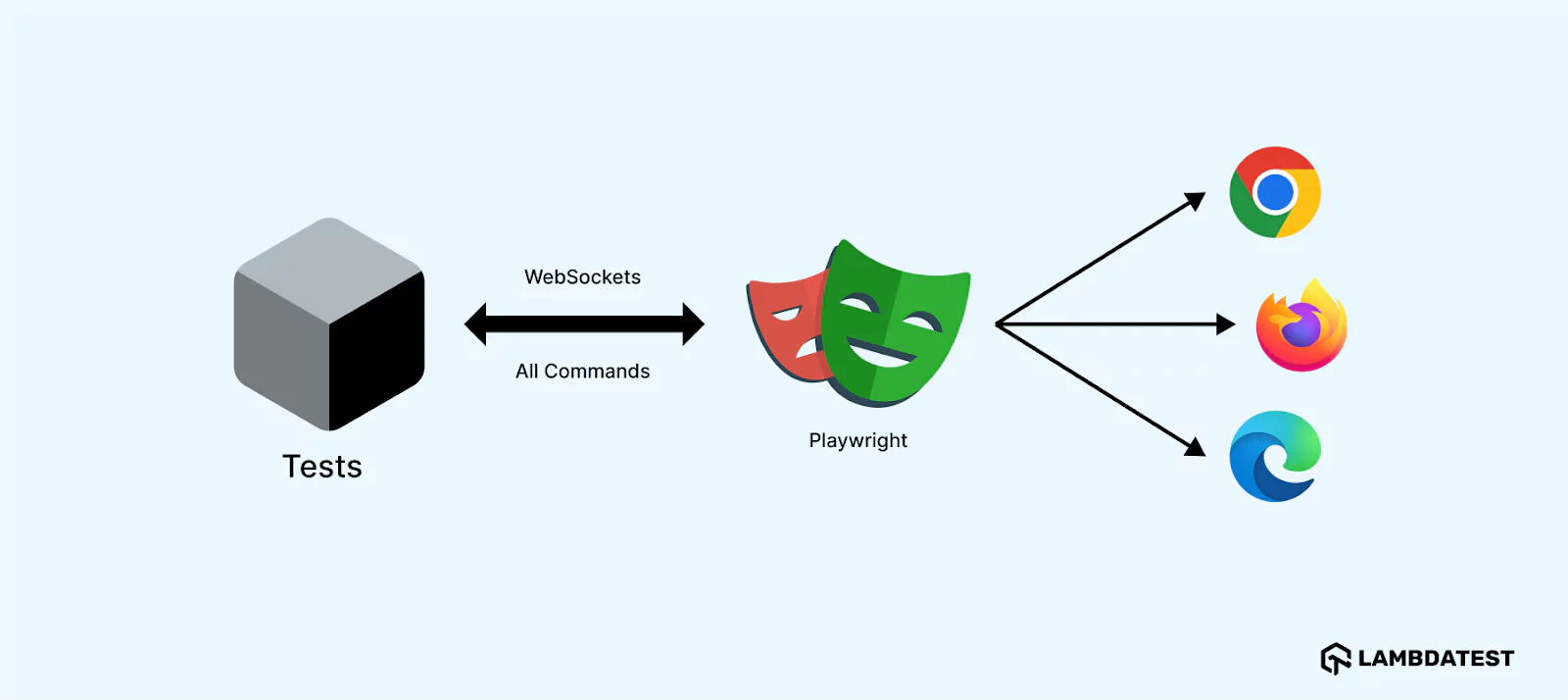
- Persistent WebSocket Connection: Playwright opens a single WebSocket to each browser at the start of a session and keeps it open for the entire run. Commands stream over that one channel rather than as per-command HTTP round trips, which removes connection-setup overhead and is the primary reason individual actions complete faster than in WebDriver-based frameworks.
- Lightweight Browser Contexts: Each test runs in an isolated browser context with its own cookies, storage, and cache. Spinning up a new context is far cheaper than launching a full browser, which is why Playwright can run hundreds of parallel tests on a single machine without state bleeding between them.
- Built-in Network Awareness: The same persistent connection that carries commands also surfaces network-level events. You can intercept API calls, mock responses, and pause until a specific request completes without bolting on an external proxy.
Let Claude Code write Playwright tests that actually pass.

Key Playwright Testing Capabilities
Playwright covers the full spectrum of web testing in a single framework. Use this map to jump straight to the dedicated guide for whatever you need to ship today.
- Core automation building blocks: Provides the fundamental constructs for interacting with web pages and structuring automation logic using Playwright functions and selectors.
- Element targeting strategy: Enables resilient identification of web elements through Playwright locators using chainable, filterable, and strict-mode selection techniques.
- Test validation approach: Implements Playwright assertions with web-first, auto-retrying checks to ensure stable validation in dynamic applications.
- Backend integration testing: Supports Playwright API testing to validate backend endpoints and combine API and UI workflows in a single test flow.
- Test architecture pattern: Uses Playwright Page Object Model to organize interactions into reusable classes for improved maintainability.
- Execution mode configuration: Enables Playwright headless testing for fast, non-UI execution in CI/CD environments.
- Network synchronization handling: Provides Playwright waitForResponse capability to wait for specific API responses instead of relying on static timeouts.
Playwright vs Selenium vs Cypress - Which Should You Use in 2026?
Choosing the right automation testing framework depends on the languages your team uses, the browsers you need to cover, and the type of application under test.
| Criteria | Playwright | Selenium | Cypress |
|---|---|---|---|
| Browser support | Chromium, Firefox, WebKit (Safari) | Chrome, Firefox, Safari, Edge, IE | Chrome, Firefox, Edge (limited WebKit) |
| Language support | JS, TS, Python, Java, .NET | Java, Python, JS, C#, Ruby, Kotlin | JavaScript, TypeScript only |
| Architecture | Single persistent WebSocket per browser | HTTP request per command (WebDriver) | Runs inside the browser (in-process) |
| Auto-waiting | Built-in, no manual waits needed | Implicit/explicit waits required | Built-in for Cypress commands |
| Multi-tab / multi-window | Native support | Supported with driver switching | Limited, not natively supported |
| Parallel execution | Native via browser contexts | Via Selenium Grid or third-party tools | Via Cypress Cloud (paid) or workers |
| API testing | Built-in request context | Not built-in | Built-in cy.request() |
| Best for | Modern web apps, CI/CD, cross-browser | Legacy systems, large existing suites | Frontend-focused, simpler setups |
| Setup complexity | Low - one command scaffolds everything | High - requires WebDriver, browser drivers | Low for basic setup |
- Choose Playwright: Best suited for Playwright testing automation projects that require cross-browser coverage, multiple language support, and a modern CI/CD-friendly testing framework.
- Choose Selenium: Ideal for Selenium testing in large existing test suites, enterprise systems, or strict Java-based automation environments where legacy infrastructure is already in place.
- Choose Cypress: Recommended for Cypress testing in frontend-focused automation projects running primarily in Chromium-based environments with a simpler setup and developer-centric workflow.
For a deeper breakdown, see the full Playwright vs Selenium vs Cypress comparison.
How to Install Playwright Using Command Line?
Installing Playwright takes one command. The CLI scaffolds a complete project with a config file, sample tests, GitHub Actions workflow, and browser binaries - no separate browser driver installation needed.
Once installed, Playwright scaffolds a complete project structure with configuration files, sample tests, browser binaries, and CI-ready setup files, making it easier to organize and scale Playwright projects across local and automated testing environments.
- Create a project directory: Create a folder to organize your automation files.
- Initialize a Node.js Project: Run the command below to generate a package.json file.
npm init -y- Install Playwright: Run the command below to install Playwright and its browser binaries (Chromium, Firefox, and WebKit).
npm init playwright@latestMake sure a supported Node.js release is installed: Playwright requires Node.js 22.x, 24.x, or 26.x. If not, download and install it from the official Node.js website. Playwright downloads its own browser binaries during installation, so you do not need Chrome, Firefox, or Safari installed separately.
How to Install Playwright Using Visual Studio Code?
The official Playwright VS Code extension by Microsoft brings test running, debugging, and code generation directly into your editor. Use this setup if you want to write and debug tests without switching between the terminal and IDE.
- Open VS Code: Launch the Visual Studio Code editor on your system.
- Open the Extensions view: Click the Extensions icon on the sidebar, or press:
Ctrl + Shift + XCtrl + Shift + P (or Cmd + Shift + P on macOS)Then run the command:
Install PlaywrightOnce set up, the VS Code extension lets you run and debug individual tests with a single click, generate tests using Playwright Codegen (recording-based test generation), pick locators by hovering over elements, and view Trace Viewer output directly in the sidebar.
How Do You Run Your First Playwright Test?
Running a test in Playwright is simply a matter of executing your test file using the Playwright test runner. Playwright tests run real browser-based validation against your application, ensuring navigation, interactions, and assertions are performed in a controlled and reliable environment.
To run your first Playwright test, follow the test scenario below. For demonstration purposes, the example uses the TestMu AI eCommerce Playground to showcase the core elements of Playwright testing, including navigation, locator strategy, and assertions.
Test Scenario:
- Locate the "Shop by Category" button on the homepage.
- Assert that the button is present in the DOM.
- Assert that the aria-expanded attribute is present and its value is "false".
Code Implementation:
import { test, expect } from '@playwright/test';

test('shop by category button has aria-expanded false', async ({ page }) => {
  await page.goto('https://ecommerce-playground.lambdatest.io/');
  await expect(page.getByRole('button', { name: 'Shop by Category' })).toHaveAttribute('aria-expanded', 'false');
});
Code Walkthrough:
- Navigation:
page.goto()navigates to the eCommerce Playground homepage and waits for the page to reach the load state before continuing. - Locator Strategy:
page.getByRole()finds the "Shop by Category" button by its accessible role and name - the most resilient locator strategy in Playwright because it mirrors how users and screen readers perceive the element. - Assertion:
expect().toHaveAttribute()verifies the button has an aria-expanded attribute set to "false". Because this is a web-first assertion, Playwright retries it automatically until the condition is met or the timeout expires.
Test Execution:
npx playwright testTo view the HTML execution report:
npx playwright show-report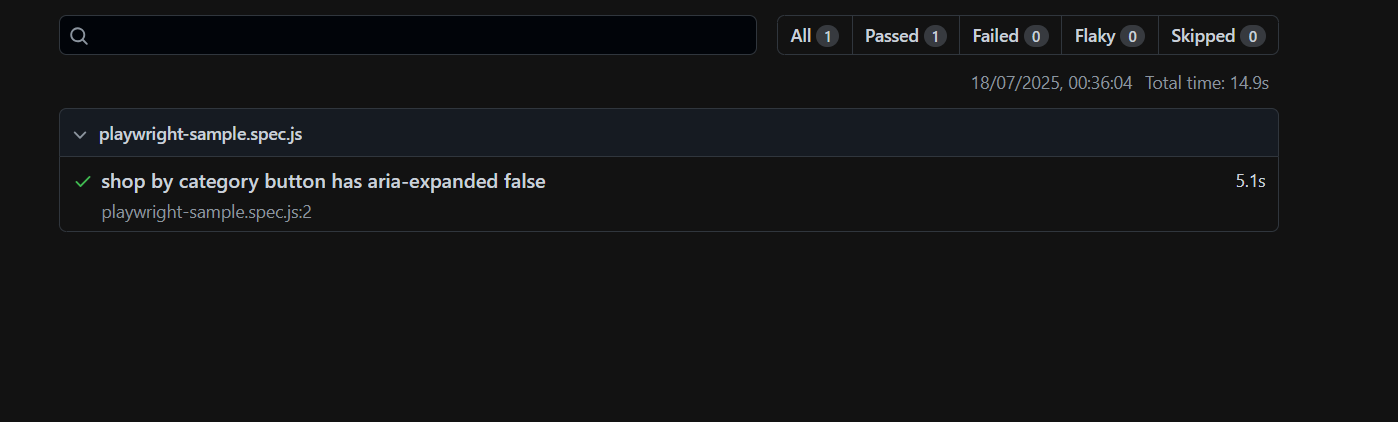
Several Playwright GitHub repositories contain example projects, reusable utilities, and framework integrations that demonstrate different Playwright testing patterns and automation setups.
In real-world automation, teams often face challenges with browser infrastructure management, parallel execution, environment consistency, and scaling Playwright tests across multiple browser and OS combinations.
Cloud-based testing platforms help eliminate this operational overhead by providing scalable browser environments, centralized execution, and faster test orchestration.
One such platform is TestMu AI(formerly LambdaTest), which enables teams to run Playwright automation at scale across cloud browsers and distributed testing environments.
How to Run Playwright Tests in Parallel on TestMu AI Cloud?
TestMu AI is a full-stack AI testing platform that allows you to run Playwright testing at scale. It enables end-to-end execution of Playwright automation across real browsers, multiple OS environments, and distributed cloud infrastructure, helping teams plan, execute, and analyze Playwright tests efficiently.
Designed for scale, it supports parallel Playwright test execution, faster feedback cycles, and reliable cross-browser validation without the overhead of maintaining local test grids.
By leveraging cloud-based execution, teams can run Playwright tests in parallel, reduce overall execution time, and achieve consistent results across distributed environments.
To run the same Playwright tests on TestMu AI cloud, you need a few extra configuration steps. They connect your local test suite to the cloud grid via the CDP WebSocket endpoint, so you get real browser coverage without managing browser infrastructure yourself.
Code Implementation:
- Set up the environment variables: Create a
.envfile in your project root. - Add TestMu AI credentials: Add your LT_USERNAME and LT_ACCESS_KEY from TestMu AI > Account Settings > Password & Security.
- Configure Playwright: Update your playwright.config.ts to include cloud connection logic.
Connect via the TestMu AI WebSocket URL:
wsEndpoint: `wss://cdp.lambdatest.com/playwright?capabilities=${encodeURIComponent(JSON.stringify(capabilities))}`Set your credentials as environment variables and define the browser, version, platform, and capabilities:
// TestMu AI capabilities
const capabilities = {
  browserName: "Chrome", // Browsers: 'Chrome', 'MicrosoftEdge', 'pw-chromium', 'pw-firefox', 'pw-webkit'
  browserVersion: "latest",
  "LT:Options": {
    platform: "Windows 11",
    build: "Playwright Demo",
    name: "Playwright Demo",
    user: process.env.LT_USERNAME,
    accessKey: process.env.LT_ACCESS_KEY,
    network: false,
    video: false,
    console: false
  },
};
Generate required capabilities using the TestMu AI Automation Capabilities Generator. Then modify your test file to import the custom test method:
import { expect } from '@playwright/test';
import test from "../lambdatest-setup";
Execute the tests:
npx playwright testMonitor your results in real time on the TestMu AI Web Automation Dashboard:
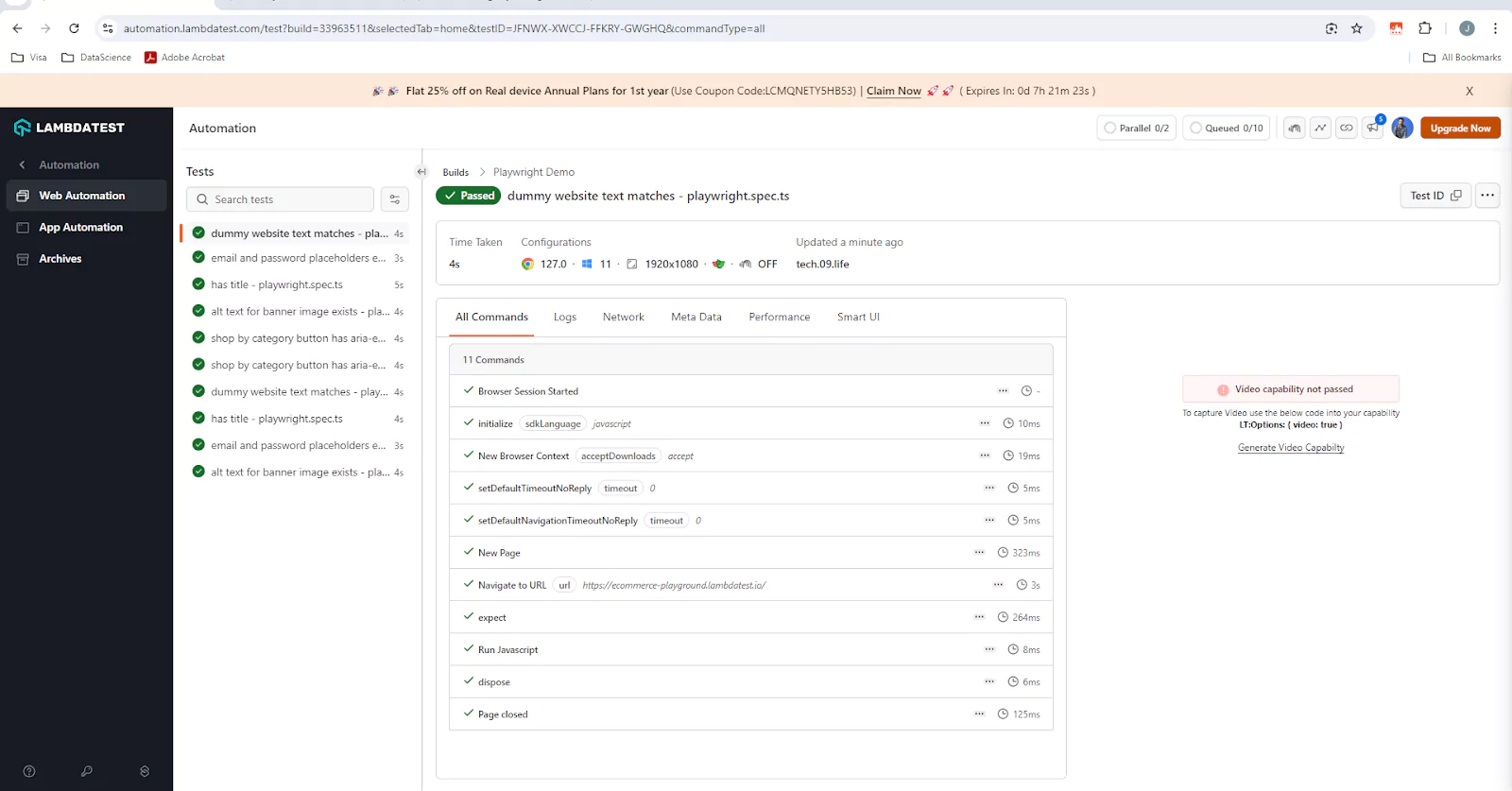
To get started, refer to the documentation on Playwright testing with TestMu AI.
In addition to scalable cloud execution, TestMu AI also provides Playwright Agents designed to simplify modern Playwright testing and Playwright automation workflows. These Playwright Agents can assist teams with intelligent test execution analysis, debugging support, failure investigation, and automated quality insights, helping reduce the manual effort involved in maintaining large Playwright automation suites.
The platform also includes specialized playwright-skills through the TestMu AI agent-skills ecosystem, enabling smarter handling of network validations, flaky test detection, synchronization issues, and execution diagnostics in Playwright testing workflows.
These Playwright Skills, when combined with core Playwright testing and Playwright automation capabilities, help teams build more reliable and scalable end-to-end automation pipelines across local, cloud, and CI/CD environments.
How Do Playwright with AI, Agents, and Vibe Testing Work Together?
Once Playwright tests run at scale on the TestMu AI cloud, the next question is how those tests get written and maintained. The 2026 shift is in authoring, not execution: scripts can be generated from natural language, which cuts the locator maintenance that consumes most of the upkeep on a mature suite.
Playwright Agents push this further with autonomous browser interaction, where agents navigate the application, adapt to UI changes, and complete workflows without a script edit for every DOM shift. Vibe Testing with Playwright comes at the same problem from the other side, turning user journeys described in plain language into executable scripts that run in real browsers.
Both still rest on Playwright's deterministic core, and these Playwright futuristic features only help because of it. The AI layer decides what to test and how to phrase it; auto-waiting, web-first assertions, and context isolation are what make the resulting run trustworthy.
Note: Skip the locator-and-assertion boilerplate. Describe your scenario in plain language and ship Playwright tests with KaneAI. Book a Demo!
Best Practices for Playwright Testing
Apply these practices to keep your Playwright suites reliable across deployments, team changes, and application updates.
- Use Built-In Locators: Prefer
getByRole,getByText, orgetByPlaceholderover CSS or XPath selectors. Role-based locators mirror how users perceive the page and are resilient to DOM changes. - Chain and Filter Locators: Narrow element targets using
.filter()and locator chaining to improve precision and reduce flakiness in list and table scenarios. - Use Web-First Assertions: Assertions like
toBeVisible()auto-wait until conditions are met - never usewaitForTimeout()as a substitute. - Avoid Fragile Selectors: Do not rely on CSS classes tied to styling or deeply nested DOM positions. Use user-facing attributes like roles, labels, or data-testid attributes.
- Generate Locators with Codegen: Use
npx playwright codegen <url>to automatically pick stable, role-first locators rather than writing them manually from HTML source. - Debug with Inspector or Trace Viewer: Run tests with
--debugor--trace onto inspect element matches, network activity, and DOM snapshots at each step. - Isolate Tests with beforeEach: Use
test.beforeEachto give every test a clean start. Tests that share state fail unpredictably in parallel runs and CI. - Optimize CI Browser Installs: Install only the browsers you need with
npx playwright install chromium --with-depsto reduce CI setup time. - Keep Playwright Updated: Run
npm install -D @playwright/test@latestregularly to stay aligned with the latest browser support and fix known issues. - Use TypeScript and Linting: Use ESLint with
@typescript-eslint/no-floating-promisesto catch missingawaitstatements before they cause flaky tests.

Learning Resources for Playwright Automation
These resources are organized by topic so you can go directly to what you need - whether that is getting started, advanced patterns, or running Playwright with AI.
Getting Started
- Installing Playwright - Complete setup guide for Node.js CLI and VS Code in under five minutes.
- Performing Playwright Testing - Running your first test on TestMu AI cloud grid.
- Playwright JavaScript - Getting started with Playwright in JavaScript.
- Playwright TypeScript - End-to-end testing with TypeScript, the most popular Playwright language.
- Playwright Python - Setting up pytest and writing browser tests in Python.
- Playwright Reporting - HTML, JSON, JUnit, and custom report configuration.
Functions, Selectors, and Interactions
- Playwright Functions and Selectors - Every core function and selector type with working code examples.
- Playwright Locators - Locator API, chaining, filtering, and strict mode explained.
- Playwright click() Method - Clicks, double-clicks, right-clicks, and force clicks.
- Playwright Inputs and Buttons - Text fields, checkboxes, radio buttons, and file uploads.
- Playwright Alerts and Dropdowns - Handling browser dialogs and select elements.
- Scrolling to an Element in Playwright - Scroll methods and infinite scroll handling.
- Playwright Date Pickers - Automating calendar and date picker UI components.
Assertions, Waiting, and Network
- Playwright Assertions - Web-first assertions, soft assertions, and custom matchers.
- Playwright waitForResponse - Pausing until a specific API response arrives before asserting.
- Playwright Wait for Navigation Methods - waitForLoadState, waitForURL, and navigation patterns.
- Playwright Timeouts - Global, test-level, and action-level timeout configuration.
Test Architecture and Configuration
- Playwright Page Object Model - Structuring large test suites for long-term maintainability.
- Playwright Fixtures - Built-in and custom fixtures for test setup and teardown.
- Playwright Projects - Multi-browser and multi-environment project configuration.
- Playwright Tags - Organizing and filtering tests with tags for selective CI runs.
- Playwright Sharding - Splitting test suites across machines for faster parallel CI.
- Playwright Frames and Windows - Multi-tab, popup, and window handling.
- Playwright iFrames - Locating and interacting with iframe content.
Advanced Testing Capabilities
- Playwright API Testing - REST API validation and combining API with UI tests in one file.
- Playwright Visual Regression Testing - Screenshot comparison and visual diff workflows.
- Playwright Component Testing - Testing React, Vue, and Svelte components in isolation.
- Playwright Headless Testing - chromium-headless-shell configuration and benchmarked speed comparisons.
- Auto Heal in Playwright - AI-powered self-healing locators for resilient automation.
- Playwright for Web Scraping - Extracting data from dynamic pages with Python.
- Playwright Docker - Containerized test execution with Docker and Docker Compose.
Debugging and Inspection
- Playwright Inspector - Visual step-through debugging and locator validation in real time.
- Playwright Futuristic Features - Self-healing locators, AI test generation, and smarter auto-waiting.
- Best Playwright GitHub Repositories - Community frameworks, utilities, and starter projects.
Playwright with AI
- Playwright With AI - MCP, AI agents, and the shift to natural language test authoring.
- Vibe Testing with Playwright - Describing user journeys and letting AI execute and validate them.
- Playwright Agents - Autonomous browser agents that adapt to UI changes without script updates.
- Playwright Skills - Teaching AI assistants to write production-ready Playwright code.
TestMu AI Playwright Video Tutorials
Complete Playwright TypeScript Tutorial
- Run Playwright Tests on 50+ Browser and OS Combinations
- Step-by-Step Playwright Setup with TypeScript
- How To Use Functions And Selectors
- Playwright Testing Features
- Page Object Model In Playwright
- What Are Playwright Fixtures
- Cross Browser Testing On TestMu AI Cloud
- Running Playwright Tests Using Jenkins
Complete Playwright Java Tutorial
- Playwright Introduction and Installation
- How To Run Your First Playwright Test
- Testing Complex Web Applications With POM
- Learn Playwright Java in 5 Hours
- How to Run Tests on Cloud
Playwright JavaScript Tutorial
TestMu AI Playwright Certifications
TestMu AI offers structured Playwright certifications with hands-on testing components backed by the cloud grid. These are the only Playwright certifications that validate real automation skills across real browsers.
Conclusion
Playwright in 2026 is your practical default for new web automation: one API across Chromium, Firefox, and WebKit; built-in auto-waiting and web-first assertions that remove a whole class of flaky-test bugs; and an architecture that scales cleanly from your laptop to thousands of parallel tests in CI. The patterns that make your suite production-ready - role-first locators, Page Object Model, context-isolated runs, and trace-driven debugging - all sit on top of those primitives.
If you are starting today, run npm init playwright@latest, write your first locator-based test against the TestMu AI eCommerce Playground then point the same test at a real-browser grid by connecting via the TestMu AI CDP WebSocket. From there, layer in Playwright with AI: install a Playwright Skill so your AI assistant generates production-grade test code, or describe scenarios in plain language and let KaneAI turn them into Playwright scripts.
To go deeper, jump into the Playwright testing documentation for cloud setup, or pick up the Playwright 101 certification for a structured, hands-on path.
Author

Jaydeep Karale
Blogs: 6


Jaydeep is a software engineer with 10 years of experience, most recently developing and supporting applications written in Python. He has extensive with shell scripting and is also an AI/ML enthusiast. He is also a tech educator, creating content on Twitter, YouTube, Instagram, and LinkedIn.
Reviewer

Parth Mistry
Reviewer
Parth Mistry is a Member of Technical Staff at TestMu AI (formerly LambdaTest), building SmartUI, the visual regression testing product. He developed and owns the SmartUI CLI, a modular TypeScript tool built on Playwright for multi-browser automation, and built the Storybook CLI for visual regression of UI components. He maintains cross-language SDKs in Python, Java, Ruby, C#, and Node.js, and engineered a Node-based visual rendering service on Kafka, Redis, MySQL, and S3. His migration of that service to an event-driven, KEDA-autoscaled architecture improved execution speed by 60% and cut annual infrastructure cost by $9,600. He also built the end-to-end SmartUI integration with KaneAI. Parth is a Google Summer of Code 2024 contributor and an alumnus of IIT Jodhpur.


Playwright FAQs
Did you find this page helpful?
More Related Blogs
TestMu AI forEnterprise
Get access to solutions built on Enterprise
grade security, privacy, & compliance
- Advanced access controls
- Advanced data retention rules
- Advanced Local Testing
- Premium Support options
- Early access to beta features
- Private Slack Channel
- Unlimited Manual Accessibility DevTools Tests