
Author End-to-End Tests in Natural Language with KaneAI
Plan, Author, and Evolve E2E Tests for Web and Mobile Apps in Natural Language.

22 Best AI Testing Tools in 2026
22 AI testing tools compared on pricing, Gartner ratings, self-healing, and coding-agent support, with KaneAI run on a real flow, plus tools that test AI agents.
Last Updated on:
On This Page
- 22 Tools Compared
- 1. KaneAI by TestMu AI
- 2. testRigor
- 3. Virtuoso QA
- 4. Autosana
- 5. TestSprite
- 6. mabl
- 7. Functionize
- 8. Katalon
- 9. Keploy
- 10. UiPath Test Cloud
- 11. Tricentis Tosca
- 12. OpenText Functional Testing
- 13. Worksoft
- 14. Copado Robotic Testing
- 15. Telerik Test Studio
- 16. Applitools Autonomous
- 17. QA Wolf
- 18. Checksum
- 19. Meticulous
- 20. Autify
- 21. Revyl
- 22. Spur
- Tools for Coding Agents
- What AI Testing Tools Do
- Test Automation vs. Testing AI
- How I Tested
- Test Data and Scores
- Free and Open Source
- Six Others I Considered
- GenAI Capabilities
- How to Choose
- Large Engineering Teams
- Agents That Test vs Agents Under Test
- Conclusion
The short answer: The best AI testing tools in 2026 are TestMu AI (KaneAI and Kane CLI), Katalon, UiPath Test Cloud, Tricentis Tosca and Copado Robotic Testing. Among AI software testing tools, pick KaneAI for natural language authoring with code export, Kane CLI for AI coding agents, Keploy for API regression and Katalon for mixed codeless and coded teams.
AI testing tools are automation testing tools that write, run, and repair software tests from natural language intent, so testers spend less time scripting locators and fixing broken suites. I compared 22 of them and scored 15 on six criteria, from authoring and self-healing to published pricing and Gartner Peer Insights ratings, and ran six hands-on tests, including a deliberate UI refactor and a seeded bug, on the top-scoring tool, KaneAI, an AI testing agent by TestMu AI. The right pick depends on your bottleneck: authoring, maintenance, API coverage, or a packaged stack such as SAP or Salesforce.
Key facts (checked November 2026)
- This guide compares 22 AI testing tools and scores 15 of them 0 to 5 on six criteria, for a maximum of 30: authoring from intent, maintenance, coverage, portability, price transparency and peer ratings.
- TestMu AI, the publisher of this guide, makes KaneAI, which scored 29 of 30 here; Katalon scored 26.
- No vendor paid for placement in this AI testing tools guide.
- This AI testing tools guide was last updated on November 23, 2026.
Overview
KaneAI by TestMu AI scored highest of the 15 scored AI testing tools in this guide, 29 of 30, for natural-language authoring that produces Selenium, Playwright, and Appium code you keep. Katalon placed second at 26. The best fit for your team depends on its biggest testing bottleneck.
Top Picks by Testing Bottleneck
- Best AI testing tool for natural-language authoring: KaneAI turns prompts, Jira tickets, PRDs, and pull requests into tests and heals broken locators by intent. Code export: yes, from tests that have run and passed. Pricing: paid plans per agent.
- Best AI testing tool for converting a manual suite: testRigor lets manual testers write tests in natural language across web, mobile, Windows desktop, mainframe, email, SMS, and phone calls. Code export: none documented. Free plan: yes, with every test public.
- Best AI testing tool for autonomous maintenance: mabl leans on AI auto-healing and lists unlimited local and CI runs and unlimited test run concurrency. Mobile app testing is an add-on, and pricing is set by quote. Free plan: no, a 14-day trial.
- Best AI testing tool for model-based enterprise suites: Tricentis Tosca adds agentic test generation to model-based tests across 200+ technologies, including SAP, Oracle, and Salesforce. One model change updates every test built on it. Free plan: no, a free trial.
- Best AI testing tool for API regression: Keploy records real API traffic and replays it as tests with mocks. Open source: yes, an Apache-2.0 core. Free plan: yes, the Playground plan.
Testing an AI Agent You Build
If the software you ship is itself an AI agent, such as a chatbot or a voice agent, it needs a different category of tool: AI agent testing tools, matched to each agent type in the section on which AI agent testing tools fit the agent you ship.
22 Best AI Testing Tools, Compared
AI testing tools use artificial intelligence to write, run, heal, and maintain software tests, from generating test cases in plain English to fixing broken locators automatically. The best AI testing tools in 2026 include KaneAI by TestMu AI, Katalon, UiPath Test Cloud, and Tricentis Tosca, the four highest scorers in this guide, compared below on pricing, ratings, and coding-agent support.
For a quick visual walkthrough of this concept, watch the video below from TestMu AI.

Subscribe to the TestMu AI YouTube channel for more tutorials on testing and automation.
KaneAI and Kane CLI take separate rows because they do different jobs: KaneAI authors and maintains tests in natural language, and Kane CLI is the terminal tool a coding agent runs to test the app it is building. Both are covered in entry 1. The last two columns show whether the suite stays yours if you leave a vendor, and whether Claude Code, Cursor, or Codex can drive the tool through an MCP server, a CLI, an agent skill, or an AGENTS.md file.
If you are comparing these tools with an outsourced QA team, our guide to QA outsourcing prices both on the same worksheet.
| Tool | Best for | What the AI does | Coverage | Free option | Price | Gartner Peer Insights | Where the tests live | Test management | Works with Claude Code, Cursor, Codex? |
|---|---|---|---|---|---|---|---|---|---|
| KaneAI by TestMu AI | Natural-language authoring with code you keep | Authors from prompts, tickets, PRDs, and PRs; self-heals; exports code | Web, native mobile, API, database, accessibility, visual | 10,000 free Kane CLI credits, valid for 30 days, no card | From $17 per agent a month, billed annually ($19 monthly) | 4.6 (423 ratings) | TestMu AI Test Manager; exports Selenium, Playwright, and Appium code | Yes: TestMu AI Test Manager, with plans, cycles, and requirement traceability for manual and automated tests | Yes: TestMu AI MCP server |
| Kane CLI by TestMu AI | Coding agents testing the app they just changed | Runs a plain-English objective in a real browser; exit code 0 pass, 1 fail, 2 error such as failed auth, 3 timeout; seals every run in a .evidence pack | Web in Chrome, native apps on iOS Simulator and Android Emulator, API calls | Free to install (npm install -g @testmuai/kane-cli); 10,000 free credits, valid for 30 days | Runs, local or cloud, use KaneAI plan credits | Rated with KaneAI under TestMu AI | Markdown test files in your repo, synced to Test Manager | Yes: tests sync to TestMu AI Test Manager | Yes: skill for Claude Code and Codex CLI; AGENTS.md for Cursor |
| testRigor | Converting a manual regression suite | Natural language tests, generative creation, self-healing | Web, native and hybrid mobile, Windows desktop, mainframe, email, SMS, calls | Free public-only plan | Quote only; no prices published | 4.4 (4 ratings) | testRigor platform, as plain-English tests | Not built in; syncs with TestRail, Zephyr, Xray, and Azure DevOps | Yes: MCP server, CLI, and skills |
| Virtuoso QA | Audit-ready testing of web apps and business systems | Builds journeys from requirements, heals by confidence threshold, captures the evidence behind each verdict | Web apps, D365, Salesforce, SAP, Oracle, Workday, ServiceNow, API inside UI journeys | Free trial on request | Quote only | 4.6 (11 ratings) | Vendor platform; Selenium (Java) export | Yes, for automated journeys: goals, journeys, and plans with run health; TestRail and Xray apps | Not documented |
| Autosana | Mobile-led teams shipping with coding agents | Natural-language flows that self-heal and update from code diffs | iOS, Android, web | 1,000 free AI actions a month, no card | Pay as you go at $0.10 per AI action; plans from $999 a month | Not listed | Vendor platform; flows sync through GitHub | Not documented | Yes: MCP server and CLI |
| TestSprite | Developer teams without dedicated QA | Plans and writes tests from code and a PRD; heals UI reruns; feeds failures back to coding agents | Web UI, REST APIs | Free plan with 150 credits a month | From $19 a month (Starter, 400 credits, first month free) | Not listed | TestSprite cloud; Python and Playwright code you can push to GitHub | Not documented | Yes: MCP server and open-source CLI |
| mabl | Autonomous maintenance at unlimited concurrency | Tests from natural language or Jira requirements; AI auto-healing | Web, API, accessibility, performance; mobile add-on | 14-day free trial | Quote only | 4.6 (7 ratings) | Vendor platform; browser tests export to Playwright and Selenium IDE | Not built in; integrates with TestRail, Xray, Zephyr, and Azure DevOps | Yes: cloud MCP server |
| Functionize | Usage-metered agentic testing | Builds tests from a description and keeps them green | Web workflows, SMS, MFA | Free plan with monthly credits | From $20 a month (Growth plan) | 4.2 (10 ratings) | Vendor platform | Yes: centralized test management, per its FAQ; also integrates with TestRail, Xray, and Zephyr Squad | Yes: MCP server |
| Katalon | Growing from codeless to full code in one platform | Test cases from requirements, self-healing locators, failure analysis | Web, mobile, API, desktop | Free Studio tier without AI script generation; 30-day trial, no card | From $1,800 per seat a year, billed annually | 4.5 (873 ratings) | Katalon Studio project files you can keep in Git | Yes: manual, automated, and AI-generated tests with suites, releases, and requirements in Katalon True Platform | Yes: Studio MCP server (Enterprise and trial) |
| Keploy | API and integration regression without hand-built mocks | Records real traffic and replays it as tests with mocks; AI-expanded edge cases | APIs, databases, queues | Open source plus free Playground plan | From $19 per user a month, billed yearly ($24 monthly), plus usage | 4.5 (13 ratings) | YAML test files in a keploy folder in your repo | No: no manual test cases or execution tracking, per Keploy | Yes: MCP server (Enterprise plan) |
| UiPath Test Cloud | Governed enterprise rollout | Agentic design and real-time self-healing during runs | Web, mobile, desktop, API, mainframe, 190+ enterprise apps | Free trial | Quote only; add-ons listed from $5,000 | 4.6 (119 ratings) | Vendor platform | Yes: UiPath Test Manager, from requirements through test sets, results, and defects | Yes: UiPath CLI MCP server; Test Manager for coding agents in preview |
| Tricentis Tosca | Packaged applications at enterprise scale | Agentic test generation over model-based tests | 200+ technologies incl. SAP, Oracle, Salesforce, Workday | Free trial | Quote only | 4.5 (165 ratings) | Tosca repository, inside the vendor platform | Yes: requirements, test cases, and execution lists in Tosca; qTest is sold separately | Yes: Tosca MCP server |
| OpenText Functional Testing | Mainframe, SAP GUI, and legacy estates | AI object recognition that adapts to UI change | Desktop, web, mobile, mainframe, SAP, API | Trial on request | Quote only on opentext.com; from $4 an hour per instance on AWS Marketplace | 4.1 (113 ratings) | Test files on disk, with Git or SVN, or in OpenText ALM | Separate product: OpenText Application Quality Management, formerly ALM | Not documented |
| Worksoft | SAP and packaged business processes | AI root cause analysis, self-healing, failure summaries, prioritization | SAP, Oracle, Dynamics, Salesforce, ServiceNow, web, desktop, mainframe | Not stated | Quote only | 4.7 (54 ratings) | Certify database on SQL Server | Yes, for automated processes: requirements, process folders, and execution history | Not documented |
| Copado Robotic Testing | Salesforce delivery pipelines | AI test agent, session-to-test capture, scenarios from user stories | Salesforce, web, mobile, API, desktop | 30-day free trial, no card | Quote only on copado.com; $42,000 a year bundle on AWS Marketplace | 4.4 (37 ratings) | Robot Framework files in GitHub, GitLab, or Azure Repos | Not documented | Not documented |
| Telerik Test Studio | Progress and .NET teams | Mixed element find logic and intelligent maintenance suggestions | Web, desktop, API, load | Downloadable trial | Perpetual licenses from $2,499 per machine, with a year of support | 4.1 (36 ratings) | Test Studio project files, with built-in Git and TFS support | Yes, lightweight: test lists that include manual tests, with run history | Not documented |
| Applitools Autonomous | Visual correctness of web apps | Crawls a site, records a flow, or turns plain English into steps; Visual AI checks each page; groups the tests a redesign touches | Web, API steps, PDFs | Free trial | Starter $667 a month, billed annually; Professional, which adds AI functional testing, is quote only | 3.5 (2 ratings) | Vendor platform | Not documented | Eyes only: MCP server for Claude Code and Cursor |
| QA Wolf | Coverage bought as a service, as code you keep | Agents create, run, and maintain tests, then fix a broken test or report a real bug | Web, iOS, Android, desktop | Free runs for new teams | $1 per web run, $2 per mobile or desktop run; managed service quote only | 5.0 (3 ratings), mobile testing services market | Playwright and Appium code you can export anytime | Not built in; results sync to TestRail, Testmo, Xray, Zephyr, and Qase | Yes: MCP server (Claude Code, Codex, Cursor) |
| Checksum | Playwright suites in your repo, repaired by pull request | Generates Playwright tests, fixes failing ones, and opens a pull request for review | Web end to end, API | Not stated; demo on request | Quote only, priced by workflows maintained | No listing found | Playwright code in your repository | Not documented | Yes: MCP for Claude Code and Cursor |
| Meticulous | Frontend regression nobody has to write | Records real sessions, builds visual end-to-end tests from them, and adds or retires tests as the app changes | Web frontends | Not stated | Quote only | No listing found | Meticulous platform, generated from recorded sessions | Not documented | Yes: MCP server and agent skills |
| Autify | One no-code agent across web, mobile, and desktop | The Aximo agent generates and runs tests from natural language with visual recognition; self-healing, flexible locators | Web, mobile, desktop | Free plan with 2,000 one-time credits | From $99 a month, billed annually ($120 monthly) | 4.0 (5 ratings) | Vendor platform | Yes: Aximo cases, plans, and run history | Yes: Aximo CLI runs an MCP server |
| Revyl | Mobile teams whose coding agents need a device to verify on | Builds the app in the cloud, walks flows like a person, and gives each change a verdict with a confidence score | iOS simulators, Android emulators, web, macOS | Free plan with monthly usage and 2 concurrent devices | Starter $250 a month ($200 billed annually) | No listing found | YAML test files in your project and on the Revyl platform | Not documented | Yes: CLI with agent skills, plus MCP |
| Spur | Consumer products sold across regions | Separate agents for exploratory, functional, UI and UX, localization, and AI feature testing | Web, iPhone, iPad, Android | 1 to 2 week pilot on your own site | Quote only; annual plans by test-run volume | No listing found | Vendor platform | Yes, on higher tiers: folders, suites, and test plans with run history | Yes: MCP server for Claude Code and Cursor |
Prices checked November 13, 2026, on each vendor's pricing page: KaneAI and Kane CLI, testRigor, Virtuoso QA, Autosana, TestSprite, mabl, Functionize, Katalon, Keploy, UiPath Test Cloud, Tricentis Tosca, OpenText Functional Testing, Worksoft, Copado Robotic Testing, Telerik Test Studio, Applitools, QA Wolf, Checksum, Meticulous, Autify, Revyl, and Spur. Quote only means the vendor publishes no dollar price. Coding-agent support was checked the same day in each vendor's documentation; Not documented means no MCP server, CLI, agent skill, or AGENTS.md route was found there. Test management was checked on November 23, 2026, in each vendor's own documentation: Yes means the vendor presents built-in test management, or the product manages manual tests or links tests to requirements; Not built in means test cases are kept in the external tools named; Not documented means the product only groups automated tests for a run, or nothing was found.
Which AI Tools for Software Testing Work With Claude Code, Cursor, and Codex?
Sixteen of the 22 tools here document a way for a coding agent such as Claude Code, Cursor, or Codex to drive them. The route decides how much of the testing stays inside the agent's own loop:
- MCP server - the agent calls the vendor's tools directly. KaneAI (through the TestMu AI MCP server), testRigor, Autosana, TestSprite, mabl, Functionize, Katalon (Enterprise and trial), Keploy (Enterprise plan), Tricentis Tosca, QA Wolf, Checksum, Meticulous, Autify, Revyl, and Spur all document one. Applitools documents its MCP server for Eyes, not for Autonomous.
- CLI with agent skills - the agent runs a command and reads the result. Kane CLI, testRigor, and Revyl install skills that tell the agent when and how to run them, Meticulous ships skills beside its MCP server, TestSprite's CLI is open source, and the UiPath CLI exposes its commands over MCP, with Test Manager support for coding agents in preview.
- AGENTS.md - Cursor and GitHub Copilot read Kane CLI's instructions from an AGENTS.md file in the repository, so they need no plugin.
- None documented - Virtuoso QA, OpenText Functional Testing, Worksoft, Copado Robotic Testing, and Telerik Test Studio.
Kane CLI is built for that loop. The agent passes a plain-English objective and gets back exit code 0 for a pass, 1 for a fail, 2 for an error such as failed authentication, or 3 for a timeout, and every run seals its screenshots, console logs, and network logs into one .evidence file the agent can read before it claims a fix works. The Kane CLI agent setup page covers the skill for Claude Code, Codex CLI, and Gemini CLI, and the AGENTS.md file for Cursor and GitHub Copilot.
When the agent also explores pages in its own browser, OpenCode Browse vs Kane CLI sets that browsing against saved release tests.
What Are AI Testing Tools?
AI testing tools use machine learning, natural language processing, and computer vision to author test cases, repair broken locators, and triage failures that a tester would otherwise handle by hand. They are also called AI testing solutions; both names describe the same products. Gartner Peer Insights tracks 91 products in this market, which it now describes as transitioning to agentic software quality assurance platforms.
The strongest tools run closer to Agentic QA, where a QA agent turns a written objective into a test plan, runs it, and repairs it when the UI shifts. The tools on this list sort by the job their AI does:
- Natural-language authoring agents - KaneAI, testRigor, Autosana, and TestSprite turn natural language intent, requirements, or code into runnable tests.
- Self-healing platforms - mabl, Functionize, Katalon, and Virtuoso QA focus on keeping suites green as the UI changes.
- API specialists - Keploy generates API and integration tests from real traffic and specs.
- Enterprise suites - UiPath Test Cloud, Tricentis Tosca, OpenText Functional Testing, Worksoft, Copado Robotic Testing, and Telerik Test Studio win inside specific stacks such as SAP, Salesforce, mainframe, or .NET.
- Code-owning and session-driven tools - QA Wolf and Checksum hand back Playwright code you keep, and Meticulous builds its suite from recorded user sessions.
- Visual and specialist agents - Applitools Autonomous judges the rendered page with Visual AI, Autify's Aximo agent covers web, mobile, and desktop, Revyl verifies builds on cloud simulators and emulators, and Spur gives each testing concern, such as localization, its own agent.
Self-healing, in AI testing, means the tool notices that a step failed because the UI changed, such as a renamed button or a new element ID, finds the intended element by other attributes, and updates the test so the run continues instead of failing on a stale locator.
Visual AI tools that compare screenshots for layout and rendering bugs are a separate category, covered in our list of the best visual testing tools. Tools that write unit tests from source code are another, compared in the guide to AI unit test generation.
For the wider discipline behind these tools, the AI testing guide covers the concepts each category builds on. Teams that would rather buy testing as a service than run a tool can compare the engagement models in this guide to AI testing services.
AI Test Automation Tools vs. AI Tools for Testing AI
The phrase AI testing tools covers two kinds of tool. AI test automation tools, the 22 in this guide, bring AI to automation testing: they write, run, and repair tests for the web, mobile, and API apps your team builds. AI tools for testing AI check the AI itself, such as an LLM feature, a chatbot, a voice agent, or an agent that calls tools, for answers that are correct, grounded, and safe, and for actions that really happened.
For an LLM feature, LLM evaluation tools measure the quality of its outputs, and the guide to LLM testing covers the test types, metrics, and a CI regression gate; scoring its live output is covered in the guide to the best AI evaluation tools for production. For a machine learning model you train, the guide to AI model testing covers the methods and the testing lifecycle. For an AI agent, the AI agent testing tools section below matches each kind of agent to the tools that test it.
How I Tested and Scored These AI Testing Tools
I scored the first 15 tools 0 to 5 on the six criteria below, using vendor documentation, live pricing pages, and Gartner Peer Insights ratings pulled on September 14, 2026, with rating counts re-checked on October 7, 2026; TestSprite and Virtuoso QA were added on October 29, 2026 and scored the same way. KaneAI also went through six hands-on Kane CLI tests. The last seven, Applitools Autonomous, QA Wolf, Checksum, Meticulous, Autify, Revyl, and Spur, came from a guide to AI powered software testing tools merged into this one on November 13, 2026. Their entries were checked against each vendor's pages that day, and they are not scored yet.
- Authoring from intent - whether tests come from natural language, requirements, or recordings rather than hand-written scripts.
- Maintenance - whether the tool repairs broken steps itself, and whether it shows you what it changed.
- Coverage - how many layers it reaches in one tool, across web, native mobile, API, desktop, mainframe, and data.
- Portability - whether tests export to an open framework or live in files you control.
- Price transparency - whether you can read a price and start without paying before a sales call.
- Peer ratings - the Gartner Peer Insights score weighted by how many reviews sit behind it, so a 4.6 from 423 ratings outscores a 4.7 from 54.
The results of those tests and the full scores are in test data and full scores below the list.
Disclosure
KaneAI is TestMu AI's product and I work on it, so it faces the same six criteria as the others, limitations included. No vendor paid for placement or previewed its entry, competitor claims were checked on their live pages on September 14, 2026 (October 29, 2026 for TestSprite and Virtuoso QA, and November 13, 2026 for the seven merged tools, TestSprite's pricing, and every tool's coding-agent support), and Reddit notes leave out vendor posts. Our editorial process explains how every claim on this page is verified.

1. KaneAI by TestMu AI: Best for Natural-Language Authoring With Code You Keep
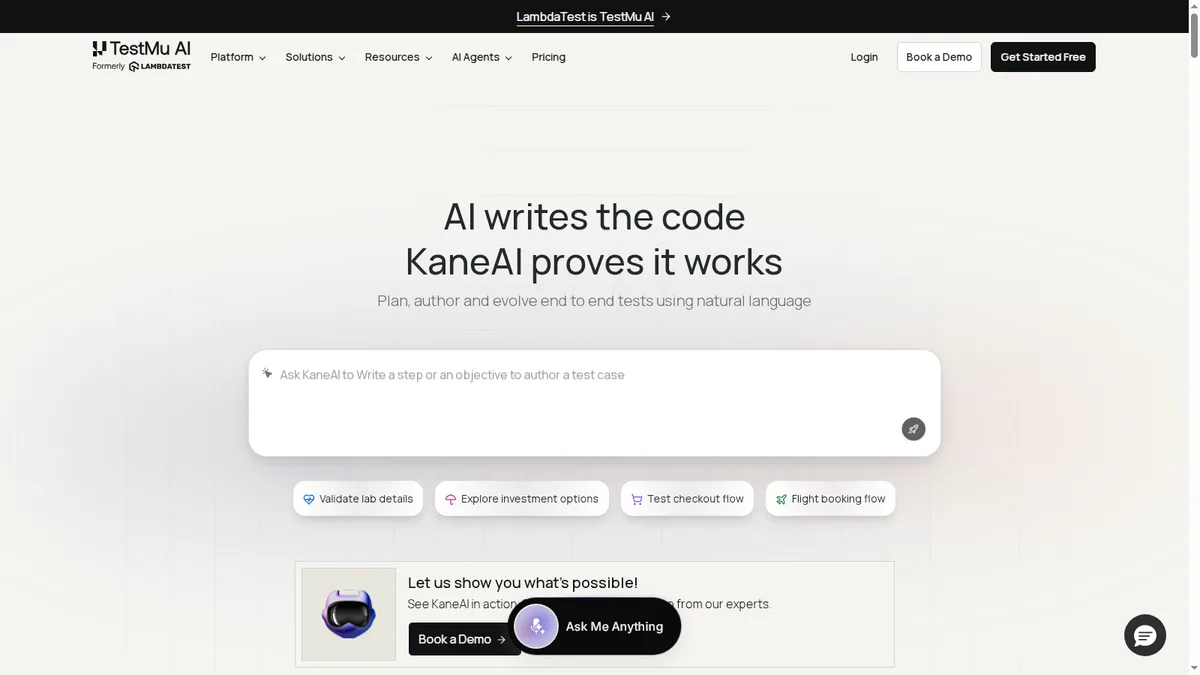
KaneAI is a GenAI-native testing agent that plans, authors, runs, and maintains tests from natural-language prompts. It also takes PRDs, Jira tickets, PDFs, screen recordings, spreadsheets, and GitHub pull requests as input, with non-English input translated automatically. For AI app testing, it can turn a flow you click through once into reusable, editable test steps.
KaneAI generates Selenium, Playwright, and Appium code from tests that have run and passed, so the suite stays yours if you move platforms, and the run in the test data below exported a natural language objective as a Playwright for Python file. Cypress and WebdriverIO export are coming soon. The guide to natural language test automation explains how a natural language step becomes an executed action and whether that holds up in production.
Key features
- Requirement-to-test - turns PRDs, Jira tickets, PDFs, recordings, and pull requests into test plans with proposed assertions you review before anything runs.
- Conversational editing - a step is corrected by describing the change, and If/Else and While logic is written in natural language.
- One connected flow - web, native mobile, API, database, network, accessibility, and visual checks can sit in the same test run.
- Self-healing by intent - smart element detection finds targets by meaning, so Auto-Heal recovers a broken locator on replay and Adaptive Heal re-authors the step when it cannot, with the rewritten test held in Version History for approval.
- Pull request validation - a GitHub App generates and runs end-to-end tests against a pull request and posts root-cause analysis back into it.
- Grid-scale runs - executes on HyperExecute test orchestration across 3,000+ browser and OS combinations and 50,000+ real devices.
AI capability
Tests start from intent rather than a script, so upkeep means checking what a heal changed. In my tests it healed the steps a renamed button broke and passed, and on a seeded bug it still failed and flagged a product defect.
Gartner rating
4.6 out of 5 from 423 ratings on Gartner Peer Insights, listed under TestMu AI.
TestMu AI was named a Leader in the 2026 Gartner® Magic Quadrant™ for Agentic Software Quality Assurance Platforms.
Gartner, Magic Quadrant for Agentic Software Quality Assurance Platforms, By Ross Power, Sushant Singhal, C.A. Swan, 12 October 2026.
Gartner and Magic Quadrant are trademarks of Gartner, Inc. and/or its affiliates.
Gartner does not endorse any company, vendor, product or service depicted in its publications, and does not advise technology users to select only those vendors with the highest ratings or other designation. Gartner publications consist of the opinions of Gartner’s business and technology insights organization and should not be construed as statements of fact. Gartner disclaims all warranties, expressed or implied, with respect to this publication, including any warranties of merchantability or fitness for a particular purpose.
Integrations
Jira and Azure DevOps for turning tickets into tests and filing drafted bugs, a GitHub App for pull request validation, and TestMu AI's Test Manager, SmartUI, HyperExecute, and Real Device Cloud. Kane CLI extends it to AI coding agents such as Claude Code, Codex CLI, Cursor, and Gemini CLI, and runs headless in CI with exit codes that can gate a merge. For a web app with no written requirements, Kane CLI Exploration maps its screens and flows from one URL before tests are written.
Devin Bots vs Kane CLI applies that merge gate to coding bots that open their own pull requests.
Pros and cons
| Pros | Cons |
|---|---|
| Tests start from requirements you already have; generates Selenium, Playwright, and Appium code, and my run confirmed Playwright; cached replays carry no LLM cost, and a renamed button healed in my test while a real bug stayed red; published per-agent pricing. | Kane CLI saves heals directly, and approval before a heal goes live sits in Test Manager, where it is on by default; locators track accessible names, so copy changes are handled by healing; generated cases need a quick dedupe; cloud authoring starts on Pro, though a no-card TestMu AI account with 10,000 free credits, valid for 30 days, is enough to try Kane CLI end to end. |
Pricing
Per agent per month, billed annually, on TestMu AI's KaneAI plans page: Starter $17 (2,000 credits, local authoring in Kane CLI), Pro $89 (12,000 credits, cloud web authoring), Max $179 (25,000 credits, web and mobile authoring), and custom Enterprise. Kane CLI is free to install, and its runs, local or cloud, use plan credits; new accounts get 10,000 free credits, valid for 30 days. Last verified: October 2026.
Verdict: My top pick when authoring is the bottleneck and you want code you own. It scored 29 of 30, losing a maintenance point because the heal in my Kane CLI test saved without review and kept a locator tied to the button's wording. The KaneAI Certification covers the authoring workflow for team rollouts.

Note: Start from one natural language objective and export the result as Playwright code you own. Try TestMu AI free
2. testRigor: Best for Converting a Manual Regression Suite
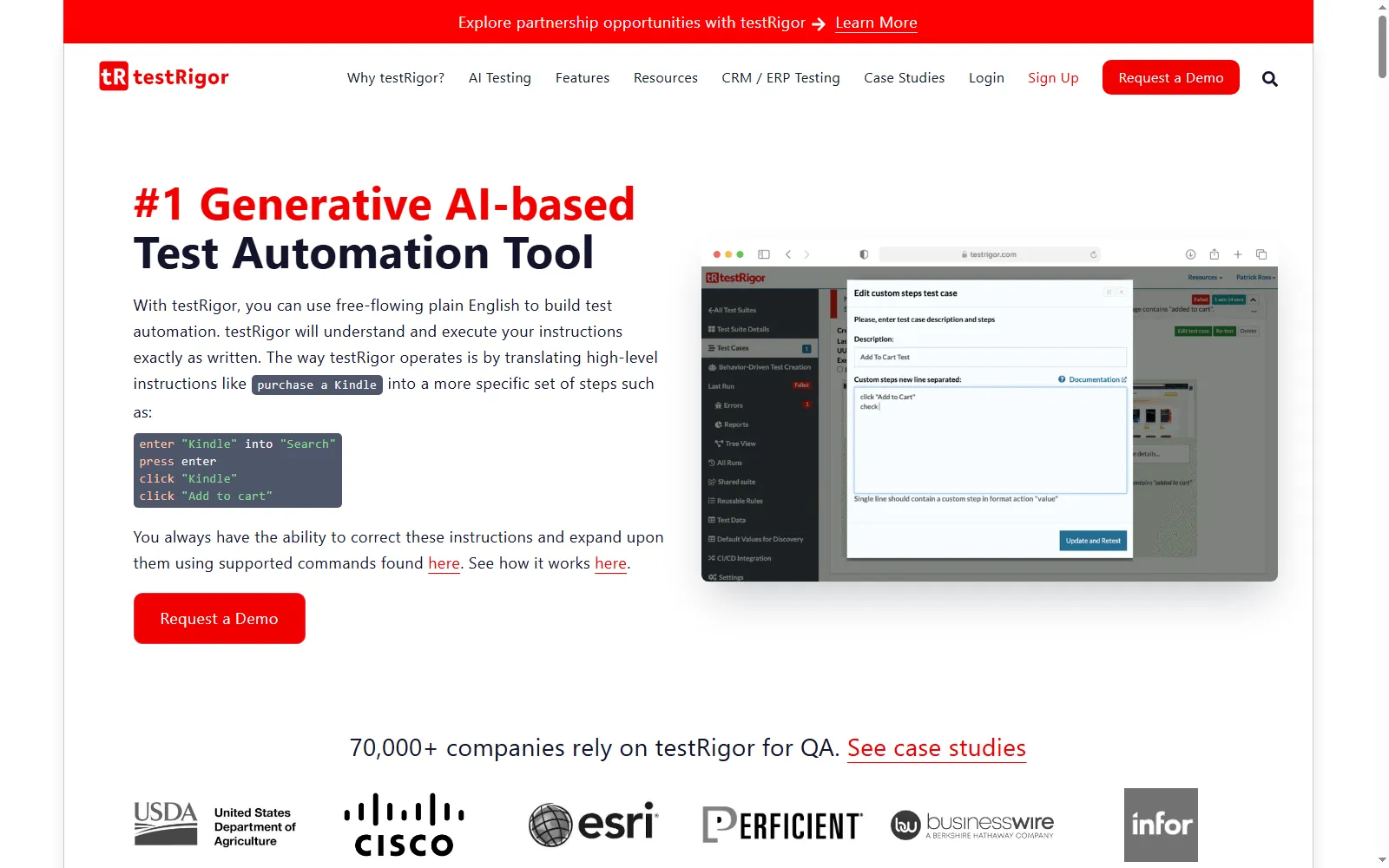
testRigor describes itself as a generative AI-based test automation tool built around free-flowing natural language, and it is the most direct answer here for manual testers who cannot write code. Tests are English instructions rather than selectors, and its home page says tests can also be generated through Claude Code.
Coverage reaches well past the browser: native and hybrid iOS and Android apps, native Windows desktop apps in paid versions, mainframe, email, SMS and phone calls through Twilio, and two-factor login flows. Native app reach is one reason teams look past Playwright, and our roundup of Playwright alternatives compares testRigor with the other options.
Key features
- Natural language authoring - tests are written as free-flowing English instructions, with no XPath or CSS selectors to maintain.
- Generative creation - tests can be generated inside testRigor or through Claude Code.
- AI self-healing - maintenance is handled by AI-based healing rather than locator repair.
- Beyond the browser - native and hybrid mobile, Windows desktop, mainframe, email, SMS, phone calls, and API testing in one tool.
AI capability
It interprets English instructions into actions at run time and heals them when the page changes, so the skill needed to author drops to describing behavior. The review burden moves rather than disappears, because someone still has to confirm each instruction encodes the intended business rule.
Gartner rating
4.4 out of 5 from 4 ratings on Gartner Peer Insights, a sample too small to weigh heavily.
Integrations
CI/CD covers GitLab, GitHub Actions, TeamCity, Bamboo, Jenkins, Spinnaker, AWS CodePipeline, Travis, and CircleCI. Test management covers TestRail, Zephyr, Xray, PractiTest, ReportPortal, and Cucumber Studio, with Jira for issues, Okta and Azure AD for SSO, Twilio for SMS and calls, and device clouds including LambdaTest (now TestMu AI).
Pros and cons
| Pros | Cons |
|---|---|
| Lowest authoring barrier for manual testers; the widest channel coverage here, including SMS, calls, and mainframe; a long published integration list. | No published prices, so cost waits on a sales call; Windows desktop testing is paid-only; tests live in testRigor's own English format with no documented code export. |
Pricing
A free Public plan, where tests and results are public, a private Pay As You Go plan, and custom Enterprise pricing; no prices are listed. Last verified: November 2026.

Verdict: The shortest migration path I found for a team sitting on a large manual suite. Weigh that against lock-in, since testRigor documents no export of its English tests to a code framework. If you later move to KaneAI, the testRigor to KaneAI migration guide shows how to collect your steps and re-create them in natural language, and the testRigor alternative page compares the two on price and code export.
3. Virtuoso QA: Best for Audit-Ready Testing of Web Apps and Business Systems
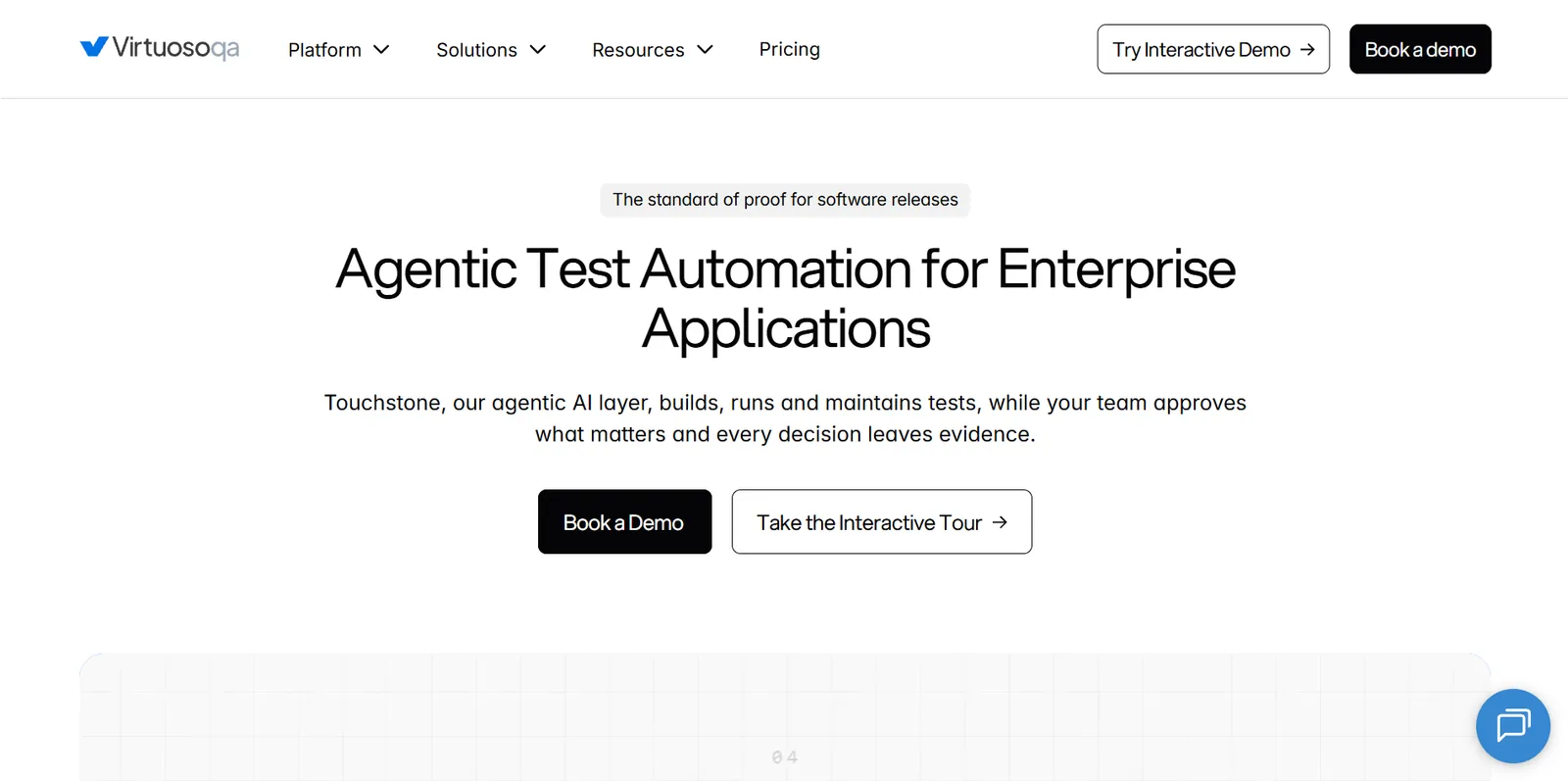
Virtuoso QA is an autonomous QA platform for browser-based applications, from custom web products to packaged systems such as Dynamics 365, Salesforce, SAP, Oracle, and Workday. Its agents turn requirements into test journeys, execute them, sort real defects from test breakage, and repair what broke.
What sets it apart is the evidence each run leaves behind. Every verdict traces back through the test journey and the requirement to the source document, alongside screenshots, DOM snapshots, network activity, and the name of whoever approved the change.
Key features
- Requirement-to-journey generation - agents draft test journeys from uploaded specs and Jira tickets, held for human approval before they join the suite.
- Natural language authoring - steps are written in natural language, with suggested next steps as you build.
- Confidence-gated self-healing - repairs broken steps at roughly 95% accuracy and declines to heal when confidence is low, logging every change for review.
- Composable testing - reusable journey libraries for ERP and CRM processes, so partners and enterprises do not rebuild the same flows per rollout.
- API checks inside UI journeys - assert on backend responses within the same end-to-end flow, with Postman collection import.
- Release evidence - step-level screenshots, DOM snapshots, and network logs tied to each requirement and approval.
AI capability
AI handles the heavy lifting, generating journeys, diagnosing failures, and proposing repairs, while execution stays deterministic, so a test passes or fails the same way on every run. The approval gate means no agent-written test or heal reaches the suite unreviewed.
Gartner rating
4.6 out of 5 from 11 ratings on Gartner Peer Insights, a small sample.
Integrations
Two-way Jira (Cloud and Data Center), native Xray and TestRail apps, Slack and Microsoft Teams notifications, generated CI scripts for Jenkins, Azure Pipelines, GitHub Actions, and GitLab CI, SSO through Okta, Azure AD, and Ping, plus a REST API and signed webhooks.
Pros and cons
| Pros | Cons |
|---|---|
| Every verdict carries traceable evidence and a named approver; heals are confidence-gated and reviewable; one platform for custom web apps and packaged business systems; Selenium (Java) export available. | Browser-based applications only, with no native mobile or desktop testing; pricing is not published; agentic generation and composable testing are paid add-ons. |
Pricing
Not published; Virtuoso offers Get Started and demo booking, with a free trial available on request. Last verified: October 2026.
Verdict: The pick when a test result has to stand up to scrutiny, whether that is a change advisory board, a compliance review, or an SI handing a system over to a client. Teams that also need native mobile coverage will want a second tool alongside it. The Virtuoso alternative page compares it with TestMu AI.
4. Autosana: Best for Mobile-Led Teams Shipping With Coding Agents
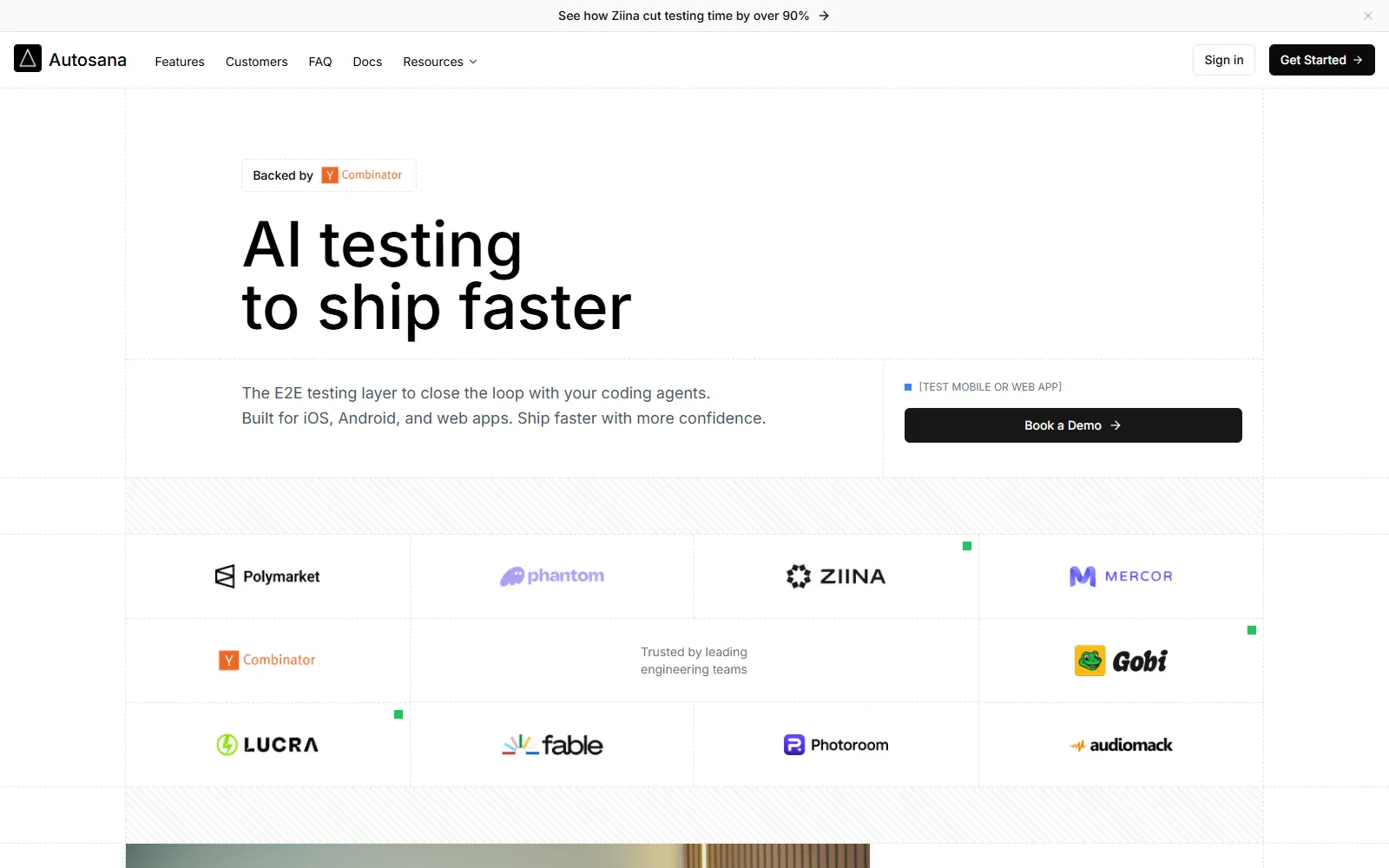
Autosana calls itself the end-to-end testing layer that closes the loop with your coding agents, built for iOS, Android, and web apps. Its documentation shows tests written as plain sentences such as "Tap the login button", run against iOS .app and Android .apk builds or in Chrome, Firefox, Edge, and Chromium on the web.
Key features
- Natural-language flows - tests are described in plain sentences rather than code.
- Self-healing - broken steps are healed automatically, per its home page.
- Diff-aware updates - agents update tests based on code diffs when the app changes.
- Three surfaces, one product - iOS, Android, and web, with Swift, Kotlin, Flutter, React Native, Ionic, and Xamarin listed as supported frameworks.
- Code-managed flows - flows can be synced through GitHub.
AI capability
It drives the app from intent, and its site says it heals broken steps as it goes. On mobile that decides whether a suite finishes unattended, so pilot it on your flakiest flow.
Gartner rating
Not listed in this Gartner Peer Insights market as of September 2026.
Integrations
Flows run on triggers or in CI, with reports by pull request, email, or Slack. Its docs list integrations with GitHub (a pull request bot and flow sync), Jira Cloud, Linear, Slack, Devin, webhooks, and Tailscale, plus an MCP server and a CLI.
Pros and cons
| Pros | Cons |
|---|---|
| Recovery behavior aimed at the parts of mobile that break scripted automation; one product for iOS, Android, and web; natural-language flows a non-engineer can drive. | No published pricing or trial terms; no peer ratings to check its claims against; no documented export to an open framework. |
Pricing
Published: pay as you go at $0.10 per AI action and $0.01 per cached action after 1,000 free AI actions a month, Startup at $999 a month, Pro at $2,499 a month, and custom Enterprise. No card is needed to start. Last verified: November 2026.
Verdict: Worth a trial for mobile-first teams already shipping with coding agents, on the strength of its self-healing claims. With no ratings and no price, your pilot is the only evidence you will have. The Autosana alternative page compares it with TestMu AI.
5. TestSprite: Best for Developer Teams Without Dedicated QA
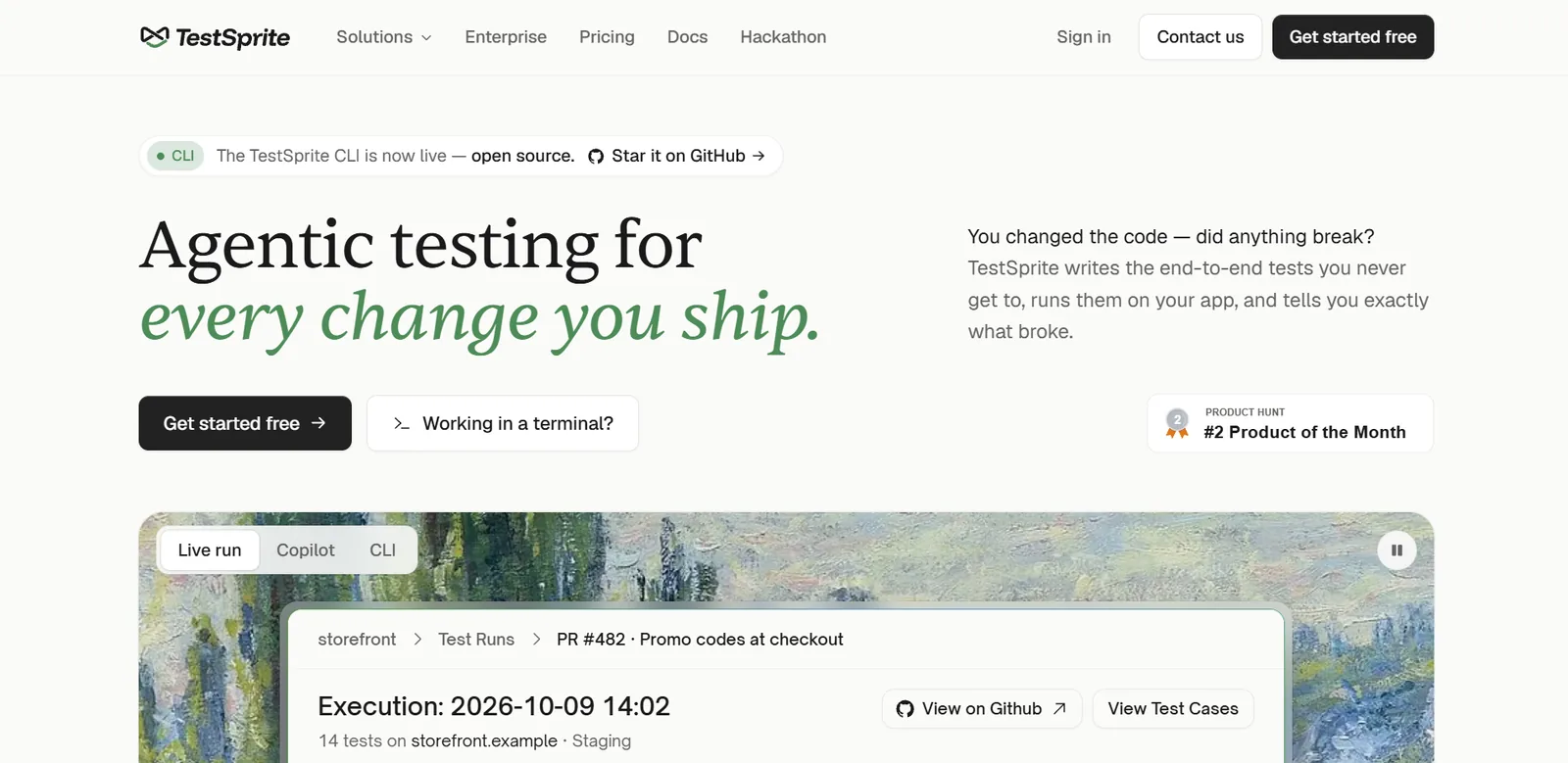
TestSprite calls itself an agentic testing tool that writes end-to-end tests, reruns them on every change, and tells you what broke. Its home page says it reads your code and PRD for context, then sends dozens of agents through the app at once, driving a real browser or hitting a live API.
The same projects and tests sit behind three surfaces: a no-code Web Portal, an MCP Server inside your IDE, and a CLI that is open source under Apache 2.0 and built for coding agents. The home page names Claude Code, Codex, Cursor, and VS Code among the agents and IDEs it works with, and TestSprite's docs FAQ says it is aimed at individual developers and small teams without dedicated QA.
Key features
- Plans from code and requirements - the MCP flow reads your PRD and codebase, writes a normalized PRD and a test plan, then generates the tests and runs them in the cloud.
- Readable test code - UI tests are Python with Playwright and API tests use plain requests calls, and the Web Portal can push the generated code to a GitHub repository.
- Auto-Heal on UI reruns - recovers a UI test that failed because the page changed, while real product bugs still fail; API tests are not healed.
- Pull request checks - a GitHub App runs the suite against a preview deployment and posts a PR comment or commit check, with an option to block the merge until tests pass.
- Failure bundles for agents - a failed CLI run hands the coding agent the failing step, DOM snapshots, the test source, a root-cause hypothesis, and a recommended fix target.
AI capability
It plans and writes tests from code and requirements, then hands each failure back to the coding agent, which fixes the app and reruns, a loop built for code that AI agents write. Someone still has to review what each generated test asserts before trusting a green run.
Gartner rating
Not listed in this Gartner Peer Insights market as of October 2026.
Integrations
GitHub through an App for pull request checks and an export of generated code, GitHub Actions through testsprite ci init github, and any CI that can run a shell command, since the CLI exits non-zero on a failed run and writes JUnit XML. Slack notifications start on the Free plan, Jira and Linear integrations come with the Standard and Pro plans, and Figma designs can be added as context.
Pros and cons
| Pros | Cons |
|---|---|
| Published self-serve plans with a free tier; one backend across a no-code portal, an IDE plugin, and an open-source CLI; generated tests are plain Python and Playwright; pull request testing on every plan, Free included on one repository. | Web UIs and REST APIs only, with no native mobile app testing; local runs are frontend-only and do not save test code; SSO, SCIM, and audit logs are Enterprise-only; the per-run credit cost is not published. |
Pricing
Published and credit-based on TestSprite's pricing page: Free at $0 with 150 credits a month, Starter at $19 a month with 400 credits and the first month free, Standard at $39 with 800 credits, Pro at $69 with 1,600 credits, and Enterprise from $199 a month, starting at 10 seats and 5,000 credits a month and also sold on AWS Marketplace. Pull request testing grows from one GitHub repository on Free to unlimited on Pro. Last verified: November 2026.
Verdict: A low-friction start for a developer team shipping AI-written code without QA staff, since the free plan, IDE plugin, and CLI reach a pull request check without a sales call. Price seats and credits before a wider rollout, and keep a second tool for native mobile apps. The TestSprite alternative page compares it with KaneAI.
6. mabl: Best for Autonomous Maintenance at Unlimited Concurrency
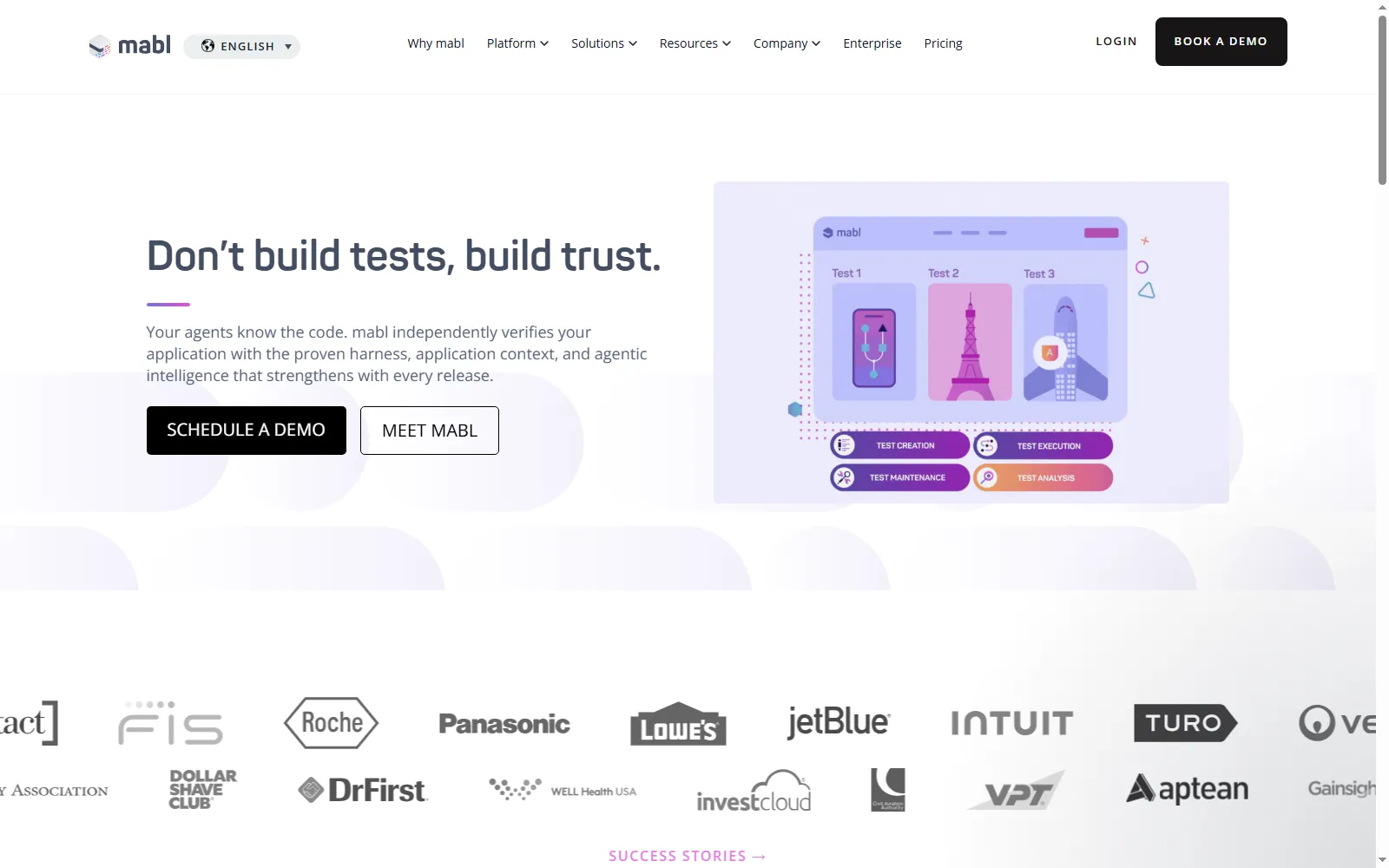
mabl positions itself as an agentic testing platform whose coverage "builds itself, runs itself, and recovers itself", pitched at teams shipping at the speed of AI coding agents. Its capability set leans on what happens after a test breaks. For a side-by-side look at the two platforms, read TestMu AI vs mabl.
Its pricing page lists unlimited local and CI test runs and unlimited test run concurrency, with cloud runs drawing on a monthly credit allowance that starts at 500 credits.
Key features
- AI test creation - tests are generated from natural language or from Jira requirements.
- AI auto-healing - tests recover from UI changes as a listed platform feature.
- Broad test types - web, API, accessibility, and performance testing, with mobile app testing sold as an add-on.
- Unlimited scale terms - unlimited apps, environments, workspaces, local runs, CI runs, and test run concurrency.
- Coding-agent friendly - works with agentic development stacks, Claude Code among them, per its home page.
AI capability
It generates tests from natural language or Jira requirements, but its strongest pitch is recovery: healing keeps existing tests green through UI change, which suits a team whose suite keeps going red.
Gartner rating
4.6 out of 5 from 7 ratings on Gartner Peer Insights.
Integrations
Jira for issues; Slack, Microsoft Teams, and Atlassian Rovo for collaboration; GitHub, GitLab, and Bitbucket for source control; Jenkins, Azure Pipelines, Bamboo, CircleCI, and Octopus Deploy for CI/CD; plus Postman, BigQuery, and webhooks.
Pros and cons
| Pros | Cons |
|---|---|
| Unlimited local and CI runs and concurrency; a strong auto-healing story; web, API, accessibility, and performance in one platform; browser tests export to Playwright and Selenium IDE. | Quote-led pricing; mobile is an add-on; cloud runs consume credits, so model credit burn on your heaviest suites; export covers browser tests only, and some step types do not export. |
Pricing
Quote-led, with no list price and a 14-day free trial. Last verified: September 2026.
Verdict: The pick when a constantly red suite is the problem and throttled concurrency has been the ceiling. Push early on how credits scale with your cloud run volume. If mabl's quote-led pricing or paying for both mobile and browser testing is the blocker, the mabl alternative comparison sets it against TestMu AI.
7. Functionize: Best for Usage-Metered Agentic Testing

Functionize calls Studio "the Agentic Quality Platform": you describe what to test, and Studio builds it, runs it, and keeps it green. An agent interprets intent on top of a deterministic, machine-learning verification core, and the platform carries built-in knowledge of Salesforce, ServiceNow, Workday, and SAP workflows.
Every plan comes with a monthly credit allowance, and a free plan with no time limit lets an individual engineer start without procurement; the paid Growth and Scale plans share one credit pool across a team.
Key features
- Describe-to-test - tests are created from a plain description of what good looks like.
- Auto-healing - healing handles test maintenance as the app changes.
- Enterprise context - built-in knowledge of Salesforce, ServiceNow, Workday, and SAP workflows.
- Hard flows covered - SMS, MFA, one-time-password, and email activation-link testing come with the paid plans, not the Free plan.
- Team controls - every plan has a team workspace, the paid plans add a shared credit pool, SSO, and RBAC, and Enterprise adds multi-team management.
AI capability
An agent turns intent into tests, and a separate deterministic core verifies them, which keeps the model from grading its own work.
Gartner rating
4.2 out of 5 from 10 ratings on Gartner Peer Insights.
Integrations
The integrations page currently reads "Coming Soon" with no named connectors, so confirm your CI and issue-tracker needs during the free plan.
Pros and cons
| Pros | Cons |
|---|---|
| A real free plan with monthly credits and parallel runs; cost scales with usage; SMS and MFA flows on the paid plans; enterprise workflow context built in. | No published integrations list yet; parallel runs are capped by plan; Enterprise carries a 12-month minimum; no documented code export. |
Pricing
Published and credit-based: a Free plan with monthly credits and 5 parallel runs, two paid plans that add credits and share one credit pool across a team, and custom Enterprise on a 12-month minimum. Last verified: October 2026.
Verdict: The easiest tool here to try with zero commitment. Run your three heaviest journeys on the free plan to learn your credit burn before you model a bill. The Functionize alternative page compares it with KaneAI.
8. Katalon: Best for Growing From Codeless to Full Code in One Platform
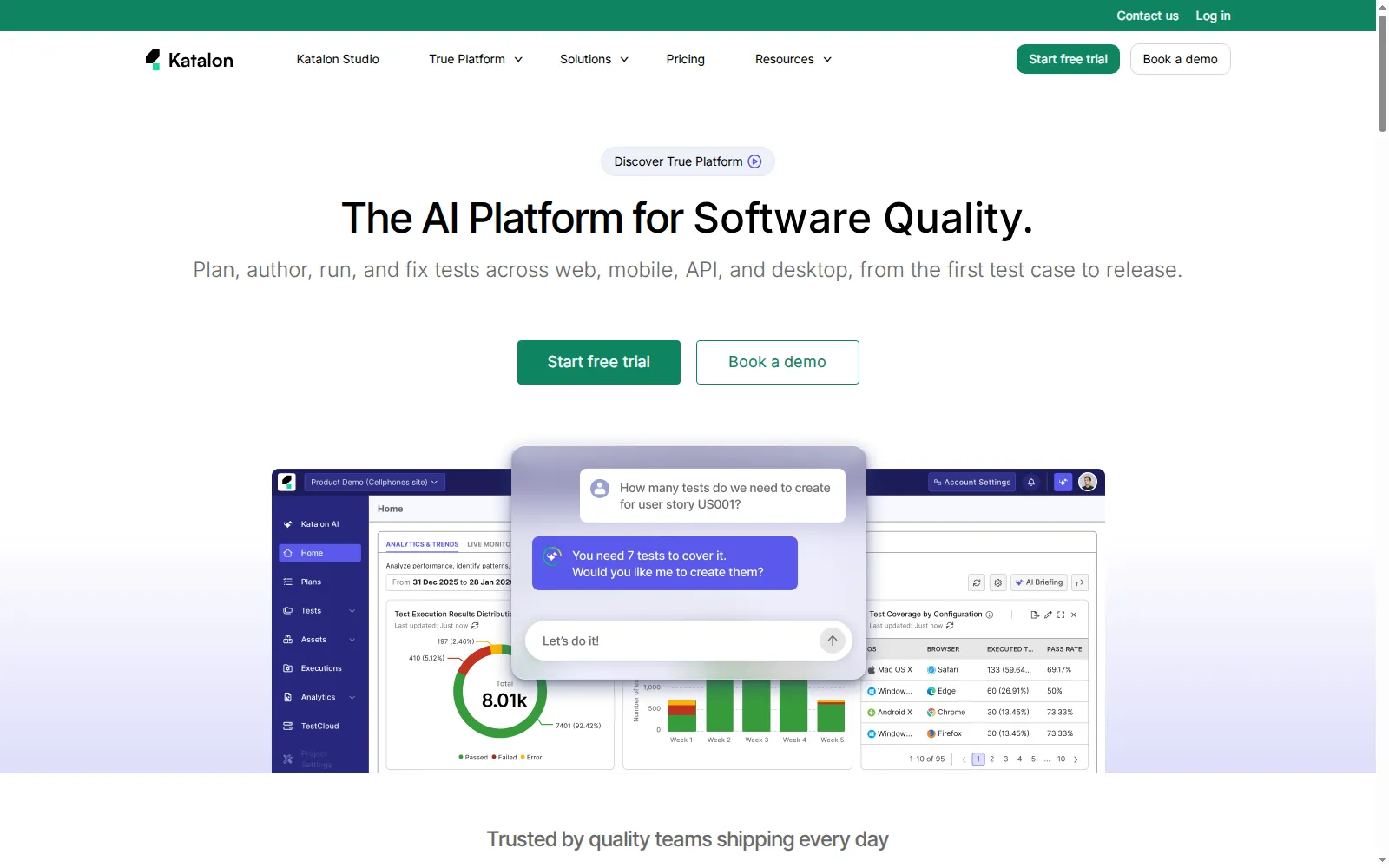
Katalon describes itself as the AI platform for software quality, covering planning, authoring, running, and fixing tests across web, mobile, API, and desktop. Katalon Studio supports no-code, low-code, and full-code authoring, so a team can start by recording and move to scripts without switching tools.
Its AI generates test cases from requirements, self-heals locators when the application changes, and analyzes failures, while Katalon MCP lets coding agents such as GitHub Copilot and Claude drive testing workflows. It also runs Playwright, Selenium, and Appium scripts, which keeps existing framework code in play.
Key features
- Three authoring modes - no-code, low-code, and full-code in Katalon Studio.
- AI from requirements - test cases generated from requirements, plus self-healing locators and failure analysis.
- Framework-friendly - runs existing Playwright, Selenium, and Appium scripts.
- Production insight - TrueTest observes real user journeys to find coverage gaps.
- Execution - TestCloud supplies real browsers and devices, or you bring your own CI runners.
AI capability
It generates, heals, and explains, layered on a mature automation tool rather than replacing it. That makes the AI easy to adopt gradually, and also means the AI features inherit the platform's learning curve.
Gartner rating
4.5 out of 5 from 873 ratings on Gartner Peer Insights for Katalon True Platform, the largest review sample in this market.
Integrations
The published catalog spans Jira, qTest, Rally, TestRail, Xray, Zephyr, and Azure DevOps for ALM; Jenkins, GitHub Actions, GitLab, CircleCI, Bamboo, AWS CodeBuild, Google Cloud Build, Harness, TeamCity, and Codemagic for CI/CD; and LambdaTest (now TestMu AI) and Selenium Grid among its cross-browser execution options.
Pros and cons
| Pros | Cons |
|---|---|
| The largest peer sample in the market; a smooth path from codeless to code; runs existing framework scripts; a broad published integration catalog. | The free Studio tier leaves out AI script generation, so AI script generation needs a paid seat or the 30-day trial; per-seat pricing scales with headcount; the AI sits on top of a large platform with its own learning curve. |
Pricing
Published per seat for individuals and small teams, with a free Studio tier for local authoring and execution, custom Enterprise pricing, and a 30-day no-card trial. Last verified: October 2026.
Verdict: The safest broad-platform pick if you want AI features on top of a mature automation tool and a review base large enough to trust. Trial it with the team that will own it, since per-seat pricing scales with headcount.
9. Keploy: Best for API and Integration Regression Without Hand-Built Mocks
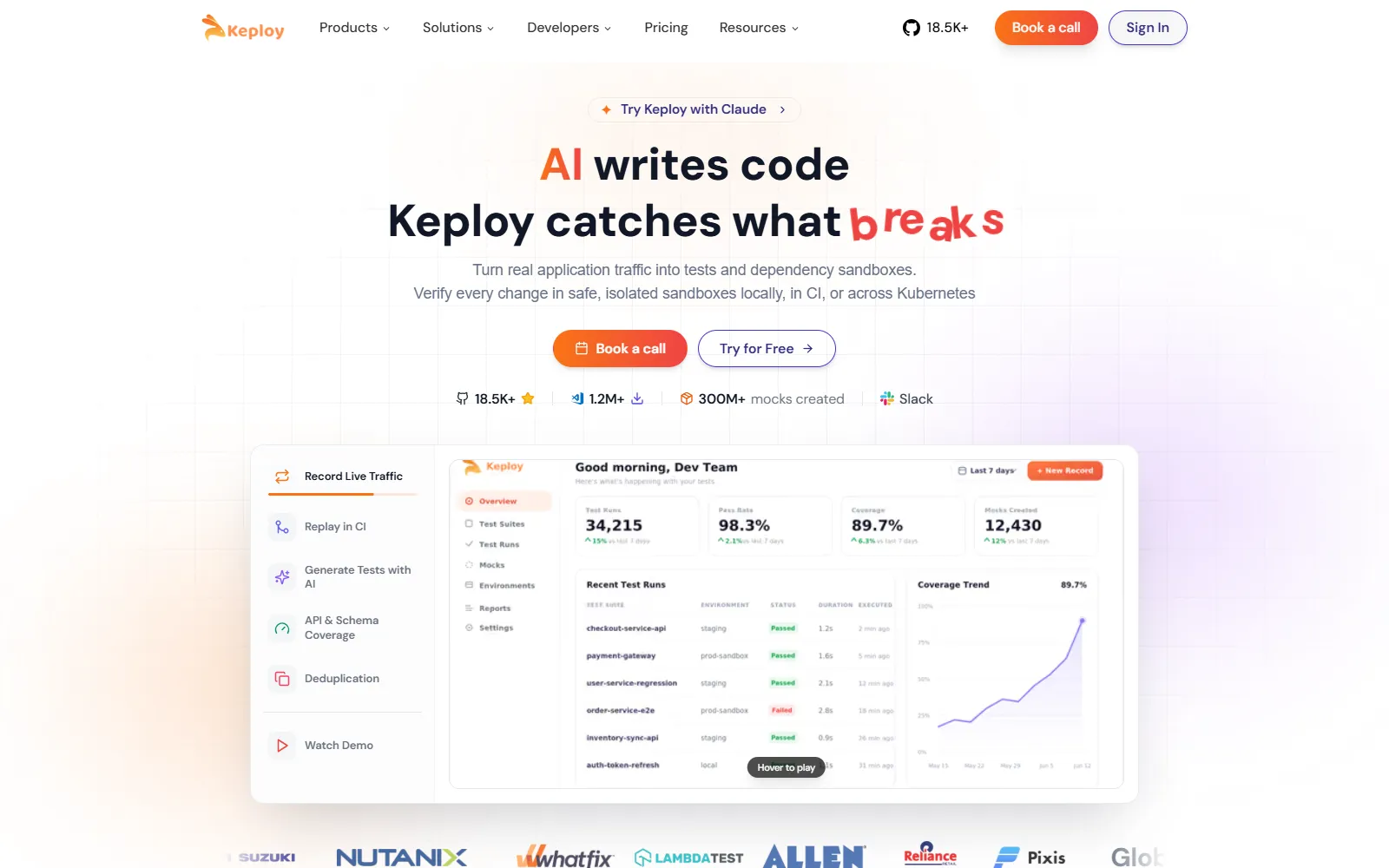
Keploy is an open-source API and integration testing platform under the Apache-2.0 license. It records real API calls, database queries, and streaming events, then replays them as tests with mocks of the dependencies, capturing traffic at the network layer with eBPF so it needs no code changes in any language.
The hosted plans add AI-generated API tests from OpenAPI and Postman, with AI expanding the edge cases automatically.
Key features
- Traffic-to-test - records API calls, database queries, and streaming events and replays them as regression tests.
- Dependency mocks - virtualizes databases such as Postgres, MySQL, and MongoDB, queues such as Kafka and RabbitMQ, and external APIs.
- Spec-driven generation - the free Playground plan generates API tests from OpenAPI or Postman and expands edge cases with AI.
- Open-source core - Apache-2.0 on GitHub with 18,000+ stars, self-hostable with community support.
- Contract and load testing - added on the Pro plan.
- Self-healing tests - listed on its pricing page, with AI credits for healing and bug detection on its hosted plans.
AI capability
It generates API tests from traffic and specs, then widens them with AI-expanded edge cases. It does not drive or check the browser UI (its Chrome extension only records a web app's API calls), so it complements an end-to-end tool rather than replacing one.
Gartner rating
4.5 out of 5 from 13 ratings on Gartner Peer Insights.
Integrations
Tests run locally or in CI, and the Enterprise plan adds recording inside Kubernetes, production traffic capture, a mock registry, and SSO with RBAC.
Pros and cons
| Pros | Cons |
|---|---|
| Open source with a free Playground plan; removes most hand-written mocks; works from traffic, OpenAPI, or Postman. | API and backend only, with no browser UI testing; traffic-derived tests encode today's behavior, including today's bugs; production traffic capture is Enterprise-only. |
Pricing
Free on the Playground plan and as self-hosted open source, with a per-user Pro plan that includes usage credit and quote-led Enterprise. Last verified: September 2026.
Verdict: The tool I would recommend most confidently for one narrow job, API regression without maintaining a mock layer. Read the first pass of generated assertions, because captured behavior is not the same as intended behavior.
10. UiPath Test Cloud: Best for Governed Enterprise Rollout
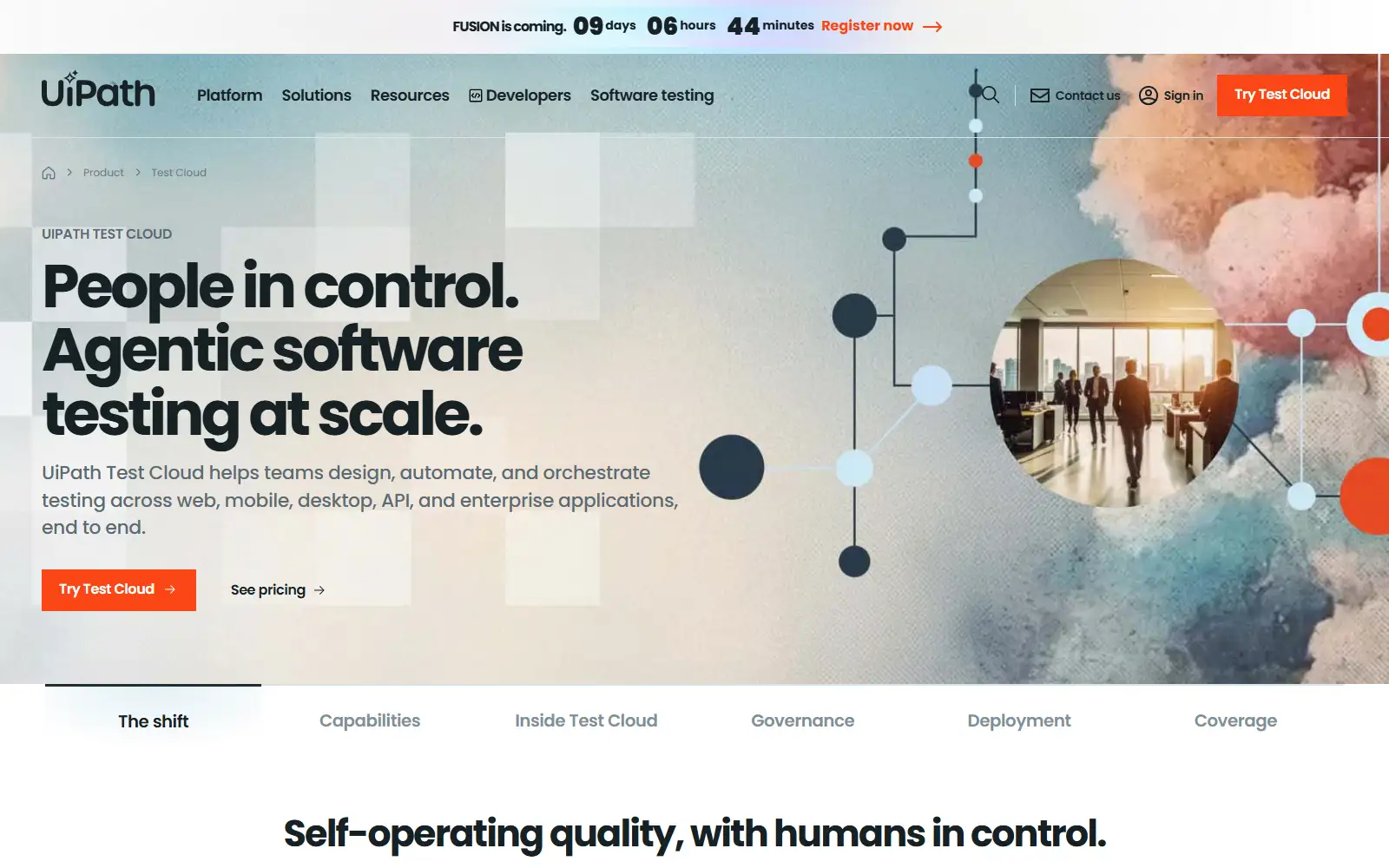
UiPath Test Cloud applies agentic AI across design, execution, and management rather than at authoring alone. AI helps write tests and generate synthetic data, and during a run self-healing repairs broken selectors, timing shifts, and UI changes in real time.
Coverage is among the broadest here: web, mobile, desktop on Windows and macOS, API, and legacy mainframe, plus 190+ enterprise applications including SAP, Salesforce, Oracle, Workday, ServiceNow, and Epic.
Key features
- Agentic design - AI helps write tests and generate synthetic data.
- Real-time healing - repairs broken selectors, timing shifts, and UI changes during execution.
- AI Trust Layer - role-based access, centralized credentials, audit-ready execution trails, PII masking, spend controls, and bring-your-own-model support.
- Deployment choice - public SaaS through Automation Cloud or private on-premises through Automation Suite.
- Insights - AI-powered views of stability, coverage, and performance.
AI capability
It works across the whole lifecycle, and the governance layer keeps an audit-ready trail of each execution. That trail is the reason to shortlist it if a compliance function will review test evidence.
Gartner rating
4.6 out of 5 from 119 ratings on Gartner Peer Insights.
Integrations
Connects with 50+ ALM tools, Jenkins, GitLab, GitHub Actions, and Azure DevOps, plus Git, SVN, and TFS for version control.
Pros and cons
| Pros | Cons |
|---|---|
| Healing during execution as well as between runs; governance and audit trails built in; broad packaged-app coverage; SaaS or on-premises. | Priced through sales; an enterprise rollout rather than an install; no documented export to an open framework. |
Pricing
Standard and Enterprise tiers are priced through sales, with a free trial of Standard. Last verified: September 2026.
Verdict: The shortlist pick for regulated enterprises where an auditor will ask how a verdict was reached. Too much machinery for a team that just needs coverage this sprint. If quote-only Test Cloud licensing is the blocker, the UiPath Test Cloud alternative page compares it with TestMu AI.
11. Tricentis Tosca: Best for Packaged Applications at Enterprise Scale
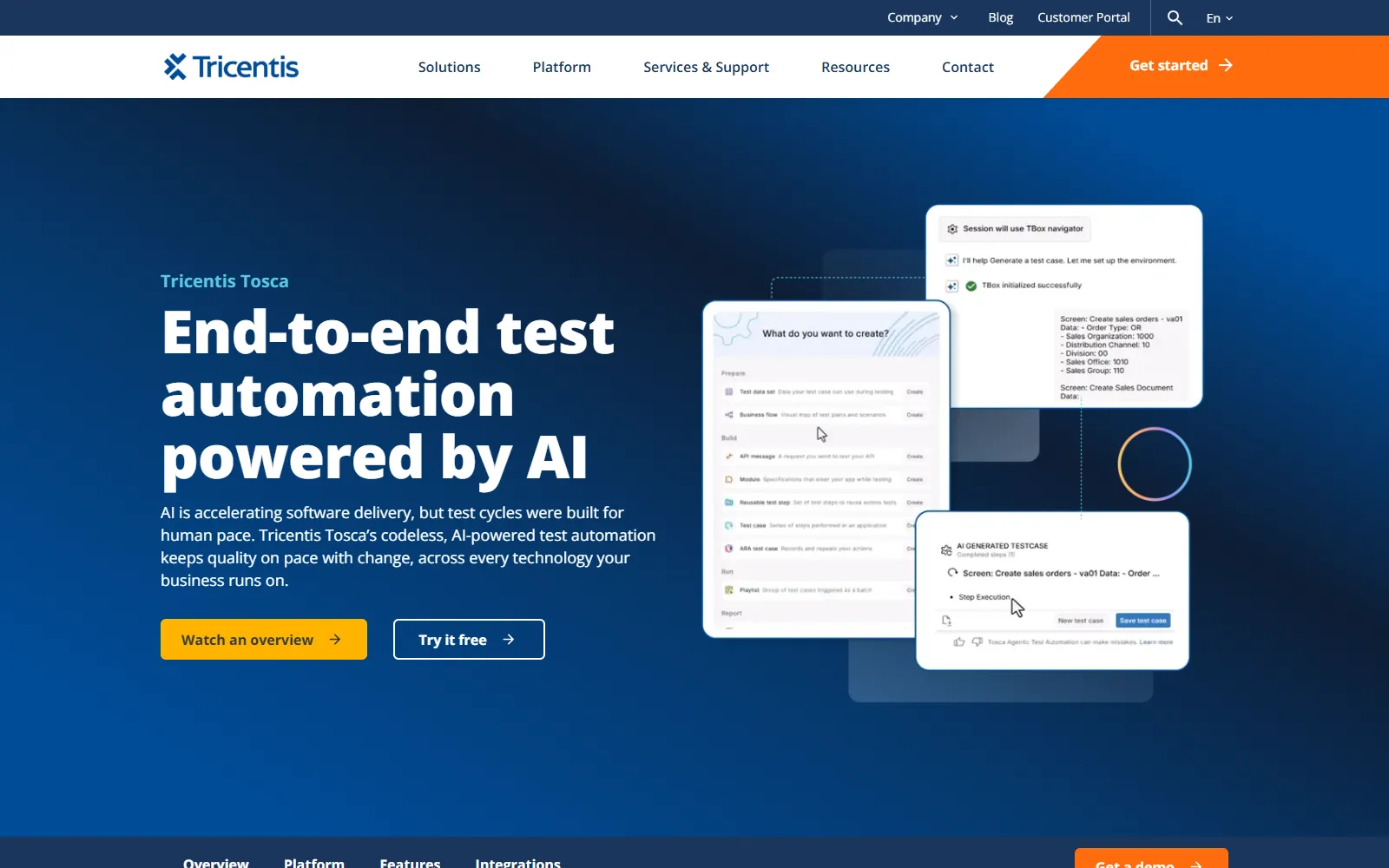
Tosca builds tests on an application model, fed by scanning or by its recorder, Tricentis ARA, and Tricentis has added agentic test automation on top. Its agents generate complete end-to-end tests from natural language descriptions and merge them into the existing Tosca repository to prevent duplicates.
Because tests are decoupled from the application, a change to the model is pushed to hundreds or thousands of test cases at once, across 200+ technologies including SAP Fiori, Oracle Fusion, Salesforce, Workday, and ServiceNow.
Key features
- Agentic test automation - end-to-end tests from natural language descriptions, merged with existing assets to prevent duplication.
- Model-based maintenance - one model change updates every test built on it.
- Elastic Execution Grid - auto-scaling cloud and on-premises agents run tests in parallel, with browser-based authoring and no local install.
- API simulation - virtual services stand in for unavailable dependencies, covering HTTP plus Kafka, MQ, and RabbitMQ.
- Data residency - EU and U.S. regional hosting.
AI capability
Agents generate tests from descriptions, and the model does the healing.
Gartner rating
4.5 out of 5 from 165 ratings on Gartner Peer Insights.
Integrations
The Tosca page links to a separate Tricentis integrations page, and Tosca's documentation covers CI/CD, qTest, SeaLights, and SAP Solution Manager integrations. Tricentis also sells qTest for test management and NeoLoad for load testing, both listed separately on Gartner Peer Insights.
Pros and cons
| Pros | Cons |
|---|---|
| Model changes propagate to thousands of tests; 200+ technologies covered natively; agentic generation merged with existing assets; regional hosting. | The model has to be built before automation pays back; tests stay inside the vendor platform; pricing is not published. |
Pricing
Not published; licensing runs through sales, with a free trial and demos. Last verified: September 2026.
Verdict: Where SAP or Oracle carries revenue, modeling the application repays the effort in a way recording does not. For a small web product it is far more platform than the problem needs. If you are moving off Tosca, qTest or Testim, the Tricentis alternative comparison covers all three.
12. OpenText Functional Testing: Best for Mainframe, SAP GUI, and Legacy Estates
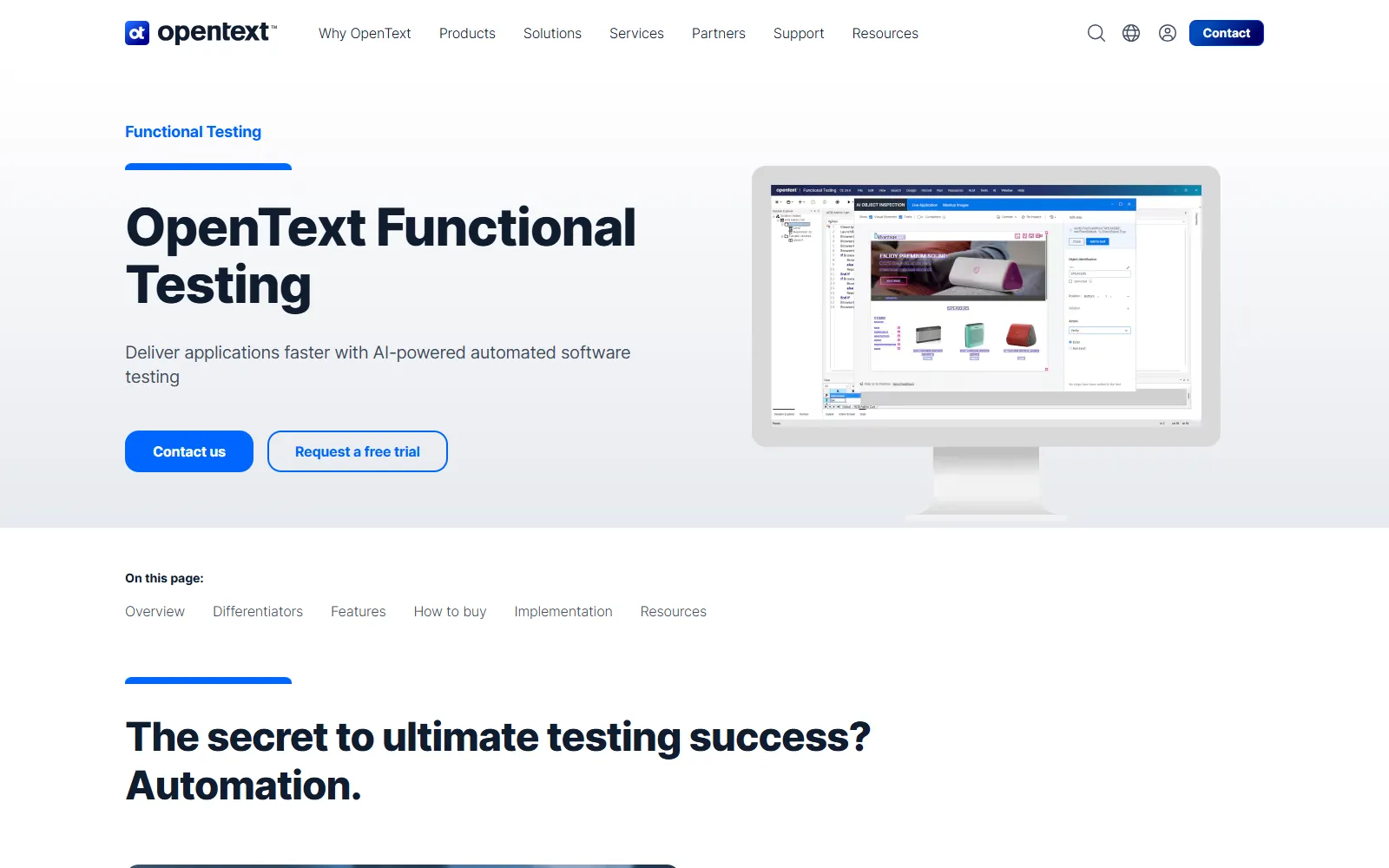
OpenText Functional Testing is the product formerly sold as UFT One, and Gartner Peer Insights still describes its listing under the Micro Focus UFT One name. It automates desktop, web, mobile, mainframe, and packaged enterprise applications, including SAP GUI, Fiori, and S/4HANA. Where SAP is the main estate, our comparison of SAP testing tools sets it beside other SAP options on GUI, Fiori, change impact and AI.
Key features
- AI object recognition - identifies objects in a way that adapts to UI changes, cutting script repair.
- Wide technology support - desktop, web, mobile, mainframe, SAP GUI, Fiori, S/4HANA, and API.
- Parallel and distributed execution - for shorter test cycles.
- Data-driven testing - with external data sources.
- Editions - including one for developers, one under OpenText Core Software Delivery, and one for SAP solutions.
AI capability
Its AI is object recognition that adapts to UI changes, which cuts script repair, and it does not generate tests from intent.
Gartner rating
4.1 out of 5 from 113 ratings on Gartner Peer Insights, tied for the lowest score here on one of the larger samples.
Integrations
DevOps toolchain integration with Jenkins, Git, Docker, and CI/CD platforms.
Pros and cons
| Pros | Cons |
|---|---|
| Reaches mainframe and legacy desktop apps that browser-first tools cannot; deep SAP support; keyword-driven and scripted authoring in one suite. | Tied for the lowest peer score here across 113 ratings; no AI test generation; quote-led licensing. |
Pricing
Quote-led through sales, with a free trial on request. Last verified: September 2026.
Verdict: Its value is protecting an existing UFT investment and reaching legacy desktop and SAP GUI. For a new program, the AI-first tools higher on this list generate tests that this one cannot.
13. Worksoft: Best for SAP and Packaged Business Processes
Worksoft's Connective Automation Platform validates end-to-end business processes rather than individual screens. Its Certify product provides codeless automation across SAP, Oracle, MS Dynamics, Salesforce, ServiceNow, IBM Maximo, UKG, web, desktop, and mainframe applications.
The platform starts by capturing real processes, mapping user actions and system changes, and then automates and runs them. On the AI side, Certify lists AI-driven root cause analysis, expanded self-healing, natural-language summaries of test failures, and AI-driven test prioritization.
Key features
- Process capture - maps real-world processes, user actions, and system changes as the foundation for automation.
- Codeless automation - business users and analysts automate processes without code.
- AI root cause analysis - highlights failure reasons and routes them to the right team.
- Adaptive automation - expanded self-healing for resilience.
- Test prioritization - AI focuses execution on high-risk areas.
AI capability
It triages and prioritizes rather than authoring. The AI explains failures in natural language and decides what to run first, which matters most when a regression cycle spans many packaged systems.
Gartner rating
4.7 out of 5 from 54 ratings on Gartner Peer Insights for Worksoft Connective Automation Platform, the highest on this list.
Integrations
Certify lists out-of-the-box integrations for DevOps, ALM, and change control without naming them on the product page, and Worksoft is also available on the SAP Store.
Pros and cons
| Pros | Cons |
|---|---|
| The top peer score on this list; process capture before automation; codeless for business analysts; broad packaged-app coverage. | Quote-led pricing; value concentrates in ERP-shaped estates; support for Worksoft v12.x ends on December 31, 2026, so existing users need an upgrade plan. |
Pricing
Quote-led, with demos booked through sales. Last verified: September 2026.
Verdict: The top peer rating here and still the wrong tool for most readers, because Worksoft is built around SAP, Oracle, and Dynamics 365 business processes. Shortlist it when an SAP process is the thing that must not break, and read the Worksoft alternative page for where it stays stronger than TestMu AI.
14. Copado Robotic Testing: Best for Salesforce Delivery Pipelines
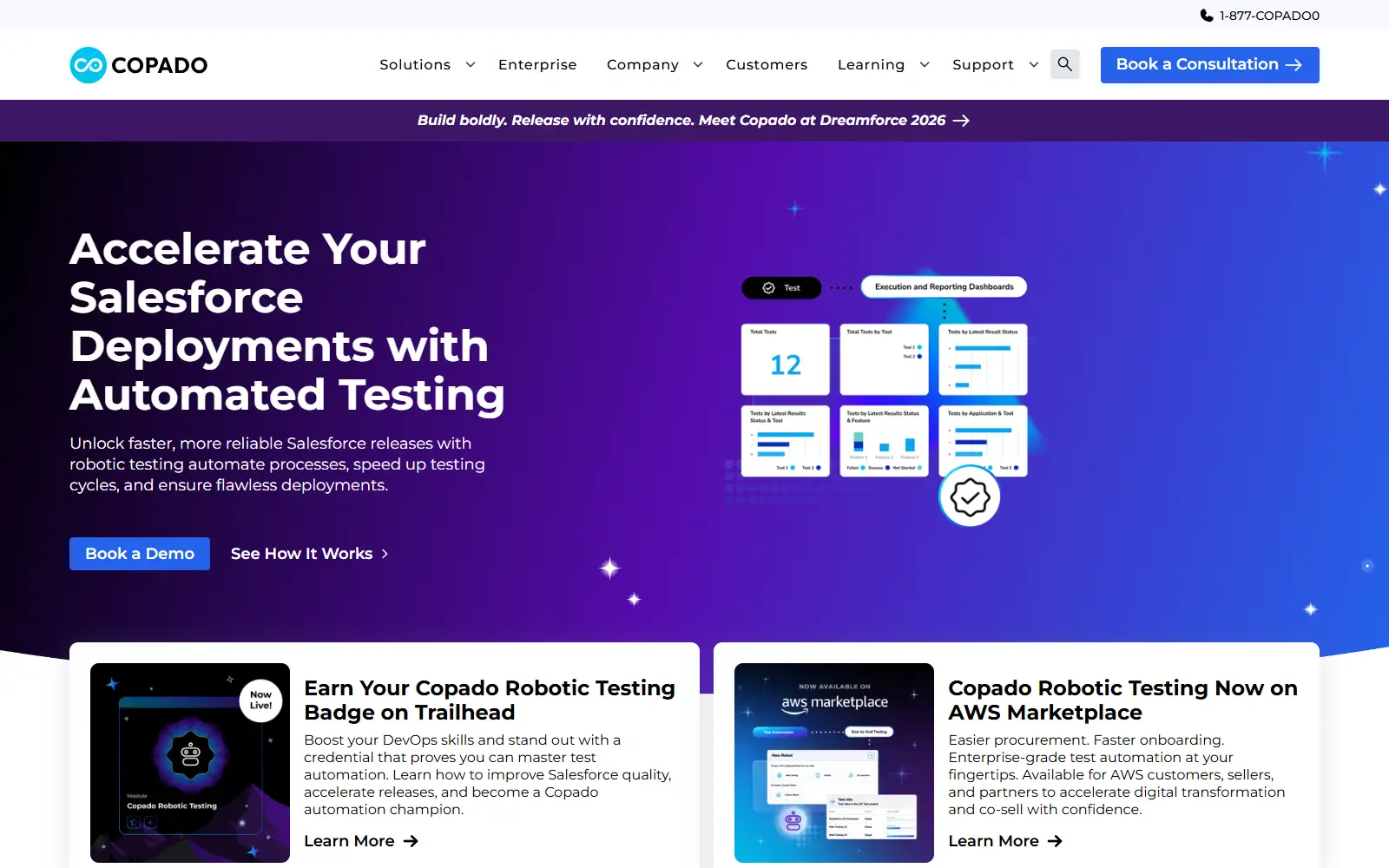
Copado Robotic Testing is low-code test automation embedded in Copado's Salesforce DevOps platform, so tests run as a stage in the release pipeline with automated quality gates rather than in a separate tool.
Key features
- AI test agent - generates tests and validates the results.
- Copado Explorer - converts manual testing sessions into automated test cases.
- Test Builder - generates scenarios from Jira or Azure DevOps user stories.
- Pipeline quality gates - tests run and are monitored inside the Salesforce DevOps pipeline.
- Unlimited parallel execution - as stated on the product page.
- Robot Framework scripts - tests are Robot Framework files on the Apache-2.0 QWeb library, kept in GitHub, GitLab, or Azure Repos.
AI capability
Its AI covers creating and judging tests, and Copado's AWS Marketplace listing adds self-healing, with metadata-aware objects in place of XPath locators so UI tests survive Salesforce releases. Why ID-based locators break on Lightning, and how metadata-aware locators handle Shadow DOM, is covered on our Salesforce test automation.
Gartner rating
4.4 out of 5 from 37 ratings on Gartner Peer Insights.
Integrations
GitHub, Jira, and Azure DevOps, with native Salesforce DevOps pipeline integration and availability on AWS Marketplace.
Pros and cons
| Pros | Cons |
|---|---|
| Testing, CI/CD, and release management on one Salesforce-native platform; scenario generation from user stories; manual sessions converted into tests; a 30-day free trial with no card. | Value concentrates in Salesforce; adopting it tends to pull in the wider DevOps platform; the only public price is one AWS Marketplace bundle. |
Pricing
Quotes run through sales, though AWS Marketplace lists a 12-month price for a Robotic Testing Scale Edition bundle; the 30-day free trial needs no card. Last verified: September 2026.
Verdict: Close to a default if you already deploy Salesforce through Copado. Treat it as a platform decision rather than a test tool purchase. The Copado alternative page compares Copado Robotic Testing with KaneAI.
15. Telerik Test Studio: Best for Progress and .NET Teams
Telerik Test Studio, from Progress Software, automates functional tests across web and desktop and a wide range of .NET and JavaScript technologies, and adds API and load testing in the same product.
Key features
- Mixed element find logic - combines object ID and image-based detection to survive UI change.
- Record and code - recorded tests with coded steps where recording is not enough.
- API and load testing - in the same tool as functional testing.
- Intelligent suggestions - maintenance help when tests break.
AI capability
Its patented find logic keeps element lookups working through UI change, and its suggestions help repair tests that break.
Gartner rating
4.1 out of 5 from 36 ratings on Gartner Peer Insights.
Integrations
Azure DevOps, Jenkins, Bamboo, and TeamCity for CI.
Pros and cons
| Pros | Cons |
|---|---|
| Published pricing with a free trial; functional, API, and load testing in one tool; a natural fit for .NET and Telerik UI teams. | Tied for the lowest peer score here; no AI test generation; licenses are per machine, so plan how they map to CI agents. |
Pricing
Published perpetual licenses per machine, each with a year of maintenance and support, in Web and Desktop and Ultimate editions. Last verified: September 2026.
Verdict: A solid automation tool that sits on AI testing lists mainly because the category label has stretched. Worth it if you already build on .NET with Telerik components.
The next seven tools joined this list on November 13, 2026, from a guide to AI powered software testing tools merged into this one. Each entry was checked against the vendor's own pages that day, and none of the seven is scored yet.
16. Applitools Autonomous: Best for Visual Correctness of Web Apps
Applitools Autonomous is the entry here built to answer whether a page looks right, not only whether it works. Its Visual AI finds elements the way a person reads a page, so a changed ID or class does not necessarily break a test, and one checkpoint can validate a full page.
Tests start one of three ways, none of them code: crawl a homepage URL or a list of URLs into a starter suite, record a flow in the interactive browser as editable plain-English steps, or describe a step in plain English and let an LLM turn it into a test step. A deterministic model then runs each test the same way every time, so a failure points to a UI change rather than a different AI reading.
Key features
- Three no-code starts - crawl URLs, record a flow, or write the steps in plain English.
- Visual AI checkpoints - one checkpoint can validate a full page instead of a column of single assertions.
- Grouped maintenance - when a change is intentional, every affected test is grouped so you can update them together.
- API and PDF steps - no-code API steps with headers, parameters, and auth, and PDFs checked with Visual AI and text assertions; scanned PDFs are not supported.
- Eyes for coded suites - teams that write code keep their existing frameworks through Applitools Eyes.
AI capability
It judges the rendered page rather than the DOM, which catches layout and appearance defects that state assertions miss. Upkeep means approving grouped updates when a redesign is deliberate.
Gartner rating
3.5 out of 5 from 2 ratings on Gartner Peer Insights for Applitools Autonomous, too few to weigh.
Integrations
Tests can run on every pull request beside your existing CI pipeline. Applitools also documents an MCP server that lets Claude Code, Cursor, and GitHub Copilot set up and review visual tests, but it serves Applitools Eyes, with setup tools for Playwright projects only, not Autonomous.
Pros and cons
| Pros | Cons |
|---|---|
| Catches visual defects that DOM checks miss; three no-code ways to start; deliberate redesigns update as a group; API and PDF steps in the same flow. | No mobile app testing described for Autonomous; AI functional testing and NLP authoring sit on the quote-only Professional tier; no documented code export; only two peer ratings. |
Pricing
Starter is published at $667 a month, paid annually, with unlimited users and Visual AI checkpoints. Professional, which lists AI-driven functional testing and NLP-based test authoring, and Enterprise are quote only, and a free trial is offered. Last verified: November 2026.
Verdict: Add it beside a functional tool when a broken layout costs as much as a broken endpoint, rather than making it your only test tool. The Applitools Autonomous alternative page compares it with TestMu AI.
17. QA Wolf: Best for Coverage Bought as a Service, as Code You Keep
QA Wolf calls itself "The AI Test Factory": agents, infrastructure, and experts for creating, running, and maintaining end-to-end tests. Teams can run it themselves on pay-as-you-go runs or buy Coverage-as-a-Service, with embedded QA engineers, unlimited maintenance, and a dedicated QA team.
The tests are open-source Playwright and Appium code, and its pricing page says you can export them anytime. When a test fails, an agent reproduces the failure, then either fixes a broken test or reports a real bug to Linear or Jira.
Key features
- Code you keep - open-source Playwright and Appium tests, exportable anytime.
- Failure triage by agent - each failure is reproduced, then the test is fixed or the bug is filed in Linear or Jira.
- Specialist agents - accessibility scans, live voice calls, Salesforce workflows, role-based permissions, visual regression, and checkout testing.
- Web, mobile, and desktop - Chrome, Firefox, and WebKit, iOS and Android, and Windows and macOS desktop apps.
- Per-run pricing - no per-seat or AI-token charges, and parallel runs cost nothing extra.
AI capability
Agents write and maintain the tests, and the managed tier adds people who own coverage. Because the output is standard Playwright and Appium, the suite survives if you leave.
Gartner rating
5.0 out of 5 from 3 ratings on Gartner Peer Insights, listed in the Mobile Application Testing Services market rather than this one.
Integrations
Linear and Jira for bugs, plus an MCP server with install options for Claude Code and Codex and setup for other MCP clients such as Cursor, so a coding agent can ask QA Wolf about tests from the editor.
Pros and cons
| Pros | Cons |
|---|---|
| Tests are open-source code you can export; per-run prices are published, with parallel runs at no extra cost; web, mobile, and desktop from one vendor; a managed option when you cannot staff QA. | Managed coverage is quoted through sales; runs longer than 5 minutes bill in 5-minute blocks; only three peer ratings, in a services market. |
Pricing
Pay as you go at $1 per web run and $2 per mobile or desktop run, with runs longer than 5 minutes billed in 5-minute blocks and each run's up to 3 attempts billed on the longest one. New teams get free runs to start, and Jump Start and Coverage-as-a-Service are quoted by sales. Last verified: November 2026.
Verdict: The pick when you need coverage faster than you can hire and refuse to end up with a suite you cannot take elsewhere. Model the per-run bill on your nightly volume first. The QA Wolf alternative page compares its pricing with TestMu AI.
18. Checksum: Best for Playwright Suites in Your Repo, Repaired by Pull Request
Checksum generates, runs, and repairs end-to-end tests in the background, and delivers them to your repository as pure Playwright code you can run anywhere. API tests sit beside the end-to-end suite.
Its repair loop is the differentiator. When a test fails, Checksum finds the cause, fixes the test, and opens a pull request for review, and it says about 70% of failures resolve that way without human involvement. It runs in CI on every commit, beside the framework you already have.
Key features
- Code in your repo - pure Playwright, delivered as pull requests.
- Fixes as pull requests - repairs pass through code review instead of being rewritten silently.
- Every commit - runs inside the CI you already have.
- API tests too - API checks run with the end-to-end suite.
- Results as a Service - an option that adds verification by human engineers.
AI capability
It writes and repairs tests as code, so every AI change is a diff a reviewer can read. The 70% self-resolution figure is the vendor's own, so measure it on your suite.
Gartner rating
No listing found on Gartner Peer Insights as of November 2026.
Integrations
Its documentation describes asking for a fix such as "heal my failing test" from Claude Code, Cursor, or VS Code over MCP, running tests with the Checksum CLI, in CI, or through a REST API, and a Git integration for the tests repository.
Pros and cons
| Pros | Cons |
|---|---|
| Output is ordinary Playwright in your repository; repairs arrive as reviewable pull requests; no per-seat or per-run fees; reachable from Claude Code and Cursor. | No published price or free trial; no mobile or desktop coverage described; no peer ratings to check its claims against. |
Pricing
Priced by the number of workflows maintained, with no per-seat or per-run fees; no dollar price is published, and the site directs visitors to request a demo. Last verified: November 2026.
Verdict: A fit for teams that want agent-written coverage to land as reviewable code, with repairs passing through code review like any other change. The Checksum AI alternative page compares it with TestMu AI.
19. Meticulous: Best for Frontend Regression Nobody Has to Write
Meticulous is the only entry here that builds its suite from real usage instead of a prompt or a document. A recorder script in local development, staging, and preview environments records sessions as you and your agents use the app, and recording production is optional.
Its AI engine tracks which code branches each interaction executed and generates visual end-to-end tests over them, adding and removing tests as the app changes. Backend responses are recorded and replayed by default, so runs need no test accounts or mock data.
Key features
- No tests written - a recorder script replaces authored cases.
- Branch-aware coverage - tests follow the code paths each session executed.
- Replayed backends - recorded responses keep changing data from breaking runs.
- Self-maintaining suite - tests are added and removed as the app changes.
- Impact on the pull request - a change's effect across user workflows shows before merge.
- Parallel runs - the site claims results for thousands of screens in under 120 seconds.
AI capability
Coverage discovery and maintenance are both automatic, so nobody owns the suite by hand. What it covers depends on the sessions it records, so make sure new flows get used in development or preview before you rely on it.
Gartner rating
No listing found on Gartner Peer Insights as of November 2026.
Integrations
Setup snippets cover Next.js, React, Vue, Angular, Nuxt, and SvelteKit, and a CI integration shows results on pull requests. An MCP server with agent skills lets Claude Code, Cursor, Codex, and other clients pull screenshot diffs, check whether a diff is a real regression, and see which lines a test covers.
Pros and cons
| Pros | Cons |
|---|---|
| No authoring and no maintenance; backend replay removes test accounts and mock data; results on the pull request before merge; an MCP server and skills for coding agents. | Web frontends only; no published pricing; coverage depends on the sessions it records; no peer ratings. |
Pricing
Not published; the site offers Get Started and Book a Demo. Last verified: November 2026.
Verdict: For frontend teams with real usage flowing through development and preview who want regression coverage nobody has to own. The Meticulous alternative page compares it with TestMu AI.
20. Autify: Best for One No-Code Agent Across Web, Mobile, and Desktop
Autify's AI testing agent, Aximo, generates and runs end-to-end tests across web, mobile, and desktop applications. You describe what to test in natural language, optionally with a start URL, and Aximo drives the app using natural language and visual recognition.
Maintenance runs on self-healing and flexible locators that adapt as the app changes, and a session can be saved as a test case. Autify also sells Autify Next, which it describes as AI-powered test automation built on Playwright.
Key features
- Natural-language objectives - no scripts and no selectors.
- Visual recognition - the agent reads the screen alongside the instruction.
- Three application types - web, mobile, and desktop from one agent.
- Self-healing locators - flexible locators keep cases working as the interface changes.
- Model choice per run - credits per step depend on the model, with Haiku 4.5 and Kimi K2.6 at half of Sonnet 5.5's web rate.
AI capability
It perceives as well as generates, which suits apps where what renders matters more than the markup. Desktop support beside web and mobile is the rare part.
Gartner rating
4.0 out of 5 from 5 ratings on Gartner Peer Insights, a small sample.
Integrations
The Aximo CLI, installed with npm i -g @autifyhq/aximo-cli, starts an MCP server that gives Claude Code, Cursor, Codex CLI, Windsurf, Kiro, and VS Code access to recorded sessions and test cases through 16 tools, six of which create or change test cases and plans.
Pros and cons
| Pros | Cons |
|---|---|
| A free plan with 2,000 one-time credits; published team pricing; web, mobile, and desktop from one agent; an MCP server through its CLI. | Credits are spent per test step, so model your run volume; no export of Aximo tests to code is documented on its site; only five peer ratings. |
Pricing
Published: a free Individual User plan with 2,000 one-time credits, Core at $99 a month billed annually ($120 monthly) with 6,000 credits a month, Team at $450 a month billed annually ($550 monthly) with 30,000 credits a month, and custom Enterprise. Last verified: November 2026.
Verdict: For teams whose surface includes desktop software alongside web and mobile and who want one no-code agent across all three. The Autify alternative page compares it with TestMu AI.
21. Revyl: Best for Mobile Teams Whose Coding Agents Need a Device
Revyl calls itself verification infrastructure for cloud agents. It runs iOS simulators, Android emulators, web browsers, and macOS computers in the cloud and streams them to your browser, and builds run on Mac minis it manages, including signed builds for App Store Connect and Google Play.
An agent walks each flow like a person, returns a screenshot for every step, and gives each change a verdict with a confidence score. Atlas keeps every session as a record you can query and replay.
Key features
- Cloud builds - compiles and signs iOS and Android apps on managed Mac minis.
- One preview link - always opens the latest build in the browser.
- Plain-word tests - no selectors to maintain, with tests stored as YAML files you can commit.
- Verdicts with evidence - a screenshot for each step and a confidence score for each change.
- Atlas - every session kept as a record you can query.
AI capability
It checks the built app on a simulator or emulator, where a mobile release actually breaks, and it is aimed at verifying each change a coding agent makes.
Gartner rating
No listing found on Gartner Peer Insights as of November 2026.
Integrations
Coding agents build through the Revyl CLI and drive a live device over MCP. The Revyl CLI installs agent skills that Cursor and Codex discover directly and Claude Code reads from its skills folder, and the site also lists Devin, GitHub Copilot, Gemini, and Windsurf.
Pros and cons
| Pros | Cons |
|---|---|
| A free plan and published Starter pricing; iOS, Android, web, and macOS in one service; tests as YAML files you can commit; built for coding agents. | Usage past plan credits is billed per device minute; the free plan's usage allowance is not published as a number; no peer ratings. |
Pricing
Published: Free at $0 with monthly usage and 2 concurrent devices, Starter at $250 a month ($200 billed annually) with $250 of compute credits and 10 concurrent devices, and custom Enterprise. Overage runs $0.15 a minute for iOS simulators and $0.12 for Android emulators. Last verified: November 2026.
Verdict: For mobile-led products where a bad release reaches users through an app store and coding agents need a device to check their own work. The Revyl alternative page compares it with TestMu AI.
22. Spur: Best for Consumer Products Sold Across Regions
Spur gives each testing concern its own agent rather than asking one agent to judge everything. Exploratory agents find paths scripts miss, functional agents chain multi-step journeys, UI and UX agents flag typos, broken links, and layout overflow, localization agents check untranslated text, currency and date formats, and regional pricing, and AI feature agents stress-test search, chat, and recommendations.
Tests are written in plain English with no code, and data tables run one flow across many products, markets, or configurations. Native iOS and Android apps come in as .ipa or .apk build files, and sessions run concurrently through IP addresses in the target country.
Key features
- An agent per concern - exploratory, functional, UI and UX, localization, and AI feature testing.
- Localization as a first-class check - language, currency, date formats, and regional pricing.
- Data tables - one flow runs across many markets or configurations.
- Web and native mobile - desktop browsers, iPhone, iPad, and Android, including Spur-owned real device labs.
- Existing cases import - from qTest and Zephyr.
- Merge gates - GitHub branch protection rules can block a merge on a failed run.
AI capability
Agents act on intent, so tests are meant to survive a redesign, and each run keeps video, screenshots, console and network logs, and the DOM as evidence.
Gartner rating
No listing found on Gartner Peer Insights as of November 2026.
Integrations
GitHub Actions is the listed CI integration, with runs triggered by a release, a pull request, a schedule, or an API call. Spur MCP lets Cursor, Claude Code, Claude Desktop, ChatGPT, and VS Code with Copilot generate tests from a pull request and run regressions from chat, and any write needs your approval.
Pros and cons
| Pros | Cons |
|---|---|
| Localization checks most tools leave out; one plain-English suite across web and mobile; real device labs and in-country IP addresses; an MCP server for coding agents. | GitHub Actions is the only listed CI integration; no published prices; no peer ratings. |
Pricing
Annual plans priced by test-run volume, not per seat, with no dollar price published. A 1 to 2 week pilot runs as a proof of concept on your own site, and overages are flagged and agreed rather than billed automatically. Last verified: November 2026.
Verdict: For consumer products sold across regions, where a currency format or an untranslated string breaks trust as fast as a broken endpoint. The Spur alternative page compares it with TestMu AI.
Test Data and Full Scores
I ran six tests on September 14, 2026 with Kane CLI 0.8.10 driving headless Chrome 152 on Windows: one on TestMu AI's Ecommerce Playground, one from a written requirement, and four on a three-version store page built to break on purpose. Credits are the drop in my TestMu AI balance.
| Test | What I did | Result | Time | Credits |
|---|---|---|---|---|
| Live-site authoring | One natural language objective on the Ecommerce Playground | Passed; exported a 12-step Playwright for Python test | 94.9 s | 46.8 |
| Tests from a requirement | A short written add-to-cart requirement | 3 scenarios and 6 cases; 3 usable after filling in the entry URL | Not timed | 30.0 |
| Authoring a saved test | A three-step test on store v1 | Passed; recorded the dropdown by its label and the button by its name | 99 s of agent time | 40.2 |
| Replay, three times | The same saved test on the unchanged page | Passed each time from cache | 4.3, 2.7, and 2.4 s of step time | 0 |
| UI refactor | v2 renames the button, changes its id, class, and wrapper, and adds a decoy button | Replay failed, diagnosed as locator rot, then passed after re-authoring from step 2 | 152 s end to end | 14.5 |
| Seeded bug | v3 shows a success message but never updates the cart count | Failed; Kane CLI labeled it a confirmed product bug of major severity | 106 s end to end | 22.0 |
On the live site, Kane CLI found four of its five action targets by accessible name, and the export was Playwright for Python on TestMu AI's MIT-licensed bindings. From the written requirement, the first scenario's three cases matched it one to one; the other three repeated those checks, so a quick dedupe left a clean set.
On the store page, three replays passed from cache with no LLM cost. When v2 renamed the button and added a decoy, Kane CLI diagnosed locator rot at 0.97 confidence, healed onto "Add to bag" rather than the decoy, and saved the new recording for 14.5 credits. When v3 broke the cart but still showed a success message, the heal still failed, and Kane CLI flagged a confirmed major product bug at 0.93 confidence without saving a passing version.
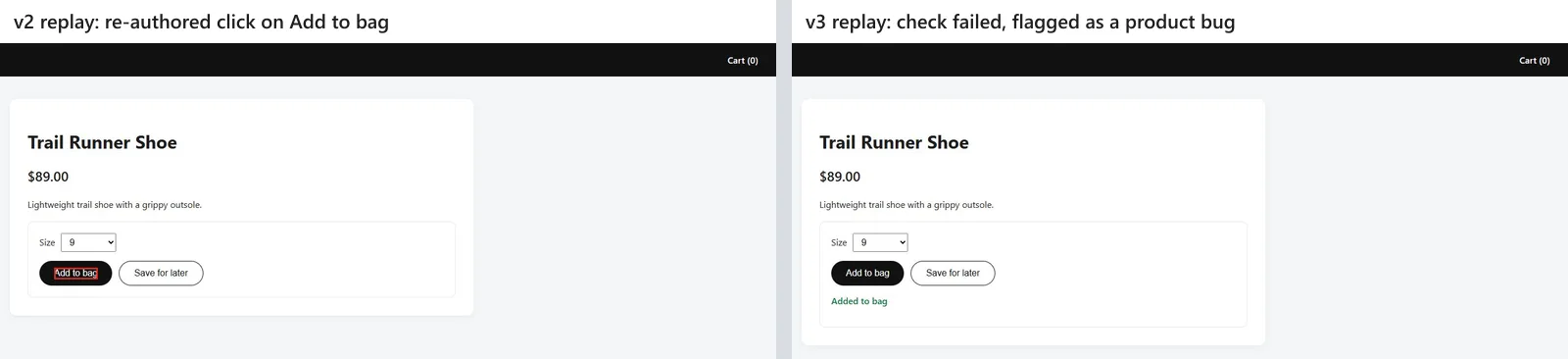
Note: Run the same check against your own staging URL: Kane CLI drives a real Chrome browser from a natural language objective and seals screenshots, network logs, and console output into one evidence pack. Try Kane CLI
The scores
Sorted by total, with each criterion scored 0 to 5; the numbered sections above group tools by type, not rank, and entries 16 to 22, added on November 13, 2026, are not scored yet. Portability is 1 where tests stay in the vendor's own format, and the 0 on peer ratings for Autosana and TestSprite means neither has a Gartner listing. Other tools earned maintenance points for documented self-repair; KaneAI's heal was checked hands-on and lost a point because its summary did not show the locator change. Evidence Reporting, which ships with the New Experience authoring engine, is built to close that gap, though it applies only where every test case in the run was authored with New Experience and the run executes on Chrome. The score above reflects what the run summary showed when the tool was tested.
| Tool | Authoring | Maintenance | Coverage | Portability | Pricing | Peer ratings | Total |
|---|---|---|---|---|---|---|---|
| KaneAI by TestMu AI | 5 | 4 | 5 | 5 | 5 | 5 | 29 |
| Katalon | 4 | 4 | 5 | 3 | 5 | 5 | 26 |
| UiPath Test Cloud | 4 | 5 | 5 | 2 | 3 | 5 | 24 |
| Tricentis Tosca | 4 | 5 | 5 | 1 | 3 | 5 | 23 |
| Copado Robotic Testing | 4 | 3 | 5 | 3 | 4 | 3 | 22 |
| mabl | 4 | 5 | 4 | 3 | 3 | 2 | 21 |
| Keploy | 3 | 3 | 3 | 4 | 5 | 3 | 21 |
| TestSprite | 4 | 4 | 3 | 4 | 5 | 0 | 20 |
| Functionize | 4 | 4 | 2 | 1 | 5 | 3 | 19 |
| Telerik Test Studio | 2 | 3 | 4 | 2 | 5 | 3 | 19 |
| testRigor | 4 | 4 | 5 | 1 | 3 | 2 | 19 |
| Virtuoso QA | 4 | 5 | 3 | 2 | 2 | 3 | 19 |
| OpenText Functional Testing | 2 | 4 | 5 | 1 | 2 | 4 | 18 |
| Worksoft | 3 | 4 | 4 | 1 | 1 | 4 | 17 |
| Autosana | 4 | 5 | 3 | 2 | 2 | 0 | 16 |
TestMu AI's KaneAI leads UiPath Test Cloud by 5 points and Tricentis Tosca by 6 on portability and published pricing. On authoring, maintenance, coverage, and peer ratings alone, all three tie at 19, the fairer reading for an SAP or Oracle estate. For the head-to-head on SAP coverage, real devices and pricing, see TestMu AI vs UiPath Test Cloud.
Free and Open Source AI Testing Tools
Keploy is open source under Apache-2.0, with its code in the Keploy repository on GitHub; Functionize, testRigor, TestSprite, Autify, and Revyl have free plans; QA Wolf gives new teams free runs; Katalon has a free Studio tier without its AI script generation; Kane CLI starts with 10,000 free credits, valid for 30 days; and eight tools offer trials.
| Tool | What free covers | Where you start paying |
|---|---|---|
| Keploy | The Apache-2.0 open-source core, self-hosted, plus a free Playground plan that generates API tests from OpenAPI or Postman | Pro adds team collaboration, contract testing, and load testing per user; production traffic capture is Enterprise |
| Functionize | A Free plan with no time limit, monthly credits, and up to 5 parallel runs | Paid Growth and Scale plans add credits, a shared team credit pool, SMS and MFA testing, and SSO; Scale raises parallel runs to 10 |
| KaneAI by TestMu AI | Kane CLI is free to install, and a no-card TestMu AI account comes with 10,000 free credits, valid for 30 days, enough to try it end to end with local authoring | Starter adds 2,000 credits a month per agent; Pro and Max add cloud authoring and HyperExecute minutes |
| testRigor | A free Public plan for one user, with every test and result public | Paid plans, including native Windows desktop testing, priced through sales |
| TestSprite | A Free plan with 150 credits a month, the CLI and IDE plugin, and pull request tests on one GitHub repository | Starter ($19 a month after a free first month, 400 credits), Standard ($39, 800 credits), and Pro ($69, 1,600 credits) add credits and repositories; SSO and audit logs are Enterprise-only, from $199 a month |
| Autify | A free Individual User plan with 2,000 one-time credits that do not expire, one web and one mobile session at a time | Core from $99 a month billed annually adds 6,000 credits a month and more concurrency; Team and Enterprise go further |
| Revyl | A Free plan with monthly usage and 2 concurrent devices, with no time limit | Starter at $250 a month ($200 billed annually) adds compute credits and 10 concurrent devices; extra usage is billed per device minute |
| QA Wolf | Free runs for every new team | Pay as you go at $1 per web run and $2 per mobile or desktop run |
| Katalon, Copado, mabl, UiPath, Tosca, Telerik, OpenText, Applitools | Trials: 30 days with no card for Katalon and Copado Robotic Testing, 14 days for mabl, free trials for UiPath Test Cloud, Tosca, and Applitools Autonomous, a downloadable trial for Test Studio, and a trial on request for OpenText Functional Testing; Katalon also has a free Studio tier without AI script generation | A license or subscription once the trial ends |
An open-source license covers the test logic, and you still pay for the infrastructure the tests run on, so budget for execution even when authoring is free. For open-source frameworks with AI features rather than commercial free tiers, the open-source AI testing tools roundup goes further. Teams testing a voice agent of their own can compare the free options in the guide to open source voice agent testing tools.
For a start that needs no account, TestMu AI's free AI test case generator turns a feature description or user story into test cases.
Momentic, which did not make this list, also starts free, with $50 of usage a month on its Free plan as of November 17, 2026, and the Momentic alternative page compares it with KaneAI on devices, browsers and code export.
Six Other AI Testing Tools I Considered
These cleared a first look but not the list, mostly because another entry covers the same job with more evidence. Ratings come from Gartner Peer Insights, re-checked on October 7, 2026.
- Testsigma - rated 4.5 from 69 ratings as an agentic platform that generates, executes, heals, and diagnoses tests across web, mobile, API, desktop, and Salesforce. It overlaps KaneAI, testRigor, and Katalon on authoring without a documented edge on portability. The Testsigma alternative page compares it with TestMu AI on real devices.
- ACCELQ - rated 4.7 from 65 ratings for automation across web, API, mobile, and desktop. It competes with Katalon for the same buyer, and Katalon's review sample is more than ten times larger. The ACCELQ alternative page weighs its quoted plans against KaneAI.
- Tricentis Testim - rated 4.4 from 28 ratings for AI-accelerated creation, execution, and maintenance of tests across web, mobile, and Salesforce apps. Tosca already represents Tricentis here, and the Testim alternative page lists seven tools for teams leaving Testim.
- Parasoft SOAtest - rated 4.7 from 88 ratings and now AI-augmented for API, web service, and microservice testing. Keploy covers the API niche with an open-source core and a free plan. The Parasoft alternative page shows which SOAtest suites move to TestMu AI.
- Keysight Eggplant Test - rated 4.4 from 77 ratings for functional test automation across platforms and devices. It overlaps OpenText Functional Testing for the same legacy-estate buyer, and the Eggplant alternative page compares it with TestMu AI.
- BlinqIO - on the previous version of this list for generating Playwright code in Gherkin form. It is out because on September 14, 2026, blinq.io returned no DNS record and blinqio.com showed a domain-parking page, so there was no live product to verify.
Which Generative AI Capabilities Does a Testing Tool Actually Need?
Gartner's definition of this market names seven mandatory capabilities, updated in October 2025, including GenAI for test development, self-healing for test scripts, and conversational user interfaces. The table turns each one into a check you can run in a proof of concept. Model benchmarks such as HumanEval score code generation on single Python functions checked by unit tests, so they cannot replace these checks on your own application.
| Mandatory capability | What to test in your POC |
|---|---|
| GenAI for test development | Feed it one real requirements document and count how many generated cases you keep unedited. |
| Conversational user interfaces | Change an existing step by describing the change. If the tool makes you re-record the step instead, it fails this check. |
| Self-healing for test scripts | Rename a button and restructure its parent container, then rerun. Check that it heals and tells you what it changed. |
| Native UI, API, and visual testing | Build one flow that performs a UI action and asserts on the backing API response. |
| Integrations | Wire it into your actual pipeline and confirm exit codes gate a merge correctly. |
| Enterprise administration | Confirm which tier includes SSO and RBAC. These usually sit in an enterprise tier and change the price. The guide to enterprise AI testing lists the other controls to check and the evidence to ask for. |
| Team collaboration | Have a second person review and edit someone else's generated test. |
On KaneAI I ran the third check and a scaled-down first check, using a five-sentence requirement instead of a full document. Half the generated cases were usable after filling in a URL, and the heal passed without reporting the locator it changed. Genuine generative AI testing tools separate from AI-assisted recorders on two counts: whether tests are generated from source material you already have rather than actions you perform, and whether self-healing explains what it changed. TestMu AI's AI-native test management keeps generated cases traceable to their requirements, and the KaneAI getting started documentation walks through the authoring flow.
How Do You Choose the Right AI Testing Tool for Your Team?
Name the bottleneck first, then shortlist AI-powered testing tools against it.
- Authoring is the bottleneck, meaning tests take too long to write and only two people can write them. Look at KaneAI, testRigor, Autosana, and TestSprite, and compare how much of the generated output you keep unedited. If you would rather nobody write tests at all, Meticulous builds its suite from recorded sessions.
- Maintenance is the bottleneck, meaning the suite goes red on every UI change. Look at mabl, UiPath Test Cloud, Tricentis Tosca, Autosana, and Virtuoso QA, which score highest on maintenance here, and test healing against a deliberate DOM restructure rather than a cosmetic tweak. Checksum sends each repair as a pull request, if you want heals to pass code review.
- Coverage is the bottleneck, meaning APIs and data paths go untested. Look at Keploy for backend regression, and check whether your end-to-end tool can assert on an API response inside a UI flow.
- Your stack decides for you. Salesforce points to Copado, SAP to Worksoft or Tosca, mainframe to OpenText Functional Testing, .NET with Telerik components to Test Studio, a mobile app built by coding agents to Revyl or Autosana, and a product sold across regions to Spur.
- Procurement is the constraint and you need a number this quarter. KaneAI, TestSprite, Functionize, Keploy, Katalon, Telerik, Autosana, QA Wolf, Autify, and Revyl publish pricing, and Copado lists one bundle on AWS Marketplace; the rest start with a sales conversation or a demo.
Whichever way that lands, run the pilot on one critical workflow rather than a toy scenario, and measure how much generated output you keep, how the suite behaves after a real UI change, and how long a full run takes at your target parallelism. If you are already trialing one tool, a head-to-head breakdown such as the Checksum AI alternative comparison is a faster starting point than a blank spreadsheet. Teams focused on authoring should also compare dedicated AI test case generation tools, and teams fighting brittle suites should read up on self-healing test automation as a category. For the maturity model and integration steps behind a wider rollout, see how teams use AI in quality assurance.
If you want agents that own the whole workflow rather than assistive features, read how agent automation testing changes debugging and CI gating before you route a pipeline through one.
How Should a Large Engineering Team Choose an AI Testing Tool?
At around 200 engineers, governance and run capacity decide the shortlist before authoring features do: who may approve an AI-written test or heal, which tier carries single sign-on, and whether a full regression finishes inside a CI window. KaneAI fits teams that want tests from tickets and pull requests as code they keep, while Virtuoso QA and UiPath Test Cloud fit audited enterprise estates.
- Access and audit - TestSprite keeps SSO, SCIM, and audit logs on Enterprise, Functionize adds SSO and RBAC on its paid plans, and UiPath Test Cloud's AI Trust Layer keeps audit-ready execution trails.
- Approval of AI changes - KaneAI holds Adaptive Heal versions for approval by default, and Virtuoso QA sends Touchstone's proposed repairs to a reviewer and records every heal.
- Run capacity - mabl lists unlimited test run concurrency, Tosca's Elastic Execution Grid scales agents automatically, and KaneAI runs on HyperExecute across 3,000+ browser and OS combinations.
- Cost as headcount grows - Katalon bills paid plans per seat, TestSprite's Enterprise plan starts at 10 seats, KaneAI is licensed per agent, and Virtuoso QA prices authoring users and execution capacity, so model the bill on your real number of test authors.
Run the pilot with two squads on the flows that broke most often last quarter, and confirm single sign-on, roles, and audit exports on the tier you would actually buy.
AI Agents That Run Your Tests vs Testing Your AI Agents
The 22 tools above are AI agents that run your tests; testing your AI agents, when the product you ship is itself an agent, needs a different kind of tool.
The tools split into two kinds: AI agents that test your app, like the 22 above, and tools that test an AI agent you build, such as a chatbot, a voice agent, or an agent that calls tools. Pick by what you ship. Both kinds belong in the toolkit of an agentic quality engineer.
| What you need to test | What a passing test shows | Tools to compare | Read next |
|---|---|---|---|
| Your web, mobile, or API app, with an AI agent writing and running the tests | The flow still works after the UI changes, and real bugs stay red | KaneAI, testRigor, Autosana, mabl, and the rest of the 22 above | The roundup of agentic AI testing tools |
| A chatbot or chat agent | Answers stay correct, grounded, and on policy across many simulated conversations | TestMu AI Agent Testing, Cekura | The roundup of chatbot testing tools |
| A voice or phone agent | Each conversation or call reaches the right outcome when a simulated caller talks to or phones the agent | TestMu AI Agent Testing, Cekura | The roundup of voice agent testing tools |
| An LLM feature or agent whose outputs you score with evals | Outputs and traces keep scoring well against your evals, before and after release | Braintrust, LangSmith, Arize Phoenix | The roundup of AI agent evaluation tools |
| An agent that acts: it calls tools, writes files, or changes records through APIs | The actions really happened, checked in the systems they changed rather than taken from the agent's own account | Agent Assurance from TestMu AI, run through the Rook CLI | The Agent Assurance page |
Every tool in the 22 above points an AI agent at your software. When the software you ship is itself an AI agent, the direction flips. TestMu AI's AI agent testing platform runs autonomous AI evaluators against chat, voice, phone, video, and image agents the way real users would, generates 60 to 100+ scenarios from your uploaded docs, and scores chat and voice on 9 quality metrics such as hallucination, bias, completeness, and context awareness, with 30+ metrics for phone calls. Chat, voice, phone, and image runs end in a Green, Yellow, or Red production-readiness verdict, and video runs pass or fail against success criteria you set.
For the method behind those runs, the guide to AI agent testing walks through how to test an agent before release, and the guide to AI evals explains how evals work and how to run one. To decide whether the agent is ready to launch at all, an AI readiness assessment makes those tests a release gate beside strategy, data and governance.
Agent Assurance is self-serve: install the Rook CLI with npm install -g @testmuai/rook@latest and start a 14-day free trial with 4,000 credits.
Conclusion
Pick the workflow that costs your team the most time each release and run it through two tools from this list, one of them KaneAI, before you read another feature page. TestMu AI's test automation cloud runs the exported suite across 3,000+ browser and OS combinations and 50,000+ real devices, and the Kane CLI documentation covers authoring that first test from your terminal. If your visitors use browsers with AI built in, the guide to the best AI browsers also covers how to test your site in them.
Testing web or mobile apps without writing code? KaneAI by TestMu AI turns natural language instructions into tests.
Author

Shantanu Wali
Blogs: 27

Shantanu Wali is Vice President of Product Management at TestMu AI, where he owns several product lines across the testing platform, including the Real Device Cloud and the Digital Experience Testing Cloud. He has also contributed significantly to the development and scaling of KaneAI, TestMu AI's flagship GenAI-native testing agent that uses natural language to make software testing faster and more reliable in this AI era. He brings 7+ years of experience across software development and product management, starting as a backend developer at Infosys building solutions for Fortune 500 clients. Shantanu holds an MBA from IIM Calcutta and a B.Tech in Mechanical Engineering.
Reviewer

Himanshu Sheth
Reviewer
Himanshu Sheth is the Director of Marketing (Technical Content) at TestMu AI, with over 8 years of hands-on experience in Selenium, Cypress, and other test automation frameworks. He has authored more than 130 technical blogs for TestMu AI, covering software testing, automation strategy, and CI/CD. At TestMu AI, he leads the technical content efforts across blogs, YouTube, and social media, while closely collaborating with contributors to enhance content quality and product feedback loops. He has done his graduation with a B.E. in Computer Engineering from Mumbai University. Before TestMu AI, Himanshu led engineering teams in embedded software domains at companies like Samsung Research, Motorola, and NXP Semiconductors. He is a core member of DZone and has been a speaker at several unconferences focused on technical writing and software quality.


AI Testing Tools FAQs
Did you find this page helpful?
More Related Blogs


TestMu AI forEnterprise
Get access to solutions built on Enterprise
grade security, privacy, & compliance
- Advanced access controls
- Advanced data retention rules
- Advanced Local Testing
- Premium Support options
- Early access to beta features
- Private Slack Channel
- Unlimited Manual Accessibility DevTools Tests