
Author End-to-End Tests in Natural Language with KaneAI
Plan, Author, and Evolve E2E Tests for Web and Mobile Apps in Natural Language.

QA Outsourcing: How to Decide What to Outsource, Automate and Keep In-House
QA outsourcing guide for engineering leaders: compare engagement models, real cost drivers, a vendor scorecard and what to keep on a platform you own.
Published on:
QA outsourcing is the idea of hiring an external team to take ownership of a particular bit of your testing (e.g., exploratory sessions, device coverage, a release surge) whilst your own people remain in charge of test strategy and release decisions. You decide by type of work, really: bring in a partner for the work that needs more people and then run your own automation through the regression.
Start with the work, then the vendor. This guide has a work type table, the pros and cons, a model comparison, a worked cost example, a vendor scorecard and the SPLIT checklist.
TL;DR
QA outsourcing means hiring an outside team to own a defined slice of your testing while your own people keep test strategy and the release decision. Decide by work type: bring in a partner for exploratory, specialist and surge work, run repeat regression on automation you own, and write test asset ownership into the contract.
Outsourced QA by Work Type
- Outsource QA testing: Give a partner the work that needs extra people for a while, such as exploratory testing of new flows, WCAG accessibility audits and launch surges. Scope it as a list of work types rather than "all QA", and keep the release go/no-go in-house.
- Regression and device coverage: Stable-flow regression and checks across many real devices and browsers repeat every release, so they belong on automation and cloud infrastructure you own, whoever operates it. TestMu AI's KaneAI and its managed AI testing service both cover this share.
Software Testing Outsourcing Models and Cost
- QA as a service: QA as a service is the managed QA model, where the vendor tests against agreed outcomes and you manage the contract rather than the testers. Pricing: fixed fee or per cycle. Test ownership: often the vendor, unless the contract says otherwise.
- Cost of outsourcing software testing: The cost of outsourcing software testing is the vendor rate plus your lead's management hours, re-triage time, test maintenance the fee leaves out, tooling and an exit reserve for rebuilding tests you do not own. Price vendor, in-house and platform options on the same worksheet.
- SPLIT checklist: Scope by work type, price the full cost, lock asset ownership, instrument the outcome with change fail rate and defect escape rate, and trial with a paid pilot. Run it before you sign and again at every renewal.
Which Testing Should You Outsource, Which Should You Automate, and Which Should You Keep?
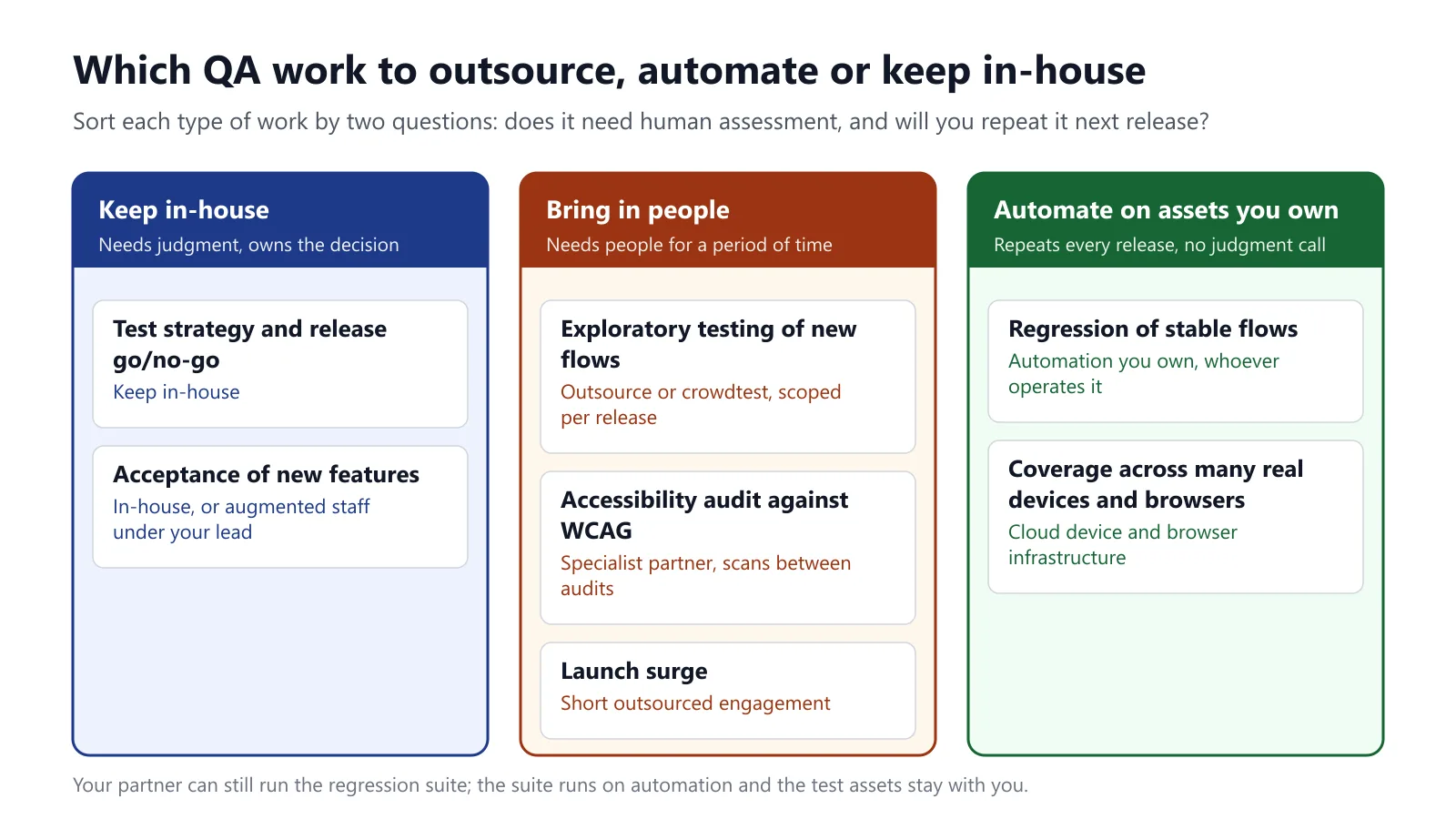
Sort your testing by type of work before you talk to any vendor. For each row, ask two questions: does it need human assessment, and will you repeat it next release?
| Work type | Needs human assessment? | Repeated next release? | Recommendation |
|---|---|---|---|
| Test strategy and release go/no-go | Yes | Yes | Keep in-house |
| Acceptance of new features with product context | Yes | No | Keep in-house, or augmented staff under your lead |
| Exploratory testing of new flows | Yes | No | Outsource or crowdtest, scoped per release |
| Accessibility audit against WCAG | Yes, specialist | Periodically | Specialist partner, plus automated scans between audits |
| Launch surge (holiday, big release) | Partly | No | Short outsourced engagement |
| Regression of stable flows | No | Yes | Automation you own, whoever operates it |
| Coverage across many real devices and browsers | No | Yes | Cloud device and browser infrastructure |
The rule that emerges is this: bring in people to do the work that requires people for a period of time, put repeat checks on any automation that you own, and keep the decisions. Your partner can still run your regression suite; the point is that the suite runs on automation and the assets remain with you.
Lots of buyers are now going to compare an AI-driven option against a human vendor. Our guide to AI testing services covers that exact choice: managed provider, managed testing agent or self-serve platform.

Engineering leads
Note: If regression is the work you'd like off your team's back, then TestMu AI has an AI testing service where a managed agent will author, run and self-heal tests across web, mobile and APIs, with results flowing into Jira, Azure DevOps and your CI/CD.
What Are the Pros and Cons of QA Outsourcing?
QA outsourcing is all about trading control for capacity. The table puts the two sides alongside each other.
| Pros | Cons |
|---|---|
| Specialist skills you do not have in-house, such as accessibility or performance testing | Less day-to-day control over how testing is done |
| Capacity you can add for a release and release afterwards | The partner lacks your product context at the start, so early bug reports need more triage |
| Devices, locales and time zones your team cannot cover | Source code and test data leave your company, which raises security and confidentiality questions |
| Your engineers spend less time on repeat test runs | Coordination time for your leads: reviews, meetings, re-triage |
| Lower hourly rates in some regions | Dependence on the vendor if tests and history live in its tools |
The downsides are reasonably well managed via the contract terms and process (covered below). The upsides are most pronounced in the case of bounded, people-intensive work; they diminish considerably in the case of regression, where you're just re-running the same checks every release.
Which QA Outsourcing Model Is That Work Best Suited to?
Each engagement model hands a different amount of control to the partner:
- Staff augmentation: the testers join your team and work according to your process. You manage them on a day-to-day basis.
- Dedicated vendor team: a vendor lead runs a team that works exclusively on your product.
- Managed QA: the vendor does the testing against the agreed outcomes. You manage the contract; you don't manage the people.
- Crowdtesting: many testers on their own devices run short, scoped cycles. The TestMu AI learning hub explains how crowdtesting differs from a classic outsourced team.
- AI testing platform or managed agent: software authors and runs the tests.
TestMu AI covers both the people-based testing services (for live interactive and automated testing) and the platform options, which are described in more detail later in this guide.
| Model | Who manages the testing | Test asset ownership | Pricing | Best for | Main risk |
|---|---|---|---|---|---|
| Staff augmentation | You | You, if tests live in your repo and tools | Hourly or monthly per person | Filling a hiring gap fast | Management load lands on your leads |
| Dedicated vendor team | Vendor lead, with your input | Depends on the contract | Monthly team rate | Long programmes with stable scope | Knowledge stays with the vendor |
| Managed QA (outcome-based) | Vendor | Often the vendor, unless the contract says otherwise | Fixed fee or per cycle | Releases with a clear test scope | Hard to change scope mid-contract |
| Crowdtesting | Platform coordinator | Bug reports, rarely reusable tests | Per cycle or per bug | Real-world device and locale coverage | Little regression value |
| AI testing platform or managed agent | You (platform) or the provider (managed agent) | Set by the product and contract; check export options | Subscription | Regression and repeat checks at scale | Still needs humans for judgement calls |
Read the ownership column before you go comparing rates, as that changes from model to model, and that's what determines what your exit cost is going to be.
Does Onshore, Nearshore or Offshore Make Any Difference to the Answer?
Region changes the rate and the working hours (not the work type decision). Pangea.ai's 2026 outsourcing cost analysis categorizes regions as onshore (US/UK), nearshore (Latin America), Eastern Europe, and South/Southeast Asia.
Nearshore partners will generally have a higher proportion of working hours in common with their North American counterparts, which is important for exploratory and acceptance work that requires a lot of back and forth. Offshore partners are the ones that are best suited to work with a very clear written scope (e.g., scripted cycles).
What Does QA Outsourcing Cost?
QA outsourcing cost has two parts: the vendor's quote and the cost of running the relationship.
In-house baseline. The U.S. Bureau of Labor Statistics reports that the median annual wage for software quality assurance analysts and testers was $104,300 in May 2025. That is about $8,690 a month in salary alone, before benefits, tooling and management time.
Vendor rates. QA Madness has North American rates at $80-$150+ per hour for manual QA and $110-$200+ for automation, versus $8-$55 and $12-$75 in India and SE Asia (QA Madness as of Nov 2026). These are ranges, not quotes.
Costs that aren't on the quote: the time from your engineers and product managers to onboard; your lead's time going through reports and re-triaging bugs; rework when the vendor tests the wrong behavior; tooling and device charges; ongoing test maintenance and failure investigation after UI changes if the fee only covers writing the new tests; and the exit cost of having to rebuild the tests you don't own.
Compare every option with the same worksheet:
Monthly cost of an option =
   vendor or platform fee
 + (internal management hours × your hourly rate)
 + (internal review and re-triage hours × your hourly rate)
 + (test maintenance hours not covered by the fee × your hourly rate)
 + tooling and device charges not in the fee
 + exit reserve (estimated rebuild cost ÷ contract months)
Worked example (illustrative inputs only, not a quote). You need 160 hours a month of manual regression, and your lead is spending 20 hours a month on vendor management. Use your own lead's loaded hourly rate for that line (it's not a tester's rate).
| Cost line | North American vendor (manual QA) | India / SE Asia vendor (manual QA) | In-house hire |
|---|---|---|---|
| Testing hours (160 h × rate range) | $12,800-$24,000+ | $1,280-$8,800 | about $8,690 salary only |
| Lead's management time (20 h × your lead's loaded hourly rate) | 20 × lead rate | 20 × lead rate | already in your team |
| Exit reserve | depends on ownership terms | depends on ownership terms | none |
The example perfectly illustrates why looking at the rate alone is misleading. The management line is the same in all cases, and the exit line can be zero or very high depending on one of the contract clauses.
How Do You Assess a QA Outsourcing Vendor?
Score each vendor on the same sheet and weight the criteria that are going to be expensive to fix later on.
| Criterion | Weight | What good looks like |
|---|---|---|
| Test asset ownership | 3 | Tests, data and run history live in your repo or your test management tool |
| Named QA lead | 3 | A named person with a CV, not "a dedicated team" |
| Metrics from past work | 3 | Defect escape and cycle-time numbers from a reference client |
| Security and data handling | 3 | NDA, no production customer data, access via your SSO |
| Paid pilot on your app | 2 | Agrees to a time-boxed, paid pilot before a long contract |
| Toolchain fit | 2 | Works in your CI, issue tracker and test management tool |
| Time-zone overlap | 1 | Shared working hours with your team |
Score each criterion 1-3, multiply by the weight, and compare the totals. A vendor that won't do a pilot, can't name a lead, or wants the tests to be run in its own proprietary tool is a massive red flag regardless of the total.
What Is the SPLIT Framework for QA Outsourcing?
SPLIT is a 5-step checklist for deciding and running any QA outsourcing engagement. You run it prior to signing, and you run it again at each renewal.
- S - Scope by work type. Refer to the work type table. Scope as a list of work types, not 'all QA'.
- P - Price the full cost. Complete the worksheet for each option, including the exit reserve.
- L - Lock asset ownership. The tests, the test data, the credentials, and the run history all stay in your systems. Put it in the contract.
- I - Instrument the outcome. Agree on the metrics beforehand. DORA's change fail rate (the proportion of deployments that require immediate intervention) and your defect escape rate are good baselines.
- T - Trial with a paid pilot. Time-box it, use your real app, and define the pass criteria in advance. Our 10 day test automation POC plan works for both vendors and tools.
SPLIT checklist (copy into your vendor review doc):
- Scope lists work types and excludes release decisions
- Cost worksheet completed for vendor, in-house and platform options
- Contract states that all test assets and run history belong to you
- Vendor works in your repo, CI and test management tool
- Change fail rate and defect escape rate baselined before start
- Paid pilot with written pass criteria completed
- Exit plan including a transition period agreed
Which Contract Clauses Protect You When the Engagement Is Over?
Most QA outsourcing pain shows up at the end of a contract. These clauses keep the exit cheap:
- Ownership: all test cases, scripts, test data and reports created under the contract are yours.
- Location: test cases live in your own test management tool. TestMu AI Test Management keeps manual, automated and KaneAI-authored tests in one workspace, with two-way issue sync to Jira, so a vendor can work inside it without owning it.
- Access: vendor staff use the accounts you issue and revoke. There are no shared credentials.
- Data: there is no production customer data in the test environments (unless it's masked, of course).
- Transition: a defined handover period with a walk-through of the open bugs and flaky tests.
- Format: an open format so the tests don't rely on the vendor's tooling.
Where Would an AI Test Platform Fit Into a QA Outsourcing Plan?
An AI test platform takes the repetitive work, the regression and the device coverage out of the headcount contract so that the people you hire can focus on the work that requires judgment.
On TestMu AI, that work runs two ways:
- Self-serve with KaneAI. KaneAI writes tests from plain English and can generate test cases from Jira tickets, PRDs, or spreadsheets. It will show you a diff when it self-heals a step after a UI change, it versions every test change, and it can export the tests out to Selenium, Playwright or Appium code. Versioning and code export are the bits that make the tests portable if your plans change.
- Managed via the AI testing service. A managed agent writes, runs, and self-heals the tests across web, mobile and APIs. The results, auto-generated bug tickets, and reports get pushed into Jira, Azure DevOps, and your CI/CD. There's no grid to provision.
TestMu AI is used by 3M+ users and 18K+ enterprises and has 50,000+ real devices. In its customer story, Dashlane (a SaaS company) reports 50% faster test execution on TestMu AI.
A platform doesn't replace human judgment. You still need exploratory testing, accessibility audits, and acceptance testing with people (in-house or outsourced), and they'll simply stop spending hours re-running the same regression suite.
For a quick visual walkthrough of this concept, watch the video below from TestMu AI.
Subscribe to the TestMu AI YouTube channel for more tutorials on testing and automation.
A Real Regression Check You Keep as Code
The regression share is easiest to judge on a real run. The check below is one plain-English objective given to Kane CLI (KaneAI in your terminal) and run against TestMu AI's Ecommerce Playground with code export turned on.
$ kane-cli run "Search for iPhone, open the iPhone product page, add it to the cart, then open the cart and verify it contains the iPhone with quantity 1" \
    --url "https://ecommerce-playground.lambdatest.io/" \
    --headless --agent --code-export --code-language python
$ echo $?
0

# Final NDJSON event (trimmed)
"result_code": 100, "reason_code": "success.complete"
"summary": "Searched for iPhone and opened its product page.
            Added the iPhone to the cart and opened the cart.
            The cart shows the iPhone with a quantity of 1."
"iphone_cart_quantity": "value: '1' -> '1' after ['strip']; equals '1' -> PASS"
"cart_contains_iphone": "value: 'true' -> 'true'; equals 'true' -> PASS"

# ~/.testmuai/kaneai/sessions/<session-id>/code-export/
requirements.txt
test.py
The run passed: Kane CLI read the quantity field and the cart row, both checks held, and the test case was saved to Test Manager. It also wrote requirements.txt and test.py to the session's code-export folder. This is an excerpt of test.py:
import os
import testmu
from testmu import expect, var, set_var
from playwright.async_api import Page

testmu.configure(
    # build and test case ID lines omitted
    name="Add iPhone to Cart and Verify",
    variables={"iphone_cart_quantity": "1", "cart_contains_iphone": "true"},
    auto_heal_version="AH2",
    default_action_timeout_ms=60000,
    default_navigation_timeout_ms=60000,
    kane_run_v4=True,
)

@testmu.test
async def test(page: Page):
    async with testmu.step('Navigate to https://ecommerce-playground.lambdatest.io/', instruction_id='5100dbc2-d615-4466-b171-153c1cfa7659'):
        await page.goto("https://ecommerce-playground.lambdatest.io/")

    async with testmu.step('Typing iPhone into the search box and searching for iPhone product page', instruction_id='d051d828-d79e-4848-b995-d4f78da7679d'):
        element_0 = page.locator("internal:role=textbox[name=\"Search For Products\"i]")
        await testmu.fill(element_0, "iPhone")

    # ... search, product click, open-cart and cart-reading steps omitted ...

    async with testmu.step('Clicking Add to cart in the iPhone product details', instruction_id='c07ab05e-ecab-466e-b00f-6408081eba26'):
        _loc_3 = page.locator("internal:role=button[name=\"Add to Cart\"i]")
        await _loc_3.click()


if __name__ == "__main__":
    testmu.run(test)
The export is Python Playwright code in which every step keeps its plain-English intent next to the locator it resolved to. Commit test.py to your own repository and it becomes a test asset you hold, which is the "Lock asset ownership" step of SPLIT in practice.
The file imports TestMu AI's testmu bindings (testmuai-playwright-bindings in requirements.txt) alongside Playwright, so list that package in your exit plan next to the tests themselves.

How Do You Roll Out QA Outsourcing in 90 Days?
A staged rollout limits the risk and gives you some real numbers before you're committed to a large-scale deployment.
- Days 1-30: baseline and pilot. Measure today's change failure rate, defect escape rate, and regression cycle time. Run the paid pilot on one product area.
- Days 31-60: run in parallel. The partner tests with your team on the same release. Your lead looks at every bug report for accuracy and duplicates.
- Days 61-90: decide. Compare the metrics against the baseline. Either expand, narrow the scope, or move the regression share into automation and keep the partner for the exploratory work.
Revisit SPLIT at day 90 and at every renewal point, in particular if the scope has drifted into regression.
Conclusion
Outsource the work that needs extra people, put repeat checks on automation you own, and keep the decisions. If regression is the part you want off your team, book a demo of TestMu AI's AI testing service, or try KaneAI, which versions every test change and exports tests to Selenium, Playwright or Appium code.
Before you sign a QA outsourcing contract, sort last quarter's testing hours into the work type table and fill in the cost worksheet for each option, exit reserve included. Then take the SPLIT checklist into the paid pilot.
Author

Prince Dewani
Blogs: 30

Prince Dewani is a Community Contributor at TestMu AI specializing in AI agents, software testing, QA, and SEO. He is certified in Selenium, Cypress, Playwright, Appium, Automation Testing, and KaneAI, and presented academic research on AI agents at PBCON-01. At TestMu AI, he has also carried out extensive cross-browser research on the support of modern web technologies such as WebGPU, WebAssembly, WebXR, WebGL2 and other web technologies, validating their compatibility and feature parity across major browsers and rendering engines through rigorous hands-on testing. Prince has hands-on experience building AI agent workflows using Anthropic Claude, Google Antigravity, n8n, LangChain, and other agentic frameworks, and works regularly with MCP and A2A protocols. He shares his work with 5,500+ QA engineers, developers, DevOps experts, tech leaders, and AI agent practitioners on LinkedIn.
Reviewer

Srinivasan Sekar
Reviewer
Srinivasan Sekar is Director of Engineering at TestMu AI, where he leads engineering and open-source initiatives behind the Selenium and Appium automation grid and owns TestMu AI's MCP Server. A committer to Appium and a contributor to Selenium, WebdriverIO, Taiko, and AppiumTestDistribution, he brings over 15 years of experience in quality engineering and open-source technologies. He is the author of the Apress book 'The MCP Standard: A Developer's Guide to Building Universal AI Tools with the Model Context Protocol,' a Certified Kubernetes and Cloud Native Associate, and an international conference speaker. Before TestMu AI he spent over eight years at Thoughtworks as a Principal Consultant and Quality Architect. Srinivasan holds a B.Tech in Information Technology from Anna University.


FAQs
Did you find this page helpful?
More Related Blogs

TestMu AI forEnterprise
Get access to solutions built on Enterprise
grade security, privacy, & compliance
- Advanced access controls
- Advanced data retention rules
- Advanced Local Testing
- Premium Support options
- Early access to beta features
- Private Slack Channel
- Unlimited Manual Accessibility DevTools Tests