
Agent Assurance for your AI Deployment
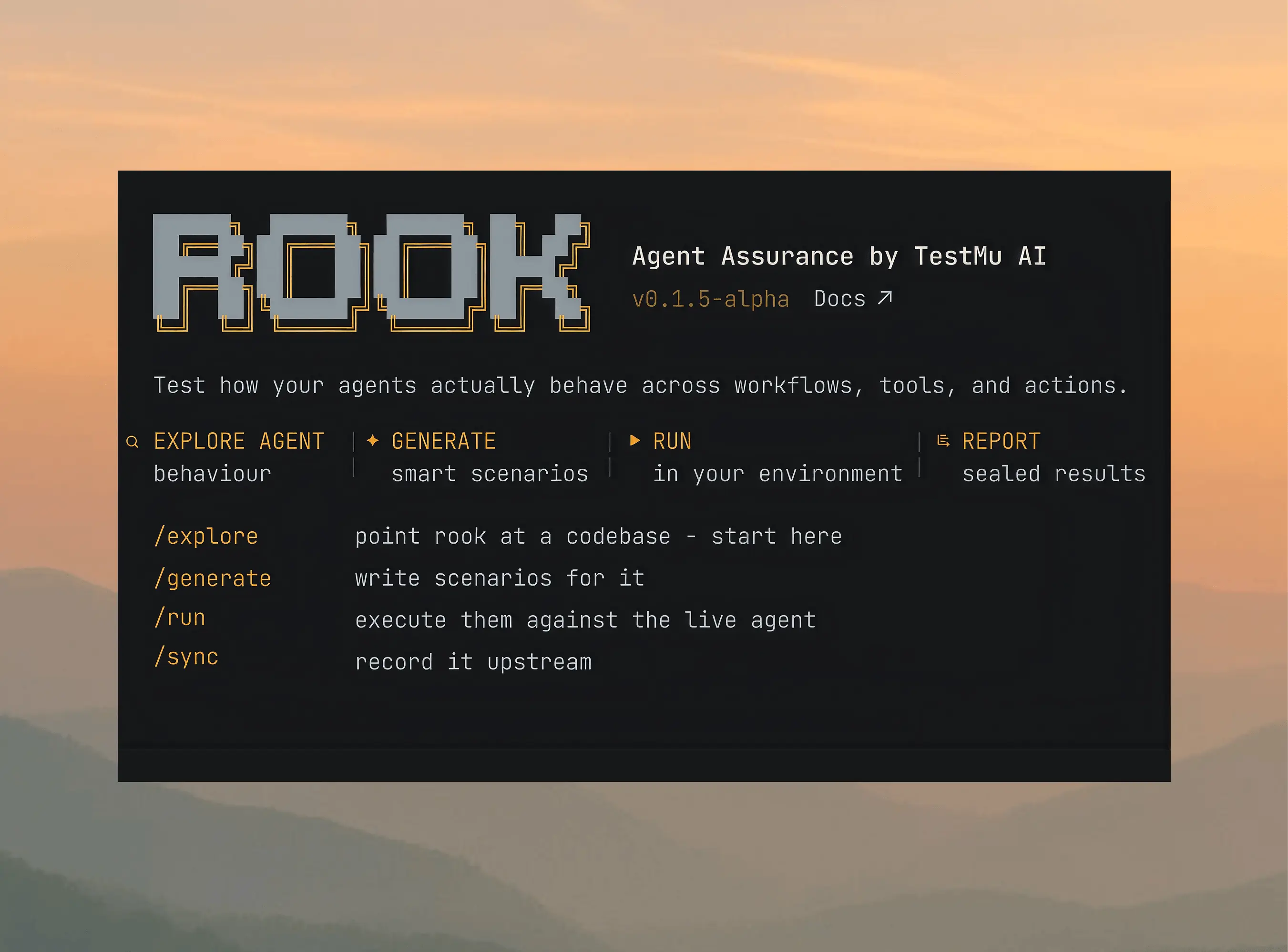
Test how your agents actually behave across workflows, tools, and actions. Catch failures and vulnerabilities before they ship.
npm install -g @testmuai/rook
- TestMu AI (Formerly LambdaTest)
- /
- Blog
- /
- 11 Best LLM Evaluation Tools for October 2026
LLM evaluation tools are platforms and libraries that score model output against defined criteria such as groundedness, relevance, hallucination and safety, instead of comparing it to one fixed expected answer. They divide into evaluation frameworks that run inside your pipeline and observability platforms that watch live traffic.
The gap they fill is familiar. A prompt change ships on Thursday, and by Monday support notices the assistant is citing documents that do not say what it claims they say. Nobody can tell whether the prompt did it, a model update did it, or the retrieval corpus changed, because nothing recorded what good looked like beforehand.
Which of these eleven fits depends less on whether it can score an output, since they all can, and more on where it sits in the lifecycle.
TL;DR
- What LLM evaluation tools do - LLM evaluation tools score model output against criteria such as groundedness, relevance, hallucination and safety, rather than matching it to a fixed expected string. They split into evaluation frameworks that run in CI and observability platforms that watch production.
- DeepEval, best for test-driven evaluation - DeepEval is an open-source framework that runs evaluations in a Pytest-style workflow, with metrics spanning RAG, agentic, safety and multimodal categories. Open source: yes.
- Ragas, best for RAG systems - Ragas is an open-source library for systematic evaluation loops, with LLM-driven metrics, synthetic test data generation and custom metrics defined through decorators. Open source: yes.
- Opik, best for open-source observability - Opik is Comet's open-source observability platform, advertising 30+ metrics including hallucination, plus guardrails and six prompt-optimization algorithms. Open source: yes.
- Promptfoo, best for security testing - Promptfoo pairs YAML-configured evaluation with automated red teaming across 50+ vulnerability types, and states 156 of the Fortune 500 among its users. Open source: yes.
- TestMu AI, best for conversational agents - Agent Testing evaluates chat, voice and phone agents with autonomous testing agents across standardized quality metrics including hallucination and bias. Open source: no.
- LangSmith, best for production monitoring - LangSmith traces agent workflows and runs online judge evaluations against live traffic, with dashboards for token usage, latency and cost. Its FAQ states it works with any LLM framework, not only LangChain. Open source: no.
- W&B Weave, best for agent observability - W&B Weave is the Weights and Biases platform for production agents, built around agent-native tracing and out-of-box behaviour monitoring for multi-turn systems. Open source: no.
- MLflow, best for teams already running ML - MLflow covers evaluation, tracing and a prompt registry alongside its existing experiment tracking and model registry, under Apache 2.0. Open source: yes.
- ZenML, best for reproducibility - ZenML versions every step result, caches redundant work to cut repeated evaluation cost, and lists 60+ integrations, so it tends to orchestrate other tools rather than replace them. Open source: yes.
- How to choose - Match the tool to your architecture first, then check whether self-hosting is required. The dataset matters more than the platform: stale evaluation cases produce confident, meaningless scores in any of them.
What Do LLM Evaluation Tools Actually Do?
An LLM evaluation tool scores model output against defined criteria instead of comparing it to a fixed expected answer. That shift is the whole point, because two correct responses to the same question can share almost no wording.
Underneath the marketing, the tools on this list do three separable jobs, and most do two of them well and the third adequately.
- Scoring - Applying metrics to an output, whether by rule, by a trained classifier, or by asking another model to judge it. This is the part every tool here can do.
- Tracing - Recording what happened inside a request: the prompt, the retrieved passages, the tool calls, the intermediate steps. Without it, a low score tells you something is wrong and nothing about where.
- Lifecycle management - Versioning datasets, prompts and models so a result can be reproduced later, and so a regression can be traced to the change that caused it.
Which of the three you need most depends on where your failures are showing up. Our guide to LLM evaluation covers the metrics themselves, which is worth settling before choosing anything on this list.
The 11 LLM Evaluation Tools
Two questions eliminate most of the list before any feature comparison starts: what are you evaluating, and can your data leave your network. Use the table to narrow the field, then read the entries that survive.
The ordering is by workflow position, not by quality ranking. Evaluation frameworks come first, then platforms that combine evaluation with production monitoring, then lifecycle tools. TestMu AI appears where its scope fits rather than at the top, and every capability below was checked against the vendor's own live documentation while writing this article.
| If you are evaluating | Start with | Because |
|---|---|---|
| A RAG application | Ragas, or TruLens | Retrieval and grounding metrics are their primary design target rather than an added module. |
| Prompts and chains in CI | DeepEval, or Promptfoo | Both put evaluations in version control and fail a build rather than populate a dashboard. |
| A live production system | LangSmith, Opik, or W&B Weave | Tracing and online evaluation of real traffic is the job they are built around. |
| A chat, voice or phone agent | TestMu AI | Conversational surfaces need generated scenarios and multi-turn scoring, not single-completion metrics. |
| Security and abuse resistance | Promptfoo | Adversarial simulation across injection and jailbreak categories is its distinguishing capability. |
| Models and LLMs together | MLflow, or ZenML | Both cover versioning and deployment, so LLM work does not need a parallel stack. |
1. DeepEval
An open-source evaluation framework that treats LLM checks like unit tests. Its own documentation describes "modularized evaluation like Pytest", which is the clearest statement of what it is for: writing assertions about model behaviour and running them the way you already run tests.
- Metric breadth - Documented metrics span custom, agentic, RAG, multi-turn, voice, safety and image categories. Counts quoted in other roundups vary, so treat the category coverage as the useful signal rather than a headline number.
- CI/CD integration - Documents unit testing in CI/CD and regression testing of LLM systems directly, which is the workflow it is built around.
- Synthetic data - Includes a golden synthesizer and a conversation simulator for teams without enough real evaluation data.
Consider it when your team already lives in Pytest and wants evaluation to fail a build rather than fill a dashboard.
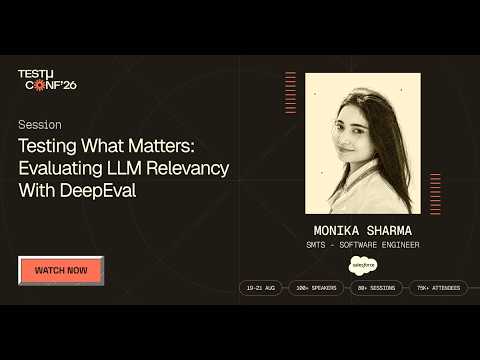
In this TestMu Conf 2026 session, Monika Sharma puts the framework to work in Testing What Matters: Evaluating LLM Relevancy with DeepEval, a deep dive into measuring and testing relevancy, the failure mode where an output looks fluent and sounds confident yet completely misses the point.
2. Ragas
An open-source library aimed squarely at retrieval systems. Its documentation frames the goal as helping teams "move from 'vibe checks' to systematic evaluation loops for your AI applications", which is a fair description of the gap most RAG projects have.
- LLM-driven metrics - Scores meaning rather than string equality, which is what makes it usable on open-ended answers.
- Custom metrics - Lets you "create custom metrics tailored to your specific use case with simple decorators", so domain-specific criteria do not require forking anything.
- Test data generation - Generates evaluation datasets, which matters because assembling one by hand is the step that stalls most RAG evaluation efforts.
Consider it when retrieval quality is your main risk. Our guide to RAG testing covers the metrics it implements.
3. TruLens
Positioned as "Evals + tracing for AI agents", TruLens combines scoring with per-step instrumentation. Worth knowing before you adopt it: Snowflake acquired the project and, per its own site, "since the acquisition, Snowflake actively maintains TruLens in open source".
- Feedback functions - Custom metrics can be any Python function, any LLM-as-judge prompt, or any span attribute, which makes it unusually open about how a score is produced.
- Per-step recording - Records "latency, inputs, outputs, tokens and cost, recorded per step", so an expensive or slow stage is visible rather than inferred.
- Retrieval metrics - Lists context relevance and groundedness explicitly, and describes itself as OpenTelemetry-native.
Consider it when you need scoring and step-level tracing from one open-source library, and Snowflake stewardship is acceptable to you.
4. Opik
Comet's "Open-Source AI Observability Platform", and one of the broadest open-source options here. It states 21k GitHub stars and covers evaluation, monitoring and safety controls in one project.
- Metric coverage - Advertises "30+ metrics for answer relevance, context precision, task completion, hallucination, and more".
- Production evaluation - Can "evaluate production traces in real time and get alerted if a user interaction fails your test criteria", which is closer to monitoring than to offline scoring.
- Guardrails and optimization - Applies guardrails to block policy violations and PII exposure, and ships six prompt-optimization algorithms.
Consider it when you want hosted-platform breadth without giving up self-hosting.
5. Promptfoo
The security-leaning entry on this list, describing itself as "automated testing that finds and fixes AI risk in development". It covers ordinary evaluation, but its distinguishing work is adversarial.
- Red teaming - Simulates real users to uncover application-specific vulnerabilities, covering "50+ vulnerability types from injection to jailbreaks".
- Declarative tests - You "iterate on prompts, configure tests in YAML, and view everything locally", so evaluations live in version control rather than a console.
- Adoption - States 156 of the Fortune 500 among its users and a community of over 300,000 developers.
Consider it when prompt injection and jailbreaks are a real risk. Our roundup of AI red teaming tools covers that category in depth.
6. OpenAI Evals
An MIT-licensed framework described as being "for evaluating large language models (LLMs) or systems built using LLMs", with a registry of existing evals. At 19.3k stars it is widely used, though its README now notes that evals can be configured and run directly in the OpenAI dashboard, which suggests the hosted path is becoming the default.
- No-code evals - States that "you don't need to write any evaluation code at all", requiring only data in JSON and parameters in YAML.
- Model-graded evals - Supports model-graded evaluation through custom YAML files, which is the LLM-as-judge pattern in its simplest form.
- Registry - Ships a registry of existing evals covering different dimensions of model capability.
Consider it when you want a standard, low-ceremony baseline and are comfortable being close to one vendor's ecosystem.
7. TestMu AI
Where the other entries evaluate model output, TestMu AI's Agent Testing evaluates deployed conversational agents. It deploys autonomous AI testing agents against chat, voice and phone agents and scores them on standardized quality metrics including hallucination, bias, completeness and context awareness.
- Surface coverage - Chat, voice and phone agents, with 9 quality metrics for chat and voice and 30+ for phone calls, which is the widest voice and telephony coverage in this list.
- Autonomous evaluation - Uses 15+ specialized testing agents rather than scripted conversations, so scenarios are generated rather than hand-written.
- Lifecycle coverage - Runs pre-launch validation, regression testing after model updates, and monitoring of real production calls.
Consider it when the thing being evaluated is a conversational product rather than a prompt or a pipeline. It is not the right tool for scoring a batch of text completions in CI, which is what most of the frameworks above are built for, and it is a commercial platform rather than an open-source library.
8. LangSmith
LangChain's "Agent and LLM Observability Platform". The common assumption that it only suits LangChain applications is wrong: its own FAQ states that "LangSmith works with any LLM framework", naming the OpenAI SDK, Anthropic SDK, Vercel AI SDK, LlamaIndex and custom implementations.
- Tracing - Native tracing for popular agent frameworks plus OpenTelemetry, with SDKs for Python, TypeScript, Go and Java.
- Production dashboards - Custom dashboards track "token usage, latency (P50, P99), error rates, cost breakdowns, and feedback scores".
- Online evaluation - Supports online LLM-as-judge and code evaluations against live traffic rather than only offline datasets.
Consider it when production visibility matters more than pipeline-native evaluation.
9. W&B Weave
The Weights and Biases entry, positioned as "observability and continuous improvement for production agents" and explicitly tailored for multi-turn, multi-agent systems rather than single completions.
- Agent-native tracing - Traces are a core primitive, aimed at exploring and debugging AI applications step by step.
- Flexible scoring - A flexible evaluation framework with custom signals, plus pre-built scorers offered through its guardrails feature.
- Behaviour monitoring - Out-of-box monitoring signals for production behaviour, which is the half most evaluation frameworks leave to you.
Consider it when you already run Weights and Biases for model training and want evaluation in the same place.
10. MLflow
The most established project here, now describing itself as "the largest open source AI engineering platform for agents, LLMs, and ML models" under Apache 2.0. Its GenAI capabilities are recent additions to a mature lifecycle tool rather than the other way round.
- Evaluation - Runs systematic evaluations, tracks quality metrics over time and is aimed at catching regressions before they reach production.
- Prompt registry - Lets teams "version, test, and deploy prompts with full lineage tracking", which few tools on this list treat as a first-class artifact.
- Reach - Integrates with LangChain, OpenAI, PyTorch and what it describes as 100+ AI frameworks, across Python, TypeScript, Java and R.
Consider it when LLM work sits beside conventional ML and you would rather not run two systems.
11. ZenML
Describes itself as "the unified layer for ML and AI" and an open-source platform for production ML systems. It is the least evaluation-specific entry here and the strongest on reproducibility, which is why it closes the list.
- Versioned artifacts - States that "every step result is versioned", covering trained models, evaluation datasets and recorded agent executions alike.
- Caching - Native caching skips redundant work and replay reuses recorded tool calls, which directly reduces the API cost of repeated evaluation runs.
- Integrations - Lists 60+ integrations including LangChain, MLflow, Hugging Face and Weights and Biases, so it tends to orchestrate other tools rather than replace them.
Consider it when reproducibility is the problem. Note that its site does not foreground RAG-specific evaluation metrics, so pair it with a scoring library if that is your need.
2M+ Devs and QAs Rely on TestMu AI for Web & App Testing Across 3000 Real Devices
 Sign up with google
How Do You Choose Between Them?
The table earlier narrowed the field by what you are evaluating. Three things decide the rest. Whether scoring is rule-based, model-graded, or both, since judge calls add cost and latency to every evaluated output. Whether it runs in your pipeline, because a suite that depends on someone remembering to run it will not run. And whether the tool helps you version and refresh the evaluation dataset, which is the part that quietly decides whether any of the scores mean anything.
That last point deserves more weight than the feature tables suggest. A stale dataset produces confident, meaningless numbers in every tool on this list, and no amount of platform capability compensates for evaluation cases that stopped resembling how the product is used. Our write-up on prompt evaluation covers keeping a baseline current as the system changes.

Note: TestMu AI's Agent Testing evaluates chat, voice and phone agents against standardized quality metrics including hallucination, bias and context awareness, before and after deployment. Try TestMu AI free!
Evaluating LLM Apps That Call Tools With Agent Assurance
The evaluation frameworks on this list score what the model returns, from DeepEval's relevancy assertions to Promptfoo's jailbreak probes. Once the same LLM can call tools, write files or hit APIs, a strong score on its reply says nothing about what it changed, so the test has to check the effect. TestMu AI's Agent Assurance is built for agents that act: it reads your codebase to work out what the agent does, invokes it for real, and grades each criterion against observed evidence.
- Effects over replies - Criteria are graded on files changed on disk, artifacts produced, and tool calls checked against the agent's declared tool surface, not the agent's own summary.
- Before release, beside your monitoring - LangSmith, Opik and W&B Weave watch production traffic. Agent Assurance is not observability: it runs a suite against the agent before you ship and does not watch live requests.
- Honest about what went unchecked - Unable to Verify sits beside Pass and Fail, stays out of the pass rate, and is reported as the assurance gap, never as a pass or a failure.
- CI gates on the report - A finished rook run exits 0 whether its scenarios passed or failed, so a pipeline reads the per-criterion verdicts from rook report --json instead of trusting the exit code.
You run Agent Assurance from the terminal as rook, or let Claude Code drive it. With the skill installed, start Claude Code in the agent's repository, type /rook and describe the test; each command it proposes still goes through Claude Code's own approvals.
npx @testmuai/rook-skill@latest install --agent claude-codeFor an LLM app that files support tickets through a tool, a bounded first request reads:
/rook Test the ticket-triage agent in this repository, which reads incoming bug reports and opens support tickets through a tool. Use the staging profile, propose up to three scenarios that check each ticket it files has the right product and severity, and show me the possible writes before invoking the target.The skill is separate from the CLI, so rook needs its own install; the Claude Code setup guide walks through both.
Conclusion
Before comparing any two of these, write down the ten inputs your system must handle correctly and what a good answer looks like for each. That file decides which tool fits, and building it usually reveals that the harder problem was never the platform.
Expect to end up with two rather than one. A framework that runs evaluations in your pipeline and a platform that watches production are different jobs, and the tools that claim both usually lead on one of them. For the second job, the roundup of the best AI evaluation tools for production compares platforms on online scoring, CI gates, alerts and self-hosting.
For evaluating conversational agents specifically, the getting started with Agent Testing documentation covers defining quality expectations for a first agent, and our guide to LLM hallucination detection covers the detection methods these tools implement underneath their metric names.
Author

Saurabh Prakash
Blogs: 20

Saurabh Prakash is an Engineering Manager at TestMu AI, where he leads engineering on agentic AI development and scalable system architecture for the quality engineering platform. He has also contributed to Test at Scale, the company's open-source test intelligence platform. He brings over 9 years of experience across Node.js, Java, Spring, MVC, data structures, algorithms, and scalable system design, with earlier roles as SDE 2 at Zomato, Senior Software Engineer at LogicHub, and Software Development Engineer at Directi. Saurabh holds a B.Tech in Computer Science and Engineering from Delhi Technological University.
Reviewer

Anubhav Singhmaar
Reviewer
Anubhav Singhmaar is an AI Product Manager at TestMu AI driving Kane CLI, the command-line tool that brings browser automation to the terminal, turning natural-language flows into runs in a real Chrome browser that return pass or fail with shareable proof. He owns the roadmap and prioritization and works with engineering to ship developer-facing features. Before TestMu AI, he spent over four years at Sprinklr owning enterprise voice AI across APAC and EMEA. A mechanical engineer turned product manager, he grounds guidance in real QA workflows.


LLM Evaluation Tools FAQs
Did you find this page helpful?
More Related Blogs

TestMu AI forEnterprise
Get access to solutions built on Enterprise
grade security, privacy, & compliance
- Advanced access controls
- Advanced data retention rules
- Advanced Local Testing
- Premium Support options
- Early access to beta features
- Private Slack Channel
- Unlimited Manual Accessibility DevTools Tests