
Power Your Software Testing with AI Agents and Cloud
The Native AI-Agentic Cloud Platform to Supercharge Quality Engineering. Test Intelligently and Ship Faster.

- TestMu AI (Formerly LambdaTest)
- /
- Blog
- /
- 15 Best Agentic AI Testing Tools in September 2026
15 Best Agentic AI Testing Tools in September 2026
15 agentic AI testing tools that write, run and fix their own tests. Ranked on what the agent does alone, where the test code lives, and where each one breaks.
Last Updated on:
A checkout flow breaks on a Tuesday afternoon. Nobody wrote a test for it, the selector it would have used changed three sprints ago, and the coding agent that shipped the change reported green because the unit tests passed and it never opened a browser.
Agentic AI testing tools are the category built for that gap. I engineer Kane CLI at TestMu AI, so I spend most of my time inside this problem, and the fifteen products below are the ones that clear a working definition of agentic rather than a marketing one. For how this category fits the wider landscape, see our roundup of automation testing tools.
Overview
Agentic AI testing tools author a test from stated intent, run it against the live application, read the result, and repair the test when the UI moves. Fifteen products qualify in 2026, ranked here on autonomy, where the test lives, coding-agent support and execution breadth rather than on vendor labelling.
- Best for coding-agent workflows: TestMu AI - Kane CLI installs as a skill into Claude Code, Codex CLI and Gemini CLI, and KaneAI runs the resulting suites across 3,000+ browser and OS combinations and 10,000+ real devices.
- Best for owning your test code: QA Wolf - generates production-grade Playwright and Appium code that stays yours and exportable, backed by a managed service that triages failures first.
- Best for repairs you can review: Checksum - writes Playwright into your repository and, when a flow shifts, fixes the test and opens a pull request instead of failing or silently rewriting.
- Best for zero authoring: Meticulous - a script tag records real sessions and the suite generates and retires itself, so nobody writes or maintains a test.
- Best for visual correctness: Applitools Autonomous - validates the full rendered page with Visual AI that reads a page the way a person does, catching defects state assertions cannot see.
- Best when an auditor will ask: UiPath Test Cloud - derives cases from requirements and relocates changed elements mid-run, behind execution trails, PII masking and policy enforced as code.
- All fifteen share the same blind spots, so plan around them rather than shopping for an exception: CAPTCHAs, files the browser downloads, frames nested out of view, and anything drawn in canvas or WebGL.
What Are Agentic AI Testing Tools?
Agentic AI testing tools are testing platforms where an AI agent owns the full cycle of a test: it derives the case from a stated outcome, runs it against the live application, interprets what came back, and repairs the test when the interface moves. Because the agent works out the path itself, there is no recorded click sequence to replay and no selector written by hand. The human role moves from writing and fixing steps to setting intent and reviewing what the agent decided.
Four capabilities have to hold at once, and a product missing any one of them leaves the work with you.
- Authoring from intent - you state the outcome and the agent derives the steps, with no recording session and no selector written by hand.
- Execution against what shipped - the agent opens a real browser or device and reads the rendered screen, instead of inferring behaviour from source.
- Interpretation - when something fails, the agent separates a real defect from an interface change it should simply absorb, and tells you which it was.
- Repair - after the interface moves, the agent resolves the original intent a second time without a commit from you.
Repair is the capability that decides the bill. A product that authors, runs and diagnoses but hands the broken selector back to an engineer has moved the cost rather than removed it.
If the category is new to you, the agentic QA guide covers the workflow before the tooling, and agentic design patterns covers how these loops are structured.
How We Evaluated
Every claim below was checked against the vendor’s own live documentation and product pages in September 2026. Anything that could not be confirmed on a vendor page is described in general terms here or omitted entirely.
Five criteria drive the order below, and the second one carries the most weight because it is the only choice you cannot cheaply undo.
- Autonomy - how many of the four capabilities above the product actually delivers, rather than claims.
- Test ownership - what remains in your hands the day the contract ends, which is why it outranks every feature comparison.
- Coding-agent surface - whether Claude Code, Cursor or a pipeline job can call it directly through MCP, a CLI or an installed skill.
- Execution breadth - the browsers, operating systems and physical devices the suite genuinely runs on.
- Reviewability - whether a person can inspect the test and its evidence, or is asked to trust a green tick.
Quick Comparison
| Tool | Where tests live | Coding-agent surface | Strongest at |
|---|---|---|---|
| TestMu AI | Exports to Selenium, Playwright, Cypress, Appium | Skills for Claude Code, Codex CLI, Gemini CLI | Agent-native CLI plus grid-scale execution |
| QA Wolf | Playwright and Appium code you keep | Exportable code into any pipeline | Owned code plus managed failure triage |
| Checksum | Playwright code in your repository | Positions as your coding agent’s testing buddy | Auto-repair that arrives as a pull request |
| TestSprite | Vendor platform, open-source CLI | MCP server and CLI | Generating a first suite from nothing |
| Meticulous | Generated from recorded sessions, no test files to write | Runs in CI on every pull request | Coverage with zero authoring and zero maintenance |
| mabl | Vendor platform | MCP servers | Web, mobile, API and accessibility in one console |
| testRigor | Vendor platform, plain English | Platform integrations | Breadth across web, mobile, desktop, mainframe |
| Applitools | Vendor platform | MCP server | Visual correctness the others cannot check |
| Autify | Vendor platform, integrates with Playwright | Aximo autonomous testing agent | Web, mobile and desktop from one agent |
| Functionize | Vendor platform | Verifies AI-generated code | Purpose-built testing models on enterprise apps |
| Tricentis Tosca | Vendor platform, model-based | Agentic orchestration inside the platform | SAP, Oracle, Salesforce and other packaged apps |
| UiPath Test Cloud | Vendor platform | Agents across design, execution and management | Governed rollout with audit trails and PII masking |
| Spur | Vendor platform | GitHub Actions, imports from test management tools | Specialised agents per testing domain |
| Revyl | Vendor platform | CLI, MCP, GitHub Actions, Cursor plugin | Mobile-first verification on cloud devices |
| Autosana | Vendor platform | Built to close the loop with coding agents | Natural-language flows across iOS, Android and web |
The 15 Best Agentic AI Testing Tools
1. TestMu AI
TestMu AI runs quality engineering through autonomous agents rather than through scripts, covering the creation, execution and improvement of tests as one connected job. KaneAI handles the authoring half: a GenAI-native agent that plans, writes, runs and maintains cases from natural-language prompts, and that will take a PRD, a Jira ticket or a recording as its starting point and self-heal the result as the product moves.
Web, mobile, API, database, accessibility and visual checks sit inside that one AI app testing flow rather than across separate tools. Nothing is trapped there either, since suites come out as Selenium, Playwright, Cypress or Appium and execute on the TestMu AI automation cloud against 3,000+ browser and OS combinations and 10,000+ real devices.
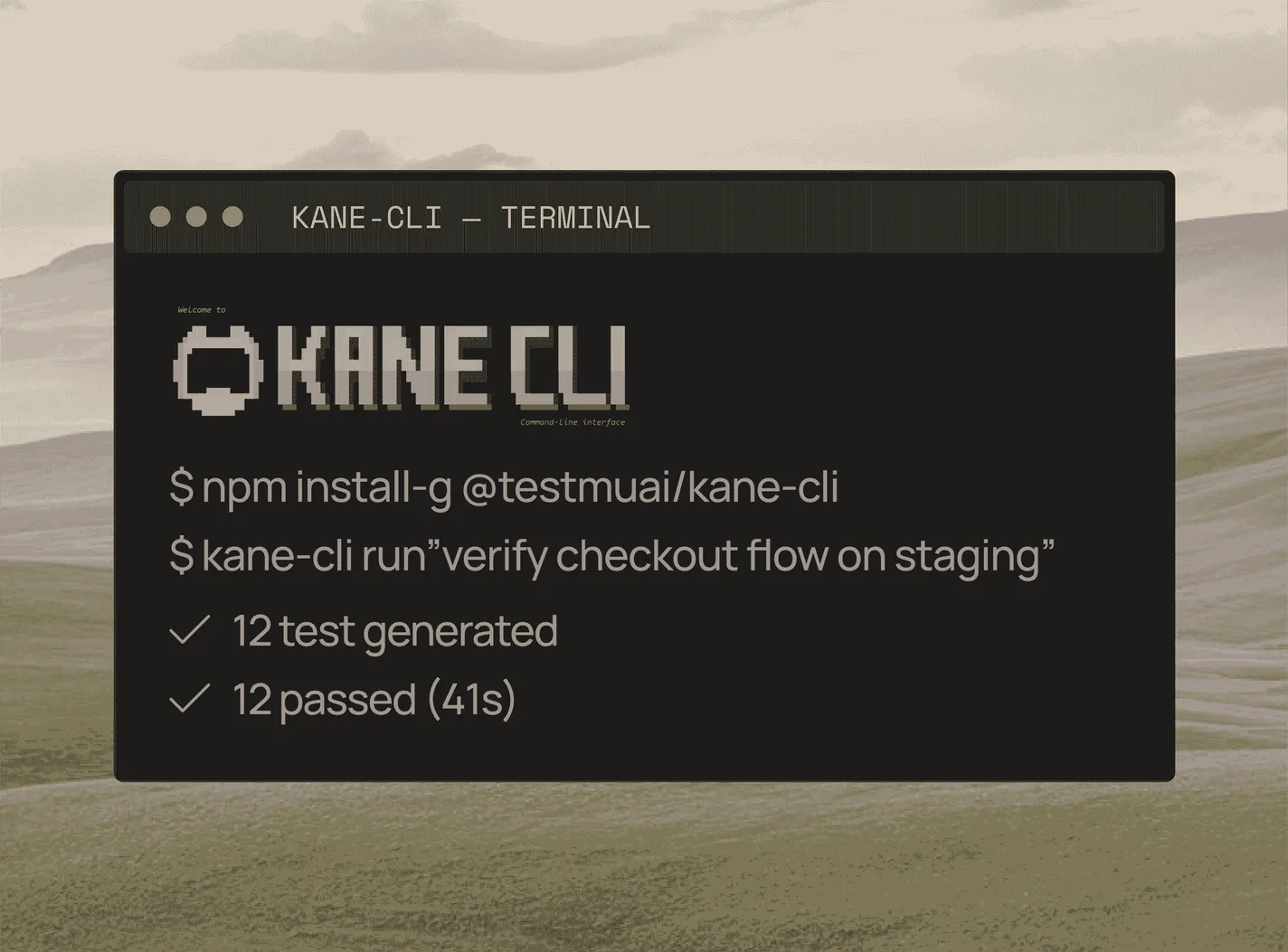
Kane CLI covers the other half. Give it an objective in plain language and it drives Chrome over the DevTools Protocol, then withholds a pass until the expected state is corroborated by DOM state, a URL change, a network response, a console log or a screenshot.
That last part is why it opens the list. One install command puts Kane CLI inside Claude Code, Codex CLI or Gemini CLI as a skill, which closes the loop that leaves coding agents declaring success against source they cannot see rendered.
Key features
- Objectives instead of selectors - describe the outcome and Kane CLI works out the path in a real Chrome session.
- One binary, three contexts - a terminal UI for a laptop, headless for CI, and an NDJSON agent mode for machine consumers.
- Callable by coding agents - installs as a skill in Claude Code, Codex CLI and Gemini CLI from a single command.
- Proof before a pass - verdicts are withheld until DOM state, a URL change, a network response, a console log or a screenshot corroborates them.
- No format lock-in - suites leave as Selenium, Playwright, Cypress or Appium code.
- Coverage at grid scale - 3,000+ browser and OS combinations alongside 10,000+ real devices.
Where it fits: Engineering teams where agents already write the code, and the missing piece is a verifier those same agents can call, without dropping to a single browser to get it.
Why Choose TestMu AI Over Other Tools?
Where most products on this list own one stage, TestMu AI runs the whole loop from one platform: KaneAI writes and maintains the cases, the automation cloud executes them across browsers and real devices, and Agent Testing grades AI agents in their own right. The practical difference is reachability, since Kane CLI drops into Claude Code, Codex CLI and Gemini CLI as an installed skill. Suites still export to Selenium, Playwright, Cypress and Appium, so none of that breadth is held hostage by the platform.
2. QA Wolf
QA Wolf runs a two-stage pipeline. One agent walks the application and builds a documented map of its workflows; a second turns that map into test code.
What lands at the end is the point. You get production-grade Playwright for web and Appium for mobile, which the company describes as exportable and yours to keep, so a cancelled contract does not take the suite with it.
It is delivered as a managed service rather than a tool you operate, with QA engineers embedded for maintenance and strategy and video playbacks for digging into failures. You are buying someone else’s cadence, which is the cost of not staffing it yourself.
Key features
- Map, then automate - one agent documents the workflows before a second writes the code against them.
- Code that survives you leaving - Playwright and Appium output the vendor describes as exportable and yours to keep.
- People included - embedded QA engineers own maintenance and test strategy on your behalf.
- Fully parallel runs - the suite executes at once rather than one case after another.
- Recorded failures - each failure comes back as a playback rather than a stack trace.
Where it fits: Teams that need coverage faster than they can hire for it, but refuse to end up with a suite they cannot take elsewhere.
3. Checksum
Checksum generates, executes and maintains end-to-end tests, and positions itself directly at teams shipping with coding agents. Its output is Playwright code that lives in your repository as real code you can modify, run anywhere and take with you.
The repair loop is what separates it. When a selector changes or a flow shifts, Checksum detects the failure, fixes the test and opens a pull request for review rather than silently rewriting or simply failing.
It plugs into an existing CI pipeline and runs on every commit, with no rip-and-replace of the framework already in use.
Key features
- Playwright output in your repo - real code you can modify, run anywhere and keep.
- Fix-by-pull-request - detected failures are repaired and raised as a PR for human review.
- Fast bootstrap - built to stand up broad end-to-end coverage in weeks rather than months.
- Runs on every commit - plugs into existing CI rather than replacing it.
- No vendor lock-in - the suite is standard Playwright, not a proprietary format.
Where it fits: Teams that want agent-generated coverage but insist the result is reviewable code in their own repository, with repairs going through code review like any other change.
4. TestSprite
TestSprite starts from context rather than from a blank file. It reads the codebase and the PRD first, then releases several agents into the running application at the same time, some driving a browser and others calling the live API.
One pass covers frontend, backend and data together. Most products on this list stop at the rendered page, which makes that span unusual here.
Two entry points serve coding agents: an MCP server for verification inside the editor and an open-source CLI for agents and pipelines, with Claude Code, Cursor and VS Code named as compatible. The exploratory start cuts both ways, because an agent choosing what matters will cover flows you would not have prioritised, so the first pass needs pruning before it gates anything.
Key features
- Reads before it explores - ingests the codebase and the PRD to decide what the application is meant to do.
- Many agents at once - features are worked through concurrently rather than in a single sequential crawl.
- Past the browser - frontend, backend and data verified in one run.
- Editor and pipeline entry points - an MCP server for in-editor checks and an open-source CLI for CI.
- Reruns on every change - the suite re-executes per commit and mends itself when elements move.
- Diagnosis, not logs - failures arrive with a proposed cause and a suggested fix.
Where it fits: Products carrying little end-to-end coverage today, where the immediate problem is producing a suite at all rather than looking after one.
5. Meticulous
Meticulous takes the most unusual position on this list: you do not write tests at all, and you do not maintain them either. A script tag added to development, staging and preview environments records real user sessions, which the platform converts into a continuously evolving suite.
It tracks which code branches executed during those interactions, then generates visual end-to-end tests across the workflows and edge cases they touched. Backend responses are mocked from the original recordings, which removes the false positives that changing data normally produces and avoids special test-account setup.
The suite evolves on its own. New tests appear as features and edge cases show up in real usage, and outdated ones are removed, with no developer intervention in either direction.
Key features
- No test authoring - a script tag records real sessions instead of engineers writing cases.
- Branch-aware generation - tracks the code branches user interactions execute and covers them.
- Mocked backends - responses replay from the original recording, so changing data does not cause false positives.
- Self-evolving suite - tests are added and retired automatically as the application changes.
- Pull-request impact view - shows the effect across user workflows before a merge.
- Heavy parallelism - runs on a compute cluster, testing thousands of screens in under 120 seconds.
Where it fits: Frontend teams with real traffic in staging or production who want broad regression coverage without anyone owning a test suite.
6. mabl
mabl arrives at this category from the opposite direction to most of the list. It is a mature platform that added agentic capability, not a young product designed around it, and the difference shows in how much ground one console covers.
Four surfaces sit together: web end to end, iOS and Android, APIs that accept existing Postman collections, and checks on the output of AI features themselves. Auto-healing and triage run across all of them rather than per surface.
MCP servers connect it to coding agents, and the platform speaks separately to developers, QA teams and the executives reading the numbers. Tests are built and run inside mabl, though the mabl CLI can export browser tests as Playwright or Selenium IDE code. Our mabl to KaneAI migration guide covers that path.
Key features
- Four surfaces, one place - web, iOS and Android, APIs, and the behaviour of AI features.
- Existing API work carries over - Postman collections import instead of being rewritten.
- Healing plus triage - tests absorb change and failures are grouped for routing.
- Agent connectivity - MCP servers expose it to Claude Code and similar tools.
- Three audiences - distinct paths for developers, QA teams and quality reporting.
Where it fits: Organisations retiring a shelf of point tools, where one console covering everything is worth more than holding the test code yourself.
7. testRigor
testRigor compiles English into steps. Write purchase a Kindle and it resolves the search, the button press and the clicks between them without you naming an element.
Its reach is the argument for it. Web across browsers and platforms, native and hybrid mobile, Windows desktop software, API invocation and validation, mainframe applications, two-factor authentication flows, and email, SMS and phone calls through a Twilio integration.
Because the specification is the test, self-healing is anchored there rather than in the markup, and a case survives a framework change as long as the sentence describing it remains accurate. Manual testers author beside engineers, and everything lives in the vendor platform.
Key features
- English compiles to steps - a written instruction resolves into the actions between start and outcome.
- Beyond the browser - web, native and hybrid mobile, Windows desktop, API and mainframe.
- Messaging paths - email, SMS and phone calls covered via a Twilio integration.
- Login second factors - authenticator apps, SMS and email all handled.
- Healing tied to the spec - the sentence is the contract, so markup changes do not break the case.
- Manual cases convert - an existing manual suite can be pulled in and automated.
Where it fits: Estates where the browser is only part of the problem, especially when Windows desktop or a mainframe still carries revenue alongside the web app.
8. Applitools Autonomous
Ask the rest of this list whether a page looks right and you get silence. They check state, which is a different question from appearance, and Applitools Autonomous is the entry that answers the second one.
There are three ways in and none of them involve a script: point it at a homepage or URL list and let it crawl, record a genuine user flow into steps you can edit, or write the steps out in English. Underneath, its Visual AI interprets the page the way a reader would rather than through the DOM, so rearranged markup does not register as a failure.
Deliberate redesigns are handled once rather than test by test, because the platform gathers every case a change touches and updates them as a set. It presents itself as the deterministic check sitting over AI-written code, with an MCP server for that path.
Key features
- Scriptless authoring - crawl from a URL, record a real session, or write the steps out.
- Sees rather than parses - interprets the rendered page like a reader instead of querying the DOM.
- One check per screen - a single visual checkpoint stands in for a column of assertions.
- Redesigns handled once - every case a deliberate change touches is updated as a batch.
- Checks AI-written code - an MCP server places it as the deterministic layer above generated code.
Where it fits: As a second layer beside a functional agent, on products where a broken layout costs as much as a broken endpoint.
9. Autify
Autify sets out to cover the whole software testing lifecycle with AI rather than a single stage of it. Its flagship, Autify Aximo, is an autonomous testing agent that runs end-to-end tests on web, mobile and desktop applications using natural language and visual recognition.
Authoring is no-code. You describe the testing objective in plain language, with no scripts and no selectors, and the platform handles creation from there.
Self-healing runs on flexible locators so tests adapt as the application evolves, and the platform integrates with Playwright for teams that want to scale execution on familiar infrastructure.
Key features
- Autonomous agent - Aximo runs end-to-end tests using natural language and visual recognition.
- Three application types - web, mobile and desktop from the same agent.
- No-code authoring - objectives are described in plain language, without scripts or selectors.
- Flexible locators - self-healing keeps tests working as the application evolves.
- Playwright integration - connects to Playwright for scalable execution.
- Lifecycle coverage - spans regression, smoke, functional and visual scenarios.
Where it fits: Teams whose surface includes desktop software alongside web and mobile, and who want one no-code agent covering all three.
10. Functionize
Functionize Studio positions itself as an independent testing agent for a full web UI workflow, built to prove quality rather than to script it.
Its architecture is the differentiator it leans on: proprietary models built specifically for testing rather than general-purpose ones, described as generative intent with a deterministic core, where agents interpret what you meant while machine learning verifies how the application actually behaved.
You describe what good looks like, and Studio builds the test, runs it and keeps it green, with auto-healing to absorb change. Enterprise coverage extends to Salesforce, ServiceNow, Workday and SAP.
Key features
- Purpose-built models - proprietary models trained for testing rather than general-purpose LLMs.
- Generative intent, deterministic core - agents interpret intent while machine learning verifies behaviour.
- Describe-and-build - you state what good looks like and Studio builds, runs and maintains it.
- Auto-healing - tests absorb application change rather than breaking.
- Enterprise application coverage - Salesforce, ServiceNow, Workday and SAP.
- Verification for AI-written code - positions explicitly at developers whose code was generated.
Where it fits: Enterprise web workflows, particularly across packaged applications, where a testing-specific model is preferred over a general-purpose one.
11. Tricentis Tosca
Tosca did not start agentic. It is enterprise end-to-end automation built on a model of the application, from which cases are assembled rather than recorded, and Tricentis has added an agentic layer above that foundation instead of discarding it.
The additions are named in the product line rather than implied: an AI workspace, agentic orchestration, agentic test creation, agentic end-to-end generation and agentic performance testing.
Packaged software is the reason to shortlist it, with the catalogue organised around SAP, Oracle, Salesforce, ServiceNow, Snowflake and Workday. Expect a programme rather than an install, and expect the tests to stay inside the platform.
Key features
- Built from a model - cases assemble from a representation of the application, not a recorded run.
- Agentic layer on a mature core - AI workspace, orchestration, creation, automation and performance testing.
- Enterprise suites first - SAP, Oracle, Salesforce, ServiceNow, Snowflake and Workday.
- Adjacent products included - test management, performance testing and quality analytics share the portfolio.
Where it fits: Enterprises whose revenue paths run through packaged software, at a scale where modelling the application pays back the effort of building the model.
12. UiPath Test Cloud
UiPath spreads agents across the entire lifecycle rather than concentrating them at authoring, so design, execution and management each get one, and cases are derived from requirements instead of typed by hand.
Healing happens mid-run rather than between runs: when an element moves, the agent reasons about what was meant, finds the replacement and carries on. The surface underneath is unusually wide, taking in desktop, web, mobile, APIs, databases and mainframes, plus SAP, Oracle, Workday, Epic and Salesforce on both Windows and macOS.
Governance is where it separates from the field. Execution trails are audit-ready, PII is masked, access is role-based and policy is enforced as code, all inside the platform rather than bolted alongside it. The weight that comes with an RPA heritage is the cost of that.
Key features
- Requirements become cases - agents derive tests from written requirements rather than from scripting.
- Healing mid-run - a moved element is reasoned about and relocated without failing the execution.
- Six application types - desktop, web, mobile, APIs, databases and mainframes.
- Enterprise software covered - SAP, Oracle, Workday, Epic and Salesforce on Windows and macOS.
- Audit before autonomy - execution trails, PII masking, role-based access and policy-as-code ship with the platform.
- Performance in the same product - functional and load testing are not separate purchases.
Where it fits: Regulated environments where someone will eventually ask how the agent reached its verdict, and a green tick is not an acceptable answer.
13. Spur
Spur runs QA through autonomous agents that plan, execute and report the tests themselves, written in plain English with no coding.
What distinguishes it is division of labour. Rather than one general agent, Spur fields specialised agents per domain: exploratory testing for unpredictable paths, functional testing for multi-step journeys, UI and UX checks for typos, broken links and layout, localisation across language, currency and regional formatting, AI feature testing for chatbots, search and recommendations, and mobile testing for iOS and Android.
Agents adapt to dynamic scenarios such as pop-ups and out-of-stock items rather than breaking on them, and it accepts web applications by URL and native mobile apps by build file.
Key features
- Specialised agents per domain - separate agents for exploratory, functional, UI and UX, localisation, AI features and mobile.
- Plain-English authoring - describe what to test and the agents handle the rest.
- Dynamic adaptation - agents handle pop-ups, out-of-stock items and UI changes rather than failing.
- Localisation testing - checks language, currency and formatting across regions.
- Test management import - brings existing cases across from tools such as qTest and Zephyr.
- Web and native mobile - applications by URL, mobile apps by build file.
Where it fits: Consumer products where localisation and exploratory coverage matter as much as the happy path, and where one agent per concern is preferable to one agent for everything.
14. Revyl
Revyl narrows deliberately. It compiles the mobile app in a cloud environment, launches it, looks at the screens, and walks user flows while recording what it saw at each step.
Atlas is the piece worth understanding. It maintains a living map of what the app genuinely does, which is the mobile counterpart of the crawl other products run against a website.
For a young product the ways in are numerous: a CLI, an MCP server, GitHub Actions, an API and a Cursor plugin. The focus that makes it strong on mobile is the same focus that leaves a web-heavy estate better served elsewhere.
Key features
- Mobile only, on purpose - compiles, launches and inspects iOS and Android builds in the cloud.
- A living app map - Atlas keeps an up-to-date record of what the build actually does.
- Verdicts from the screen - checks the rendered view and keeps the evidence behind it.
- Entry points - CLI, MCP server, GitHub Actions, API and a Cursor plugin.
Where it fits: Companies where the app is the product and a bad build reaches users through an app store rather than a deploy.
15. Autosana
Autosana positions itself squarely at teams already shipping with coding agents, calling itself the end-to-end layer that closes that loop, and it spans iOS, Android and web rather than picking one.
Flows are written, not coded, which is what lets a manual tester work in the dashboard while an engineer wires the same product into their tooling.
Recovery is what its users describe first. A failing flow gets adjusted rather than abandoned, and the agent will scroll to find an element that has moved out of view instead of stopping at it. The reported wins cluster in mobile’s awkward corners: deep links, authentication and embedded webviews.
Key features
- Built for agent workflows - sold as the end-to-end layer that completes a coding agent’s cycle.
- iOS, Android and web - all three from a single product rather than a mobile-only tool.
- Written, not coded - scenarios are described in plain language with no scripting step.
- Adjusts instead of stopping - a failing flow is re-planned mid-run rather than reported as broken.
- The hard mobile paths - deep links, authentication and embedded webviews.
Where it fits: Teams whose agents ship mobile and web together, and who want the testing layer usable by someone who does not open an IDE.

Note: Agent-authored tests still have to run somewhere real. KaneAI authors from plain English and exports to the framework your team already uses, so the agent's output lands as code you own rather than rows in a console. Try it free!
How Is Testing With an Agent Different From Testing an Agent?
Every tool above uses an agent to test conventional software. That is a different problem from testing an AI agent, and search results for this category blur the two constantly.
Assertions assume a stable answer. Ask an agent the same question twice and the wording changes, which leaves nothing fixed to compare against and no element to query.
What replaces the assertion is a score. TestMu AI Agent Testing turns testing agents loose on chat, voice and phone agents and grades what comes back for hallucination, bias, completeness and context awareness, running 9 metrics on chat and voice and more than 30 on phone calls. Scores replace assertions for model output too, and a comparison of the best LLM evaluation tools shows what each one measures.
Anything customer-facing belongs in that second category rather than this list, and the AI agent testing guide works through the metrics before it reaches products. For agents that act on real systems, end to end agent testing follows a request through every tool call to the resulting change and the reply the user reads.

Where Do These Tools Still Fail?
The same walls appear whichever product you buy, because they come from operating a real browser rather than from any one design. Each is documented by a vendor rather than inferred here.
- CAPTCHAs - none of the fifteen get past one. Either disable the challenge in the test environment or hand that step to a person.
- Browser-initiated downloads - a triggered file often lands in the browser download directory without being surfaced in the run output, so the assertion has nothing to check.
- Deeply nested iframes - a payment frame in view is usually fine, while frames buried several levels down and off-screen need naming in the objective.
- Canvas and WebGL - a drawing tool or 3D viewport is observable as an image, so clicks register and rendered changes are visible, but pixel-level and animation correctness are not verifiable.
- Long animations - a transition past the half-minute mark burns through the step budget, so raise the ceiling or cut the test either side of it.
- Thin documentation - agents that read requirements and tickets to decide what matters produce weaker coverage when there is little to read.
None of this argues against adopting one. It is the checklist to run your revenue-critical flows against before an agent is allowed to block a release.
How Do You Choose Between Them?
Begin with the exit, not the demo. Asking what remains yours after the contract ends removes more candidates than the next three questions together.
- What survives cancellation? If the answer must be a working suite, the field narrows immediately to TestMu AI, QA Wolf and Checksum, and how good the rest are stops mattering.
- Who writes your code today? Where agents already do, the verifier has to be something they can call themselves through a skill, an MCP server or a CLI, which leaves Kane CLI, TestSprite, Checksum and Autosana.
- What is your surface? Mobile-first favours Revyl or Autosana; desktop alongside web and mobile favours Autify or testRigor; SAP, Oracle or Salesforce narrows to Tricentis Tosca, UiPath Test Cloud or Functionize; visual correctness needs Applitools alongside a functional agent.
- Who reviews the output, and who has to approve it? If nobody has time, a managed service such as QA Wolf does the triage, and Meticulous removes authoring entirely. If a regulator or internal audit has to sign off, UiPath Test Cloud’s audit trails matter more than raw autonomy.
Published shortlists of the best agentic testing tools mostly name the same products, which means the decision is made by your constraints and not by the ranking. Test yours on something difficult rather than on a login page.
How to Audit the Agent That Repairs Your Tests
The fifteen products above act rather than talk, opening browsers, writing Playwright into repositories and repairing suites without being asked, which leaves the question of who checks their work. TestMu AI Agent Assurance reads your codebase, writes the test suite, runs your AI agent for real, and grades every criterion against observed evidence. The evidence is what the run produced, not the agent’s account of it.
- Observed effects - verdicts rest on files changed on disk, artifacts produced, and tool calls checked against the agent’s own declared tool surface.
- Grey-box discovery - manifests, prompts, tool tables and MCP servers are read first, and where an agent declares nothing, the run says so rather than guessing.
- Three verdicts - Pass, Fail and Unable to Verify, with Unable to Verify excluded from the pass-rate denominator and reported beside the pass rate as the assurance gap.
- A terminal path - rook, an Apache 2.0 CLI still in pre-alpha, runs explore, generate, run and report against an agent you own.
Point it at staging, because the agent under test is yours and its writes are real. In CI, gate on the verdicts in the JSON report rather than the exit code, since a finished run exits 0 whether scenarios passed or failed. The Autonomous Agent category that covers tools of this kind is open by waitlist rather than generally available.
Gating a release on verdicts belongs to pre-production agent testing, which grades what an agent changed before launch, while observability scores live traffic afterward.

Conclusion
Take the flow your team dreads maintaining, reduce it to one sentence of intent, and give that sentence to two products from the list. Whichever travels furthest before asking you for a selector has earned a real trial.
Where agents are already writing the features, the shortest route is dropping a verifier they can call into the loop that produces the code. Setup is covered in the getting started with KaneAI documentation, and the agentic QA tools roundup approaches the same products from the quality-assurance side.
For a first-hand account, see Trust, Risk and Quality in Agentic Finance from Testμ 2026.
Author

Samyak Goyal
Blogs: 32

Samyak Goyal is a Senior Member of Technical Staff at TestMu AI engineering Kane CLI, the command-line tool that runs browser automation from the terminal, where a flow described in natural language executes in a real Chrome browser and returns pass or fail with shareable proof. He is a backend engineer with 4+ years of experience, previously an SDE at Innovaccer, where he built APIs, introduced Kafka, and cut deployment from weeks to hours. Samyak also builds multi-agent systems, skill-orchestration frameworks, and a personal copilot that indexes 200+ microservice repositories.
Reviewer

Salman Khan
Reviewer
Salman is a Test Automation Evangelist and Community Contributor at TestMu AI, with over 6 years of hands-on experience in software testing and automation. He has completed his Master of Technology in Computer Science and Engineering, demonstrating strong technical expertise in software development, testing, AI agents and LLMs. He is certified in KaneAI, Automation Testing, Selenium, Cypress, Playwright, and Appium, with deep experience in CI/CD pipelines, cross-browser testing, AI in testing, and mobile automation. Salman works closely with engineering teams to convert complex testing concepts into actionable, developer-first content. Salman has authored 120+ technical tutorials, guides, and documentation on test automation, web development, and related domains, making him a strong voice in the QA and testing community.


Agentic AI Testing Tools FAQs
Did you find this page helpful?
More Related Blogs

TestMu AI forEnterprise
Get access to solutions built on Enterprise
grade security, privacy, & compliance
- Advanced access controls
- Advanced data retention rules
- Advanced Local Testing
- Premium Support options
- Early access to beta features
- Private Slack Channel
- Unlimited Manual Accessibility DevTools Tests