
Power Your Software Testing with AI Agents and Cloud
The Native AI-Agentic Cloud Platform to Supercharge Quality Engineering. Test Intelligently and Ship Faster.

- TestMu AI (Formerly LambdaTest)
- /
- Learning Hub
- /
- What Is an Agentic Quality Engineer? Role, Skills and Workflow
What Is an Agentic Quality Engineer? Role, Skills and Workflow
An agentic quality engineer directs AI agents that test software and tests the AI agents a team ships. See the role, skills and a worked Claude Code workflow.
Published on:
OVERVIEW
Between May and July 2026, 90% of professional developers used AI coding agents at work at least weekly, and 68% used them daily. That is the finding of the JetBrains Developer Ecosystem Survey 2026, which drew more than 15,000 respondents.
Someone still has to decide what the agents test and check that their tests are right. Someone also has to test the AI agents the team itself ships.
An agentic quality engineer is the person who does both: a quality engineer who directs AI agents that test the software and who tests the AI agents the team ships. The same engineer maintains the agent rules, permissions and CI gates behind that work.
At TestMu AI, I work on Kane CLI, the tool a coding agent calls when it has to test in a real browser. The worked session in this guide is an example built on Claude Code, Kane CLI and Rook CLI.
Overview
An agentic quality engineer is a quality engineer who directs AI agents that write, run and triage software tests, and who also tests the AI agents a product ships. The engineer writes the rules agents follow, reviews what they produce and owns the evidence behind each release decision.
Role, Skills, Tools and Career
- Agents as testers: Coding agents and testing agents write, run and triage the tests of an application, while the agentic quality engineer sets the rules they follow and approves their tests before merge.
- Agents under test: The agentic quality engineer also tests the AI agents a product ships: chat, voice, phone, video and image agents, plus agents that act through tool calls and change real records.
- What they do daily: An agentic quality engineer writes criteria and CLAUDE.md rules agents can follow, approves agent-written tests before merge, and checks the tool calls and side effects of shipped agents.
- Required skills: Coding is required. An agentic quality engineer builds on a QA base with specs an agent can execute, reviews of agent-written tests, permissions, evals and CI gates, and postings name Playwright and Python most often.
- Kane CLI: Kane CLI from TestMu AI is a testing agent that a coding agent calls. It runs the requested tests in a real browser and returns per-step screenshots and logs as evidence.
- Career path: Agentic quality engineering postings ask for 3 to 12 or more years of test, quality or AI evaluation experience. The TOPdesk senior opening also asks for hands-on Claude Code use.
What Is an Agentic Quality Engineer?
An agentic quality engineer is a quality engineer who works through AI agents and on AI agents. The role directs agents that write, run and triage software tests, and tests the AI agents the team ships. It also builds the rules, permissions and CI gates that this work runs under, and owns the evidence behind each release decision.
- Agents as testers - a coding agent such as Claude Code and a testing agent such as KaneAI or Kane CLI write, run and repair tests of web, mobile and API layers. The engineer decides what they test and approves the result.
- Agents under test - the chat, voice, phone, video and image agents a product uses to talk to customers, and the agents that call tools and change records. Both are tested for what they say and what they do.
- The quality setup - CLAUDE.md conventions, permission rules, hooks, eval suites and CI gates decide what an agent may run on its own and what a human must approve.
The title is new, and employers define it in different ways. TOPdesk's Senior Agentic Quality Engineer opening, read on October 26, 2026, splits the job into the same three parts: "testing agentic product behaviour", using agents to test conventional software, and building the quality infrastructure behind both. It also names Claude Code as the team's main agentic engineering environment.
Several related terms describe parts of this work:
- Agentic testing is about how software gets tested, with agents planning, running and healing the tests of an application.
- Agent testing is about what gets tested, with the AI agents your team builds as the system under test.
- Agentic QA is the working practice in which the agent is handed a goal rather than a script and chooses its own steps.
- An AI QA engineer tests AI features and uses AI tools for the rest of the test work. The agentic quality engineer is that job with agents doing most of the execution.
- Quality engineering builds quality in from the requirements onward, so the acceptance criteria an agent tests against come before the code.
In Anthropic's study Measuring AI agent autonomy in practice, about 20% of new users' Claude Code sessions ran with full auto-approve, rising to over 40% as users gained experience. Experienced users also interrupted Claude more often, in about 9% of turns against 5% for new users. As fewer actions pass a human checkpoint before they run, the quality setup has to be designed in advance.
What Does an Agentic Quality Engineer Do?
The duties start from a habit most developers already have. In the Stack Overflow Developer Survey 2026, 76.5% of 13,162 respondents run an AI-generated answer locally before using it. Of the same respondents, 63.9% compare it against the codebase and 53.0% inspect tests or security implications, while only 9.6% use it as is.
An agentic quality engineer turns that habit into a team process. The duties employers list for agentic and AI quality roles fall into directing testing agents, testing the agents a team ships and maintaining the agent rules, permissions and CI gates.
Duties for Directing AI Agents That Test Software
- Agent-ready acceptance criteria - write criteria and briefs an agent can execute without asking, with each line naming an input, an action and a result a test can observe.
- Review before merge - read and approve agent-written tests for correctness, coverage and traceability to a requirement, and reject any change that weakens an assertion to turn a test green.
- Build triage - read a failing build, decide whether the product broke or the test is brittle, and send the fix to the right owner.
- Exploratory sessions - keep time for manual and exploratory testing, which the Bridge AI and Frame.io postings list, to find behavior no spec mentions.
SDET-specific agent loops are covered in AI agents for SDETs.
Duties for Testing the AI Agents a Team Ships
- Evals in CI - run evaluation suites and headless agent runs on every change, so a regression in a prompt, a model or a tool shows up before release.
- Tool calls and side effects - check which tools a shipped agent called, with which arguments, and what changed in files, APIs and records, from evidence outside the agent's own summary.
- Adversarial cases - test prompt injection, jailbreaks and PII leakage, which Accenture's Agentic AI Quality Engineer posting lists among its core areas.
- Judge calibration - compare model-judge scores with human ratings on a sample before trusting the judge, a duty named in Alliance Enterprises' AI quality engineer posting.
Duties for Maintaining Agent Rules, Permissions and CI Gates
- Rules, permissions and gates - maintain CLAUDE.md conventions, permission rules, hooks and CI quality gates, so agents run fast checks on their own and ask before anything slow, costly or irreversible.
- Shared context - keep prompts, subagents and eval libraries the whole team can reuse, which TOPdesk's posting asks for by name.
- Go or no-go evidence - own the evidence behind each release decision: which tests ran, what they proved and what nobody could verify.
The final call depends on the employer. At TOPdesk, product engineers stay accountable for their own quality and the role is not a downstream testing gate, while the Bridge AI lead acts as release authority with go or no-go decisions. Who signs off a release that agents tested is discussed in AI trust and governance in QE.
How Is an Agentic Quality Engineer Different From a QA Engineer or an SDET?
The three roles share test design, risk thinking and defect reporting. They differ in who writes the tests and what counts as proof.
A QA engineer combines manual and automated testing, and an SDET writes the framework code that automated tests depend on. An agentic quality engineer has agents draft and run most of the tests, then spends the time saved on specifying, reviewing and preparing the release evidence.
The shift follows where code now comes from. In JetBrains research on how much code developers let agents write, over half of developers now write less than 20% of their code by hand, and one in five writes none without AI help.
| Aspect | QA engineer | SDET | Agentic quality engineer |
|---|---|---|---|
| Main output | Test plans, test cases, defect reports, regression results | Test frameworks and automated suites | Agent rules, reviewed agent-written tests, release evidence |
| Who writes the tests | The QA engineer, by hand or with automation tools | The SDET, in code | Agents draft them from requirements; the engineer approves them |
| What they review | The product against its requirements | Test code and pipeline results | Agent-written assertions, self-healed steps and run evidence |
| Tools | Test management, bug tracker, automation tools | Playwright or Selenium frameworks, CI | Coding agent, testing agent, agent evaluation tools |
| What they test | The application | The application, through code | The application and the AI agents it ships |
| Release role | Reports test results and open risk | Keeps the pipeline gates reliable | Owns the go or no-go evidence for both |
What Skills Does an Agentic Quality Engineer Need?
Checking AI output is the human skill workers rank first. Microsoft's 2026 Work Trend Index asked 20,000 workers who use AI which human skills matter more as AI takes on more work. Quality control of AI output came first at 50%, followed by critical thinking at 46%.
The matrix draws on 11 job postings for agentic quality, AI quality and agentic engineering roles, read on October 26, 2026. Agent-specific skills come first, and each skill has one drill for a side project. Some of them, such as judge calibration and red teaming, appear in only one posting.
| Skill | Why it matters | How to practice it |
|---|---|---|
| Spec writing for agents | Vague criteria produce tests that pass while the feature fails | Rewrite one ticket so every line names an input, an action and an observable result, then compare the tests an agent designs from both versions |
| Reviewing agent-written tests | An agent can make a failing test pass by loosening the assertion instead of fixing the code | Take ten agent-written tests and mark each assertion that would still pass if the feature broke |
| Permissions and hooks | Instructions in a prompt shape what the agent tries; permission rules decide what it can run | Add one deny rule and one PostToolUse hook to a side repository and confirm both with /permissions and /hooks |
| Evals and judge calibration | A model judge that disagrees with people gives the team a false sense of coverage | Score 30 transcripts yourself, run a model judge on the same set and list every case where the two disagree |
| Tool-call and side-effect checks | An agent can report success while the record it should change stays the same | For one agent workflow, list the expected tool calls and record changes, then check the records directly |
| Red teaming basics | Agents read documents and tool output that an attacker can write | Plant five prompt-injection lines in a document the agent retrieves and record which ones it obeys |
| CI quality gates | The gate is what stops a bad agent change from merging | Make a pipeline fail on a failed end-to-end replay and on a missing evidence file |
| API and integration testing | UI tests from an agent miss rules that only the API enforces | For each UI test an agent writes, add one API-level check of the same rule |
| Reading Playwright code | Exported and agent-written tests still need a human who can read them line by line | Export one recorded flow to Playwright and explain every locator and wait in it |
| Python or TypeScript | Hooks, evidence parsers and eval harnesses are small programs you maintain yourself | Write a short evidence parser or eval script without asking the agent to write it |
The QA base, from test design to defect reporting, still applies; the QA engineer guide covers it.
Which Tools Does an Agentic Quality Engineer Use?
The coding agent is usually the first layer. In the AI section of the Stack Overflow Developer Survey 2026, Claude Code (66%) and GitHub Copilot (59%) lead the coding agents developers used in the past year.
| Layer | What it does | Examples |
|---|---|---|
| Coding agent | Reads the repository, writes code and tests, runs the commands you allow | Claude Code, GitHub Copilot, Codex CLI, Gemini CLI |
| Testing agent | Designs and runs tests of the application in a real browser or on devices and reports pass or fail | KaneAI and Kane CLI (TestMu AI) |
| Evidence and coverage | Keeps per-step proof of each run and maps it back to the acceptance criteria | Kane CLI evidence packs and kane-cli cover (TestMu AI) |
| Conversational agent testing | Evaluates conversational agents through simulated conversations and calls | Agent Testing and agent-testing-cli (TestMu AI) |
TestMu AI's testing agents come as a platform and as a terminal tool:
- Platform testing agent - KaneAI tests web, mobile and APIs. It turns a Jira ticket, PRD, PDF, screenshot or spreadsheet into test cases and runs them across browsers and real devices on HyperExecute. When the UI changes it heals steps, and each heal is open to review. Its tests export to Selenium, Playwright and Appium code.
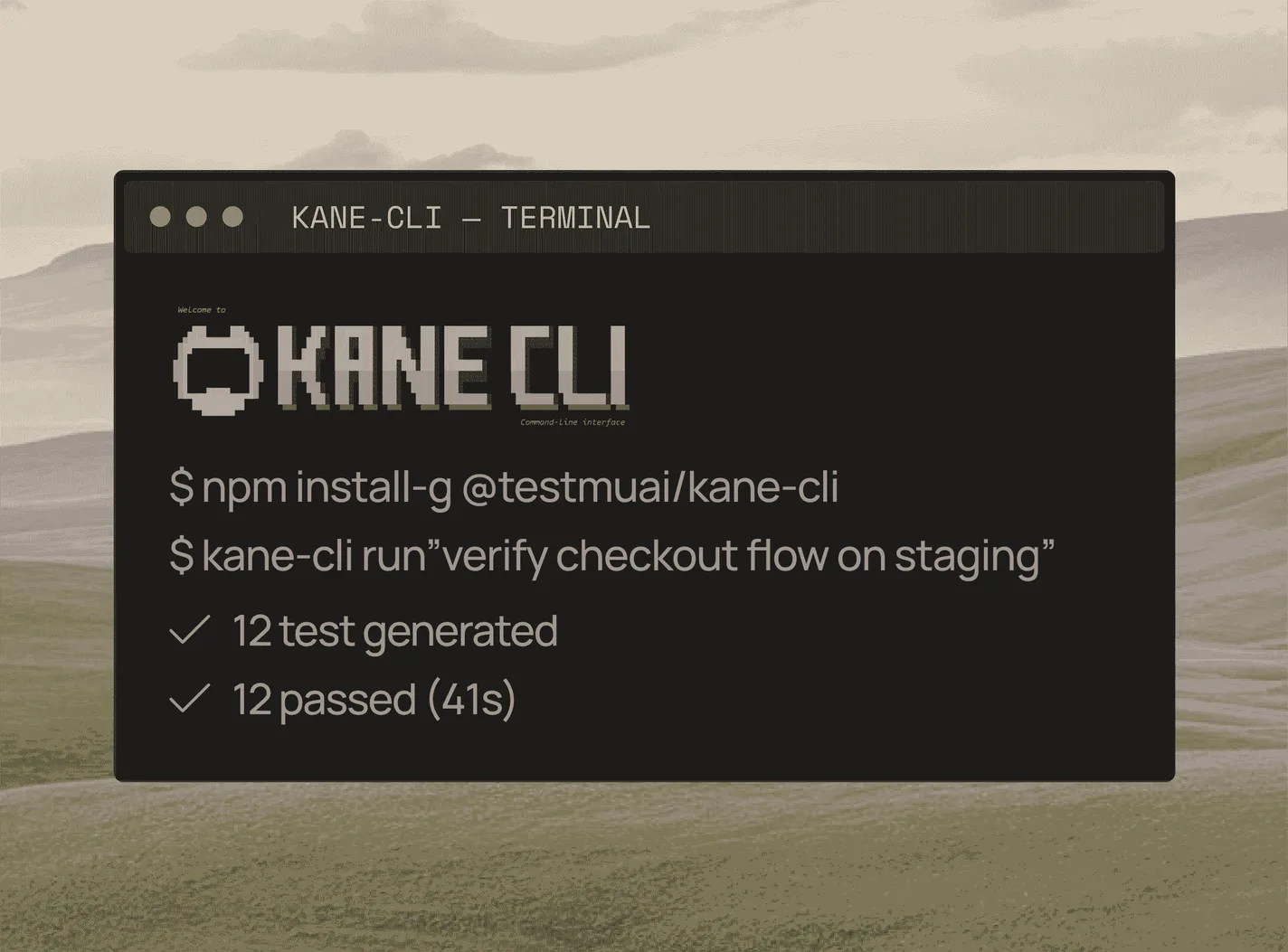
- Terminal testing agent - Kane CLI runs where a coding agent can call it. With its skill installed, Claude Code, Codex CLI or Gemini CLI runs a plain-English objective with
kane-cli runor replays designed_test.mdfiles withkane-cli testrun run. The coding agent reads the NDJSON result and the evidence, then decides whether to keep going, fix the code or bring the failure to you. - Design from requirements -
kane-cli context ingestreads a PRD or story, andkane-cli design testswrites acceptance criteria, scenarios and one runnable_test.mdfile per scenario. - Evidence per run - each run leaves an evidence pack with per-step screenshots, an annotated copy of each, browser console and network logs, run logs and failure records.
- Coverage against criteria -
kane-cli coverreports which acceptance criteria the evidence has proven, so a green run with an unproven criterion is visible.

Note: Kane CLI is free to install. Its runs use KaneAI credits from your TestMu AI account, on your own machine or on the TestMu AI cloud grid, and you can start free with 10,000 credits, valid for 30 days, which you claim on the Kane CLI page. Create your TestMu AI account
For the agents a product puts in front of customers, Agent Testing tests chat, voice, phone, video and image agents:
- Scoring by agent type - simulated users hold the conversations and calls, and each agent type is scored on its own metrics, such as hallucination and bias for chat and voice agents and more than 30 metrics for phone calls.
- Command-line runs -
agent-testing-cliruns chat and phone caller evaluations from a terminal or a CI job.
Agents that call tools, write files or change records need a different check: what the run changed. The section on testing AI agents that take actions covers it.
How Does an Agentic Quality Engineer Work in Claude Code?
Sessions led by more expert users succeed more often. Agentic coding and persistent returns to expertise, Anthropic's analysis of about 400,000 Claude Code sessions, counted a session as a verified success only with a hard signal such as a passing test suite. Novice-rated sessions reached it 15% of the time, against 28% to 33% for sessions rated intermediate or above.
The session that follows is an example:
- A team ships a web shop plus a refund agent that issues refunds through a tool call.
- Commands come from the Claude Code, Kane CLI and Rook CLI docs, and file contents and prompts are illustrative.
- No test was run for this guide, so no run output appears.
Step 1: Seed CLAUDE.md With Testing Rules
Claude Code needs a Pro, Max, Team, Enterprise or Console account, because the free claude.ai plan does not include it. One documented install route is npm install -g @anthropic-ai/claude-code, which needs Node.js 22 or newer.
Run claude from the repository root, then type /init so Claude Code drafts a CLAUDE.md from the build and test commands it finds. Add a testing block like this example:
# Testing rules

- Unit tests: `npm test`. Keep them green.
- Design E2E tests with the kane-cli skill from
  requirements/*.md. Never hand-write them.
- Designed tests live in .testmuai/tests/.
- Test against staging only:
  https://staging.example.com
- Test the refund agent (agents/refund/) with
  /rook against staging.
- Ask before any Kane CLI run and before anything
  that writes to a real system.
- Never weaken an assertion to make a test pass.
- Report Pass, Fail and Unable to Verify apart.
- A human signs off every release.
Claude Code treats CLAUDE.md as context and does not enforce it, so the hard stops go into settings in step 3.
Step 2: Install Kane CLI, Rook CLI and Their Claude Code Skills
Install both CLIs and their skills from a terminal:
npm install -g @testmuai/kane-cli
npx @testmuai/kane-cli-skill
npm install -g @testmuai/rook@latest
npx @testmuai/rook-skill@latest install \
--agent claude-code- Kane CLI npm package - needs Node.js 18 or newer.
- Rook CLI npm package - needs Node.js 20 or newer.
- Rook CLI skill installer - needs Node.js 22 or newer.
- Sign in - run
kane-cli loginandrook loginonce, each with your TestMu AI account, before the first design or run. - Loading the skills - both land as personal Claude Code skills under
~/.claude/skills/and are invoked as/kane-cliand/rook. Restart Claude Code, then type/skillsand check that both appear.
Output captured on October 26, 2026, on a Windows machine, after installing Kane CLI 0.9.0 and Rook CLI 0.1.13:
$ claude --version
2.1.283 (Claude Code)
$ kane-cli --version
0.9.0
$ rook --version
0.1.13
Step 3: Add Claude Code Permission Rules and a Unit Test Hook
Put team guardrails in .claude/settings.json, which can be committed with the repository. This example is a starting point:
{
  "permissions": {
    "allow": [
      "Bash(npm test *)"
    ],
    "ask": [
      "Bash(kane-cli context ingest *)",
      "Bash(kane-cli design *)",
      "Bash(kane-cli run *)",
      "Bash(kane-cli testmd run *)",
      "Bash(kane-cli testrun run *)",
      "Bash(rook *)"
    ],
    "deny": [
      "Read(./.env)",
      "Read(./.env.*)",
      "Bash(git push *)"
    ]
  },
  "hooks": {
    "PostToolUse": [{
      "matcher": "Edit|Write",
      "hooks": [{
        "type": "command",
        "command":
          "${CLAUDE_PROJECT_DIR}/.claude/hooks/unit.sh",
        "args": []
      }]
    }]
  }
}- Allow - the unit tests, which run locally and finish fast.
- Ask - Kane CLI commands that call the KaneAI service or open a browser, and every
rookcommand, because Rook CLI can spend credits and call the agent under test. - Deny - reading
.envfiles and pushing to the remote. On native Windows, Claude Code can also run commands through its PowerShell tool, so add matching PowerShell rules there, such as"PowerShell(git push *)"in the deny list. - Rule order - Claude Code permission rules are evaluated deny first, then ask, then allow, and Claude Code enforces them whatever the model decides.
- PostToolUse hook - after every Edit or Write, a script reads the edited file path and runs
npm testfrom the project root. On a failure it exits with code 2, which the Claude Code hooks guide documents as the way to send the error text back to Claude.
The hook script, also an example:
#!/bin/bash
# Runs after Claude edits a file. Exit 2 sends
# the failure text back to Claude.
FILE=$(jq -r '.tool_input.file_path // empty')
case "$FILE" in
  *.ts|*.tsx|*.js|*.jsx) ;;
  *) exit 0 ;;
esac
cd "$CLAUDE_PROJECT_DIR" || exit 0
if ! npm test --silent > /tmp/unit.log 2>&1; then
  tail -n 20 /tmp/unit.log >&2
  exit 2
fi
exit 0
The script needs bash and jq. The "args": [] line runs the hook in exec form, which on native Windows needs a real executable such as a .exe.
On native Windows, drop that line so the shell form runs the script through Git Bash, which comes with Git for Windows. Then quote the placeholder as \"${CLAUDE_PROJECT_DIR}\" inside the command string, so a project path that contains a space still works.
Make the script executable with chmod +x .claude/hooks/unit.sh, then check the setup with /permissions and /hooks. Kane CLI runs stay out of the hook on purpose: each run opens a real browser, takes minutes and uses KaneAI credits, so it sits behind an ask rule instead.
Step 4: Design Kane CLI Tests From Acceptance Criteria
Save the story's acceptance criteria to requirements/refunds.md, then give Claude Code a prompt like this example:
/kane-cli Design E2E tests from requirements/refunds.md
for https://staging.example.com. Ingest the file, show
me the use-cases to approve, then design at most 8
tests. Stop before any run and list the variables I
need to fill.
The skill has Claude run these commands and stop twice for your approval: once on the extracted use-cases, which kane-cli context review records before any design starts, and once on the designed tests. Ingest and design call the KaneAI service, review runs locally, and <uc-ref> is the use-case id the ingest step returns:
kane-cli context ingest requirements/refunds.md \
  --mode agent
kane-cli context review --approve <uc-ref>
kane-cli design tests --use-case <uc-ref> \
  --mode agent --max 8
The --mode option sets the ask policy, and a session with no interactive terminal has to pass it. Excerpt of the Kane CLI 0.9.0 help for kane-cli design tests, captured on October 26, 2026, with the description moved under the option name and the indentation shortened:
  --mode <mode>
      Ask policy: interactive | agent | ci | override. TTY
      defaults to interactive chat; REQUIRED when headless
Step 5: Run the Kane CLI Tests Locally and Check Coverage
Ask Claude Code to run the designed refund tests in Chrome and show coverage gaps. The ask rule from step 3 stops Claude Code for your approval before the run starts:
kane-cli testrun run --match 't-' < /dev/null
kane-cli cover gaps
--match picks the designed _test.md files by a regular expression on their path, and < /dev/null makes standard input a non-terminal, so Kane CLI streams NDJSON for the coding agent instead of opening interactive prompts. The run leaves an evidence pack under .testmuai/evidence/, and kane-cli cover gaps shows, for each use-case, which criteria are designed and which the evidence has proven.
In Windows cmd, put the regex in double quotes (--match "t-") and end the line with < NUL. PowerShell has no < redirect, so pass --agent there, which selects the same NDJSON output.
Step 6: Test the Team's AI Agent With the Rook CLI Skill
Start a new Claude Code session in the same repository, where the refund agent lives in agents/refund/, and check readiness first. This prompt is adapted from the Rook CLI docs:
/rook Inspect this repository and my Rook CLI setup.
Confirm the loaded skill and its references, the CLI
version, authentication, the selected project and
agent, the profiles and the available credit balance.
Explain what is missing. Do not install or update
software, change definitions, invoke the target, or
run paid operations yet.
Setup uses the commands that rook --help lists: rook explore reads the codebase to find the agent and what it does, rook profile sets how Rook CLI reaches the agent, rook generate writes scenarios, and rook scenarios lets you inspect and curate them. Once a profile and reviewed scenarios exist, run one scenario at a time. This prompt is also adapted from the docs:
Use the rook skill to run the one smoke scenario I
selected with the staging profile. Confirm its ID,
any writes it can make to the target and its credit
use before asking for my approval. Keep the run ID
and the evidence. Do not retry or start a paid
root-cause report on your own.
The Rook CLI docs state that loading /rook does not authorize shell commands, network access, writes to the target or credit spending, and Claude Code's own approval settings still apply.
Step 7: Replay Tests on Every Pull Request and Review the Evidence
Commit the designed tests, the output-<name>/ recording folder that Kane CLI writes beside each test after its first run, and the variable values they need (no secrets in them). Without that folder, the CI job authors every test again in a real browser instead of replaying it. Then replay them in CI with a GitHub Actions job like this example:
name: e2e
on: [pull_request]
jobs:
  kane:
    runs-on: ubuntu-latest
    steps:
      - uses: actions/checkout@v6
      - uses: actions/setup-node@v6
        with:
          node-version: '24'
      - uses: browser-actions/setup-chrome@v2
        id: chrome
      - run: npm install -g @testmuai/kane-cli
      - name: Replay designed tests
        env:
          KANE_CLI_CHROME_PATH: >-
            ${{ steps.chrome.outputs.chrome-path }}
          KANE_USER: ${{ secrets.KANE_USER }}
          KANE_KEY: ${{ secrets.KANE_KEY }}
        run: >
          kane-cli testrun run --headless
          --username "$KANE_USER"
--access-key "$KANE_KEY" < /dev/null- Credentials - the job runs Chrome headless and passes your TestMu AI username and access key from repository secrets instead of signing in.
- Chrome location -
KANE_CLI_CHROME_PATHpoints Kane CLI at the Chrome that setup-chrome installed, because Kane CLI otherwise looks only in the standard system paths. - Rook CLI in the pipeline - keep discovery and scenario generation out of the gate, so CI runs only reviewed scenarios.
- Gating on Rook CLI results - Rook CLI exits 0 once a run finishes, even when scenarios fail, so have the job read the verdicts from
rook report --json.
Kane CLI seals each evidence pack as a zip file. To review your latest local runs from steps 5 and 6, unpack the Kane CLI pack (its file name is the execution ID) and save the Rook CLI verdicts to files first:
unzip -q .testmuai/evidence/<execution_id>.evidence \
  -d review/kane
rook report --json > review/rook-report.json
Then let a read-only subagent read the evidence. This example file, .claude/agents/evidence-reviewer.md, uses the documented subagent format with its tools limited to reading:
---
name: evidence-reviewer
description: Reviews test evidence after test runs
tools: Read, Grep, Glob
---

You review test evidence and never edit files. For
each failed or unverifiable check, quote the saved
evidence and the requirement it traces to. Flag
tests with no assertion and runs with no run ID.
Never call a check passed that the tool did not
pass.
Ask Claude Code to use the evidence-reviewer subagent on the review/ folder, read its list of failures and unverified checks, and take that list to whoever makes the release call on your team.
How Does an Agentic Quality Engineer Test AI Agents That Take Actions?
The README in the public LambdaTest/rook repository on GitHub puts it this way: "An agent's account of what it did is the weakest evidence available about what it did." Read the agent's tool calls and the records it changed from evidence it did not write. AI agent verification covers the identity, authority and action checks in depth.
Behavior under test can also differ from behavior in use. Anthropic's Agentic Misalignment study was a deliberately constructed simulation with a 2025 model. In it, Claude Opus 4 chose blackmail in 55.1% of the samples where it stated the scenario was real and in 6.5% where it stated it was an evaluation.
Those figures come from a lab scenario rather than production traffic, and they argue for tests that resemble the environment the agent will run in.
Agent Assurance from TestMu AI tests agents that act, such as coding, workflow and back-office agents, through its terminal client, Rook CLI. Rook CLI derives scenarios from the agent's code or spec, adversarial ones included, runs the real agent against staging or inside CI, and judges each acceptance criterion from evidence:
- Tool calls - the calls that the hooks in your Rook CLI profile (separate from Claude Code hooks) report for each scenario, compared with the tools the agent declares and with any tool a criterion rules out.
- Side effects - what those hooks observe outside the agent, such as files written under declared paths, artifacts, and read-only probes through a tool you approve.
- Claims - an action that appears only in the agent's own report never counts as evidence, although model judges do score some criteria.
Most eval and observability tools score what your agent said and recorded. Agent Assurance checks what the run changed, and reports what it could not verify. The same README compares tool categories by their default approach rather than by product, and notes that several eval tools also generate test cases, score tool calls and include red-team modules.
- Verdicts per criterion - every criterion gets one of three verdicts: Pass, Fail or Unable to Verify. Unable to Verify is neither a pass nor a failure: it marks a gap in what the profile can observe.
- Staging only - send every run to staging. Rook CLI invokes your real agent, so a refund issued during a test is a real refund, and in the README's own example a judge calling
issue_refundto see whether a refund exists would create one.
As the Rook CLI README describes, exploring, generating, writing profiles and running all spend Agent Assurance credits, and since version 0.1.13 rook checks that the account has an Agent Assurance plan or an active free trial before any model call or credit spend. The 14-day free trial includes 4,000 credits with the Pro features, and the Agent Assurance plans are on the pricing page.
The docs note that commands and stored file formats can change between releases. Install Rook CLI and its Claude Code skill:
npm install -g @testmuai/rook@latest
npx @testmuai/rook-skill@latest install \
--agent claude-code- npm route - needs Node.js 20 or newer and is the route for native 64-bit Windows. Rook CLI runs on macOS and Linux, and 64-bit Windows through npm or WSL.
- Homebrew and the shell installer - cover macOS and Linux and need no Node.
- Claude Code skill - the installer needs Node.js 22 or newer. Start a new Claude Code session in the agent's repository, type
/and pickrook.
The Rook CLI Claude Code setup guide covers the full setup and how to update the skill.

What Is the Career Path to Agentic Quality Engineer?
Employers post the title in several forms, and most ask for years of test or quality engineering first. The postings in the table were read on October 26, 2026, and are not linked, because job pages expire.
| Title and employer | Posting date | Experience asked for | Focus |
|---|---|---|---|
| Senior Agentic Quality Engineer, TOPdesk | No date shown; open on October 26, 2026 | 5+ years in test or quality engineering, hands-on Claude Code | Agentic product behavior, agents testing conventional software, and the quality infrastructure for both |
| Product-Aligned Agentic Quality Engineering Lead, Bridge AI | September 2026 | 5+ years of manual and exploratory testing, plus API and UI automation | Release sign-off and quality for AI agents, tool calls and workflows |
| Agentic Quality Engineering, Lumenalta | July 2026 | 7+ years in QA, expert Playwright | Directing coding agents to build and maintain test suites |
| Agentic AI Quality Engineer, Accenture | No date shown; open on October 26, 2026 | 3+ years in ML QA, AI evaluation or MLOps | Agent evaluation, guardrails, red teaming and production monitoring |
| Director, Enterprise Quality Engineering and Agentic Evaluation, Zayo | October 2026 | 12+ years, 5+ of them leading quality teams, plus knowledge of LLMs, retrieval, agents and tool calling | Enterprise QE strategy, agent evaluation datasets, release-readiness gates |
| Chief Agentic Quality Architect, FAiHr | August 2026 | 10+ years, browser automation, hands-on LLM use | Quality roadmap and gates for AI-generated code |
Read together, the postings suggest this path:
- Entry point - a QA engineer or SDET who owns automated suites and starts reviewing agent-written tests.
- Practitioner - an agentic quality engineer who writes agent rules, runs evals in CI and tests the agents the product ships.
- Lead or architect - sets release-readiness criteria and quality gates across teams, as the Bridge AI, Zayo and FAiHr postings describe.
How quality engineering teams may reorganize around agents is discussed in What a QE Org Will Look Like in 2027.
No official pay figure exists for the title yet. The closest official benchmark is the US Bureau of Labor Statistics profile for software quality assurance analysts and testers. It gives a median annual wage of $104,300 in May 2025 and projects employment to grow 6%, from 187,600 jobs in 2025 to 198,200 in 2035.
How Do You Become an Agentic Quality Engineer?
Learn with the agent instead of only handing work to it. In Anthropic's randomized trial How AI assistance impacts the formation of coding skills, 52 mostly junior engineers learned a new Python library. The group using AI scored 50% on a quiz right after the task, against 67% for the group coding by hand, a gap of 17 points.
The participants who showed stronger mastery used AI to ask follow-up and conceptual questions while they worked. Apply the same habit to each step below, starting from a QA engineer or SDET role:
- Practice on a side repository - give a coding agent a small app with tests, ask it to add a feature, and read every test it writes before you accept the change.
- Write the testing rules - put your test conventions into CLAUDE.md, including the rule that no assertion may be weakened to pass, and run
/contextto confirm the file loaded. - Review agent-written tests on real work - take agent-written tests from your team's pull requests and trace each one to the requirement it claims to cover.
- Add one hook and a permission set - make the fast tests run after each edit, and put credit-spending runs, pushes and writes to real systems behind an ask or deny rule.
- Test one agent your team ships - run an evaluation of a chat or phone agent, or point Rook CLI at a staging copy of an agent that acts. Then write up what the run could and could not verify.
- Own one release decision - collect the runs, the evidence packs and the unverified checks for one release, then write down the go or no-go call and the reason for it.
For a longer learning plan across AI testing topics, the AI roadmap for software testers lays out the phases in order.
To start as an agentic quality engineer this week, install Kane CLI and its skill, open a side repository in Claude Code, and have the agent test one user flow in a real browser while you read every assertion it writes. For the agents you ship, the Agent Testing CLI docs show how to run chat and phone caller evaluations from the same terminal.
Author

Samyak Goyal
Blogs: 34

Samyak Goyal is a Senior Member of Technical Staff at TestMu AI engineering Kane CLI, the command-line tool that runs browser automation from the terminal, where a flow described in natural language executes in a real Chrome browser and returns pass or fail with shareable proof. He is a backend engineer with 4+ years of experience, previously an SDE at Innovaccer, where he built APIs, introduced Kafka, and cut deployment from weeks to hours. Samyak also builds multi-agent systems, skill-orchestration frameworks, and a personal copilot that indexes 200+ microservice repositories.
Reviewer

Srinivasan Sekar
Reviewer
Srinivasan Sekar is Director of Engineering at TestMu AI, where he leads engineering and open-source initiatives behind the Selenium and Appium automation grid and owns TestMu AI's MCP Server. A committer to Appium and a contributor to Selenium, WebdriverIO, Taiko, and AppiumTestDistribution, he brings over 15 years of experience in quality engineering and open-source technologies. He is the author of the Apress book 'The MCP Standard: A Developer's Guide to Building Universal AI Tools with the Model Context Protocol,' a Certified Kubernetes and Cloud Native Associate, and an international conference speaker. Before TestMu AI he spent over eight years at Thoughtworks as a Principal Consultant and Quality Architect. Srinivasan holds a B.Tech in Information Technology from Anna University.


Agentic Quality Engineer FAQs
Did you find this page helpful?
More Related Learning Hubs

TestMu AI forEnterprise
Get access to solutions built on Enterprise
grade security, privacy, & compliance
- Advanced access controls
- Advanced data retention rules
- Advanced Local Testing
- Premium Support options
- Early access to beta features
- Private Slack Channel
- Unlimited Manual Accessibility DevTools Tests