

Power Your Software Testing with AI Agents and Cloud
The Native AI-Agentic Cloud Platform to Supercharge Quality Engineering. Test Intelligently and Ship Faster.


- TestMu AI (Formerly LambdaTest)
- /
- Learning Hub
- /
- LLM Testing: How to Test Applications Built on Large Language Models
LLM Testing: How to Test Applications Built on Large Language Models
LLM testing explained: types, key evaluation metrics, how to build a testing strategy, popular frameworks, common challenges, and real-world use cases.
Last Updated on:
Large Language Model (LLM) testing is the process of evaluating LLM-powered applications to ensure they generate accurate, relevant, reliable, and safe responses. Unlike traditional software testing, where outputs are deterministic, LLM testing focuses on assessing response quality, factual accuracy, consistency, hallucinations, bias, and overall model behavior across different prompts and scenarios.
A comprehensive LLM testing strategy combines automated evaluations, human review, regression testing, and continuous monitoring to identify issues before they impact users. As LLMs become an integral part of chatbots, AI agents, coding assistants, enterprise search, and content generation tools, robust testing is essential for building trustworthy AI applications.
In this guide, you will learn what LLM testing is, its types, key evaluation metrics, testing strategies, popular frameworks, common challenges, and real-world use cases. For a code-level companion to this guide, see LLM test automation.
TL;DR
- LLM testing evaluates the quality of a response rather than matching it to an exact expected string, because the same prompt can produce a different answer on every run.
- The unit under test is the whole pipeline. Prompts, retrieval, external APIs, function calling, memory, and agents all shape the answer, so testing only the model leaves most of the failure surface unchecked.
- Eight test types cover a production application, spanning unit, functional and integration, regression, performance, security, bias and fairness, prompt, and human evaluator testing.
- Metrics group into five buckets, covering task quality, safety and bias, context grounding for RAG, human and judge scores, and system performance and cost.
- A golden dataset of prompts paired with trusted reference answers is the baseline that makes regression detection possible after a prompt, model, or retrieval change.
- Automate the evaluations and keep humans for what automation misses, such as tone, empathy, and reasoning quality that no exact-match metric captures.
- Testing does not end at deployment. Monitor correctness, hallucination rate, latency, and cost in production, because real users surface scenarios no development dataset predicted.
- Framework choice follows architecture, with Ragas suited to RAG, Promptfoo to prompt engineering and red teaming, LangSmith to tracing, DeepEval to end-to-end evaluation, and TestMu AI's Agent Testing platform to folding evaluations into CI.
What is LLM Testing?
LLM testing is the process of evaluating, validating, and monitoring the performance of Large Language Models (LLMs) and the applications built on top of them. Its goal is to ensure that AI-generated responses are accurate, relevant, safe, reliable, and aligned with the intended user experience before and after deployment.
Unlike traditional software, LLMs do not produce the same output every time they are given the same input. Their responses are probabilistic, meaning they can vary based on factors such as the prompt, model configuration, temperature settings, and surrounding context. Because of this non-deterministic nature, conventional testing methods that rely on exact expected outputs are not sufficient.
Model size is one of the variables this testing has to settle. Our guide to SLM vs LLM covers where smaller models hold up, where they break, and how to measure the difference on your own requests.
Instead, LLM testing focuses on evaluating the quality of responses using semantic metrics and real-world scenarios. Rather than asking, "Did the model return the exact expected answer?" the question becomes, "Did the model generate a response that is correct, relevant, complete, grounded in facts, and safe for users?" The assertion patterns behind that shift are covered in detail in testing non-deterministic AI outputs.
Modern LLM applications are also more than just the language model itself. They often include prompts, retrieval systems (RAG), external APIs, function calling, memory, and AI agents that work together to generate responses. A comprehensive testing strategy evaluates every part of this pipeline, not just the model's output.
For example, an AI customer support chatbot should not only answer customer queries correctly but also:
- Understand the user's intent.
- Retrieve the most relevant information from its knowledge base.
- Avoid hallucinating facts when information is unavailable.
- Generate responses that are safe, unbiased, and compliant with organizational policies.
- Maintain consistent performance even after prompt updates or model upgrades.
To achieve this, teams combine automated evaluations, benchmark datasets, regression tests, adversarial testing, and human reviews to continuously assess model performance throughout the AI development lifecycle. This helps identify issues early, maintain response quality over time, and ensure that LLM-powered applications remain trustworthy as models, prompts, and datasets evolve.
Types of LLM Testing
LLM applications need to be tested from multiple perspectives to ensure they are accurate, reliable, secure, and production-ready. While some tests evaluate individual prompts or model responses, others focus on performance, security, integrations, or long-term reliability. Together, these testing types provide a comprehensive assessment of an LLM application's behavior throughout the development lifecycle.
Below are the most common types of LLM testing and what each one evaluates.
Unit Testing
Unit testing checks the smallest testable part of an LLM workflow, usually a single prompt-response pair or one isolated capability. The goal is to verify that the model produces the expected format, tone, or content under controlled conditions. In practice, you might test whether the model returns valid JSON, uses the right label, or stays within a word limit.
For example, if your model is supposed to summarize text in three bullet points, a unit test can verify that the output contains exactly three bullets and no extra commentary. You can also score outputs using rules, similarity checks, or rubric-based evaluation instead of exact string matching, because LLM outputs can vary in wording while still being acceptable.
Functional And Integration Testing
Functional testing checks whether the LLM performs the intended task correctly from the user's perspective. It focuses on understanding the prompt, following instructions, and producing the right kind of answer. Integration testing goes one step further by checking how the model works with external systems such as APIs, databases, retrieval layers, agents, or UI workflows.
These two are often grouped together because real LLM applications usually depend on more than just the model itself. For example, a support chatbot might need to classify a request, retrieve a help article, and generate a final response. A functional test confirms the bot gives the right answer, while an integration test confirms every connected component works correctly in sequence.
Regression Testing
Regression testing checks whether a change has broken something that already worked. In LLM systems, regressions often appear after model upgrades, prompt edits, retrieval changes, or tool-chain updates. The idea is simple: rerun a saved set of important prompts and compare the results against known-good outputs or expected score thresholds.
This is one of the most important test types for production systems because LLM behavior can shift in subtle ways. A prompt improvement might help one use case but reduce accuracy or formatting reliability elsewhere. Regression suites help teams catch those trade-offs before deployment.
Performance Testing
Performance testing measures how well the LLM or LLM application behaves under load. The usual metrics are latency, throughput, resource consumption, and cost per request. This testing helps answer practical questions such as how fast the model responds, how many requests it can handle, and whether response quality stays stable as usage increases.
A model that works well in a demo may fail under real traffic. For example, a support assistant might respond correctly in one-to-one testing but become slow or expensive when hundreds of users arrive at once. Performance testing gives teams a realistic view of production readiness.
Security Testing
Security testing checks whether the LLM can be manipulated, tricked, or exploited. Common attacks include prompt injection, jailbreak attempts, data exfiltration, unsafe tool use, and adversarial inputs designed to force incorrect behavior. The goal is to reduce risk from both malicious users and unexpected input patterns.
This is especially critical for systems that can call tools, access private data, or take actions on behalf of users. A secure LLM application should resist instructions that try to override policies or expose sensitive information. Security tests often use red-team style prompts that simulate realistic attack behavior. Dedicated prompt injection testing goes deeper on this one attack class, checking whether direct and indirect inputs can override the model's rules.
Bias And Fairness Testing
Bias testing examines whether the model produces unfair, stereotyped, or discriminatory outputs across different groups. Fairness testing looks at responses across attributes such as gender, race, age, language, geography, or other protected characteristics. The aim is to detect systematic differences in quality, tone, or decision-making.
This test type is essential in public-facing systems and any application where recommendations or judgments may affect people. For example, if the same user question is asked with different demographic references, the model should not change its helpfulness, respectfulness, or accuracy unfairly. Bias and fairness testing is usually done with paired prompts and comparative scoring.
Prompt Testing
Prompt testing evaluates how the model responds to different prompt styles, instructions, and edge cases. It helps teams see which prompt version produces the most reliable, accurate, and well-formatted output. This includes changes in wording, role instructions, constraints, chain-of-thought-style prompting, and tool-use instructions.
Prompt testing is one of the fastest ways to improve LLM quality without changing the model itself. For example, a clearer instruction may reduce hallucinations or improve structure dramatically. Because prompt changes can alter behavior in unexpected ways, prompt testing is usually paired with regression testing.
Human And Evaluator Testing
Human and evaluator testing combines human review with automated or model-based scoring. Human reviewers judge criteria that are hard to capture with rules alone, such as usefulness, naturalness, safety nuance, and reasoning quality. Evaluator testing uses rubrics, heuristics, or LLM-as-a-judge methods to score outputs more quickly and consistently at scale.
This approach is widely used because not all LLM quality can be measured by exact-match metrics. A response may be technically correct but still be vague, poorly structured, or unsafe in context. Human reviewers are best for calibration and high-stakes evaluation, while automated evaluators help with speed and repeatability.

Note: TestMu AI evaluates AI-powered applications with autonomous testing agents that score every response, on a schedule or on every deployment. Try it free.
Key Metrics Used in LLM Testing
Key metrics in LLM testing fall into a few major buckets: task quality, safety and robustness, context use, human and judge scores, and system performance and cost.
Task Quality Metrics
These measure how good the answer is for the intended task.
- Accuracy and correctness. How often the model's answer is factually right or matches the ground truth for structured tasks (QA, classification, extraction). Commonly measured with accuracy, precision and recall, or F1-score on labeled datasets.
- Answer relevance. Whether the response actually answers the user's question or solves the task, instead of drifting off-topic.
- Prompt alignment and instruction-following. How well the model obeys instructions (for example, "respond in JSON", "keep under 100 words", "use bullet points"), which is critical for downstream reliability.
- ROUGE, BLEU, BERTScore. Reference-based metrics that compare generated text against gold references. BLEU and ROUGE use n-gram overlap, while BERTScore uses embeddings to measure semantic similarity, especially for summarization and translation.
- Perplexity. Indicates how well a model predicts the next token. Useful in training and model comparison, though it does not always reflect user-facing quality.
- Coherence. Checks whether the text is logically structured, stays on topic, and maintains consistent meaning across the response.
- Fluency and readability. How natural and well-formed the language is, including grammar, style, and overall readability.
Safety, Bias, And Hallucination Metrics
These focus on whether outputs are safe, fair, and trustworthy.
- Hallucination rate and factuality. How often the model fabricates facts or makes unsupported claims, often measured against a reference or given context.
- Toxicity. Whether content includes harassment, hate, abusive language, or other unsafe text.
- Bias and fairness scores. Track differences in responses across demographic groups or protected attributes to detect systematic bias.
- Safety and policy compliance. How often the model violates safety policies (for example, self-harm instructions, disallowed topics, or data leakage), often evaluated using stress-test prompt sets.
Context Use And RAG-Specific Metrics
For retrieval-augmented generation and tool-using systems.
- Contextual relevancy and grounding. Measures whether the answer is grounded in the provided context documents or tool outputs, rather than inventing information.
- Citation quality. Whether the model cites the right passages, links, or sources and whether those citations genuinely support its claims.
Human And LLM-Judge Metrics
These cover subjective aspects of quality.
- Helpfulness and usefulness score. Human or LLM-as-judge rating of how useful the response is for the user's task, usually on a 1 to 5 or 1 to 10 scale.
- Overall quality and preference score. When comparing models or prompts, evaluators rate or choose which answer they prefer and aggregate results into a single quality indicator.
- Tone and appropriateness. Whether the style and tone match the expected audience (for example, professional, neutral, empathetic).
System Performance And Cost Metrics
These are critical from an MLOps and production perspective.
- Latency. Time from request to first token or full response, essential for interactive applications and UX.
- Throughput. Number of requests or tokens the system can process per unit time, which determines scalability and capacity planning.
- Token speed and generation rate. Tokens generated per second, affecting responsiveness for long outputs.
- Cost per request or per token. Monetary cost of serving a query or generating tokens, often tracked alongside quality to manage ROI.
- Error rate and failure rate. Frequency of technical failures (timeouts, malformed JSON, tool call errors) and business logic failures (incorrect classifications, broken formats), used to monitor reliability.
How to Build an Effective LLM Testing Strategy
Building a reliable LLM application requires more than evaluating outputs before deployment. Since prompts, models, retrieval pipelines, and user interactions continuously evolve, testing should be an ongoing process integrated throughout the AI development lifecycle. An effective LLM testing strategy combines automated evaluations, human judgment, regression testing, and continuous monitoring to ensure the application remains accurate, reliable, and safe as it scales.
The following steps provide a practical framework for building a comprehensive LLM testing strategy.
Step 1: Define Clear Testing Objectives
Before creating test cases or selecting evaluation metrics, establish what success looks like for your LLM application. Every AI system serves a different purpose, so its testing goals should align with its business objectives. For example, a customer support chatbot may prioritize factual accuracy and consistency, while a content generation tool may focus more on creativity and fluency.
Defining clear objectives also helps determine which metrics matter most. Consider factors such as response quality, factual correctness, safety, latency, cost, and user satisfaction. Having measurable goals from the outset makes it easier to evaluate model performance objectively throughout development.
Step 2: Build a Representative Evaluation Dataset
A high-quality evaluation dataset is the foundation of effective LLM testing. Instead of testing with only a few manually written prompts, create a dataset that reflects how real users interact with your application. Include common queries, edge cases, ambiguous prompts, adversarial inputs, and domain-specific scenarios to ensure your tests cover a wide range of real-world situations.
Many organizations also maintain a golden dataset, a curated collection of prompts paired with trusted reference answers or expected behaviors. This dataset serves as a benchmark for future evaluations and makes it easier to detect regressions whenever prompts, retrieval pipelines, or underlying models are updated.
Step 3: Choose the Right Evaluation Metrics
No single metric can fully evaluate an LLM application. Instead, combine multiple metrics based on your application's requirements. For example, correctness measures factual accuracy, answer relevancy determines whether responses address user intent, and faithfulness verifies that answers are grounded in the retrieved context. For Retrieval-Augmented Generation (RAG) applications, metrics such as context precision and context recall are equally important for evaluating retrieval quality.
Beyond response quality, consider operational metrics such as latency, token usage, and cost per request, as well as safety metrics like toxicity and bias. Together, these metrics provide a more complete view of your application's overall performance. Choosing which of them to score and which to gate a release on is covered in our guide to LLM evaluation.
Step 4: Automate Evaluations
Manual testing quickly becomes unsustainable as LLM applications grow. Automating evaluations allows teams to validate hundreds or thousands of prompts consistently, reducing manual effort while identifying issues much earlier in the development cycle. Automated tests can be triggered whenever prompts change, models are upgraded, retrieval pipelines are modified, or new features are introduced, helping teams detect regressions before they reach production.
Modern AI testing platforms such as TestMu AI (formerly LambdaTest) make this process more scalable by enabling automated LLM evaluations as part of the development workflow. Teams can validate prompt behavior, evaluate response quality, identify regressions after prompt or model updates, and integrate AI testing into existing CI/CD pipelines. By automating repetitive evaluation tasks, developers can focus more on improving their applications while maintaining confidence in every release. For a walkthrough of running evaluations at volume, see how to scalably test LLMs.
Step 5: Combine Automated and Human Evaluation
Although automated evaluation provides speed and consistency, it cannot fully assess qualities such as helpfulness, tone, empathy, or overall user experience. Human reviewers are often needed to evaluate nuanced responses, especially for applications where context and communication quality are critical.
The most effective testing strategies combine automated metrics with periodic human evaluation. Automated testing ensures scalability and repeatability, while human feedback helps identify issues that algorithms may overlook, resulting in a more balanced and reliable assessment of model performance.
Step 6: Perform Continuous Regression Testing
LLM applications evolve constantly. Even small prompt modifications, model upgrades, or retrieval improvements can unintentionally change the model's behavior. Regression testing helps ensure that new updates do not negatively impact existing functionality or reduce response quality.
Running the same evaluation dataset after every significant change allows teams to compare current performance against previous benchmarks. This makes it easier to identify degraded accuracy, increased hallucinations, broken workflows, or unexpected behavioral changes before deployment.
Step 7: Monitor Production Performance
Testing should not end once an application is deployed. Real users often interact with AI systems in ways that are not represented in development datasets, making continuous monitoring essential for maintaining quality over time.
As your application evolves, continuously monitor the evaluation metrics discussed earlier, such as correctness, answer relevancy, faithfulness, hallucination rate, latency, consistency, toxicity, bias, and cost per request. Tracking these metrics helps identify performance degradation, detect regressions, uncover new edge cases, and measure the real-world impact of prompt updates, model upgrades, or retrieval changes.
By regularly analyzing these metrics alongside user feedback, teams can refine prompts, expand evaluation datasets, and improve testing strategies to ensure their LLM applications continue delivering accurate, reliable, and trustworthy responses in production.

Popular LLM Testing Frameworks
LLM testing frameworks help developers evaluate, benchmark, and monitor the quality of Large Language Model (LLM) applications throughout the development lifecycle. They provide capabilities such as automated evaluations, prompt testing, regression testing, RAG evaluation, observability, and CI/CD integration, enabling teams to build reliable AI applications with confidence.
Below are five of the most widely used LLM testing frameworks:
DeepEval
DeepEval is an open-source LLM evaluation framework developed by Confident AI. It is designed to help developers evaluate LLM applications, AI agents, RAG pipelines, chatbots, and custom AI workflows. Often described as "Pytest for LLMs," DeepEval enables teams to write automated evaluations, run end-to-end and component-level tests, generate synthetic datasets, and integrate testing into existing development workflows.
Key features:
- Pytest-style testing. Write LLM test cases using familiar Python testing patterns.
- 50+ built-in evaluation metrics. Evaluate correctness, answer relevancy, faithfulness, hallucinations, safety, agent behavior, RAG performance, and multimodal applications.
- End-to-end and component-level evaluations. Test complete LLM applications or individual components such as retrieval pipelines and prompts.
- Synthetic dataset generation. Generate evaluation datasets for edge cases and difficult scenarios.
- Regression testing. Detect quality regressions after prompt, model, or application updates.
- CI/CD integration. Automate LLM evaluations within GitHub Actions, GitLab CI, Jenkins, CircleCI, and other CI/CD platforms.
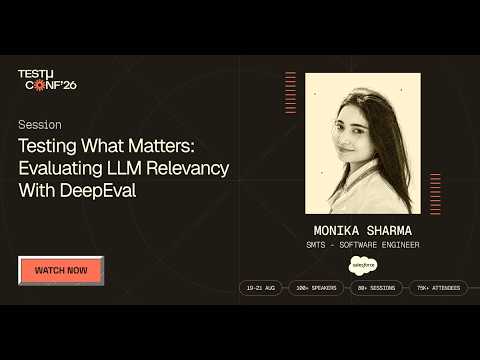
In this TestMu Conf 2026 session, Testing What Matters: Evaluating LLM Relevancy with DeepEval, Monika Sharma goes deep on relevancy, the failure mode where an answer looks fluent and sounds confident yet completely misses what the user asked, and shows how to measure and test it with DeepEval.
LangSmith
LangSmith is LangChain's developer platform for building, debugging, evaluating, and monitoring LLM applications. It provides deep visibility into application execution, helping developers trace workflows, inspect prompts, compare experiments, and continuously improve application quality throughout development and production.
Key features:
- Application tracing. Visualize complete execution paths for prompts, chains, tools, and agents.
- Prompt evaluation. Compare prompt versions and measure their impact on output quality.
- Dataset management. Create and maintain reusable evaluation datasets.
- Experiment tracking. Benchmark models, prompts, and workflows across multiple iterations.
- Online evaluations. Evaluate production traces using automated and human feedback.
- LangChain integration. Native support for LangChain and LangGraph applications.
Ragas
Ragas is an open-source evaluation framework built specifically for Retrieval-Augmented Generation (RAG) applications. Rather than evaluating only generated responses, it measures both retrieval quality and answer quality using reference-free evaluation metrics, helping developers identify weaknesses across the entire RAG pipeline.
Key features:
- Faithfulness evaluation. Verify whether responses are grounded in retrieved context.
- Answer relevancy. Measure how well responses address user queries.
- Context precision. Evaluate the relevance of retrieved documents.
- Context recall. Measure whether sufficient context has been retrieved.
- Reference-free evaluation. Assess RAG systems without requiring manually labeled ground-truth datasets.
- RAG pipeline evaluation. Test both retrieval performance and response generation.
Promptfoo
Promptfoo is an open-source framework for testing, evaluating, and red teaming LLM applications. It enables developers to compare prompts across multiple models, automate evaluations, benchmark AI systems, and test RAG applications and AI agents before deployment.
Key features:
- Prompt testing. Compare prompt performance across different LLM providers.
- Automated evaluations. Execute repeatable evaluations using custom datasets.
- Regression testing. Detect prompt and model regressions over time.
- RAG evaluation. Measure factuality, faithfulness, answer relevance, and context quality.
- AI agent testing. Evaluate tool use, task completion, and multi-turn conversations.
- Red teaming. Test applications against adversarial prompts and jailbreak attacks.
TruLens
TruLens is an open-source evaluation and observability framework designed for LLM applications. It helps developers evaluate response quality, monitor application behavior, and analyze Retrieval-Augmented Generation (RAG) systems using customizable feedback functions and production observability.
Key features:
- Feedback functions. Evaluate responses using customizable quality metrics.
- Groundedness evaluation. Measure whether responses are supported by retrieved context.
- RAG evaluation. Assess retrieval quality and generated responses.
- Application observability. Monitor model behavior throughout development and production.
- Execution tracing. Analyze interactions across the entire LLM pipeline.
- Continuous monitoring. Track application performance over time.
Frameworks like DeepEval and LangSmith solve the model and pipeline layer of the problem: they score outputs, trace chains, and catch regressions in prompts and RAG retrieval. What they don't cover is what happens once that LLM ships inside a real product, where a chatbot lives in a web UI, a voice agent handles live calls, and an agentic workflow clicks through actual screens. That is the gap TestMu AI fills.
TestMu AI approaches LLM testing from the application end rather than the library end. Its Agent Testing platform connects to an LLM-powered application through the same channel real users reach, then deploys 15+ specialized AI testing agents that each probe a different failure mode across a generated scenario set. Every exchange is scored against metrics like accuracy, intent recognition, and hallucination detection with configurable thresholds, and each run returns a production-readiness verdict backed by the specific conversation turns that drove each score, rather than a bare list of numbers.
Because Agent Testing sits on the same platform as KaneAI and a real device and browser cloud spanning thousands of environments, teams can validate not just whether the model's answer is correct, but whether the entire AI-powered experience behaves correctly for an end user. In practice, the two approaches are complementary: use an eval framework to harden the model layer during development, and use TestMu AI to continuously verify the application layer where your LLM actually meets production traffic.
Common Challenges in LLM Testing
Testing Large Language Models (LLMs) is more challenging than testing traditional software because LLMs generate probabilistic rather than deterministic outputs. The same prompt can produce different responses, making conventional testing methods ineffective. Additionally, issues such as hallucinations, prompt sensitivity, security vulnerabilities, and model drift require specialized evaluation strategies.
Probabilistic and Non-Deterministic Outputs
The challenge: LLMs can generate different responses for the same prompt, making exact output comparison and traditional regression testing unreliable.
How to overcome it: Evaluate responses using semantic metrics like correctness, answer relevancy, and faithfulness instead of exact text matching.
Hallucinations and Factual Accuracy
The challenge: LLMs may generate incorrect or fabricated information that appears accurate, reducing the reliability of AI applications.
How to overcome it: Validate responses against trusted data sources or benchmark datasets. For RAG applications, ensure responses are grounded in the retrieved context.
Prompt Sensitivity
The challenge: Small changes in prompt wording can significantly impact the quality, accuracy, or format of the generated response.
How to overcome it: Test multiple prompt variations and perform regression testing after prompt or model updates to ensure consistent behavior.
Context Limitations
The challenge: During long conversations, LLMs may lose earlier context or fail to follow previous instructions, leading to inconsistent responses.
How to overcome it: Evaluate multi-turn conversations and long-context scenarios to measure how well the model retains information over extended interactions.
Security and Adversarial Attacks
The challenge: Prompt injections and jailbreak attempts can manipulate LLMs into bypassing safety mechanisms or exposing sensitive information.
How to overcome it: Conduct regular adversarial testing and red teaming to identify vulnerabilities and strengthen model guardrails before deployment.
Cost, Latency, and Model Drift
The challenge: Large-scale evaluations can be expensive, while frequent model updates may introduce unexpected behavioral changes and regressions.
How to overcome it: Automate evaluations using benchmark datasets, integrate testing into CI/CD pipelines, and continuously monitor key metrics to detect regressions early.
Overcoming these challenges requires a combination of automated evaluation, human review, regression testing, and continuous monitoring. By adopting a structured testing strategy, organizations can improve the accuracy, reliability, and security of their LLM-powered applications while delivering a more consistent user experience.
Real-World LLM Testing Use Cases
Large Language Models are increasingly being integrated into customer-facing applications, enterprise workflows, and AI agents. Since each application has unique quality, safety, and performance requirements, LLM testing must be tailored to the specific use case. Below are some of the most common real-world scenarios where comprehensive LLM testing is essential.
- AI chatbots and virtual assistants. AI chatbots are widely used for customer support, IT helpdesks, and virtual assistants. Testing focuses on response accuracy, intent recognition, conversation consistency, hallucination detection, and safety. Multi-turn conversations are also evaluated to ensure the chatbot retains context and follows user instructions throughout the interaction.
- Retrieval-Augmented Generation (RAG) applications. RAG applications combine LLMs with external knowledge sources to generate grounded responses. Testing verifies that the retrieval system returns relevant documents and that the generated answer accurately reflects the retrieved context. Common evaluation metrics include faithfulness, context precision, context recall, and answer relevancy.
- AI coding assistants. Coding assistants help developers generate code, explain errors, and suggest fixes. LLM testing evaluates code correctness, syntax validity, logical accuracy, security vulnerabilities, and the model's ability to generate reliable code across different programming languages and frameworks.
- AI agents. Unlike traditional chatbots, AI agents can reason, call external tools, execute workflows, and make multi-step decisions. Testing ensures agents select the correct tools, complete tasks successfully, recover from failures, and produce reliable outcomes across complex workflows rather than evaluating only the final response.
- Content generation platforms. LLMs power applications for writing blogs, marketing copy, product descriptions, emails, and social media posts. Testing focuses on factual accuracy, grammar, tone, consistency, brand alignment, originality, and compliance with content guidelines while ensuring outputs remain relevant to the intended audience.
- Enterprise knowledge assistants. Organizations use LLM-powered assistants to answer questions from internal documentation, policies, and knowledge bases. Testing validates document retrieval quality, factual correctness, access control, and citation accuracy while ensuring confidential information is not exposed to unauthorized users.
- Healthcare and financial AI. In regulated industries such as healthcare and finance, even minor inaccuracies can have serious consequences. LLM testing emphasizes factual accuracy, compliance, bias detection, safety, explainability, and adherence to industry regulations before deployment into production environments.
For the conversational surface specifically, chatbot testing covers the test types and case templates that apply once an LLM is answering real users.
Conclusion
As LLM-powered applications become more capable, testing can no longer be treated as a one-time activity before deployment. Models evolve, prompts change, and user interactions introduce new scenarios that can affect response quality over time.
A well-defined LLM testing strategy helps teams continuously evaluate accuracy, reliability, safety, and overall performance throughout the application lifecycle. By combining meaningful evaluation metrics, automated testing, regression testing, and production monitoring, organizations can identify issues early and deliver more dependable AI experiences.
To put this into practice, start by assembling a golden dataset from real user prompts, then automate the evaluation loop so it runs on every prompt and model change. Teams testing the wider application around the model can author those journeys in natural language with KaneAI.
Author

Anubhav Singhmaar
Blogs: 34

Anubhav Singhmaar is an AI Product Manager at TestMu AI driving Kane CLI, the command-line tool that brings browser automation to the terminal, turning natural-language flows into runs in a real Chrome browser that return pass or fail with shareable proof. He owns the roadmap and prioritization and works with engineering to ship developer-facing features. Before TestMu AI, he spent over four years at Sprinklr owning enterprise voice AI across APAC and EMEA. A mechanical engineer turned product manager, he grounds guidance in real QA workflows.
Reviewer

Samyak Goyal
Reviewer
Samyak Goyal is a Senior Member of Technical Staff at TestMu AI engineering Kane CLI, the command-line tool that runs browser automation from the terminal, where a flow described in natural language executes in a real Chrome browser and returns pass or fail with shareable proof. He is a backend engineer with 4+ years of experience, previously an SDE at Innovaccer, where he built APIs, introduced Kafka, and cut deployment from weeks to hours. Samyak also builds multi-agent systems, skill-orchestration frameworks, and a personal copilot that indexes 200+ microservice repositories.


LLM Testing FAQs
Did you find this page helpful?
More Related Blogs
TestMu AI forEnterprise
Get access to solutions built on Enterprise
grade security, privacy, & compliance
- Advanced access controls
- Advanced data retention rules
- Advanced Local Testing
- Premium Support options
- Early access to beta features
- Private Slack Channel
- Unlimited Manual Accessibility DevTools Tests