

Power Your Software Testing with AI Agents and Cloud
The Native AI-Agentic Cloud Platform to Supercharge Quality Engineering. Test Intelligently and Ship Faster.


- TestMu AI (Formerly LambdaTest)
- /
- Blog
- /
- Natural Language Test Automation: How It Works and Fails
Natural Language Test Automation: How It Works and Fails
Natural language test automation turns plain English into executable tests. See how element resolution works, where non-determinism appears, and when to use it.
Published on:
Natural language test automation lets you write a test as a plain English sentence and have a language model resolve that sentence into executable steps against the live application. The 2025 Stack Overflow Developer Survey reports that 66% of developers name "almost right, but not quite" AI output as their biggest frustration, and that is the failure mode a generated test has to survive.[1]
This guide covers how a sentence becomes an executed test, the three architectures that interpret it, production reliability, verifying a generated test, the Gherkin precedent, selector hygiene, and where plain English tests belong.
Key Takeaways
- Element resolution: Test reliability comes from how the runner finds an element at run time.
- Temperature 0: Setting temperature to 0 does not make a model deterministic, because inference output shifts with server batch size.
- Almost-right output: 66% of developers name near-correct AI output as their top frustration, so budget review time for every generated test.
- Resolution caching: Resolve a step to a locator once and replay the stored locator, so model variance is confined to repair time.
- Role and test-id locators: Targeting by role, visible text, or test id removes most selector churn with no AI involved.
- Suite placement: Start on new, high-churn flows with shallow assertions and keep code for complex state and exact values.
What Is Natural Language Test Automation?
Natural language test automation is automated testing where the test is authored as a plain English instruction and software converts that instruction into executable steps. A step reads "click Checkout and verify the order total is 49.99" instead of a locator and an assertion method.
The term covers two generations of technology that behave very differently. Classical systems parsed the sentence with tokenization and part-of-speech tagging, then matched the parsed words to a fixed set of stored actions. Current systems send the instruction and the live page state to a language model, which infers the intended action and target.
The parser-versus-model distinction matters when you evaluate a tool. A parser only handles phrasings someone mapped in advance, so it fails on a sentence it has not seen. A model handles new phrasing but introduces run-to-run variance. Both are marketed with the same phrase, so ask which one you are buying.
How Does a Plain English Test Step Become an Executed Action?
A plain English step executes in four stages: the system reads the instruction, captures the current application state, picks one element as the target, then performs the action and checks the result. Stage three is where almost every failure happens.
Element resolution is the hard part because a sentence like "click the submit button" can match three elements on a real page. The system has to choose, and how it chooses is the most important property of the tool. Three architectures resolve that choice differently.
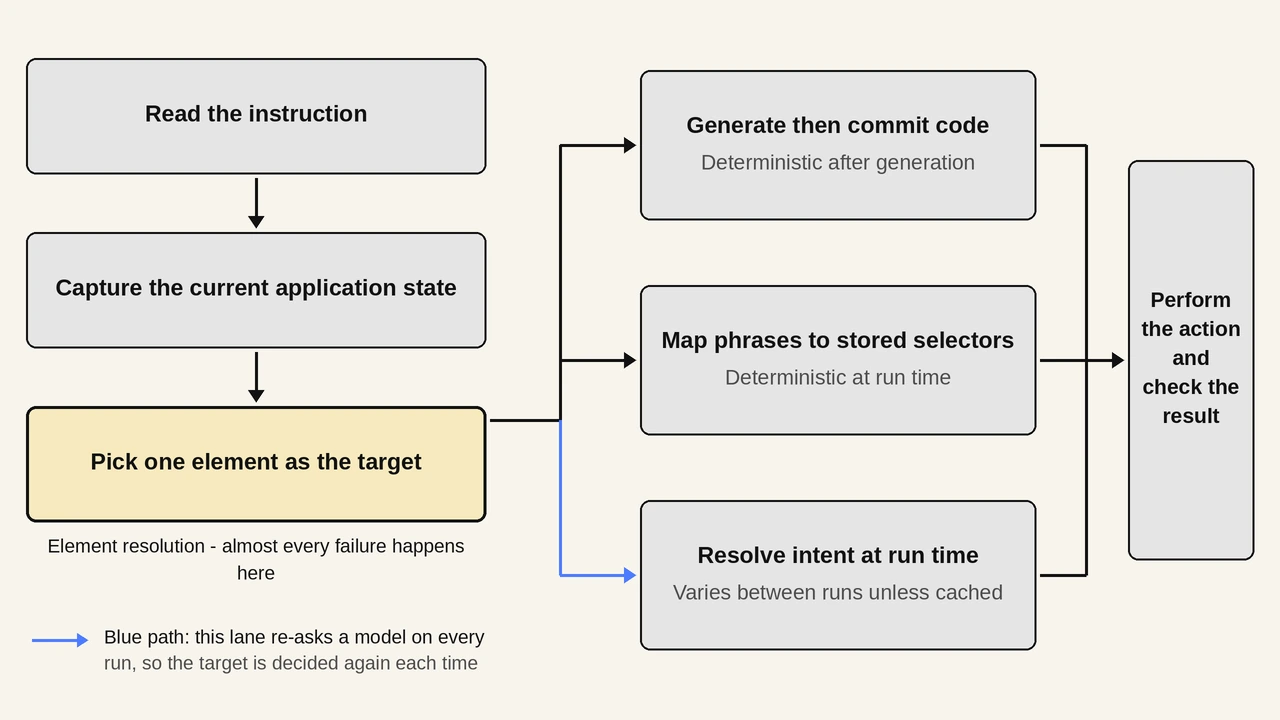
| Architecture | How the target is found | Run-to-run behavior | Where it breaks |
|---|---|---|---|
| Generate then commit code | A model writes a locator once, a human reviews it, and the code is committed to the repository. | Identical to any hand-written Playwright or Selenium test after generation. | Regenerating a test silently drifts from the version a reviewer approved. |
| Map phrases to stored selectors | A parser matches the phrase against a stored locator recorded for that step. | Deterministic at run time, because no model runs during execution. | A rephrased step or a renamed attribute breaks the match. |
| Resolve intent at run time | A model reads the rendered screen on every run and selects the target semantically. | Varies between runs unless the resolved target is cached and replayed. | Ambiguous wording and pages with several plausible matches. |
That third architecture is the one that defines intent-based testing, where the test binds to the outcome rather than to a stored locator, and it carries a distinct failure mode worth understanding before adopting it.
Playwright ships the generate-then-commit architecture in its own toolchain.
Playwright's planner agent explores the application and writes a Markdown plan, the generator agent turns that plan into Playwright tests and verifies selectors and assertions live as it performs the scenario, and the healer agent replays failing steps and suggests a locator or wait fix.[2] The output is ordinary test code, which is why it inherits ordinary test-code behavior. Our walkthrough of Playwright agents covers that workflow step by step.
What Does Plain English Authoring Actually Improve?
Plain English authoring improves authoring speed first, review speed second, and team readability third. Every gain carries a condition, and the condition decides whether the saving survives a real suite.
The authoring gain is the concrete one. Playwright's generator agent turns a plan into executable tests and verifies selectors and assertions live as it performs the scenario, so a generated test has already run once before a reviewer opens it.[2] That shortens the write-then-debug loop, not the maintenance cycle behind it.
- Time to first test: Describing a flow in one sentence skips the inspect-element and copy-selector steps that open every hand-written test.
- First-run verification: A generator that executes a scenario while writing it catches a broken locator before review rather than during the next CI run.
- Cross-role readability: Gherkin proved plain-language steps read well and still left engineers owning them, so readability alone does not move authoring to product or QA.[9]
- Existing locator quality: A suite already targeting by role and test id has less selector churn left to recover, so its measurable gain is smaller.[7]
Is Natural Language Test Automation Reliable Enough for Production?
Natural language test automation is reliable for straightforward flows and unreliable as a full replacement for coded suites. The deciding factor is whether the tool re-asks a model on every run. Cached resolution behaves like a normal test; live re-resolution inherits the model's variance.
Two published numbers set the honest expectation. On WebArena, a benchmark of real web tasks driven by natural-language goals, the best GPT-4 based agent reached an end-to-end task success rate of 14.41% against human performance of 78.24%.[3] A systematic review of AI-powered testing tools found they struggle with complex UI changes and contextual understanding, and named false positives and dependency on predefined models as active constraints.[4]
The mechanism behind the variance is more specific than "models are random," and knowing it changes what you ask a vendor. Setting temperature to 0 does not make the output deterministic. Horace He and Thinking Machines Lab generated 1,000 completions from Qwen3-235B-A22B-Instruct-2507 at temperature 0 and got 80 unique completions, with the first divergence at token 103.[5]
Batch size is the cause. Many inference kernels produce slightly different numerical output depending on how many requests are batched together, and server load changes the batch size unpredictably, so the same request can resolve one way under light load and another way at peak.[5] A test suite that re-resolves elements through a shared inference endpoint therefore has a flakiness source that no retry policy in your framework can see.
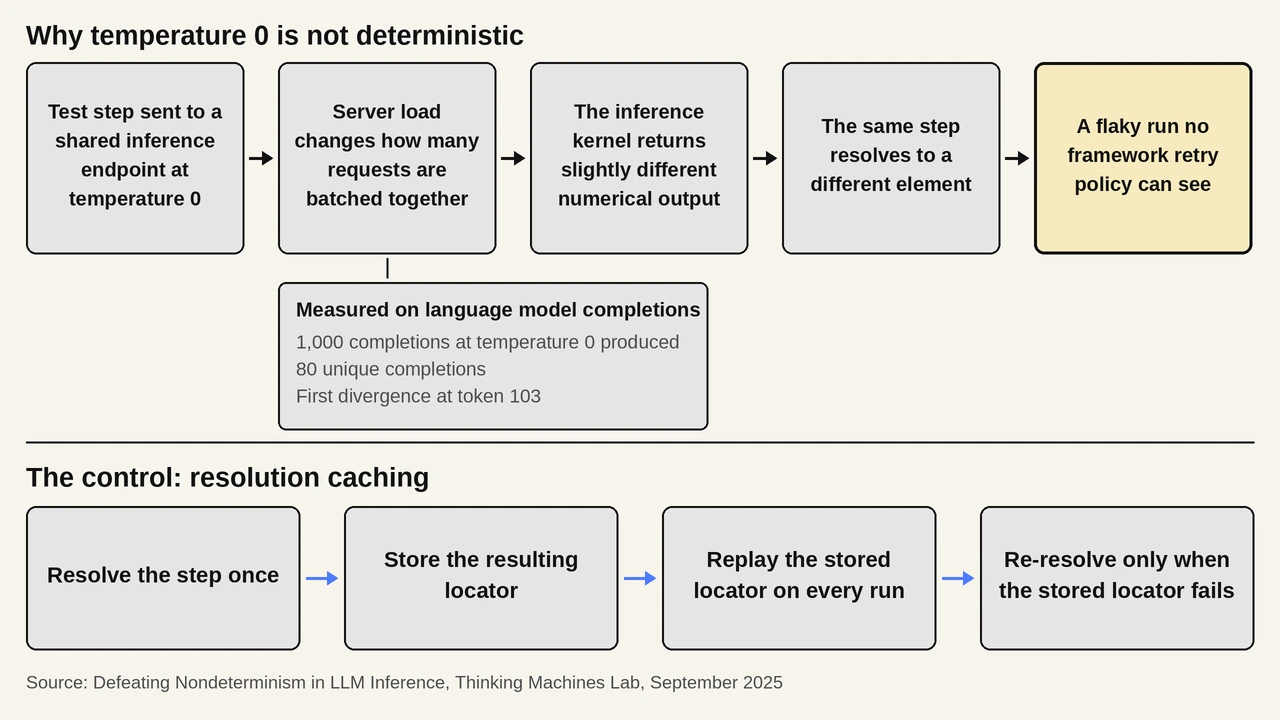
The practical control is to stop asking the model during normal runs. Resolve each step once, store the resulting locator, and replay it; let re-resolution fire only when the stored locator fails. That confines model variance to repair time, where a human is already looking. Our guide to the flaky test problem covers how to measure the baseline before you change anything.

How Do You Know a Generated Test Checks What You Meant?
You read it. A generated test that runs green proves the steps executed, not that the assertion was correct, so every generated test needs a human to confirm the assertion matches the requirement before it enters the suite.
Review time decides whether the authoring savings hold. The 2025 Stack Overflow Developer Survey found that 46% of developers actively distrust the accuracy of AI output while 33% trust it, and only 3% highly trust it.[1] Distrust at that level is a review budget, and it has to be planned rather than discovered.
There is a structural argument here that vendor documentation rarely raises. Writing a test and writing the implementation are two independent expressions of the same requirement, and the disagreement between them is what catches a misunderstanding. When one model generates both the code and the test that checks it, both come from the same interpretation, and that cross-check disappears.
Practitioners on Hacker News described the same loss of independent verification: a generated test can be technically sound and still test the wrong thing, because the design flaw was never caught by an independent implementer.[6] Two rules follow. Keep the requirement, not the generated test, as the thing a reviewer checks against. Never let the same agent author both the feature and its gating test.
Does Plain English Authoring Reduce Test Maintenance?
Plain English authoring reduces authoring time reliably and maintenance time conditionally. Self-healing converts a broken locator from a rewrite into a review, which is cheaper but not free, because a human still approves each proposed repair.
Before attributing selector churn to selectors, check how the selectors were written. Playwright's own guidance is direct about the cause: "Your DOM can easily change so having your tests depend on your DOM structure can lead to failing tests," and it recommends targeting elements by role, label, or an explicit test id rather than a CSS class chain such as button.buttonIcon.episode-actions-later.[7]
The difference between DOM-coupled and role-based locators has a cost consequence. A suite built on inspector-copied XPath breaks on cosmetic refactors, and moving it to role and test-id targeting removes most of that churn with no AI in the loop.
A suite already using role-based locators has far less maintenance for a tool to save, so the business case for adopting one is weaker there. Measure your current break rate and its causes first. Our reference on Selenium locators lists the stable strategies.
In the Reddit thread "Anyone using natural language for test automation or still writing selectors?" on r/ExperiencedDevs, practitioners argued that flakiness is both the core end-to-end testing problem and the core language-model problem, and one commenter reported running about 40% of their tests in natural language with code still required for complex scenarios.[8] The thread reached no consensus that plain English authoring is production-ready.
The strongest objection in the r/ExperiencedDevs thread was about the baseline rather than the technology. One commenter argued that copying an elaborate selector out of the element inspector guarantees brittle tests, and that structuring the UI so tests select by visible content and role removes the problem at its source. That critique is correct, and it is the first thing to fix.

Note: Run plain English and coded suites across 3,000+ browser and OS combinations with TestMu AI. Try free!
Is Plain English Test Authoring Just Gherkin and BDD With a Language Model?
No, and the difference is the mapping layer. Gherkin needed a step-definition method for every phrase, so the plain language was only an interface over code someone still wrote. A language model resolves the sentence directly, with no step definitions to maintain.
The precedent is worth studying because it failed for a reason that has nothing to do with parsing. Andy Knight, who teaches BDD practice at Automation Panda, describes the mechanical friction plainly: Gherkin lets people write specs in plain language, "but the steps they write must be written perfectly and identically every time."[9]
The organizational failure mattered more. Gherkin assumed business stakeholders would write or review the scenarios, and in practice engineers wrote and maintained them alone. Developers on Hacker News described the same outcome, one calling Cucumber "very, very poorly suited for writing anything beyond very basic specifications."[10] The plain-language artifact became documentation nobody read.
Two lessons transfer to any plain English suite you adopt now. Name the owner of the tests before you start, because the tests default to whoever is on call for the pipeline. Then check whether non-engineers genuinely author tests after month one, since that is the assumption the previous generation got wrong. Our Cucumber testing guide covers the step-definition model in detail.
Which Tests Should Stay in Code?
Keep code wherever the assertion is exact or the setup is complex. Plain English is well suited to navigation and happy-path flows, and poorly suited to precise numeric checks, elaborate fixtures, and any test whose failure blocks a deploy.
Use these criteria to split the suite:
- Exact-value assertions: Tax, interest, and currency rounding checks belong in code, because a semantic assertion that a total "looks correct" is not an assertion.
- Complex fixtures: Tests needing seeded database state, mocked third-party responses, or a specific permission matrix are faster to express in code than in prose.
- Deploy gates: A blocking test must fail for exactly one reason, so remove every avoidable variance source from the tests that hold the release.
- High-churn UI flows: Onboarding and checkout paths that change every sprint are the best candidates to move, since authoring cost dominates there.
- Coverage gaps: Flows nobody automated because writing the test cost more than the risk justified are pure upside for plain English authoring.
Ambiguity is the practical limit on prose. "Verify the dashboard loads correctly" gives a model nothing to check, while "verify the dashboard shows a row for order 1042" is checkable. Write steps that name an observable fact, and the ambiguity objection largely goes away.
How Do You Add Plain English Authoring Without Losing Control of the Suite?
Insist on a review gate before execution and an export path to code you own. Those two properties keep a plain English suite reviewable in a pull request and portable if you change tools, which is what teams lose when they adopt a tool without checking for either.
Ownership is the failure teams hit. Tests authored inside a vendor interface never reach the repository, so nobody reviews them in a diff, nobody can grep them, and the suite cannot move. The second failure is unreviewed generation: an agent proposes a plan and the plan runs before anyone reads it.
KaneAI from TestMu AI is built around both gates. It converts a natural-language prompt, a Jira ticket, or a PRD into a structured test plan, and that plan is human-readable and reviewable before anything executes, as you can follow step by step when you author a KaneAI test in natural language. The capabilities that matter for keeping control are specific:
- Plan review gate: Test plans are approved by a human before execution, and user input takes priority over agent decisions during a run.
- Multi-framework export: Generated tests export to Selenium, Playwright, Cypress, and Appium, so the suite lives in your repository rather than only in a dashboard.
- Reusable modules: Common steps such as login become a block authored once, so fixing the module updates every test that uses it.
KaneAI does not remove the review step, and TestMu AI's own guidance avoids claims of zero maintenance. Self-healing re-anchors a step when the UI shifts, which turns a rewrite into an approval, and smart versioning keeps a history so a heal that changed behavior can be rolled back. The same plain English authoring reaches native apps too, where a phrase like "scroll down until the Submit button is visible" resolves into a real gesture through KaneAI's scroll-until action on mobile rather than a brittle coordinate swipe.
The walkthrough below shows a described flow becoming an executable test case, including the plan step that a reviewer approves.

For a broader view of where model-driven tooling fits across a suite, our overview of ai in test automation maps the categories, and No-code test automation covers the builder-based alternative.

Conclusion
Natural language test automation earns its place as an authoring layer rather than a replacement for coded suites. The property that decides whether it works is element resolution. Cache the resolved locator and a plain English test behaves like a normal test. Re-ask a model on every run and you have added a flakiness source your framework cannot see.
Start by measuring your current break rate and its causes, then move role-based locators in before you move a tool in. Pick new, high-churn flows for the pilot, keep exact-value and deploy-gating tests in code, and require a review gate plus an export path from any tool you adopt. Read the getting started with KaneAI guide when you are ready to run the first flow.
Sources and References Used
- [1] 2025 Developer Survey: AI - Stack Overflow (2025)
- [2] Test Agents: Planner, Generator and Healer - Playwright Documentation
- [3] WebArena: A Realistic Web Environment for Building Autonomous Agents - Zhou et al. (July 2023, revised April 2024)
- [4] AI-powered software testing tools: A systematic review and empirical assessment of their features and limitations - Garousi et al. (August 2024, revised May 2025)
- [5] Defeating Nondeterminism in LLM Inference - Horace He, Thinking Machines Lab (September 2025)
- [6] Discussion on AI-generated tests and independent verification - Hacker News (2025)
- [7] Best Practices: Use locators resilient to DOM changes - Playwright Documentation
- [8] Anyone using natural language for test automation or still writing selectors? - r/ExperiencedDevs (December 2025)
- [9] Is BDD Dying? - Andy Knight, Automation Panda (March 2025)
- [10] Cucumber lets you write automated tests in plain language - Hacker News discussion (2025)
Author

Prince Dewani
Blogs: 28

Prince Dewani is a Community Contributor at TestMu AI specializing in AI agents, software testing, QA, and SEO. He is certified in Selenium, Cypress, Playwright, Appium, Automation Testing, and KaneAI, and presented academic research on AI agents at PBCON-01. At TestMu AI, he has also carried out extensive cross-browser research on the support of modern web technologies such as WebGPU, WebAssembly, WebXR, WebGL2 and other web technologies, validating their compatibility and feature parity across major browsers and rendering engines through rigorous hands-on testing. Prince has hands-on experience building AI agent workflows using Anthropic Claude, Google Antigravity, n8n, LangChain, and other agentic frameworks, and works regularly with MCP and A2A protocols. He shares his work with 5,500+ QA engineers, developers, DevOps experts, tech leaders, and AI agent practitioners on LinkedIn.
Reviewer

Srinivasan Sekar
Reviewer
Srinivasan Sekar is Director of Engineering at TestMu AI (formerly LambdaTest), where he leads engineering and open-source initiatives behind the Selenium and Appium automation grid and owns TestMu AI's MCP Server. A committer to Appium and a contributor to Selenium, WebdriverIO, Taiko, and AppiumTestDistribution, he brings over 15 years of experience in quality engineering and open-source technologies. He is the author of the Apress book 'The MCP Standard: A Developer's Guide to Building Universal AI Tools with the Model Context Protocol,' a Certified Kubernetes and Cloud Native Associate, and an international conference speaker. Before TestMu AI he spent over eight years at Thoughtworks as a Principal Consultant and Quality Architect. Srinivasan holds a B.Tech in Information Technology from Anna University.


Natural Language Test Automation FAQs
Did you find this page helpful?
More Related Blogs
TestMu AI forEnterprise
Get access to solutions built on Enterprise
grade security, privacy, & compliance
- Advanced access controls
- Advanced data retention rules
- Advanced Local Testing
- Premium Support options
- Early access to beta features
- Private Slack Channel
- Unlimited Manual Accessibility DevTools Tests