

Power Your Software Testing with AI Agents and Cloud
The Native AI-Agentic Cloud Platform to Supercharge Quality Engineering. Test Intelligently and Ship Faster.


- TestMu AI (Formerly LambdaTest)
- /
- Blog
- /
- Agentic QA: A Practical Guide to Agentic Quality Assurance
Agentic QA: A Practical Guide to Agentic Quality Assurance
Agentic QA uses AI agents that plan, run, and adapt tests alone. See how agentic quality assurance works, who validates agent output, and where it fits.
Last Updated on:
Agentic QA is quality assurance where an AI agent receives a testing goal instead of a script, then works out for itself which steps reach that goal. Scripted automation fixes that sequence before the run; an agent decides it during the run.
Moving the decision from authoring time to run time changes where the maintenance cost lands. A renamed button no longer turns forty tests red, because nothing in the run was pinned to that button's identifier.
TL;DR
Agentic QA is software testing where an AI agent receives a plain-language objective and works out at runtime which steps reach it, instead of replaying a sequence written in advance. It fits high-churn UI flows and unscripted coverage gaps, and every run still ends on a deterministic assertion the model cannot argue with.
What Defines Agentic Quality Assurance?
- Goal-driven execution: Agentic QA takes an objective written in plain language, such as verify a returning customer can complete checkout with a saved card, rather than an ordered list of clicks and selectors.
- Runtime element resolution: The agent queries the live application and picks an element by intent at the moment it acts, so a renamed button becomes a re-plan instead of a failed locator.
- Deterministic assertion boundary: In agentic QA the pass or fail decision sits outside the model, on a fixed check such as an exact text match, an HTTP status code, or a stored visual baseline.
- Agent-native output: A run is agent-native when another program is the primary reader of its result, emitting a typed event stream a coding agent or CI job parses rather than a dashboard a person interprets.
- Mandatory timeout: An agent that cannot find its way does not fail fast on its own, so an unattended agentic QA run without a hard time limit can hang indefinitely.
Where Does Agentic QA Fit Today?
- Strongest fit: Exploratory sweeps, high-churn UI regression, and flows nobody has scripted yet, where locator repair currently costs the most engineering time.
- Weakest fit: The thousand-test smoke suite running on every commit, because each agent decision costs a model call and stays slower than a scripted assertion.
- Runs unattended in CI: Yes, provided the runner is headless, credentials arrive as flags rather than an interactive login, and the pipeline branches on the exit code.
- Replaces QA engineers: No. Agentic QA absorbs step authoring and locator repair, not the judgment about what quality means for a specific product.
- Platform coverage: TestMu AI ships agentic QA as a testing agent for authoring and execution, a terminal and CI runner, and a separate evaluation platform for teams whose product is itself an AI agent.
What Is Agentic QA?
Agentic QA holds four properties at once, and a tool missing any of them is AI-assisted rather than agentic. Agentic quality assurance is the same term written in full, applying the agentic AI pattern to the test layer.
- Goal input - the operator states an outcome and never names a step.
- Live state, not a snapshot - the agent reads the actual page, API response, or screen state at the moment it acts.
- Non-deterministic routing - two runs against a changed UI can legitimately take different routes to the same verified end state.
- In-run feedback - results feed back into the next decision inside the same run, which separates an agent from a one-shot generator that writes a test and stops.
How Is Agentic QA Different From Traditional QA and Test Automation?
The difference is where the decision-making lives. Manual QA puts it in a person during execution, scripted automation freezes it into code before execution, and agentic QA hands it to a model during execution.
| Dimension | Manual QA | Scripted automation | Agentic QA |
|---|---|---|---|
| Test input | A written test case a person reads and follows | Code with explicit selectors, waits, and assertions | A natural-language objective describing the outcome |
| Response to a UI change | Tester adapts instantly and usually says nothing | Test fails on a stale locator until someone edits it | Agent re-resolves the element, continues, and surfaces the change for review |
| Maintenance unit | Rewriting the test case document | Editing selectors, waits, and page objects | Rewording the objective or tightening the assertion |
| Coverage growth | Limited by tester hours available in the sprint | Limited by engineering hours spent authoring | Limited by how precisely objectives can be stated |
| Result reliability | Varies with tester attention and fatigue | Deterministic, and repeats the same mistake exactly | Same verdict, different route on each run |
| Best applied to | Exploratory work and subjective judgment calls | Stable, high-value flows that rarely change | High-churn UI and unscripted coverage gaps |
On a high-value flow that rarely changes, such as a payment path, agentic QA complements rather than replaces a deterministic regression testing suite. Teams already running self-healing test automation are partway there, since runtime element repair is the first agentic behavior most suites adopt. Deciding which of the two shapes a given check actually needs is worked through in qa agent vs verification tool.
How Does Agentic Quality Assurance Actually Work?
It runs a loop of four operations, repeated until the objective is met or a step limit is hit.
- Observe - the agent captures the live state, whether that is page structure, visible text, the accessibility tree, network responses, or a screenshot.
- Decide - it maps the objective onto what it can see and selects one concrete next action, along with the element it will act on.
- Act - it performs the click, entry, scroll, or API call, then waits for the application to settle.
- Verify - it re-reads the state and checks whether the action moved the run toward the objective, then continues, retries differently, or reports a failure.
An exploratory testing session is a human running this exact loop, with intuition supplying the decide step. The difference is that a tester stops at the end of the session and an agent does not.
Are Agentic QA, Autonomous Testing, and Agent-Native QA the Same Thing?
No, and they do not even measure the same thing. AI-assisted, agentic, and autonomous sit on one axis that tracks how much the human still does. Agent-native sits on a second axis that tracks who reads the result, which is why it can be true of a tool at any point on the first axis.
- AI-assisted testing keeps the human as the operator. The model suggests a locator, drafts a test, or summarizes a failure, and a person accepts or rejects every suggestion before anything runs.
- Agentic QA moves execution to the agent but keeps the human as the goal-setter and approver.
- Autonomous testing is the stronger claim, describing a system that also selects its own objectives, typically by crawling an application and deciding what is worth testing.
Most tools marketed as autonomous are agentic testing tools with a discovery phase in front. Skip the label and ask who writes the objective and who signs off on the verdict.
If a human does both, it is agentic, whatever the pricing page calls it. That test also sorts the agentic AI tools market faster than any feature matrix.
Agent-native is the second axis, and it measures who the run reports to. A tool that reports through a dashboard assumes a person will read and interpret it. An agent-native runner assumes a program will, so it emits a structured result another agent or a CI job consumes directly without scraping logs or parsing prose.
| Term | Who picks the objective | Who reads the result |
|---|---|---|
| AI-assisted testing | A human, who also approves each generated step | A human, in an editor or dashboard |
| Agentic QA | A human writes the objective; the agent picks the steps | Either, depending on the runner |
| Autonomous testing | The system, usually by crawling and deciding what matters | Either, depending on the runner |
| Agent-native QA | Unspecified, because this axis says nothing about it | Another program, via a machine-readable event stream |
Kane CLI makes the distinction concrete. Its agent mode emits one typed NDJSON event per line as the run progresses, and every line is a complete JSON object a caller can act on before the run finishes:
{"type":"run_start","objective":"Verify checkout","timestamp":"2026-04-30T10:30:45Z"}
{"type":"step_start","index":0,"objective":"Navigate to cart page"}
{"type":"step_event","index":0,"event":"action","detail":"Navigated to /cart","success":true}
{"type":"step_event","index":0,"event":"screenshot","detail":"Screenshot captured"}
{"type":"step_end","index":0,"status":"passed","duration":2.3,"summary":"Navigated to cart"}
{"type":"step_start","index":1,"objective":"Click checkout button"}
{"type":"run_end","status":"passed","summary":"Checkout completed","duration":45.2}
The run_end event always arrives last and carries the status, duration, and any values the run extracted, so a caller can stop reading there. Each step_event is tagged as a screenshot, reasoning, action, vision, assertion, or evaluation, which is the forensic trace a reviewer reads when a green run looks suspicious.
Nothing in that stream is written for a person. It exists so a coding agent can decide whether to keep working, which is the same design pressure that produces agent-first development on the engineering side of the same workflow.
The clearest tell that a runner is agent-native is what it does when nobody is watching. Kane CLI exposes an ask_user event for mid-run questions and disables it automatically when stdin is not a TTY, so an unattended run returns a verdict instead of hanging on a prompt no one will answer.
The practical consequence is that agent-native is the property you check before granting autonomy, not after. A tool can be fully autonomous and still be unusable in an unattended pipeline if its only output is a page a human has to open.
What Happened When I Ran an Agentic QA Loop Myself?
KaneAI turned one plain-English sentence into a six-step test case and passed it in 120.9 seconds. I named no selector, no element id, and no step order.
I ran it from the terminal against the Selenium Playground form demo. My objective was one line: enter a specific string into the message field and verify the page displays that exact string back.
KaneAI decomposed that into six steps, auto-titled the case Verify Message Display, and filed it in Test Manager as TC-50159 with a CLI tag.
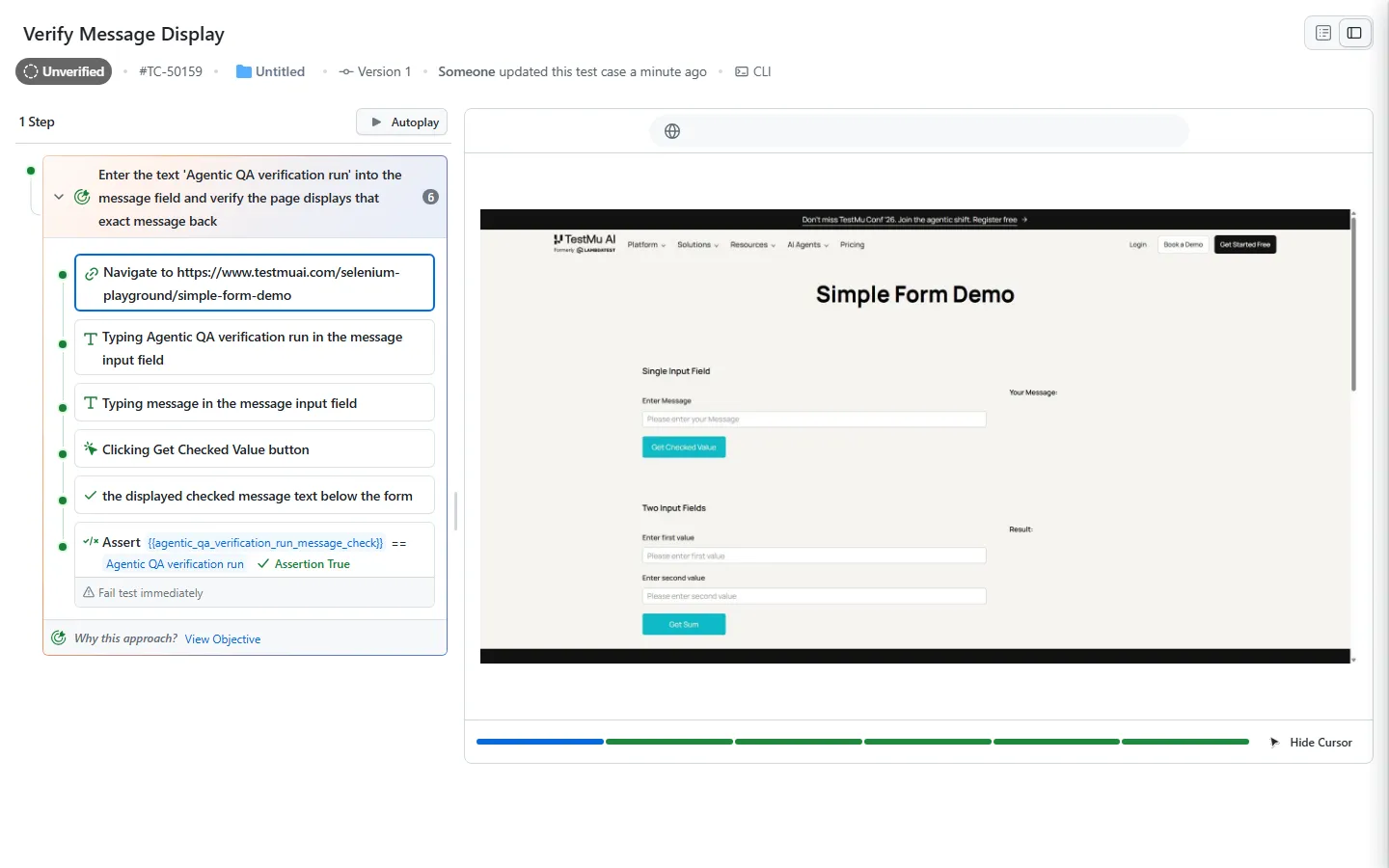
The self-correction is worth pausing on. Step two typed the string with a trailing period, and step three retyped it without one. Nothing in my objective asked it to check its own typing.
The assertion tells you more about the product than the pass does. KaneAI stored the on-page text as a reusable variable, applied a strip transform, then compared with equals rather than contains, because a contains check would have passed on a partially filled field.
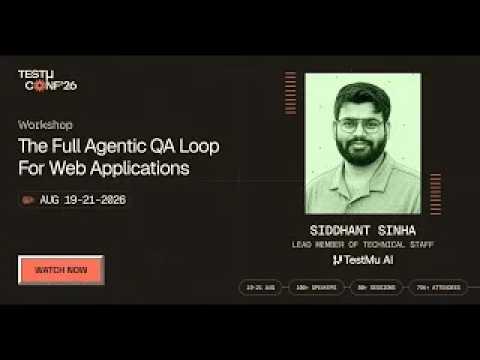
The run above covers only the authoring step. In this TestMu Conf 2026 workshop, Siddhant Sinha runs the whole loop end to end with the same CLI in The Full Agentic QA Loop for Web Applications — Author, Evidence, Assure, Maintain, carrying on from authoring into capturing what actually happened, assuring it against intent, and keeping the suite from rotting as the product changes.
Who Validates the AI Agent's Test Results?
You do, and the validation needs a concrete mechanism. An agent that both performs the action and judges whether it worked is grading its own homework. The failure mode is a quiet green run that verified nothing.
In a randomized controlled trial published by METR in July 2025, 16 experienced open-source developers worked through 246 real issues on repositories they had contributed to for years. They took 19% longer on the issues where AI tools were allowed. Asked afterwards, those same developers estimated AI had made them 20% faster.
If practitioners cannot judge their own output reliably, an agent judging its own output is not a control at all. Four controls do the real work:
- Pin the assertion, not the route. Let the agent discover and navigate freely, then decide pass or fail with a deterministic check: an exact text match, an HTTP status code, a database row, or a stored visual baseline.
- Read the trace on every new objective. A run can reach the right end state through wrong reasoning, and only the step-by-step trace exposes an agent that skipped the flow you cared about.
- Re-run new objectives before trusting them. One green run proves the agent found a path; it does not prove the path is reproducible.
- Separate discovery failures from product failures in triage. An agent that could not find the checkout button is reporting a navigation problem, which is a different ticket from a checkout that rejects a valid card.
With that third control, agent runs start to resemble a flaky test problem, because a non-reproducible red is exactly the signature teams already know how to triage badly. Grouping recurring agent failures by root cause is a job for test intelligence, since a flaky agent decision and a real product defect look identical in a raw pass or fail count.
The same separation decides where this control belongs in the wider process, which agentic SDLC vs STLC maps phase by phase.
How Does KaneAI Run the Agentic Quality Assurance Process?
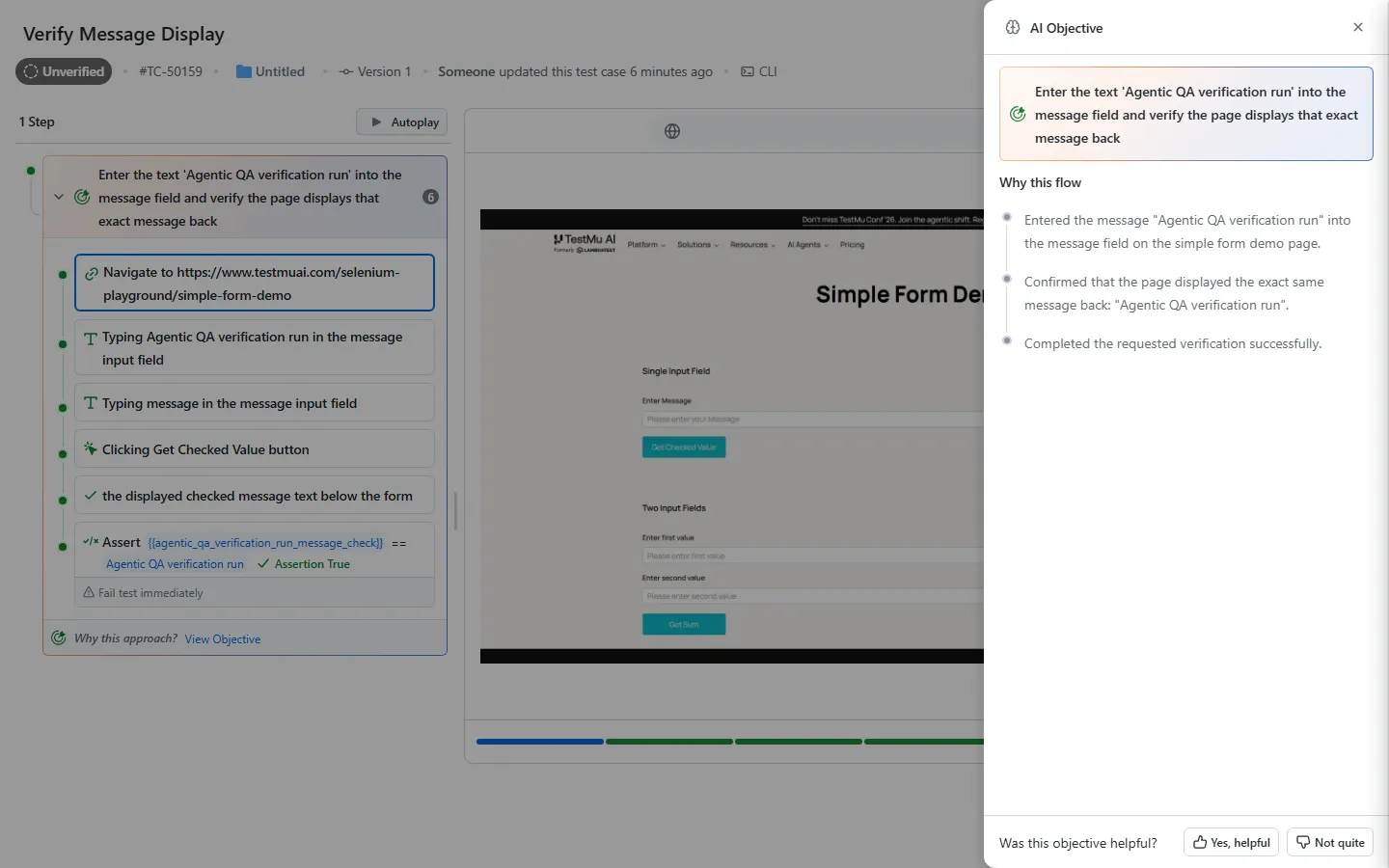
KaneAI runs it as a five-phase cycle from intent to maintained coverage, with a human review gate after planning. The model is the authoring surface, so you can type a condition a recorder could never capture: click the second result, not the first.
- Intent and context intake - input is whatever the team already has, from a typed prompt or a PRD to a Jira ticket, a spreadsheet, a screen recording, or a GitHub pull request diff. Non-English input is auto-translated first.
- Plan and scenario generation - KaneAI converts that intake into a readable plan of ordered steps, with smart assertions proposed where validation matters. Nothing executes until a person reviews it, and the plan carries KaneAI's own explanation of the flow.
- Authoring and element resolution - each step resolves against the live application through smart element detection, identifying targets by intent and context instead of binding to a brittle selector. Steps refine conversationally.
- Execution on the cloud grid - tests run in parallel through HyperExecute across 3,000+ browser and OS combinations and 10,000+ real mobile devices. A paused run lets a person correct a step and hand control back.
- Maintenance and evolution - results arrive with root-cause analysis and, where applicable, auto-drafted bug tickets carrying the trace. Self-healing re-anchors steps that would break on UI changes, and common steps promote into reusable modules so one fix propagates everywhere.
A single KaneAI flow also spans layers. In one connected run it can:
- Click through the UI and assert the backing API returned the right payload.
- Confirm the database write landed, using a live query rather than a UI proxy for it.
- Audit the rendered page for WCAG violations and produce a compliance report.
- Capture a visual regression diff against the stored baseline.
Case-level retry intelligence absorbs intermittent failures instead of failing the whole run. One caveat on the self-healing above: it reduces maintenance without eliminating it, because every heal still surfaces for review.
Generated tests export to Selenium, Playwright, Cypress, or Appium, so the existing codebase stays the system of record. The KaneAI getting started documentation walks through the first authoring session.

How Do You Test AI Agents Themselves?
You score their output on quality metrics instead of asserting against selectors. When the product you ship is a chatbot, a voice assistant, or a phone agent, the same input produces a different response every run. Correctness becomes a graded judgment rather than a boolean.
The failure modes are unfamiliar to a functional testing team, and none of them surface in a status-code check. An agent can:
- Invent a policy that does not exist and state it confidently.
- Contradict what it said two turns earlier in the same conversation.
- Treat users differently based on accent or phrasing.
- Answer correctly in a tone that destroys the interaction.
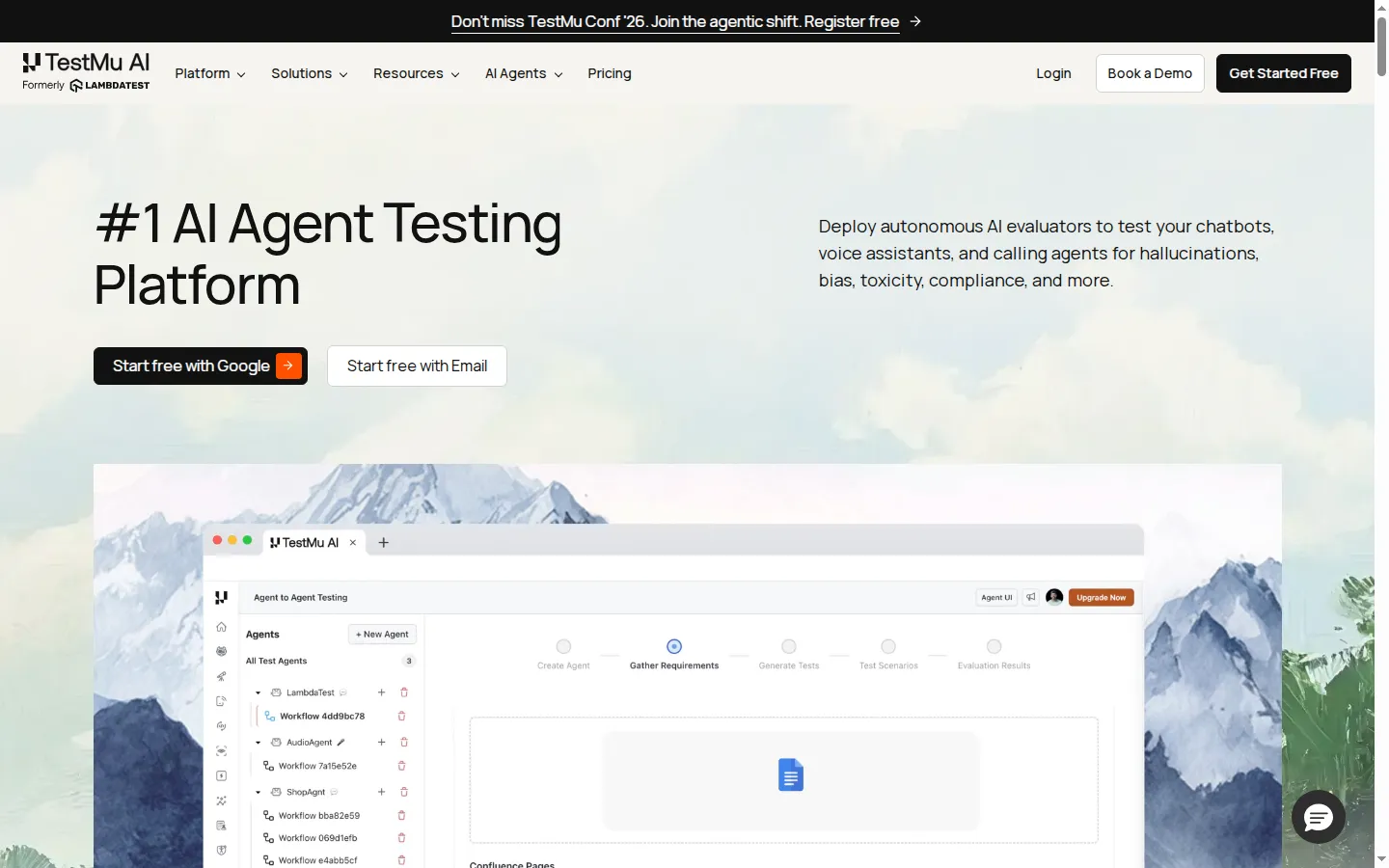
TestMu AI handles QA for AI agents with Agent Testing, which deploys 15+ specialized evaluator agents against the agent under test:
- Surfaces - chat, voice, inbound and outbound phone, and image agents.
- Chat and voice scoring - 9 quality metrics, including hallucination, bias, completeness, and context awareness.
- Phone scoring - 30+ metrics applied per call.
- Test scenarios - 60 to 100+ per workflow, built from an uploaded document.
- Verdict - a production-readiness call instead of a wall of transcripts.
Fixed metrics beat human review because two reviewers disagree on whether an answer was complete. The platform applies the same criteria on every run and returns a reproducible score with a stated confidence level.
That reproducibility lets you compare model versions and show an auditor how a release was judged. The scoring concepts come from AI agent testing and LLM testing practice.
How Do You Run Agentic QA From the CLI?
You drive it from the terminal: run the agent headless, give it a hard timeout, pass credentials as flags, and branch on the exit code.
Kane CLI runs headed on a laptop and headless on a runner from the same binary. Its agent mode suppresses the terminal interface and emits the NDJSON stream described earlier, the only form a pipeline can actually parse.
A CI invocation carries all four of the rules below in a single command:
kane-cli run "Verify checkout flow completes" \
  --url https://staging.myapp.com \
  --headless \
  --agent \
  --timeout 300 \
  --max-steps 50 \
  --username "$LT_USERNAME" \
  --access-key "$LT_ACCESS_KEY"
A timeout is what keeps terminal runs from becoming the flakiest stage you own, and three habits sit alongside it:
- Always set a timeout. An agent that cannot find its way does not fail fast on its own, and a hung run blocks the terminal or the runner indefinitely.
- Never use the interactive login flow on a runner. It opens a browser for authentication, which a headless machine cannot complete; pass the username and access key as flags instead.
- Branch on the exit code rather than parsing text. Kane CLI returns 0 for passed, 1 for failed, 2 for error covering auth failures, Chrome crashes, and environment issues, and 3 for timeout or cancellation. Every non-zero code stops the pipeline.
- Point at a remote browser when the runner image cannot install Chrome. A minimal container has no browser available, and a remote endpoint redirects the run to a hosted one.
The third rule makes agentic stages safe to run as blocking in continuous testing pipelines. Exit 1 means the product failed your assertion, so the build should stop. Exit 2 means the run never got a clean shot at the product, so investigate the runner before you blame the code.
The Kane CLI agent mode documentation covers the full event schema each run emits.

Note: Run your first agentic objective end to end on TestMu AI cloud. Try TestMu AI free!
How Do You Implement Agentic QA Without Rewriting Your Suite?
Add agents where your scripted suite is weakest instead of migrating what already works. Rollouts stall when a team converts an entire regression suite at once, and they succeed when they start with the flows that fail most often for non-product reasons.
- Rank your suite by repair frequency over the last quarter, not by importance. The tests you edited most often are the ones paying the locator tax an agent absorbs.
- Pick one high-churn flow and write it as an objective. Keep the scripted version running in parallel so you compare verdicts rather than trusting the new one blind.
- Tighten the assertion until a deliberately broken build fails it. An objective that cannot report red on purpose cannot be trusted when it reports green.
- Move the run into CI as a non-blocking stage and watch it for a full release cycle before letting it fail a build.
- Expand next into unscripted coverage gaps. The gain is largest where you have no test at all today.
- Retire scripted tests only after their agentic equivalent has caught a real defect. A test that has never failed has never proven it can.
When the two verdicts disagree, believe the scripted test and treat the agent run as unproven until you have read its trace. That rule is what keeps a parallel run from becoming two sources of truth.
Pointing agents at requirements early also makes shift left testing practical, since generating coverage from a ticket no longer waits for someone to have authoring time. The agentic testing in UI automation walkthrough covers browser-layer specifics.
What Are the Limitations of Agentic QA?
None of these are bugs awaiting a fix. Each one falls out of letting a model decide at runtime, so no release will close them. They are also the reason autonomy is granted per gate rather than platform-wide, which is what the autonomy ladder in human out of the loop testing sets out.
- Reproducibility - runs vary by default, so a failure you cannot reproduce is a normal event and usually says nothing about the runner.
- Objective quality - a vague objective produces confident nonsense, because the agent finds some interpretation of it and reports success against that. No amount of model quality fixes an underspecified goal.
- Latency - each decision costs a model call, so agents belong on high-churn surfaces and the thousand-test smoke suite you run on every commit stays scripted.
- Debugging - the question shifts from a stack trace to why the agent picked the element it did, a less familiar and slower investigation than reading a null pointer.
- Stability - Google's 2025 DORA research found higher AI adoption is associated with an increase in both software delivery throughput and software delivery instability.
The same DORA 2025 analysis reports that 90% of technology professionals now use AI at work, while 30% of developers report little to no trust in the code it generates.
Will AI Agents Replace QA Engineers?
No, but they replace a large share of what QA engineers currently spend the week doing. Step authoring and locator repair are absorbed well. Deciding what quality means for a specific product, and owning the consequences of shipping, are not tasks a goal-following system can hold.
The work that grows:
- Writing objectives precise enough that only one reading passes, which is closer to specification work than to scripting.
- Deciding which flows an agent must never touch alone, such as anything that moves money or writes to production data.
- Defining acceptance criteria precise enough that an assertion can encode them, since most vague objectives originate in a vague requirement.
- Budgeting model spend per suite, because every agent decision is a billable call and coverage now has a marginal cost per run.
If experienced developers can misread the direction of their own productivity effect, a QA function that trusts agent self-reports will not notice its coverage degrading.
The AI roadmap for software testers maps the skill order, and the TestMu AI certifications cover the automation and AI testing foundations these roles now assume.
Note: Agent Testing starts on a usage-based free tier. Read the Agent Testing getting started guide
How Do You Get Started With Agentic QA?
Rewrite your most-edited test as a plain-English objective in KaneAI. The six-step rollout above then applies unchanged, starting with the parallel scripted baseline.
Generated cases land in TestMu AI's Test Manager with their steps, assertions, and run history attached, which is what keeps the objective you wrote and the evidence it produced in one place when someone later asks why a release was signed off.
Before letting any of it run unattended, check the output contract rather than the marketing copy. If the runner cannot emit a machine-readable result your pipeline parses without scraping logs, it is not agent-native, and a human stays in the loop whether or not the tool calls itself autonomous.
If your product is itself an AI agent, run agent evaluation on the same schedule as your functional suite, not as a pre-launch gate. A model update changes behavior no regression script is watching, and that is the coverage gap AI in software testing teams miss most often. For the tooling side of this workflow, compare agentic QA tools on autonomy, test ownership and execution breadth.
Testμ 2026 covered this from several directions, in Agentic AI and the Next Decade of Quality Engineering, Reinventing the QE Practice at Global Scale in Agentic Era and The Full Agentic QA Loop for Mobile Applications.
Author

Abhishek Mishra
Blogs: 10

Abhishek Mishra is a Technical Product Manager at TestMu AI (formerly LambdaTest), where he owns Test Manager, the test management product. He has over 8 years of experience in product management and market analysis, spanning AI-native software testing, product strategy, and analytics. On TestMu AI, he authored guides on test management and test case management. Previously, he served as the Product Lead at IndiaClan and co-founded Gartley618 Technologies, a firm focused on quantitative trading and blockchain. He holds a B.Tech degree.
Reviewer

Sirajuddin Khan
Reviewer
Sirajuddin Khan is Vice President of Product Management at TestMu AI (formerly LambdaTest), where he drives the company's agentic AI product strategy, building a suite of autonomous agents that includes Agentic Browsers and Agentic Visual Testing and shifting the unit of work from test execution to autonomous outcomes. One of the company's earliest product leaders, he has owned the roadmap for the high-performance execution cloud and grew the cross-browser testing products from early adoption to market leadership. He brings over a decade of experience across SaaS, B2B, and eCommerce, with earlier product roles at Wydr and ShopClues, where his catalog and search work cut delivery SLAs and lifted seller activity. Sirajuddin holds an MBA in Information Technology from Sikkim Manipal University and a B.Tech in Computer Science Engineering from Maharshi Dayanand University.


Agentic QA FAQs
Did you find this page helpful?
More Related Blogs
TestMu AI forEnterprise
Get access to solutions built on Enterprise
grade security, privacy, & compliance
- Advanced access controls
- Advanced data retention rules
- Advanced Local Testing
- Premium Support options
- Early access to beta features
- Private Slack Channel
- Unlimited Manual Accessibility DevTools Tests