

Power Your Software Testing with AI Agents and Cloud
The Native AI-Agentic Cloud Platform to Supercharge Quality Engineering. Test Intelligently and Ship Faster.


- TestMu AI (Formerly LambdaTest)
- /
- Learning Hub
- /
- AI Agent Testing: A Complete Guide With Examples (2026)
AI Agent Testing: A Complete Guide With Examples (2026)
AI agent testing explained: how to test AI agents for accuracy, safety, and reliability - methods, tools, and real examples for QA teams in 2026.
Last Updated on:
AI agent testing covers two disciplines: AI agents testing your software by planning, creating, executing, and self-healing tests, and testing the AI agents you ship, such as chatbots and voice assistants. Fortune Business Insights values the AI-enabled testing market at $1.01 billion in 2025 and projects it to reach $4.64 billion by 2034 at an 18.30% CAGR.
This guide covers what AI testing agents are, how they work, their types and use cases, how to test the AI agents you ship, the strengths and limitations of agents, market size, and an implementation plan.
Key Takeaways
- Perceive-reason-act-learn loop: AI testing agents decide what to test from the live application state instead of replaying a fixed script, so tests keep running when the app changes.
- Intent-based self-healing: Agents match an element's purpose rather than its locator, so a "Login" button renamed "Sign in" no longer breaks the test.
- Documented customer results: Case studies report 78% faster test execution, 9x more tests executed, and 50% lower infrastructure costs after moving to agent-based testing.
- Two distinct disciplines: AI agent testing covers both agents that test your software and testing the AI agents you ship, which need hallucination, bias, and context scoring.
- Data dependency limit: Agents learn from historical runs, so a new product with thin test history gets unreliable predictions until that data accumulates.
- Pilot-first adoption: Start with one flaky regression suite, measure time saved and bugs found, then scale over 6 to 18 months with a human reviewing releases.
What Are AI Testing Agents?
AI testing agents are autonomous programs designed to automate the software testing cycle (planning, creation, execution, and adaptation) by learning from application data and test results.
Unlike static automation scripts, these agents operate much like experienced testers: they proactively analyze requirements, understand app context, create or modify test cases on the fly, and rapidly adapt to changes in the product, all while requiring only minimal human oversight.
Their core value lies in accelerating testing speed, increasing coverage, and catching critical issues before they reach production environments.
TestMu AI's Agent Testing platform applies these same autonomous agents to validate chatbots, voice, and phone assistants across thousands of real-world scenarios.
AI testing agents possess four critical capabilities that set them apart.
- They operate autonomously, making testing decisions without constant human input.
- They adapt their strategies based on what they learn from each test run.
- They understand context. Not just what to test, but why it matters to your application.
- And they continuously learn, getting smarter with every bug they find and every test they run.
The technical architecture might sound complex, but it's actually elegant.
These agents gather data through computer vision and natural language processing, analyze patterns using machine learning, generate and execute tests autonomously, and then learn from the results to improve future testing.
It's a continuous cycle of improvement that traditional testing simply can't match.
How Does an AI Testing Agent Work?
AI testing agents work in a continuous perceive, reason, act, and learn loop, instead of replaying a fixed script step by step. This loop lets them keep testing reliably as the application under test changes.
- Perceive: The agent collects the current state of the application from the DOM, screenshots, API responses, and test logs, using computer vision and natural language processing to make sense of raw input.
- Reason: It reads requirements, user stories, or a plain-English objective, then decides what to test next, which elements matter, and how to reach a goal, rather than following a hardcoded path.
- Act: It generates and runs the test, interacts with the interface or endpoint, and captures the outcome, regenerating locators on the fly when the UI shifts.
- Learn: It compares the result against the expected behavior, self-heals broken steps, and feeds what it learned back into the next run so coverage and accuracy improve over time.
Because the agent reasons about intent rather than memorizing exact selectors, a renamed button or a relocated field does not break the test. The agent recognizes the element's purpose and continues. That single difference is why AI testing agents behave so differently from the static automation many teams rely on today.
AI Testing Agents vs. Traditional Test Automation
The fastest way to understand agentic AI test automation is to compare it directly against the script-based automation most teams already run.
Dimension | Traditional Test Automation | AI Testing Agents |
|---|---|---|
Test creation | Hand-written scripts and fixed locators | Generated from plain-English goals and requirements |
Handling UI changes | Breaks; needs manual edits | Self-heals by recognizing element intent |
Maintenance effort | High and recurring | Low; agents adapt automatically |
Coverage | Limited to scripted paths | Generates edge cases humans may miss |
Who can author tests | Engineers with scripting skills | Anyone using natural language |
Improvement over time | Static until rewritten | Learns continuously from each run |
Why Use AI Testing Agents?
AI testing agents improve results by speeding up testing cycles, increasing coverage, reducing costs, and enhancing quality with earlier tests, broader coverage, and self-healing when apps change.
Let's talk results, because that's what matters in the boardroom.
Speed improvements. TestMu AI customers see major execution gains: Boomi cut its full test run from 9.5 hours to about 2, a 78% faster test execution, with AI-native test execution.
Test coverage. AI test agents generate edge cases humans might never consider. TestMu AI customer Boohoo, for example, now executes 9x more tests across a range of devices, browsers, and user scenarios that would take human testers months to document.
Cost reduction. Organizations that adopt TestMu AI for AI-native testing cut spend too: Emburse reported a 50% reduction in infrastructure costs. Maintenance also drops because AI agents self-heal when applications change.
Quality improvements. When AI testing agents democratize testing through natural language, more people can create tests, leading to wider use case coverage, tests earlier in the SDLC, and better quality software overall.
What Are the Types of AI Agents for Software Testing?
The main types of AI agents for software testing are generative, auto-healing, visual, accessibility, performance, security, and predictive agents. Each type owns a different stage of the testing cycle.
The list below is not exhaustive, but it shows the range of agentic testing you can run today.
Where the agents themselves rely on machine learning models, AI/ML testing validates the accuracy, bias, and drift characteristics of those underlying models before agents are deployed. For agents that talk to users, conversational AI testing validates chat, voice, and phone behavior across real scenarios.
- Generative AI Agents create new test cases by analyzing requirements and user stories. They generate thousands of test scenarios from a single requirement, ensuring comprehensive coverage.
- Accessibility Testing Agents help with identifying opportunities to make your application or website more accessible to users with disabilities and meet the WCAG guidelines.
- Auto-healing Agents identify when a test is broken due to changed locators or divs and automatically fix the test to avoid failures.
- Visual AI Agents specialize in UI testing by analyzing screenshots and identifying visual discrepancies across browsers and devices. They detect pixel-level changes and understand visual context.
- Performance AI Agents monitor application behavior under various conditions, automatically identifying bottlenecks and optimization opportunities while simulating realistic user patterns.
- Security AI Agents analyze code patterns to identify vulnerabilities, continuously scanning for security gaps and adapting detection methods as new threats emerge.
- Predictive AI Agents keep an eye out for repeating patterns and errors. With more data, these AI testing agents can help with better test insights as well as predict if a certain change could lead to errors.
For a comprehensive overview of how these agents work in practice, the guide to a visual testing AI agent explains setup, baseline management, intelligent diff detection, and integration into CI/CD workflows.
What Are the Use Cases of AI Testing Agents?
The most common use cases for AI testing agents are natural-language test authoring, self-healing scripts that survive UI changes, shift-left testing in development, and predictive analysis that flags likely failures.
Each one maps to a task QA teams already run by hand today.
1. Intelligent NLP-based Test Authoring
AI agents can generate comprehensive test cases from minimal input using natural language processing. This kind of natural-language test authoring lets anyone describe a scenario and get a runnable test.
For instance, KaneAI by TestMu AI allows users to create complex test scenarios using simple natural language instructions.
Instead of writing detailed scripts, testers provide objectives like:
1. Visit testmuai.com and sign up for an account
2. Go to the dashboard and open the KaneAI agent
3. Try to create a new test and see if it gets added to the pending tab
4. Report success if you see it in Pending. Else fail.
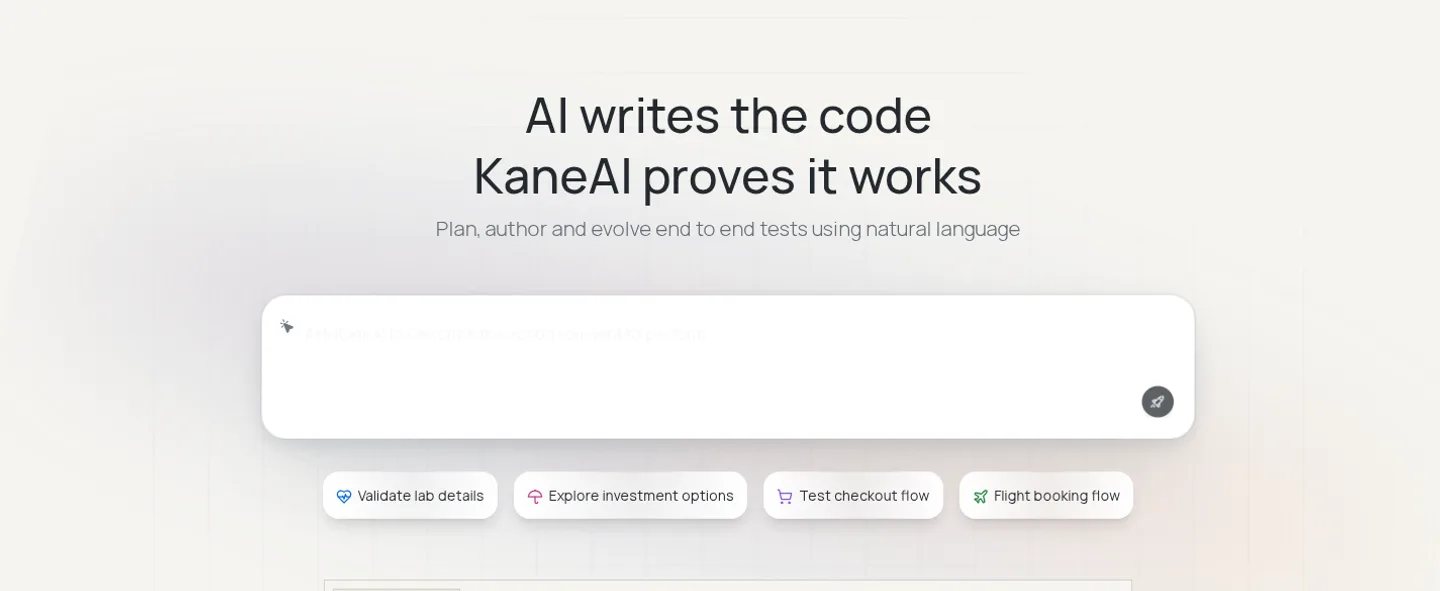
With simple natural language instructions, an AI agent can generate complete testing workflows for you. This democratizes test automation, removing barriers that previously limited participation to technical specialists.
AI agents can also analyze application architecture, user flows, and business logic to create test cases covering both happy paths and edge cases. They can automatically generate test data, identify validation points, and create assertions for comprehensive coverage.
Along with generation, AI agents surface test cases that humans might miss, improving coverage. This capability is particularly valuable in agile environments where requirements change frequently.
2. Self-Healing Test Scripts
Traditional automation scripts break when applications change. For instance, it could be a change in button placement, element IDs, or the addition of new fields.
Self-healing tests are when AI agents automatically adapt to these changes, maintaining test continuity without manual intervention. So, instead of relying on specific locators, AI agents understand functional purpose.
Suppose you've prompted the AI testing agent to test your app's login functionality, and the login button is changed to "Sign in" and placed at a different location.
Unlike traditional scripts that would require edits, AI agents look around on the page to find a login button. Since they're based on LLMs, AI testing agents also understand that "login" and "sign in" mean the same thing. And they continue testing with the changed button.
3. Shift-Left Testing
Shift left testing is the process of bringing testing activities earlier in the development life cycle. AI testing agents help your team shift left since it's easier for developers to author tests in plain English, encouraging them to run as many tests locally as possible before pushing them to the pipeline.
The result is fewer bugs in production and improved DORA metrics for your team, especially a reduced change failure rate.
4. Predictive AI Testing Agents
These AI testing agents are changing how QA teams handle defects and project risk. Unlike traditional test suites that catch failures after the fact, predictive agents actively scan patterns in test results, code changes, and historical defects to flag tests most likely to fail in the future. This proactive approach enables you to address likely problem areas before they turn into production outages or customer complaints.
With more data over time, these agents learn how new features, user behaviors, and system dependencies affect software stability. They provide targeted recommendations on what to test, where regressions are probable, and which tests might be redundant, all tailored to your evolving application.
As a result, teams can allocate time more efficiently, prioritize critical paths, and minimize risk, leading to fewer escaped bugs and a more robust product release after release.

Which Are the Leading AI Agents in Software Testing?
Four AI-native testing agents cover distinct jobs: KaneAI authors tests in natural language, HyperExecute orchestrates execution, SmartUI compares visual states, and Agent Testing validates the AI agents you ship.
KaneAI is a generative AI testing agent built for planning, creating, and editing tests using simple natural language. It allows testers to write test steps in plain English, then automatically converts those instructions into executable code for web, mobile, or API applications. Teams using KaneAI by TestMu AI for AI app testing can also generate tests from a Jira ticket, a PRD, a PDF, or a video. This makes it possible to build and maintain complex test suites quickly, even without deep technical skills. KaneAI can also automatically update tests when applications change, reducing time spent on manual maintenance.
HyperExecute is a blazing-fast, AI-native test orchestration and execution platform. It manages the way tests are scheduled and run across thousands of environments, making sure you get the test results as quickly and reliably as possible. With HyperExecute, you can run your tests on cloud infrastructure that automatically scales to your needs, making it suitable for everything from quick local checks to large-scale, parallelized testing across different browsers and devices.
SmartUI is an AI visual testing agent. It detects changes in user interfaces by comparing screenshots, highlighting only the differences that matter while filtering out noise. This helps teams quickly spot unintended shifts in appearance or layout across browsers and devices without reviewing each change manually. SmartUI is especially helpful for releases with frequent frontend updates or when UI consistency is critical.
Agent Testing is TestMu AI's platform for validating other AI agents, such as chatbots, voice assistants, and even phone assistants. This platform tests how AI models handle conversation, reasoning, intent, and context by generating real-world scenarios and measuring for accuracy, bias, and other critical factors. It's designed to help teams ensure that their AI-powered applications work as intended and meet enterprise standards before going live.
What Is the Difference Between AI Testing Agents and Testing AI Agents?
AI agents testing software plan, write, run, and repair tests against your product. Testing AI agents is the reverse: scoring a chatbot or voice assistant you ship on hallucination, bias, and context awareness.
Both sides share the phrase "AI agent testing", and three things separate them.
- Direction of the test: in the first case the agent is the tester, in the second the agent is the thing under test.
- What you assert: a Selenium check asserts a fixed value, while a shipped agent answers differently on every run, so you score responses instead of matching them.
- Who owns it: QA teams point AI testing agents at the product, while the team shipping an AI feature owns the evaluation of that feature.
A QA agent sits on the first side of that line, turning a natural-language intent into a suite it runs and repairs against your own product while your testers review each plan it proposes. The second side is where most teams have no process yet.
How to Test AI Agents Effectively (Beginner's Guide)
To test AI agents, define the agent's ideal behavior, generate scenarios across happy paths, edge cases, and adversarial inputs, then score each response on hallucination, bias, and context awareness.
Testing an AI agent is harder than testing a button. A Selenium check asserts that a label equals "Submit"; an AI agent answers the same question differently on every run, so there is no fixed selector or output to assert against. The failure modes are also different: hallucinated facts, biased responses to different phrasing, lost context across turns, and confidently wrong answers that slip past a manual spot check. Measuring how much an agent's behavior varies between identical runs is covered separately in our guide to AI agent reliability. Those failure modes are all about what the agent said, and an agent that calls tools carries a second class of failure that scoring its output cannot reach, which we cover in our guide to detecting false completion reports.
An AI agent testing framework makes that repeatable, and it comes down to four steps:
- Define ideal behavior: write the agent's role, responsibilities, and hard constraints so the evaluator knows what "correct" means.
- Generate scenarios at scale: cover happy paths, edge cases, adversarial inputs, and different personas instead of a handful of scripted prompts.
- Score every response: grade each turn on hallucination, bias, completeness, context awareness, and tone rather than eyeballing transcripts.
- Get a go or no-go verdict: roll the scores into a single production-readiness call so leadership can decide without reading every transcript.
Deterministic and LLM-as-a-Judge Evaluators
Two evaluator types cover most agentic AI testing: deterministic checks that run in code, and LLM-as-a-judge scoring that grades open-ended replies. Deterministic checks catch the failures that have one correct answer, and the judge model handles everything that does not.
- Deterministic evaluators: Assert conditions with a single right answer. Did the agent call the correct tool, return valid JSON, stay inside a set number of model calls, and include the required disclaimer.
- LLM-as-a-judge evaluators: Score replies where no exact string is correct. A second model grades each response for factual grounding, tone, and completeness against the agent's stated role.
Write the deterministic checks first. They are cheaper, they never drift, and they catch the tool-calling bugs that a judge model reading only the final text will miss.
Core Evaluation Metrics for AI Agents
AI agent evaluation scores whether the agent finished the task, picked the right tools, grounded its answer in real data, and followed its instructions. A single accuracy percentage hides all four. Each one is scored the way AI evals score anything, against a fixed set of cases rather than one live run.
- Task completion: Did the agent finish the request end to end instead of stopping halfway or looping on the same step.
- Tool selection quality: Did the agent call the right tool with the right arguments. Wrong-tool calls are a common agent failure and stay invisible to scoring that reads only the final message.
- Groundedness: The share of claims traceable to the retrieved context. OWASP tracks unsupported output as LLM09 Misinformation in the Top 10 for LLM Applications 2025.
- Instruction and context adherence: Did the agent respect its system prompt and carry earlier turns forward instead of losing them mid-conversation.
- Agent efficiency: Steps, tokens, and latency per completed task. This is the cost of the same run, and it regresses quietly when a prompt changes.
Adversarial and Safety Testing
Adversarial testing checks what the agent does when the input is hostile rather than typical. The OWASP Top 10 for LLM Applications 2025 ranks Prompt Injection as LLM01 and Excessive Agency as LLM06.
- Prompt injection: Hostile text in a user message or a fetched document tries to override the system prompt. Test it with instructions hidden inside content the agent reads, not only inside what the user types.
- Excessive agency: The agent takes an action wider than the task required, such as deleting a record when asked to read one. Give the agent a tool it should refuse to use, then check that it refuses.
- Sensitive information disclosure: The agent repeats personal data, credentials, or its own system prompt back to the user.
- Jailbreak framing: Role-play or hypothetical framing pushes the agent past the refusal rules it follows under direct questioning.
Offline Evaluation and Production Tracing
Offline evaluation runs before release against a fixed scenario set. Production tracing samples real conversations after release. An agent needs both, because real users phrase requests in ways no scenario set predicted.
- Offline evaluation: Run the same scenario set on every build so a prompt edit or model upgrade that changes behavior is caught before release, such as a move to Claude Opus 5.5, which lowered the default effort and rejects forced tool calls. This is the agent equivalent of a regression suite.
- Production tracing: Record real conversations, then review a sampled slice on a fixed schedule. Traces show the phrasings and tool paths the scenario set missed.
- Feedback capture: A thumbs up or down on each response turns user signal into the next round of test scenarios.
Every trace that fails review becomes a new offline scenario. That loop is what keeps an agent from regressing on the same bug twice.
This is exactly what TestMu AI's Agent Testing platform automates. You upload a PRD or describe the agent, and the platform auto-generates 60 to 100+ scenarios, then runs 15+ specialized evaluation agents that score chat, voice, and phone agents across nine quality metrics, including hallucination, bias, completeness, and context awareness. The result is a Green, Yellow, or Red production-readiness verdict backed by the exact conversation turns that drove each score, so you ship AI features on evidence rather than a hopeful spot check.

Note: Stop spot-checking your chatbot by hand. Test your AI agents for hallucination, bias, and accuracy on TestMu AI before they reach customers. Start for free
End to End Testing for Agents
The checks above validate an agent turn by turn. End to end agent testing covers the whole path instead: the request a user makes, the model's reasoning, every tool the agent calls, the change it makes in a downstream system, and the response the user finally reads.
The point of the exercise is the join between those layers. An agent can report that it issued a refund, sound entirely convincing, and leave no refund in the billing system. Only a test that checks the downstream state catches that.
Classic end to end practice does not transfer cleanly, for three reasons.
- There is no fixed path - The same request can route through different tools on different runs, so a test that pins an exact sequence fails the first time the model finds an equally valid route.
- The output is not a page - The result may be prose, a created record, or an API call, so assertions move from the interface to the effect the run produced.
- The run really acts - An agent with write-capable tools changes real data, so the suite needs a staging environment and test data you can regenerate rather than a production tenant.
That leads to a simple rule: assert on outcomes rather than routes. Write down what must be true once the run finishes, such as the record existing with the right values and no tool outside the permitted set having been called, then let the agent reach that state however it does.
Keep the suite small for the same reason. End to end agent runs are slow and spend tokens on every execution, so they suit the handful of journeys where a silent half-failure would be expensive: the paths that move money, change records, or send something to a customer.
Our guide to end to end agent testing works through the five stages to cover and what to assert at each one.
Agent Assurance, TestMu AI's product for verifying agents that act, is built for exactly this discipline. Point it at the codebase of an agent you own and it derives the test suite itself, generating functional, non-functional, and adversarial scenarios such as prompt injection, tool misuse, and instruction override, then invokes the agent for real and grades every criterion against observed evidence, meaning files changed, artifacts produced, and tool calls, rather than the agent's own account of the run. Each criterion resolves to Pass, Fail, or Unable to Verify, with the unverified share reported beside the pass rate, and in CI its exit codes separate an agent that did something wrong from a run it could not test.
Note: Your agent says the refund went through. Prove it. Early access is opening in batches. Join the Agent Assurance waitlist
What Are the Strengths and Limitations of AI Testing Agents?
AI testing agents excel at regression, visual, and performance testing, where scale and repetition dominate. They fall short on subjective user experience, undocumented business logic, and legacy system integration.
The three areas below are where agents consistently pay off first.
- Regression testing: AI agents automatically identify what changed in your code and generate appropriate tests. They prioritize based on risk, running critical path tests first. API testing benefits from automatic test generation from specifications and intelligent handling of non-deterministic responses.
- Visual and UI testing: AI-powered visual comparison clearly sees the difference between acceptable variations and actual bugs. Mobile testing across hundreds of device configurations becomes manageable with natural language test creation that works across platforms.
- Performance testing: AI agents analyze historical data to anticipate bottlenecks before they happen. They simulate realistic load conditions based on actual user patterns, not theoretical models.
But let's be honest, there are still some limitations.
- AI agents struggle with subjective user experience evaluation. They can't tell you if something "feels" right to users. Creative testing scenarios that require human intuition remain challenging. Understanding complex business logic, especially when it's not well-documented, can trip them up.
- There's data dependency. An AI testing agent learns from historical test results and product behavior, so in a brand-new product or a sparsely tested area there is little signal to learn from. Until that history builds up, the agent's predictions and self-healing are only as reliable as the data behind them.
- Integration with legacy systems can be complex. If your tech stack includes 20-year-old mainframe systems, AI testing integration won't be plug-and-play. Non-deterministic AI responses create validation challenges - how do you test something when correct answers vary?
How Big Is the AI Testing Agents Market?
Fortune Business Insights values the AI-enabled testing market at $1.01 billion in 2025 and projects $4.64 billion by 2034, an 18.30% CAGR. That is roughly a 4.6x increase over nine years.
Four forces drive that growth: release speed, application complexity, cost, and the QA skills gap.
- Release speed: Teams deploy multiple times a day, and script-based regression suites cannot keep pace.
- Application complexity: Modern applications carry more states and device combinations than a human team can cover by hand.
- Cost: Agentic AI testing cuts manual authoring and test-maintenance time, the two largest line items in most QA budgets.
- Skills gap: Experienced QA engineers are hard to hire, and natural-language authoring lets more of a team write tests.
At that pace, AI-enabled testing is one of the fastest-growing enterprise software categories, and adoption curves this steep tend to flip from early-adopter advantage to table stakes within a few years. If you're not exploring it now, you risk being in the minority sooner than you would expect.
How Do You Implement AI Testing Agents?
Roll out AI testing agents in three stages: assess testing maturity and pain points in months 0 to 6, run a scoped pilot on one or two flows, then scale to wider coverage between months 6 and 18.
Start with assessment and planning (months 0-6). Evaluate your current testing maturity honestly and identify your biggest testing pain points. Is it speed, coverage, or maintenance? Then, define clear success metrics in terms of what would make the investment in AI testing agents worthwhile.
Begin with a pilot program. Scope a focused initial implementation rather than a big-bang rollout. At this stage, you might ask: do you build AI agents in-house, or leverage a proven platform? While building may sound tempting, it typically requires deep AI expertise, extended development time, and ongoing maintenance, and that's before you ever see value in production. Most organizations find it far more efficient to work with a leading platform that offers AI-native testing agents out of the box, ready to deliver measurable results. For example, platforms like TestMu AI provide production-ready AI agents, so your team can skip the prolonged R&D phase and focus on deploying, measuring, and optimizing testing outcomes.
Choose one or two specific testing scenarios where AI can demonstrate clear value. You can also experiment with orchestration platforms like n8n for automation testing to automate test execution flows and reporting during the pilot phase. Measure everything from time saved, bugs found, and costs reduced.
Focus on team development. Implementing AI agents is as much about upskilling and training your existing employees as it is about licensing software. Encouraging your team to learn effective prompting techniques will help them get better results from AI testing agents. This is a new way of thinking and working for your team.
Scale strategically (months 6 to 18). Expand from pilot to wider implementation gradually, and make sure you establish proper governance frameworks for AI use. As your teams mature, document best practices, and build feedback loops between AI results and human expertise. This documentation will serve as a valuable resource for new team members and help position your organization as a thought leader in AI-enabled QA.
The key thing to remember is that AI testing agents, no matter how sophisticated, still need a human in the loop (HITL) to verify findings, test cases, and scripts. Whether you are testing an AI chatbot or a complex web application, AI agents are not here to replace your testing team, they're here to empower your team to be faster and far more efficient. You want a human to give the final pass before any code goes to production, ensuring quality and confidence at every release.
Should You Adopt AI Testing Agents?
Yes, for most teams. AI testing agents pay off fastest where regression suites are flaky, releases ship daily, and maintenance eats QA time. They pay off slowest on new products with thin test history.
AI agents are not a fleeting technological trend. They change the QA workflow itself, and they change it for the better.
But the window for early advantage is closing quite fast. As AI adoption in testing accelerates across the industry, being a fast follower means being average. You want to be AI-mature before your competitors adopt it.
Here's my advice after watching countless clients switch to AI-native testing: start small, but start now. Pick one flaky regression suite or one manual smoke test, and let an agent author and run it this week. If you are trialing an AI browser-testing agent, compare a Magnitude alternative.
The fastest first step is KaneAI, which lets you describe that test in plain English and run it on the TestMu AI cloud. Follow the KaneAI getting started guide to set up your first test, then expand from there.
Author

Sai Krishna
Blogs: 24

Sai Krishna is Director of Engineering at TestMu AI (formerly LambdaTest), where he leads agentic AI for quality engineering, building AI agents that autonomously drive mobile and conversational test automation. His current focus is Agent Testing and Model Context Protocol (MCP) support for mobile. He is a core contributor and member of the Appium open-source project and the creator of AppiumTestDistribution and appium-device-farm. With over 14 years of experience including more than 9 years at Thoughtworks as a Principal Consultant, he holds a BSc in Electronics and speaks regularly at TestMu and Appium Conf on Appium, mobile automation, and agentic AI in testing.
Reviewer

Srinivasan Sekar
Reviewer
Srinivasan Sekar is Director of Engineering at TestMu AI (formerly LambdaTest), where he leads engineering and open-source initiatives behind the Selenium and Appium automation grid and owns TestMu AI's MCP Server. A committer to Appium and a contributor to Selenium, WebdriverIO, Taiko, and AppiumTestDistribution, he brings over 15 years of experience in quality engineering and open-source technologies. He is the author of the Apress book 'The MCP Standard: A Developer's Guide to Building Universal AI Tools with the Model Context Protocol,' a Certified Kubernetes and Cloud Native Associate, and an international conference speaker. Before TestMu AI he spent over eight years at Thoughtworks as a Principal Consultant and Quality Architect. Srinivasan holds a B.Tech in Information Technology from Anna University.


AI Agent Testing FAQs
Did you find this page helpful?
More Related Learning Hubs
TestMu AI forEnterprise
Get access to solutions built on Enterprise
grade security, privacy, & compliance
- Advanced access controls
- Advanced data retention rules
- Advanced Local Testing
- Premium Support options
- Early access to beta features
- Private Slack Channel
- Unlimited Manual Accessibility DevTools Tests