

Power Your Software Testing with AI Agents and Cloud
The Native AI-Agentic Cloud Platform to Supercharge Quality Engineering. Test Intelligently and Ship Faster.


- TestMu AI (Formerly LambdaTest)
- /
- Learning Hub
- /
- Open Source Voice Agent Testing Tools in Oct 2026
Open Source Voice Agent Testing Tools in 2026: What They Cover, What They Leave to You, and When You Need One Platform
Open source voice agent testing tools compared, the 8 gaps they leave, what a free run really costs, and how to test chat, voice, IVR and video agents in one place.
Published on:
Voice agents rarely ship alone. The same company runs a chatbot on its website, an IVR in front of its phone line, a voice agent behind the IVR and, increasingly, a video agent for interviews or onboarding. Customers move between them. A bug in any one is a bug in the experience.
Open source voice agent testing tools include Pipecat's eval harness, the LiveKit Agents test framework, EVA-Bench, voicetest, promptfoo, DeepEval and SIPp. They are strong at testing the model, the prompt and tool calls, usually inside one framework. They leave real phone lines, accents, noise, IVR menus, scoring calibration and every channel other than voice to you.
TL;DR
Open source voice agent testing tools are free frameworks that test a voice agent's model, prompt and tool calls, usually inside one framework such as Pipecat or LiveKit. They leave real phone lines, accents, background noise, IVR menus, judge calibration and every channel other than voice for your own team to build and maintain.
Are Open Source Voice Agent Testing Tools Really Free?
- Licence cost: The code of an open source voice agent testing tool is free to download and run. Licence fee: No. Per-run cost: Yes, because every run still bills the simulated caller, the agent and the judge model.
- Engineering time: Building the caller simulator, calibrating the LLM judge and rewriting scenarios after every policy change is the largest cost of an open source setup, and it grows with each channel your team adds.
Can Open Source Tools Test an IVR?
- SIPp: SIPp generates SIP calls for capacity testing and can replay DTMF tones from a packet capture, but it does not understand the menu prompts it hears or score the conversation. Scores the conversation: No.
- LangWatch Scenario: The open source LangWatch Scenario SDK can dial a number through Twilio and press DTMF keys, but each keypress is a scripted step, so every IVR path is a test your team writes and updates when the menu changes.
- Framework test suites: Pipecat evals swaps the phone line for a local eval transport, and the LiveKit Agents test framework asserts on turns inside LiveKit, so an IVR menu that sits in front of the agent on a real phone line is outside what they test.
- TestMu AI Agent Testing: TestMu AI Agent Testing places real calls that detect DTMF and verify routing and transfers, and it tests chat, voice, IVR and video agents in one account with one scenario library.
How Do Open Source Voice AI Testing Tools Compare?
| Tool | What it tests | Where it fits | What you still build |
|---|---|---|---|
| Pipecat evals | Scripted and simulated conversations, text or synthetic audio | Pipecat bots | Anything outside Pipecat; real phone calls |
| LiveKit Agents testing | Turn-by-turn messages, tool calls and handoffs in pytest or Vitest | LiveKit agents in CI | Audio simulation runs on LiveKit Cloud; other stacks |
| EVA-Bench | Bot-to-bot audio with noise and accent perturbations | Benchmarking models | Your own scenarios; caller, agent and judge costs |
| voicetest | LLM-simulated users against imported Vapi, Retell, LiveKit agents | CI checks | Audio evaluation (off by default); calls to your deployed agent |
| promptfoo | Prompt regression and red teaming, mostly on text | Prompt changes | Telephony; full audio conversations |
| DeepEval | LLM-judge metrics on transcripts | Scoring | Real phone calls; its voice mode is still in beta |
| SIPp | SIP call generation and load | Telephony capacity | Any conversation scoring |
Details as described in each project's repository or docs, October 2026. For commercial platforms, see AI voice agent testing tools.
EVA-Bench also shows why one passing run proves little. Across 12 systems and 213 scenarios, the EVA-Bench paper reports a median gap of 0.44 on its accuracy metric (EVA-A) between peak performance (pass@k) and reliable performance (pass^k).
What Gaps Do Open Source Voice Agent Testing Tools Leave?
- Real phone calls - Most open source tools test text or synthetic audio inside a framework. Real callers come through carriers, codecs and SIP trunks. Bugs at that layer never appear in a local test.
- Real callers - A caller simulator that sounds like your customers needs many voices, accents, speaking speeds and background noise. Building and maintaining that library is a project in itself.
- The IVR in front of the agent - In enterprises, a voice agent usually sits behind an IVR menu. DTMF keypresses, menu timeouts and transfers between the IVR and the agent are where many calls fail. Pipecat evals and LangWatch Scenario can press scripted DTMF keys, and LangWatch Scenario can dial out through Twilio, but every menu path is a script you write and update when the IVR tree changes. Dedicated IVR testing tools cover the menu layer.
- Scenarios that stay current - Someone has to write test scenarios and rewrite them every time the policy, prompt or product changes. Without generation from your source documents, suites go stale within weeks.
- A judge you can trust - An LLM judge needs written criteria, calibration against human review and a confidence signal. A score from 12 conversations should not carry the same weight as a score from 200.
- Repeated runs and reliability - The same call can pass once and fail next time. Reliable testing means running each scenario several times and counting a pass only when every run passes. Every extra run adds to the bill.
- Production calls - Pre-launch tests catch what you thought of. Real recordings catch what you didn't. You need the same metrics on both.
- Every other channel - Your chatbot, your IVR and your video agent each need testing too. Three open source stacks means three sets of metrics, three dashboards and three maintenance jobs.
How Much Does Free Voice Agent Testing Actually Cost?
The EVA-Bench paper itself warns that generating five validated trials per scenario carries non-trivial cost, and that full reproduction requires access to commercial model APIs.
| Cost | Open source setup | Single platform |
|---|---|---|
| Licence | Free | Subscription |
| Caller, agent and judge model calls | You pay each provider per run | Included or metered by the platform |
| Phone numbers and telephony | You buy and configure | Provided |
| Caller voices, accents, noise | You build the library | Provided |
| Scenario writing and upkeep | Engineering time, every change | Generated from your docs |
| Judge calibration | Engineering time | Built in, with confidence levels |
| IVR, chat and video testing | Separate tools or none | Same platform |
| Reporting for release decisions | You build dashboards | Go-live verdict per run |
The licence is the smallest line on this list. The largest is engineering time, which grows with every channel you add.
Is Open Source Enough for Your Voice Agent?
Open source is the right choice when all of these are true:
- You run one agent on one framework.
- You mainly need to check prompts and tool calls in CI.
- Your agent is not reached through a phone number or an IVR.
- You have engineers available to build and maintain the harness.
If any of these is false, you will spend more building testing infrastructure than testing your agent.
Should You Use Open Source and a Platform Together?
Keep your framework's open source tests in CI for fast, cheap checks on every commit. Add a platform for everything that needs real calls, real voices, other channels and a release decision.
The two layers do different jobs. The split mirrors LLM evaluation vs agent testing.
How Does TestMu AI Test Chat, Voice, IVR and Video Agents?
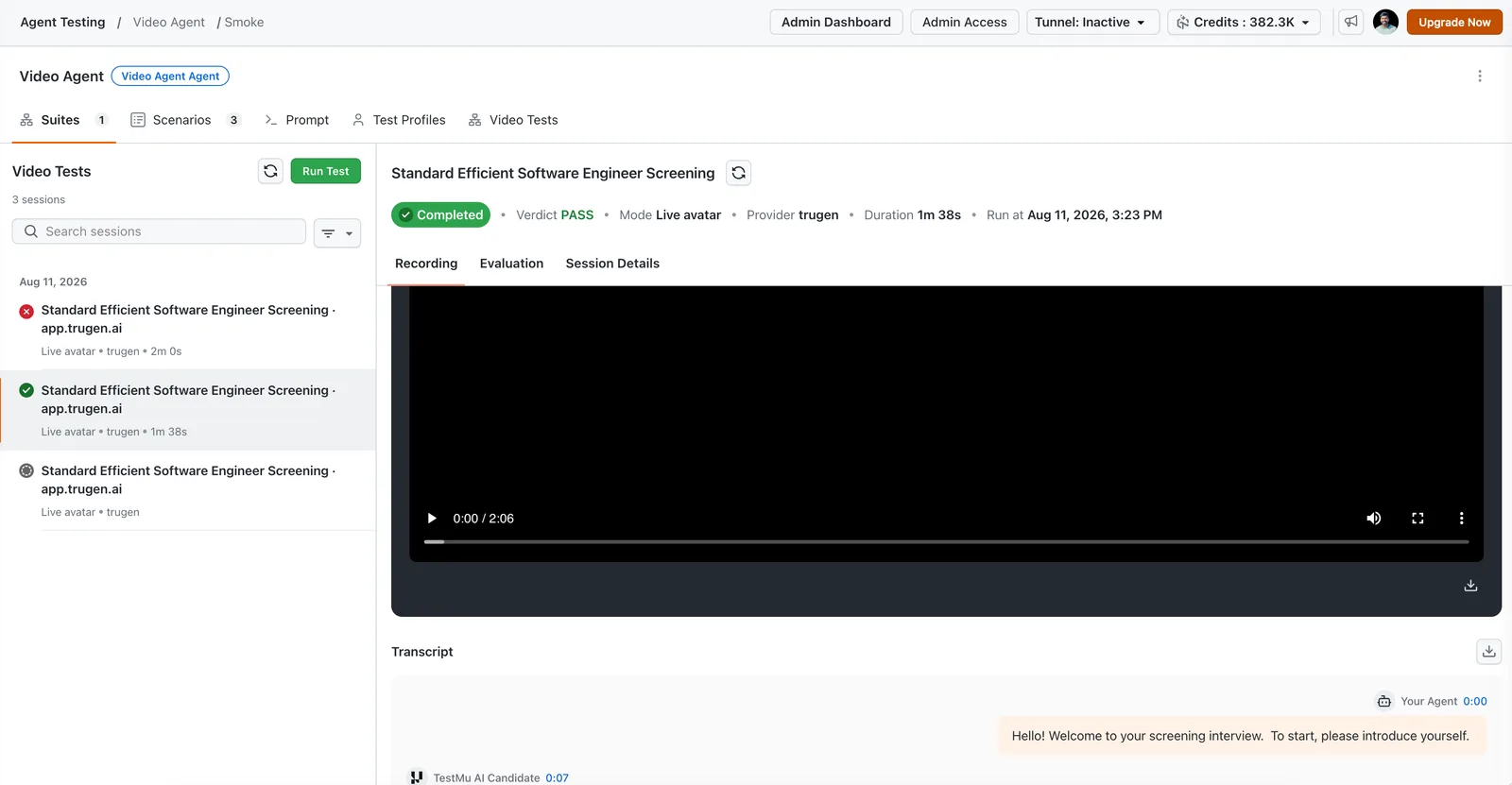
TestMu AI Agent Testing, an AI agent testing platform, runs autonomous AI evaluators that act like real users across every channel you ship. All four channels share one scenario library and one account. Chat, voice and IVR runs end in one go-live verdict, and video runs end in a Pass or Fail against your success criteria.
| Channel | How TestMu AI tests it | What it scores |
|---|---|---|
| Chatbot testing | AI personas hold multi-turn conversations with your bot through its endpoint | 9 quality metrics: hallucination, bias, completeness, context awareness, response quality, conversation flow and more |
| Voice agent testing | Real inbound and outbound calls with 200+ voice profiles, 50+ accents, 15 background-noise presets, masked numbers in 20+ country codes | 9 quality metrics plus 30+ call metrics: latency, STT accuracy, intent recognition, containment, FCR, CSAT |
| IVR testing | Real calls that walk every menu branch and timeout, detect DTMF and verify routing, transfers and fallbacks; concurrent calls for load | 30+ call metrics, with speaker-identified transcripts |
| Video agent testing | Joins from a web URL as a simulated candidate with a real face and voice, for AI interviewers, onboarding assistants and virtual front desks | Pass or Fail against your success criteria, plus conversation flow, question handling, response quality and avatar presentation scored 0 to 10 as diagnostics, with recording, turn-labeled transcript and timestamped evidence |
Across every channel:
- Scenarios from your source of truth - Upload PRDs, PDFs or audio, or connect Jira and Confluence, and get 60 to 100+ scenarios with validation criteria.
- A release decision, not just scores - Every chat, voice and IVR run ends Green, Yellow or Red, with confidence tied to evaluation volume. Video runs return Pass or Fail against your success criteria.
- Production analysis - Batch-upload real MP3 or WAV call recordings and score them with the same metrics as pre-launch tests.
- Built for CI - Schedule runs with cron, trigger them from the terminal, and reach private agents through secure tunnels on HyperExecute.
- Works with your stack - Vapi, Retell, ElevenLabs, LiveKit, Pipecat, Bland, Synthflow, Twilio and more.
And because TestMu AI (formerly LambdaTest) also runs web and mobile testing, the chat widget itself can be tested across 3,000+ browser and OS combinations and 10,000+ real devices on the same account.

Note: Test chat, voice, IVR and video agents from one TestMu AI account. Create a free account
How to Start Testing Your Voice Agent
Start with the channel your customers reach first, usually the phone line. Keep your framework's open source tests in CI, then point Agent Testing at the same agent and compare its verdict with what your harness reported. The testing your first AI agent guide walks through the setup.
Author

Chaitanya Sharma
Blogs: 20

Chaitanya Sharma is an AI Product Manager at TestMu AI (formerly LambdaTest), where he builds agentic AI capabilities focused on computer vision and multi-modality, moving testing beyond static script execution toward autonomous, agent-driven workflows. Before TestMu AI he shipped 135+ features at Sprinklr for a no-code community and website builder used by Fortune 500 enterprises including Dell, Samsung, and Polestar. At Policybazaar he led the zero-to-one launch of a digital lending and insurance marketplace embedded in Bahrain's dominant payments app, building a risk-intelligence engine that compressed loan-approval times by 80%. He explored machine learning and NLP through research at the University of Cambridge, and holds a B.Tech from Delhi Technological University.
Reviewer

Mayank Bhola
Reviewer
Mayank Bhola is Co-Founder and Head of Products at TestMu AI (formerly LambdaTest), where he leads the entire product portfolio across KaneAI, Kane CLI, HyperExecute, SmartUI, the Real Device Cloud, Accessibility, and other software testing product lines. As an early Lead Architect he designed and built the company's flagship Tunnel technology from scratch, created the React-based automation platform, and architected the data-intensive pipelines and FAAS services that scale it. He brings more than 10 years of experience in software development and product engineering, with earlier roles as Head of Technology at Juggernaut Books and Senior Software Engineer at PressPlay TV and Zomato. Mayank holds a B.Tech in Computer Engineering from JIIT Noida.


Open Source Voice Agent Testing FAQs
Did you find this page helpful?
More Related Learning Hubs
TestMu AI forEnterprise
Get access to solutions built on Enterprise
grade security, privacy, & compliance
- Advanced access controls
- Advanced data retention rules
- Advanced Local Testing
- Premium Support options
- Early access to beta features
- Private Slack Channel
- Unlimited Manual Accessibility DevTools Tests