

Power Your Software Testing with AI Agents and Cloud
The Native AI-Agentic Cloud Platform to Supercharge Quality Engineering. Test Intelligently and Ship Faster.


- TestMu AI (Formerly LambdaTest)
- /
- Blog
- /
- How To Implement Shift Left Testing Approach?
How To Implement Shift Left Testing Approach?
In this blog, you will learn about implementing the shift left testing approach and how shift left testing can improve product quality, and more.
Last Updated on:
On This Page
- What is the Software Development Life Cycle (SDLC)?
- What is Shift Right Testing?
- What is Shift Left Testing?
- What are the different types of Shift Left Testing?
- How to implement the Shift Left Testing approach?
- Shift Left & the Testing Pyramid
- Technical Enablers: TDD, CI/CD
- The Cultural Shift
- Shortcomings of the Shift Left Testing approach
- Shift Left Vs Shift Right? What is the way ahead?
The “shift left” approach is based on the principle that if the software development team can test code as it is being developed, they can discover errors earlier than if they wait until the end of the project. The shift left testing approach encourages developers to write tests earlier in the development cycle, before code is released for testing.
Overview
To implement a shift left testing approach, software development teams must involve testers during the initial requirements phase and run automated tests in parallel on every commit using TestMu AI to catch defects early when they are cheaper to fix.
How the shift left approach works
- QA teams: Involving testers and QA professionals during the initial requirements and design stages ensures that teams prevent defects and clear up ambiguities before coding begins.
- Testing Pyramid: Following the Testing Pyramid means favoring many fast unit and API/contract tests over slow, late-stage UI tests to optimize execution speed and catch bugs early.
- ESLint: Implementing the ESLint static code analysis tool allows developers to automatically inspect code on every commit to catch syntax and style errors during early development.
- SonarQube: Integrating the SonarQube static analysis platform into the development workflow helps continuously inspect code quality and identify potential security vulnerabilities early in the lifecycle.
- DevSecOps: Sharing quality ownership across developers, QA, product, and security teams ensures continuous testing throughout the lifecycle and reduces overall software release risk.
Why it matters
- TestMu AI: Running automated tests in parallel on every commit using the automation cloud keeps feedback loops fast as test coverage grows.
Shift left testing process is an agile software development practice that emphasizes putting test cases in place early in a project’s life cycle, meaning during initial development phases rather than at the end. It also means that, instead of just covering a small percentage of a project’s expected functionality, a large percentage of the functionality will be covered by automated tests.
Shift left testing is also instrumental in reducing the number of defects that find their way into the production software. It’s about shifting from manual to automated testing so that by the time you need to do manual testing, there is less work to be done from a quality standpoint. In essence, it aims to catch bugs earlier so that they are easier and cheaper to fix at the early stages of the development lifecycle.
However, before discussing the shift left testing process in detail, we need to understand a typical Software Development Life Cycle (SDLC) and the fundamentals of Shift Right Testing.
This article on shift left testing will guide you about the shift left testing approach and how teams can leverage shift left testing to improve the product quality and more.
Let’s Get Started!

What is the Software Development Life Cycle (SDLC)?
The Software Development Life Cycle (SDLC) is the step-by-step process teams use to plan, build, test, and maintain software. Where testing sits inside that cycle is exactly what the shift left approach changes.
The Traditional SDLC (Waterfall Model)
In the traditional Waterfall model, work moves through fixed stages in sequence - planning and requirement analysis, design, development, testing, deployment, and maintenance - with each stage finishing before the next begins. Testing sits near the end, so defects surface late, when they are hardest and most expensive to fix.
Most teams have since moved to Agile, which you can compare in this guide on Agile vs Waterfall methodology. That late-testing bottleneck is exactly the problem the shift left approach sets out to solve.
What is Shift Right Testing?
Shift right testing suggests moving the testing activities later in the Software Development Life Cycle, usually after the software has been deployed in the production environments. Thus, it is also known as “Testing In Production,” and it helps uncover issues that could not be detected within the development or testing environments.
In simple terms, shift right testing is performed on applications that are already built and released to the end-customer. This testing practice is widely being adopted these days and is closely tied to DevOps activities.
The goal of shift right testing is to mainly ensure correct performance, stability, and usability of the application in the production environment. The feedback and reviews are thus collected from targeted users to understand the software’s function in real-world conditions. This helps enhance the quality of the software much further.
What is Shift Left Testing?
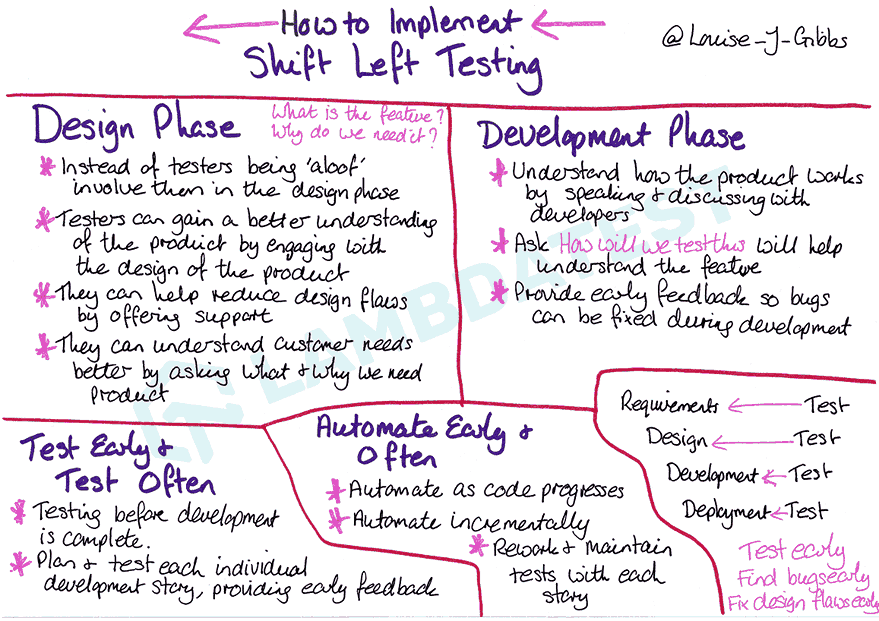
By Louise J Gibbs
The shift-left approach in software testing means conducting testing, quality checks, and performance evaluation early in the development process, even before writing code. This helps teams anticipate and handle any issues that may arise during development, leading to better performance and smoother delivery.
On the other hand in traditional Waterfall model testing comes into the picture very late in the cycle or the shift right testing, where testing is done at the end or right of the cycle. Shift right testing is ideal for improving product quality and performance by solving issues that are witnessed in the production environment.
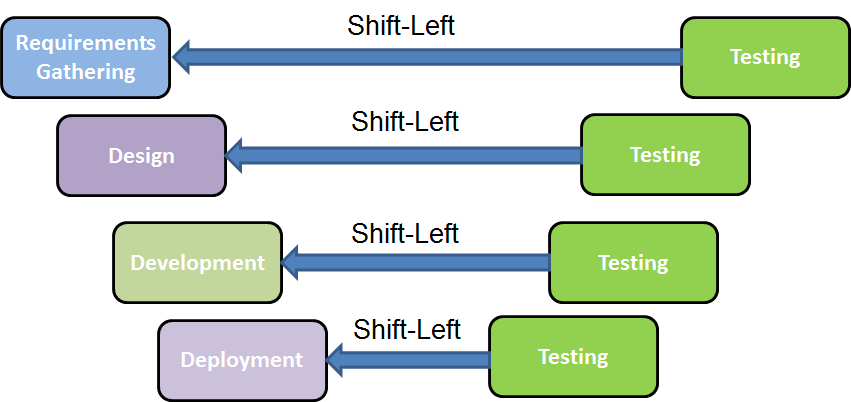
However, the shift left testing approach suggests moving the Testing activities “Left” or rather “earlier” in the development cycle. Thus, it involves the testers much earlier in the software development life cycle. It aims to identify bugs and bottlenecks earlier in the development process.
As a result, it improves the quality of the code and reduces the overall time consumed in the cycle. It helps in ensuring that fewer defects make it to the production environment.
Compared to shift right testing, where the testing was at the extreme right of the development cycle, the shift left testing approach involves testing at each development phase. Overall, it focuses on continuous testing throughout the development cycle.
Importance Of Shift Left Testing approach
In the traditional Waterfall model, where the testing is carried out at the end of the cycle, a situation arises where severe defects are caught. It is difficult and costly to fix such critical bugs at the end of the cycle. The cost involved in fixing bugs rises exponentially with its discovery stage.
As a result, late testing in the cycle leads to:
- Increased costs owing to bug discovery at a later stage
- Longer bug fix times
- Error-prone software since the QA gets less time to validate the entire product
- Lesser time for automating the tests, which eventually leads to regression defects
- Poor end-user experience as customers experience products with bugs
However, shift left testing by getting the testers involved early in the cycle helps in reducing costs involved in bug discovery and bug fixes. As a result, there is no delay or effect on the project’s final deliverables and even leads to customer satisfaction.
To realize the potential of the shift left testing process in the field of test automation, TestMu AI is hosting a webinar on Shift-Left Testing and Continuous Feedback to Deliver Quality at Agile Speed in association with Patrick Walsh - Engineering Manager at Teckro. Here’s a teaser for the same:

Shift Left and Shift Right in Software Testing
Till now, we covered the essential fundamentals of shift right testing as well as shift left testing. While shift left testing ensures that lesser bugs make it to the production environment, the shift right testing approach ensures that issues discovered by end-users in the end-product are fixed at an expedited pace.
Both the testing approaches have their own significance and enterprises need to leverage the combination of shift right testing and shift left testing to improve product quality across the entire paradigm of product development. The intent should be to minimize the cost involved in discovering and fixing defects.
Advantages of Shift Left Testing approach
We covered how you can avoid the risk of finding severe bugs at the end of the cycle by testing earlier in the cycle. However, that is not the only advantage that the shift left testing approach offers.
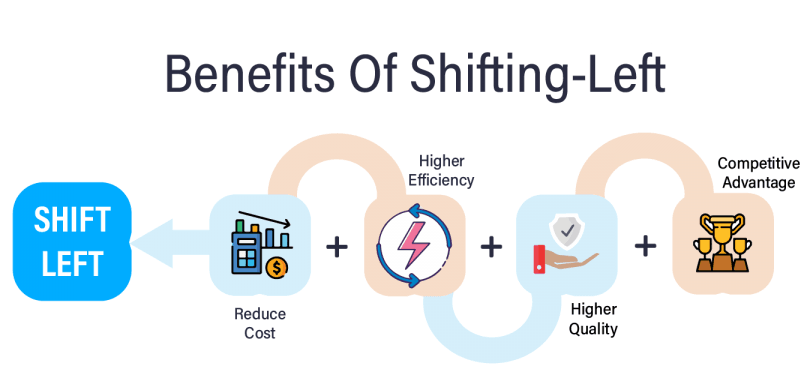
Here are the salient benefits of shift left testing:
- Reduced time to market since the overall QA process happens in a continuous manner
- Reduced costs involved in fixing bugs
- Top-notch product quality
- Improved customer experience due to a strong product base and lesser production issues
- Improved efficiency and reduced time in the overall software development lifecycle
The ROI of Shift Left Testing
As a QA manager, one of the key responsibilities should be to reduce the TAT (Turn Around Time) involved in bug discovery and bug fixing stages. Reduced TAT brings significant benefits across the entire value chain.
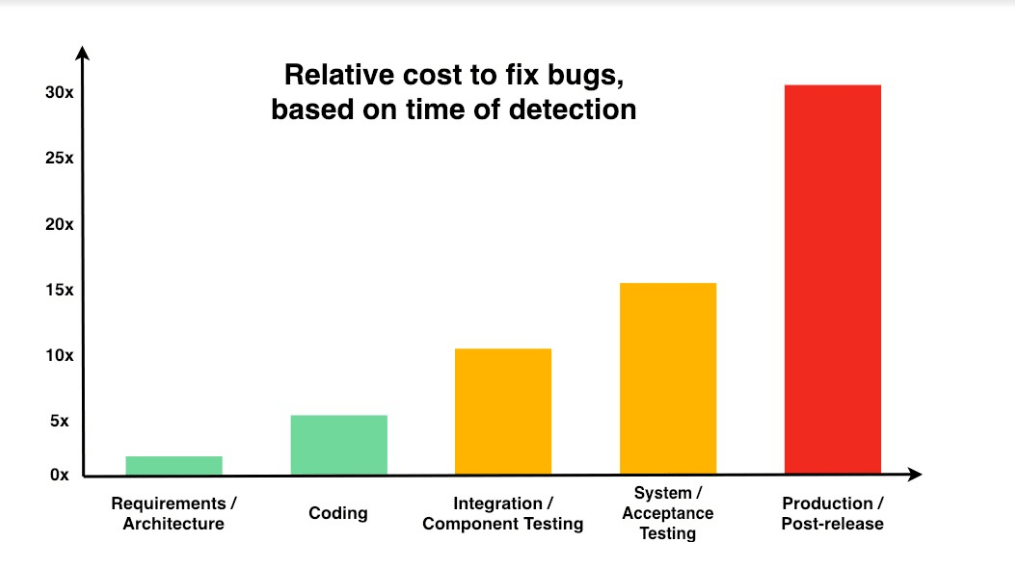
The cost of detecting and fixing defects in software increases exponentially with time in the software development workflow. In simple terms, the later the bugs are found in the release cycle, the more expensive they turn out to be to fix. As a result, it costs much less to fix bugs that are discovered at an early stage.
And guess what, fixing a bug that is found post-production costs approximately 30x more than it would have taken to fix it in in-house environments. Whoof!
The below graph shows the relative cost of fixing bugs based on their time of detection, and as you can notice the cost increases exponentially with the lateness of their discovery
What are the different types of Shift Left Testing?
There are four different types of shift left testing that provide different values when performed.
Traditional Shift Left Testing
In order to understand the traditional shift left testing approach, we first must understand the traditional V-Model in a Software Development Life Cycle.
SDLC V-Model
We already saw one of the most widely used SDLC models, which is the Waterfall model. The V-Model is an extension of the Waterfall model and is based on the association of a testing phase for each corresponding development stage. Therefore, it is also known as the Verification and Validation model. This means that there is a directly associated testing phase for every single phase in the development cycle. For example, the following image illustrates a typical V Model.
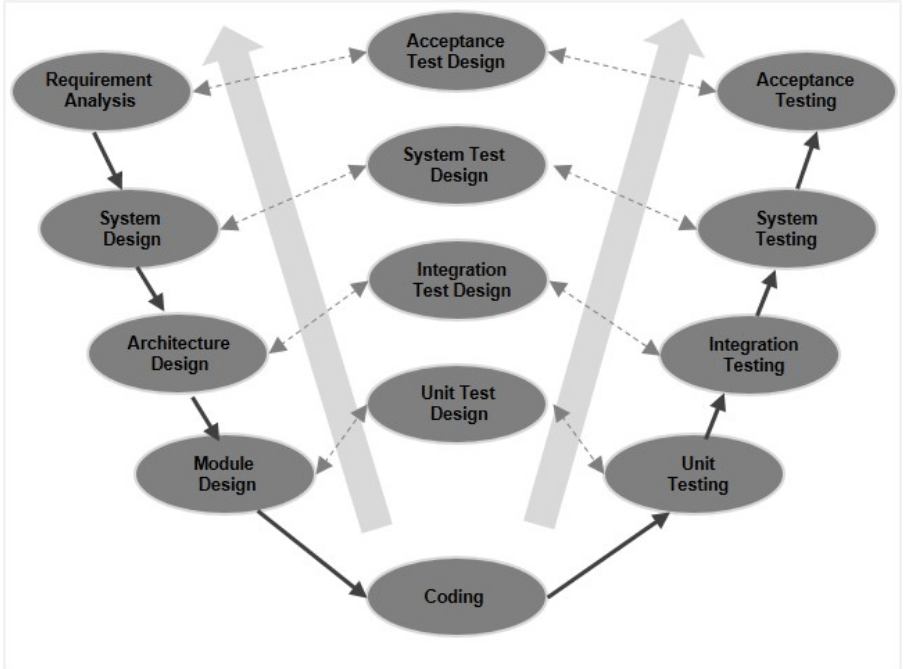
Now, you know about the V Model. Let’s see what the traditional shift left testing process offers us.
The traditional shift left testing process moves the testing lower down, hence, towards the left on the right side of the V Model.
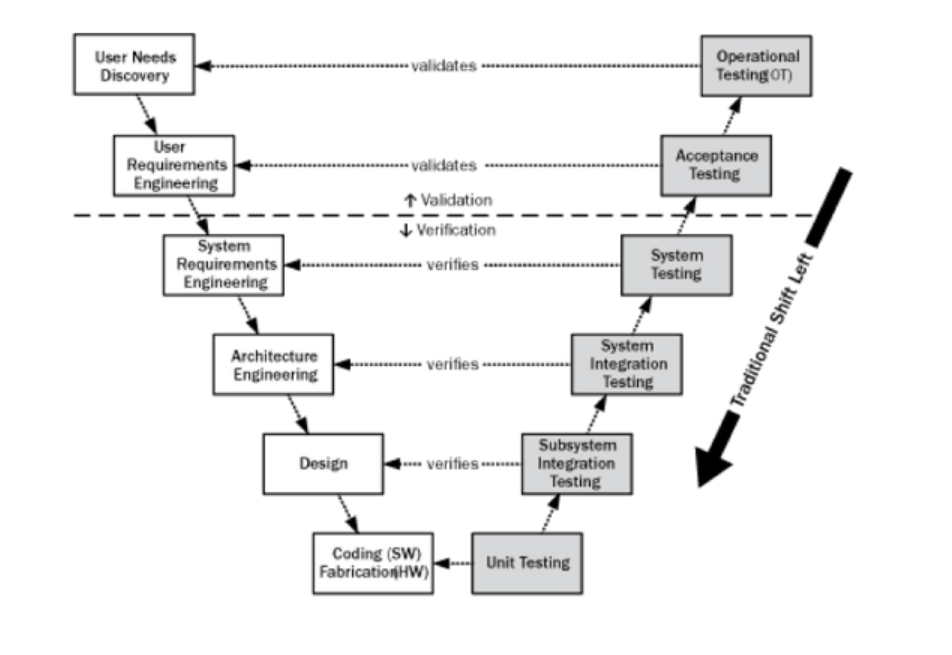
The traditional shift left testing process focuses more on Unit Testing and Integration Testing. This is done using API testing and achieved via the usage of API testing and utilizing Selenium testing tools. It does not put more emphasis on acceptance testing & system-level testing.
Incremental Shift Left Testing
This shift left testing approach is most suitable for projects which are developing complex and large software systems. In such cases, it becomes difficult to manage all the tasks and deliverables together.
Hence, they are broken down into smaller bits. These pieces are built upon each other, and with each increment, the software is also delivered to the customer. After each delivery, the development & testing is incrementally shifted to the left. Now, this helps even the testing teams as they can test each of the individual bits.
Hence, it introduces incremental testing via an incremental development cycle. The below image is an illustration of Incremental shift left testing.
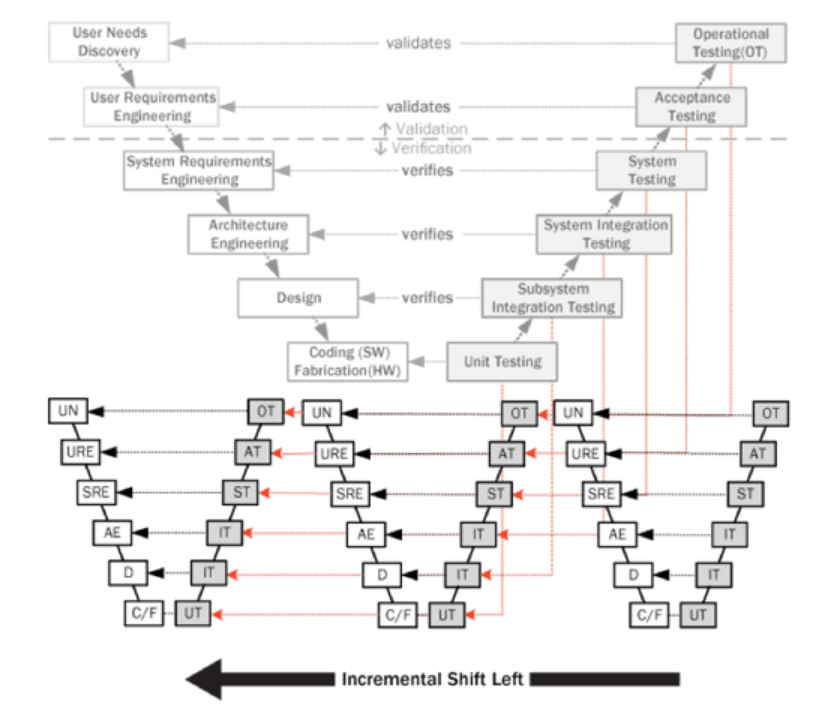
The red dashed arrows indicate the shift left here since the bits of the large V Model are shifted left to become increments of the corresponding types of testing in the smaller incremental V Models. It introduces
Agile/DevOps Shift Left Testing
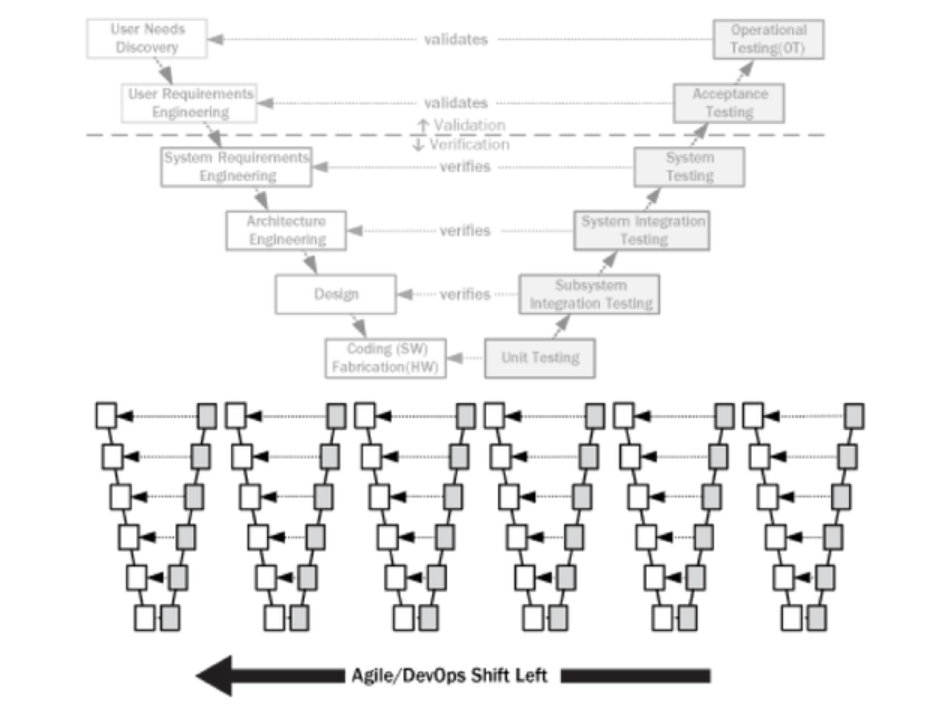
This approach of shift left testing is usually done in a number of sprints. It emphasizes continuous testing via an evolutionary life cycle composed of many smaller sprints. It is mainly used for developmental testing and not for operational testing, which occurs once the system is operational.
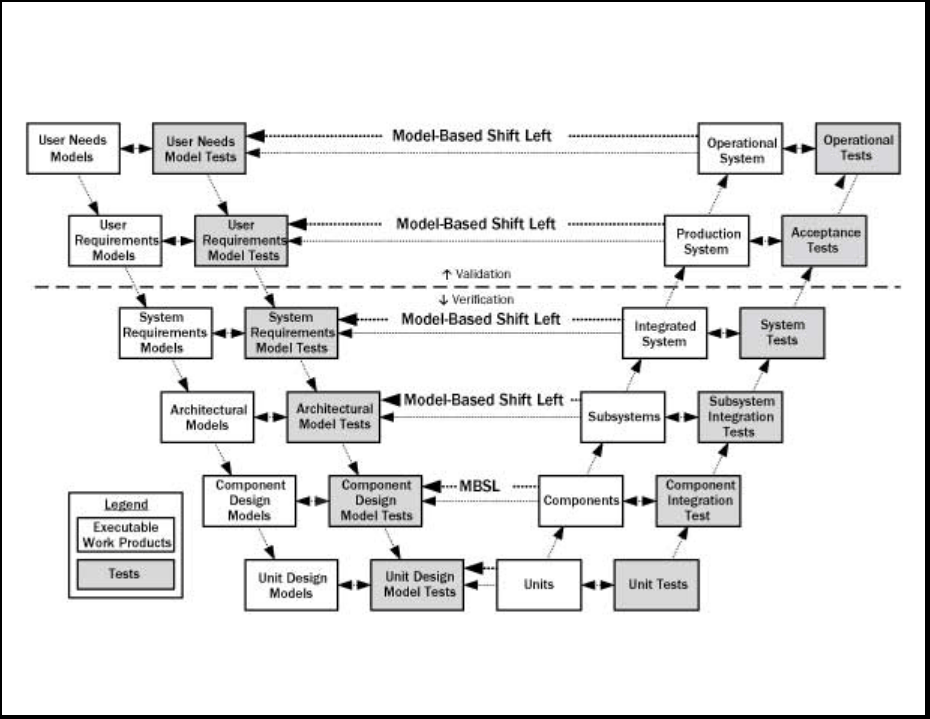
Model-Based Shift Left Testing
The overall idea behind shift left testing is to catch bugs early before it becomes too late. However, in the above three models that we discussed, testing would start at the early stage of the development cycle. This leads to missing some of the critical issues of the requirement gathering phase, which later gets uncovered once the development cycle is over.
Interestingly, around 45-65% of the defects are introduced during the requirement gathering phase, which we would miss in the above three models. In model-based shift left testing, testing can start at the earliest, so bugs are identified and solved long before the software development cycle starts. Imagine how helpful that would be. The below picture is an illustration of model-based shift left testing.
Also Read - The Automation Testing Life Cycle
How to implement the Shift Left Testing approach?
Here are some of the important steps that need to be implemented for rolling out a shift left testing strategy:
By Louise J Gibbs
- Include Testers During Initial Plan And Analysis: Requirement gathering is the most important phase in any software development life cycle. The testing team must get involved during the requirement analysis and gathering phase to have a thorough understanding of the requirements (and use cases). They must review, understand and analyze during this phase. This will lead to avoiding any ambiguity or confusion later in the cycle while testing the product.
- Include Testers During Design And Development: QA Teams must collaborate with the developers during the designing and development phase, providing them with the test scenarios that address all the customer use cases and business requirements.
- Develop A Robust & Strong Test Plan: The testing team must develop a robust test plan to catch most of the defects during the initial phases and avoid finding critical issues during the actual testing phase.
- Unified Test Strategy: A unified test strategy helps the QA teams to analyze dependencies on the environment, automation, test data, etc., and helps in overall readiness. This strategy covers all the dimensions of Quality Control and helps define clear responsibilities for the individual team members.
- Risk-Based Analysis: This is usually done to examine each test scenario’s impact and the likelihood of failure. Once the test plan is ready, the testers must decide the priority of the test cases, and later, discuss with the developers the likelihood of that failure and the impact of that failure from the project manager.
- Static Testing: Static testing is carried out in the early phases of the project and includes validation of requirements and design. The purpose of static testing is to find defects early in the life cycle that could be very expensive to remove in the later phases of the project.
- Include Developers Into Testing Activities: Developers must ensure that they test the individual units of code before sharing it with the concerned QA teams. This can easily address critical issues even before they are pushed.
- Inculcate Test Automation: Since shift left testing process involves continuous testing, repeating tests in every continuous cycle can be troublesome for both developers and testers. Hence, both teams should embrace test automation tools that can help them run the tests and ensure better code coverage and product quality.
With test automation, however, the problems of managing the automation suite and real devices arise. However, cloud-based cross browser testing platforms like TestMu AI help you perform end-to-end automation tests on a secure, reliable, and scalable online Selenium Grid.
You can perform automated cross browser testing with Selenium scripts on 3000+ virtual browsers and operating systems environments, giving you higher test coverage and significantly lesser built times. You could also run a single test across multiple browser/OS configurations simultaneously.
This post on Cross Browser Testing In Selenium will help you quickly get started with Selenium automation testing on the TestMu AI Selenium automation grid. Hence, switching to TestMu AI can help you utilize the shift left testing capacity to its full benefit. Easy!
You can go through the following video to have a quick demo of performing cross browser testing on the TestMu AI platform.

Also, you can follow the TestMu AI YouTube Channel and stay updated with the latest tutorials around Selenium testing, Cypress testing, CI/CD, and more.
Also Read - What is Selenium?
Aligning Shift Left Testing With the Testing Pyramid
Shifting left is not only about testing earlier, it is about testing at the right level. The Testing Pyramid, popularized by Mike Cohn, describes how to distribute tests so feedback is fast and cheap. Shifting left means restructuring your suite to match it, with most tests at the bottom and few at the top.
| Layer | Share of tests | What it covers | Speed |
|---|---|---|---|
| Unit tests | Most (base) | Individual functions and classes tested in isolation. | Milliseconds |
| Integration / API / contract tests | Some (middle) | How modules and services work together; contract tests verify a service keeps its API promises to consumers. | Fast |
| UI / end-to-end tests | Fewest (top) | Full user journeys through the real interface and browser. | Slow |
The heavier the bottom of the pyramid, the more defects you catch in seconds at commit time instead of minutes or hours later. Shifting left flips the common anti-pattern (the "ice-cream cone", where slow, brittle UI tests dominate) by pushing coverage down to fast unit and API/contract tests, and reserving a thin layer of end-to-end tests for the critical paths that only a real browser can validate.
Technical Enablers: TDD, Static Code Analysis, and CI/CD
Three engineering practices turn shift left from an intention into a repeatable workflow.
Test-Driven Development (TDD)
TDD is the most literal form of shifting left: you write a failing test before writing the code that makes it pass, then refactor. The cycle is called red-green-refactor. Because the test exists first, every line of production code is written to satisfy a verified expectation, so coverage is built in rather than bolted on.
// 1. RED - write a failing test first
test('applies a 10% discount', () => {
  expect(applyDiscount(100, 0.10)).toBe(90);
});

// 2. GREEN - write the minimum code to pass
function applyDiscount(price, rate) {
  return price - price * rate;
}

// 3. REFACTOR - improve the code while the test stays green
Static Code Analysis
Static code analysis inspects source code without running it, catching bugs, code smells, and security issues the moment code is written. Linters such as ESLint enforce style and flag common JavaScript mistakes, while tools like SonarQube scan for bugs, vulnerabilities, and maintainability problems across an entire codebase. Running them automatically on every change moves a whole class of defects to the far left of the pipeline.
CI/CD Pipeline Integration
Continuous integration and continuous delivery (CI/CD) are what make early testing continuous. Every commit or pull request triggers the pipeline: static analysis runs, unit and integration tests execute, and the merge is gated on the results, so broken code never reaches the main branch. For the slower cross-browser and end-to-end layer, running the suite in parallel keeps that gate fast. TestMu AI HyperExecute orchestrates test runs up to 70% faster, so full-matrix coverage still fits inside a pull-request check.
Shift Left Testing vs TDD
These two are often confused. Shift left testing is the broad strategy of moving testing activities earlier across the whole lifecycle; TDD is one specific developer practice that helps you get there.
| Aspect | Shift Left Testing | Test-Driven Development (TDD) |
|---|---|---|
| What it is | A strategy for when testing happens | A coding practice for how code is written |
| Scope | The entire SDLC: requirements, design, code, and CI/CD | The unit and function level during development |
| Who does it | Developers, QA, product, and security together | Primarily developers |
| Relationship | The umbrella goal | One technique that helps achieve it |
The Cultural Shift: Shared Quality Ownership and Developer Wellbeing
Shifting left is as much a cultural change as a technical one. Quality stops being a phase owned by a separate QA team at the end of the line and becomes a shared responsibility across developers, testers, product, and security from day one.
- Shared quality ownership: developers write and own unit and integration tests, QA focuses on exploratory and higher-level scenarios, and a failing test is treated as a shared problem rather than a hand-off.
- Developer wellbeing: catching defects at commit time removes the high-stress, late-night fire drills that follow a buggy release. Fewer production incidents and emergency rollbacks mean a calmer, more sustainable pace for the whole team.
- Faster, higher-trust feedback: when tests run continuously, developers get feedback in minutes and fix issues while the context is still fresh, instead of weeks later.
How to Implement Shift Left Security (DevSecOps)
Security is one of the highest-value things to shift left. Traditionally, security testing happened just before release; DevSecOps moves it into development instead. In practice, that means adding static application security testing (SAST) and dependency or vulnerability scanning to the same CI pipeline that runs your unit tests, writing security-focused test cases alongside functional ones, threat modelling during design, and treating a new vulnerability the same way you treat a failing build. Catching an injection flaw or a vulnerable dependency at commit time is far cheaper than patching it in production.
Shortcomings of the Shift Left Testing approach
We saw that there are so many key benefits of the shift left strategy. But we know everything comes with its own challenges. So here’s a limitation of the shift left testing approach:
The major problem is that in order to shift left, the entire methodology needs to change, which would require a team effort. First, the managers and stakeholders need to start the plan from scratch and introduce it to the team members.
Later, the team members need to adjust accordingly, which means a change in skill sets, tools, coding languages, etc. You see, that is a drastic change for anyone to get accustomed to! But once adopted, the benefits are enormous.
Shift Left Vs Shift Right? What is the way ahead?
We read about shift right and how it helps discover all performance and usability issues in a production environment that can never be seen in a development or testing environment and improves the customer experience.
On the other hand, the shift left helps us save time, effort, risk, and resources enormously. And the million-dollar question arises? Which one is better or which one to look for?
Honestly, I feel these two testing methods are amazing and have their own set of benefits. Opting for any of these would enormously help you. However, why not merge both? By shifting our testing left and simultaneously shifting our testing right, we can test at every stage of the software development cycle, which will help us achieve continuous testing even better. Isn’t that amazing?
Reach out to your QA, Development, and DevOps team members, and you can probably figure out a plan on how to include both in your release cycle.

Conclusion
In this article on shift left testing, we read about what is shift left testing, what are the different types of it, its pros and cons, and how to implement it. In a nutshell, the shift left testing process is all about finding defects earlier, thereby reducing the overall cost, testing continuously to reduce defects in the end, and as a result, improving the customer experience. We also read about shift right and how it differs from shift left.
Shift left testing has brought a huge change when it comes to the testing world. For testers, the core concept till now was just defect detection. However, the shift left testing process has introduced the concept of early defect detection and how it can lead to early defect prevention and, as a result, reap benefits for the entire team.
I hope you enjoyed reading the article and learned some more about the shift left testing approach.
Happy Testing!!
Author

Ria Dayal
Blogs: 8


Ria Dayal is a Principal QA Engineer at Informatica with over 10 years of experience in software testing, automation, and Agile delivery. She is skilled in Selenium, Java, REST Assured, Cucumber, Postman, and Jenkins, with additional expertise in shell scripting, Docker, and log monitoring. She has also worked with Deloitte and Infosys on automation and manual testing projects. Ria holds certifications in AWS Fundamentals, Salesforce Administration, and Generative AI.


Frequently asked questions
Did you find this page helpful?
More Related Blogs
TestMu AI forEnterprise
Get access to solutions built on Enterprise
grade security, privacy, & compliance
- Advanced access controls
- Advanced data retention rules
- Advanced Local Testing
- Premium Support options
- Early access to beta features
- Private Slack Channel
- Unlimited Manual Accessibility DevTools Tests