

Power Your Software Testing with AI Agents and Cloud
The Native AI-Agentic Cloud Platform to Supercharge Quality Engineering. Test Intelligently and Ship Faster.


- TestMu AI (Formerly LambdaTest)
- /
- Learning Hub
- /
- Defect Management Tutorial: A Comprehensive Guide With Examples And Best Practices
Defect Management Tutorial: A Comprehensive Guide With Examples And Best Practices
In this Defect management tutorial, learn all the fundamentals of the Defect management process, its importance, phases, and much more
Last Updated on:
On This Page
- Overview
- What is the Defect in Software testing
- What is Defect management
- Why should you consider Defect management
- Benefits of Defect management
- Limitations of Defect management
- Defect management life cycle
- Phases of Defect management
- Role of Defect Report in managing defects
- How to manage your defects effectively
- Important Defect metrics
- Defect Metrics and KPIs
- Agile and DevOps Defect Mgmt
- SLAs and Defect Triage
- Top Defect Management Tools
Defect management tracks a bug from the moment testers spot a variation between expected and actual results in a software product through to its resolution, aiming to catch problems in the earliest stages of the development lifecycle since no application can ship completely defect-free. Structured tracking, documentation, and monitoring keep this task manageable even across large, complex codebases.
TL;DR
- Defect management tracks a bug from the moment testers spot a variation between expected and actual results through to its resolution.
- Five phases shape the defect management process, from defect prevention and deliverable baseline through discovery, resolution, and process improvement.
- A defect moves through statuses like New, Open, Assigned, Fixed, Ready for Retest, and Closed, reopening if retesting still reproduces it.
- Severity-based SLAs give a critical blocker one hour to acknowledge and 24 hours to resolve, while cosmetic issues wait for capacity.
- Low defect rejection and leakage ratios, roughly 5 to 10 percent, indicate strong test execution quality.
- TestMu AI logs a defect in one click to trackers like Jira, Asana, and Trello from a running test.
What is the Defect in Software testing?
Defects in software testing are variations between the expected behavior defined by user or business requirements and the behavior the application actually shows. A defect in a software application is an error in the application’s code that stops it from producing the expected output.
Testers who validate a code snippet see deviations or differences between the expected and existing outcomes. These variations are known as defects. They typically identify defects during test execution.
The defect is also known as bugs, issues, or incidents.
What is Defect management?
Defect prevention is far more successful and efficient in lowering the number of flaws when managing defects. It also makes it very affordable to repair any shortcomings discovered early in the software development process. Simply put, finding and addressing issues constitutes the Defect management process. Defect flow is one of the capabilities to compare across test management tools.
Less buggy software will be readily available in the market if Defect management is conducted more effectively and with full attention. Most businesses use a Defect management process that includes defect discovery, removal, and improvement.
The primary objectives of adopting Defect management for various projects or organizations are:
- It offers operational help for fixing and retesting discovered flaws.
- It provides information for a defect status and progress report.
- It gives suggestions for guidance on defect release.
- It determines the primary cause of the condition and suggests fixes.
Why should you consider Defect management?
A reductive process, defect data management requires as much input as feasible. Customers, product managers, quality test engineers, software engineers, and tech support staff have important fault input that needs documentation. It functions best when everyone notifies the system of any uncovered flaws.
You must consider Defect management because it helps in several ways, such as -
- Removing false positives brought on by test environment anomalies, test code or data problems, or test process flaws.
- Deleting duplicate entries when a bug produces results that appear to testers to be a collection of unrelated issues.
- Removing items from the list won't deter people from reporting defects on a timely basis.
Benefits of Defect management
Before proceeding further in this Defect management tutorial, let us look at the benefits of the Defect management process, which optimizes the organization's workflows. Software tools involve the detection or tracking of non-technical issues.
- Existence of defect tracking tools: Defect tracking is one of the critical steps in the Defect management process. Many defect tracking tools are available to track flaws like Jira, Trello, Asana, Hive, etc. Teams already on Atlassian can close the loop between the defect and the test that found it with Jira test management.
- Verify resolution: Defect management process also aids in determining whether or not all issues that are discovered or tracked have been addressed. Simply say, it enables us to ensure the rectification of tracked issues.
- Provide useful metrics: The Defect management process offers defect metrics and automation tools. These defect metrics are helpful for reporting and ongoing development.
Limitations of Defect management
Having looked at the benefits, you must also consider the limitations for adequately implementing the process in the correctly designated areas.
- If you do not handle the Defect management process correctly, there will be a significant cost increase over time, and consequently, it would escalate the product price.
- If faults or defects are not handled correctly at an early stage, they may later cause more harm and increase the cost of repair.
- If the Defect management process does not execute correctly, further drawbacks such as loss of revenue, customers, and tarnished brand reputations can occur.
Defect management life cycle
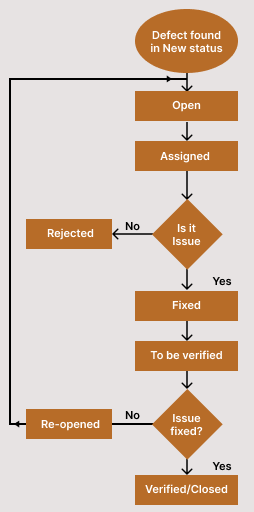
The below defect life cycle describes the workflow of the Defect management process -
- Whenever the testing team discovers a bug in the software, they mark it as "New."
- An “Open” status indicates that the issue is ready to be assigned to the development team once a QA lead assesses it and determines it to be valid.
- The status of the defect changes to "Assigned" when a QA lead assigns it to the appropriate developer. At this point, a developer needs to start identifying and fixing the flaw.
- The developer rejects the flaw when they believe it to be untrue or invalid. The testing team receives a new assignment, and the defect has the status of "Rejected."
- The defect status is changed to "Duplicate" if the problem is reported twice or if both defects have the same symptoms and procedures for reproduction.
- If difficulties or hurdles in the current release prevent a specific flaw from being fixed, that defect receives the status of "Deferred" or "Postponed."
- Developers can identify a flaw as "Not Reproducible" if they cannot reproduce it using the "Steps to Reproduce" provided by the testing team. The testing team should now give developer-specific reproduction instructions
- Developers can flag bugs as "Need additional information" if they are unclear about the procedures provided by QA to reproduce the fault. The testing team must give the development team the necessary information in this situation.
- A flaw is marked as a "Known defect" if it is already known and present in the production environment.
- The error is "Fixed" when a developer makes the required adjustments
- The developer now changes the status to "Ready for Retest" and sends the bug to the testing team for verification.
- The tester marks the defect as "Closed" if it correctly validates and there are no new issues.
- The remark of the problem is "Reopened" if the tester discovered during retesting that it was still reproducible or only partially fixed. The developer must now investigate this flaw once further
Phases of Defect management
We are often involved in designing, testing, deploying, and shipping products that we cannot get ahead to put proactive Defect management processes and tools to reduce the risks upfront
So, let us look at the Defect management phases in detail to manage our defects effectively
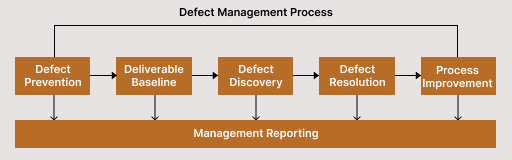
- Defect prevention: Defect prevention is the first step in the Defect management process. The optimal approach is to correct any flaws discovered early in the testing process rather than waiting until they are found and fixed.
Because it is less expensive, you can lessen the impact in the initial stages of addressing or resolving faults. But for later stages, finding flaws and then fixing them can be expensive, along with exacerbating the impacts of a problem.
The following are the main steps in defect prevention:
This approach saves money because addressing flaws discovered during early testing doesn't need much. The best method for minimizing the impact of a defect is to remove it within the initial development stage.
- Determine critical risks: By identifying the risk, we can analyze the projected financial impact of each crucial situation. Determine the system's critical risks, which will have a more significant impact if they arise during testing or later. The risk of defects is reduced in this stage by following procedures, methodology, and best practices.
- Estimate expected impact: Once we identify every considerable risk, we may focus on the higher risks to the system and attempt to reduce or eliminate them. You can't eliminate options that will lessen their likelihood of happening and their economic implications. For each critical incident, determine the financial impact of the risk.
- Reduce predicted impact: After identifying all significant defects, focus on the top defects that, if present, could affect the system and attempt to reduce or remove the risk. Because when it comes to defect prevention, we can immediately pinpoint the system's key risks that will have a more significant impact if they materialize during testing or at a later stage.
- Deliverable baseline: The Deliverable baseline is the second step in the Defect management process. Here, the delivery defines the design, documentation, or development.
When a deliverable (or product) hits its predetermined milestone during development, we can state that it is a baseline. As the product is transferred from one milestone to the next, the defect in the deliverable has a more significant impact on the existing system. In other words, we may claim that you can control the further changes once a deliverable is baselined.
- Defect discovery: It is the next step in the Defect management process. It is impossible to make a system defect-free by eliminating all of its flaws. Additionally, it could result in longer-term harm. However, you can spot the flaws early on before they increase the project's cost.
The following steps in the defect discovery process:
Only a flaw is detected if developers have acknowledged or recorded it as a valid one. When a fault is officially reported to the development team and recognized as a defect, we can claim the defect's detection.
- Find a defect in the system before it becomes a significant issue. It is the first step in the defect discovery process.
- As soon as the testing team discovers a defect, they have to inform the development team that there is a problem that needs to be looked into and fixed.
- If a genuine issue is assigned to the development team by the testing team, it is the development team's job to acknowledge the defect and go forward with fixing it.
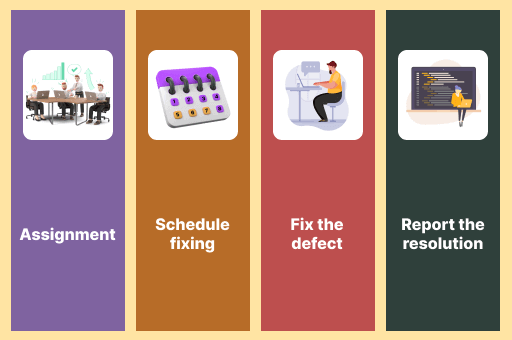
- Defect resolution: It involves fixing the flaws step-by-step. The method of fixing a defect starts with assigning it to a developer, who then schedules it for correction according to priority, sets it, and sends a resolution report to the test manager. To fix the issue, you can take the actions below.
- Assignment: It involves assigning a task to a developer (or other technicians) and changing the status to ‘Responding.’
- Fixing the schedule: Fixing the schedule: The developer side is in command in this phase. Depending on the priority of the issues, they will develop a plan for improving them.
- Fix the flaw: The test manager keeps track of the defect-fixing process compared to the above timeline while the development team is working to address the shortcomings.
- Report the resolution:When you fix the bugs, ask for a report from the developers detailing the resolution.
- Process improvement: All the stages mentioned above involve organizing and fixing the defects. We will now examine the lower priority issues because they are still crucial and impact the system during the process improvement phase. From the standpoint of the process improvement phase, all acknowledged issues are equivalent to significant defects and must be fixed.
Everyone involved in the project must look back and determine the source of the issue to improve the process. Though you need to prioritize faults and address them during the defect resolution process, this does not imply that lower priority issues are unimportant or do not significantly influence the system from a process standpoint.
All flaws found are considered critical problems from the process improvement perspective. Based on that, you can adjust the base-lining document, review process, and validation process to catch defects earlier in the Defect management process when they are less expensive.
Role of Defect Report in managing defects
A defect report is a detailed document that contains defect information like its description, stack traces, expected and actual outcomes, and other vital information. It ensures the defect is identified and fixed before it affects our users. A defect report can be 2 to 20 pages or more.
You should include the following information in your Defect report.
- Defect ID: Maintain a unique defect ID. You can also generate it via bug tracking tools.
- Heading: Give a short and crisp heading that defines the problem statement.
- Description: A summary of the defect describes how and when the defect was found.
- Screenshots and video recordings:Attaching a screenshot of the defect and its video recording can help you locate the issue quickly.
- Expected vs. actual results:Convey what should be the expected results and what is the actual result to help the developer get a clear picture of what’s expected and what’s not.
- Environment: Include the necessary information about the test environment like browser, version, operating system, resolution, etc.
- Source URL: It helps developers know the defect's exact location.
- Priority and severity: Specify the severity of the defect and prioritize it accordingly.
- Additional information:Provide extra chunks of information like your name, due date, developer to whom the task has been assigned, etc.
Intrigued to know how to write a good bug report? Check our advanced guide on how to write a bug report.
How to manage your defects effectively?
Defect management is the key aspect of the software development process. Irrespective of whether the bug is minor or major, it’s vital to log, manage and fix each defect to build effective and scalable applications. Hence, choosing a defect management platform is critical. Several solutions like TestMu AI available in the market come with defect tracking features.
Managing defects well starts with agreeing on the states each one passes through. The stages of the bug life cycle define who owns a defect at every handoff, from New through Assigned and Retest to Closed.
TestMu AI is a cloud-based cross browser testing platform that enables developers and testers to perform live-interactive and automated testing of their websites and applications across 3,000+ browser and OS combinations and 10,000+ real devices.
It also offers testing on a real device cloud that helps you identify all the bugs while testing your web and mobile apps in real-world scenarios. TestMu AI supports different developer tools for app and web testing that make it easier to identify and fix defects instantly.
While testing applications, if you come across any defects, you can directly mark and report them using TestMu AI's one-click bug logging feature to your favorite bug tracking tools like Jira, Asana, Trello, Bugasura, etc., including the Hive integration for logging bugs to your Hive instance in a single click.

You can subscribe to the TestMu AI YouTube Channel and get the latest tutorials around Automation testing, Playwright, Responsive testing, and more.
TestMu AI has an in-built Issue Tracker that allows you to track and manage defects in one place. You can share your logged defects across various platforms to your team members via e-mails and shared links, export them in PDF and XLSX formats, and do much more. Issue Tracker also has the Reproduce at TestMu AI feature to retest your defects on the same test environment.
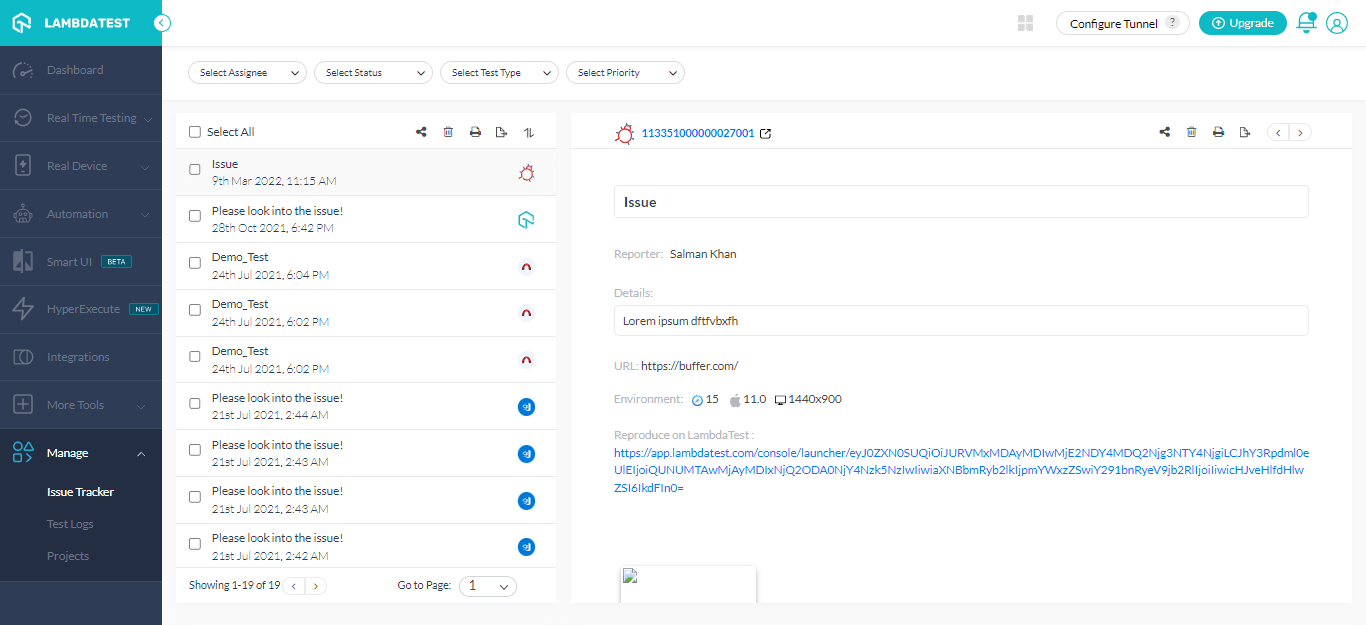
TestMu AI also has a Test Logs library that contains all the logs of your browser and app testing.
Important Defect metrics
Let’s consider that you reported 52 bugs, and out of them, only 34 are identified as actual defects. It implies that 18 reported defects were incorrect and involved some error while performing software testing. So, how can you estimate the quality of test execution?
A few metrics are helpful when it comes to measuring the quality of test case execution
- Defect rejection ratio: (Number of defects rejected / Total number of defects identified) * 100
- Defect leakage ratio: (Number of defects missed / Total number of defects identified) * 100.
If the value of DRR and DLR is low (5~10%), the better the quality of the test execution
For the above scenario, the defect rejection ratio is 34.61%. The scenario records no defects escaping to production, so it does not supply a defect leakage ratio.
Essential Defect Management Metrics and KPIs
Metrics turn Defect management from a reactive habit into a measurable process. The formulas below give QA leads a concrete read on test effectiveness, code quality, and how much risk is leaking into production. Track them cycle over cycle to see whether your Defect management process is actually improving.
| Metric | Formula | What it tells you |
|---|---|---|
| Defect Density | Total defects / Size of the module (in KLOC or function points) | How defect-prone a component is, so you can focus retesting on the riskiest modules. |
| Defect Detection Percentage (DDP) | (Defects found in testing / (Defects found in testing + Defects found after release)) * 100 | How effective your testing is at catching defects before release. Higher is better. |
| Defect Leakage Rate | (Defects found in production / Total defects found) * 100 | The share of defects that slipped past testing into production. Lower is better. |
| Defect Rejection Rate | (Defects rejected / Total defects reported) * 100 | How many logged defects were invalid, which flags noise in the reporting process. |
| Escaped Defects | Count of defects found after release | The raw number of Escaped Defects reaching users, a direct signal of release quality. |
Defect Density pinpoints which parts of the codebase need the most attention, while Defect Detection Percentage (DDP) and the Defect Leakage Rate together show how much your test suite is catching versus missing. A high Defect Rejection Rate usually points to unclear reproduction steps or a noisy intake process rather than a real quality problem. Watching Escaped Defects release over release is the clearest way to confirm the Defect management process is trending in the right direction.
Defect Management in Agile and DevOps Methodologies
In Agile and DevOps teams, Defect management shifts left. Instead of waiting for a dedicated test phase, defects are caught inside the same sprint they appear in, which keeps the cost of a fix low and the feedback loop short. Testing runs alongside development, so a defect logged on Monday is often triaged, assigned, and closed before the sprint review.
Here is how defect handling changes across an Agile and DevOps workflow:
- Sprint planning and backlog grooming - bugs are prioritized alongside user stories, given a severity, and pulled into the sprint based on their impact on the release goal.
- Continuous integration - CI/CD pipelines run automated tests on every merge and log defects automatically, so a broken build surfaces the failure the moment code is pushed.
- Shared ownership - developers, testers, and product owners all triage and update defects, rather than defects living only with a separate QA team.
- Definition of done - a story is not complete until its known defects are resolved or consciously deferred, which stops bugs from carrying over sprint after sprint.
Security defects follow the same shift-left principle. Maturity frameworks like OWASP SAMM (Software Assurance Maturity Model) help teams build defect prevention and secure code review into the pipeline, so vulnerabilities are treated as defects and caught early rather than after release.
Understanding SLAs and Triage in Defect Management
A Service Level Agreement (SLA) in Defect management defines how quickly a defect must be acknowledged and resolved based on its severity. Tying resolution times to severity keeps critical issues from sitting in a backlog and gives both QA and development a shared, measurable target.
| Severity | Example | Typical SLA target |
|---|---|---|
| Critical / Blocker | Checkout fails, app crashes on launch, data loss | Acknowledge within 1 hour, resolve within 24 hours |
| High / Major | A core feature is broken with no workaround | Resolve within 2 to 3 business days |
| Medium / Minor | A feature misbehaves but has a workaround | Resolve within the current or next sprint |
| Low / Cosmetic | UI alignment, a typo, or a minor styling issue | Resolve when capacity allows, often a backlog item |
A Defect Triage meeting is where the team reviews new defects together and decides what happens to each one. QA leads, developers, and product owners agree on severity and priority, confirm the defect is valid and reproducible, assign an owner, and set the target release. Regular triage stops low-value defects from consuming sprint capacity and makes sure genuinely urgent issues jump the queue.
The Role of a Defect Manager
A defect manager owns the defect lifecycle from intake to closure. In practice, that means running triage, assigning severity and priority, routing each defect to the right developer, and tracking resolution against the agreed SLAs. They also report on metrics such as Defect Density and the Defect Leakage Rate so stakeholders can see whether quality is improving. On smaller teams a QA lead often wears this hat, while larger organizations assign it as a dedicated role. The goal is the same either way - keep defects moving toward closure without stalling the release.
Top Defect Management Systems and Software
A defect management system gives teams one place to log, track, and report on defects, and the right choice depends on how tightly it integrates with your test execution and delivery pipeline. The tools below are widely used across QA and engineering teams, each with a different focus.
| Tool | Best for | How it fits the workflow |
|---|---|---|
| Jira | Agile teams tracking defects alongside stories | Customizable workflows, sprint boards, and deep integration with most test platforms make it a default issue tracker for many teams. |
| Bugzilla | Open-source, self-hosted bug tracking | A long-standing, free tracker with detailed defect fields and advanced search, popular where teams want full control of their data. |
| Rollbar | Real-time error and defect monitoring | Captures production errors as they happen and groups them into actionable items, closing the loop between monitoring and defect logging. |
| New Relic | Observability-driven defect detection | Surfaces performance and error data across the stack, so defects are spotted from live telemetry, not just manual reports. |
| SafetyCulture | Inspection and issue tracking for operations | Logs and tracks issues from field inspections, extending defect tracking beyond software into physical and process quality. |
Whichever tracker you choose, the real gain comes from connecting it to where tests actually run. TestMu AI's Test Management platform links every requirement to its test cases, runs, and defects in a single traceability matrix, then logs a failing test as a defect in Jira or Azure DevOps with full context - steps, environment, and expected versus actual results - populated automatically. When a developer resolves the ticket, the status syncs back to the linked test case, so QA and development work from one source of truth instead of reconciling two systems. This significantly reduces the manual overhead of defect handoffs and gives release owners a data-backed view of what is still open.

Conclusion
Defect management is the core of software testing. The entire software development process should adhere to the Defect management approach, not just specific testing or development activities.
You can find and fix software issues as a part of the Defect management process. The entire Defect management procedure will assist in identifying the issue as early as possible and ensuring that the end-users get a high-quality product.
Author

Swapnil Biswas
Blogs: 8


Swapnil Biswas is a Product Marketing Manager at TestMu AI, leading product marketing for KaneAI and HyperExecute while orchestrating GTM campaigns and product launches. With 5+ years of experience in product marketing and growth strategy, he specializes in AI, SEO, and content marketing. Certified in Selenium, Cypress, Playwright, Appium, KaneAI, and Automation Testing, Swapnil brings hands-on expertise across web and mobile automation. He has authored 20+ technical blogs and 10+ high-ranking articles on CI/CD, API testing, and defect management, enabling 70K+ testers to improve automation maturity. His work earned him multiple awards, including Top Performer, Value of Agility, and Wall of Fame. Swapnil holds a PG Certificate in Digital Marketing & Growth Strategy from IIM Visakhapatnam and a BBA in Marketing from Amity University.
Reviewer

Abhishek Mishra
Reviewer
Abhishek Mishra is a Technical Product Manager at TestMu AI, where he owns Test Manager, the test management product. He has over 8 years of experience in product management and market analysis. His expertise spans across AI-native software testing, product strategy, and analytics. Previously, Abhishek served as the Product Lead at IndiaClan and co-founded Gartley618 Technologies, where he led innovative projects in quantitative trading and blockchain. He holds a B.Tech degree.


Defect Management FAQs
Did you find this page helpful?
More Related Learning Hubs
TestMu AI forEnterprise
Get access to solutions built on Enterprise
grade security, privacy, & compliance
- Advanced access controls
- Advanced data retention rules
- Advanced Local Testing
- Premium Support options
- Early access to beta features
- Private Slack Channel
- Unlimited Manual Accessibility DevTools Tests