

Power Your Software Testing with AI Agents and Cloud
The Native AI-Agentic Cloud Platform to Supercharge Quality Engineering. Test Intelligently and Ship Faster.


- TestMu AI (Formerly LambdaTest)
- /
- Blog
- /
- Shift-Left vs Shift-Right: A Question of Quality At Speed
Shift-Left vs Shift-Right: A Question of Quality At Speed
Quality at Speed is a journey, not a destination. Read more on how Shift-left vs Shift-right can contribute to this factor.
Last Updated on:
On This Page
- Shift-right gives the customer and operations priorities
- Shift-left improves quality and speed by design
- Continuous delivery brings faster iterations
- Test At Scale with TestMu AI
- Shift-left vs shift-right depending on the limiting factors
- AI Agents in Shift-Left and Shift-Right
- Continuously improve value delivery, shifting where necessary
Shift-left testing catches defects early in design and development, while shift-right testing validates real behavior after release in production.
Shift-left relies on reviews and test-driven development before code ships, and shift-right relies on production monitoring such as golden-signal tracking and chaos engineering after it ships.
This article covers six systemic angles: shift-right and customer priorities, shift-left and design-stage quality, faster delivery through continuous iteration, testing at scale, choosing between the two by bottleneck, and continuously improving value delivery.

Key Takeaways
- Shift-left focuses on catching defects during design and development, before code reaches production.
- Shift-right focuses on validating real behavior after release, using live production data instead of staging estimates.
- Site Reliability Engineering techniques such as golden-signal tracking and chaos engineering represent the technology side of shift-right.
- Continuous delivery and software craftsmanship push for faster release cycles but do not remove the need for good code design.
- The weakest point in a software delivery flow limits overall speed, so fixing a bottleneck elsewhere in the process wastes effort.
- Value-stream mapping, limiting-factor analysis, task prioritization, and retrospectives form a repeatable cycle for improving quality and speed together.
Shift-right gives the customer and operations priorities
Shift-right, also known as production testing, focuses on evaluating quality in real-world conditions after deployment and release. This approach aims to enhance customer experience by analyzing the value delivered in live production environments. By leveraging real user interactions, shift-right ensures high-quality applications can handle real user load effectively. This customer-centric testing strategy aims to optimize and improve quality, making it vital for a seamless user experience.

One significant benefit of shift-right is to provide the most accurate data from a customer point of view as directly performed in the production. Staging environments can be used to some extent but hardly reflect the reality of the traffic, and some events only happen in the target environments like infrastructure instabilities, and network latencies, among others.
Another significant benefit of shift-right is to focus different profiles on the same and factual objectives above their local priorities. Product owners, software engineers, and testers can all collaborate on customer journey performance supported with factual metrics, building up an internal culture of continuous improvement of business and technology.
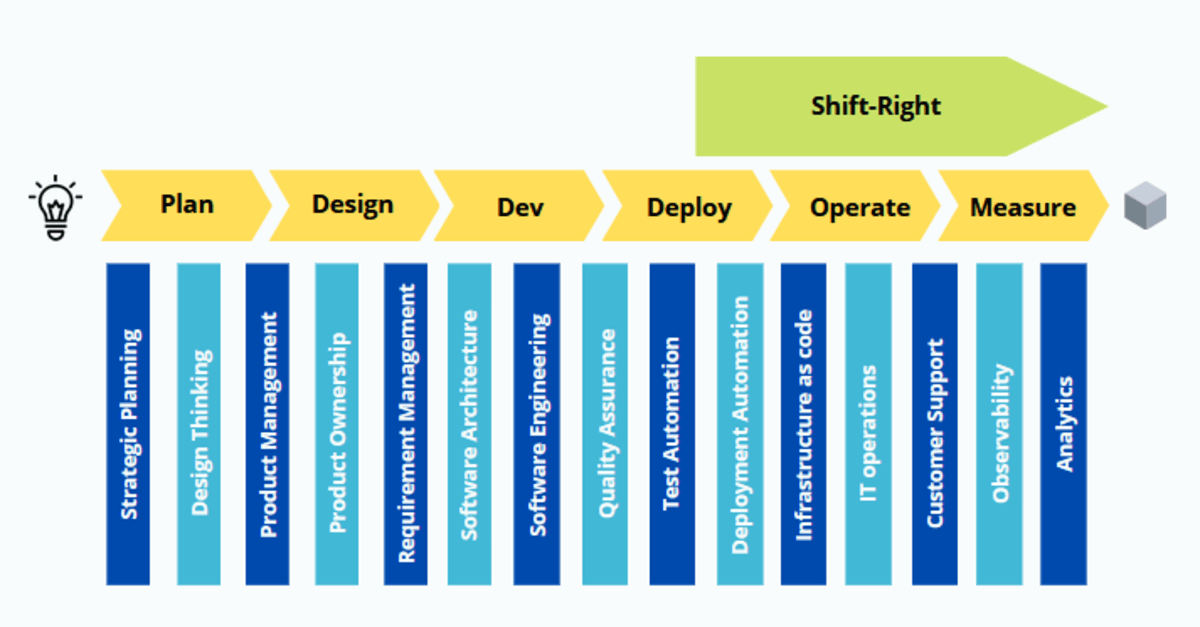
Customer journey monitoring is an example of business-focus methodologies measuring the paths taken by users on the digital experience channels. Its value is to provide visibility about the performance of major paths and their areas of improvement, but also on recurring issues, users can face like error pages resulting from bugs or unmanaged exceptions.
Site Reliability Engineering (SRE) best represents the technology focus of shift-right with techniques such as Progressive Delivery or Chaos Engineering where improvements are continuously measured with the golden signals of availability, response time, error rate, and latency of services in production, all giving inputs for upstream improvements.
Testing in production with shift-right for the right reasons can therefore bring major quality improvements for what makes sense to be measured there. For other cases, it is best to implement quality improvements right from the beginning with shift-left.
Key Takeaway: Shift-right testing evaluates software in production after release, using customer journey monitoring and Site Reliability Engineering signals such as availability, response time, error rate, and latency to guide improvements.

Shift-left improves quality and speed by design
Shift-left testing emphasizes quality practices earlier in the software lifecycle, up to the initial planning and design stages where things are only on paper and can be easily changed. Its effective implementation is not easy, requiring the collaboration of multiple actors with different priorities, not necessarily familiar with the requirements and design phases.
Organizations that can shift left benefit from increased quality and speed with minimal rework in later stages. The key is to implement systematic practices of reviews and testing that provide rapid feedback on key assumptions and quality requirements. Defects detected at the stage can be quickly corrected at a much lower cost.
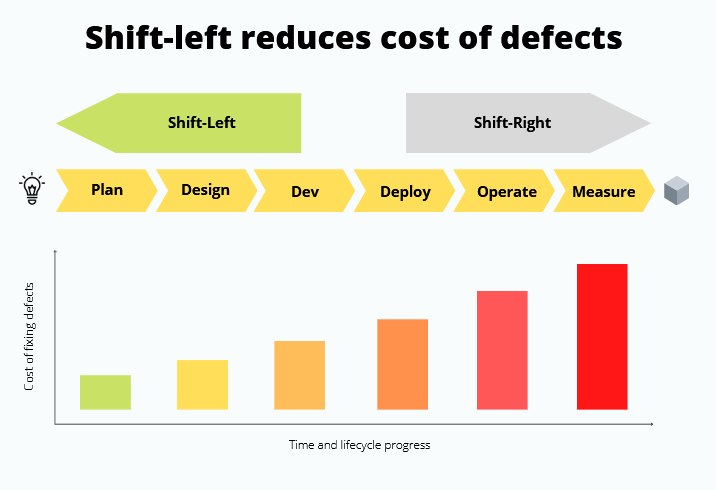
Shift-left methodologies also have the two prisms of business and technology.
Shifting left on the business relies on assessing customer and functional requirements as early as possible, wherever in the planning phases improving the priorities to maximize the potential value delivery, or in the design phases, making sure that key customer requirements will be answered in the software implementation that will follow.
The technology side of shifting-left is about non-functional requirements such as security, performance, and reliability. These can be addressed with checklists to identify the most important ones, to then define deliverables that will answer these requirements once the product will be built in implementation stages.
While Shift-left and Shift-right are important, the core of the work is to build valuable software that relies on good code in the first place, at the middle of the software lifecycle.
Key Takeaway: Shift-left testing moves reviews and testing into the planning and design stages, where business requirements and non-functional requirements such as security, performance, and reliability can still be changed on paper.
Continuous delivery brings faster iterations
Software implementation is largely influenced by the paradigm of Continuous Delivery and Software Craftsmanship respectively pushing for faster cycles of delivery through automation and well-crafted software from the start. The key objectives are to support faster business iteration, maximize the business value delivery, and contain technical debt.
The focus of code implementation are the software engineers that emerging platform teams consider as their customers. They must be able to leverage self-service, automation and insights for frictionless iterations code implementation of code delivery with reliability and confidence leveraging automation and testing.
Organizations that embrace such paradigms leverage continuous testing and continuous monitoring practices to accelerate their cycles of iterations and value delivery. But their main problem is the increasing complexity and size of the codebase that over time, becomes harder to maintain and slower to release.
Shift-left and shift-right helps with proper software design or customer journey monitoring but do not solve all issues. Specific solutions are appearing on the market to keep the rhythm of software delivery even with a growing codebase, providing ways to build, deploy and test the minimum of code impacted by a proposed changes

Key Takeaway: Continuous delivery and software craftsmanship shorten release cycles through automation and well-crafted code, but a growing codebase becomes harder to maintain and slower to release, which shift-left and shift-right alone do not fix.
Test At Scale with TestMu AI
Practices of software craftsmanship combine software production and testing to improve the core of the software lifecycle like hexagonal architecture, test-driven development (TDD), or more generally the Agile Testing framework to adapt the testing techniques—whether manual or automated—depending on the context of the product.
Now that we understand that the question is not “Shift-left vs shift-right” as each stage of the software lifecycle must and can be improved for quality at speed, one question remains: where to start?
A good starting point is adopting platforms that support scalability and flexibility in testing across diverse environments. TestMu AI is an AI-native test orchestration and execution platform that allows you to run manual and automated tests at scale across 5000+ real devices, browsers, and OS combinations. This ensures faster feedback, better coverage, and improved quality throughout the development lifecycle—without compromising speed or agility.
Shift-left vs shift-right depending on the limiting factors
We can be tempted to improve all parts of the software lifecycle, launching many improvements in shift-left and shift-right, hoping to drastically improve quality and speed across the software lifecycle. But most of the time, it is a waste of resources where people are busy instead of being productive and can become a bad habit.
The performance of any system is limited by its weakest point, making it the only priority to tackle; actions done outside of the bottleneck will not affect the system until the weakest point is improved. This behavior is an opportunity to help us prioritize our initiatives focusing on removing bottlenecks of quality and speed across the software lifecycle.
Techniques coming from the manufacturing world make a lot of sense in the software world that in the end is a flow of work that must be optimized for value delivery. Many frameworks have common points to start by understanding how things work and what are the problems before planning, implementing, and measuring improvements.
The same logic can be used in the software. Methodologies must be adapted to the software specifics like the software lifecycle stages and leverage the access to advanced automation and scaling capabilities. The main challenge in software is to visualize the distributed flow of work making it complex to get an end-to-end vision of the multiple integrated pieces.
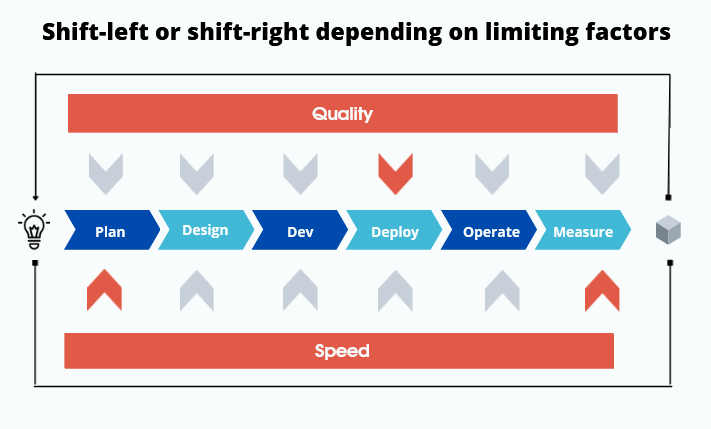
The following steps enable to improve quality and speed through iterations:
- Value-stream mapping to understand the flow and its performance
- Limiting factors identification with root-cause analysis, issues-tree
- Task-prioritization mechanisms to implement identified improvements
- Measurement & retrospectives to learn and adapt from experience.
Each of these activities must be performed as a continuous process after each increment to define the most important priorities depending on the identified limiting factors. In some cases, shift-left would be the main part to address to improve quality upstream, while automation would be required in the middle to streamline activities that remain manual.
The discussion between shift-left vs shift-right moves from a debate of opinions to factual improvements of the software value chain based on facts. The customers, business, and users are the center of attention where efforts must be translated into valuable outcomes concretely improving quality and speed across the software lifecycle.
The goal is to reach and maintain a state of continuous value delivery in a rapidly evolving ecosystem to sustain the business.
Key Takeaway: The choice between shift-left and shift-right depends on where the bottleneck sits: shift-left when quality problems start upstream, and automation when manual work slows the middle of the software lifecycle.

How Do AI Agents Change Shift-Left And Shift-Right Testing?
AI agents now generate tests earlier for shift-left and analyze production signals faster for shift-right, narrowing the gap between the two practices.
The shift shows up in four concrete ways across both practices today:
- Design-time test generation: an agent reads a requirements document or a user story and drafts the test cases before a single line of code exists, pushing quality earlier into the design stage.
- Production anomaly triage: an agent watches the golden signals a site reliability team tracks, availability, response time, error rate, and latency, and flags a deviation before a person notices the dashboard.
- Agentic quality engineering: a quality engineering team pairs an agent with human review so the agent proposes a fix and a person confirms it matches the actual customer need.
- Cross-team feedback loops: an agent routes a production finding straight to the backlog item that caused it, closing the loop between shift-right monitoring and agile testing cycles without a manual handoff.
A person still has to confirm a flagged anomaly is a real regression and not a one-off traffic spike, so shift-right monitoring keeps a human in the loop even as an agent takes the first pass.
Key Takeaway: AI agents extend shift-left by drafting test cases from requirements before code exists and extend shift-right by watching availability, response time, error rate, and latency in production, while a person still confirms that an anomaly is a real regression.
Continuously improve value delivery, shifting where necessary
Quality at Speed software is a journey rather than a destination where only the actors are able to master the software flow can reinvent themselves to remain valuable, successfully equilibrating shift-left and shift-right practices depending on their maturity.
It’s about creating a mature system where the practices shared by value-stream mapping, limiting factors removals, and continuous improvements focused on quality at speed becomes an organizational habit enabling to support the business growth.
Shift-left vs shift-right is therefore not the question to be answered. Instead, we must continuously ask which practices would have the most impact to deliver quality and speed across the end-to-end software lifecycle.
This question requires more than software engineering—it’s Quality Engineering.
Key Takeaway: Quality at speed is a continuous journey, so teams should keep asking which practice will most improve quality and speed across the end-to-end software lifecycle instead of choosing shift-left or shift-right once.
Author

Antoine Craske
Blogs: 10


Antoine Craske is a community contributor with 15+ years of experience spanning software architecture, quality engineering, and large-scale technology transformation. He has worked extensively on continuous testing, CI/CD practices, and software quality at enterprise scale, alongside leading architecture and engineering teams as a CTO and Chief Architect. Antoine is the author of multiple books on quality engineering and system architecture, a frequent conference speaker, and the creator of frameworks focused on measurable improvements in software delivery and testing practices.


Shift-Left vs Shift-Right FAQs
Did you find this page helpful?
More Related Blogs
TestMu AI forEnterprise
Get access to solutions built on Enterprise
grade security, privacy, & compliance
- Advanced access controls
- Advanced data retention rules
- Advanced Local Testing
- Premium Support options
- Early access to beta features
- Private Slack Channel
- Unlimited Manual Accessibility DevTools Tests