

Power Your Software Testing with AI Agents and Cloud
The Native AI-Agentic Cloud Platform to Supercharge Quality Engineering. Test Intelligently and Ship Faster.


- TestMu AI (Formerly LambdaTest)
- /
- Blog
- /
- Agile Vs Waterfall Methodology
Agile Vs Waterfall Methodology
Agile vs waterfall methodology compared across requirements, team structure, delivery cadence, and risk, with guidance on which model fits your project.
Last Updated on:
Agile vs waterfall methodology comes down to when requirements are allowed to change. Waterfall locks scope in a signed requirement document before design starts. Agile splits the same work into sprints and accepts new user stories in each one.
This guide covers how exactly both of them work, the pros and cons of agile and waterfall, how AI coding agents change the choice, going agile in browser compatibility testing, and why results matter in the end.
Key Takeaways
- Waterfall fixes the requirement document before design begins, so a late scope change means restarting the affected phases.
- Agile splits a project into sprints and takes new user stories from the customer at the start of each sprint.
- Waterfall shows the customer a working product only after deployment, while agile gives the customer a demo in every sprint.
- Waterfall keeps testers idle until the development phase ends, while agile puts developers and testers in the same sprint.
- Waterfall suits projects with clear and stable requirements, and agile suits projects where requirements are expected to change.
- Agile trades detailed documentation for working software, so a large or complex project still needs a documentation plan.
How Exactly Both of Them Work
Waterfall provides a more sequential approach to software development. It works in the following order.
- Software requirement document is gathered
- The application is designed after requirement is finalized
- Development begins and parallelly unit testing is executed
- Performance testing is carried out to ensure the system performs well under load or stress
- User acceptance testing confirms the build against the agreed requirements
- Defect fixing where the developer starts working on the bugs detected by the testing team
- The application is deployed in production
Agile however, does not follow any linear path. It follows an iterative approach to development. Instead of creating tasks, the entire duration of the project is divided into phases called sprints. Agile generally focuses on four fundamental values
- Interaction between team members rather than tools.
- A properly working software rather than all-inclusive documentation.
- Collaboration of customer in every sprints.
- Quick response to change instead of following a plan.
Requirement Gathering Phase
If waterfall model is used for the application development, both the customer and the organization need to have clear understanding of the requirement specifications beforehand. There is no scope of changing them once the requirement is accepted.
Agile methodology however, there is no fixed requirement document from the get go. Customer provides user stories in each sprint and the job of the developer is to finish the coding and present a demo. If the customer is not satisfied with the product and requires more add-ons, he requests change in the application. Agile is thereby, more flexible in requirements than waterfall.
Suitable Projects
If the customer is clear about the requirements of the software that is going to be developed, Waterfall model is the best approach to follow, since it follows a linear approach and requirements are made clear in the first phase.
If the application you are planning to develop needs to evolve with each phase and frequent overhauls may be expected in the project, Agile methodology is the best approach to keep up with customer requirements and technology landscape.
Product Visibility to The Customer
When waterfall model is followed, the customer can only see the full product after the project comes to an end and the application is deployed into production.
In Agile, since the duration is split into multiple sprints, customer gets frequent opportunities to look at the product and thereby, take decisions regarding acceptance criteria and changes to be performed.
Working as a Team
A biggest disadvantage of Waterfall model is that, it does not allow integrated collaboration between developers and testers. Testers begin their work only after the development phase is over and they work individually.
In Agile, testers and developers work together. Each sprint has a testing phase and every time a new function is released, it is immediately followed by regression testing.
Splitting a Big Task into Smaller Ones
In Waterfall model, software development becomes a bit complex since the entire application is to be completed as one single project. It becomes a hectic job for developers and more hectic for testers when they begin testing a large application.
In Agile, the project gets split up into multiple user stories. Developers and testers work together in each phase to understand the requirements and the customer finally gives a review of whether everything is done correctly. It makes the job easier and quicker.
Key Takeaway: Waterfall moves a project through requirement gathering, design, development, testing and deployment in one fixed order, while agile repeats that same sequence inside every sprint.
Pros and Cons of Agile and Waterfall
Waterfall Approach
Although traditional, waterfall model is advantageous in many ways.
- A predictable and static workflow ensures that the team can calculate proper cost estimation and get an idea of deadline.
- Since the process requires documentation, a paper trail leads the way to each development phase. Following the logic of past projects, the team can set groundwork for future projects also.
- The process is straightforward, so no prior knowledge is required by the team in order to start working on the waterfall model.
However, cons are there as well
- Since the model is rigid, any major change can prove to be costly for both the customer as well as the team, since the entire project has to be scrapped off and started again.
- The result of multiple phases of requirement gather, development and testing lead to quite a lot of time before the stakeholders actually get to view the live application.
Agile Methodology
Since it follows an iterative approach, Agile is advantageous in many ways
- Short development phases make the project adaptable and always ready for any major or minor change required by the customer.
- The customer can view the live project during every sprint and regular feedback results in a better-quality product.
- Developers and testers work hand in hand along with the customer. A better teamwork results in the development of an individual as well as business of the organization.
Whenever there are advantages, it is followed by certain disadvantages
- Agile prefers a working application over documentation. This is a good thing but depending on the complexity of a project, a proper balance between documentation and coding may sometimes be necessary
- The methodology is designed for small teams. Therefore, each team member must be proficient in their roles and self-dependent.
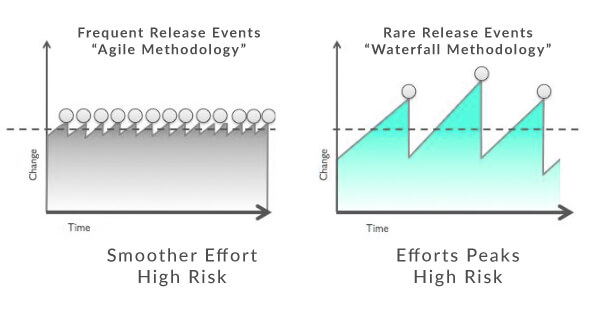
Key Takeaway: Waterfall buys a predictable cost and deadline estimate at the price of rigidity, while agile buys adaptability at the price of lighter documentation and a dependence on small, self-sufficient teams.
How Do AI Coding Agents Change the Agile vs Waterfall Choice?
AI coding agents push teams toward agile because they shorten the build step and leave code review as the bottleneck. A waterfall plan sizes a phase in weeks. An agent that drafts the same module in an afternoon makes that estimate wrong before the phase starts.
Four changes matter in practice.
- GitHub Copilot, Cursor, Claude Code: these assistants generate a working slice in hours, so a sprint can absorb a change that a signed requirement document cannot.
- Model Context Protocol (MCP): MCP servers connect an assistant to Jira and GitHub, so the agent reads the same user story and the same repository the team is working on.
- Unit and regression tests: agents draft them next to the code, which suits the agile testing practice of testing inside every sprint instead of in a separate phase.
- Non-determinism: the same prompt can produce different code on two runs, so a person still has to read the diff and accept it against the story.
Waterfall still fits fixed scope work such as a regulated release with a frozen specification, because the approved document is part of what gets delivered. For everything else, the limit is no longer how long coding takes. It is how fast a team can review and accept what an agent produces.
Key Takeaway: AI coding agents move the constraint in a software project from writing code to reviewing it, which suits a short sprint cycle more than a long fixed waterfall phase.
Going Agile in Browser Compatibility Testing
In most development cycles, even those following agile development methodologies, browser compatibility testing is the last priority. Teams run it once the whole project is built and deployment is a few steps away. Some teams run it only after deployment.
The reasoning is understandable. A development team makes the application work first and worries about compatibility later. On large projects that order backfires. Running cross browser testing during development of critical user stories costs less than fixing every page after development is finished.
Key Takeaway: Running browser compatibility checks inside the sprint that builds a critical user story costs less than fixing compatibility across every page after development ends.
In The End, Results Matter
People who are in the industry for a long time will suggest that a proper planning with requirements clarified beforehand will ensure successful delivery. But, we live in a world where fast delivery results in improved profit. Therefore, based on the nature of the project it is on up to the team and the stakeholder to figure out which approach will be perfect to use.

Author

Arnab Roy Chowdhury
Blogs: 69


Arnab Roy Chowdhury is a community contributor with 10+ years of experience working across software development, web UI engineering, and technical content writing. Currently a Senior Consultant at Capgemini, he has hands-on experience in building and maintaining cross-browser compatible web interfaces using HTML5 and modern frontend practices. Arnab has also contributed as a freelance web developer and writer, combining practical development expertise with clear technical documentation. He holds a Bachelor’s degree in Computer Engineering.


Agile vs Waterfall FAQs
Did you find this page helpful?
More Related Blogs
TestMu AI forEnterprise
Get access to solutions built on Enterprise
grade security, privacy, & compliance
- Advanced access controls
- Advanced data retention rules
- Advanced Local Testing
- Premium Support options
- Early access to beta features
- Private Slack Channel
- Unlimited Manual Accessibility DevTools Tests