

Power Your Software Testing with AI Agents and Cloud
The Native AI-Agentic Cloud Platform to Supercharge Quality Engineering. Test Intelligently and Ship Faster.


- TestMu AI (Formerly LambdaTest)
- /
- Learning Hub
- /
- Test Automation Pyramid: Layers, Ratios, How to Apply It
Test Automation Pyramid: Layers, Ratios, How to Apply It
The test automation pyramid splits tests into unit, integration, and end-to-end layers in a 70/20/10 ratio. Learn each layer and how to apply it in 2026.
Last Updated on:
The test automation pyramid is a strategy that splits automated tests into three layers: unit at the base, integration in the middle, and end-to-end at the top.
You write many fast, cheap tests at the bottom and few slow, expensive ones on top, so feedback stays quick and failures are easy to localize.
TL;DR
The test automation pyramid splits automated tests into three layers, unit at the base, integration in the middle, and end-to-end at the top, with far more fast, cheap tests than slow, expensive ones. How many of each you write depends on cost and speed, not on which tests feel important.
- Three layers - unit tests at the base, integration in the middle, end-to-end and UI at the top.
- The ratio - aim for roughly 70% unit, 20% integration, and 10% end-to-end tests.
- The anti-pattern - a top-heavy ice cream cone makes suites slow, flaky, and hard to debug.
- How to apply it - measure your current shape, push tests down, and keep the top layer thin.
- Tools and AI - JUnit, Selenium, and Cypress per layer, plus AI authoring like KaneAI to cut top-layer cost.
What Is the Test Automation Pyramid
The test automation pyramid is a model for structuring an automated test suite. It defines which types of tests to write, how many of each, and in what order to run them, so code changes get fast, reliable feedback.
The model traces back to Mike Cohn, who introduced it in his book Succeeding with Agile. Its staying power comes from a single idea: the speed and cost of a test should decide how many of them you write.
A common misread is that the pyramid says UI tests are bad. It does not. Each test should earn its place by cost.
Because a UI test is far more expensive to run and maintain than a unit test, you need a strong reason to add one instead of pushing the check lower. The shape is a budget, not a ban.
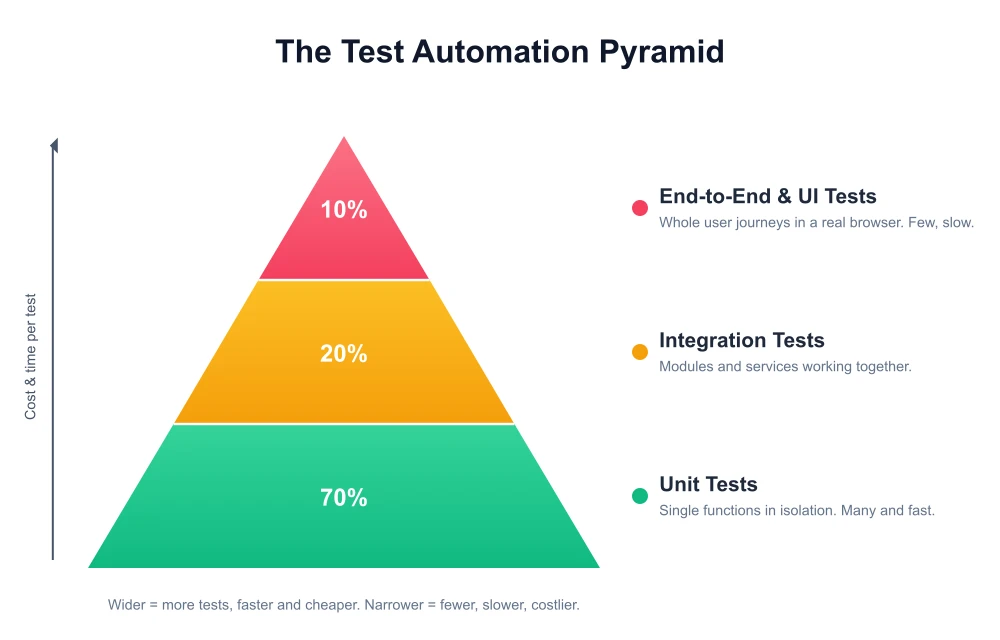
The test automation pyramid has three layers:
- Unit tests - verify a single function or class in isolation.
- Integration tests - verify components, APIs, and databases working together.
- End-to-end and UI tests - verify full user journeys through the running app.
Each layer differs in scope, speed, cost, and who owns it. The table below compares the three:
| Attribute | Unit | Integration | End-to-End / UI |
|---|---|---|---|
| Scope | A single function or class in isolation | Components, APIs, and databases together | Full user journeys through the running app |
| Speed | Milliseconds | Seconds | Minutes |
| Maintenance cost | Low | Medium | High |
| Who writes it | Developers | Developers and SDETs | SDETs and QA |
| Share of suite | ~70% | ~20% | ~10% |
| Common tools | JUnit, NUnit, PyTest, Jest | RestAssured, Postman, Testcontainers | Selenium, Cypress, Playwright |
The pattern is consistent: the cheaper and faster a test is, the more of them you should have.
The Three Layers of the Test Automation Pyramid
Here is what each layer tests, who writes it, and how to keep it healthy. Work from the base up, since the lower a layer sits, the more of your suite it holds.
Unit Tests: The Base Layer
Unit tests are the foundation and make up the largest share of the suite. Each checks a single function or class in isolation, so it runs in milliseconds and pinpoints the exact code that broke.
Developers write unit tests against the code they just wrote, which makes them quick to author and run. Because they isolate one unit, they reveal bugs at the block level and give near-instant feedback.
Good unit tests follow the FIRST principles: Fast, Isolated, Repeatable, Self-validating, and Timely. If a test hits a real database or network, it is no longer a unit test; replace those collaborators with mocks or stubs.
Aim for one test class per production class, and test the public interface, not private methods. Skip trivial getters and framework glue, and spend the budget on branches, calculations, and edge cases where bugs hide. This layer usually contributes 60-70% of a healthy pyramid.
Integration and Service Tests: The Middle Layer
Integration tests verify that separate parts work together: modules calling each other, code talking to a database, or your app calling an external API. They catch defects unit tests miss, such as incompatible interfaces and data mismatches.
They are slower than unit tests because they need real collaborators and a production-like environment. Keep the layer smaller than the unit layer, and add a test wherever your code crosses a boundary it does not own.
For databases, confirm your code reads and writes correctly, and use a separate test database or transactional rollbacks so runs stay isolated. Tools like Testcontainers spin up a real database per run and catch dialect-specific bugs an in-memory substitute would hide.
For external services, verify the contract at the boundary: requests, responses, errors, and authentication. Where the real service is flaky or unavailable, mock it. Where two teams share an interface, consumer-driven contract tests catch breaking API changes before they ship.
End-to-End and UI Tests: The Top Layer
End-to-end and UI tests drive the assembled application the way a user would, confirming the whole system works together. They give the most confidence and cost the most to run and maintain.
Because they exercise the real UI across browsers, they are the slowest and flakiest layer. Browser quirks, timing, and pop-up dialogs all cause false failures, and a red test rarely tells you which component broke.
Keep the layer thin. Reserve end-to-end testing for the handful of journeys that would cost you customers if they broke, such as sign-up, login, and checkout.
You can tame most flakiness with a few habits: wait on explicit conditions instead of fixed sleeps, isolate each test's data, reset state between runs, and quarantine a genuinely flaky test rather than letting it erode trust.
Acceptance testing and exploratory testing also live here. Acceptance tests confirm a feature works from the user's point of view; exploratory sessions surface usability and edge-case issues that scripted tests miss.

What Is the Ideal Test Pyramid Ratio
There is a widely used answer, and a more useful one that explains why it works and when to break it.
The 70/20/10 Rule Explained
A widely cited rule of thumb turns the pyramid into proportions: roughly 70% unit tests, 20% integration or service tests, and 10% end-to-end or UI tests. The numbers are a heuristic, not a law, but they capture the shape well.
Why the Ratio Tracks Cost and Speed, Not Test Importance
The ratio is about economics, not importance. An end-to-end test is not less valuable than a unit test; it is more expensive to run and maintain, so you run fewer of them.
Unit tests run in milliseconds and cost almost nothing to maintain, so they dominate. Integration tests are slower but validate how components connect. End-to-end tests are the slowest and flakiest, so a thin top layer keeps the whole suite fast and easy to debug.
When to Deviate From 70/20/10
Treat the split as a starting point, not a quota. A logic-heavy backend may push closer to 80% unit tests, while a thin UI over well-tested services may lean more on integration tests.
The reliable way to tune the ratio is to watch where bugs escape to production, then add tests at the lowest layer that would have caught them.
How to Diagnose Your Current Test Pyramid Shape
Before you rebalance, measure the pyramid you actually have. Most teams assume a healthy shape and find an ice cream cone instead.
Measuring Your Actual Test Distribution
Count the tests in each layer and turn them into percentages. Most runners let you tag or group suites by type, or you can split by directory, so the numbers fall out of a single report.
Compare the result against 70/20/10. If unit tests are well under half the suite, the base is too thin, whatever the total count looks like.
Warning Signs Your Pyramid Is Inverted
A few symptoms give it away: CI takes tens of minutes, most tests drive the UI, and the same tests fail intermittently without a real defect.
Watch behavior too. When developers stop running tests locally because they are slow, or bugs a unit test would have caught reach production, the shape is working against you.
Reading Execution Time and Flake Rate by Layer
Counts alone hide the real cost. Record each test's run time and its recent pass and fail history, then group both by layer.
The tell is disproportion. If end-to-end tests are a small share of the suite but most of the runtime and most of the flaky reruns, the top of your pyramid is doing too much work.
The Inverted Test Pyramid (Ice Cream Cone Anti-Pattern)
The inverted test pyramid, often called the ice cream cone anti-pattern, is what you get when the layers flip upside down.
How Teams Drift Into the Ice Cream Cone
A large scoop of slow end-to-end and UI tests sits on top, a thin band of integration tests in the middle, and unit tests shrink to a small cone at the bottom.
Teams drift here when they test primarily through the interface and skip lower-level checks, often because the UI is the one layer everyone understands.
What It Costs: Runtime, Flakiness, Debugging
The result is costly. End-to-end suites take hours to run, fail intermittently for reasons unrelated to real defects, and need constant maintenance as the UI evolves.
Debugging is the worst part. A single red test rarely tells you which component broke, so every failure becomes an investigation.
How to Push Tests Back Down the Pyramid
Recover by pushing coverage downward: write unit and integration tests for logic that end-to-end tests currently guard, then trim the redundant UI tests until the shape returns to a healthy pyramid.
When the top layer is unavoidable, run it on the TestMu AI automation cloud to parallelize those slow tests across thousands of browser and device combinations, so the top stops being a bottleneck.
How to Implement the Test Automation Pyramid
Building the pyramid is a sequence, not a one-off. Start at the base and add each layer only where the one below cannot give you the confidence you need.
Begin with unit tests as you write code, so the base grows with the codebase instead of as an afterthought. For legacy code with no seams, add characterization tests first, then refactor toward testable units.
Add integration tests at the boundaries the unit layer cannot see: the database, queues, and third-party APIs. Keep them hermetic with disposable dependencies so they stay reliable.
Add a thin end-to-end layer last, covering only the critical journeys. Then enforce the shape in review and CI: run the fast layers first, block on them, and treat each new UI test as a decision that needs justification.
Tools and Frameworks for Each Pyramid Layer
Each layer has its own toolset. Matching the tool to the layer keeps tests fast to write and cheap to maintain.
Unit Testing Frameworks
At the base, xUnit-family frameworks test components in isolation: JUnit with Selenium for Java, NUnit for .NET, PyTest for Python, and Jest for JavaScript. Mocking libraries like Mockito or Sinon.js create the test doubles that keep each test focused.
Integration and API Testing Tools
In the middle, API and integration tools exercise the seams between components. RestAssured, Postman, and Supertest make and assert HTTP requests, while Testcontainers provides throwaway databases and dependencies for realistic runs.
End-to-End and UI Automation Tools
At the top, browser and mobile automation tools drive the real interface. Selenium testing with the WebDriver protocol is the standard for broad cross browser testing, with Cypress E2E testing and Playwright as modern alternatives, and Appium for native mobile apps.
Running Selenium needs a browser driver that matches each browser version, which is hard to keep in sync across a team and CI. Since Selenium 4.6, the bundled Selenium Manager downloads the right driver automatically, so a modern Gradle setup is minimal:
dependencies {
    testImplementation 'org.seleniumhq.selenium:selenium-java:4.46.0'
    testImplementation 'org.testng:testng:7.11.0'
    // Selenium Manager (bundled since 4.6) auto-downloads matching drivers.
    // Add WebDriverManager only if you need explicit driver control:
    // testImplementation 'io.github.bonigarcia:webdrivermanager:6.3.4'
}
The real constraint at this layer is infrastructure: enough real browsers and devices to run the suite in parallel. TestMu AI is an AI-native test automation platform that runs your tests across thousands of browser and OS combinations and 10,000+ real devices, so the slow top layer stops gating releases.
- Parallel cloud execution - run Selenium, Cypress, Playwright, and Appium suites concurrently across thousands of environments.
- HyperExecute - AI-native test orchestration that TestMu AI states runs suites up to 70% faster than traditional grids.
- Real Device Cloud - test on 10,000+ real Android and iOS devices, not emulators, for accurate mobile results.
- KaneAI - author and maintain tests codeless in plain English, cutting the cost of the top layer.
- Auto-healing locators - self-resolve broken selectors when the UI changes, reducing end-to-end flakiness.

How AI Is Reshaping the Top of the Pyramid
The top of the pyramid has always been the expensive part: end-to-end tests are slow to write and slower to maintain. AI is changing that math, which is why the shape is being revisited in 2026.
AI-native authoring lets you describe a test in plain English and generate the script, so end-to-end coverage no longer means hand-writing selectors. TestMu AI's KaneAI is one example of this natural-language approach.
Self-healing locators tackle the other half of the cost. When the UI changes, the test updates its selectors instead of failing, which cuts the flakiness and maintenance that make teams avoid the top layer.
The effect is not a bigger end-to-end layer but a cheaper one. AI app testing keeps the top thin and reliable, while automated failure triage points you at the real cause faster than scanning logs by hand.
KaneAI, TestMu AI's GenAI-native testing agent, brings this shift to the top of the pyramid:
- Natural-language authoring - write and edit tests in plain English, so the top layer no longer needs hand-written selectors.
- Test generation from tickets - drop in a Jira ticket, PRD, or screenshot and get structured test cases back.
- Self-healing tests - when the UI shifts, KaneAI updates the affected steps and surfaces the diff for review.
- Multi-framework export - export the generated tests to Selenium, Playwright, Cypress, and Appium.
- Cross-platform coverage - author once, then run across desktop, mobile web, and native apps.

Common Challenges When Applying the Test Pyramid
Even teams that buy into the pyramid hit the same obstacles. Naming them early makes them easier to avoid:
- UI-heavy habits - teams test through the familiar interface and drift into the ice cream cone; push logic checks down instead.
- Flaky end-to-end tests - intermittent failures erode trust; stabilize with explicit waits, isolated data, and quarantine.
- Brittle integration tests - shared environments fail for unrelated reasons; use disposable, per-run dependencies.
- Legacy code with no seams - untestable code blocks unit coverage; add characterization tests, then refactor.
- Ownership gaps - a layer no one owns rots; let developers own unit and integration, QA own the top.
- Guessing the shape - teams assume a healthy pyramid; measure distribution, runtime, and flake rate by layer.
Test Automation Pyramid Best Practices
The pyramid organizes your testing; a few habits get more out of it:
- Automate deliberately - decide which cases are worth automating and the scope of each test, not everything by reflex.
- Push tests down - when a higher-level test catches a bug no lower one caught, add a lower test for it.
- Keep test code clean - readable, well-named tests are easier to maintain and less likely to hide bugs of their own.
- Use realistic data - order tests by risk and back scenarios with good-quality test data.
- Avoid duplication - once a condition is covered lower down, drop the redundant higher-level test that only slows the suite.
Order tests by speed in your pipeline rather than by type. Run the fast unit tests first so a broken build fails in seconds, and push slower integration and end-to-end suites to later stages.
As the suite grows, run it in parallel so total wall-clock time stays flat even as the test count rises. Parallel workers plus a cloud grid for the top layer keep a large pyramid from turning every commit into a long wait.
Conclusion
The test automation pyramid is still the clearest guide to a fast, trustworthy suite: a wide base of unit tests, a moderate integration layer, and a thin cap of end-to-end and UI tests, at roughly a 70/20/10 ratio.
Measure the shape you actually have, push tests down toward the base, and let AI and a platform like TestMu AI keep the slow top layer fast as the suite grows.
Author

Devansh Bhardwaj
Blogs: 80


Devansh Bhardwaj is a Community Evangelist at TestMu AI with 4+ years of experience in the tech industry. He has authored 30+ technical blogs on web development and automation testing and holds certifications in Automation Testing, KaneAI, Selenium, Appium, Playwright, and Cypress. Devansh has contributed to end-to-end testing of a major banking application, spanning UI, API, mobile, visual, and cross-browser testing, demonstrating hands-on expertise across modern testing workflows.
Reviewer

Himanshu Sheth
Reviewer
Himanshu Sheth is the Director of Marketing (Technical Content) at TestMu AI, with over 8 years of hands-on experience in Selenium, Cypress, and other test automation frameworks. He has authored more than 130 technical blogs for TestMu AI, covering software testing, automation strategy, and CI/CD. At TestMu AI, he leads the technical content efforts across blogs, YouTube, and social media, while closely collaborating with contributors to enhance content quality and product feedback loops. He has done his graduation with a B.E. in Computer Engineering from Mumbai University. Before TestMu AI, Himanshu led engineering teams in embedded software domains at companies like Samsung Research, Motorola, and NXP Semiconductors. He is a core member of DZone and has been a speaker at several unconferences focused on technical writing and software quality.


Test Automation Pyramid FAQs
Did you find this page helpful?
More Related Learning Hubs
TestMu AI forEnterprise
Get access to solutions built on Enterprise
grade security, privacy, & compliance
- Advanced access controls
- Advanced data retention rules
- Advanced Local Testing
- Premium Support options
- Early access to beta features
- Private Slack Channel
- Unlimited Manual Accessibility DevTools Tests