

Power Your Software Testing with AI Agents and Cloud
The Native AI-Agentic Cloud Platform to Supercharge Quality Engineering. Test Intelligently and Ship Faster.


- TestMu AI (Formerly LambdaTest)
- /
- Blog
- /
- Agile Development - Are we building the right thing?
Agile Development - Are we building the right thing?
Agile development works when teams know why a feature is needed. Learn to question requirements, run impact mapping, and prioritize work that delivers customer value.
Last Updated on:
Agile development delivers the right product when the team asks why a customer needs a feature before writing code. Impact mapping, a strategic planning technique Gojko Adzic introduced in 2012, turns that question into a diagram of the business goal, the actors who affect it, and the deliverables that change their behavior. This guide covers why Agile teams should always ask "Why", practices for customer engagement, who should attend an impact mapping session, and how teams write requirements for AI coding agents.
Key Takeaways
- Agile teams build the right thing when they ask why a customer requested a feature and what problem the feature solves, before any code is written.
- Most customer issues reported on technically strong development teams trace back to missed or missing requirements caused by a lack of communication and unset expectations.
- Impact mapping, a strategic planning technique introduced by Gojko Adzic in 2012, shows which people influence a business goal and which features are worth building first.
- An impact map answers four questions in order: why is the team doing the work, who can help or hinder the goal, how should those people behave differently, and what deliverables support that behavior change.
- Writing each impact map deliverable as a measurable outcome, such as returning readers opening the app twice a week, tells the team what to instrument after release and when the work is finished.
- AI coding assistants make writing code cheap, so the cost of building the wrong thing rises and the discussion about why a feature is needed becomes more valuable, not less.
Always ask "Why"
In my experience, one of the most critical ways that Agile teams and their testers can contribute to their customer is by making sure they focus on the business purpose of each new feature they need to deliver. When we can ask why customers request the feature and the problem they are trying to resolve, we're more likely to build the right thing. During feature review, the team (Engineering with Product) will discuss different aspects such as feature requirements, goals, acceptance testing, and how to measure success. With this discussion, the team can create a roadmap and set business and technical milestones.
A constructive discussion about "why" we are building this product or why our customers need it, involving both product and engineering team members, frequently leads to the realization that the customer isn't asking for a product they actually need or that what they are asking for won't solve the problem. This is an essential conclusion as, in the end, if the customer doesn't get the right solution, the business may suffer.
This is because the ROI and delivered functionality are vital components of the product's business value. This is why it is so important to focus on the "Why" before diving into creating the functionality. So, when working on a new business requirement asked by the field, keep thinking about building the "right" thing and any other questions that will help you keep product quality high.
AI coding assistants have made the build step cheap, which raises the cost of building the wrong thing. A team can generate a working screen in an afternoon, so writing the code is no longer the slow part of delivery. Agreeing on what the customer actually needs is the slow part. Teams that treat fast code generation as a reason to skip the "why" conversation end up shipping more unused features, not fewer.
Key Takeaway: Asking why a customer needs a feature, before the team builds it, often reveals that the requested feature will not solve the customer's real problem, which protects both ROI and product quality.
Practices for Customer Engagement
Understanding the "Why" can be difficult in most cases as the customer is not always available for the team. So, how can we overcome this barrier and answer the "Why"? There are many effective practices to help the business and delivery teams figure out the right things to build.
I proposed some tools for examples and requirements in my book "Agile Quality: A Practical Approach," including mind maps, checklists, flow diagrams, and more. Here, I want to focus on Impact mapping as an additional practice that I found valuable for understanding customer needs and using them to increase the value we deliver and create tests that guarantee the quality of the product.
Impact mapping
Impact Mapping is a strategic planning technique (introduced by Gojko Adzic in 2012). I use it in many organizations during product development to visualize the impacts that various people (in the method they will be addressed as 'Actors') will have in contributing and helping us achieve a common business goal.
A goal might be something simple such as implementing a specific tool that will promote discussions, something you want to achieve as a team (for example, better RCA and retrospective processes ) you want to promote, or it might be something big you want to achieve such as implementing a new development framework that will take weeks and even months.
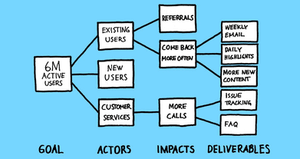
Impact Mapping has been adapted from other planning and brainstorming tools such as Flow-Diagrams, Mind mapping, etc. (all covered in my Book "Agile Quality: A Practical Approach"). Impact Mapping is a light, simple, and structured way to make sure the team maintains their focus on the purpose of what to build, and it helps identify the most valuable features to build first.
The focus shifts from "What are we going to do?" (as I usually see in organizations at the beginning of a new project) to "Why are we building this, what is the problem it will resolve, what is our goal, who can help us promoting the project and what risks can getting in our way" For, me the most significant thing about it is that it increases and encourages every participant in the room to focus on the goal and not waste time on bureaucracy and other political issues that may influence the decisions made at the end.
At the end of the impact map process, you should have a diagram that visualizes the process outcome, including:
- The goal the team wants to achieve or problem statement.
- High-level prioritization of project scope that could be delivered.
- What impacts (if any) the development process and how.
- List of people in the business who help or hinder our ability to achieve our goal.
- List of potential impacts and risks that may affect the project.
User Story that translates deliverables into specific features to be implemented. An impact map is a visual mind-map structure used for answering four fundamental questions:
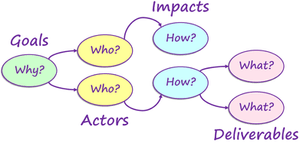
Q1: Why? - The central node that starts the whole process is used to answer "Why are we doing this" and "What is our Goal?" Your goals should define the problem or requirement to be solved and are usually presented by someone who represents the business (Product Owner, project manager, etc.).
For Example:
- Increase gross margin.
- Reduce field tickets.
- Increase the number of monthly Active Users by x until the end of the year
Q2: Who? - This node is used to describe the people (Individuals, Roles, and Key stakeholders) who can make an impact (who can help us, and who is getting in our way?") on the outcome. And if we simplify, we need to map the people who can bring the team closer to achieving the goal or prevent us from reaching it.
For Example:
- Support team
- Existing customers
- New customers
- Customer success agents
- Marketing department
- Finance department
Q3: How? - During this stage, the team will identify what they want out of each actor to help promote the team from achieving their goals. So, a good practice to generate this list is to ask questions like "How could our actors' behavior change to help us achieve our goal?" or "Which behavior is most likely to get us to our goal?" Or "Which behavior is most likely to add a negative impact on our ability to reach our goal?
Let's say that you want to increase awareness around your company website. An ideal impact would be getting users (Identified in the previous node) to spread the word about the site to their friends using a subscription program.
Q4: What? The fourth and last step of the impact mapping process identifies the deliverables (Tools, Features, Processes, and Business activities) that actors will use to achieve the desired outcome. More importantly, they represent what the team can do to help them.
For example, let's say that you're managing a technical blog that helps users increase their knowledge. Your goal is to boost traffic from new users. The impact you want is to get users to access your app more frequently.
So, one of the 'Features' that can help you achieve this goal could include an E-mail campaign or push notifications to potential readers. It will allow them to remain updated with new content uploaded to the blog and give them a reason to return to the blog.
Write every deliverable on the map as a measurable outcome before the team commits to it. Instead of "add push notifications", record "returning readers open the app at least twice a week". The outcome tells the team what to instrument and what to check after release, so the map feeds straight into the test plan. It also gives the team a stopping rule: once the impact is reached, that branch of the map is done, even if other ideas on the branch were never built.
Key Takeaway: Impact mapping lets an Agile team answer the customer's "Why" without the customer in the room, by mapping the business goal, the actors who affect the goal, the behavior change the team wants, and the deliverables that create the behavior change.
Who should attend this session?
I have a rule for my teams that each meeting should include all stakeholders to promote the meeting goal. So, as long as you keep it in mind, for this session, I would usually expect to see the "Product Owner," "Project Technical Owner," facilitator, and project sponsors (Business and Technical).
Key Takeaway: An impact mapping session should include the Product Owner, the Project Technical Owner, a facilitator, and the business and technical project sponsors, so every stakeholder needed to reach the goal is in the room.
How do Agile teams write requirements for AI coding agents?
Write the requirement down as a versioned artifact the agent reads, and keep its measurable outcome attached to it. Google's 2025 DORA report on AI-assisted software development found that 90% of survey respondents report using AI at work, and it reports a positive relationship between AI adoption and software delivery throughput and a negative relationship with software delivery stability. The report summarizes the pattern by saying AI does not fix a team, it amplifies what is already there. The tooling does not supply the goal. A team without an agreed goal produces more output against an unclear one.
Spec-driven development is the practice that has grown out of this. Spec Kit, an open source toolkit from GitHub, gives AI coding agents structured processes, reusable templates, and documented outcomes. Its stated rule is to define what and why before deciding how, and the workflow runs in that order: /speckit-specify writes the feature specification, /speckit-plan produces the technical plan, /speckit-tasks breaks it into work items, and /speckit-implement builds them. The specification is the artifact the team reviews, not the chat transcript.
Project context is the other half. AGENTS.md is an open format for guiding coding agents, described by its maintainers as a README for agents, and it is used by over 60,000 open source projects. It carries build commands, test commands and code conventions so the agent does not guess them. Neither file replaces the "Why" conversation. They give it a place to live. An impact map already produces a goal, an actor, a behavior change and a measurable outcome, and those four fields transfer directly into a specification an agent can be held to. The DORA report makes the same point from the data side: user-centricity is a prerequisite for AI success, because AI becomes most useful when it is pointed at a clear problem.
Key Takeaway: Agile teams write requirements for AI coding agents as versioned artifacts with a measurable outcome attached, using formats such as GitHub's Spec Kit for the specification and AGENTS.md for project context, because an AI coding agent amplifies an existing goal rather than supplying one.

Author

David Tzemach
Blogs: 46


David Tzemach is a software quality and engineering leader with 19+ years of experience in software testing, quality assurance, and large-scale R&D operations. He specializes in building QA organizations from scratch, defining quality frameworks, and implementing agile and shift-left testing practices across enterprise environments. David has served as Head of QA and QA Architect, authored multiple books on agile quality and testing, and actively contributes to the testing community through his QualityBreach platform and publications.


Agile Development FAQs
Did you find this page helpful?
More Related Blogs
TestMu AI forEnterprise
Get access to solutions built on Enterprise
grade security, privacy, & compliance
- Advanced access controls
- Advanced data retention rules
- Advanced Local Testing
- Premium Support options
- Early access to beta features
- Private Slack Channel
- Unlimited Manual Accessibility DevTools Tests