

Power Your Software Testing with AI Agents and Cloud
The Native AI-Agentic Cloud Platform to Supercharge Quality Engineering. Test Intelligently and Ship Faster.


- TestMu AI (Formerly LambdaTest)
- /
- Blog
- /
- 11 Best AI Agents to Boost Workflow Automation [2026]
11 Best AI Agents to Boost Workflow Automation [2026]
Compare the 11 best AI agents of 2026 for workflow automation, verified on each vendor's live product pages, with a stated method and a guide on how to choose.
Last Updated on:
An AI agent earns its place when it finishes work you would otherwise hand off, not when it answers a question. This list covers 11 agents that ship today, each checked against its vendor's own live product pages in September 2026, with the entries that turned out to be renamed, retired, or discontinued removed rather than carried forward. If you would rather build your own, compare the libraries in our guide to the 9 best LLM agent frameworks.
Key Takeaways
The best AI agent depends on the job you are automating. For orchestrating several agents in code, CrewAI is the strongest open-source choice in 2026. Each bullet below matches one agent to one job, from enterprise operations through software engineering to quality engineering, so you can shortlist by task rather than by brand.
Which AI Agent Fits Which Job?
- Best for multi-agent orchestration: CrewAI - An open-source framework that runs a crew sequentially or under a manager agent delegating down a chain of command, with memory persisting across separate executions.
- Best for model-agnostic agent builds: Google ADK - Generally available across Python, TypeScript, Go, Java, and Kotlin, with connectors for Gemini, Anthropic, OpenAI, Ollama, and vLLM rather than Google models alone.
- Best for no-code autonomous agents: AutoGPT Platform - Agents run on a schedule or a trigger, built by dragging blocks together or by briefing AutoPilot in chat, across 45 or more connected platforms with no API keys.
- Best for CRM operations: Agentforce 360 - Salesforce grounds agents in CRM records through Data 360, deploys the same agent to chat and voice, and applies data masking and zero data retention through its Trust Layer.
- Best for enterprise back office: Oracle Fusion Agentic Applications - Named agents such as the Payables Agent and Ledger Agent execute in real time against live Fusion data across finance, HR, supply chain, and customer experience.
- Best for software engineering: Devin - Cognition's agent handles code migrations and refactors, reproduces and fixes bugs, and repairs CI failures, learning a codebase by reading past session trajectories.
- Best for quality engineering: TestMu AI KaneAI - A GenAI-native testing agent that plans, authors, executes, and evolves tests from natural language, exporting to Selenium, Playwright, Cypress, or Appium so there is no lock-in.
- Best for long-horizon reasoning: Claude Opus 5.5 - Anthropic's current default for most workloads, with a 1M-token context window and adaptive thinking steered by an effort parameter rather than a manual token budget.
How Do You Choose Between Them?
Match the agent to the job first, then check that it connects to the systems you already run, and confirm you can test what it does before it reaches customers.
What Are AI Agents?
AI agents are software systems that pursue a goal across multiple steps, deciding what to do next from what they observe rather than following a fixed script. The distinction that matters in practice is that an agent is given an objective instead of an instruction, and it keeps acting until the objective is met or it runs out of room to try.
Every agent runs the same three-stage loop, repeated until the goal is reached:
- Perception - Gather the current state from the environment: user instructions, API responses, database rows, page content, or the output of a previous step.
- Decision-making - Choose the next action from the available tools, weighing what has already been tried against how far the goal still is.
- Action - Execute that action against a real system, then feed the result back into the next round of perception.
That loop is also the difference between an agent and an assistant. An assistant returns an answer and stops. An agent takes the answer and does something with it, which is what makes the question of how you verify its work a practical one rather than an academic one.
How We Picked These AI Agents
This list is organized by job, not ranked. A hiring agent and a multi-agent framework do not compete, so numbering them against each other would be false precision. TestMu AI builds KaneAI, which appears at position 8 in its category slot for the same reason.
Four criteria decided inclusion:
- Shipping today - The product is generally available or publicly installable, and its vendor page resolved in September 2026. Research prototypes and waitlist-only products were excluded.
- Claims verified at source - Every capability described below was checked against the vendor's own documentation or product page, not against a directory listing or a secondary summary.
- Acts, not just answers - The agent takes actions against real systems. Chat interfaces that only return text were excluded.
- Distinct job - Each entry covers a category no other entry already covers, so the list stays useful rather than repetitive.
That check removed several tools that appear on comparable lists. Oracle has no product called Miracle Agent, a name that circulates on aggregator directories but appears on no Oracle page. OpenAI folded Operator into ChatGPT agent in July 2025. The Agent.ai marketplace now redirects to a different domain entirely. Microsoft moved AutoGen into maintenance mode and points new projects at its Agent Framework, so it is named here as context rather than given a slot.
The 11 Best AI Agents for 2026
Each entry below names what the agent does, the capability that distinguishes it, and the kind of team it suits.
1. CrewAI
CrewAI is an open-source framework for orchestrating autonomous AI agents and building complex workflows. A crew is a team of autonomous agents that collaborate to solve the tasks delegated to them.
What it does well:
- Role-based agents - Role, goal, and backstory are first-class attributes that shape how each agent reasons.
- Task delegation - An allow_delegation flag lets agents hand work to each other, and the hierarchical process organizes that into a managerial chain of command.
- Sequential and hierarchical processes - Run a crew step by step, or under a manager agent that delegates down. Individual tasks can be marked for asynchronous execution so the crew continues without waiting.
- Persistent memory - A unified memory system stores context to disk, so an agent recalls relevant history before each task rather than starting cold.
- Tool integration - Agents call external APIs through the CrewAI toolkit or LangChain tools.
Worth knowing before you commit: the documented process types are sequential and hierarchical. Concurrency is a task-level and flow-level feature, not a third process mode, which catches teams that expect parallel execution as a switch.
2. Google ADK (Agent Development Kit)
Google ADK is an open framework for building, evaluating, and deploying AI agents. It is optimized for Gemini and Google Cloud but is model-agnostic and deployment-agnostic, so the same agent code runs against Gemini, Gemma, Claude, OpenAI models, or local runtimes through Ollama and vLLM. ADK is generally available across Python, TypeScript, Go, Java, and Kotlin.
What it does well:
- Model flexibility - Gemini is first-class, with connectors for Anthropic, OpenAI, LiteLLM, Ollama, and vLLM.
- Composable agent types - Custom agents, workflow agents, and multi-agent composition are all documented patterns.
- Tool and API integration - Custom tools, OpenAPI tools, and MCP tools cover external systems, alongside an integrations catalogue.
- Two-tier memory - Session state carries short-term context within one conversation, while a separate memory service acts as a searchable long-term archive the agent can consult.
- Live and voice agents - Streams audio in and out and accepts image frames for real-time, multimodal sessions.
3. AutoGPT Platform
AutoGPT enables the creation, deployment, and management of continuous agents that automate repetitive processes.
What it does well:
- Conversational agent creation - Describe the job in chat and AutoPilot builds the agent for you, without leaving the conversation.
- Low-code workflows - A visual builder lets you drag blocks together and branch on conditions without writing code.
- Continuous agents - Deploy cloud-based agents that run indefinitely, activating on a schedule or on a trigger such as a new email or form submission.
- Block-based logic - Compose agents from reusable blocks covering integrations, data processing, and conditional decision-making, so deterministic steps do not need a model call.
- Broad service integration - 45 or more connected platforms and hundreds of models, with no API keys required.
4. Agentforce 360
Agentforce is Salesforce's AI agent platform for building and deploying autonomous agents that handle specialized business tasks. Salesforce now ships it as Agentforce 360, announced in October 2025, pairing the agent runtime with Data 360 so agents answer with governed company context.
What it does well:
- Agentforce Builder - Builds agents in plain language on Canvas, a document-style workspace where you write, edit, and validate in one flow.
- Data 360 grounding - Grounds agents in Salesforce CRM records and unified external data through Data 360, the layer Salesforce renamed from Data Cloud.
- Multi-channel deployment - Runs the same agent across chat and voice, plus Slack, apps, and portals.
- Atlas Reasoning Engine - Breaks a prompt into smaller tasks and evaluates at each step, mixing deterministic workflows with model reasoning.
- Salesforce Trust Layer - Applies data masking, zero data retention, and toxicity detection to agent prompts and responses.
5. Oracle Fusion Agentic Applications
Oracle builds AI agents into Oracle Fusion Cloud Applications rather than bolting them on. Oracle calls the result Fusion Agentic Applications: teams of specialized agents, each with its own domain expertise, that plan, reason, and execute complete processes across finance, HR, supply chain, and customer experience. Agents receive goals rather than instructions, and they act inside the transactional system.
What it does well:
- Domain-specific agent teams - Oracle ships named agents per function, including a Payables Agent and Ledger Agent in finance, and Service Request Triage and Renewal agents in customer service.
- Agent Studio - Build and extend agents, including partner and external agents, without traditional application development.
- Native to the transactional system - Agents execute in real time against live Fusion data rather than a copied dataset.
Oracle reports faster execution, less manual effort, and earlier issue detection as the outcomes these agents target, which is a fair summary of what embedded back-office automation buys a finance or HR team.
6. Devin
Devin, built by Cognition, plans, writes, tests, and ships code inside your existing repository and tooling. It understands natural language and handles code migrations and refactors, reproducing and fixing bugs, and building integrations against unfamiliar APIs. Cognition now ships it across a web app, Devin Desktop, and a CLI. If you are putting agent-written code into production, our Devin app testing guide covers how to verify the output.
What it does well:
- Natural language tasking - Assign work in plain language, with the vendor's own rule of thumb that a three-hour task is a realistic unit.
- Legacy modernization - Migrates and modernizes legacy stacks including COBOL, .NET, Talend, and legacy ETL codebases, with agents able to work repositories in parallel.
- Bug and CI repair - Identifies and resolves bugs, fixes CI failures, and runs visual checks with full browser use.
- Codebase learning - Picks up tribal knowledge and improves over time by reading past session trajectories.
7. Replit Agent 4
Replit Agent is the AI agent built into the Replit platform. Its current version, Agent 4, turns plain-language prompts into working software including web apps, mobile apps, slides, and designs, with no coding required. It writes the code, sets up infrastructure, and tests its own work. Teams shipping agent-built apps can check them with our Replit app testing guide.
What it does well:
- Prompt to application - Converts plain-language prompts into apps, designs, and slides without requiring code.
- Infrastructure setup - Sets up project infrastructure and configures databases as part of building.
- Design Canvas - An always-available infinite canvas that replaced stand-alone Design Mode, showing interactive previews of the running app.
- Self-testing - The agent tests its own work on a regular basis rather than handing back untested output.
- Parallel agents - Multiple agents work independent tasks and merge back into the main app.
8. TestMu AI KaneAI (Formerly LambdaTest)
KaneAI is a GenAI-native testing agent that lets teams plan, author, execute, and evolve test cases across web, mobile, API, database, network, and accessibility layers using natural-language prompts. It covers the full test lifecycle: generating a test plan from requirements, authoring the steps, running them on the cloud grid, and keeping them green.
What it does well:
- Natural language test authoring - Describe the test in plain language and KaneAI generates the steps.
- Multi-framework export - Export generated tests to Selenium, Playwright, Cypress, or Appium in multiple languages, so there is no lock-in.
- Self-healing - Smart element detection re-anchors steps when the UI changes and surfaces each heal for review, significantly reducing maintenance.
- Reusable test modules - Promote common flows such as login or setup into blocks, so one fix propagates everywhere the block is used.
- Native app testing - Run the same authored tests against real Android and iOS devices.
- Advanced test configurations - Tunnel support for locally hosted and firewalled apps, geolocation testing for location-sensitive behavior, and proxy configuration for routing and intercepting test traffic.
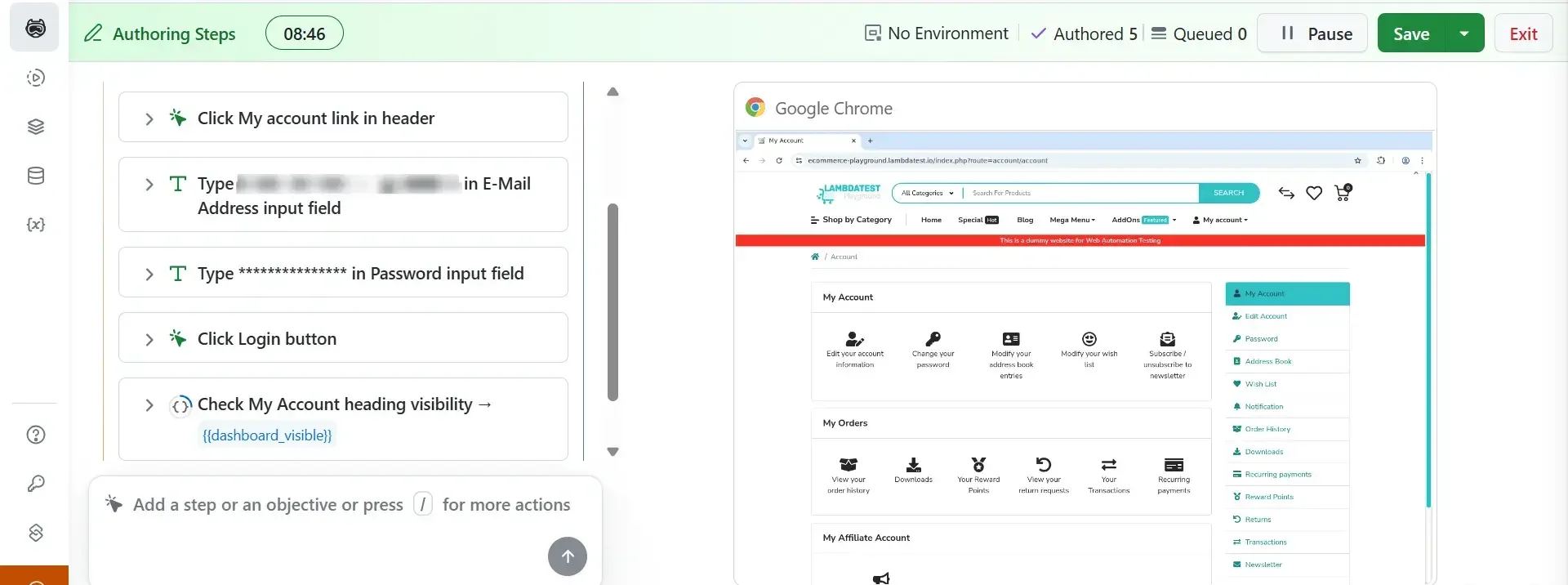
The authoring view above is a five-step login test written as plain instructions, ending in a visibility check captured as a variable. The browser pane on the right runs each step as it is authored, against the Ecommerce Playground.
Setup and first-run steps are covered in the KaneAI documentation.

9. Claude Opus 5.5
Claude is Anthropic's model family, and its current models are built to run long, multi-step agentic work rather than answer one prompt at a time. Anthropic's models overview lists Claude Fable 5.1, Claude Opus 5.5, Claude Sonnet 5, and Claude Haiku 4.5, and tells developers to start with Claude Opus 5.5 for most workloads, reaching for Claude Fable 5.1 on demanding reasoning and long-horizon agentic work.
What it does well:
- Long-horizon agentic work - Claude Opus 5.5, released in September 2026, is built for long-running agentic coding and knowledge work.
- Large working context - A 1M-token context window with 128K maximum output, extending to 300K output tokens on the Batch API behind a beta header.
- Adaptive thinking - Reasoning depth is always on and steered by an effort parameter rather than a manual token budget, defaulting to medium effort.
- Multimodal input and tool use - Every current Claude model takes text and images and supports vision and tool calling, which is what lets it drive an agent loop.
One migration note: the Claude 3.5 Sonnet generation was retired on the Claude API in October 2025, so any integration still pinned to it now fails.
10. Paradox
Paradox automates the administrative half of hiring through conversational interfaces, and its assistant Olivia handles candidate interaction end to end. Workday completed its acquisition of Paradox in October 2025; the brand and the product line continue, and the combined offering is sold as the Candidate Experience Agent.
What it does well:
- Conversational ATS - A mobile-first applicant tracking system aimed at high-volume frontline hiring.
- Conversational scheduling - Automates interview scheduling, the step that usually consumes recruiter time.
- Conversational career sites - Delivers candidate experiences around the clock rather than in office hours.
- Conversational apply - Runs applications and screening through chat instead of a form.
- Conversational events - Manages recruiting events with automated workflows.
11. Fellow
Fellow is a meeting assistant that records, transcribes, and summarizes meetings across Google Meet, Zoom, and Microsoft Teams, then makes the resulting record searchable. It suits teams whose decisions happen in meetings and then get lost.
What it does well:
- AI note taker - Records, transcribes, and summarizes meetings across the major conferencing platforms.
- Ask Fellow - Retrieves answers from past meeting notes and transcripts rather than requiring you to reopen them.
- Pre-meeting briefs - Assembles a brief ahead of the meeting so attendees arrive with context.
- Meeting recaps - Sends recap emails with recordings, transcripts, and summaries after the call.
AI Agents Compared at a Glance
Pricing models are described rather than priced, because vendor rates change without notice. Check the current figure on the vendor's own site before you budget.
| Agent | Primary job | Open source | Commercial model |
|---|---|---|---|
| CrewAI | Multi-agent orchestration in code | Yes | Free framework plus a paid enterprise runtime |
| Google ADK | Model-agnostic agent development | Yes | Free framework; cloud usage billed separately |
| AutoGPT Platform | No-code autonomous agents | Yes | Self-host free, or a hosted subscription |
| Agentforce 360 | CRM and customer operations | No | Enterprise contract, consumption based |
| Oracle Fusion Agents | Finance, HR, supply chain back office | No | Included with Fusion Cloud Applications |
| Devin | Software engineering | No | Per-seat subscription with usage tiers |
| Replit Agent 4 | App building from prompts | No | Subscription with usage-based agent credits |
| TestMu AI KaneAI | Quality engineering and test automation | No | Free trial, then per-agent subscription |
| Claude Opus 5.5 | Reasoning engine behind an agent | No | Token-based API billing |
| Paradox | High-volume hiring | No | Enterprise contract |
| Fellow | Meeting capture and recall | No | Per-seat subscription with a free tier |
Agentic AI Tools vs Single-Task Assistants
Plenty of products marketed as agentic AI tools are assistants with a scheduler attached. The line worth drawing is whether the software decides its own next step.
An assistant runs a path someone else defined. Give it the same input twice and it takes the same route twice. An agentic tool is given an outcome and chooses the route, which is why two runs of the same job can look different and still both be correct. That difference drives everything downstream, including cost, because an agent that decides its own steps also decides how many model calls to spend.
Ask these three when a product page will not say plainly:
- Does it choose its own tools? An agent picks from a tool set at run time. An assistant calls the tool it was wired to call.
- Does it recover from failure? Agents retry, reroute, or escalate. Assistants return an error.
- Does it carry state between steps? Persistent memory is what lets step nine use what step two learned.
CrewAI, Google ADK, and the AutoGPT Platform sit firmly on the agentic side of that line. Fellow sits on the assistant side and is useful anyway, which is the point: the label matters less than whether the job gets finished.

Best AI Agents for Business Automation
Business automation has a different shortlist from developer tooling, because the constraint is rarely capability. It is whether the agent can reach the system of record and whether anyone will sign off on letting it write there.
Most deployments fall into one of these patterns:
- Agents inside the system of record - Oracle Fusion Agentic Applications and Agentforce 360 act directly on live transactional data. Adoption is fastest here because there is no integration project, though you inherit the vendor's release cycle.
- Agents across systems - The AutoGPT Platform connects 45 or more platforms without API keys, which suits work that spans tools nobody has integrated. The trade is that you own the reliability of the seams.
- Agents your team builds - CrewAI and Google ADK give the most control and the most responsibility. Choose these when the process is genuinely yours and no vendor models it.
Start with the narrowest process that has a clear success signal and a cheap failure. A scheduling handoff or an invoice-matching step gives you a real measurement inside a month. Enterprise-wide rollouts tend to stall before anyone learns whether the agent worked.
How to Choose the Right AI Agent
Work through these in order. The early criteria eliminate faster than the later ones.
- Task fit - Name the specific job before comparing products. An agent built for hiring will lose to a framework you configure yourself if the job is not hiring.
- Integration reach - Check the connector list against the systems you run. This eliminates more candidates than any other criterion.
- Control over autonomy - Decide what the agent may do unsupervised. Escalation paths and guardrails matter more than raw capability once real data is involved.
- Testability - Establish how you will confirm the agent did what it reported before it reaches customers.
- Data handling - Read the published controls by name, such as retention, masking, and residency, rather than accepting a general assurance.
- Exit cost - Confirm what you keep if you leave. Frameworks and tools that export in open formats cost less to reverse.
The fourth criterion is the one teams skip. Evaluating AI agents is harder than evaluating deterministic software, because a run that looks successful can still have taken a wrong path.
For the agents on this list that talk to customers through chat, voice, or phone, the TestMu AI AI agent testing platform is free to start. Autonomous AI evaluators converse with your agent like real users across 60 to 100 or more scenarios per workflow generated from your uploaded context, score chat and voice on 9 quality metrics including hallucination, bias, completeness, and context awareness, apply 30 or more call metrics to phone agents, and roll the results into a Green, Yellow, or Red production-readiness verdict.
The agents that act rather than talk fail differently: the risk is a confident report of work that did not happen as described. If you go the build-your-own route with frameworks like CrewAI or Google ADK, TestMu AI ships Agent Assurance for exactly that gap. It reads your agent's codebase and derives the test suite itself, functional, non-functional, and adversarial scenarios included, then invokes the agent for real and grades each criterion against observed evidence such as files changed, artifacts produced, and tool calls made, reporting Pass, Fail, or Unable to Verify with the assurance gap beside the pass rate. The agent you point it at is yours and its writes are real, so point it at staging.

Note: Building your own agent instead of buying one from this list? Grade the effect, not the account. Explore Agent Assurance
Conclusion
Pick the narrowest job on your list that an agent could finish end to end, then run one of these against it for a fortnight and measure what changed. That single trial will tell you more than any comparison table, including this one.
If that job is testing, KaneAI authors and runs the tests from a plain-language brief and exports them to the framework your team already uses.
Author

Samyak Goyal
Blogs: 30

Samyak Goyal is a Senior Member of Technical Staff at TestMu AI engineering Kane CLI, the command-line tool that runs browser automation from the terminal, where a flow described in natural language executes in a real Chrome browser and returns pass or fail with shareable proof. He is a backend engineer with 4+ years of experience, previously an SDE at Innovaccer, where he built APIs, introduced Kafka, and cut deployment from weeks to hours. Samyak also builds multi-agent systems, skill-orchestration frameworks, and a personal copilot that indexes 200+ microservice repositories.
Reviewer

Chaitanya Sharma
Reviewer
Chaitanya Sharma is an AI Product Manager at TestMu AI (formerly LambdaTest), where he builds agentic AI capabilities focused on computer vision and multi-modality, moving testing beyond static script execution toward autonomous, agent-driven workflows. Before TestMu AI he shipped 135+ features at Sprinklr for a no-code community and website builder used by Fortune 500 enterprises including Dell, Samsung, and Polestar. At Policybazaar he led the zero-to-one launch of a digital lending and insurance marketplace embedded in Bahrain's dominant payments app, building a risk-intelligence engine that compressed loan-approval times by 80%. He explored machine learning and NLP through research at the University of Cambridge, and holds a B.Tech from Delhi Technological University.
AI Agents FAQs
Did you find this page helpful?
More Related Blogs
TestMu AI forEnterprise
Get access to solutions built on Enterprise
grade security, privacy, & compliance
- Advanced access controls
- Advanced data retention rules
- Advanced Local Testing
- Premium Support options
- Early access to beta features
- Private Slack Channel
- Unlimited Manual Accessibility DevTools Tests