

Power Your Software Testing with AI Agents and Cloud
The Native AI-Agentic Cloud Platform to Supercharge Quality Engineering. Test Intelligently and Ship Faster.


- TestMu AI (Formerly LambdaTest)
- /
- Blog
- /
- Voice Agents: Speech-to-Speech vs Chained Architecture
Voice Agents: Speech-to-Speech vs Chained Architecture
Speech-to-speech or chained? Learn how the two voice agent architectures work, where each fits, and how to test voice agents before customers call.
Last Updated on:
Have you ever called a company and heard a robotic voice say “Press 1 for sales, press 2 for support”? Now imagine calling and hearing a friendly voice that understands your problem right away, and maybe even lightens the mood with a small joke. AI voice agents make that possible today.
If you want to build one, you face a big decision at the start, and it shapes how your agent sounds, thinks and responds. It comes down to a choice between two personalities: a Smooth Talker that is charming, reads emotion and can chat about anything, or a Reliable Rule-Follower that is precise, follows instructions and gets the task right every time.
These are not just fun labels. They are two different ways of building a voice agent, and your choice decides its speed, how human it feels and the problems you will hit while building it. Let’s explore each path.
TL;DR
- A Smooth Talker voice agent uses a speech-to-speech model that hears and replies in audio, so conversations feel fast and natural.
- A Reliable Rule-Follower chains speech-to-text, a language model and text-to-speech, trading some speed for control and a full text record.
- Speech-to-speech agents suit empathetic, open-ended conversations such as tutoring, companionship and complex customer service.
- Chained agents suit structured tasks where mistakes are unacceptable, such as appointment booking, order tracking and banking security checks.
- Production voice agents often combine both, with a conversational front agent handing precise tasks to rule-following agents in the background.
- Voice agents need testing across accents, noise, interruptions and handoffs, which AI-driven agent testing can simulate at scale.
Part 1: Meet the Smooth Talker (Speech-to-Speech Voice Agent)
Imagine an AI agent that doesn’t just hear your words but hears the music behind them. It hears your sigh of frustration, your excitement when you talk about your vacation, or your slight hesitation when you’re unsure.
This is the Smooth Talker. In the technical world, this is called a Speech-to-Speech (S2S) architecture. It represents the forefront of voice AI.
How Does It Work? A Simple Analogy
Think about how you engage in a conversation. When a friend speaks to you, you don’t first mentally transcribe their words, formulate a written reply, and then read it aloud. You just need to listen, process, and respond. Your brain handles sound, meaning, and emotion all at once.
That’s exactly what a speech-to-speech agent does. It takes your voice as input and produces its own voice as output. There’s no middle step of converting everything to text. It thinks and responds in audio, making the whole process incredibly fast and fluid.
What Does This Feel Like for a User?
Using a Smooth Talker agent feels less like operating a machine and more like having a genuine conversation.
- The Empathetic Helper: You’re calling to complain about a faulty product. The agent hears the stress in your voice and says, “Wow, it sounds like you’ve had a really frustrating day with this. I’m so sorry to hear that. Let’s get this sorted out for you right away.” It feels heard and understood.
- The Patient Teacher: You’re learning Spanish with an AI tutor. You stumble on a word, pausing for a second. The agent doesn’t just wait silently; it gently says, “You’re close! Take your time. That one’s a bit tricky.” It responds to your hesitation, not just your words.
- The Fun Companion: You are using an interactive game that allows you to talk to characters. The agent can laugh along with you, sound surprised when you uncover a clue, and whisper when you’re supposed to be stealthy.
The Good Stuff: Why You’d Want a Smooth Talker?
Here’s why having a Smooth Talker on your side can make a real difference:
- It’s Super Fast and Fluid: Because it doesn’t have to go through multiple steps (audio-to-text, text-to-AI, AI-to-audio), the conversation has almost no delay. This eliminates those awkward pauses that make you wonder if the AI is still there.
- It Understands Feelings: This is its superpower. It can detect tone, emotion, and intent in your speech. This allows it to be empathetic, engaging, and much more human-like.
- It’s Great at Just Chatting: These agents excel in open-ended, unstructured conversations. You don’t have to follow a strict menu. You can change the topic, ask follow-up questions, and just talk, making it perfect for brainstorming, language practice, or customer service scenarios where the problem isn’t straightforward.
The Hard Part: Challenges of Building a Smooth Talker
Creating a charming personality isn’t straightforward. It’s more of an art than a science, and it comes with unique challenges.
- You Become a “Personality Director”: The main way you control this agent is through its initial instructions, called a “prompt”. This prompt is like a detailed character sheet for an actor, and you have to define everything:
- Identity: Is it “Ava, a friendly and knowledgeable librarian” or “Unit 734, a formal and precise technical assistant”?
- Demeanour: Should it be patient and calm or upbeat and energetic?
- Tone of Voice: Should it sound warm and conversational or polite and authoritative?
- Filler Words: Do you want it to sound more human by occasionally saying “um” or “let’s see…”? You have to specify this.
- Pacing: Should it speak quickly, or slowly and deliberately?
- Solving the Mystery of a “Bad Conversation”: With a traditional bot, you can read a text log to see exactly where a wrong answer came from. A speech-to-speech model works on audio directly, so there is no intermediate text step to inspect, and any transcript is a separate output that may not match what the model actually “heard”. If the agent sounds cold or gives a strange response, you often have to listen back to the audio to work out why, which is slow.
- The “Premium” Price Tag: Thinking in audio takes a lot of computing power. It’s like the difference between streaming a high-definition movie and reading an email, so a speech-to-speech agent can cost more to run, especially with thousands of users talking to it at once.

Note: Test your voice agents across real-world scenarios. Book a Demo!
Part 2: Meet the Reliable Rule-Follower (Chained Voice Agent)
Now, let’s meet the other personality: the Reliable Rule-Follower. This agent’s main goal is to complete a task perfectly. It’s built for precision, accuracy, and control. It might not win any awards for charm, but it will never, ever get your appointment time wrong.
Technically, this is called a Chained Architecture because it chains together several different steps to work.
How Does It Work? A Simple Analogy
Imagine a team of three specialists working in a chain:
- The Stenographer (The “Ear”): This specialist’s only job is to listen to what you say and type it out perfectly. This is the speech-to-text part.
- The Strategist (The “Brain”): This specialist takes the typed-out text from the stenographer, reads it, and decides on the perfect, logical response. This is the large language model (LLM).
- The Announcer (The “Mouth”): This specialist takes the written response from the Strategist and reads it out loud in a clear, consistent voice. This is the text-to-speech part.
This three-step process of listening and typing, thinking and writing, then reading aloud is how the rule-follower operates. OpenAI’s voice agents guide calls it a chained voice pipeline and notes its main advantage: you can inspect or transform the intermediate text and replace each component independently.
What Does This Feel Like for a User?
Interacting with a rule-follower is a very structured and predictable experience. It’s focused on the task at hand.
- The Perfect Receptionist: You’re booking a doctor’s appointment. The agent asks for your name. You say, “Jane Doe.” It responds, “Got it. That’s J-A-N-E, D-O-E. Is that correct?” It confirms every detail to ensure there are no errors.
- The Efficient Warehouse Clerk: You want to check your order status. The agent asks for your order number. You provide it, and it gives you a precise update: “Your order, number 9-8-7-5, is currently out for delivery and is expected to arrive by 5 PM today.”
- The Trustworthy Bank Teller: You’re going through a security check over the phone. The agent follows the exact same script every single time, asking for specific pieces of information in a specific order, ensuring maximum security and compliance.
The Good Stuff: Why You’d Want a Rule-Follower
A rule-following agent earns its place through a few concrete advantages:
- You Are in Complete Control: Because every part of the conversation is converted to text, you have a perfect written record of everything said. This is fantastic for businesses that need to keep logs for compliance, training, or quality control. It also makes it incredibly easy to see exactly where a conversation went wrong and fix it.
- It’s Super Reliable and Predictable: This agent will strictly adhere to your instructions. If you establish a workflow for scheduling appointments, it will adhere to that process without deviating from it or becoming creative. This is essential for tasks where mistakes are not an option.
- It’s Easier to Get Started: If you already have a text-based chatbot, you’ve already done the hardest part (building the “brain”). You just need to add the “ear” and the “mouth” to turn it into a voice agent. This makes it a fantastic starting point for anyone new to building voice AI.
The Hard Part: The Challenges of Building a Rule-Follower
While reliable, this agent has trade-offs that can make the user experience feel a bit clunky.
- The Awkward Pause: That three-step process takes time. There’s a slight but noticeable delay between when you finish speaking and when the agent starts its reply. This latency can make the conversation feel stilted and unnatural, like a walkie-talkie conversation where you have to wait your turn to speak.
- It’s a Little “Tone-Deaf”: The agent’s “brain” only ever sees plain text, so it has no idea how you said something. If you say “This is just great…” sarcastically, it will take you literally. This lack of emotional awareness can make the agent seem cold or unhelpful, especially if the user is upset.
- It Doesn’t Like Being Interrupted: The agent is designed to wait for you to finish your sentence before it starts its process. If you interrupt it or talk over it (which constantly happens in real conversations), it can get confused, and the whole system can break down.
Part 3: Beyond the Big Choice, Real-World Puzzles for Builders
Once you’ve chosen your agent’s core personality, the work isn’t over. Modern voice agents are agentic: they don’t just talk, they take actions such as looking up an order, booking a slot or calling an internal API, and often hand work to other agents. That is where the harder problems come from.
Puzzle 1: The “Let Me Transfer You” Moment (Agent Handoffs)
No single person is an expert on everything, and the same is true for AI agents. You might have a friendly “greeter” agent that answers the phone, but when a customer wants to process a complicated return, you need a “returns expert” agent.
The challenge is making the handoff between these two agents seamless. You need to build a system where the greeter can pass all the information it has already collected (like the customer’s name and order number) to the returns expert.
This way, the customer doesn’t have to suffer through the most hated phrase in customer service: “I’m sorry, you’ll have to explain your problem to me all over again.”
Puzzle 2: The “Let Me Check on That” Moment (Hybrid Systems)
What if you want the best of both worlds? You want the friendly, natural conversation of a Smooth Talker, but you also need the rule-following precision of a Rule-Follower for certain tasks.
You can build a hybrid system! Imagine you’re talking to a friendly AI travel agent (a Smooth Talker). The conversation is excellent, but then you ask it to do something very specific: “Find me a flight that complies with my company’s 30-page travel policy document.”
The Smooth Talker can be programmed to say, “Of course, let me just check on that for you.” In the background, it sends that complex request to a specialised rule-following agent.
The Rule-Follower reads the policy, finds the right flights, and sends the answer back to the Smooth Talker, who then delivers the information to you in a natural, conversational way. The user never knows that two different AIs were involved.
Once these architectures ship, the harder problem is validating them in production conditions, including handoffs, multi-turn corrections, accents, and noise. This complete guide to voice quality testing covers MOS, PESQ, POLQA, WER, latency at P95 and P99, and the simulated-caller patterns that catch these failures before customers do.
Puzzle 3: The “Dress Rehearsal” (Testing Your Agent)
Testing a voice agent is much harder than testing a website. You can’t just check if buttons work. You have to test the experience. This means you need to ask questions like:
- Does it understand people with different accents?
- What happens if someone is calling from a noisy car or a busy café?
- How does it handle it when someone hesitates, stutters, or uses slang?
- Does the agent’s personality actually come across as intended? Does the “friendly” agent actually sound friendly?
- Crucially, how do you test the complex interactions between agents, like the handoff we just discussed?
Manual testing can only take you so far. You can’t possibly have enough people to cover every accent, every type of background noise, or every possible conversational path. This is where automated and specialized testing becomes essential.
This is where agentic testing helps: instead of people placing test calls, AI agents act as the callers. TestMu AI Agent Testing simulates conversations with 200+ voice profiles, 50+ accents and 15 background-noise environments, then scores each response for hallucination, bias, completeness and context awareness.
Instead of checking lines of code, you test the actual conversation: how your agent handles interruptions, whether a handoff to another agent keeps the caller’s details, and whether its personality stays consistent across thousands of interactions.
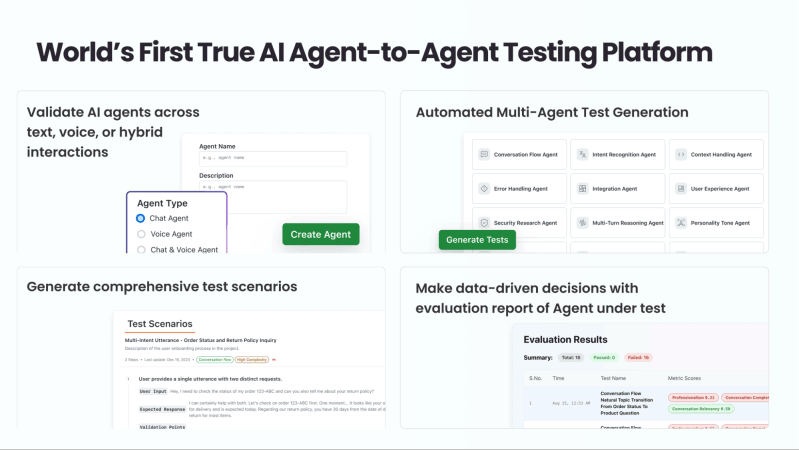
This level of rigorous, conversational testing is what turns a good prototype into a great, production-ready voice agent that users can trust. It’s the final, critical step in ensuring your agent is ready for the unpredictability of the real world.
To try it on your own agent, start with a handful of your most common call flows and add harder callers once those pass.
Conclusion: So, Which Agent Should You Build?
The choice between a Smooth Talker and a Reliable Rule-Follower isn’t about which one is better. It’s about choosing the right tool for the right job.
Build a Smooth Talker (Speech-to-Speech) when the experience is the most important thing. This is the right choice for applications where you want to create an emotional connection, have natural conversations, and delight the user.
It suits language tutoring apps, interactive story games, mental health companions and high-end customer service where empathy is key.
Build a Reliable Rule-Follower (chained) when the task is the most important thing. This is the right choice when accuracy, control and completing a process correctly are non-negotiable.
It suits scheduling appointments, tracking orders, phone banking security checks and any other structured workflow where every step has to be right.
The most exciting part is that you don’t have to be limited to just one.
The future of voice AI lies in creating teams of the best AI agents that work together. A Smooth Talker greets the user, while a team of Rule-Followers in the background handles the complex tasks. By understanding the strengths and challenges of each, you can start building voice experiences that are not just functional but truly conversational.
Whichever you build, test it the way callers will use it before launch. The Agent Testing getting started guide shows how to run your first simulated conversations.
Citations
- OpenAI - Voice agents guide (developers.openai.com), linked above
- IBM Research - Voice-based AI agents - https://research.ibm.com/publications/voice-based-ai-agents-filling-the-economic-gaps-in-digital-health-delivery
Co-authored by Sai Krishna, Director of Engineering at TestMu AI.
Author

Srinivasan Sekar
Blogs: 18


Srinivasan Sekar is Director of Engineering at TestMu AI (formerly LambdaTest), where he leads engineering and open-source initiatives behind the Selenium and Appium automation grid and owns TestMu AI's MCP Server. A committer to Appium and a contributor to Selenium, WebdriverIO, Taiko, and AppiumTestDistribution, he brings over 15 years of experience in quality engineering and open-source technologies. He is the author of the Apress book 'The MCP Standard: A Developer's Guide to Building Universal AI Tools with the Model Context Protocol,' a Certified Kubernetes and Cloud Native Associate, and an international conference speaker. Before TestMu AI he spent over eight years at Thoughtworks as a Principal Consultant and Quality Architect. Srinivasan holds a B.Tech in Information Technology from Anna University.
Reviewer

Chaitanya Sharma
Reviewer
Chaitanya Sharma is an AI Product Manager at TestMu AI (formerly LambdaTest), where he builds agentic AI capabilities focused on computer vision and multi-modality, moving testing beyond static script execution toward autonomous, agent-driven workflows. Before TestMu AI he shipped 135+ features at Sprinklr for a no-code community and website builder used by Fortune 500 enterprises including Dell, Samsung, and Polestar. At Policybazaar he led the zero-to-one launch of a digital lending and insurance marketplace embedded in Bahrain's dominant payments app, building a risk-intelligence engine that compressed loan-approval times by 80%. He explored machine learning and NLP through research at the University of Cambridge, and holds a B.Tech from Delhi Technological University.


AI Voice Agent FAQs
Did you find this page helpful?
More Related Blogs
TestMu AI forEnterprise
Get access to solutions built on Enterprise
grade security, privacy, & compliance
- Advanced access controls
- Advanced data retention rules
- Advanced Local Testing
- Premium Support options
- Early access to beta features
- Private Slack Channel
- Unlimited Manual Accessibility DevTools Tests