


World’s largest virtual agentic engineering & quality conference




- TestMu AI (Formerly LambdaTest)
- /
- Blog
- /
- 13 Real-World AI Agent Examples (2026)
13 Real-World AI Agent Examples (2026)
Explore 13 real-world AI agent examples across coding, testing, support, and security, plus how AI agents work, their types, and where they deliver real value.

Swapnil Biswas
Author
Last Updated on: June 10, 2026
Gartner predicts that 33% of enterprise software applications will include agentic AI by 2028, up from less than 1% in 2024, according to its forecast on agentic AI adoption. AI agents have moved from research demos into production systems that resolve support tickets, write code, analyze data, and run software tests on their own.
An AI agent is software that can perceive context, reason through a goal, and take actions using tools, with little or no step-by-step human direction. This page skips the hype and shows 13 real, currently shipping AI agents you can see in action today.
Each example names the product, the company behind it, and the exact job the agent does, grouped by category from software engineering and customer support to testing, security, and supply chain.
Overview
What Is an AI Agent?
An AI agent is software that pursues a goal autonomously by perceiving context, reasoning about what to do next, and acting through tools and APIs. Unlike a chatbot that answers and waits, an agent runs a perceive-reason-act loop until the task is done.
What Are the Main Types of AI Agents?
- Reactive agents: Respond to current input using fixed rules, with no memory.
- Model-based reflex agents: Keep an internal model of the world to handle partial information.
- Goal-based agents: Plan action sequences to reach a defined goal.
- Utility-based agents: Weigh trade-offs to pick the best outcome, not just any valid one.
- Learning and multi-agent systems: Improve from feedback, and coordinate several specialized agents on one workflow.
What Are the Best AI Agent Examples in 2026?
Strong, currently shipping examples include KaneAI for software testing, Cursor and Devin for coding, OpenAI ChatGPT Agent for web tasks, Gemini Deep Research for analysis, Sierra for customer support, and CrowdStrike Charlotte AI for security operations.
How Does TestMu AI Use AI Agents?
TestMu AI builds KaneAI, a GenAI-native, end-to-end testing agent that turns plain-English instructions into automated web, mobile, and API tests, then auto-heals and analyzes them across thousands of real environments.
What Is an AI Agent?
An AI agent is a software system that uses a large language model as its reasoning engine to perceive context, plan a sequence of steps, call external tools, and act toward a goal with minimal human direction. The defining trait is autonomy: it decides what to do next instead of waiting for a prompt at every step.
Most production agents run the same four-stage loop:
- Perceive: Read inputs such as a user request, a document, an API response, or a screenshot.
- Reason and plan: Break the goal into subtasks and decide the next action.
- Act with tools: Call APIs, query databases, browse the web, or run code to change the real world.
- Observe and adapt: Check the result, update its plan, and repeat or escalate to a human.
This loop is what separates an agent from a chatbot or an assistant. A chatbot answers inside one conversation; an AI assistant drafts and waits for you to act; an AI agent executes the task end to end and reports back.
Adoption is the reason this matters now. According to the Stanford HAI AI Index 2025, 78% of organizations reported using AI in 2024, up from 55% in 2023, and the share using generative AI in at least one business function jumped from 33% to 71%. For a deeper primer, see our guide on what AI agents are, including their components and types.
Types of AI Agents
AI agents are grouped by how they make decisions. Classic AI theory defines five core types, from simple reflex agents to learning agents, and modern systems add multi-agent setups where several agents collaborate. The table below maps each type to what it does and where you see it.
| Agent Type | How It Decides | Real-World Example |
|---|---|---|
| Reactive (simple reflex) | Acts on the current input using fixed condition-action rules, with no memory. | A thermostat or a spam filter that flags an email on rules alone. |
| Model-based reflex | Maintains an internal model of the world to act under partial information. | A robot vacuum that maps a room and avoids known obstacles. |
| Goal-based | Plans a sequence of actions to reach a defined goal. | A navigation agent that routes you to a destination. |
| Utility-based | Scores possible outcomes and picks the one with the highest payoff. | A trading or pricing agent that optimizes for return under constraints. |
| Learning | Improves its behavior over time from feedback and outcomes. | A recommendation agent that adapts to your interactions. |
| Multi-agent system | Several specialized agents coordinate through an orchestration layer. | A QA pipeline where one agent plans tests, another writes them, a third runs them. |
One caution before you shop: not everything labeled an "agent" is one. Gartner estimates only about 130 of the thousands of agentic AI vendors are genuine, with the rest rebranding chatbots, robotic process automation, and assistants in a practice it calls "agent washing." Read the capabilities, not the marketing.
The most capable production systems are increasingly multi-agent AI systems, where each agent owns one job and an orchestrator manages sequencing and handoffs.

Note: Author and run agentic, self-healing tests from plain English with TestMu AI. Try TestMu AI for free!
13 Real-World AI Agent Examples
These 13 AI agents are live products you can use today, chosen for category diversity so you can see how agents differ across coding, testing, support, research, data, sales, operations, security, and healthcare. Momentum is real: Deloitte predicts that 25% of companies using generative AI will launch agentic AI pilots in 2025, rising to 50% by 2027.
For a broader view of how these map to business problems, see our breakdown of AI agent use cases across industries.
Full disclosure: KaneAI, listed first, is TestMu AI's own agent; the other twelve are independent products from other companies, included on the strength of what they ship.
1. KaneAI by TestMu AI (Formerly LambdaTest)
Category: Software testing and QA. KaneAI is a GenAI-native, end-to-end testing agent built for quality engineering teams. You describe what to test in plain English, and it plans, authors, and evolves the tests, converting requirements directly into executable code across web, mobile, and API, with support for all major languages and frameworks.
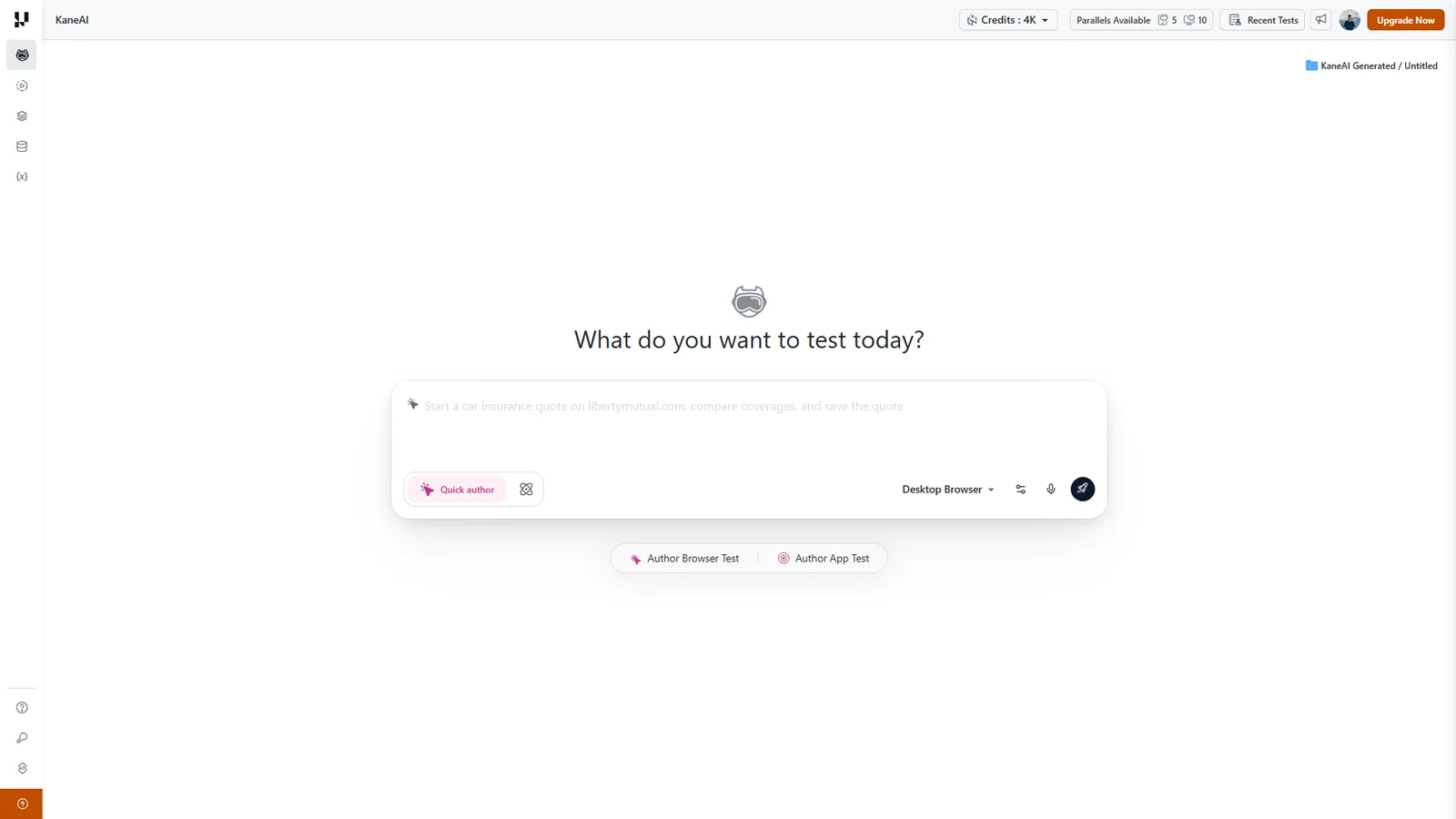
What makes it a true agent rather than a script recorder:
- Generates tests from real inputs: turn a JIRA ticket, PRD, PDF, screenshot, or spreadsheet into structured test cases, so test creation is not limited to people who write code.
- Handles complex logic in plain English: express conditionals, assertions, and API checks as natural language, then export the result as framework code in the language your team already uses.
- Reduces maintenance: auto-healing repairs affected steps based on the test's original intent when the UI shifts, and KaneAI flags bugs it finds during test generation and execution.
KaneAI is built as an assistant, not a replacement: every run pairs with a human review step, so engineers approve and refine what the agent proposes. It also fits existing workflows: tagging a JIRA issue can trigger test automation, and a GitHub app can read a pull request to suggest the tests that change needs. Explore the broader AI QA agent capabilities, or this walkthrough of using an AI agent to generate Selenium Java tests.
2. Cursor
Category: Software engineering. Cursor, built by Anysphere, is an AI coding agent wrapped in a full IDE. Beyond autocomplete, its agent mode can take a task description and autonomously write, edit, run, and review code across multiple files, letting a developer hand off whole features and review the result.
It reads your codebase for context, proposes multi-file changes, and runs commands to verify its own work, which is why coding is currently the most mature agent category.
3. Devin
Category: Autonomous software engineering. Devin, from Cognition, is marketed as an autonomous AI software engineer that learns a codebase and executes coding tasks such as migrations, refactors, bug fixes, and pull-request reviews while keeping humans in the loop for approval, and teams increasingly need ways to test apps built with Devin before they ship.
Capability benchmarks back the category up: Deloitte notes that in one evaluation, Devin resolved nearly 14% of real GitHub issues, about twice as well as LLM-based chatbots. That is still far from human-level, which is exactly why oversight matters.
4. ChatGPT Agent by OpenAI
Category: Web and computer use. OpenAI's ChatGPT Agent, which absorbed the company's earlier Operator product, is a computer-using agent that drives its own browser and virtual machine. It navigates websites, clicks, types, scrolls, and fills forms to complete web tasks the way a person would, instead of relying on a dedicated API for each site.
This browser-control pattern is what lets one agent book a reservation, compile research, or fill a multi-step web form without custom integrations.
5. Gemini Deep Research
Category: Deep research. Gemini Deep Research, from Google, is an agentic research assistant that autonomously browses hundreds of websites, plus connected sources like Gmail and Drive, to gather and synthesize information into a detailed, multi-page report in minutes.
It plans a research strategy, runs many searches in parallel, and reasons over the findings, turning hours of manual reading into a structured brief you can review and cite.
6. Sierra
Category: Customer service. Sierra is an enterprise platform for building and deploying conversational customer-service agents across chat, SMS, WhatsApp, email, and voice. Its agents resolve customer issues autonomously, taking real actions like processing a return rather than just answering questions.
The difference from a basic support bot is action: a Sierra agent can look up an order, apply a policy, and complete the resolution end to end.
7. ThoughtSpot Spotter
Category: Data analysis and BI. Spotter, from ThoughtSpot, is an autonomous AI analyst agent. It answers natural-language data questions by reasoning step by step, checking its own work, and surfacing governed, explainable insights across enterprise data, so non-analysts can interrogate dashboards in plain language.
Because it stays inside governance rules and shows its reasoning, the answers are auditable, which is essential for business decisions.
8. 11x Alice
Category: Sales and marketing. Alice, from 11x, is an autonomous AI sales development representative, marketed as a digital worker. It researches prospects across dozens of data sources and runs personalized, multichannel outreach to book qualified meetings and build pipeline without a human sending each message.
It shows how agents move from drafting to doing: instead of suggesting an email, Alice researches, writes, sends, and follows up on its own. The same shift is reshaping marketing, where AI agents for content creation draft and publish at scale.
9. Cleric
Category: IT, DevOps, and SRE. Cleric is an AI site reliability engineering agent that autonomously investigates production alerts, runs root-cause analysis within minutes, and recommends fixes inside the tools teams already use, such as Slack and monitoring dashboards.
For on-call engineers, that means the agent triages the noise and arrives with a hypothesis, rather than handing over a wall of logs.
10. CrowdStrike Charlotte AI
Category: Cybersecurity and SOC. Charlotte AI, from CrowdStrike, is an agentic AI security analyst positioned as the brain of the agentic security operations center. It autonomously triages detections, filters out false positives, and accelerates threat investigation and response so human analysts focus on real threats.
Security is a natural fit for agents because alert volume far outstrips analyst time, and an agent can work the queue continuously.
11. Bland AI
Category: Voice. Bland is an enterprise voice AI platform that builds and operates autonomous AI phone agents. They handle inbound and outbound calls around the clock with natural conversation and integrations into CRM and telephony systems, covering scenarios from appointment reminders to qualification calls.
Voice agents extend the agent pattern to the phone channel, where latency and natural turn-taking are the hard problems.
12. Abridge
Category: Healthcare. Abridge is a clinical AI agent that listens to patient-clinician conversations in real time and generates contextually aware, billable clinical notes, integrated directly into Epic electronic health record systems. It removes documentation work so clinicians spend more time with patients.
It is a clear example of a domain-specialized agent: narrow scope, deep integration, and a measurable reduction in administrative load. Because clinical software is high-stakes, the agents around it need rigorous testing too, which is where agentic quality for healthcare apps comes in.
13. SAP Joule Agents
Category: Supply chain and enterprise operations. SAP Joule Agents are autonomous agents embedded across SAP systems. They sense supply chain disruptions, run risk and feasibility analysis, and execute end-to-end actions from demand forecasting to supplier collaboration, all within the enterprise software where the data already lives.
Embedding agents inside the system of record is a pattern you will see more of, because it removes the integration tax that slows standalone agents.

AI Agents in Software Testing
Software testing is one of the highest-value places to deploy AI agents, because QA is full of repetitive, multi-step work where judgment is needed but human bandwidth is scarce. According to Gartner, 40% of enterprise applications will integrate task-specific AI agents by the end of 2026, up from less than 5% in 2025, and testing pipelines are an early adopter.
An agentic testing approach spreads work across specialized agents that span the full lifecycle:
- Plan: Agents generate structured test cases from requirements, tickets, or screenshots.
- Author: Tests are written from natural-language prompts, lowering the barrier for non-coders.
- Execute: Tests run in parallel across browsers and devices, with self-healing test automation when locators break.
- Analyze: Agents run automated root-cause analysis and flag flaky tests through pattern detection.
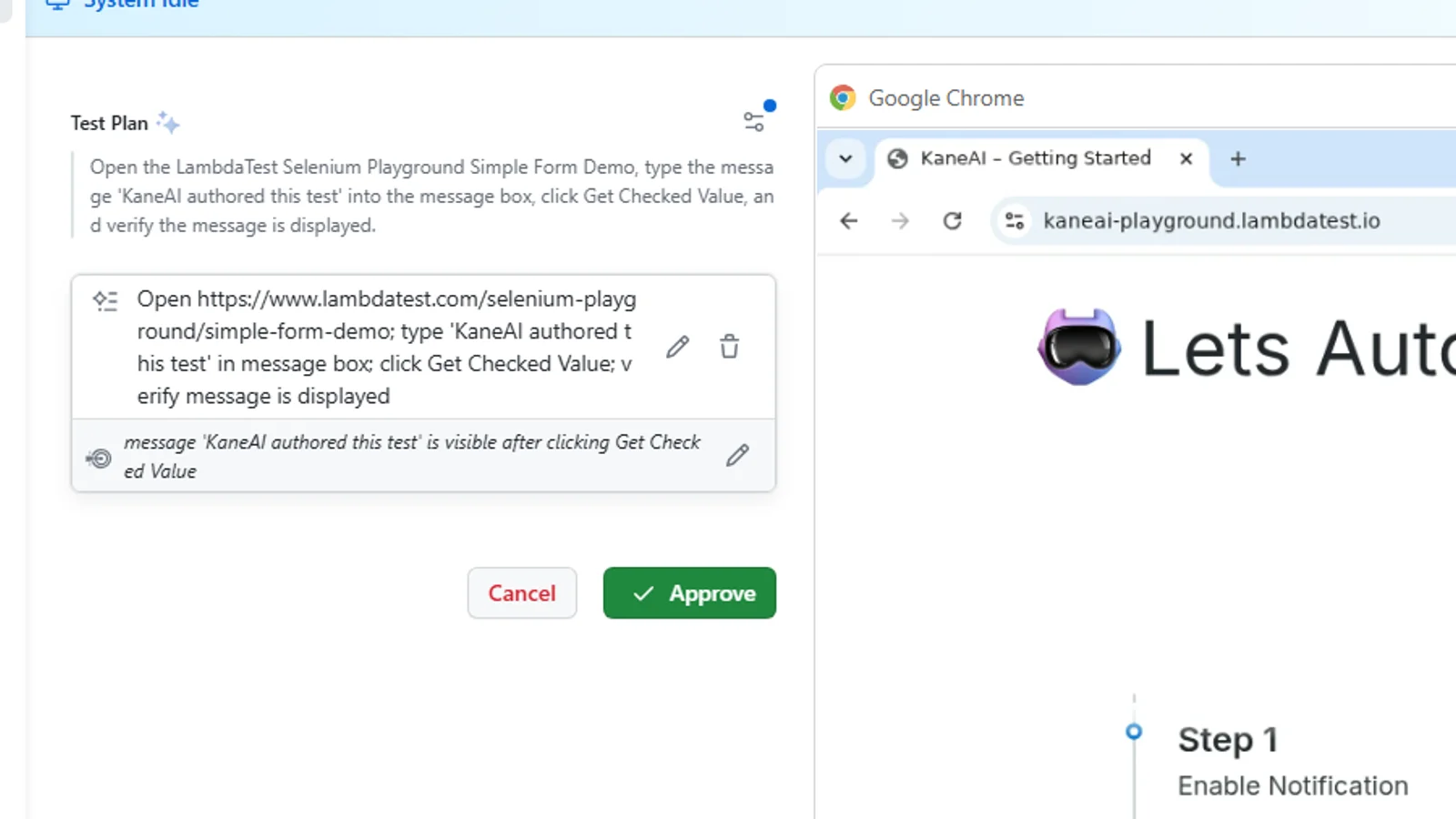
The screenshot above is KaneAI doing exactly that: it turned a one-line, plain-English request into an executable test plan with an explicit assertion, then paused for human approval before running it on the cloud.
This is exactly the model behind agentic testing on TestMu AI, where KaneAI plans and writes tests while platform agents handle root-cause analysis through test intelligence. For the wider context, see how teams put AI in QA and the fundamentals of agentic AI testing.
One realistic expectation: agents are strongest on bounded tasks. The Stanford HAI AI Index 2025 found that on short two-hour tasks, top AI agents scored four times higher than human experts, yet humans still outperformed them two-to-one when tasks stretched to 32 hours. That is why a human-in-the-loop review step belongs in every QA workflow. The KaneAI getting-started docs walk through setting that up.

How to Choose an AI Agent
The biggest risk is starting too broad. Gartner predicts over 40% of agentic AI projects will be canceled by the end of 2027 because of escalating costs, unclear business value, or inadequate risk controls, so the goal is a focused first win, not a moonshot.
Use this checklist to evaluate any AI agent before you commit:
- Pick one bounded workflow: Choose a high-volume, repetitive task with measurable outcomes, such as test execution or ticket triage.
- Check the autonomy level: Confirm whether it acts end to end or only drafts, and whether that fits the risk of the task.
- Require human-in-the-loop controls: Make sure you can approve, override, and audit the agent's actions.
- Verify integrations: The agent must connect to the tools and data you already use, or the integration tax will sink the ROI.
- Demand evaluation and testing: Insist on a way to measure accuracy and reliability through proper AI agent evaluation, and a path to test the agent itself before production.
- Confirm governance: Look for data handling, access controls, and traceability that satisfy your compliance needs.
If you cannot name the metric the agent should move, it is too early to deploy it. Start where the workflow is well understood and the result is easy to score.
Conclusion
AI agents have crossed from demos into daily work across coding, support, research, security, and testing. Gartner expects that by 2028, at least 15% of day-to-day work decisions will be made autonomously through agentic AI, up from 0% in 2024, so the question is no longer whether to adopt agents but which workflow to start with.
For QA teams, software testing is the clearest first win: the work is repetitive, the outcomes are measurable, and the maintenance burden is exactly what an agent removes. Start with TestMu AI's KaneAI to author and run self-healing tests from natural language, then follow the getting-started documentation to wire it into your pipeline with a human-in-the-loop review step.
Note: This article was researched and drafted with AI assistance, then reviewed, fact-checked, and published by Swapnil Biswas, Product Marketing Manager for KaneAI at TestMu AI, whose work centers on agentic AI testing and test automation. Every statistic, link, and product claim was verified against primary sources. Read our editorial process and AI use policy for details.
Author
Swapnil Biswas
Blogs: 9


Swapnil Biswas is a Product Marketing Manager at TestMu AI, leading product marketing for KaneAI and HyperExecute while orchestrating GTM campaigns and product launches. With 5+ years of experience in product marketing and growth strategy, he specializes in AI, SEO, and content marketing. Certified in Selenium, Cypress, Playwright, Appium, KaneAI, and Automation Testing, Swapnil brings hands-on expertise across web and mobile automation. He has authored 20+ technical blogs and 10+ high-ranking articles on CI/CD, API testing, and defect management, enabling 70K+ testers to improve automation maturity. His work earned him multiple awards, including Top Performer, Value of Agility, and Wall of Fame. Swapnil holds a PG Certificate in Digital Marketing & Growth Strategy from IIM Visakhapatnam and a BBA in Marketing from Amity University.







Frequently asked questions
Did you find this page helpful?
More Related Blogs
TestMu AI forEnterprise
Get access to solutions built on Enterprise
grade security, privacy, & compliance
- Advanced access controls
- Advanced data retention rules
- Advanced Local Testing
- Premium Support options
- Early access to beta features
- Private Slack Channel
- Unlimited Manual Accessibility DevTools Tests