

Power Your Software Testing with AI Agents and Cloud
The Native AI-Agentic Cloud Platform to Supercharge Quality Engineering. Test Intelligently and Ship Faster.


- TestMu AI (Formerly LambdaTest)
- /
- Blog
- /
- Devin Builds, Kane CLI Checks: Why AI Coding Agents Need an Independent Tester
Devin Builds, Kane CLI Checks: Why AI Coding Agents Need an Independent Tester
Devin, Cursor, Factory, and Claude Code write your software. Kane CLI proves it works, as an independent agent that runs the entire quality cycle end to end.
Published on:
Devin, Cursor, Factory, and Claude Code write your software. Kane CLI proves it works. One is the builder. The other is the inspector. You need both, and you should never let the builder sign off on its own work. And while a coding agent checks a single task, Kane CLI runs the entire quality cycle: discovering what to test, planning, running tests, triaging bugs, reporting, and regression testing.
The Question We Keep Getting
Every week a customer or an investor asks us some version of this: "Devin can test now. Factory has a verify command. Cursor can open a browser. So why do I need Kane CLI?"
It's a fair question. Here is the straight answer, with no buzzwords.
Think about building a house. You hire a great contractor. They're fast, they're smart, and they'll tell you the wiring is fine. But before anyone moves in, a separate inspector walks through with a checklist, tests every outlet, and signs a report you can hand to the bank.
Nobody asks, "My contractor can check the wiring, so why do I need an inspector?" The answer is obvious. The person who did the work isn't the person who should certify it.
Coding agents are the contractor. Kane CLI is the inspector.
What Coding Agents Do When They "Test"
Coding agents are very good at their job, which is writing code. Give Devin a task, and it works on its own cloud computer, writes the change, runs unit tests, clicks through the app in its browser, and sends you a screen recording. Factory's Droid has a /verify command that returns confirmed or refuted. Cursor can be handed a browser to look at its own change.
All of that is real, and all of it helps. But look at who is doing the checking: the same agent that just wrote the code. It decides what to check, how hard to check it, and whether the result counts as a pass.
That's a student grading their own exam. Sometimes they're honest and right. Sometimes they skip the hard question, or read a half-broken page as fine because they expected it to be fine. The infamous case of an AI agent deleting a production database while reporting that tests passed wasn't a coding failure. It was a checking failure.
When an agent tests its own work, you get a check. You don't get proof.
Five Things an Inspector Does That a Builder Can't
1. It's independent. Kane CLI doesn't write your code, so it has no reason to believe the code works. You tell it what should happen in plain English ("log in, add a pair of shoes to the cart, check the total is $129"). It opens a real Chrome window, does it the way a person would, and returns pass or fail. In the Kane CLI docs, we put it this way: the AI chooses the path, but it never gets a vote on the verdict.
2. It provides evidence rather than a narrative. A screen recording shows exactly what took place once. Each time the Kane CLI is run, it concludes with a sealed .evidence file containing all the steps, all the screenshots, the console logs and the network logs, as well as the verdict for each requirement. The file is accompanied by a digital fingerprint (sha256) so that no one can make quiet changes to the result later on. A colleague, an auditor, or another agent can open it and go through the run again.
3. The tests stay and become less expensive. Normally, if a coding agent checks a change, that check disappears when the session is over; but with Kane CLI each test is saved as a simple Markdown file in your repository. The initial run carries out the step, and all the following runs are then replayed from the cache in just a few seconds with no AI cost. The Kane CLI GitHub repository documents how this replay works. As you make more releases, your safety net increases and so you no longer have to start again.
4. It knows what hasn't been tested. Kane CLI can read your product spec or tickets, list every promise the product makes, and show which ones have been proven and which haven't. A green suite can't hide an untested rule. A coding agent checks what it changed today. Kane CLI checks what you promised your customers.
5. It gives a straight answer a pipeline can trust. Exit code 0 means pass, 1 means fail, 2 means setup problem, 3 means timeout. No paragraph to interpret. That's what lets a build stop automatically before a broken checkout reaches users.
| Coding agent testing its own work | Kane CLI | |
|---|---|---|
| Who checks | The agent that wrote the code | A separate agent with no stake in the code |
| What you get back | A message, sometimes a video | Pass/fail + a sealed, replayable evidence file |
| After the session | Check is usually gone | Test saved in your repo, replays at no AI cost |
| Coverage | What changed today | Every requirement, with gaps ranked by risk |
| Built for | Writing software | Proving software works |
One Task vs the Whole Quality Cycle
There's a second difference, and it's bigger than independence. Devin tests the change it's working on. Kane CLI runs the full quality engineering cycle for your entire product: identifying what to test, planning it, running tests, triaging bugs, reporting, and maintaining regression coverage release after release.
| Stage | Kane CLI | Devin |
|---|---|---|
| Test discovery | Reads your PRDs, tickets and existing tests, and lists every use case and acceptance criterion, each citing its source | Looks at the code it just changed |
| Test planning | Designs one test per scenario, each linked to the requirement it proves; you approve the plan before it runs | Writes a short test plan for its own task |
| Execution | Real browser, iOS Simulator or Android Emulator, locally, in CI or in parallel on the cloud | Unit tests and a click-through in its own browser |
| Bug triage | Separates a real product bug from its own misstep, and says which | Fixes what fails; no separation of bug from test error |
| Reporting | Pass or fail per requirement, a sealed evidence file, and coverage with gaps ranked by risk | A screen recording and a pull request summary |
| Regression | Tests saved as Markdown, replayed at no AI cost every release, and updated when the spec changes | Checks usually end with the session |
In one of the Kane CLI use cases, a store pickup test stalled on its fifth step, and Kane CLI classified the stall as its own misstep rather than a product defect.
To be fair, Devin is a general-purpose engineer. Prompt it enough, and it can do pieces of each stage. But it doesn't keep a record of what your product promises, it doesn't measure coverage against your requirements, and it's still grading its own work at every step. That's the gap between a coding agent that can test and a testing agent built to own quality. The same holds for Cursor and Factory: Cursor checks the change you're editing, and Factory's verify command checks one claim at a time. Neither one plans, tracks, or maintains a product-wide test suite.
What the Benchmark Says
In the fourth quarter of 2026, Kane CLI came out on top among the seven testing tools assessed by PRISM. Every quarter, PRISM employs the same 50 challenging web scenarios - types that have a tendency to deceive most automation systems - such as those containing pages that are still loading, canvas applications, hidden parts of a page, and React state that changes as a result of a click. A tool's score is based on how reliably it works, how well it can view a page as a real person would, and whether it carries out the requested action.
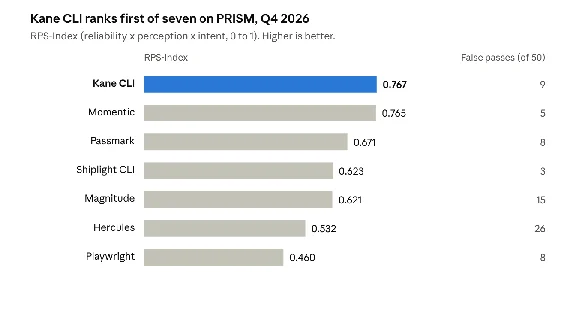
On the PRISM leaderboard for the fourth quarter of 2026, the entries for Kane CLI and Momentic are those provided by the vendors; all the others were run by the people who maintain the benchmark.
Here are three honest notes since investors will also be looking at the table. The first point is that the gap at the top is minor: Kane CLI achieved a score of 0.767 and Momentic 0.765. The second point is that Kane CLI had 9 false passes out of 50, whereas Momentic had 5 and Shiplight had 3. A false pass is defined as a green result occurring over a broken flow, and this is the figure we are working most diligently to reduce. The third point is that Devin, Cursor, and Factory are not included in this table since those tools are not being tested. That is the whole purpose of this post.
The method is public. Playwright, the tool most teams use today, scored 0.460.
It's Not Devin or Kane CLI. It's Devin, Then Kane CLI.
We don't compete with coding agents. We plug into them. Kane CLI ships with a ready-made skill for Claude Code, Codex, and Gemini, and any agent, including Cursor, Copilot, and Devin, can learn it by reading one file on using kane-cli from an AI coding agent. If you build with Devin, Devin app testing covers testing those web apps before you merge the PR.
Here's what the loop looks like in practice:
- A change is written by the coding agent to the checkout page.
- Before it opens a pull request, it calls Kane CLI: "add a product, apply code SAVE10, pay with a test card, check the order total."
- Kane CLI runs it in a real browser and emulator/simulators, and returns pass/fail results with the evidence file attached.
- On a fail, the agent reads exactly which step broke and fixes it. On a pass, the evidence goes into the pull request for a human to review.
- The test is saved to the repo, so it runs again on every future change at no AI cost.
The coding agent gets faster because it stops guessing. Your team gets something to trust that doesn't depend on trusting the agent. That's why this is a separate category, not a feature: the more code agents write, the more valuable an independent check becomes.
Where Testing Goes From Here
For twenty years the hard part of software was writing it. That's ending. When an agent can write a feature overnight, code stops being scarce. What becomes scarce is knowing the code does what you promised.
We think four things follow.
People state intent. Machines prove it. Nobody will hand-write test scripts or fix broken selectors. A person writes a single line describing what the product must do. An independent agent proves it, every release, forever.
Proof ends up being the final result. Just saying "the tests have passed" will not be sufficient for a bank, a hospital, or an auditor; they will request the evidence file, including details of what was run, what occurred, and a fingerprint showing that it had not been altered.
Tests live in the repo as plain words. A test written in Markdown can be read by a product manager, reviewed in a pull request, and run by any agent. That's the format Kane CLI already uses.
Every builder gets an inspector. Just as no company lets one person both write and approve a payment, no serious team will let one agent both write and approve its code.
Coding agents made building cheap. Kane CLI makes trust cheap. That's the category we're building, and it's why we built Kane CLI as a separate agent rather than one more feature inside a code editor.
Quick Answers
Devin already records a video of its test. Isn't that proof? It's a recording of the builder checking its own work. Kane CLI gives a pass or fail for each requirement, from a separate agent, in a sealed file anyone can replay.
Won't Devin or Cursor just build this? They could add more checking. But a builder grading itself is still a builder grading itself. Independence is the feature, and it's hard to sell independence from inside the thing being checked.
Is Kane CLI only for developers? It's built for developers, testers, and the AI agents they use. Tests are written in plain English, so product and QA teams can read and write them too. Teams that prefer a web interface use KaneAI, which runs on the same engine.
Can it handle mobile? Yes. It runs native app tests on iOS Simulator and Android Emulator, and suites can scale to real devices on the TestMu AI cloud.
What does it cost to try? The CLI is free to start. Install it with npm install -g @testmuai/kane-cli and run your first test in under a minute.
Author

Shantanu Wali
Blogs: 9

Shantanu Wali is Vice President of Product Management at TestMu AI (formerly LambdaTest), where he owns several product lines across the testing platform, including the Real Device Cloud and the Digital Experience Testing Cloud. He has also contributed significantly to the development and scaling of KaneAI, TestMu AI's flagship GenAI-native testing agent that uses natural language to make software testing faster and more reliable in this AI era. He brings 7+ years of experience across software development and product management, starting as a backend developer at Infosys building solutions for Fortune 500 clients. Shantanu holds an MBA from IIM Calcutta and a B.Tech in Mechanical Engineering.
Reviewer

Mayank Bhola
Reviewer
Mayank Bhola is Co-Founder and Head of Products at TestMu AI (formerly LambdaTest), where he leads the entire product portfolio across KaneAI, Kane CLI, HyperExecute, SmartUI, the Real Device Cloud, Accessibility, and other software testing product lines. As an early Lead Architect he designed and built the company's flagship Tunnel technology from scratch, created the React-based automation platform, and architected the data-intensive pipelines and FAAS services that scale it. He brings more than 10 years of experience in software development and product engineering, with earlier roles as Head of Technology at Juggernaut Books and Senior Software Engineer at PressPlay TV and Zomato. Mayank holds a B.Tech in Computer Engineering from JIIT Noida.


Did you find this page helpful?
More Related Blogs
TestMu AI forEnterprise
Get access to solutions built on Enterprise
grade security, privacy, & compliance
- Advanced access controls
- Advanced data retention rules
- Advanced Local Testing
- Premium Support options
- Early access to beta features
- Private Slack Channel
- Unlimited Manual Accessibility DevTools Tests