

Power Your Software Testing with AI Agents and Cloud
The Native AI-Agentic Cloud Platform to Supercharge Quality Engineering. Test Intelligently and Ship Faster.


- TestMu AI (Formerly LambdaTest)
- /
- Blog
- /
- AI in Regression Testing: Faster Tests, Less Maintenance
AI in Regression Testing: How AI is Transforming Software Quality
Learn how AI in regression testing automates test execution, prioritizes high-risk tests, self-heals scripts, and predicts defects for faster releases.
Last Updated on:
Regression testing makes sure new code changes do not break existing functionality. As an application scales, running the full suite after every change becomes slow and expensive, and that is exactly where AI helps.
According to Capgemini's World Quality Report 2024-25, 72% of organizations report faster test automation after adopting generative AI, and regression testing is one of the areas where that speed pays off most.
AI in regression testing optimizes test selection, automates test generation and execution, and strengthens defect detection. In this blog, we explore how AI improves regression testing and how TestMu AI's AI-native tools put it to work.
Key Takeaways
To transform regression testing and accelerate software quality, teams should use TestMu AI to automate test creation, prioritize execution based on risk, and automatically heal broken test scripts. This AI-driven approach reduces manual maintenance and optimizes test selection to ensure critical updates are validated quickly.
- Natural-language authoring: KaneAI allows teams to create, manage, and debug regression tests using plain-language instructions and automatically heals affected steps when UI elements change.
- Visual AI validation: SmartUI analyzes desktop and mobile screens to determine whether layout changes are real regressions or expected updates, avoiding brittle pixel-by-pixel diffing.
- Parallel test execution: HyperExecute orchestrates parallel test runs across browsers and over 10,000 real devices on the cloud to keep feedback loops fast.
- Failure analysis: Test Intelligence predicts failures, identifies flaky tests, and clusters related failures so teams can resolve one underlying cause instead of triaging duplicate reports.
- Risk-based test selection: This optimization method prioritizes tests based on code-change impact, past failures, and risk analysis, ensuring high-risk areas are checked first.
- AI regression testing works best when engineers remain in the loop to review AI-generated tests and self-healed changes before deploying them into the active pipeline. When an agent also decides which tests run, agent regression testing covers how to audit the ones it skipped.
What Is AI in Regression Testing?
AI in regression testing uses artificial intelligence tools and techniques to automate and enhance the entire regression testing process.
While traditional manual regression testing depends heavily on human effort, AI brings intelligent test automation and data-driven insights to increase the effectiveness and efficiency of the process.
AI-powered regression testing tools adapt dynamically to changes in test scripts, prioritize test cases, and predict the areas most likely to be impacted when new updates ship.
They also analyze defect patterns, user behavior, and historical data to recognize risk-prone areas and ensure critical functionality is thoroughly tested.
When the component under regression is an ML model rather than a rule-based function, AI/ML testing provides the methods for detecting accuracy degradation and behavioral drift across versions.
Traditional vs AI Regression Testing
Here is how AI regression testing improves on the traditional approach across four key areas:
| Area | Traditional Regression Testing | AI Regression Testing |
|---|---|---|
| Test selection | Runs the full suite or relies on manual judgment about what to re-test. | Prioritizes tests by code-change impact, past failures, and risk analysis. |
| Maintenance | Testers manually fix broken locators and steps after UI changes. | Self-healing updates locators and steps automatically through minor changes. |
| Test creation | Scripts are written by hand, requiring coding effort and time. | Tests are generated from plain language and exported to multiple frameworks. |
| Defect detection | Subtle regressions can be missed during repetitive manual checks. | ML flags anomalies and predicts failure-prone areas before they ship. |

Key Components of AI Regression Testing
A few building blocks are what separate AI regression testing from a regular automation suite. On TestMu AI, each one maps to a specific capability:
- Self-healing locators: When a selector or element shifts, the test repairs its own steps instead of failing, so a renamed button does not break the run. KaneAI applies this automatically.
- Visual AI validation: Rather than brittle pixel-by-pixel diffing, AI decides whether a layout change is a real regression or an expected update. SmartUI does this across desktop and mobile screens.
- Risk-based test selection: The engine scores each test by what the latest commit touched, past failure history, and real user paths, then runs the highest-risk cases first.
- Failure clustering: Related failures are grouped so you fix one underlying cause instead of triaging dozens of duplicate reports. Test Intelligence clusters failures and forecasts what is likely to break next.
- Pipeline-native execution: These components only help if they run on every change, so AI regression testing executes inside CI/CD across browsers and 10,000+ real devices, orchestrated in parallel by HyperExecute.
Role of AI in Regression Testing
AI makes regression testing faster, smarter, and more efficient. Here are the main ways it helps:
- AI-Powered Test Gap Identification: AI analyzes usage patterns, user behavior, and historical data to find gaps in the current test suite, so the QA team can cover critical workflows and edge cases by improving existing tests or adding new ones.
- Faster Test Case Generation: AI tools let you generate test cases with AI, speeding up the entire testing cycle.
- Self-Healing Test Scripts: AI automatically adapts test scripts when the underlying codebase changes, for example when UI element locators shift. Self-healing minimizes manual updates, prevents failures from minor changes, and keeps suites reliable over time.
- Smarter Defect Detection With ML: AI uses machine learning to flag anomalies and predict failure-prone areas. It analyzes historical defect data to prioritize risk-prone code and catches subtle patterns a manual tester might miss.
Just as AI improves accuracy and speed in AI in data integration, it plays a similar role in making regression testing more intelligent. The same shift extends to conversational systems, where AI voice agent regression testing catches behavior drift across builds.

Note: Boost your regression testing with AI across 10,000+ real devices on TestMu AI. Try TestMu AI today!
Use Cases of AI in Regression Testing
AI plays a specific role across different regression testing scenarios. Here are the most common use cases:
- Test Case and Script Generation: AI analyzes user behavior to create regression test cases, including edge cases, and generates scripts across different programming languages and frameworks.
- Test Data Generation: AI produces synthetic or realistic test data to improve coverage for regression scenarios.
- Test Prioritization and Optimization: AI identifies critical regression tests based on code changes, past failures, and risk analysis, then optimizes execution by running high-risk tests first and in parallel.
- Self-Healing and Test Maintenance: Auto-Heal recovers the locator at run time, and where the step has to change instead, an agent re-authors the objective and saves it as a version to approve. Self-healing test automation covers where each one holds and where it stops, and the documentation on healing and dynamic test lists the strategies.
- Defect Detection and Reporting: AI surfaces insights into test failures, trends, and defect predictions, and detects UI differences across versions to prevent unintended design changes.
For visual regression specifically, cloud-based platforms like TestMu AI offer a visual testing tool, an AI-native solution that catches pixel-level changes across desktop and mobile environments between releases.
Challenges With Traditional Regression Testing
Traditional regression testing ensures new changes do not break existing functionality, but it gets harder as software scales. Here are the key challenges:
- Re-running test cases after every update is tedious and time-consuming, especially as the suite grows.
- Executing every test after each code change is inefficient, so deciding which ones to run becomes increasingly complex.
- As software evolves, test suites need constant updates to stay relevant, adding to the maintenance burden.
- Manual regression testing is repetitive and monotonous, leading to a decline in attention and accuracy.
To overcome these limitations, teams increasingly layer AI on top of regression testing to add automation, intelligence, and efficiency.
5 Best Practices for AI Regression Testing
AI accelerates regression testing, but it works best with a clear strategy. Use these practices to get reliable results:
- Prioritize, don't automate everything: Let AI rank tests by risk and code-change impact, and run high-risk suites first instead of re-running the whole suite blindly.
- Keep engineers in the loop: Review AI-generated tests and self-healed locators before trusting them. Google's 2024 DORA report found that AI adoption can reduce software delivery stability unless teams keep robust automated testing and review practices in place.
- Pair self-healing with version control: Track every AI-driven change so you can audit and roll back. KaneAI versions each test change with instant rollback.
- Run in parallel on the cloud: Execute regression suites across browsers and real devices in parallel with HyperExecute to keep feedback fast.
- Measure the right signals: Track escaped defects, flaky-test rate, and maintenance time. Use Test Intelligence to spot flaky tests and predict what breaks next.
How Does KaneAI Help With AI Regression Testing?
KaneAI by TestMu AI is a GenAI-native software testing agent for high-speed quality engineering teams. It lets you create, manage, and debug regression tests using natural language, reducing the need for extensive coding expertise. Its AI app testing runs also include root-cause analysis for each failure and case-level retries that absorb flaky failures.
Key features for regression testing:
- Effortless Test Creation: Design and evolve tests with plain-language instructions, making automation accessible regardless of skill level.
- Intelligent Test Planner: Automatically generates and organizes test steps from your high-level objectives.
- Multi-Language Code Export: Convert tests into any major language or framework to fit your automation stack.
- Sophisticated Assertions: Express complex conditions and assertions in natural language.
- Self-Healing Tests: Automatically updates affected steps when UI elements change, so regression suites stay green through minor edits.
- API Testing Support: Test backend systems alongside UI flows in unified runs for broader regression coverage.
- Seamless JIRA Integration: Trigger automated tests directly from JIRA tasks for continuous regression checks.
- Smart Version Control: Track every change with built-in versioning for organized test management and instant rollback.
Let's walk through generating a regression test with KaneAI. For the demonstration, we will create a web-based test.
Note: Please ensure you have access to KaneAI. To get access, please contact sales.
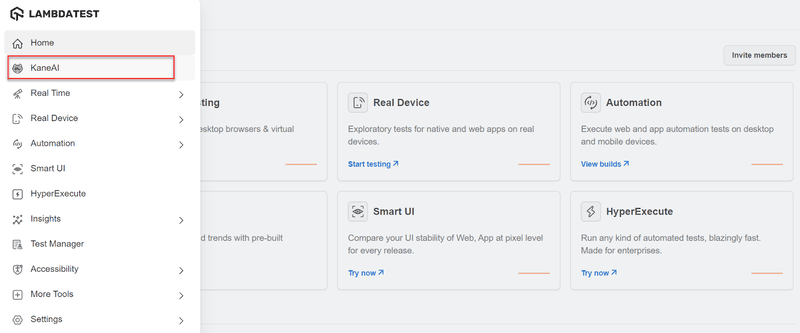
- Navigate to the TestMu AI dashboard and click the KaneAI option.
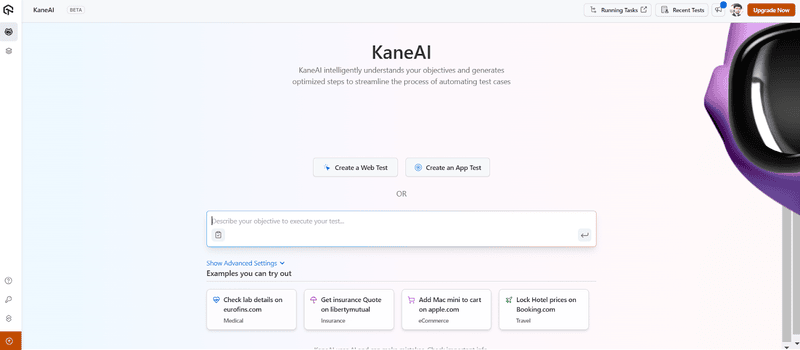
- Click on the Create a Web Test button. It opens the browser with a side panel to write test steps.
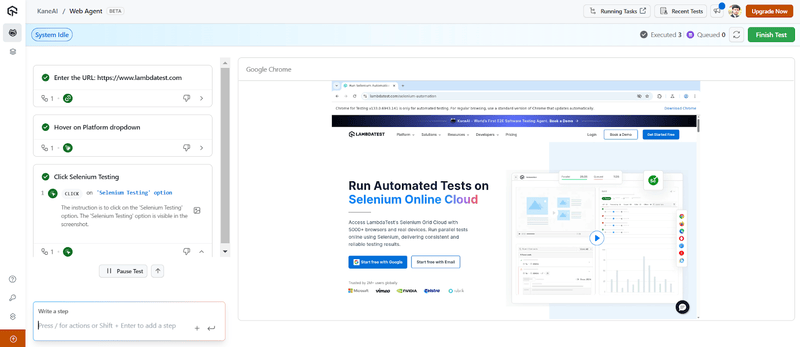
- Interact with the browser agent, and it records the test steps based on your actions.
- Click on the Finish Test button and then click the Save Test Case button.
- You are redirected to TestMu AI's test management platform, where you can manage test cases and view Summary, Code, Runs, Issues, and Version History.
- To generate code for the test cases, click on the Code tab.
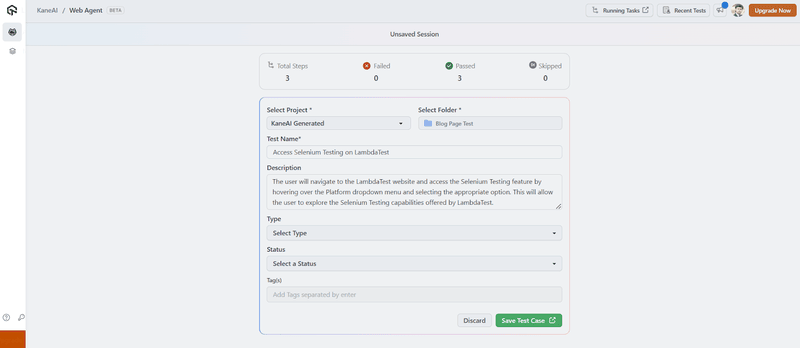
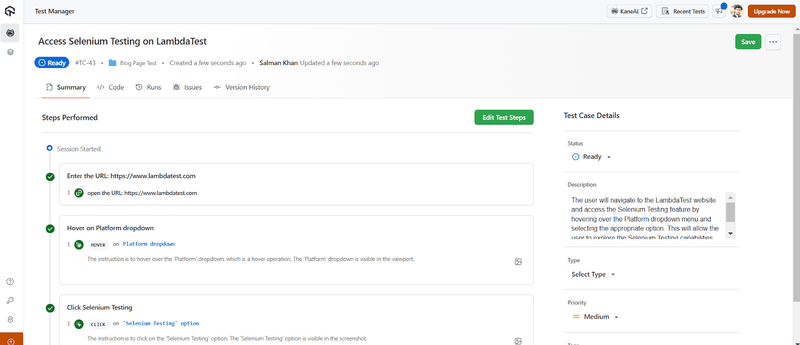
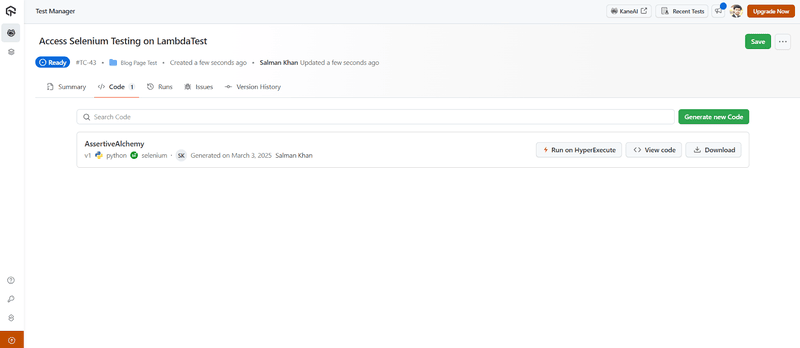
You will find multiple options based on your needs: generate code in a different language or framework, run tests on HyperExecute, view and edit code in the built-in editor, or download the entire test suite with code files.
To get started, refer to this getting started guide on KaneAI.
As AI in software testing grows, upskilling keeps you competitive. The KaneAI Certification proves your hands-on AI testing skills and positions you as a future-ready QA professional.

Conclusion
Start small: pick one slow, high-maintenance regression suite, let AI prioritize and self-heal it, then expand once you trust the results. AI addresses the inefficiencies of traditional regression testing by optimizing execution, cutting maintenance overhead, and enabling predictive defect detection.
GenAI-native agents like KaneAI streamline the process further by prioritizing tests, automating maintenance, and reducing redundant execution. The shift is already underway: 68% of organizations are using generative AI or have a roadmap for it, per the World Quality Report 2024-25.
To begin, create your first AI regression test with the KaneAI getting started guide linked above.
Also, learn to leverage AI automation tools to streamline your testing process and optimize efficiency across your workflows.
If you want to build your AI testing skills step by step, follow this AI roadmap for software testers that covers automation, ML fundamentals, and AI agent testing.
Citations
Machine Learning Approach for Regression Testing: https://ijisae.org/index.php/IJISAE/article/view/5322
Note: This article was researched and drafted with AI assistance, then reviewed, fact-checked, and published by Salman Khan, Test Automation Evangelist at TestMu AI, whose listed expertise includes Automation Testing and Software Testing. Every statistic, link, and product claim was verified against primary sources. Read our editorial process and AI use policy for details.
Author

Salman Khan
Blogs: 138


Salman is a Test Automation Evangelist and Community Contributor at TestMu AI, with over 6 years of hands-on experience in software testing and automation. He has completed his Master of Technology in Computer Science and Engineering, demonstrating strong technical expertise in software development, testing, AI agents and LLMs. He is certified in KaneAI, Automation Testing, Selenium, Cypress, Playwright, and Appium, with deep experience in CI/CD pipelines, cross-browser testing, AI in testing, and mobile automation. Salman works closely with engineering teams to convert complex testing concepts into actionable, developer-first content. Salman has authored 120+ technical tutorials, guides, and documentation on test automation, web development, and related domains, making him a strong voice in the QA and testing community.
Frequently asked questions
Did you find this page helpful?
More Related Blogs
TestMu AI forEnterprise
Get access to solutions built on Enterprise
grade security, privacy, & compliance
- Advanced access controls
- Advanced data retention rules
- Advanced Local Testing
- Premium Support options
- Early access to beta features
- Private Slack Channel
- Unlimited Manual Accessibility DevTools Tests