

Power Your Software Testing with AI Agents and Cloud
The Native AI-Agentic Cloud Platform to Supercharge Quality Engineering. Test Intelligently and Ship Faster.


- TestMu AI (Formerly LambdaTest)
- /
- Learning Hub
- /
- What Is Agentic RAG? Working, Architecture, and How to Test It [2026]
Agentic RAG puts an autonomous AI agent in charge of retrieval-augmented generation, so the system can plan, decide what to fetch, grade what it retrieved, and self-correct instead of answering in one fixed pass.
Enterprise adoption of generative AI more than doubled in a year, from 33% to 71% of organizations using it in at least one business function, per Stanford HAI's 2025 AI Index.[11] But adoption is not the same as autonomy: Menlo Ventures' 2025 State of Generative AI in the Enterprise found that only 16% of enterprise deployments qualify as true agents, systems where the model plans, executes actions, observes feedback, and adapts; the rest are still copilots.[9] Agentic RAG is one of the most practical ways to cross that line, and the hard part is proving it works.
This guide covers what agentic RAG is, how it differs from traditional RAG, how the agentic loop works, the main architectures and named techniques (Self-RAG, Corrective RAG, Adaptive-RAG), the 2026 frameworks and retrieval stack, real use cases, the challenges, and the part most explainers skip: how to test, evaluate, and observe an agentic RAG system before it reaches production.
Overview
Agentic RAG is an advanced retrieval-augmented generation architecture where autonomous AI agents use planning, tool routing, and self-correction loops to answer complex queries. To ensure these systems function correctly, developers must evaluate the agentic loop using specialized testing tools to score context accuracy and prevent hallucinations.
What changes when RAG becomes agentic?
- Planning: The autonomous agent determines whether retrieval is necessary and breaks complex queries down into sub-queries to improve search precision.
- Tool choice: The autonomous agent dynamically routes queries to vector databases, web searches, SQL tools, or internal APIs based on the specific request.
- Self-correction: The autonomous agent grades retrieved documents and automatically re-queries, rewrites, or falls back to web search if the retrieved context is weak.
- Iteration: The agentic RAG system continuously loops and gathers evidence instead of relying on a single, one-shot retrieval pass to generate its final response.
How does an agentic RAG system run a query?
- Plan and route: The agentic RAG system classifies the incoming query to determine the most effective retrieval strategy before executing any search.
- Retrieve: The agentic RAG system pulls candidate documents from multiple integrated tools or data sources to compile a comprehensive context for generation.
- Grade and reflect: The agentic RAG system scores the relevance of retrieved documents and triggers a rewrite or re-query if the context is insufficient.
- Generate and self-check: The agentic RAG system produces the final answer and verifies that it is fully grounded in the retrieved context before outputting.
How does TestMu AI help with agentic RAG?
- Agent evaluation: TestMu AI Agent Testing scores chatbots, voice, and phone agents for hallucination, bias, and context accuracy across realistic scenarios to verify the agentic loop works.
What Is Agentic RAG?
Agentic RAG is retrieval-augmented generation in which one or more autonomous AI agents drive the retrieval and generation process. Rather than running a fixed retrieve-then-generate pipeline, the agent reasons about the query, plans which sources or tools to use, judges what it retrieved, and loops until it can answer with grounded evidence.
The original RAG formulation from Lewis et al. paired a parametric language model with a non-parametric retrieval memory, letting a model ground its output in an external corpus instead of relying on what it memorized during training.[1] Agentic RAG keeps that grounding and adds the four building blocks of an AI agent on top: a reasoning model, memory, planning with self-reflection, and tools.
The 2025 academic survey on agentic RAG describes the shift as embedding agentic design patterns, reflection, planning, tool use, and multi-agent collaboration, directly into the RAG workflow, so retrieval becomes a decision the system makes rather than a fixed first step.[2] To understand the agent layer that makes this possible, see AI agents.
Agentic RAG vs Traditional RAG
Traditional (naive) RAG embeds a query, fetches the top-k chunks once, and generates an answer with no way to judge or correct what it retrieved. Agentic RAG turns that static pipeline into a control loop the agent can steer. The difference is not the retriever; it is who decides what happens next.
| Dimension | Traditional RAG | Agentic RAG |
|---|---|---|
| Process flow | Fixed, one-shot: retrieve, rank, generate. | Iterative control loop: plan, retrieve, grade, re-retrieve, generate. |
| Query handling | Uses the query as-is for a single lookup. | Can decompose, reformulate, and route the query before retrieving. |
| Sources and tools | One vector store, fetched once. | Multiple sources and tools (vector DB, web search, SQL, APIs) chosen at runtime. |
| Self-correction | None; bad retrieval flows straight into the answer. | Grades retrieved context and re-queries, rewrites, or falls back when it is weak. |
| Cost and latency | Low; one retrieval and one generation per query. | Higher; extra reasoning and repeated tool calls add cost and latency. |
| Best fit | Simple, well-scoped lookups with one clear source. | Complex, multi-hop, or high-stakes queries spanning several sources. |
Agentic RAG is not a strict upgrade. It improves accuracy on complex, multi-hop questions but adds compute cost and latency on every loop, which is why a common production pattern routes simple queries to traditional RAG and reserves the agentic path for the hard ones. The 2025 survey frames naive, advanced, modular, and agentic RAG as an evolution ladder, not a replacement of one by the next.[2]
How Does Agentic RAG Work?
Agentic RAG works as a reasoning loop. The agent plans how to answer a query, retrieves information, observes the result, decides whether it is sufficient, and either refines and retries or generates a grounded answer. The dominant implementation is the ReAct pattern, which interleaves a Thought, an Action (a retrieval or tool call), and an Observation until a stop condition is met.
A working agentic RAG system has six moving parts:
- Reasoning model: The LLM that plans, decides, and writes the final answer.
- Router or planner: Classifies the query and chooses a retrieval strategy or source.
- Retriever and vector store: Turns the query into an embedding and fetches candidate chunks.
- Tools: Web search, SQL, internal APIs, and other agents the model can call.
- Memory: Short-term working context for the current task and, optionally, a long-term store.
- Evaluation or critique loop: Grades the retrieved context and the draft answer, and triggers a retry when either is weak.
The control loop, expressed as framework-neutral pseudocode, looks like this:
# Conceptual agentic RAG control loop (framework-neutral)
def agentic_rag(query):
    plan = router.classify(query)          # no_retrieval | single_step | multi_step
    if plan == "no_retrieval":
        return llm.answer(query)           # simple query: skip retrieval

    context = []
    for step in range(MAX_STEPS):
        docs  = retriever.search(query, plan)    # vector DB, web, or SQL tool
        grade = evaluator.score(query, docs)     # CRAG-style confidence check
        if grade == "insufficient":
            query = llm.rewrite(query, docs)     # reformulate and retry
            continue
        context += docs
        if reasoner.is_enough(query, context):
            break

    answer = llm.generate(query, context)
    if critic.faithfulness(answer, context) < THRESHOLD:
        answer = llm.regenerate(query, context)  # self-correct ungrounded output
    return answer
Every arrow in that loop is a decision the agent can get wrong, which is exactly why agentic RAG needs a different testing approach than a single retrieve-and-generate call. Prompt design shapes both the routing and the final synthesis, so it pays to treat it deliberately; see prompt engineering.
Agentic RAG Architecture and Patterns
Agentic RAG architectures scale from a single decision-making agent to a coordinated team of specialized agents. The 2025 survey classifies them by agent count, control structure, and autonomy; in practice four patterns cover most builds.[2]
- Single-agent (router): One agent acts as a dispatcher in front of several sources and tools, deciding per query whether to hit a vector store, a web search, or an API. The lowest-overhead pattern and the right starting point.
- Multi-agent: A coordinator delegates to specialized retrieval agents, one per source or domain, then merges their results. Useful when knowledge is spread across systems with different access patterns. To go deeper on coordination, read multi-agent AI systems.
- Hierarchical: A master agent plans, mid-level agents coordinate clusters of workers, and worker agents execute. Fits tasks with nested structure, such as financial analysis that fans out across documents and data feeds.
- Adaptive: A classifier routes each query by complexity, so easy questions skip retrieval, moderate ones get a single pass, and hard ones trigger iterative multi-step retrieval.
Three named techniques from the research literature define how the agent grades and corrects its own retrieval, and they are worth knowing by name:
- Self-RAG: Asai et al. train a model to emit reflection tokens that decide when to retrieve and grade its own output; their 7B and 13B models outperformed ChatGPT on open-domain QA and reasoning.[3]
- Corrective RAG (CRAG): Yan et al. add a lightweight evaluator that scores retrieved documents and returns a confidence degree, then refines them, runs a web search, or both. It is plug-and-play on an existing pipeline.[4]
- Adaptive-RAG: Jeong et al. train a smaller-model query-complexity classifier that routes each query to no retrieval, single-step retrieval, or iterative multi-step retrieval, spending compute only where the question demands it.[5]
Start with a single-agent router. Move to adaptive routing when query complexity varies widely, and to multi-agent or hierarchical only when knowledge genuinely spans separate systems. More agents add coordination cost, not accuracy by default.
Frameworks and Tools for Building Agentic RAG
Two layers make up an agentic RAG stack: an orchestration framework that runs the agent loop, and a retrieval layer that serves relevant context. None of these are interchangeable with the rest; pick the orchestration framework that matches the control flow you need.
Orchestration frameworks:
- LangGraph: An MIT-licensed, graph-based agent runtime from LangChain that models the loop as nodes, edges, and conditional edges, with built-in persistence and human-in-the-loop checkpoints. The production default for stateful retrieve, grade, rewrite, generate graphs.
- LlamaIndex: A data framework for context-augmented apps, with connectors, indexing, query engines, and a router query engine for query routing and decomposition over a RAG corpus.
- Haystack: An Apache-2.0 orchestration framework from deepset that structures agentic RAG as explicit, branching pipelines of retrievers, routers, memory, evaluators, and generators (now on its 2.x release line).
- CrewAI: An MIT-licensed multi-agent framework, independent of LangChain, that orchestrates role-playing agents with a role, goal, and tools, plus event-driven Flows for auditable enterprise workflows.
- DSPy: An MIT-licensed framework from Stanford NLP for programming, not prompting, foundation models; you declare behavior with Signatures and let optimizers tune the pipeline, including RAG and agent loops.
On the Microsoft side, AutoGen and Semantic Kernel both moved into maintenance mode in 2026 as their capabilities converged into the new Microsoft Agent Framework; AG2 continues the original AutoGen as a community-driven, Apache-2.0 fork. If you are standardizing on one vendor stack, factor that consolidation into the choice.
Retrieval layer:
- Vector databases: Pinecone (managed and serverless), plus open-source options like Weaviate, Qdrant, Milvus, Chroma, and pgvector, which index embeddings and serve fast approximate-nearest-neighbor search.
- Embedding models: Encode text into dense vectors; their quality directly sets the ceiling on retrieval relevance.
- Hybrid search: Fuses a dense vector index with a sparse BM25 keyword index, typically merged with Reciprocal Rank Fusion, to lift recall before generation.
- Rerankers: Cross-encoders that re-score retrieved candidates so the most relevant chunks reach the model's context, improving grounding without changing the rest of the pipeline.
Tool and data integration:
- Model Context Protocol (MCP): An open standard from Anthropic (2024), now widely adopted, giving agents one uniform way to reach external tools and data instead of bespoke per-integration wrappers. It cuts tool bloat and makes backends swappable.
Once the stack is assembled, the work shifts from building to validating it. For an end-to-end walkthrough of that crossover, read building and testing AI agent-powered LLM applications.

Note: Building an agentic RAG assistant is half the work; proving it stays accurate in production is the other half. TestMu AI's AI-native Agent Testing scores your assistant for hallucination, bias, and context accuracy across realistic scenarios, so your retrieval and reasoning hold up under real traffic. Start testing for free.
Agentic RAG Use Cases
Agentic RAG earns its extra cost on tasks that need multi-step reasoning or pulling from several sources. The 2025 survey catalogs applications across customer support, enterprise knowledge, finance, healthcare, legal, and education.[2] The patterns that recur in production:
- Enterprise knowledge assistants: The agent plans, refines queries, and retrieves iteratively across internal documents, wikis, and tickets until the task goal is met, surfacing answers a public model cannot.
- Customer support and help desk: A routing agent retrieves device- and plan-specific answers from knowledge bases and manuals, then can take an action, deflecting work that generic chatbots escalate.
- Financial research and market intelligence: Agents combine real-time data feeds with internal analysis for regulatory checks, fraud signals, and investment research.
- Healthcare clinical QA: The agent decomposes a complex clinical question and retrieves from verified medical sources before answering, a domain the survey lists explicitly.
- Legal and contract analysis: Agents scan large contract sets, extract clauses, and flag risk by combining semantic search with structured legal knowledge.
- Coding assistants: RAG-driven agents traverse a codebase, find similar implementations, follow dependency graphs, and generate context-aware reviews and specs.
For more single-agent and multi-agent scenarios across QA and operations, read AI agent use cases.
Challenges and Failure Modes of Agentic RAG
The same loop that makes agentic RAG powerful also makes it fragile and expensive. The governance and reliability gaps are well documented: Deloitte's 2025 enterprise research found that only 21% of organizations have a mature governance model for agentic AI, and Gartner predicts that over 40% of agentic AI projects will be canceled by the end of 2027 over escalating costs, unclear value, or weak risk controls.[12][13] McKinsey's 2025 State of AI shows the value gap behind those cancellations: 88% of organizations now use AI in at least one business function, yet only 39% report any earnings (EBIT) impact from it.[10]
- Cost and latency: Every extra reasoning step and tool call adds tokens and wall-clock time, so the agentic path only pays off when the query value clears that overhead.
- Orchestration complexity: Coordinating routers, retrievers, tools, and critics is a distributed-systems problem, not a single prompt.
- Compounding errors: A wrong tool call or bad retrieval early in the loop propagates and amplifies downstream, so a small mistake can wreck the final answer.
- Residual hallucination: Feedback loops reduce but do not eliminate ungrounded output; the model can still assert claims the context does not support.
- Unsettled evaluation: Scoring a multi-step trajectory is harder than scoring one answer, and standard metrics miss agent-specific failures.
The 2026 systematization-of-knowledge survey on agentic RAG names the failure modes that final-answer metrics miss outright: compounding hallucination propagation, memory poisoning, retrieval misalignment, and cascading tool-execution vulnerabilities.[8] These do not show up when you only check whether the last answer was right, which is why agentic AI testing has to look at the whole run.

How to Test and Evaluate Agentic RAG
Agentic RAG is harder to test than naive RAG for three reasons: it is non-deterministic, so the same input can take different paths; it retrieves over multiple hops, so the answer depends on a sequence of decisions; and its errors compound across steps. Final-answer metrics like BLEU, ROUGE, or exact match miss all of this, so you have to evaluate the trajectory, not just the output.[2][8] It is the same behavior-over-output discipline that separates strong and weak approaches to testing AI applications.
A complete agentic RAG evaluation covers three layers:
- Retrieval quality: Context precision asks whether the relevant retrieved chunks are ranked highest, and context recall asks whether retrieval surfaced everything needed to answer. The RAGAS documentation defines both with explicit formulas.[15]
- Generation quality: Faithfulness (the share of claims in the answer that the retrieved context supports) measures grounding and catches hallucination, while answer relevancy checks the response actually addresses the query.[6]
- Agent behavior: Trajectory evaluation checks the agent called the right tools in the right order without looping. LangSmith's trajectory-match evaluators surface wrong tool selection and retrieval drift.[14]
Much of this scoring uses LLM-as-judge, and the evidence that the approach works is strong: in the MT-Bench study, a GPT-4 judge reached over 80% agreement with human preferences, the same level humans reach with each other, and in one setup hit 85% agreement against 81% among the humans themselves.[7] That validates the model-based metrics behind RAGAS, TruLens, DeepEval, and LangSmith, though judges are non-deterministic and best paired with deterministic trajectory checks.
The open-source evaluation toolkit breaks down by job:
- RAGAS: Reference-free RAG scoring (faithfulness, answer relevancy, context precision and recall) without human-annotated ground truth.
- DeepEval: Runs RAG metrics as pytest-style unit tests for CI/CD, with a dedicated hallucination metric.
- TruLens: Observability and the RAG triad of context relevance, groundedness, and answer relevance, useful for pinpointing which stage is failing.
- LangSmith: Tracing plus deterministic and judge-based trajectory evaluators for multi-step agent runs.
In the TestMu Conference 2026 session Testing What Matters: Evaluating LLM Relevancy with DeepEval, Monika Sharma goes deeper on the relevancy metric in that toolkit, the failure mode where an answer looks fluent and sounds confident but completely misses what the user asked.
Those libraries cover offline scoring well. The harder problem, the one I keep seeing teams underestimate while working on KaneAI at TestMu AI, is coverage at scale: a production agentic RAG assistant has thousands of conversation paths, dozens of personas, and a long tail of hallucinated tool calls and retrieval drift that only appear under realistic load, and hand-written test cases never reach that volume, the same scale problem behind how to scalably test LLMs.
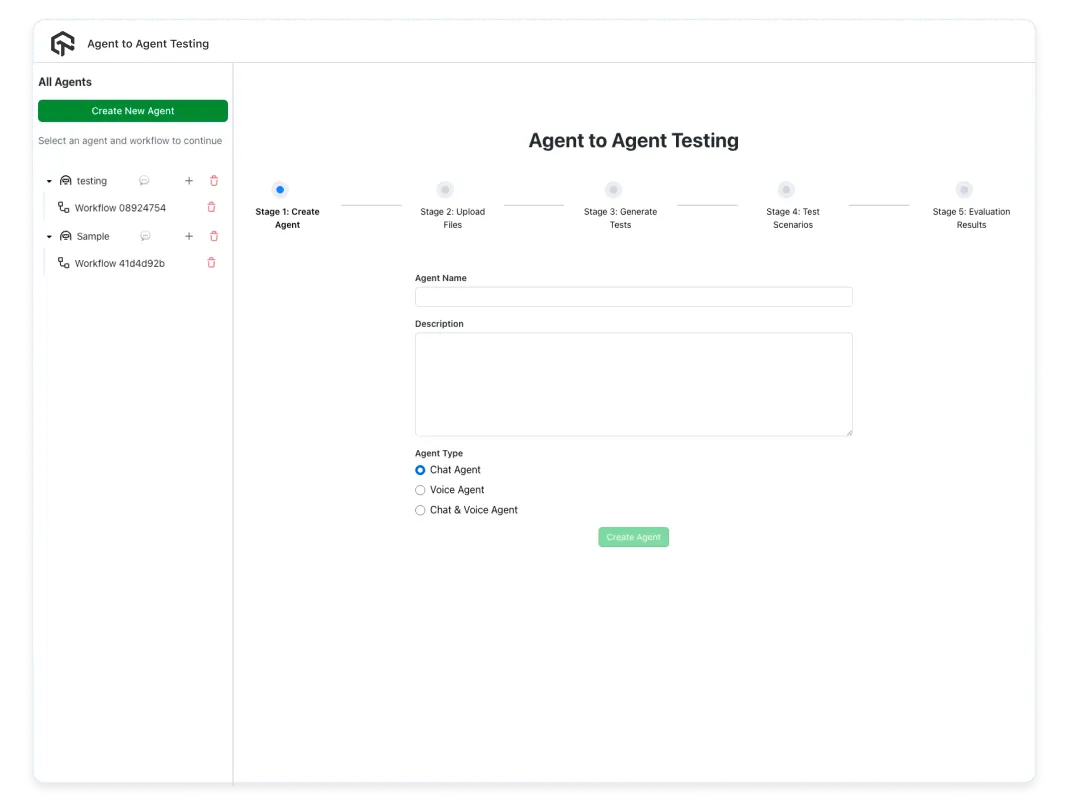
To close that gap, platforms like TestMu AI (formerly LambdaTest) provide Agent Testing, which tests chatbots, voice assistants, and calling agents for hallucination, bias, toxicity, and compliance, scoring every conversation across nine quality dimensions. The capabilities that map directly to agentic RAG failure modes:
- Autonomous scenario generation: The platform generates and runs test scenarios automatically and scores the full conversation trajectory, not just the final answer.
- Nine quality dimensions: One scoring framework covering hallucination, bias, toxicity, context awareness, and conversation flow, applied across chat, voice, and phone agents.
- Multi-modal coverage: Chat, voice, inbound and outbound phone, and image agents tested under realistic conditions that hand-written test cases never reach.
For the metric-by-metric playbook on scoring agents, read AI agent evaluation; for continuous monitoring and tracing in production, a practice increasingly called AgentOps, see AI observability and AI agent testing. To set up your first run, see the testing your first AI agent documentation.
Deliver Enterprise-Grade Quality with AI Agents

Beyond agent testing, TestMu AI offers a catalog of purpose-built AI agents, including KaneAI for test authoring, that maintain your quality layer end to end. Pairing offline RAG metrics with scenario-scale agent testing is what separates an agentic RAG demo from one that survives production.
Conclusion
Agentic RAG is not a faster RAG; it is a different architecture that trades a fixed pipeline for an adaptive loop, buying accuracy on hard queries at the price of cost, latency, and a wider failure surface. The takeaway is three decisions: a routing strategy (send simple queries to traditional RAG, hard ones to the agentic path), a framework that matches your control flow, and an evaluation layer that scores the whole trajectory.
The concrete first step is to stand up that evaluation layer before you scale: wire RAGAS-style retrieval and faithfulness metrics plus trajectory checks into CI, then validate the assistant against scenario-scale traffic with TestMu AI Agent Testing, following the testing-your-first-AI-agent guide. If the eval harness reads cleanly, the agentic design is justified; if you cannot measure the loop, you are not ready to ship it. To go deeper on the testing side, read LLM test automation.
Citations
- [1] Retrieval-Augmented Generation for Knowledge-Intensive NLP Tasks - Lewis et al. (arXiv:2005.11401)
- [2] Agentic Retrieval-Augmented Generation: A Survey on Agentic RAG - Singh et al. (arXiv:2501.09136)
- [3] Self-RAG: Learning to Retrieve, Generate, and Critique through Self-Reflection - Asai et al. (arXiv:2310.11511)
- [4] Corrective Retrieval Augmented Generation - Yan et al. (arXiv:2401.15884)
- [5] Adaptive-RAG: Learning to Adapt Retrieval-Augmented LLMs through Question Complexity - Jeong et al. (arXiv:2403.14403)
- [6] Ragas: Automated Evaluation of Retrieval Augmented Generation - Es et al. (arXiv:2309.15217)
- [7] Judging LLM-as-a-Judge with MT-Bench and Chatbot Arena - Zheng et al. (arXiv:2306.05685)
- [8] SoK: Agentic Retrieval-Augmented Generation - Taxonomy, Architectures, Evaluation, and Research Directions (arXiv:2603.07379)
- [9] 2025: The State of Generative AI in the Enterprise - Menlo Ventures
- [10] The State of AI in 2025 - McKinsey & Company
- [11] AI Index Report 2025 - Stanford HAI
- [12] Agentic AI is scaling faster than its guardrails - Deloitte
- [13] Gartner Predicts Over 40% of Agentic AI Projects Will Be Canceled by End of 2027 - Gartner
- [14] Evaluate your agent with trajectory evaluations - LangChain / LangSmith Docs
- [15] RAGAS Documentation - context precision and context recall metrics
Note: This article was researched and drafted with AI assistance, then reviewed, fact-checked, and published by Swapnil Biswas, Community Contributor at TestMu AI, whose listed expertise includes AI Testing and Generative AI. Every statistic, link, and product claim was verified against primary sources. Read our editorial process and AI use policy for details.
Author

Swapnil Biswas
Blogs: 8


Swapnil Biswas is a Product Marketing Manager at TestMu AI, leading product marketing for KaneAI and HyperExecute while orchestrating GTM campaigns and product launches. With 5+ years of experience in product marketing and growth strategy, he specializes in AI, SEO, and content marketing. Certified in Selenium, Cypress, Playwright, Appium, KaneAI, and Automation Testing, Swapnil brings hands-on expertise across web and mobile automation. He has authored 20+ technical blogs and 10+ high-ranking articles on CI/CD, API testing, and defect management, enabling 70K+ testers to improve automation maturity. His work earned him multiple awards, including Top Performer, Value of Agility, and Wall of Fame. Swapnil holds a PG Certificate in Digital Marketing & Growth Strategy from IIM Visakhapatnam and a BBA in Marketing from Amity University.


Agentic RAG FAQs
Did you find this page helpful?
More Related Blogs
TestMu AI forEnterprise
Get access to solutions built on Enterprise
grade security, privacy, & compliance
- Advanced access controls
- Advanced data retention rules
- Advanced Local Testing
- Premium Support options
- Early access to beta features
- Private Slack Channel
- Unlimited Manual Accessibility DevTools Tests