

Power Your Software Testing with AI Agents and Cloud
The Native AI-Agentic Cloud Platform to Supercharge Quality Engineering. Test Intelligently and Ship Faster.


- TestMu AI (Formerly LambdaTest)
- /
- Learning Hub
- /
- Agent Performance: Metrics, Benchmarks, and Testing AI Agents
Agent Performance: Metrics, Benchmarks, and Testing AI Agents
AI agent performance explained: the metrics that matter with their common mistakes, real industry benchmarks, and how to evaluate an AI agent before it reaches production.
Last Updated on:
On This Page
- What is agent performance?
- Which metrics matter most?
- What are good benchmarks?
- Standardized AI Benchmarks
- Execution-Level Metrics
- Common Failure Modes
- Agent-to-Agent Testing
- How is AI measured differently?
- How do you measure AI agents?
- How do you evaluate before production?
- How do you improve performance?
- Conclusion
- Citations
Agent performance is how well an AI agent resolves customer issues, scored on quality, speed, and cost. Gartner predicts that by 2029, agentic AI will resolve 80% of common customer service issues on its own, without a human.[1] This guide covers what agent performance means for AI agents, which metrics matter and the common mistake in each, real industry benchmarks, how to measure AI agents, how to evaluate one before production, and how to improve it.
Overview
To optimize AI agent performance, evaluate agents using task-completion benchmarks like τ-bench for customer service and SWE-bench for coding. Because AI agents are non-deterministic, you must run hundreds of simulated conversation scenarios scored by an AI evaluator to measure quality, speed, and cost.
- CSAT: This quality metric measures how a conversation felt, but should be paired with resolution rates since unsatisfied customers often skip surveys.
- First contact resolution (FCR): This quality metric tracks issues solved in a single contact, which directly correlates with customer satisfaction.
- First response time (FRT): This metric measures the time to an agent's first reply but must be analyzed alongside resolution metrics to prevent gaming.
- Average handle time (AHT): This speed metric tracks total conversation duration but requires context from quality metrics to be meaningful, as a password reset and billing dispute are not directly comparable.
- Containment rate: This outcome metric measures the share of conversations closed without human handoff, though it must be paired with resolution checks to ensure customers did not simply abandon the chat.
- Escalation rate: This outcome metric tracks human handoffs, where a rising rate is not always bad because clean handoffs on complex cases are better than unresolved containment.
- Cost per conversation (CPC): This cost metric divides operating costs by handled conversations to justify automation, but must be read against resolution rates to ensure cheap conversations are actually effective.
- AI-specific metrics: Intent recognition accuracy, hallucination frequency, response latency, and task completion rate measure the agent's underlying execution and reasoning capabilities rather than just customer satisfaction.
- τ-bench: This benchmark measures multi-turn task completion and policy adherence in airline and retail domains by running agents through dynamic conversations with simulated users.
- SWE-bench: This benchmark evaluates software engineering agents by checking if their generated code patches successfully resolve real GitHub issues and pass repository tests.
- GBA-Bench: This enterprise suite scores multi-step workflow completion and task execution accuracy within enterprise settings, measuring task completion over a trajectory against a ground-truth outcome.
- TestMu AI: This platform runs scripted and adversarial testing scenarios against single or chained agents, scoring trajectories and gating deployments in CI/CD pipelines.
- Scenario-based evaluation: This method runs hundreds of conversation scenarios to score agent replies for resolution, hallucination, bias, and tone, bypassing the limitations of fixed-answer testing.
What is agent performance?
Agent performance is how well an AI agent resolves customer issues. It is measured by three things: how well the agent solves the issue (quality), how fast it responds (speed), and how much it costs (cost). Quality means the issue was solved and the customer was satisfied. Speed means how long the agent took to reply. Cost means how many conversations the agent closed on its own, without sending the customer to a human.
Customer service teams have used these three metrics for years. The same three apply to an AI agent that answers chats, takes phone calls, and completes tasks on its own. One thing is different. An AI agent can be fast, polite, and wrong in the same reply. The metrics stay the same. How you measure and improve them changes.
Which agent performance metrics matter most?
AI agent performance uses the same customer service metrics teams have tracked for years, grouped into quality, speed, and cost. There are dozens of metrics, but a short list moves a release decision. For each metric below, the table gives the definition, how to read it, and the common mistake. The common mistake matters as much as the definition, because most teams track these numbers and still read them wrong.
| Metric | Dimension | How to read it and the common mistake |
|---|---|---|
| CSAT | Quality | Post-chat survey: positive responses divided by total responses. It shows how the conversation felt, not whether the issue was solved. Only some customers answer the survey, so a high score can hide the unhappy customers who never replied. |
| First contact resolution (FCR) | Quality | Issues solved in one contact divided by total contacts. It is the metric most tied to satisfaction. Common mistake: defining "solved" loosely. A conversation the customer reopens two days later was not solved, so define it by a survey or a no-reopen window. |
| Customer effort score (CES) | Quality | How hard the customer had to work to get an answer. It is the strongest predictor of loyalty. A reply that took five clarifying turns can still score badly. That is the problem CSAT misses, because the conversation can feel polite and still take too much effort. |
| First response time (FRT) | Speed | Time to the agent's first reply. It is easy to game. An instant "Let me look into that" counts as a fast first response but solves nothing, so read it next to a resolution metric. |
| Average handle time (AHT) | Speed | Total time per conversation. It has no single good number, because a password reset and a billing dispute are not comparable. It means nothing without a quality metric beside it. |
| Containment rate | Outcome | Share of conversations the AI agent closes without a human handoff. Common mistake: reading it as success. Containment counts the absence of a handoff, not a solved issue, so a customer who gives up still counts as contained. |
| Escalation rate | Outcome | Share of conversations handed off to a human. It is the inverse of containment. A rising rate is not always bad. A clean handoff on a genuinely hard case is better than a contained conversation that solved nothing. |
| Abandonment rate | Outcome | Share of customers who leave mid-conversation. It exposes what containment hides. A customer who walks away frustrated counts as contained, so abandonment is the metric that catches a flattering containment number. |
| Cost per conversation (CPC) | Cost | Total operating cost divided by conversations handled. It is the number that justifies automation. Cheap conversations that escalate or lose the customer are not cheap, so read CPC against resolution, not alone. |
Two trade-offs decide whether these numbers are honest. The first is speed against quality. Push average handle time down and the agent starts closing conversations before the issue is solved, repeat contacts go up, and FCR drops. The second is containment against resolution, which is specific to AI agents. A bot can report 85% containment while some of those conversations ended with the customer abandoning the chat. Containment on its own measures how often the agent avoided a human, not how often it helped, so pair it with a resolution check and CSAT.
Of the quality metrics, customer effort score carries the most weight. Harvard Business Review studied more than 75,000 customers and found that reducing customer effort predicts loyalty better than trying to delight the customer.[2] For an AI agent, a low-effort resolution beats a fast but painful one.
What are good agent performance benchmarks?
A metric needs a reference point. Most agent performance guides skip this, so here are sourced numbers to compare against. Use them as a starting point, then rebaseline against your own issue complexity. A technical support queue and a retail FAQ are not comparable, so the same number means different things in each.
- First contact resolution: SQM Group puts the cross-industry average at 70%, a good rate at 70% to 79%, and world-class at 80% or higher, a level only about 5% of call centers reach.[3]
- Customer satisfaction: Microsoft's Dynamics 365 team reports a roughly 78% CSAT industry average measured by post-call surveys, with world-class at 85% or higher.[4]
- Voice response latency: the production target for AI voice agents is 800 milliseconds or less, with leading agents under 500 milliseconds, because customers hang up about 40% more often when a voice agent takes longer than one second to reply.[4]
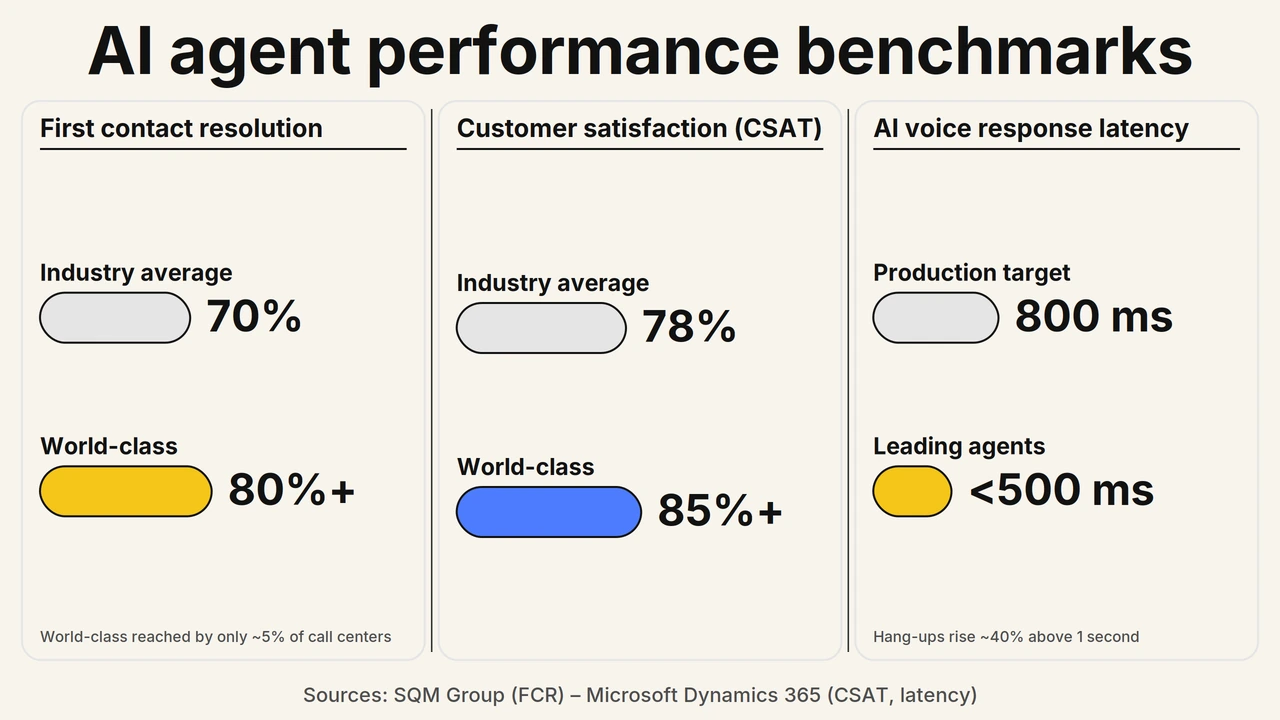
One caution on the FCR benchmark: it depends on the definition. If you count a conversation as solved even when the customer reopens it two days later, an AI agent will read about 10 points high against this number. Set what "solved in one contact" means before you trust the result.

Note: Shipping a chatbot or voice agent? Validate the chat widget across real browsers and 10,000+ real devices with TestMu AI before launch. Start testing free.
Standardized AI Agent Benchmarks: Beyond Call Center Metrics
The numbers above are call-center benchmarks. They tell you whether an agent satisfies customers, but nothing about whether its underlying reasoning is sound. A separate family of benchmarks does that, and developers building agents care about these far more than CSAT.
The key difference is what they test. A static LLM evaluation asks a model one question and grades one answer. An agent benchmark grades a whole trajectory: a multi-step task where the agent must call tools, react to results, and follow rules across many turns, which is what real agents actually do.
- τ-bench (Tau-bench): Built by Sierra for agentic customer service. It runs an agent through dynamic, multi-turn conversations with a simulated user, requiring it to use domain-specific API tools and stay within policy guidelines across airline and retail domains. It measures whether the agent completes the real task, not whether one reply sounds good.
- SWE-bench: The standard for coding agents. It gives an agent a real GitHub issue from an open-source project and checks whether its patch actually resolves the issue and passes the repository's tests, an end-to-end task rather than a code-completion prompt.
- GBA-Bench and enterprise suites: Newer benchmarks target business-process agents, scoring multi-step workflow completion in enterprise settings. The common thread across all of them is task completion over a trajectory, measured against a ground-truth outcome.
The practical takeaway: keep the two benchmark families separate. Human and call-center benchmarks (FCR, CSAT, containment) tell you if customers are happy; AI-agent benchmarks (τ-bench, SWE-bench) tell you if the agent's reasoning holds up on real tasks. A dashboard that reports only the first is measuring half the agent.
In the TestMu Conference 2026 session Beyond Benchmarks: Evaluating Agents Against What They are Actually Supposed to Do, Francesca Lazzeri picks up where public leaderboards stop, covering trace-level scoring, multi-turn and tool-use testing, LLM-as-judge calibration, and evals wired into CI rather than run once before launch.

Execution-Level Metrics: Tool Correctness and Trajectory Efficiency
Outcome metrics tell you the agent got the right answer. Execution-level metrics tell you how it got there, which is what you need to debug a failing agent, because two agents can reach the same answer through a clean two-step path or a wasteful twelve-step loop.
- Tool call accuracy (tool correctness): Of the moments the agent chose a tool, how often did it pick the right one? An agent that reaches for a search API when it should have called the refund API is failing here even if it recovers later.
- Argument correctness: Picking the right tool is half the job; passing it the right parameters is the other half. Calling the refund API with the wrong order ID is a distinct, and common, failure that tool-accuracy alone hides.
- Trajectory efficiency: The number of steps taken versus the minimum needed. Redundant steps, repeated tool calls, and loops all inflate this, and each extra step costs latency and tokens. An efficient agent reaches the goal in close to the optimal path.
- Token usage / cost: Every step consumes tokens, so trajectory efficiency and token usage move together. Two agents with identical accuracy can differ tenfold in cost, and at production volume that gap is the difference between viable and not.
None of this is visible without LLM tracing: capturing the full step-by-step record of each run (every prompt, tool call, argument, and result). Frameworks such as DeepEval and Databricks Agent Evaluation exist to score these execution-level metrics from traces. Without the trace, a failing agent is a black box; with it, you can see the exact step where the trajectory went wrong.
Common AI Agent Failure Modes to Watch For
Agents fail in recognizable patterns. Naming them makes them easier to catch in a trace, because once you have seen each one you spot it on sight in the logs.
- The Interrogation Loop: The agent asks clarifying question after clarifying question instead of acting, usually because it is under-confident or missing a tool. The user gives up before the task is done. Catch it with a cap on turns-before-first-action.
- The Ghost Action: The agent takes a real action (sends an email, updates a record) without logging or tracing it, so you cannot tell what happened or reproduce it. This is why tracing is a prerequisite, not a nice-to-have.
- The Confident Fabricator: The agent hallucinates a tool output, for example inventing an order status the API never returned, and proceeds confidently on the fake data. It is the most dangerous mode because the reply looks correct. Catch it by asserting tool outputs against ground truth, not by reading the final answer.
- The Budget Burner: The agent enters a loop, retrying or re-reasoning without progress, and consumes a massive number of tokens before anyone notices. A hard step limit and a token budget per task are the guardrails.
The Ghost Action and the Confident Fabricator share a root cause: the only evidence most teams have is the agent's own account of what it did. TestMu AI's Agent Assurance closes that gap for agents that act. It reads the agent's codebase and derives the test suite, generates functional, non-functional, and adversarial scenarios, invokes the agent for real, and grades each criterion against observed evidence such as files changed, artifacts produced, and tool calls rather than the agent's summary. Every criterion gets one of three verdicts, Pass, Fail, or Unable to Verify, and the assurance gap is reported beside the pass rate so you know how much of that pass rate was actually observed.
Note: Your agent says it worked. Prove it. Early access is opening in batches. Join the Agent Assurance waitlist
What Is Agent-to-Agent Testing in Multi-Agent Systems?
Single-agent metrics stop being enough the moment you chain agents together. In a multi-agent architecture (a supervisor agent delegating to worker agents, for example) one agent's output becomes another's input, and new failure modes appear at the seams between them.
Agent-to-agent testing focuses on the handoffs rather than the individual agents:
- Context handoff: Does the receiving agent get everything it needs? Context lost or truncated at the boundary is the most common multi-agent bug, and each agent looks fine in isolation.
- Message passing: Is the format the supervisor emits actually what the worker expects? A schema mismatch between two agents is an integration bug, tested the same way you test any contract between services.
- Cascading errors: A small error in an upstream agent (a slightly wrong extraction) compounds as it flows downstream. Testing has to trace a fault to its origin agent, not just observe the wrong final output.
This is exactly what TestMu AI Agent Testing is built for: running scripted and adversarial scenarios against agents (single or chained), scoring the trajectory, and gating on the result in CI/CD so a regression in one agent cannot silently break the chain.
How is AI agent performance measured differently from human agents?
The metrics are the same. How you measure them changes, because of two things about the model the agent runs on. First, the agent is non-deterministic, so the same question can produce different wording, and sometimes a different outcome, on each run. Second, it can fail silently, giving a fluent, well-formed answer that is wrong. A human agent does neither of these things in the same way.
Silent failure is the main difference. An AI agent will state a refund policy, a product spec, or a shipping date that does not exist, and phrase it like a correct answer. CSAT and handle time will not catch it, because the conversation looks smooth and the customer leaves satisfied. The problem appears later, when the customer acts on the wrong information. Non-determinism adds a second problem. A reply you checked yesterday can change after a prompt or model update, so a one-time check proves little. AI agents need metrics aimed at the reasoning itself, which is the same problem covered in AI agent testing.
TestMu AI builds this kind of quality coverage into a complete ecosystem of AI agents that gives engineering teams an end-to-end quality layer across enterprise applications.
Explore the TestMu AI agent ecosystem

How do you measure AI agent performance?
Microsoft's Dynamics 365 team measures AI agents across three stages every interaction passes through: understand the request, reason about the answer, and respond.[4] The metrics below map to those stages. They sit on top of the customer service metrics, not in place of them.
- Intent recognition accuracy (Understand): the share of requests the agent maps to the correct intent. For voice agents, word error rate measures transcription quality before intent is even attempted.
- Task completion rate (Reason): whether the agent finished the job, issued the refund, booked the slot, or closed the ticket, not just replied about it.
- Context retention across turns (Reason): whether the agent remembers what was said three messages ago, which is where multi-turn conversations usually break.
- Hallucination frequency (Reason): how often the agent states something false or unsupported. It is the metric most tied to trust and compliance risk.
- Bias and toxicity rate (Reason): how often the agent produces unfair, off-tone, or harmful content. It turns a model problem into a brand and compliance problem.
- Response latency (Respond): time to first response, held against the 800-millisecond bar for voice agents.
Hallucination frequency is the hardest one to measure. You cannot catch it by reading the reply, because a hallucinated answer reads like a correct one. You measure it by knowing the correct answer in advance and checking the agent against it across many runs. For an AI agent, that is why measurement and evaluation become the same task.
How do you evaluate an AI agent before production?
For an AI agent, the activity is evaluation, not testing. Testing assumes a fixed system: give the same input, expect the same output, assert on it. An AI agent is non-deterministic, so the same question can return different wording, and sometimes a different decision, on each run. You cannot assert on exact text. You evaluate instead. You score whether a response is good against set criteria, across many runs, the way you grade an open-ended answer rather than mark a multiple-choice one.
Many teams skip this and ship anyway. The failures repeat. A prompt change to fix one phrasing regresses a thousand other conversations. A hallucinated policy reaches customers because nobody knew the correct answer in advance. A bias the demo never showed appears the first time a real persona hits the agent. Spot-checking a few replies by hand does not catch any of this, because the bad runs hide among the good ones and only show up at scale.
What you evaluate. Pre-production evaluation scores each response for hallucination, bias and toxicity, completeness, context awareness, task completion, and tone, the same reasoning-level metrics from the section above. Because no two runs are identical, you score across hundreds of generated scenarios, not one. You use an AI evaluator, a second model that judges each reply against a rubric, because a human cannot read thousands of conversations and a string match cannot grade meaning. This is the evaluator-based approach used in AI agent evaluation, applied here as a pre-release gate.
How it gets gated. The scenarios, scores, and thresholds run inside CI/CD, so every prompt or model change is re-evaluated before it deploys, and a regression blocks the release instead of reaching a customer. Building this in-house means wiring up an evaluator model, a scenario generator, and a scoring rubric, then maintaining all three as the agent changes.
TestMu AI's Agent Testing platform packages this workflow, so you can evaluate an agent's real performance before launch. It scores each agent response against a standard set of quality dimensions: user satisfaction, hallucination detection, completeness, file generation accuracy, conversation flow, bias detection, response quality, context awareness, and file handling quality.
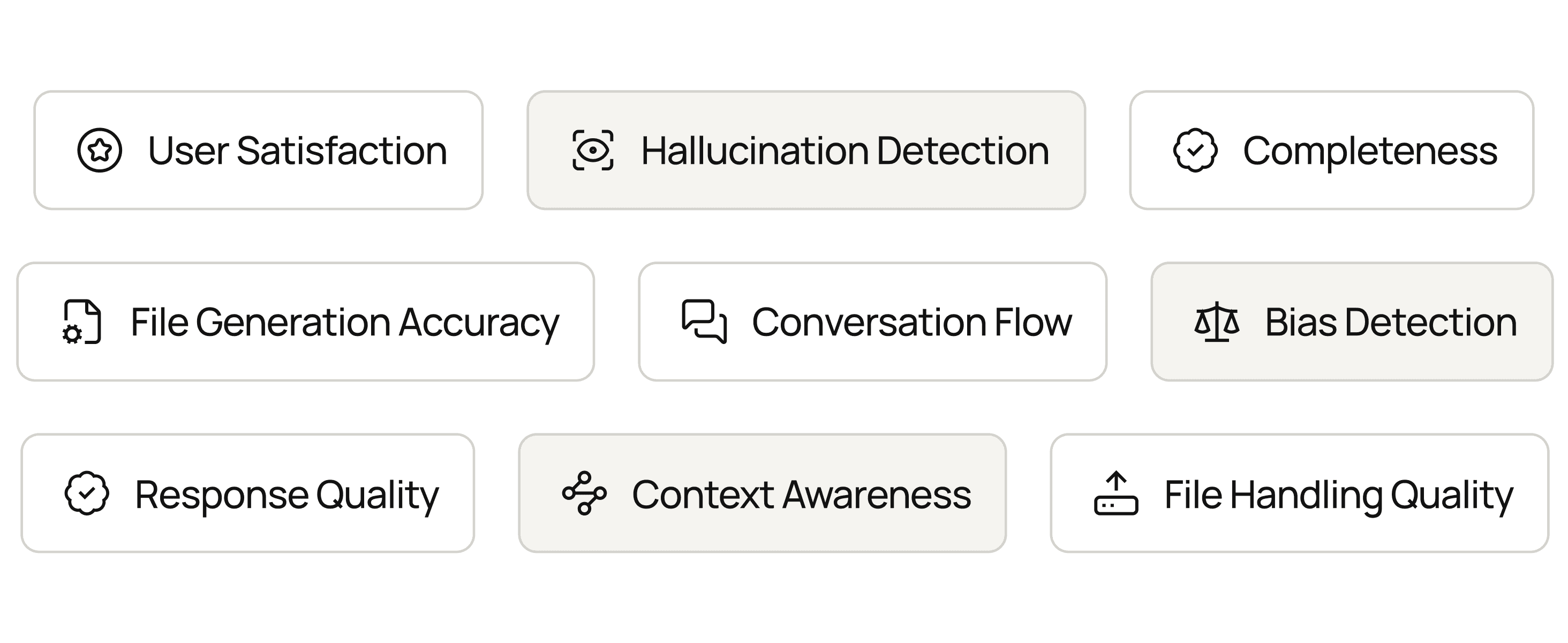
Around that scoring, the platform also adds:
- Chat, voice, and phone agents in one place: the platform evaluates customer service chatbots, voice assistants, and phone caller agents, including inbound call handling and outbound calling. You gate the same channels your customers use, not just a text transcript.
- Scenario generation from your own inputs: upload requirements, docs, audio, PDFs, or JIRA tickets, and the platform generates thousands of conversation scenarios. That volume is what makes a non-deterministic agent's failure modes show up before launch instead of after.
- Standardized scoring you can gate on: every response is scored for hallucination, bias, toxicity, completeness, and context awareness. That turns the reasoning-level metrics above into pass-or-fail numbers a release pipeline can act on.
- Voice and persona simulation: 200+ voice profiles, 50+ accents, and 15 background noise environments test a voice or phone agent against noise, accents, poor connections, and edge-case personas. A voice agent that works in a quiet demo can still fail on a noisy call.
Each capability maps to a risk that pre-production evaluation exists to catch. Channel coverage catches the voice or phone failure a chat transcript hides. Scenario volume catches the rare regression a handful of manual checks miss. Standardized scoring catches the silent hallucination. Persona simulation catches the accent or angry-customer path the demo never walked. Setup steps are in the agent testing platform documentation.
Evaluate your AI agent before production
How do you improve AI agent performance?
You do not coach an AI agent. Its behavior comes from its prompt, its grounding data, and its model. So improvement is a change to one of those, followed by re-evaluation, not a feedback conversation. Work in this order.
- Fix the prompt and knowledge base first. A low resolution rate is usually a grounding gap, where the agent has no source for the answer, or an instruction gap, where it improvises. Fix the data or the instructions before reaching for a bigger model.
- Re-evaluate the full scenario suite after every change. Because the agent is non-deterministic, a fix for one phrasing can regress ten others you cannot see by eye. Run the whole suite, not just the conversation you were debugging.
- Target effort and resolution, not just latency. Speeding up replies while the agent still makes customers repeat themselves trades a good number for a worse experience. Improve the path that solves the issue in fewer turns.
- Monitor live traffic, not just pre-release runs. Sample real conversations for hallucination, tone, and abandonment, because production surfaces phrasings and edge cases your generated scenarios missed. Feed those back into the suite.
For an AI agent that runs in a browser-based chat widget, the experience across real browsers and devices matters as much as the words. A widget that breaks the input box on iOS Safari fails the user no matter how good the model is. That is the case for running these checks on a real real device cloud rather than emulators.
Conclusion
Pick one metric from each dimension: CSAT for quality, first response time for speed, and containment rate paired with a resolution check for outcome. Baseline them against the benchmarks above. Then add the AI-specific metrics: hallucination frequency, bias, and task completion rate. A fast, friendly reply that invents a fact still fails the customer. The biggest change is moving evaluation upstream: score the agent across hundreds of scenarios before it reaches a customer, not after.
When an AI agent handles real customers, the number you report should match the performance your customers see. Evaluate the agent before launch with TestMu AI's Agent Testing platform, and run the chat widget across real browsers and devices with its automation testing cloud, so a non-deterministic agent is checked continuously instead of in production.
Citations
- Gartner. "Gartner Predicts Agentic AI Will Autonomously Resolve 80% of Common Customer Service Issues Without Human Intervention by 2029." March 2025. gartner.com
- Harvard Business Review. "Stop Trying to Delight Your Customers." July 2010. hbr.org
- SQM Group. "What Is a Good First Call Resolution Rate?" sqmgroup.com
- Microsoft Dynamics 365. "AI Agent Performance Measurement." February 2026. microsoft.com
Author

Prince Dewani
Blogs: 30

Prince Dewani is a Community Contributor at TestMu AI specializing in AI agents, software testing, QA, and SEO. He is certified in Selenium, Cypress, Playwright, Appium, Automation Testing, and KaneAI, and presented academic research on AI agents at PBCON-01. At TestMu AI, he has also carried out extensive cross-browser research on the support of modern web technologies such as WebGPU, WebAssembly, WebXR, WebGL2 and other web technologies, validating their compatibility and feature parity across major browsers and rendering engines through rigorous hands-on testing. Prince has hands-on experience building AI agent workflows using Anthropic Claude, Google Antigravity, n8n, LangChain, and other agentic frameworks, and works regularly with MCP and A2A protocols. He shares his work with 5,500+ QA engineers, developers, DevOps experts, tech leaders, and AI agent practitioners on LinkedIn.
Reviewer

Swapnil Biswas
Reviewer
Swapnil Biswas is a Product Marketing Manager at TestMu AI, leading product marketing for KaneAI and HyperExecute while orchestrating GTM campaigns and product launches. With 5+ years of experience in product marketing and growth strategy, he specializes in AI, SEO, and content marketing. Certified in Selenium, Cypress, Playwright, Appium, KaneAI, and Automation Testing, Swapnil brings hands-on expertise across web and mobile automation. He has authored 20+ technical blogs and 10+ high-ranking articles on CI/CD, API testing, and defect management, enabling 70K+ testers to improve automation maturity. His work earned him multiple awards, including Top Performer, Value of Agility, and Wall of Fame. Swapnil holds a PG Certificate in Digital Marketing & Growth Strategy from IIM Visakhapatnam and a BBA in Marketing from Amity University.


Agent Performance FAQs
Did you find this page helpful?
More Related Blogs
TestMu AI forEnterprise
Get access to solutions built on Enterprise
grade security, privacy, & compliance
- Advanced access controls
- Advanced data retention rules
- Advanced Local Testing
- Premium Support options
- Early access to beta features
- Private Slack Channel
- Unlimited Manual Accessibility DevTools Tests