

Power Your Software Testing with AI Agents and Cloud
The Native AI-Agentic Cloud Platform to Supercharge Quality Engineering. Test Intelligently and Ship Faster.


- TestMu AI (Formerly LambdaTest)
- /
- Learning Hub
- /
- Multi-Agent AI Systems: Working, Architecture, and Testing [2026]
Multi-agent AI systems use multiple specialized AI agents that coordinate through message passing to solve problems, that a single agent cannot complete on its own.
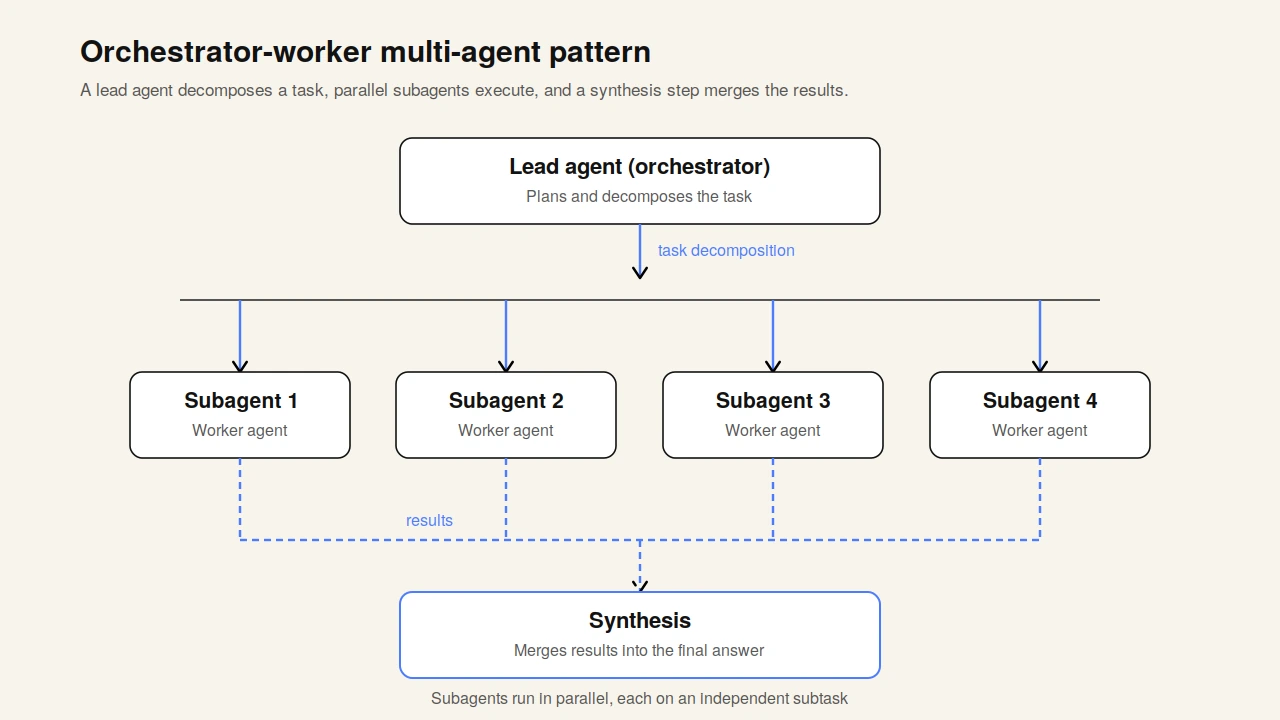
Anthropic's research shows a Claude Opus 4 lead coordinating Claude Sonnet 4 subagents outperformed a single Opus 4 baseline by 90.2%, using roughly 15x the tokens of a standard chat.[1]
This guide covers what multi-agent AI systems are, how they work, when to choose them over a single agent, the main architectures and communication protocols, the top 2026 frameworks, real use cases, Berkeley's MAST failure findings, and how to test them before production.
Overview
To solve complex tasks that exceed a single LLM's context window, deploy a multi-agent AI system using LangGraph for workflows requiring explicit state control, or CrewAI for rapid business workflow deployment. These systems coordinate specialized, autonomous agents through structured message passing to decompose, execute, and synthesize tasks.
Defining Traits of Multi-Agent Systems
- Autonomy: In a multi-agent AI system, each agent makes decisions inside its own scope without checking with a central authority on every step.
- Local view: In a multi-agent AI system, no single agent holds complete global knowledge of the task, meaning each agent reasons strictly over its own slice of context.
- Decentralized control: In a multi-agent AI system, coordination is distributed across the agents rather than concentrated in one decision point, even when a lead agent orchestrates the workflow.
- Message-passing coordination: In a multi-agent AI system, agents exchange typed messages or tool-call results through a coordinator, a message bus, or a shared workspace.
How Multi-Agent Systems Run Tasks
- Decompose: During task execution in a multi-agent AI system, a lead agent or planner breaks the primary user task into smaller, scoped subtasks.
- Dispatch: During task execution, the multi-agent AI system routes each individual subtask to the specialized agent best suited for it.
- Execute: During task execution, subagents run in parallel or sequence, calling tools, retrieving data, and producing scoped outputs. For how this is configured in one coding agent, see Claude Code subagents.
- Synthesize: During task execution, the lead agent or a synthesis step merges the subagent outputs into a single response or artifact. Claude Code Agent Teams is one shipping implementation of this pattern.
Top Multi-Agent Frameworks and Tools
- Best for state-machine orchestration: LangGraph - LangGraph is an orchestration library built on LangChain that provides built-in persistence and human-in-the-loop checkpoints for production workflows needing explicit state control.
- Best for rapid business workflows: CrewAI - CrewAI is a role-based framework that models agents as a crew with assigned roles, goals, and tools, prioritizing fast time-to-production over fine-grained control.
- Best for conversational setups: AutoGen - AutoGen is a Microsoft Research framework designed for complex multi-agent conversation setups, utilizing its v2 API as the default configuration.
- Best for OpenAI-native deployments: OpenAI Agents SDK - OpenAI Agents SDK is the production successor to Swarm, adding native sub-agents, sandboxed tool calls, and first-class Model Context Protocol support.
- Best for Claude-native deployments: Anthropic Claude Agent SDK - Anthropic Claude Agent SDK is designed for Claude-native deployments, featuring built-in tool use and memory primitives for Claude Opus or Sonnet workloads.
- Best for GCP-native deployments: Google ADK - Google ADK is an Agent Development Kit optimized for multimodal agents and Google Cloud Platform deployments with built-in Agent2Agent interoperability.
- Best for end-to-end quality assurance: TestMu AI - TestMu AI provides a full catalog of specialized AI agents to maintain your quality layer across test authoring, self-healing, orchestration, and root-cause analysis.
What Is a Multi-Agent AI System?
A multi-agent AI system is a software architecture in which two or more autonomous AI agents, each with its own role, tools, and decision-making process, coordinate through message passing to complete a task that no single agent could finish alone. Each agent runs with autonomy, a local view of the problem, and decentralized control over its own actions.
Wikipedia defines a multi-agent system as a computational system of multiple interacting intelligent agents that solves problems individual agents cannot tackle on their own. The defining characteristics are autonomy, local views, decentralization, self-organization, fault tolerance, and a shared communication protocol.[2]
A multi-agent AI system in 2026 typically composes several AI agents (planners, retrievers, coders, reviewers), each backed by an LLM, through structured tool calls, an orchestrator, and an open communication protocol such as the Model Context Protocol (MCP) or the Agent2Agent (A2A) protocol. The orchestrator layer, including the coordination patterns and how to test them, is covered in our guide to agentic AI orchestration.
How Do Multi-Agent AI Systems Work?
A multi-agent AI system works by decomposing a task into subtasks, assigning each subtask to a specialized agent, running those agents in parallel or sequence, and synthesizing the outputs into a single result. Agents share state through a coordinator, a message bus, or a shared workspace, and hand off when one agent's task completes.
Each agent in the system has four operating pieces:
- Role and instructions: A system prompt or charter that constrains what the agent reasons about (planner, researcher, coder, reviewer, compliance checker).
- Tool set: A scoped list of tools the agent is allowed to call, including retrieval, code execution, web search, database queries, and other agents.
- Memory or state: A short-term working context for the current task and, optionally, a long-term store the agent can read or write.
- Handoff contract: A structured output the agent emits so the next agent (or the orchestrator) can consume the result without parsing free-form text.
Park et al. (Stanford and Google Research) tested how memory works in their 25-agent Smallville simulation. Each agent kept a complete record of its experiences in natural language, periodically summarized those records into higher-level reflections, and retrieved the most relevant ones when making a decision.[3] Production systems use the same three-part pattern, backed by a vector store and a structured event log.
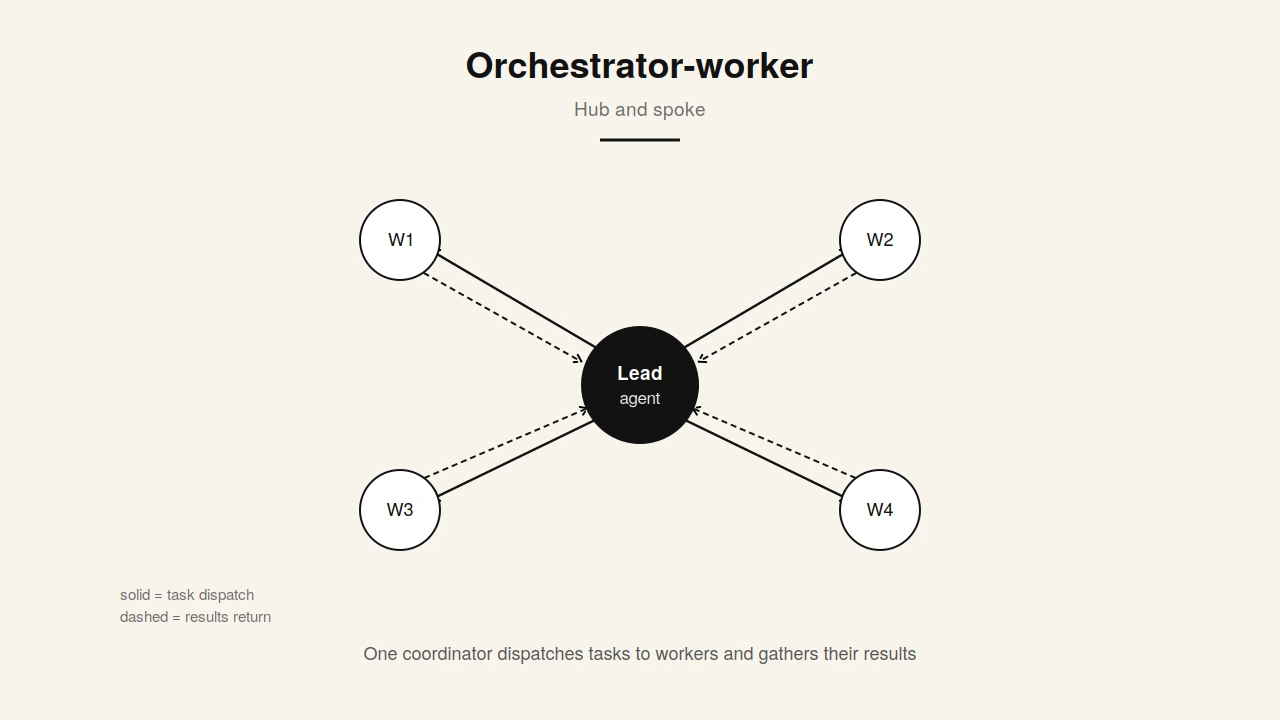
The hub-and-spoke orchestrator-worker pattern dominates 2026 production deployments because every message routes through one lead agent, which keeps the full trajectory traceable and debuggable. Decentralized swarm and peer-to-peer mesh patterns exist, but they are much harder to audit at scale.
When Should You Use Multi-Agent vs Single-Agent AI Systems?
Use a single-agent system for focused, self-contained tasks with a clear scope, such as summarizing a document or answering a question from one data source. Use a multi-agent system when a task needs parallel exploration, several specialized roles, or a workflow that exceeds one agent's context window.
| Dimension | Single-Agent | Multi-Agent |
|---|---|---|
| Token cost | Around 1x chat for a plain LLM call, up to 4x chat with tool use. | Around 15x chat in Anthropic's research-system benchmark. |
| Latency | Faster end-to-end with one model call per turn. | Higher per-turn coordination overhead, though parallel subagents can cut wall-clock time on breadth-first tasks. |
| Debugging | One trace per run, easy to replay step by step. | Distributed traces across agents; failures often hide inside the handoffs between them. |
| Best fit | Focused, scoped tasks with one clear skill (summarize, classify, answer one question). | Parallel exploration, multi-skill workflows, or context that exceeds a single agent's window. |
| Failure surface | Hallucination, wrong tool call, prompt drift. | All of the above plus coordination drift, context isolation, and runaway subagent spawning. |
| Example | A single LLM with retrieval and tool use answering one question end to end. | Anthropic's orchestrator-worker setup with Claude Opus 4 as lead and Claude Sonnet 4 subagents in parallel. |
Anthropic's separate guide on building effective agents adds the same caution: "Start with simple prompts, optimize them with comprehensive evaluation, and add multi-step agentic systems only when simpler solutions fall short."[4] A practical decision frame:
- Pick single-agent when: the task is short, the scope is narrow, latency matters more than breadth, or the workload is hot-path production where every extra token has a unit-economics cost.
- Pick multi-agent when: the task fans out into independent subtasks (breadth-first research, multi-source synthesis), specialized roles raise output quality (planner plus coder plus reviewer), or the workflow spans a window longer than one agent's context can hold.
- Avoid multi-agent when: a single, well-prompted agent with the same tools answers correctly. Adding a coordinator just to add agents is the most common waste pattern.
What Are the Main Multi-Agent System Architectures?
Five architectures are used in multi-agent AI systems in production: orchestrator-worker, hierarchical, sequential, swarm, and mesh. These describe how agents coordinate with each other; how the software they operate is shaped for them is covered in agent-native architecture.
- Orchestrator-worker (hub and spoke): A lead agent decomposes the task, dispatches subtasks to specialized worker agents, and synthesizes their outputs. Anthropic's research system uses this pattern with one Claude Opus 4 lead and three to five Claude Sonnet 4 subagents in parallel.[1] Easy to trace, easy to debug, and the dominant production pattern in 2026.
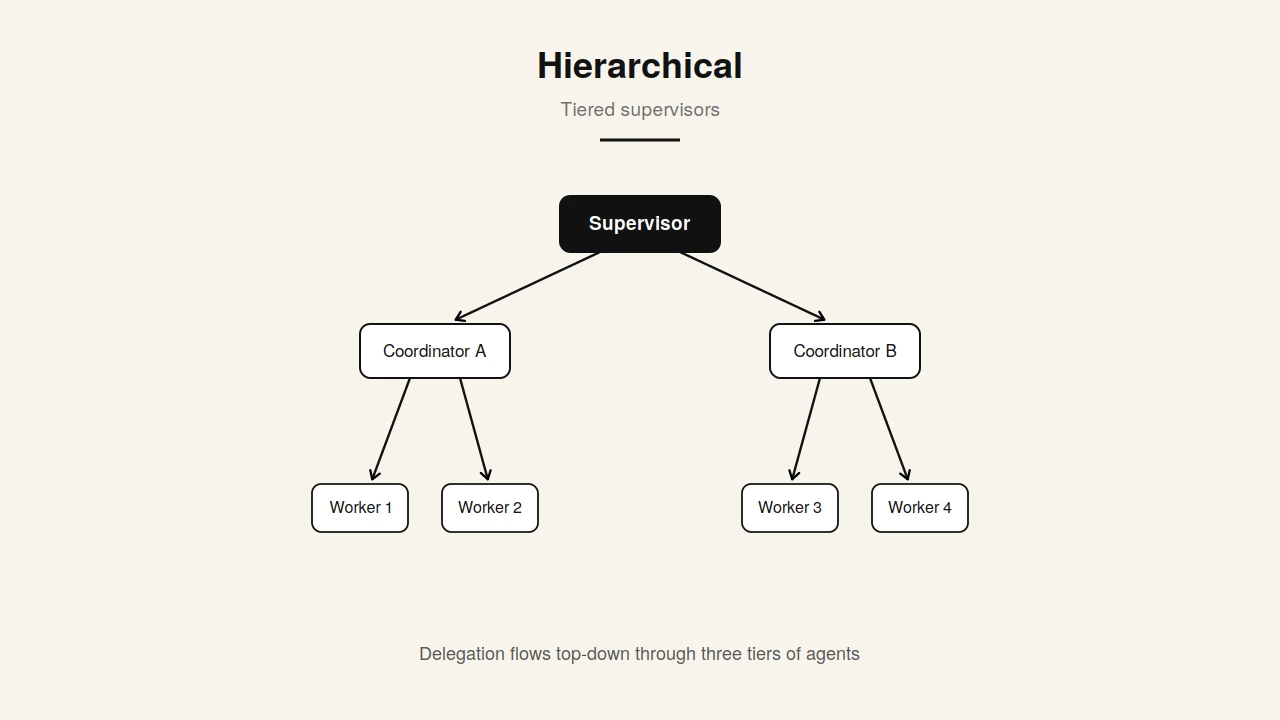
- Hierarchical (tiered supervisors): A tree of agents where each layer supervises the layer below. The top layer plans, the middle layer coordinates clusters of worker agents, and the bottom layer executes. Useful when the task itself has nested structure (a company-wide research request that fans out to teams that fan out to individuals).
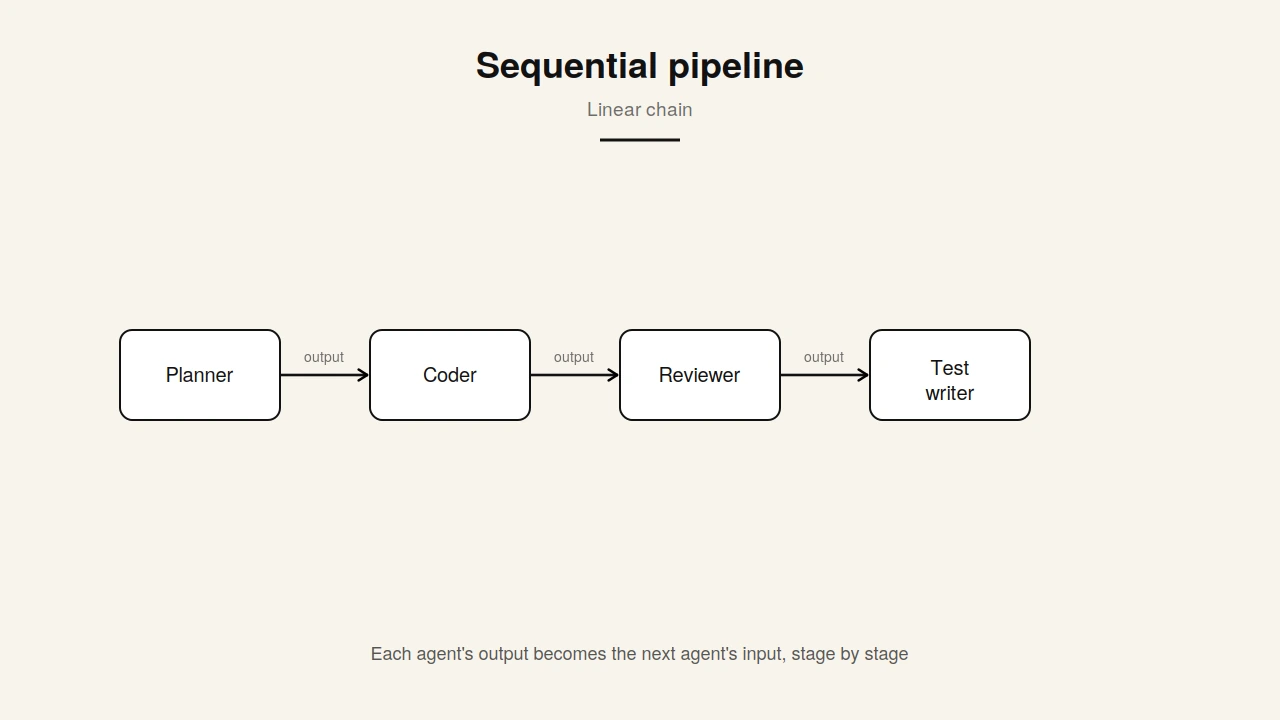
- Sequential pipeline: Agents pass output to the next agent in a fixed order. A code-generation pipeline (planner then coder then reviewer then test writer) is the canonical example. Cheap to reason about, but no parallelism and no early exit.
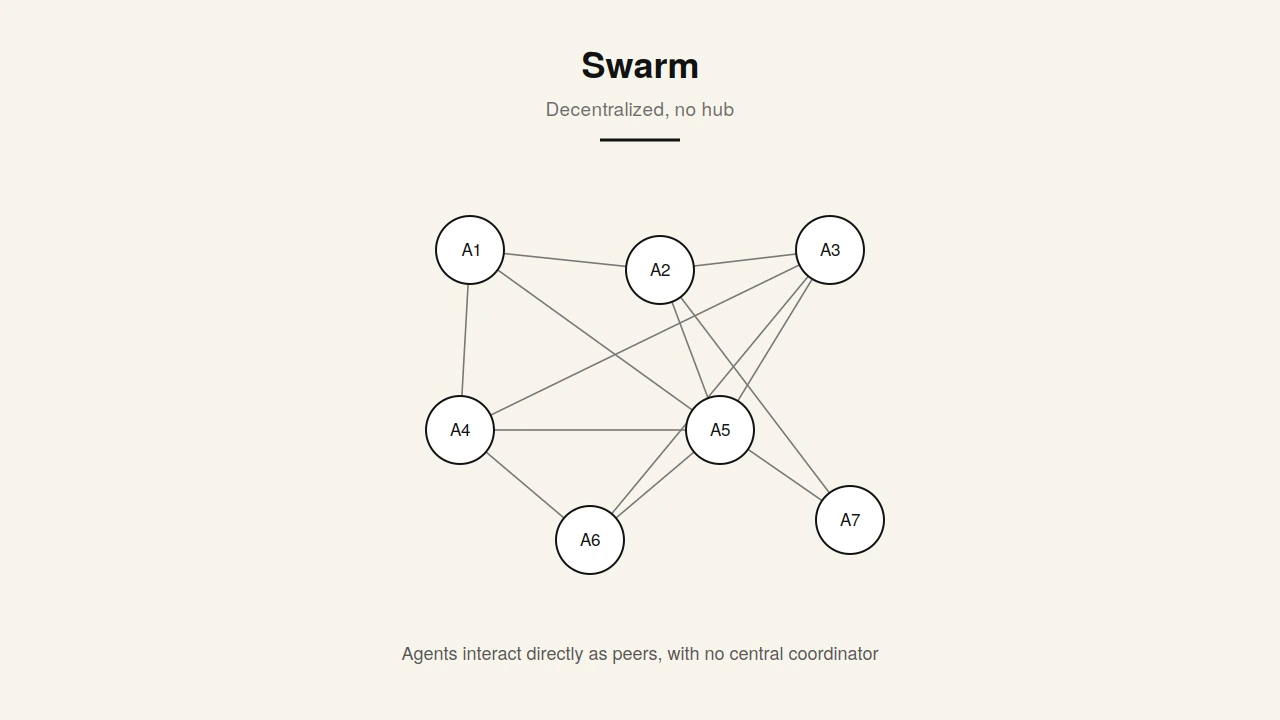
- Swarm (decentralized): Agents coordinate through emergent rules rather than a central planner. Useful for exploratory or simulation-style problems where the workflow cannot be specified in advance, but hard to audit and rarely chosen for enterprise production.
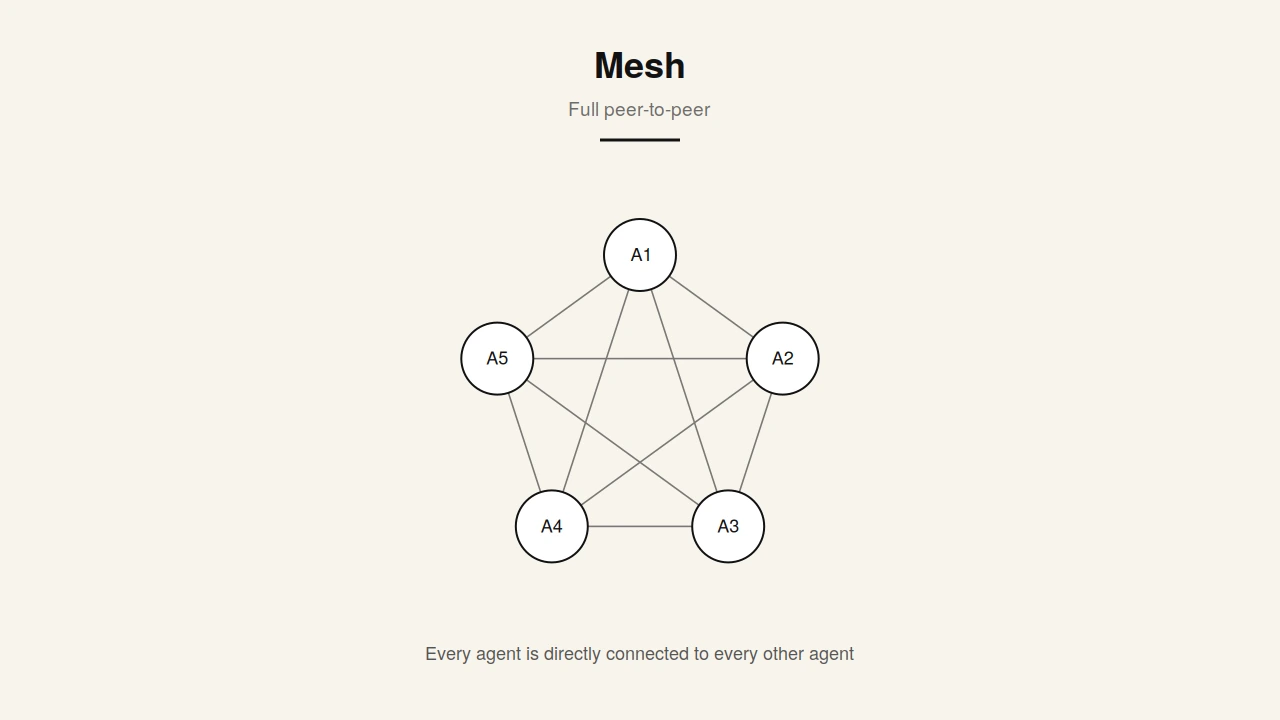
- Mesh (peer-to-peer): Agents talk directly to each other through a discovery layer, without a single coordinator. A2A is built for this case. Useful for connecting agents from different vendors, but harder to control cost and behavior than orchestrator-worker.
Start with orchestrator-worker for any new multi-agent build. Move to hierarchical only when the task tree exceeds two levels. Move to swarm or mesh only when the workflow cannot be defined in advance. Whichever shape you pick, the role split that keeps judgment out of the hands of whichever agent produced the work is covered in planner, generator, and evaluator roles in agentic AI architecture.
Communication Protocols: MCP and A2A
Multi-agent AI systems communicate through two open protocols that solve different problems. The Model Context Protocol (MCP) standardizes how an agent connects to external tools and data sources. The Agent2Agent (A2A) protocol standardizes how agents discover each other and delegate tasks across vendors.
| Dimension | MCP (Model Context Protocol) | A2A (Agent2Agent Protocol) |
|---|---|---|
| What it is | A standard for connecting an AI agent to external tools and data sources. | A standard for connecting one AI agent to other AI agents. |
| Use in a multi-agent system | The universal tool adapter every agent uses to call external tools and APIs. | The coordination layer that lets a CrewAI agent delegate work to a LangGraph agent through a standard interface. |
| Example | An agent calling a Postgres database, a Slack API, or a local file system. | A planner agent on CrewAI assigning a code-review task to a reviewer agent on LangGraph. |
| Released by / when | Anthropic, November 2024. | Google, April 2025; later moved to the Linux Foundation. |
Most production multi-agent designs use both protocols together: MCP for tool calls inside each agent, A2A for agent-to-agent communication. To know more about MCP and how it works in the agentic era, read MCP and AI agents. For how to verify an A2A implementation against the specification, see agent-to-agent protocol testing.
Top Multi-Agent AI Frameworks in 2026
Production multi-agent frameworks in 2026 fall into two groups: open-source orchestration libraries and vendor-aligned SDKs. The right pick depends on your runtime, observability stack, and target model provider.
- LangGraph: A state-machine orchestration library on top of LangChain, with built-in persistence and human-in-the-loop checkpoints. The default for production workflows that need explicit state control.
- CrewAI: A role-based framework that models agents as a "crew" with assigned roles, goals, and tools. Strongest fit for business workflows where time-to-production matters more than fine-grained control.
- AutoGen: A Microsoft Research framework for conversational multi-agent systems, with the v2 API as default. Common in research and complex multi-agent conversation setups.
- OpenAI Agents SDK: OpenAI's vendor SDK (the production successor to the experimental Swarm). Adds native sub-agents, sandboxed tool calls, and first-class MCP support.
- Anthropic Claude Agent SDK: Anthropic's SDK for Claude-native deployments, with built-in tool use and memory primitives. The default when the workload is already on Claude Opus or Sonnet.
- Google ADK: Google's Agent Development Kit, strongest for multimodal agents and GCP-native deployments, with A2A interop built in.
The architecture (orchestrator-worker, hierarchical, sequential) decides what the framework needs to do, not the other way around. Pick the pattern first, then pick the smallest framework that supports it.
Deliver Enterprise-Grade Quality with AI Agents

TestMu AI provides a full catalog of AI agents that maintain your quality layer end to end without breaking it in production. The catalog covers test authoring, self-healing, test orchestration, root-cause analysis, and more, with a dedicated agent for every stage of the testing pipeline.
Real-World Use Cases for Multi-Agent AI Systems
Multi-agent AI systems are worth the token cost in workloads that need parallelism, specialization, or long-running coordination. The use cases below appear across industries with different agent designs.
- Breadth-first research: A lead agent decomposes a research question into independent sub-queries that subagents run in parallel against the web, internal docs, and structured databases. Anthropic's research system reduced research time by up to 90% on complex queries by running three or more tools concurrently per subagent.[1]
- Customer-support triage: A routing agent classifies an inbound chat, a domain agent answers the specific question (billing, refunds, technical), and an escalation agent decides when to hand off to a human. Each agent has a narrow scope and a separate quality bar.
- Code-generation pipelines: Planner, coder, reviewer, and test-writer agents run in sequence so the planner can specify the contract, the coder writes against it, the reviewer flags violations, and the test-writer locks the contract with assertions.
- Supply-chain optimization: Supplier, logistics, and inventory agents negotiate routing and stock in real time, each owning a slice of the network. A central planner coordinates only when conflicts arise.
- Autonomous cloud ops: Monitoring agents detect anomalies, scaling agents adjust capacity, and cost-control agents bound spend. Each runs continuously and reports to a coordinator that arbitrates priorities.
- Fraud detection pipelines: Transaction-screening, pattern-matching, and risk-scoring agents run in parallel on each event, and a verdict agent merges their signals into a single decision.
Software testing follows the same specialization logic: a QA agent takes a test described in natural language, runs it across 3,000+ browser and OS combinations and 10,000+ real devices, and heals the affected steps itself when the UI shifts, so the tester spends the review on the test plan instead of on broken selectors. To explore single-agent use cases across QA, customer support, and DevOps, read AI agent use cases.
What Are the Challenges and Failure Modes in Multi-Agent AI Systems?
The dominant failure modes in multi-agent AI systems are coordination drift, context isolation, runaway subagent spawning, and token sprawl. UC Berkeley's Sky Computing Lab analyzed 200 conversation traces (averaging over 15,000 lines each) across seven popular multi-agent frameworks (MetaGPT, ChatDev, HyperAgent, OpenManus, AppWorld, Magentic, AG2) and published the Multi-Agent System Failure Taxonomy (MAST), which lists 14 failure modes the team found in real production runs.[5]
The most common patterns to watch for:
- Coordination drift: Subagents share no grounding and produce contradictory outputs, even when each agent reasons correctly on its own slice. The lead agent then synthesizes a plausible-sounding but inconsistent answer.
- Context isolation: Two agents operate on different representations of the same underlying data (different definitions, different ownership records, stale snapshots). The MAST taxonomy puts this under inter-agent misalignment, and agent handoff testing is how you catch it at the transfer boundary.
- Runaway subagent spawning: A lead agent with a vague rubric spawns far more subagents than the task needs. Anthropic's early iterations spawned 50+ subagents for simple queries before the team added rate limits.[1]
- Endless tool calls: Subagents search for non-existent sources or call tools in a loop because there is no termination condition. Adds latency and token cost without improving the answer.
- Duplicate work: Underspecified subtask descriptions cause two subagents to do the same thing and return conflicting answers, which the lead agent must then reconcile.
- Token sprawl: The 15x token premium becomes the practical blocker. Multi-agent systems pay back only when the per-task value clears the token cost, not on every workflow.
In my experience debugging multi-agent runs, teams often blame the LLM for a wrong answer when the real failure is the handoff contract between agents. A planner emits a free-form text description, the worker interprets it differently on each run, and the lead agent merges contradictory outputs into a single response. The fix is rarely a smarter model; it is a typed schema (JSON, Protobuf, or similar) that constrains how the worker reads the planner's output.
Most of these failures occur at the boundaries between agents, not inside any single agent. Each agent can pass its own unit tests while the multi-agent trajectory still fails, which is why multi-agent systems need a separate testing layer.

Note: Every failure mode above hides behind the same surface: the final answer is the lead agent's own account of what its workers did, and a confident synthesis reads the same whether the handoffs worked or not. Agent Assurance starts from that premise: it reads your codebase, derives functional, non-functional, and adversarial scenarios, invokes the system for real, and grades each criterion against observed evidence such as tool calls, files changed, and artifacts produced, reporting the share of criteria it could not verify as an explicit assurance gap beside the pass rate. Early access is opening in batches. Join the Agent Assurance waitlist
How Do You Test Multi-Agent AI Systems?
For a practitioner walkthrough of the four layers to cover and how to grade an agent on observed evidence rather than its own summary, see the guide to multi agent testing.
Traditional testing fails for multi-agent AI systems. Behavior is non-deterministic across runs, conversations drift, and failures occur in the handoffs between agents. Effective testing requires three things: evaluate each agent in isolation, validate handoffs across realistic scenarios, and trace every message in a full trajectory. Single-agent unit tests do not cover this layer, and you can test your AI agents built on frameworks like Maxim against realistic scenarios.
Three checks separate a multi-agent test layer from a single-agent one:
- Per-agent unit evaluation: Each agent is tested in isolation against ground-truth inputs and outputs, scored on hallucination, tone consistency, and tool-call correctness.
- Handoff and trajectory validation: The full multi-agent trace is replayed end to end so the test layer can flag dropped state, context loss, or contradictory outputs at agent boundaries.
- Scenario coverage at scale: Realistic personas, accents, languages, and adversarial inputs are simulated to surface failure modes the developer team did not anticipate.
To go deeper on scoring methodologies and continuous monitoring, read AI agent evaluation, and for the formula behind each number see AI agent evaluation metrics.
Beyond behavior, you can test the architecture itself. Architectural unit testing enforces the boundary and dependency contracts between agents so the codebase cannot drift from the intended design. Open-source tools do this inside a plain unit test: ArchUnit (Java) and import-linter (Python) let you assert rules like "the planner agent must not import a worker agent's internals" or "tool adapters may not depend on orchestration code," and the test fails the build when a change violates the contract.
The hardest part is testing at scale. A production multi-agent system has thousands of conversation paths, dozens of personas, and a long tail of hallucinated tool calls, leaked context, and persona breaks that appear only under realistic load. Hand-written test cases and ad-hoc prompt evaluations cannot cover this volume, and the custom evaluation harnesses teams build to address it are themselves untested.
In this TestMu Conf 2026 session, Build Your Own Benchmark: Why Agents Need Custom Evals (and How to Create Them), Haritha Sreedharan Nair explains why public leaderboard rankings do not tell you whether agents can reliably complete the real-world tasks your product promises, and how to build a custom evaluation benchmark that does.
To address these challenges, platforms like TestMu AI (formerly LambdaTest) provide Agent Testing, which uses 15+ specialized AI testing agents to validate chatbots, voicebots, and phone agents end to end across thousands of real-world scenarios. Key capabilities include:
- Multi-Agent Test Generation: 15+ specialized AI testing agents (security researchers, compliance validators, bias detectors, hallucination hunters, edge-case generators, reasoning validators) run in parallel to generate, execute, and score test scenarios across the trajectory.
- Standardized Metrics Across Channels: A unified scoring framework for chat, voice, and phone interactions covering interaction quality, hallucination detection, bias and toxicity, context awareness, and completeness, with consistent measurement across modes.
- Real-World Simulation: 200+ voice profiles, 20+ background sound environments, and diverse personas (international caller, impatient user, accessibility needs, off-script user) simulate conditions human testers cannot manually create.
To set up your first test, see the testing your first AI agent documentation.
Conclusion
Multi-agent AI systems are not a better version of single-agent systems but a different architecture with a different cost profile and failure surface. The takeaway is three concrete decisions: an architecture (orchestrator-worker is the production default), a framework (LangGraph, CrewAI, or a vendor SDK matched to the model provider), and a testing layer (per-agent evaluation plus handoff validation plus scenario coverage).
The first action is a one-page design doc that names the architecture, the framework, and how each agent and each handoff will be tested before production. If that doc reads cleanly, the multi-agent design is justified; if it reads as agents for the sake of agents, a single agent is the answer. To learn more about testing AI agents, read AI agent testing. If you are choosing an agent framework, compare a HyperAgent alternative.
Citations
- [1] How we built our multi-agent research system - Anthropic Engineering
- [2] Multi-agent system - Wikipedia
- [3] Generative Agents: Interactive Simulacra of Human Behavior - Park et al., Stanford and Google Research (arXiv:2304.03442, April 2023)
- [4] Building Effective Agents - Anthropic Engineering (December 2024)
- [5] Why Do Multi-Agent LLM Systems Fail? - Cemri et al., UC Berkeley Sky Computing Lab (arXiv:2503.13657, March 2025)
Author

Prince Dewani
Blogs: 30

Prince Dewani is a Community Contributor at TestMu AI specializing in AI agents, software testing, QA, and SEO. He is certified in Selenium, Cypress, Playwright, Appium, Automation Testing, and KaneAI, and presented academic research on AI agents at PBCON-01. At TestMu AI, he has also carried out extensive cross-browser research on the support of modern web technologies such as WebGPU, WebAssembly, WebXR, WebGL2 and other web technologies, validating their compatibility and feature parity across major browsers and rendering engines through rigorous hands-on testing. Prince has hands-on experience building AI agent workflows using Anthropic Claude, Google Antigravity, n8n, LangChain, and other agentic frameworks, and works regularly with MCP and A2A protocols. He shares his work with 5,500+ QA engineers, developers, DevOps experts, tech leaders, and AI agent practitioners on LinkedIn.
Reviewer

Sri Harsha
Reviewer
Sri Harsha is Engineering Manager of the Open Source Program Office at TestMu AI (formerly LambdaTest), where he leads open-source engineering behind the Selenium and Appium automation grid and builds agentic AI systems for quality engineering. He is a member of the Selenium Technical Leadership Committee and a committer to WebdriverIO and Appium, and was recognized with the LambdaTest Delta Award 2023 for Best Contributor in open-source testing. He brings over 10 years of experience in software testing and automation, with earlier roles at EPAM Systems and ZenQ. Sri Harsha holds a B.Tech in Computer Science from Jawaharlal Nehru Technological University.
Multi-Agent AI Systems FAQs
Did you find this page helpful?
More Related Learning Hubs
TestMu AI forEnterprise
Get access to solutions built on Enterprise
grade security, privacy, & compliance
- Advanced access controls
- Advanced data retention rules
- Advanced Local Testing
- Premium Support options
- Early access to beta features
- Private Slack Channel
- Unlimited Manual Accessibility DevTools Tests