

Power Your Software Testing with AI Agents and Cloud
The Native AI-Agentic Cloud Platform to Supercharge Quality Engineering. Test Intelligently and Ship Faster.


- TestMu AI (Formerly LambdaTest)
- /
- Blog
- /
- 9 Best LLM Agent Frameworks for 2026
9 Best LLM Agent Frameworks for 2026
Compare the 9 best LLM agent frameworks for 2026, from LangGraph and CrewAI to Google ADK, with orchestration models, licenses, and how to test what you build.
Last Updated on:
You wire an LLM to a few tools, and the demo works. Then you hand it a real request: look something up, decide what to do next, call the right tool, and recover when a step fails. The single prompt that nailed the demo now loops, forgets context, or calls the wrong tool. That gap, between a clever prompt and a system that acts reliably, is what an LLM agent framework is built to close.
An LLM agent framework is a library that gives a large language model the scaffolding to plan, call tools, keep state, and coordinate other agents, so it can finish multi-step tasks instead of answering one prompt at a time. The need is no longer theoretical. In LangChain's State of AI Agents survey of 1,340 practitioners, run from November 18 to December 2, 2025, 57.3% said they already run agents in production, with another 30.4% building toward it.[1] The framework is only half the stack; the other half is the model it drives, so compare the best agentic AI LLM models before you commit.
This guide compares the 9 best LLM agent frameworks for 2026, what each one is good at, their orchestration model, language, and license, a side-by-side table, and the step most roundups skip: how to test the agents you build before they reach users.
Overview
To build reliable AI agents in 2026, use LangGraph for fine-grained control over stateful production workflows, or choose CrewAI for rapidly prototyping role-based multi-agent systems. These frameworks provide the necessary scaffolding to plan, call tools, and coordinate tasks.
Best LLM Agent Frameworks for 2026
- Best for controllable production workflows: LangGraph - This framework uses a graph-based orchestration model with conditional edges and durable state to give teams fine-grained control, auditability, and rollback points in Python and JavaScript.
- Best for fast role-based prototypes: CrewAI - This framework provides a high-level Python environment to assemble agents with defined roles and tasks into sequential or hierarchical crews, making it the fastest path to multi-agent prototypes.
- Best for enterprise Microsoft and Azure stacks: Microsoft Agent Framework - This successor to AutoGen and Semantic Kernel offers graph-based workflows, session-based state, and native Azure AI Foundry integration for Python and .NET.
- Best for lightweight, OpenAI-native agents: OpenAI Agents SDK - This minimal Python and JavaScript SDK is built on agent-to-agent handoffs, guardrails, and built-in tracing for teams building primarily on OpenAI models.
- Best for data-heavy and RAG-first agents: LlamaIndex - This framework leverages its strong data connectors, indexing, and event-driven AgentWorkflow tooling to help agents reason over private documents, databases, and knowledge bases.
- Best for typed, structured outputs: Pydantic AI - This model-agnostic Python framework brings type safety and schema-validated responses to ensure agent outputs are predictable and structured for your codebase.
- Best for Google Cloud and Gemini stacks: Google ADK - This open-source, code-first toolkit in Python and Java provides built-in evaluation and deployment to Vertex AI Agent Engine.
- Best for minimal, code-first agents: smolagents - This minimal Hugging Face library under a thousand lines of code allows agents to write their actions as Python snippets executed in a secure sandbox.
- Best for high-performance, multi-modal agents: Agno - This framework supports text, image, audio, and video inputs with low instantiation overhead, making it ideal for high-throughput, multi-modal agents and multi-agent workflows.
Do you need a framework to build an agent?
- When to use a framework: You do not need a framework for simple patterns against raw APIs, but you should adopt one once you require durable state, multi-agent handoffs, streaming, and observability.
How do you make sure the agent actually works?
- How to test your agents: Because agents are non-deterministic, you must evaluate them across many scenarios. The Agent Testing platform from TestMu AI runs autonomous evaluators to check for hallucinations, bias, and broken tool calls.
What is an LLM agent framework?
An LLM agent framework is a software library that turns a language model from something that answers into something that acts. It supplies the parts you would otherwise hand-build: a planning or reasoning loop, a way to call tools and APIs, memory and state that persist across steps, and orchestration when several agents need to work together.
Anthropic draws a useful line between two things these libraries build. Workflows are systems where LLMs and tools follow predefined code paths. Agents are systems where the LLM dynamically directs its own process and tool usage, keeping control over how it accomplishes a task.[2] Most frameworks in this list can build both, and the better ones let you mix them.
Under the hood, almost every framework wires up the same loop: the model reads a goal, decides on an action, calls a tool, reads the result, and repeats until the task is done. What separates them is how much control they hand you over that loop, how they manage state, and how they coordinate multiple agents. For the broader landscape, see our guide to agentic AI frameworks and the fundamentals of AI agents.
What to look for in an LLM agent framework
Before the list, here is the checklist that actually decides the choice. Score each framework against these, not against star counts, because a framework that fits your stack and control needs beats a more popular one that does not.
- Orchestration model: Graph, role-based crew, or conversational handoffs. This shapes how you reason about and debug the agent more than any other choice.
- Control vs. abstraction: Low-level libraries give you explicit control over every step; high-level ones get you running in a few lines but hide the loop. Pick the level your task needs.
- State and memory: Does it persist conversation history, checkpoints, and long-running state, or reset every run? Production agents need durable state.
- Multi-agent support: Whether the framework can coordinate specialized agents that hand off work, and how explicit that coordination is.
- Tool and MCP integration: How easily it connects to tools, functions, and Model Context Protocol servers, and how many integrations ship out of the box.
- Model flexibility: Model-agnostic frameworks let you swap or mix providers; vendor SDKs are tuned for one stack and trade flexibility for a smoother path.
- Observability: Built-in tracing, streaming, and human-in-the-loop hooks decide whether you can see what the agent did when it goes wrong.
- Language and license: Python is universal, but .NET, Java, or TypeScript support may be non-negotiable. Confirm the open-source license fits your use.
9 best LLM agent frameworks for 2026
Each framework below is open source, actively maintained, and used in real deployments. GitHub star counts are as of June 2026 and signal community size, not quality, so read them alongside the orchestration model and the "best for" line.
1. LangGraph
LangGraph, from the LangChain team, models an agent as a graph of nodes and edges with explicit shared state. Instead of a black-box loop, you define exactly which step runs next, where the agent can branch, and where it pauses for a human. That control is why it shows up most often in production-grade, stateful agents (~35,000 GitHub stars, MIT license).
- Orchestration: Directed graph with conditional edges, durable state, and checkpoints.
- Standout features: Time-travel debugging, human-in-the-loop pauses, and persistence for long-running agents.
- Languages: Python and JavaScript/TypeScript.
- Best for: Teams that need fine-grained control, auditability, and rollback points in a production workflow.
- Consider: The graph model has a steeper learning curve than role-based abstractions.
2. CrewAI
CrewAI is a standalone, lean framework built around a simple mental model: you define agents with roles and goals, give them tasks, and assemble them into a crew that runs sequentially or in parallel. It is the fastest path from idea to a working multi-agent prototype when work splits cleanly into roles like researcher, writer, and reviewer (~54,000 GitHub stars, MIT license).
- Orchestration: Role-based crews with sequential and hierarchical process types.
- Standout features: Readable role and task abstractions, plus a separate Flows API for more deterministic control.
- Languages: Python.
- Best for: Quick, role-decomposed multi-agent workflows and teams that want the lowest barrier to entry.
- Consider: The high-level abstractions can hide details you eventually need for tight production control.
3. Microsoft Agent Framework
The Microsoft Agent Framework is the direct successor to both AutoGen and Semantic Kernel, created by the same teams and combining AutoGen's simple agent abstractions with Semantic Kernel's enterprise features.[3] It adds graph-based workflows for explicit multi-agent orchestration on top of single-agent building blocks (~11,000 GitHub stars, MIT license).
- Orchestration: Individual agents plus graph-based workflows with type-safe routing and checkpointing.
- Standout features: Session-based state, middleware, telemetry, and native Azure AI Foundry integration.
- Languages: Python and .NET (C#).
- Best for: Enterprises on the Microsoft and Azure stack, and teams migrating off AutoGen or Semantic Kernel.
- Consider: It is newer than the projects it replaces, so some patterns are still settling.
4. OpenAI Agents SDK
The OpenAI Agents SDK is the production-ready successor to OpenAI's experimental Swarm project. It keeps a small surface area built on four primitives, agents, handoffs, guardrails, and tracing, so OpenAI-native teams can stand up a multi-agent app without much ceremony (~27,000 GitHub stars, MIT license).
- Orchestration: Explicit agent-to-agent handoffs with input and output guardrails.
- Standout features: Built-in tracing, sessions, hosted tools, and a lightweight, few-abstractions design.
- Languages: Python and JavaScript/TypeScript.
- Best for: Teams building primarily on OpenAI models who want an official, minimal SDK.
- Consider: It is tuned for the OpenAI stack, so it is less of a fit if you need broad provider flexibility.
5. LlamaIndex
LlamaIndex started as a data framework for retrieval-augmented generation and grew agent capabilities on top of that strength. If your agent's job is to reason over private documents, databases, and knowledge bases, its indexing, retrieval, and AgentWorkflow tooling is hard to beat (~50,000 GitHub stars, MIT license).
- Orchestration: Event-driven AgentWorkflow with single and multi-agent patterns over indexed data.
- Standout features: Best-in-class data connectors, indexing, and retrieval for grounded answers.
- Languages: Python and TypeScript.
- Best for: Data-heavy and RAG-first agents that must cite or reason over a corpus.
- Consider: Its agent layer is one part of a large framework, so there is a lot of surface to learn.
6. Pydantic AI
Pydantic AI, from the team behind Pydantic, brings the type-safety mindset that powers much of the Python AI ecosystem to agents. It is model-agnostic and leans on validated, structured outputs, so the agent's responses fit a schema your code can trust (~18,000 GitHub stars, MIT license).
- Orchestration: Type-safe agents with structured outputs, tools, and dependency injection.
- Standout features: Schema-validated responses, model-agnostic design, and a familiar feel for Python developers.
- Languages: Python.
- Best for: Teams that want predictable, typed outputs and a lightweight, Pythonic agent layer.
- Consider: It is younger than the largest frameworks, so its ecosystem of integrations is still growing.
7. Google ADK
The Google Agent Development Kit (ADK) is an open-source, code-first toolkit for building, evaluating, and deploying agents. It is optimized for Gemini and the Google Cloud stack but stays model-agnostic, and it ships built-in evaluation and deployment paths that many lighter frameworks leave to you (~20,000 GitHub stars, Apache 2.0 license).
- Orchestration: Composable workflow agents and LLM-driven agents with multi-agent hierarchies.
- Standout features: Built-in evaluation, a developer UI, and deployment to Google Cloud and Vertex AI Agent Engine.
- Languages: Python and Java.
- Best for: Teams on the Google Cloud and Gemini stack that want an opinionated, end-to-end kit.
- Consider: It is most comfortable inside the Google ecosystem, even though it runs elsewhere.
8. smolagents
smolagents, from Hugging Face, is a deliberately minimal library whose core is under a thousand lines of code. Its signature idea is the code agent: instead of emitting JSON tool calls, the agent writes its actions as Python snippets, which makes loops, conditionals, and tool composition natural.[4] Actions run in a sandbox (~28,000 GitHub stars, Apache 2.0 license).
- Orchestration: Code agents that write actions as Python, with a classic tool-calling agent as an alternative.
- Standout features: Tiny core, sandboxed execution, and tight Hugging Face Hub integration.
- Languages: Python.
- Best for: Developers who want a minimal, hackable framework and the flexibility of code-based actions.
- Consider: Running model-written code demands a proper sandbox, which the library supports but you must configure.
9. Agno
Agno (formerly Phidata) focuses on performance and multi-modality. It builds agents that work with text, image, audio, and video, plugs into a wide range of models and vector stores, and ships memory and knowledge primitives, with an emphasis on low instantiation overhead at scale (~41,000 GitHub stars, Apache 2.0 license).
- Orchestration: Single agents, teams, and multi-agent workflows with built-in memory and knowledge.
- Standout features: Multi-modal support, broad model and vector-store coverage, and a focus on runtime performance.
- Languages: Python.
- Best for: High-throughput and multi-modal agents that need to spin up quickly at scale.
- Consider: The rename from Phidata means some older tutorials and references still use the previous name.

LLM agent frameworks compared
Use this table to shortlist by orchestration model, language, and license, then read the relevant sections above. Star counts are from GitHub as of June 2026 and are rounded.
| Framework | Orchestration model | Language | License | Stars (Jun 2026) | Best for |
|---|---|---|---|---|---|
| LangGraph | Stateful graph | Python, JS/TS | MIT | ~35K | Controllable production workflows |
| CrewAI | Role-based crews | Python | MIT | ~54K | Fast role-based prototypes |
| Microsoft Agent Framework | Agents + graph workflows | Python, .NET | MIT | ~11K | Enterprise Microsoft and Azure stacks |
| OpenAI Agents SDK | Handoffs + guardrails | Python, JS/TS | MIT | ~27K | OpenAI-native, lightweight agents |
| LlamaIndex | AgentWorkflow over data | Python, TS | MIT | ~50K | Data-heavy and RAG-first agents |
| Pydantic AI | Type-safe, model-agnostic | Python | MIT | ~18K | Typed, structured outputs |
| Google ADK | Workflow + LLM agents | Python, Java | Apache 2.0 | ~20K | Google Cloud and Gemini stack |
| smolagents | Code agents (Python actions) | Python | Apache 2.0 | ~28K | Minimal, code-first agents |
| Agno | Teams + multi-agent workflows | Python | Apache 2.0 | ~41K | High-performance, multi-modal agents |
How to test the LLM agents you build
Every framework above helps you build an agent. None of them tells you whether the agent is safe to ship. That is the gap, because an agent is non-deterministic: the same question can produce different wording, a different tool call, or a confident answer that is wrong, on each run. A single passing demo proves almost nothing.
So you do not test an agent the way you test a function with one expected output. You evaluate it: run it across many scenarios and personas, then score each run for the things that actually break in production.
- Task completion: Did the agent reach the correct end state, not just produce fluent text?
- Hallucinations: Did it invent facts, tools, or steps that do not exist?
- Tool and handoff correctness: Did it call the right tool with the right arguments, and recover when one failed?
- Bias, toxicity, and tone: Did it stay safe and on-brand across adversarial and edge-case inputs?
- Consistency: Does it behave the same way across repeated runs of the same scenario?
Running thousands of those scenarios by hand is where teams stall. TestMu AI's Agent Testing platform automates it: it deploys autonomous AI evaluators that generate and run thousands of scenarios against your chatbot, voice, or LLM agent, then score each interaction for hallucinations, bias, toxicity, completeness, and context awareness. It tests across 200+ voice profiles and diverse personas, and plugs into CI/CD so every change is validated before release. The Testing Your First AI Agent docs walk through the first run end to end.
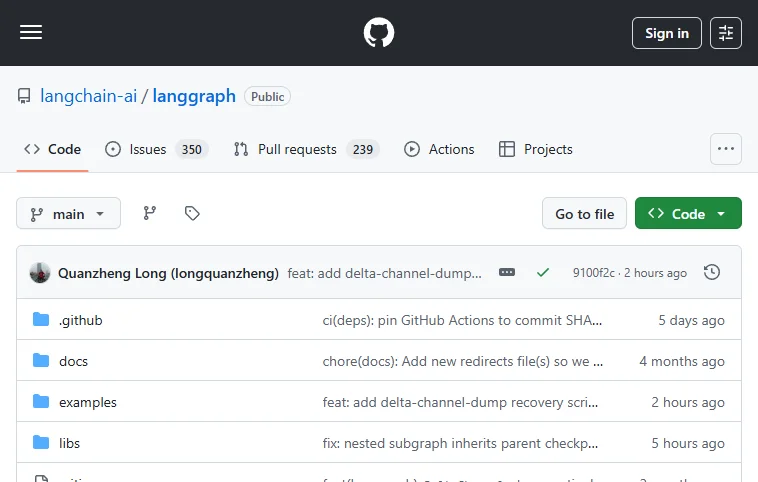
Many of these agents also need to act on the live web, scraping a page, filling a form, navigating a dashboard, and a raw HTTP fetch returns an empty shell for JavaScript-heavy sites. TestMu AI's Browser Cloud gives agents real Chrome sessions on demand with session persistence, a built-in tunnel to local and internal environments, and full session video, console, and network logs. I captured the screenshot below by running a live Browser Cloud session against the LangGraph repository, the same infrastructure an agent would use to read a real page.

Note: Shipping an agent built with one of these frameworks? Validate it before your users do. TestMu AI Agent Testing runs autonomous evaluators against your agent for hallucinations, bias, broken tool calls, and off-script behavior across thousands of scenarios. Start testing your agents free
Which LLM agent framework should you use?
Start from your dominant constraint, not the leaderboard. Map your situation to the framework that fits it, then validate the agent the same way regardless of which you pick.
- You need control and auditability: Choose LangGraph for explicit, stateful graphs with rollback points.
- You want a multi-agent prototype fast: Choose CrewAI for role-and-task crews with the lowest barrier to entry.
- You are on the Microsoft or Azure stack: Choose the Microsoft Agent Framework, especially if you are migrating from AutoGen or Semantic Kernel.
- You build on OpenAI models: Choose the OpenAI Agents SDK for an official, lightweight, OpenAI-native path.
- Your agent reasons over private data: Choose LlamaIndex for its retrieval and indexing strength.
- You need typed, predictable outputs: Choose Pydantic AI for schema-validated, model-agnostic agents.
- You are on Google Cloud and Gemini: Choose Google ADK for an end-to-end, code-first kit with built-in evaluation.
- You want minimal and hackable: Choose smolagents for a tiny core and code-based actions.
- You need multi-modal at scale: Choose Agno for performance-focused, multi-modal agents.
For agents that coordinate several specialists, also read how multi-agent AI systems are structured and tested before you commit to one orchestration model.
Conclusion
Pick one framework that matches your main constraint, build the smallest agent that does a real task, then put it under evaluation before you scale. LangGraph and the Microsoft Agent Framework reward control; CrewAI and the OpenAI Agents SDK reward speed; LlamaIndex, Pydantic AI, Google ADK, smolagents, and Agno each win on a specific axis.
Whichever you choose, the agent still has to behave on inputs you did not script. Run it through TestMu AI's Agent Testing platform to catch hallucinations and broken tool calls before users do, and if you also want AI to author and maintain your end-to-end tests, start with KaneAI. The Testing Your First AI Agent guide is the fastest way to see it on your own agent.
Note: AI assistance was used in researching and drafting this article. Prince Dewani, Community Contributor at TestMu AI, who builds AI agent workflows and specializes in automation testing, verified every statistic, framework detail, and product claim against primary sources before publication, following our editorial process and AI use policy.
Author

Prince Dewani
Blogs: 28

Prince Dewani is a Community Contributor at TestMu AI specializing in AI agents, software testing, QA, and SEO. He is certified in Selenium, Cypress, Playwright, Appium, Automation Testing, and KaneAI, and presented academic research on AI agents at PBCON-01. At TestMu AI, he has also carried out extensive cross-browser research on the support of modern web technologies such as WebGPU, WebAssembly, WebXR, WebGL2 and other web technologies, validating their compatibility and feature parity across major browsers and rendering engines through rigorous hands-on testing. Prince has hands-on experience building AI agent workflows using Anthropic Claude, Google Antigravity, n8n, LangChain, and other agentic frameworks, and works regularly with MCP and A2A protocols. He shares his work with 5,500+ QA engineers, developers, DevOps experts, tech leaders, and AI agent practitioners on LinkedIn.


LLM Agent Frameworks FAQs
Did you find this page helpful?
More Related Blogs
TestMu AI forEnterprise
Get access to solutions built on Enterprise
grade security, privacy, & compliance
- Advanced access controls
- Advanced data retention rules
- Advanced Local Testing
- Premium Support options
- Early access to beta features
- Private Slack Channel
- Unlimited Manual Accessibility DevTools Tests