

Power Your Software Testing with AI Agents and Cloud
The Native AI-Agentic Cloud Platform to Supercharge Quality Engineering. Test Intelligently and Ship Faster.


- TestMu AI (Formerly LambdaTest)
- /
- Learning Hub
- /
- What Are AI Agents? Components, Types and Examples
What Are AI Agents? Components, Types and Examples
Explore AI agents - their benefits, core components, how they work, different types, and common challenges with real-world examples.
Last Updated on:
AI agents are systems that autonomously perform tasks on behalf of a user or another system. It leverages artificial intelligence to analyze data, make decisions, and take actions based on environment with minimal or no human intervention. These AI agents can also learn and adapt over time to improve their performance.
Overview
AI agents are autonomous software systems that perceive their environment, make decisions, and execute actions to achieve specific goals. For open-ended tasks, the ReAct paradigm provides flexible, step-by-step reasoning, while the ReWOO paradigm is best for predictable, high-volume workflows where minimizing token cost is critical.
Components of AI Agents
- Perception: This component collects and processes raw data from the environment using sensors, cameras, or APIs to understand context.
- Memory: This component stores static knowledge and learned experiences, often using vector databases to retrieve relevant past context.
- Planning and Reasoning: This component analyzes data from perception and memory to make decisions and plan the most effective actions.
- Action: This component executes decisions by interacting with the environment, such as calling APIs, running code, or sending responses.
- Adaptation: This component learns from feedback and past actions to continuously refine strategies and improve efficiency over time.
Workflow of AI Agents
- Set a Clear Objective: Define a specific goal, task, or target for the AI agent to complete without human intervention.
- Gather Contextual Data: Collect relevant input data from the environment, users, sensors, or external APIs to understand the task.
- Interpret Inputs: Use AI techniques like natural language processing to understand the intent and context behind the user's request.
- Plan a Strategy: Analyze the gathered data to determine the most effective sequence of actions to achieve the desired outcome.
- Perform Actions: Execute the planned steps autonomously using tools, APIs, or code execution to complete the defined goal.
- Measure Outcomes: Evaluate the success of the completed task based on system feedback, logs, and user responses to learn from results.
- Refine and Improve: Adjust strategies based on feedback to continuously enhance the agent's performance and decision-making in future tasks.
What Are AI Agents?
AI agents are a software system that performs tasks autonomously on behalf of the user. They do so by planning, reasoning, and interacting with external tools, APIs, and environments. AI agents make use of memory, contextual understanding, and adaptive strategies to manage diverse workflows efficiently.
Built on Large Language Models (LLMs), AI agents can understand natural language and handle different input types, including code, image, audio, and structured data, to make informed decisions. They constantly evaluate information through feedback loops, select the best actions, access external resources, and improve over time.
Benefits of AI Agents
AI agents offer some key benefits that go beyond simple automation. Here’s how they’re reshaping customer interactions and business processes:
- Maximize Operational Speed: AI agents can work concurrently when deployed on scalable infrastructure, enabling them to process multiple tasks in parallel without human delays. This not only maximizes speed but also ensures that businesses can meet customer demands without compromising quality.
- Smarter Decision-Making: AI agents process large amounts of data and extract valuable insights that would be impossible for human teams to identify manually. These insights empower businesses to make data-driven decisions in real-time, responding to emerging trends and market shifts faster than ever before.
- Greater Scalability: As business demands increase, so does the workload. AI agents scale effortlessly to handle larger volumes of customer interactions. So, be it a sudden surge in requests or steady long-term growth, AI agents can adapt, maintaining high-quality service across all levels of demand.
- Get Actionable Insights: Every interaction with an AI agent generates valuable data. By analyzing this data, businesses can uncover trends and behaviors that help shape their strategy. Whether it’s optimizing customer service or refining product offerings, AI-driven insights fuel smarter business decisions that align with customer needs.
- Personalize Customer Experiences: AI agents aren't just reactive; they can predict needs. They continuously learn from past interactions and tailor responses to each customer, creating a more personalized experience. Over time, this learning process allows AI agents to offer solutions that feel more intuitive and relevant, enhancing overall customer satisfaction.

Note: Plan, author, and evolve tests in natural language with TestMu AI KaneAI. Try KaneAI free!
Core Components of AI Agents
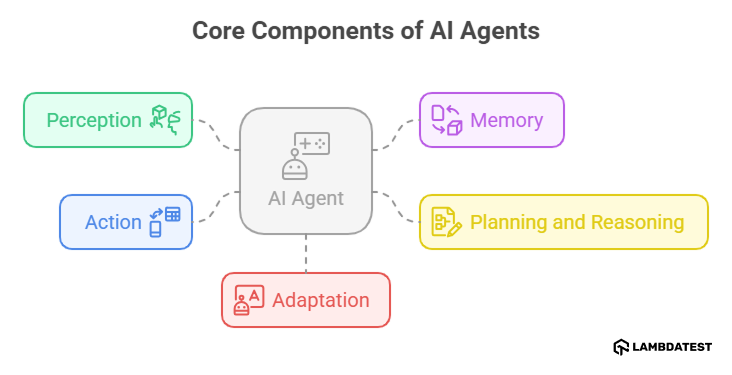
There are different building blocks that make up an AI agent. They represent the essential components (or modules) the agent needs to function. Each component handles a specific task and, when combined, they enable the agent to perceive, reason, act, and adapt.
- Perception: This component enables the AI agent to collect and process data from its environment. The agent uses various ways to gather data, such as cameras, microphones, sensors, or APIs. It processes this raw input to understand its environment and the context of its tasks.
- Memory: This is where the AI agent stores essential information, including facts, rules, and learned experiences. In modern LLM-based agents, long-term memory is typically implemented with vector databases: text is converted into embeddings and retrieved by semantic search, so the agent recalls the most relevant past context (a technique known as retrieval-augmented generation). Short-term memory holds the running conversation, while this persistent layer combines static knowledge with learned experience across sessions.
- Planning and Reasoning: This component uses the data from Perception and Memory to make decisions and plan actions. It analyzes the information, considers possible results, and determines the most effective way to achieve the agent's goals.
- Action: Once the Planning and Reasoning component has decided on a course of action, the Action component executes these decisions by interacting with the environment. For instance, if you want to send a response, the agent performs the required action based on its goals.
- Adaptation: This component allows the agent to learn from its experiences and adjust its behavior over time. It constantly refines its strategies by incorporating feedback and past actions. So, this ensures that the agent becomes more efficient and capable of handling new tasks or environmental changes.
How Do AI Agents Work?
An AI agent can perform actions autonomously, typically in response to a goal or task defined by a user or the system itself. At its core, every modern agent runs the same continuous loop: it observes its environment, reasons about the next step, acts through a tool or API, and evaluates the result before looping again.
| Stage | What happens |
|---|---|
| Observe | The agent gathers input and current state from the user, environment, sensors, or APIs. |
| Reason | The LLM plans the next step, deciding which tool to call or which action moves it closer to the goal. |
| Act | The agent executes the chosen action, such as calling an API, running code, or updating a record. |
| Evaluate | The agent checks the result against the goal and feeds it back into the next observation, repeating until the task is complete. |
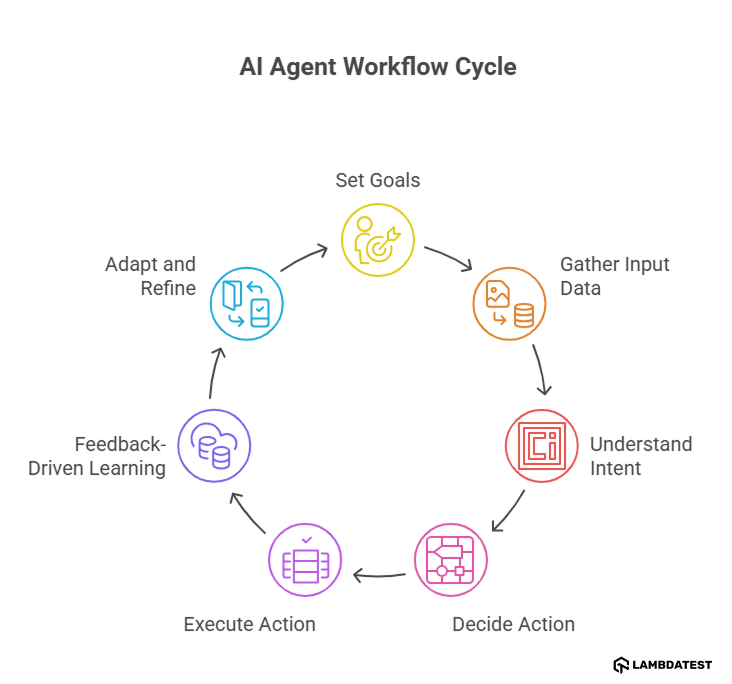
- Setting the Goals: The process starts when you set a clear goal for the AI agent. This can be a specific task, a question, or a goal to be accomplished.
Example: You want to deploy a new version of your web application to production. The goal is: "Deploy the latest web application version to the production environment." - Gathering Input Data from the Environment: The AI agent understands the environment to complete the task. This involves collecting relevant data. The input can come from various sources like the user, external systems, sensors, or APIs.
Example: The agent might check which version of the web application is ready for deployment, confirm the current status of the production environment, and gather any environment-specific configurations or settings (such as server capacity, dependencies, etc). - Understanding Intent Behind the Input: The agent uses AI techniques such as Natural Language Processing (NLP) to interpret your request. It doesn’t just take the words literally, but understands the context and the underlying goal or objective behind them.
Example: When you say, “Deploy the latest web application version,” the AI interprets this as a requirement to perform a deployment by leveraging contextual rules, constraints, or predefined rules. - Deciding the Best Course of Action: The agent analyzes the gathered data. Based on its analysis, it determines the most effective strategy or method to achieve the desired outcome or goal. It makes decisions by processing the data and choosing the best course of action.
Example: The AI might choose to deploy the new web application version in stages (canary release), monitoring performance at each step. It might decide to roll out the update first to a small set of users to avoid issues for the entire user base. - Executing the Selected Action: With a plan in place, the AI agent carries out the task. It follows the predefined steps to complete the goal, performing the required actions without further human intervention.
Example: The agent triggers the deployment pipeline, moving the new version of the web application to production. It uses CI/CD tools to automate the deployment process, ensuring that everything happens according to the defined plan. - Feedback-Driven Continuous Learning: After performing the action, the agent waits for feedback to evaluate the success of the task. It learns from this feedback, whether it’s positive or negative, and uses it to improve future actions.
Example: The agent checks the system logs for any errors or performance issues post-deployment. If the deployment goes smoothly, the task is successful. However, if users report issues (like a broken feature), the agent learns from the feedback and adjusts future deployments, perhaps by automating more testing or checking for common errors. - Adapting and Refining Over Time: With continuous feedback, the AI agent refines its processes, learning from past experiences to improve its performance in future tasks. It continuously adjusts its decision-making to be more effective and efficient.
Example: Over time, the agent may learn to prioritize certain types of checks (like database migrations) during deployment, or it may adapt to handle issues faster by rolling back a deployment more quickly when issues arise.
Notice that at every step of this deployment example, the evidence that the task actually succeeded comes from the agent's own account of its work. TestMu AI Agent Assurance exists to check that account: point it at an agent you own and it reads the codebase, derives functional, non-functional, and adversarial scenarios, invokes the agent for real, and grades each criterion against observed evidence such as files changed, artifacts produced, and tool calls. Anything it cannot check is reported as Unable to Verify, with the assurance gap shown beside the pass rate.
Note: Building an agent that acts on real systems? Test how your agents actually behave across workflows, tools, and actions. Join the Agent Assurance waitlist
Reasoning Paradigms: ReAct and ReWOO
The Observe-Reason-Act-Evaluate loop can be wired together in different ways. Two reasoning paradigms dominate how modern LLM agents decide what to do next, and the choice between them is a direct trade-off between adaptability and cost.
ReAct (Reasoning and Acting)
ReAct interleaves reasoning and action: the agent thinks one step, calls a tool, reads the observation, then thinks again with that new information in hand. This "think, act, observe, repeat" pattern lets the agent course-correct mid-task when a tool returns something unexpected. It was introduced in the paper ReAct: Synergizing Reasoning and Acting in Language Models and is now the default loop behind most agent frameworks. The cost is that every step is a separate LLM call plus a tool round-trip, which adds latency and token usage on long tasks.
ReWOO (Reasoning Without Observation)
ReWOO decouples planning from execution: the agent writes the full plan of tool calls up front, runs those tools, then composes the answer from the collected evidence, instead of pausing to re-reason after each observation. Removing the redundant, interleaved prompts is what saves compute, the paper ReWOO: Decoupling Reasoning from Observations reports 5x token efficiency on the HotpotQA benchmark. The trade-off is less flexibility: a plan fixed in advance cannot react to a surprising intermediate result the way ReAct can.
- Choose ReAct for open-ended, exploratory tasks where the next step genuinely depends on what the last tool returned.
- Choose ReWOO for predictable, high-volume workflows where the sequence of tool calls is known ahead of time and token cost matters.
The Modern Generative AI Agent Stack
Classical agents (reflex, goal-based, utility-based) describe perception and action in the abstract. A production LLM agent implements those ideas as concrete software layers. Four of them do the heavy lifting.
- Foundation Model (the brain): A large language model sits at the core, interpreting the goal, planning steps, and deciding which tool to invoke. Everything else in the stack exists to feed this model context and carry out its decisions.
- Tool Integration (the hands): Through function calling, the model emits a structured request that maps to a real API, SDK, or database query, so the agent can send an email, query a system, or run a script instead of only producing text. This is what turns a chatbot into an agent that changes state in the outside world.
- Memory and Retrieval (the notebook): Vector databases store past context as embeddings and return the most relevant pieces by semantic search, giving the agent grounded, up-to-date information beyond its training data.
- Orchestration (the workflow): A control layer runs the reasoning loop, sequences tool calls, manages retries, and enforces stopping conditions so a multi-step task completes reliably.
Open-source agents such as AutoGPT and coding agents like Devin popularized this stack, chaining a foundation model to tools and memory to pursue multi-step goals with limited supervision.
Types of AI Agents
Let’s break down AI agents based on their types. Each type represents a different level of complexity and is suited to different types of tasks.
- Simple Reflex Agents: These are the simplest types of AI agents. They work based on condition-action rules, where actions are triggered by specific conditions in the environment. Reactive agents do not store information or have memory, and their actions are strictly dependent on their current state.
- Model-Based Reflex Agents: These agents extend reactive agents by introducing an internal model of an environment. This model helps the agent keep track of the environment's state (e.g., the state of the world based on past sensor readings). It maintains a memory of past actions and observations that can handle partially observable scenarios.
- Goal-Based Agents: These agents are designed to achieve specific objectives. They don't just react based on immediate inputs but engage in planning and decision-making to determine the best sequence of actions to achieve their objectives. These agents use means-end reasoning, where they select actions that lead them closer to an objective.
- Utility-Based Agents: These agents evaluate different possible outcomes using a utility function, which assigns a numerical value to each possible state based on its desirability. They choose actions that maximize overall utility, allowing them to balance multiple objectives.
- Learning Agents: These agents improve their performance over time by learning from experience. They are capable of adapting to dynamic and unpredictable environments by adjusting their decision-making process based on feedback. These agents can learn through trial and error (reinforcement learning) or by processing data (supervised or unsupervised learning).
- Hierarchical Agents: These agents decompose complex tasks into smaller, more manageable sub-tasks or goals, often organized in a hierarchical manner. They are structured to solve problems by breaking them down into high-level objectives and then progressively refining them into sub-goals.
- Multi-Agent Systems (MAS): These systems consist of multiple autonomous agents that interact with each other, often to achieve a common goal or work in parallel to solve complex problems. Each agent in a MAS operates independently, making its own decisions based on local information, but can also collaborate with other agents to share information, coordinate actions, and achieve global objectives.
What Are Some Real-World Applications of AI Agents?
AI agents are being used in many areas to automate work, optimize processes, and improve decision-making.
- Software Testing: AI QA agents now automates test creation, identifies flaky tests, and heals broken scripts during execution. They scan UI changes, detect regressions, and even write test cases or scripts based on high-level user stories or bug reports. Teams increasingly lean on AI agent testing to keep these workflows reliable end to end.
- IT and Process Automation: In IT environments, AI agents monitor infrastructure health, detect anomalies, and even deploy fixes without human intervention. If a server slows down or a process crashes, these agents can detect and remediate issues instantly, often before users notice.
- Personal Assistants and Conversational AI: Voice assistants and intelligent AI chatbots are practical examples of AI agents in action. For example, Siri setting reminders, Alexa playing music, or a support chatbot answering account queries. These agents work by understanding natural language, figuring out the user’s intent, and performing actions, all in real time.
- Recommendation Systems: When you get a movie suggestion on Netflix or a product recommendation on Amazon, there’s an AI agent working behind the scenes. These agents observe your behavior, what you watch, buy, or skip and adapt based on that input. With every click or rating, they refine their recommendations, aiming to match your preferences more closely. Over time, this makes the platform more engaging and personalized, keeping users coming back.
- Smart Home and IoT: In homes, AI agents manage everything from temperature to lighting. A thermostat might raise the heat when it detects a drop in temperature, while a motion sensor can turn on lights as someone enters a room. These are basic reflex agents. More advanced systems learn routines like adjusting the lights at sunset or lowering blinds during peak sun hours, without being told, offering comfort and energy efficiency without constant user input.
- Healthcare and Medical Systems: In hospitals and clinics, AI agents support medical teams by handling time-sensitive and data-heavy tasks. They examine X-rays to detect abnormalities, prioritize patients based on urgency, or monitor vital signs for signs of decline. They take over these continuous monitoring tasks and help clinicians focus on what matters most, like diagnosis, treatment, and patient care.
They can also be integrated into CI pipelines to act immediately on pull requests, running tests, gathering results, and flagging risks without developer intervention.
Tools like n8n for automation testing can also be used to orchestrate testing workflows and connect QA processes with external systems.
Similarly, AI browsers like Perplexity Comet and Opera Aria embed AI assistants directly into the browsing experience, enabling users to summarize pages, ask contextual questions, and automate web tasks without switching tools.
How to Use AI Agents: Example Using TestMu AI KaneAI
Let’s take an example of TestMu AI KaneAI - a GenAI-native, end-to-end testing agent built on modern Large Language Models. You can use it to plan, author, execute, and evolve tests using natural-language prompts, turning PRDs, Jira tickets, and recordings into executable tests without writing test code by hand.
You can also watch the video below to see how to automate web app testing using KaneAI:
Features:
- Scheduled Test Runs: Schedule your tests to run at specified times, enabling continuous integration and regular testing without manual intervention.
- Jira Integration: Integrate with Jira to create and manage tests directly from tickets, streamlining your testing workflow.
- API Testing: Define and validate API requests within your tests, ensuring backend services function correctly alongside frontend interactions.
- Modules: Enhance test reusability by creating modular test steps that can be reused across multiple tests.
- Assertions: Incorporate assertions into your tests to validate that your software application behaves as expected, checking conditions like element visibility or text content.
- TOTP Authentication: Support for Time-Based One-Time Password (TOTP) authentication allows you to automate login processes requiring two-factor authentication.
- Auto-Healing: Automatically detects and fixes broken locators during test execution, reducing maintenance efforts and enhancing test reliability.
To get started, check out this guide on web app testing with KaneAI.

Challenges With Using AI Agents
Though AI agents offer benefits in terms of automation, effectiveness, and decision-making, they are used alongside a set of challenges. They are as follows:
- Data Privacy: AI agents need a lot of data to work effectively. They gather, store, and transfer large amounts of information to train and work. However, this creates risks related to privacy, as sensitive data can be exposed or misused.
- Emotional Intelligence and Ethical Challenges: AI agents have difficulty handling tasks that require understanding emotions or making complex moral decisions. AI models can sometimes produce biased or unfair results.
- Unpredictable Environments: AI agents process and react to data, but they often struggle in environments where conditions are constantly changing or unpredictable. These environments demand a high level of flexibility, quick decision-making, and the ability to handle unexpected variables, which is challenging for AI agents.
- Resource-Intensive Nature: Training and using AI agents demand substantial computational power. This can be expensive, especially for organizations using on-premise infrastructure. Maintaining the necessary hardware and scaling it can be challenging, particularly for smaller businesses with limited budgets.
Agents that take actions add risks of their own, such as false completion reports and goal hijacking, and the guide to agentic AI risks covers a pre-release test for each.
Operational Risks: Infinite Loops and Human-in-the-Loop
Autonomy is the whole point of an agent, and it is also where the engineering risk concentrates. Because an agent decides its own next action, a flawed decision can compound instead of stopping. Two failure modes matter most in production.
- Infinite feedback loops: An agent can get stuck repeatedly prompting itself or calling the same tool without converging on a result, burning tokens and API budget on every cycle. Guardrails such as step limits, loop detection, and a maximum action budget stop a runaway agent before it drains resources.
- Non-deterministic output: Unlike a Selenium assertion that checks whether button text equals "Submit", an agent gives a different answer to the same prompt on each run. That makes hallucination, bias, and incomplete answers hard to catch with traditional pass/fail tests.
The standard control for both is human-in-the-loop (HITL): keeping a person at the gate for approval, correction, or escalation instead of letting the agent run fully unattended. For example, TestMu AI KaneAI applies HITL to test authoring, reviewers approve the generated plan before it runs, can pause a run mid-execution to correct a step, and user input always takes priority over the agent's decisions.
Testing an agent's behavior is a separate discipline from building it. TestMu AI Agent Testing validates chat, voice, and phone agents by running scenarios through specialized evaluators that score for hallucination, bias, completeness, and context awareness, then return a Green, Yellow, or Red production-readiness verdict. It also runs red-team checks for prompt injection, jailbreaks, and PII leakage, the adversarial failure modes that infinite loops and non-determinism tend to expose.
Note: Validate your AI agents for hallucination, bias, and prompt injection before you ship. Explore Agent Testing
AI Agents vs AI Assistants vs AI Bots: Key Differences
AI agents, AI assistants, and AI bots are sometimes used interchangeably, but they are different, with unique capabilities and uses. Their understanding is important for effective integration into business operations.
| Aspect | AI Agents | AI Assistants | AI Bots |
|---|---|---|---|
| Definition | Autonomous systems that perform tasks, make decisions, and adapt to real-time data. | Advanced virtual assistants that use NLP and machine learning for personalized interactions. | Rule-based programs that simulate conversations using predefined responses. |
| Complexity | Highly complex, capable of independent decision-making and process automation. | Moderately complex, understands context and improves responses over time. | Basic, follows scripts and predefined rules. |
| Learning & Adaptation | Continuously learns, adapts, and makes independent decisions based on real-time data. | Learns from user behavior and adapts responses accordingly. | Does not learn from past interactions, requires manual updates. |
| Functionality | Automates workflows, analyzes data, optimizes processes, and interacts with multiple systems. | Manages schedules, sets reminders, controls smart devices, and performs personalized tasks. | Provides basic information, handles FAQs, and interacts via text or voice. |
| Use Cases | Business automation, predictive analytics, and intelligent test automation. | Personal productivity, virtual assistants (e.g., Siri, Alexa). | Customer support, website chat, FAQ automation. |
| Integration | Operates across different systems, tools, and workflows for complex decision-making. | Integrates with multiple applications and services. | Limited to specific platforms and predefined responses. |
Is ChatGPT an Agent or an LLM?
At its core, ChatGPT is an application built on a large language model (the LLM is the foundation model; the app is the interface around it). A plain LLM only predicts text, it has no memory beyond the current context and cannot act on the outside world. ChatGPT becomes agentic only when it is given tools: with browsing, code execution, or function calling enabled, it can observe, plan, act, and loop, which is the behavior that defines an agent. So the accurate framing is that ChatGPT is an LLM-powered assistant that can operate as an agent when connected to tools, not an autonomous agent by default.
Future of AI Agents
Here are a core takeaways that capture what’s ahead for AI agents over the coming time:
- Market Growth and Cross-Industry Adoption: According to Global Market Insights, the worldwide AI agents market is valued at USD 7.7 billion in 2025 and is projected to reach USD 105.6 billion by 2034, a 39.5% compound annual growth rate. Organizations across healthcare, finance, eCommerce, manufacturing, and software engineering are moving beyond pilots into fully deployed agentic systems.
- Multimodal Agents and Context-Aware Autonomy: Agents are no longer single-task bots; they now understand text, images, audio, and actions, enabling adaptive decision-making (e.g., summarizing slides mid-meeting, reviewing code, or moderating feedback loops). Emerging architectures support long-term memory, reasoning chains, and dynamic planning for more complex workflows.
- Multi-Agent Ecosystems and Agent Marketplaces: The future belongs to multi-agent systems, where specialized agents (e.g., "analyst", "editor", "researcher") collaborate to solve end-to-end tasks. Businesses are building Agent-as-a-Service (AaaS) models and establishing marketplaces to buy, rent, or customize domain-specific agents.
- Human-Agent Teaming Is a New Workplace Norm: Organizations are adopting “AI agent onboarding” practices, equipping agents with roles, performance metrics, and supervised ground truth feedback.
Citations
- AI Agents: Evolution, Architecture, and Real-World Applications (arXiv): https://arxiv.org/abs/2503.12687
Author

Srinivasan Sekar
Blogs: 18


Srinivasan Sekar is Director of Engineering at TestMu AI (formerly LambdaTest), where he leads engineering and open-source initiatives behind the Selenium and Appium automation grid and owns TestMu AI's MCP Server. A committer to Appium and a contributor to Selenium, WebdriverIO, Taiko, and AppiumTestDistribution, he brings over 15 years of experience in quality engineering and open-source technologies. He is the author of the Apress book 'The MCP Standard: A Developer's Guide to Building Universal AI Tools with the Model Context Protocol,' a Certified Kubernetes and Cloud Native Associate, and an international conference speaker. Before TestMu AI he spent over eight years at Thoughtworks as a Principal Consultant and Quality Architect. Srinivasan holds a B.Tech in Information Technology from Anna University.
Reviewer

Anubhav Singhmaar
Reviewer
Anubhav Singhmaar is an AI Product Manager at TestMu AI driving Kane CLI, the command-line tool that brings browser automation to the terminal, turning natural-language flows into runs in a real Chrome browser that return pass or fail with shareable proof. He owns the roadmap and prioritization and works with engineering to ship developer-facing features. Before TestMu AI, he spent over four years at Sprinklr owning enterprise voice AI across APAC and EMEA. A mechanical engineer turned product manager, he grounds guidance in real QA workflows.
On This Page
- What Are AI Agents?
- Benefits of AI Agents
- Core Components of AI Agents
- How Do AI Agents Work?
- Reasoning: ReAct & ReWOO
- Modern AI Agent Stack
- Types of AI Agents
- What Are Some Real-World Applications of AI Agents?
- How to Use AI Agents: Example Using TestMu AI KaneAI
- Challenges With Using AI Agents
- Operational Risks & HITL
- AI Agents vs Assistants vs Bots
- Future of AI Agents
- Citations
AI Agents FAQs
Did you find this page helpful?
More Related Learning Hubs
TestMu AI forEnterprise
Get access to solutions built on Enterprise
grade security, privacy, & compliance
- Advanced access controls
- Advanced data retention rules
- Advanced Local Testing
- Premium Support options
- Early access to beta features
- Private Slack Channel
- Unlimited Manual Accessibility DevTools Tests