

Power Your Software Testing with AI Agents and Cloud
The Native AI-Agentic Cloud Platform to Supercharge Quality Engineering. Test Intelligently and Ship Faster.


- TestMu AI (Formerly LambdaTest)
- /
- Blog
- /
- AI in Software Testing
AI in Software Testing: Use Cases, Tools & What Actually Works in 2026
Explore AI in software testing with benefits, use cases, types, and adoption challenges. Understand how it differs from manual testing, its shortcomings and future.
Last Updated on:
AI in software testing does more than automate repetitive tasks. It learns from past failures, adapts test strategies on its own, and keeps scripts running without constant manual fixes.
According to the Capgemini World Quality Report 2024-25, 68% of organizations are advancing Generative AI in quality engineering, split evenly between teams already using it and teams building roadmaps after successful pilots.
TL;DR
- AI in software testing uses machine learning, NLP, and deep learning to create, run, and maintain tests, so it predicts defects and adapts to application changes instead of relying on hand-written scripts.
- Generative AI in quality engineering has moved from pilots into production, so AI fluency is becoming a baseline QA skill rather than a competitive edge.
- Success depends less on the tool than on clearing adoption barriers, since data privacy, CI/CD integration, hallucinated output, and an AI skills gap each need a mitigation before AI testing scales.
- AI now spans test generation, self-healing, synthetic test data, log anomaly detection, defect prediction, and visual checks, so start with AI-native test intelligence on your costliest bottleneck before investing in a broader stack.
- Complex multi-module workflows, UX intuition, and ambiguous requirements still need a domain-expert tester, so AI handles execution while humans keep judgment.
- The TestMu AI KaneAI agent lets teams write, debug, and evolve tests in natural language across web, mobile, and API, all on a cloud of 10,000+ real devices and 3,000+ browser and OS combinations.
What Is AI in Software Testing?
AI in software testing applies machine learning, NLP, and deep learning to automate test creation, find defects early, and fix broken test scripts without manual effort.
Unlike traditional automation that breaks when the UI changes, AI agents learn from application behavior, adapt to changes, and flag high-risk areas before testers even start scripting.
What Are the Types of AI Testing?
The main types of AI testing include functional, regression, performance, security, bias, explainability, data, adversarial, model drift, compliance, and autonomous testing.
Here are the primary types of AI software testing and what each demands in practice:
- Functional Testing: AI generates functional tests by learning expected behavior from user interactions. The biggest benefit is for complex, branching workflows where manually scripting every path is impractical.
- Regression Testing: AI identifies features most at risk after code changes and prioritizes those tests. This transforms regression from "run everything" to "run what matters," making high-frequency deployment sustainable.
- Performance Testing: AI adapts load scenarios in real time based on system behavior, finding bottlenecks that fixed load profiles miss. Adjusting load dynamically mirrors real traffic patterns and exposes issues that static scripts cannot.
- Security Testing: AI identifies vulnerabilities by analyzing code patterns and simulating attacks at scale. It catches injection flaws and misconfigured permissions but does not replace expert review for business logic vulnerabilities.
- Bias and Fairness Testing: AI audits model outputs across demographic segments to detect discriminatory patterns. This is essential for systems making decisions about people. Teams must define their fairness criteria before testing, not after.
- Explainability Testing: Tests whether AI model decisions can be clearly explained using techniques like SHAP or LIME. This is critical in regulated industries where explainability and accuracy often trade off against each other.
- Data Testing: AI validates datasets for errors, drift, and inconsistencies that hurt model accuracy. This is the most overlooked area in ML pipelines. Automated data testing catches issues before they become mysterious accuracy drops in production.
- Adversarial Testing: AI generates deceptive inputs to test model stability. Production ML systems face adversarial inputs daily, from modified images breaking classifiers to crafted text getting past content filters. This must be standard validation, not an afterthought.
- Model Drift Testing: AI monitors model performance over time and alerts teams when accuracy degrades due to changing data patterns. Every model drifts. Continuous monitoring with automated alerting is the basic production requirement.
- Ethical and Compliance Testing: AI verifies systems meet regulatory requirements like GDPR, HIPAA, and emerging AI governance frameworks. Automated compliance checks catch obvious violations like PII in training data before they become audit findings.
- Autonomous Testing: AI generates and executes test cases without human intervention across web, mobile, desktop, and API platforms. Teams getting value here set up proper monitoring first, because autonomous tests need clear pass/fail signals.
Pro-tip: You can also use platforms like TestMu AI Agent Testing to check how AI agents behave. It simulates real-world interactions, letting you see how agents respond, adapt, and perform in dynamic situations.
You can measure accuracy, reliability, bias, and safety. This helps teams spot weak points and improve agent performance.
To get started, check out this TestMu AI Agent Testing guide. For a broader understanding of how to validate AI systems end to end, our guide on testing AI applications covers the full spectrum of testing types, tools, and best practices.
AI Software Testing vs Manual Software Testing
AI testing automates and adapts to changes while manual testing relies on human execution and exploratory checks. The real question is which combination gives your team the fastest feedback for your release cadence.
| Aspect | AI Software Testing | Manual Software Testing |
|---|---|---|
| Approach | AI-driven automation that analyzes, predicts defects, and optimizes test processes for faster, more reliable outcomes. | Testers execute predefined scripts and exploratory tests. |
| Test Case Generation | Automatically generated using AI insights, historical data, and patterns to improve coverage and effectiveness. | Written and maintained manually by QA engineers. |
| Execution Speed | Fast, parallel execution across multiple environments using AI optimization. | Slower, limited by human pace. |
| Accuracy | High accuracy via predictive analytics and pattern recognition, reducing human error. | Prone to human error and oversight. |
| Test Coverage | Broad and deep; AI identifies and prioritizes high-risk areas efficiently. | Often limited; time-consuming to expand. |
| Maintenance | Self-healing scripts adapt automatically to UI and code changes, reducing manual updates. | Manual updates required for every change. |
| Defect Detection | Proactive; predicts likely failure points before execution using AI insights. | Reactive; defects found during test runs. |
| Feedback Loop | Continuous testing with rapid feedback for faster iterations. | Slower feedback cycles. |
| Flakiness Management | AI stabilizes tests using dynamic locators, diagnostics, and self-healing capabilities. | Troublesome; flaky tests require manual investigation. |
| Resource Utilization | Optimized resource use; focuses human effort on complex scenarios. | High manual effort and staffing. |
| Time to Market | Shorter release cycles with faster, targeted testing enabled by AI. | Longer due to manual cycles. |
What Are the Real-World AI Use Cases in Software Testing?
Real-world AI use cases in software testing include test case generation, self-healing automation, defect prediction, visual testing, and smart test execution in CI/CD pipelines.
Adoption is broad but shallow. The Capgemini World Quality Report 2025-26 found 89% of organizations piloting or deploying Generative AI-augmented workflows, but only 37% in production and just 15% at enterprise-wide implementation. Non-adopters actually grew, from 4% to 11%, and roughly a third of organizations reported minimal gains against an average productivity boost of 19%.
That gap between pilot and production is the useful signal. The four use cases below are the ones that reach production most often, each with what it genuinely does well and the failure mode that stalls it.
1. Test Case Generation
Generation is where adoption has moved fastest. Capgemini describes the shift as Gen AI moving from analyzing outputs, such as defect analysis and reporting, to shaping inputs, with test case design and requirements refinement now leading adoption. The model reads requirements, user journeys, and existing suites, then drafts functional, edge, and regression cases through automatic test case generation.
What it does well is volume and recall on edge cases a tired human skips at 5pm on a Friday. What it does badly is knowing which cases matter. A generator handed a thin requirements doc produces plausible tests for behavior the product does not have, and those cases pass review because they read correctly.
The failure mode is coverage inflation. Suites grow by hundreds of cases, the dashboard turns green, and nobody notices the generated set never touches the three flows that carry revenue. Gate it by requiring every generated case to map to a real requirement or a real past defect, and delete the ones that map to neither.
2. Self-Healing Automation
Self-healing test automation repairs broken locators by tracking an element across attribute, position, and DOM changes rather than binding to one brittle selector. Teams running nightly regressions against a fast-moving UI see the clearest return, since a single sprint can break dozens of locators that would otherwise be fixed by hand.
The failure mode is healing a test that should have failed. When a developer removes a checkout button and the healer rebinds to a visually similar element, the suite reports green on a broken purchase flow. The repair is real, the pass is fake, and the defect ships.
Treat every heal as a review item rather than a silent success. Log what was healed and why, alert when the heal rate on a suite climbs, and fix the naming conventions underneath, because a suite that heals constantly is telling you the application has no stable test hooks.
3. Visual AI
Visual AI compares renders semantically instead of pixel by pixel, so anti-aliasing, font smoothing, and dynamic content stop generating noise while genuine layout breaks still surface. It catches the class of defect that passes every DOM assertion, such as a button that overlaps text or a grid that collapses only at one viewport width.
The failure mode is baseline rot. Baselines drift as designers ship intentional changes, reviewers approve diffs in bulk to clear a backlog, and within a quarter the baseline encodes several bugs as expected behavior. After that the tool reports clean because it is comparing against the wrong truth.
Version baselines with the release that produced them, require a named approver per diff rather than a bulk accept, and re-baseline deliberately after a design system change instead of letting it happen one approval at a time.
4. Failure Triage
Triage is the least glamorous and often the highest return. AI clusters failures across a run, separates one broken dependency from forty downstream symptoms, and turns thousands of log lines into a short list of probable causes. On a suite where a single infrastructure blip fails 200 tests, that is the difference between an hour of reading output and a two-minute read.
The failure mode is confident misattribution. The cluster names a root cause that sounds right, an engineer fixes that, and the real defect stays in the build because nobody re-opened the raw logs. Triage output is a hypothesis with evidence attached, not a verdict.
Keep the raw logs one click from the summary, and track how often the suggested cause turns out to be the actual fix. If that number is not measured, there is no way to know whether triage is saving time or redirecting it.
A common thread runs through all four. Google's 2025 DORA report, drawn from nearly 5,000 technology professionals, found 90% now use AI at work and more than 80% believe it increased their productivity, while 30% report little or no trust in the code it generates. Its central finding is that AI does not fix a team, it amplifies what is already there, and that acceleration without strong automated testing and fast feedback loops leads to instability rather than speed.
Read against the Capgemini numbers, the pattern is consistent: the constraint on AI in testing is rarely the model. It is whether the surrounding practice, including review gates, stable test hooks, versioned baselines, and measured triage accuracy, is good enough for acceleration to be safe. Here are the other use cases that reach production:
- Smarter Test Execution: AI evaluates code changes, failure history, and risk scores to run relevant tests first and skip low-value cases. Risk-based prioritization shortens pipeline run time while still catching the same defects.
- Defect Prediction: AI in software defect prediction looks at past bugs, code change patterns, and code complexity to flag high-risk modules before testing begins. This shifts QA from reactive to proactive, but accuracy depends on clean defect data.
- Synthetic Test Data Generation: AI generates realistic, privacy-safe test data that covers edge cases and rare conditions, removing the bottleneck of sourcing or masking production data. This is especially useful for regulated domains where real user data cannot enter test environments.
- Continuous Testing: AI embedded in CI/CD pipelines learns from build and failure data to adapt test selection per commit. It avoids running 2,000 tests when a one-line CSS change only needs 30, making continuous delivery pipelines viable.
- Natural Language Testing: In NLP testing, AI converts plain language into executable test steps. This lets product managers contribute scenarios directly, removing the delay between writing requirements and creating test scripts.
- AI Agents for Autonomous Testing: In autonomous testing, AI agents explore applications independently, creating tests without predefined scripts - the core idea behind Agentic Quality Assurance, where an agent receives a testing goal rather than a script. They discover paths scripted tests miss, but need proper monitoring to ensure agents test meaningful scenarios.
The rise of Generative AI tools has made many of these capabilities accessible across teams of all sizes, from startups automating their first test suite to enterprises scaling coverage across hundreds of services.
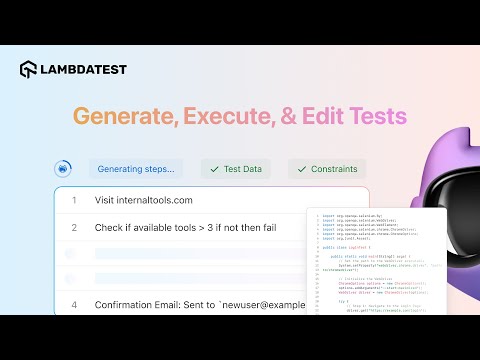
Several of these use cases come together in the KaneAI testing agent from TestMu AI, which generates structured test cases from a plain-language prompt, validates API responses in the same run, and flags visual regressions, all from a single agent. The walkthrough below shows how to generate, execute, and edit these tests, then run them on HyperExecute:
What Are the Benefits of AI in Software Testing?
The key benefits of AI in software testing include improved accuracy, faster execution, expanded coverage, reduced flakiness, and lower maintenance cost for automation teams.
Here are the key benefits of AI testing and what they mean in practice:
- Improved Test Accuracy: AI uses predictive analytics in software testing to reduce false positives. Fewer false alerts rebuild developer trust in test results, making CI pipelines effective quality gates.
- Faster Test Execution: AI-based prioritization runs failure-prone tests first, so failures surface early instead of at the end of a long run. The shift moves from "run everything" to "run what matters."
- Enhanced Test Coverage: AI analyzes code paths and defect history to find coverage gaps. It solves "we need the right tests," not "we need more tests."
- Reduced Test Flakiness: AI self-healing repairs broken locators using smart locator strategies that track how elements appear on the page. It fixes the broken locator, but teams should also fix underlying naming conventions.
- Better Test Maintenance and Stability: AI adapts scripts automatically when UI elements change, cutting the maintenance cost that kills automation ROI for teams shipping frequently.

Note: Address flaky tests with AI-native test intelligence from TestMu AI. Try TestMu AI Today!
How to Use AI in Software Testing
To use AI in software testing, define your testing goals, choose the right AI tools or agents, integrate them into your CI/CD pipeline, run tests, and analyze results.
Start with a specific bottleneck, not a technology decision. Identify whether maintenance, flakiness, or speed is your core problem first.
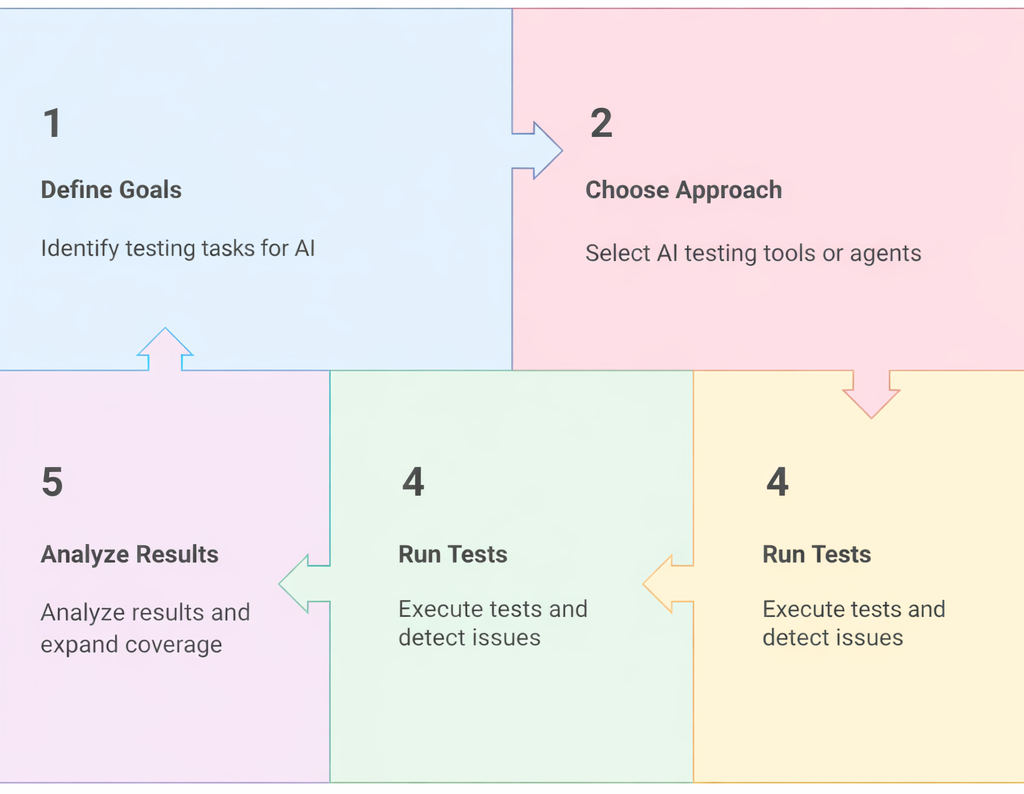
Here is how to structure your AI testing adoption:
- Define Goals: Pick one specific problem like flaky tests, slow regressions, or coverage gaps. Vague goals like "use AI for testing" lead to failed pilots.
- Choose Approach: Decide between adding AI to your existing framework or deploying standalone AI agents. Adding AI is lower risk; autonomous agents need more setup.
- Integrate with Tools or Agents: Connect AI testing tools or agents to your CI/CD pipeline with quality inputs like user stories and defect data. Poor data produces generic tests.
- Run Tests: Let the AI generate cases, prioritize high-risk modules, and repair scripts. Monitor early cycles closely to check that tests are catching real bugs.
- Analyze Results: Review AI outputs critically. Expand coverage where gaps exist, but remove duplicate or trivial tests. The goal is a leaner suite, not a bigger one. Track how many bugs reach production to measure real impact.
Shortcomings of AI in Software Testing
AI testing has real limitations vendors understate. Deploy AI where it works and keep human expertise where it is irreplaceable. Generative AI in software testing accelerates repetitive tasks but fails predictably here:
- Testing for Complex Scenarios: AI cannot reason about multi-step workflows across multiple modules and integrations. A domain-expert tester catches how a discount code interacts with loyalty tiers. For complex integration scenarios, human test design remains essential.
- UX Testing: AI catches broken layouts and accessibility violations but cannot evaluate whether a workflow feels intuitive. AI tells you a button exists, not whether users understand what it does. UX still requires human judgment.
- Documentation Review: AI flags inconsistencies in test documentation but cannot evaluate whether a requirement is ambiguous or incomplete from a business perspective. Requirements review requires human judgment AI cannot reliably handle.
- Test Reporting and Analysis: AI generates metrics and dashboards but struggles to provide useful context. Knowing 12 tests failed is useless without understanding which failures block the release versus which are environmental. Human interpretation remains critical.
What Are the Challenges of Adopting AI in Software Testing?
The main challenges of adopting AI in software testing are data privacy risks, integration complexity, unreliable or hallucinated output, a shortage of AI skills, and the cost of clean training data.
These are adoption barriers, not capability limits. The Capgemini World Quality Report 2025-26 ranks the most common ones, and each has a practical mitigation:
- Data Privacy and Security (67%): The most cited concern. Keep regulated data out of prompts and test environments by using synthetic data, and run AI testing on infrastructure with SOC 2 and ISO 27001 controls rather than ad-hoc local setups.
- Integration Complexity (64%): AI tools that do not fit your existing CI/CD pipeline stall at the pilot stage. Start with one pipeline step and a tool that exposes APIs and native CI plugins instead of a rip-and-replace rollout.
- Hallucination and Reliability (60%): AI can produce plausible but wrong tests. Keep a human in the loop to review generated cases, and treat AI output as a first draft to validate, not a final suite to trust blindly.
- Skills Gap (50%): Half of organizations report they lack AI/ML expertise. Reskill existing QA engineers on prompting and AI-tool workflows rather than waiting to hire specialists, since testing judgment matters more than model internals.
- Data Quality and Cost: AI is only as good as the defect history and logs it learns from. Budget time to clean and label that data first; feeding AI noisy inputs produces confident but inaccurate predictions.
What Is the Future of Software Testing With AI?
The future of AI in software testing points toward autonomous quality systems, smarter element handling, lower manual effort, and AI-driven predictive testing across delivery pipelines.
As AI moves from assisting individual testers to running inside the pipeline, the differentiator stops being access to a model and becomes the discipline around it, meaning the review gates, stable hooks, and measured accuracy described earlier. Teams that build those first get compounding returns; teams that do not get faster failure. Understanding prompting techniques for testers is part of that discipline, since prompt quality determines how useful these systems are in practice.
- Growing Role of AI: AI is becoming infrastructure, not tooling. Within the next few years, test frameworks without AI capabilities will feel as outdated as manual deployment scripts feel today. Teams should evaluate AI support as a key factor when selecting any new testing tool.
- Smarter Element Handling: AI in test automation is evolving beyond locator repair to contextual understanding of UI elements. Future agents will understand what an element does rather than relying on HTML attributes, making tests stable through redesigns.
- Expanded Automation: AI will handle tasks currently requiring human judgment, like distinguishing bugs from design updates. The scope of "requires a human tester" will shrink, leaving higher-skilled strategy and domain reasoning.
- Reduced Human Dependency: Human testers will shift from execution to oversight, defining quality standards and reviewing AI decisions. Teams that reskill QA engineers for this shift will outperform those that simply reduce headcount.
- Quantum Computing Impact: Quantum computing remains speculative for testing but holds potential for large-scale test combination problems that take too long with regular computing. Watch this trend but focus current resources on proven AI capabilities.
- Predictive Capabilities: AI will evolve from predicting which tests to run to predicting which code changes cause production incidents. This connects testing and production monitoring into one quality view across the delivery pipeline.
- Lower Maintenance Effort: Intelligent test automation will push test maintenance costs toward zero. When tests are cheap to maintain, teams can afford broader coverage without having to decide which tests are worth keeping.

Conclusion
AI is transforming testing now. Teams using AI-driven testing ship faster with fewer production defects. The question is no longer whether to adopt AI in testing but where to start and how to scale responsibly.
Start with the pain point that costs your team the most time: flaky tests, slow pipelines, or maintenance effort. Prove value there, then expand. The teams that try to adopt AI everywhere at once end up adopting it nowhere effectively.
For QA teams looking to start their AI journey, this AI roadmap for software testers provides a structured path from programming basics to autonomous testing.
With AI reshaping testing workflows, the testers who thrive are the ones who understand both testing fundamentals and AI capabilities. The KaneAI Certification validates hands-on AI testing skills and positions you as a QA professional ready for the next generation of quality engineering.
Note: This article was researched and drafted with AI assistance, then reviewed, fact-checked, and published by Salman Khan, Test Automation Evangelist at TestMu AI, whose listed expertise includes AI in testing and test automation. Every statistic, link, and product claim was verified against primary sources. Read our editorial process and AI use policy for details.
Author

Salman Khan
Blogs: 147


Salman is a Test Automation Evangelist and Community Contributor at TestMu AI, with over 6 years of hands-on experience in software testing and automation. He has completed his Master of Technology in Computer Science and Engineering, demonstrating strong technical expertise in software development, testing, AI agents and LLMs. He is certified in KaneAI, Automation Testing, Selenium, Cypress, Playwright, and Appium, with deep experience in CI/CD pipelines, cross-browser testing, AI in testing, and mobile automation. Salman works closely with engineering teams to convert complex testing concepts into actionable, developer-first content. Salman has authored 120+ technical tutorials, guides, and documentation on test automation, web development, and related domains, making him a strong voice in the QA and testing community.
Reviewer

Samyak Goyal
Reviewer
Samyak Goyal is a Senior Member of Technical Staff at TestMu AI engineering Kane CLI, the command-line tool that runs browser automation from the terminal, where a flow described in natural language executes in a real Chrome browser and returns pass or fail with shareable proof. He is a backend engineer with 4+ years of experience, previously an SDE at Innovaccer, where he built APIs, introduced Kafka, and cut deployment from weeks to hours. Samyak also builds multi-agent systems, skill-orchestration frameworks, and a personal copilot that indexes 200+ microservice repositories.


AI in Software Testing FAQs
Did you find this page helpful?
More Related Blogs
TestMu AI forEnterprise
Get access to solutions built on Enterprise
grade security, privacy, & compliance
- Advanced access controls
- Advanced data retention rules
- Advanced Local Testing
- Premium Support options
- Early access to beta features
- Private Slack Channel
- Unlimited Manual Accessibility DevTools Tests