

Power Your Software Testing with AI Agents and Cloud
The Native AI-Agentic Cloud Platform to Supercharge Quality Engineering. Test Intelligently and Ship Faster.


- TestMu AI (Formerly LambdaTest)
- /
- Blog
- /
- What Is Intelligent Test Automation: Definition and Examples
What Is Intelligent Test Automation: Definition and Examples
Discover intelligent test automation, its process, and real-world examples. Learn how AI-driven testing enhances speed, accuracy, and scalability.
Last Updated on:
On This Page
- What Is Intelligent Test Automation?
- Why Integrate Intelligent Test Automation?
- Real-World Examples of Intelligent Test Automation
- Scope of Intelligent Test Automation
- How Does KaneAI Help in Intelligent Test Automation?
- Shortcomings of Intelligent Test Automation
- Best Practices for Adopting Intelligent Test Automation
- Future of Intelligent Test Automation
The software testing industry has seen rapid advancement in recent years. One of the most promising technologies that has evolved and has the power to revolutionize the entire QA industry is intelligent test automation.
Intelligent test automation is an approach that enhances the efficiency and effectiveness of the test automation process by incorporating technologies like artificial intelligence, machine learning, and more.
In this blog, we will explore intelligent test automation and its real-world examples.
AI Overview
What Is Intelligent Test Automation?
Intelligent Test Automation (ITA) is the use of artificial intelligence to enhance automated software testing processes. It applies machine learning, predictive analytics, and self-healing mechanisms to create, execute, maintain, and optimize test cases with minimal manual intervention.
Why Is Intelligent Test Automation Important?
Modern applications are deployed frequently through Agile and DevOps workflows. Traditional automation scripts often break when UI elements or workflows change, increasing maintenance costs and slowing release cycles.
Intelligent test automation improves reliability, reduces flaky tests, and enables continuous testing within CI/CD pipelines, supporting faster and more stable software releases.
How Does Intelligent Test Automation Work?
- AI-Based Test Generation: Automatically creates test cases from requirements, user flows, or historical execution data.
- Self-Healing Mechanisms: Detects and updates broken locators when UI changes occur.
- Risk-Based Test Prioritization: Uses analytics to run high-impact tests first.
- Execution Optimization: Reduces redundant test runs while improving overall coverage.
When Should Organizations Use Intelligent Test Automation?
- When applications release updates frequently.
- When UI changes repeatedly break traditional scripts.
- When regression cycles delay deployments.
- When manual test maintenance becomes costly and time-consuming.
- When large-scale cross-browser or cross-device validation is required.
What Are the Benefits of Intelligent Test Automation?
- Higher Stability: Reduces flaky and brittle test failures.
- Lower Maintenance: Minimizes manual script updates.
- Faster Feedback: Accelerates CI/CD testing cycles.
- Improved Coverage: Expands testing across complex applications.
- Scalability: Supports enterprise-level regression testing.
What Is the Future of Intelligent Test Automation?
- Autonomous Test Agents: AI-driven systems that manage and execute tests independently.
- Predictive Defect Detection: Identifies potential failures before release.
- Natural Language Test Creation: Generates tests from plain-language requirements.
- Deeper DevOps Integration: Seamless intelligence across development and deployment pipelines.
What Is Intelligent Test Automation?
Intelligent test automation or ITA refers to the process of integrating technologies such as artificial intelligence, machine learning, and more into test automation. By leveraging the power of this combination, ITA enhances test creation, test management, and more.
It often uses a model-based testing approach where models representing expected behavior or business logic help automate different testing tasks. The AI model that drives your automation testing process helps identify relevant components, optimize test cases or test scripts, and adapt testing strategies based on historical data and patterns.
Why Integrate Intelligent Test Automation?
Here are some of the key reasons why it’s a wise move to incorporate AI in software testing, especially in test automation, to foster seamless digital experiences for businesses:
- Improves Decision-Making: Intelligent test automation can analyze enormous amounts of test data and offer actionable insights throughout the software testing life cycle, enhancing decision-making. Predictive analytics enables testers to prioritize efforts effectively by identifying high-risk areas.
- Offers Predictive Testing: Intelligent test automation also includes predictive testing capability, which predicts potential failures and defects before they occur. Predictive testing analyzes software metrics, user behavior, and historical test data to identify high-risk areas and suggests where testers should focus their efforts.
- Provides High Speed and Better Efficiency: Intelligent test automation significantly accelerates the pace of the testing process by automating time-consuming and repetitive tasks while maintaining accuracy. Unlike conventional or manual automation, it leverages AI, ML, and other technologies to optimize test execution, focusing on high-risk areas.
- Simplifies Complex Workflows: Intelligent test automation simplifies the process of handling interconnected components and intricate workflows. ITA is capable of automating the entire workflow, adapting to UI changes, and ensuring data integrity by validating inputs, outputs, and processes.

Note: Boost your intelligent test automation with AI and cloud. Try TestMu AI Today!
Real-World Examples of Intelligent Test Automation
AI testing using various techniques such as AI, ML, natural language processing, and more introduces a whole new level of adaptability and intelligence.
These capabilities are increasingly reflected in practical AI agent use cases, where intelligent systems assist teams in creating, maintaining, and optimizing automated testing workflows.
Let’s explore some real-world examples of intelligent test automation:
- Test Authoring: The manual process of writing test scripts is a time-intensive process that calls for significant resources and some level of technical expertise. The ITA process involves using tools incorporating AI techniques like NLP to redefine this process by enabling an intuitive authoring of tests, unlike traditional script-based processes.
- Test Maintenance: It’s a persistent challenge to maintain test suites in highly dynamic environments with frequent software updates. ITA successfully addresses this challenge by integrating self-healing capabilities that eliminate the need for much human intervention.
- Test Automation Analytics: ITA and analytics are a powerful combination that fundamentally altered how organizations have been approaching QA. AI tools perform aggregation and analysis of data across the testing life cycle and offer actionable insights.
- Scriptless or No-Code Test Automation: Scriptless automation eliminates the requirement for coding skills in creating test scripts. A scriptless approach also leverages the power of natural language processing, drag-and-drop functionalities, and intuitive interfaces to enable testers to create tests and execute them without having to write even one line of code.
- Self-Healing Tests: AI helps in self-healing mechanisms to adapt test scripts to any modifications in the software applications. It can easily identify changes in software applications, like changed attributes or locators, and update the test scripts automatically so that they align with the current application state.
- Voice-Assisted Tests: The trend of incorporating voice technology in software applications is increasing, which has positioned voice assisted software testing as one of the most innovative advancements aligning with growing trends.
These tools enable testers to use simple graphical interfaces or plain language to give prompt inputs for defining test cases, which then get converted into test scripts. AI tools also facilitate the dynamic generation of scenarios, which involves the automatic tailoring of tests to cover different performance benchmarks and edge cases.
During the updation of elements such as workflows, identifiers, or page layouts, AI tools are able to recognize modifications and automatically adapt the scripts. Not only does this ensure test continuity, but it also successfully reduces development cycle downtime and enables faster delivery of new features and updates.
Advanced analytics are able to forecast any potential risks, highlight test execution and efficiencies, and identify failure patterns for the QA teams to make smart, data-driven decisions. Predictive analytics uses historical data for pin pointing vulnerable areas and estimating future performance of the application as it goes a step further.
It also reduces the effort and time spent on maintaining the test suite and facilitates uninterrupted execution of tests, despite how rapidly the software evolves. Self-healing tests play a major role in empowering QA teams to put more emphasis on strategic activities, such as creating test scripts, instead of spending all their time repeatedly catering to broken scripts.
As the prevalence of voice-enabled services and devices increases, it has become necessary to test such systems with the utmost effectiveness. ITA simplifies any interactions testers have to make with automation testing tools by integrating voice-assisted features and validating voice-based applications.
Scope of Intelligent Test Automation
Intelligent test automation provides smarter and more efficient ways to ensure software quality. Here is what intelligent test automation covers:
- Creating Test Scripts: AI testing tools help automate the creation of test scripts, making the process faster and reducing human effort.
- Automated Test Execution: Test cases are executed automatically across different browsers, devices, and platforms, ensuring comprehensive coverage.
- Self-Healing Tests: When elements in the software application change or fail, intelligent test automation can adapt and update test scripts automatically, reducing maintenance effort.
- Predictive Testing: AI-driven predictive analytics identify potential issues before they occur, helping teams address them proactively.
- Model-based Testing: AI leverages a well-defined model of the software product to design and execute tests, ensuring a thorough and structured approach.
- Reports and Insights: Intelligent test automation generates detailed reports that provide an in-depth analysis of software quality and highlight areas needing improvement.
To perform intelligent test automation, it’s important to choose the right AI testing tool. However, when it comes to AI tools for test automation, be it low-code or no-code, they often have some limitations, including a lack of customization, occasional need for manual coding, and challenges in maintainability as applications evolve. Interoperability issues and bugs in auto-generated scripts are other challenges that can lead to invalid test results.
However, various AI app testing assistants like KaneAI can streamline and make your intelligent test automation process easier.
These systems often follow concepts explained in MCP and AI Agents, where AI agents interact with testing tools while maintaining context across automation workflows.
How Does KaneAI Help in Intelligent Test Automation?
KaneAI by TestMu AI is a GenAI native QA Agent-as-a-Service platform for high-speed quality engineering teams in creating, debugging, and enhancing tests using natural language. It simplifies test automation by reducing the expertise and time required to get started.
Features:
- Simplifies test creation with intelligent generation using natural language.
- Translates actions into plain language instructions, enabling the effortless building of robust tests.
- Exports test scripts in multiple languages, supporting various major programming frameworks.
- Automates test steps based on high-level objectives, streamlining the testing process.

Let’s look at an example of verifying the add-to-cart functionality by adding products to the cart by using the TestMu AI eCommerce Playground.
- Choose the KaneAI option from the TestMu AI dashboard.
- Select the Create a Web Test button, which will open a browser. You can write test cases on the side panel.
- For the demo, press Enter after writing the steps in the Write a step text area and the test step gets recorded.
- Go to this link https://ecommerce-playground.lambdatest.io/.
- Use the Search For Products search box for typing the search query canon.
- Select Canon EOS 5D.
- Click on the Finish Test button located at the top-right corner to complete this session. Follow it up by saving the test case.
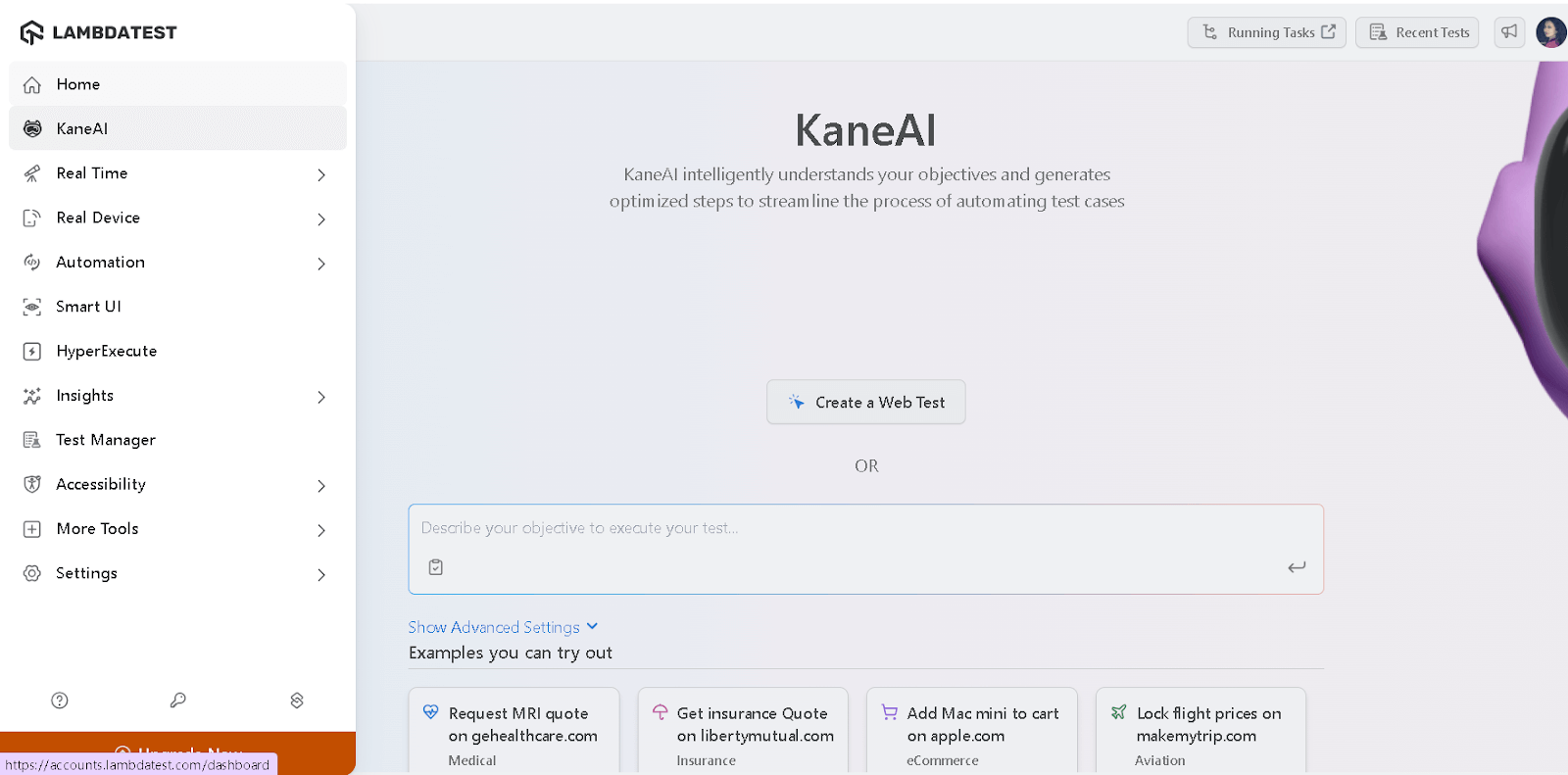
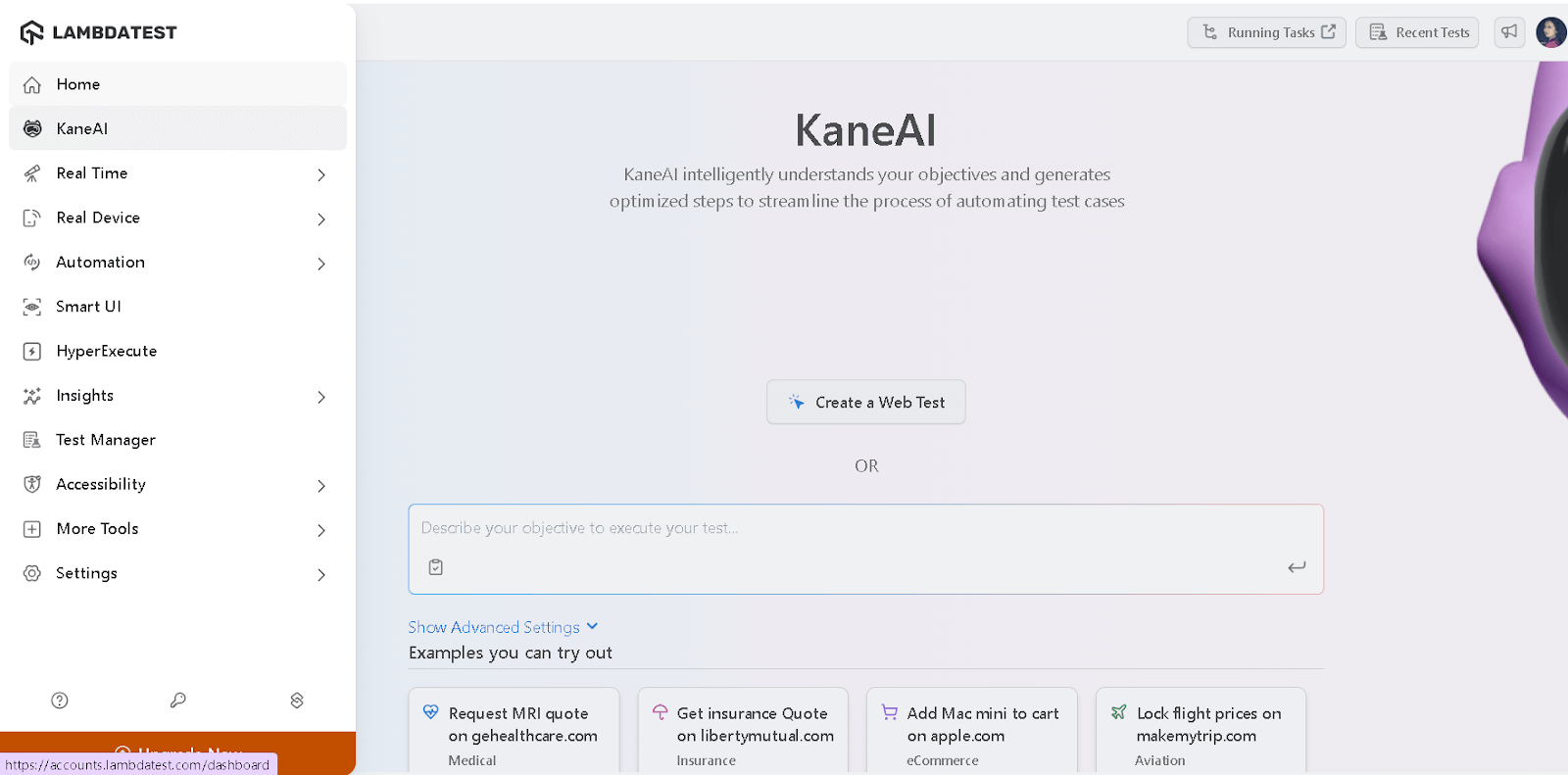
You can either interact with the browser manually while your actions are recorded or use the text area for writing test steps.
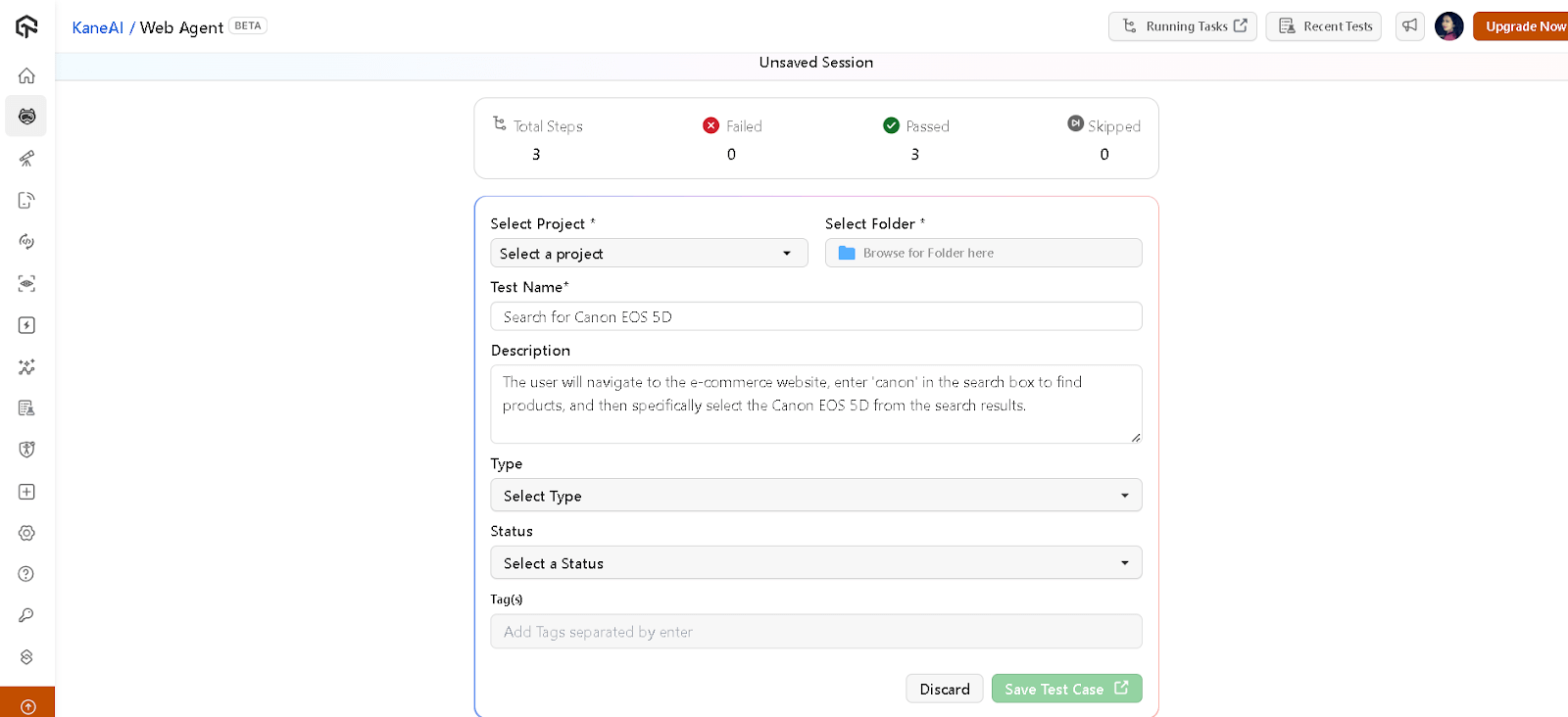
For example, let’s use the test scenario:
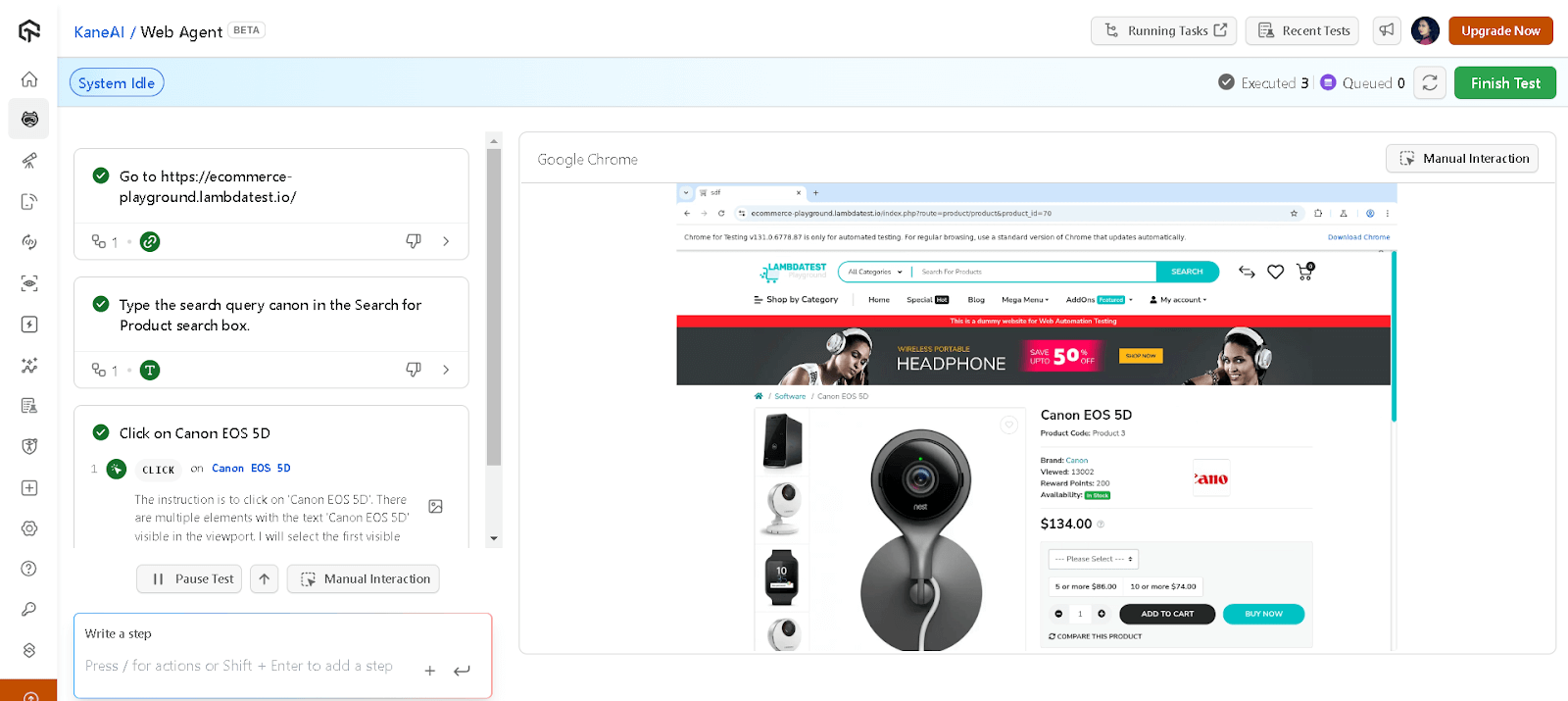
AI auto-populates fields such as Test Name and Description, thus saving time. You can organize tests in folders and reuse them later as per requirement.
To get started, refer to the KaneAI documentation.
With the rise of AI in testing, its crucial to stay competitive by upskilling or polishing your skillsets. The KaneAI Certification proves your hands-on AI testing skills and positions you as a future-ready, high-value QA professional.
Shortcomings of Intelligent Test Automation
ITA also poses some challenges that, if left unaddressed, can cause hindrances to the successful implementation and adoption of ITA.
- Test Maintenance Challenges: Frequent changes, such as the addition of new features or UI updates, can result in broken test automation scripts. It can be resource-intensive and time-consuming to update and maintain these scripts on a regular basis.
- Limitations in the Availability of High-Quality Data: ITA heavily relies on enormous volumes of high-quality data to train predictive models and accurately simulate real-world environments. Insufficient or inaccurate low-quality data can lead to unreliability and results.
- Ambiguities and Measuring ROI: Determining ROI when it comes to ITA implementation can turn out to be a complex task. While it definitely has proven long-term benefits like higher test coverage and reduced maintenance, it may not give results instantly.
- Over-Dependence on Artificial Intelligence: Even if an organization accelerates the integration of ITA, it might be under the wrong impression that AI completely replaces any manual efforts. If the QA team relies too heavily on AI to an extent where decision-making is hampered, AI models would probably fail to perform as per expectations.
- Compliance and Security Concerns: Testing environments involve handling sensitive and vulnerable data. Using AI-powered tools might raise some concerns about data compliance and security and whether it adheres to regulations such as HIPAA or GDPR.
Best Practices for Adopting Intelligent Test Automation
Adopting ITA can have a significant impact on the enhancement of test automation processes. Nevertheless, transitioning to an AI-powered testing system or integrating ITA calls for tactful planning and execution if an organization wishes to realize its full potential.
On that note, let’s check out some best practices for adopting Intelligent Test Automation in detail.
- Having Clarity in Objectives and Goals: Start by defining clear objectives and goals before you even think about adopting ITA into your testing process. It’s important to establish clarity in goals and ensure that they’re in perfect alignment with the broader technology and business strategies of an organization.
- Choosing the Right Technologies and Tools: It’s pivotal to choose the right ITA tools for successful implementation. Organizations should evaluate a tool based on its existing system compatibility, scalability, ease of integration, support of AI, and so on.
- Fostering Collaboration and Upskilling Teams: Intelligent test automation comes with the introduction of new workflows and technologies that need the acquisition of specialized skills by team members.
- Starting Small With Gradual Scaling: The most effective approach to implementing ITA is to adopt a phased method of implementation. Start with pilot projects focusing on automating well-defined and specific areas such as regression suites or smoke tests. These projects allow teams to evaluate the effect of ITA on quality and efficiency by serving as a proof of concept.
- Prioritize Risk Areas and Test Coverage: Effective implementation of ITA involves prioritizing high-risk areas that are crucial to user experience. Intelligent tools are capable of identifying coverage gaps and suggesting additional test scenarios that offer comprehensive validation.
- Continuous Monitoring and Optimization: Instead of being a one-time implementation, ITA is an ever-evolving process that needs continuous optimization and monitoring. They should also be using advanced analytics tools that offer actionable insights into overall test coverage, failure rates, and execution trends.
- Aligning ITA With CI/CD Practices and DevOps: You can seamlessly integrate ITA into your CI/CD pipelines and DevOps workflows to maximize its benefits. It should automatically trigger automated tests, which ensures fast feedback on any changes in code.
Future of Intelligent Test Automation
It’s no secret that intelligent test automation is on its way to completely revolutionize various industries through the combination of advanced AI technologies.
As businesses continue to adapt to quickly evolving technological landscapes, intelligent test automation will drive innovation, boost productivity, and transform operations. In the future, we can foresee a greater integration of AI and ML into test automation tools, which will empower them to go far beyond basic rule-based operations.
Conclusion
ITA exhibits high speed, accuracy, and efficiency, which promises to change the way QA teams work. They bring some considerable benefits, such as adaptive test maintenance, AI-based test optimization, self-healing, etc.
While AI automation might not be a core reality for some organizations right now, it’s going to capture the testing landscape, and for good reason. All in all, quality assurance professionals will function with greater efficiency as long as they have the right technologies and tools to implement ITA. The same intelligence now powers AI website testing, applying these techniques directly to your web apps.
Citations
- Intelligent Test Automation: https://www.researchgate.net/publication/374776889_Intelligent_Test_Automation
Author

Salman Khan
Blogs: 138


Salman is a Test Automation Evangelist and Community Contributor at TestMu AI, with over 6 years of hands-on experience in software testing and automation. He has completed his Master of Technology in Computer Science and Engineering, demonstrating strong technical expertise in software development, testing, AI agents and LLMs. He is certified in KaneAI, Automation Testing, Selenium, Cypress, Playwright, and Appium, with deep experience in CI/CD pipelines, cross-browser testing, AI in testing, and mobile automation. Salman works closely with engineering teams to convert complex testing concepts into actionable, developer-first content. Salman has authored 120+ technical tutorials, guides, and documentation on test automation, web development, and related domains, making him a strong voice in the QA and testing community.
Reviewer

Chaitanya Sharma
Reviewer
Chaitanya Sharma is an AI Product Manager at TestMu AI (formerly LambdaTest), where he builds agentic AI capabilities focused on computer vision and multi-modality, moving testing beyond static script execution toward autonomous, agent-driven workflows. Before TestMu AI he shipped 135+ features at Sprinklr for a no-code community and website builder used by Fortune 500 enterprises including Dell, Samsung, and Polestar. At Policybazaar he led the zero-to-one launch of a digital lending and insurance marketplace embedded in Bahrain's dominant payments app, building a risk-intelligence engine that compressed loan-approval times by 80%. He explored machine learning and NLP through research at the University of Cambridge, and holds a B.Tech from Delhi Technological University.


Intelligent Test Automation FAQs
Did you find this page helpful?
More Related Blogs
TestMu AI forEnterprise
Get access to solutions built on Enterprise
grade security, privacy, & compliance
- Advanced access controls
- Advanced data retention rules
- Advanced Local Testing
- Premium Support options
- Early access to beta features
- Private Slack Channel
- Unlimited Manual Accessibility DevTools Tests