
Power Your Software Testing with AI Agents and Cloud
The Native AI-Agentic Cloud Platform to Supercharge Quality Engineering. Test Intelligently and Ship Faster.

- TestMu AI (Formerly LambdaTest)
- /
- Blog
- /
- AI/ML Testing: A Complete Guide [2026]
AI inaccuracy is the top production risk for organizations deploying AI, cited by roughly a third of respondents in McKinsey's State of AI 2025 report. AI/ML testing is the discipline that catches these gaps before users encounter them in production.
AI and ML systems don't behave like traditional software. They learn from data, make probabilistic decisions, and their performance shifts over time. AI in software testing introduces responsibilities that don't exist in traditional QA: validating training data, detecting drift after deployment, auditing for bias, and ensuring model outputs stay within acceptable bounds.
Overview
To perform AI/ML testing, validate machine learning models for accuracy, fairness, and reliability using tools like TestMu AI for natural language test automation and Great Expectations for data quality. This process requires a structured six-step lifecycle spanning pre-training data validation to post-deployment drift monitoring.
What Is AI/ML in Software Testing
- Testing AI/ML Models: Validating machine learning models ensures prediction accuracy, checks bias across user groups, and monitors behavior under distribution shift.
- AI-Augmented Testing: AI-augmented software testing uses artificial intelligence to generate test cases, prioritize execution, and self-heal broken scripts without manual rework.
How to Test an AI Model
- Step 1: Define acceptance criteria: Defining acceptance criteria requires setting accuracy thresholds, fairness bounds, and latency limits before model training begins.
- Step 2: Validate training data: Validating training data requires running completeness, consistency, and distribution checks on your dataset before training begins.
- Step 3: Evaluate on a held-out test set: Evaluating on a held-out test set measures business-aligned metrics on unseen data to prevent data leakage.
- Step 4: Run bias and fairness checks: Running bias and fairness checks before deployment measures demographic parity and equal opportunity across demographic groups.
- Step 5: Load test the inference API: Load testing the inference API verifies P95 latency and error rates under realistic traffic before going live.
- Step 6: Deploy drift monitoring: Deploying drift monitoring sets up alerts before go-live so model degradation is visible from day one.
Best Tools for AI/ML Testing
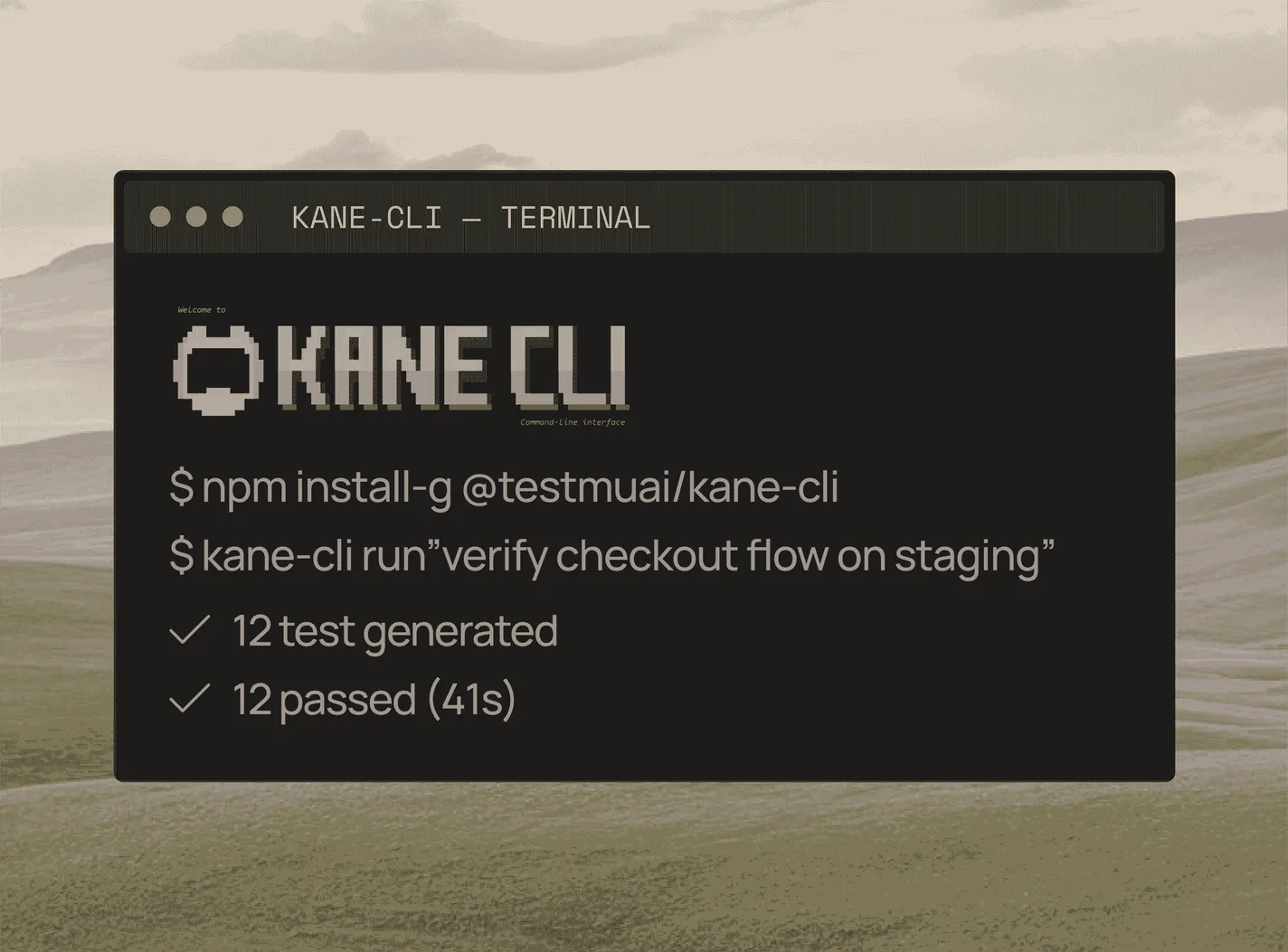
- Best for natural language test automation: TestMu AI - KaneAI plans, authors, and runs test cases across web, mobile, APIs, and databases using plain English prompts.
- Best for data quality validation: Great Expectations - Great Expectations validates training, validation, and test data quality, including completeness and consistency, before model training begins.
- Best for model evaluation: Deepchecks - Deepchecks evaluates machine learning models on held-out test sets to measure performance using business-aligned metrics.
- Best for experiment tracking: MLflow - MLflow provides dedicated experiment tracking capabilities to monitor and manage machine learning models during development.
- Best for production drift monitoring: Evidently AI - Evidently AI monitors models in production to track performance degradation, input distribution changes, and real-world data drift.
- Best for global explainability: SHAP - SHAP assigns contribution values to input features based on cooperative game theory to verify prediction drivers.
- Best for local explainability: LIME - LIME approximates feature importance by building a simple local model around individual high-stakes predictions during compliance reviews.
- Best for RAG faithfulness testing: Ragas - Ragas scores retrieval-augmented generation outputs against retrieved context to detect hallucinations and measure answer relevancy.
- Best for RAG context evaluation: TruLens - TruLens evaluates LLM outputs by measuring context precision and recall to ensure retrieved information is ranked correctly.
What Is AI/ML Testing
AI/ML testing validates artificial intelligence and machine learning systems for accuracy, fairness, and reliability in real-world scenarios.
It is a focused subset of AI testing as a discipline, applied specifically to systems where the output is learned from data rather than explicitly programmed: classification models, regression pipelines, recommendation engines, computer vision systems, large language models, and GenAI-powered features. AI and ML in software testing covers two distinct disciplines:
- Testing AI/ML Models: Validating what the model does: prediction accuracy, bias across user groups, robustness to edge cases, and behavior under distribution shift. A separate guide to AI model testing walks through its core methods and each stage of its lifecycle.
- AI-Augmented Testing: Using artificial intelligence in software testing to generate test cases, prioritize execution, and self-heal broken scripts without manual rework.
Machine learning in software testing is shifting QA teams from rule-based scripts to learned-behavior systems, which changes what effective validation looks like at every stage.
Why Does AI/ML Testing Matter
AI/ML testing prevents accuracy failures, bias incidents, regulatory penalties under the EU AI Act, and silent model degradation that only surfaces after real users are affected.
- Model accuracy: Models that perform well during training often fail in production due to distribution shift. Without holdout test sets and defined accuracy thresholds, teams ship models with unknown real-world performance.
- Bias and fairness: Obermeyer et al. (2019) found a widely used healthcare algorithm that systematically underestimated illness severity in Black patients. Bias surfaces after deployment, not before, unless you test for it.
- Production reliability: Models degrade after deployment as real-world data drifts from training distributions. Testing doesn't stop at launch; it continues as long as the model runs in production.
- Regulatory compliance: The EU AI Act mandates documented testing for high-risk AI systems. Non-compliance carries significant financial and legal consequences that increase as AI adoption scales. An AI governance framework built from the EU AI Act turns obligations like this into tested policy lines with named owners.
AI observability is the discipline that makes model degradation visible in production through continuous monitoring, alerting, and drift detection before failures reach users.
Beyond validating AI systems themselves, QA teams are also using AI to accelerate their own workflows - covered in this guide to AI-augmented software testing, which walks through where AI assists test authoring, maintenance, and triage without removing engineer judgment from the loop.
How Is AI/ML Testing Different From Traditional Testing
Unlike traditional software, AI/ML systems produce probabilistic outputs, drift over time, and require statistical validation, fairness audits, and continuous post-deployment monitoring.
For teams using LLMs to generate and automate their tests, LLM test automation covers how this shift changes the tools and processes on the quality engineering side.
| Dimension | Traditional Software | AI/ML Systems |
|---|---|---|
| Output type | Deterministic: same input always returns same output | Probabilistic: outputs are predictions with confidence scores |
| Expected outcomes | Well-defined pass/fail criteria for each test case | Statistical validation across many examples required |
| Coverage approach | Measurable code coverage (lines, branches, paths) | Input space is too vast to enumerate; coverage metrics are inadequate |
| Post-deployment testing | Largely ends at deployment | Continues indefinitely: drift detection, bias monitoring, revalidation |
| Primary quality concern | Code correctness and logic errors | Data quality, model drift, fairness, and explainability |
| The oracle problem | Expected outcome is always defined | No single correct answer for many tasks (e.g., image captioning) |
Most teams test thoroughly before deployment, then stop. The gap between testing what was deployed and testing what continues to run in production is where most AI failures originate. AI in QA is where teams are restructuring their validation workflows to account for these post-deployment responsibilities.

Note: Test your AI Agents with Agent Testing. Try TestMu AI Today!
What Are the Types of AI/ML Testing
AI/ML testing covers eight types: functional, performance, bias and fairness, security, robustness, data quality, model drift, and A/B testing. Each targets a distinct production failure mode.
| Type | What It Tests | Key Metrics |
|---|---|---|
| Functional Testing | Model meets specified functional requirements; API endpoints return correct structures; error handling works | Prediction format, API response correctness, error rates |
| Performance Testing | System behavior under various load conditions | Prediction latency (P95), throughput (predictions/sec), CPU and GPU utilization |
| Bias and Fairness Testing | Equal treatment of all user groups; outcome disparities across protected characteristics | Demographic parity, equal opportunity, predictive parity |
| Security Testing | Resistance to adversarial inputs, data poisoning, model inversion, and prompt injection | Attack success rate, input validation coverage |
| Robustness Testing | Model behavior with noisy, corrupted, or out-of-distribution inputs | Accuracy on edge cases, performance under noise |
| Data Quality Testing | Training, validation, and test data quality including labels and distribution | Completeness rate, label accuracy, class balance, leakage detection |
| Model Drift Testing | Whether model performance degrades over time in production | Accuracy trends, input distribution changes, feature importance shifts |
| A/B Testing | New model version performance compared to baseline on real users | Statistical significance, business KPIs, engagement metrics |
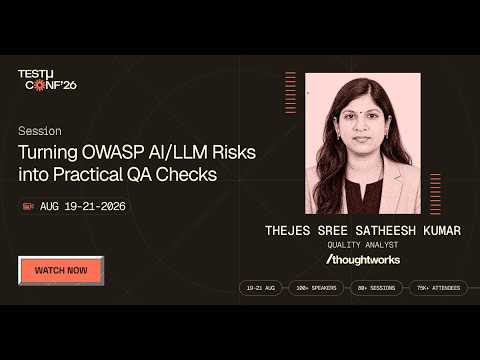
Of those eight, security testing is the one most teams have no playbook for. In this TestMu Conf 2026 session, Testing the Untestable: Turning OWASP AI/LLM Risks into Practical QA Checks, Thejes Sree Satheesh Kumar turns prompt injection, data leakage, unsafe output, hallucinations, and agent misuse into checks a QA team can actually run, the failure modes that traditional API and UI automation misses.
The toolchain and pass criteria for AI in performance testing, AI in regression testing, and generative AI testing each differ based on the specific failure mode they target.
How Do You Test an AI Model
Testing an AI model follows a six-step lifecycle that spans data validation, model evaluation, bias checks, and continuous production monitoring.
- Define acceptance criteria before training: Set minimum accuracy thresholds, fairness requirements, latency limits, and bias bounds by demographic group. Without these upfront, you have no basis to approve or reject a model. For a high-risk system, EU AI Act conformity testing checks against such prior defined metrics and probabilistic thresholds.
- Validate training data before training begins: Run completeness, consistency, and distribution checks on your dataset. A corrupted or imbalanced dataset makes every downstream result unreliable. Generative AI for test data generation shows how AI tooling can accelerate this validation step.
- Evaluate on a held-out test set: Never evaluate on training data. Use a separate, representative test set and measure using your business-aligned metrics: F1, recall, MAE, or whatever your use case demands. The same measurement frameworks used in AI agent evaluation apply here: define thresholds before training, then validate against them on unseen data. The steps, from the held-out split to a confidence interval on each score, are in this guide on how to evaluate AI models.
- Run bias and fairness checks before deployment: Test model outcomes across demographic groups. Measure demographic parity and equal opportunity metrics. Document disparities even when they fall within acceptable thresholds.
- Load test the inference API: Verify the model serving layer handles peak throughput. AI performance testing and load management is where teams define the P95 latency and throughput targets that inference APIs must meet before going live.
- Deploy monitoring from day one: Set up drift detection and performance alerts before going live. Without monitoring, degradation is invisible until users are already affected. Under AI model governance, a drift signal is one of the triggers for re-validating the model.
Platforms such as TestMu AI's Agent Testing lets specialized AI agents handle each testing layer independently and share findings across the pipeline, so your team runs comprehensive AI/ML validation without every step becoming a bottleneck.
To get started, check out this TestMu AI's Agent Testing guide.
What Is the 30% Rule in AI
The 30% rule is a common rule of thumb for step three above: reserve roughly 30% of your dataset as a held-out test set and train on the remaining 70%. It is not a formal law, just a widely used default that keeps evaluation honest.
- Why keep 30% separate: Evaluating on data the model trained on inflates accuracy. A held-out split gives an unbiased estimate of how the model generalizes to unseen inputs.
- Prevents data leakage: When test data influences training, results look strong in evaluation and collapse in production. A strict split is the first defense against leakage.
- The ratio is not fixed: 70/30 and 80/20 are both common. Large datasets can afford a smaller test fraction; small datasets often use k-fold cross-validation instead of a single split so every record is tested once.
How Do You Test Explainability and Hallucinations in LLMs
Explainability testing checks whether you can trace why a model produced an output, and hallucination testing checks whether a language model's output is actually grounded in its source data rather than invented. Both are validation layers that classification metrics like accuracy and F1 do not capture. For a wider view of LLM test design, a Testμ Conf session covers how to scalably test LLMs with intrinsic and extrinsic metrics.
Explainability Testing
For tabular and classification models, explainability testing verifies that feature attributions are stable and defensible. Two methods dominate:
- SHAP (SHapley Additive exPlanations): Assigns each input feature a contribution value for a given prediction, based on cooperative game theory. Test that the features driving a decision are the ones domain experts expect, and that no protected attribute is silently dominating.
- LIME (Local Interpretable Model-agnostic Explanations): Builds a simple local model around a single prediction to approximate which inputs mattered most. Useful for spot-checking individual high-stakes outputs during a fairness or compliance review.
For large language models, feature weights are less useful than grounding. Explainability shifts to citation and source attribution: can the model show which retrieved passage supports each claim it made? That question leads directly into hallucination testing.
Hallucination and Faithfulness Testing
A hallucination is any confident output that is not supported by the source context or the real world; documented LLM hallucination examples show the cost in court filings, newsrooms and product launches. For retrieval-augmented generation (RAG) systems, open-source evaluation frameworks such as Ragas and TruLens score outputs against the retrieved context instead of a fixed expected answer. The core metrics to test:
- Faithfulness: Are the claims in the answer actually supported by the retrieved context? Low faithfulness is the direct signal of hallucination.
- Answer relevancy: Does the response address the question that was asked, without padding or drift?
- Context precision: Are the most relevant retrieved passages ranked highest, or is noise crowding out the signal?
- Context recall: Did retrieval surface all the information needed to answer correctly, or are there gaps the model then filled by guessing?
These metrics are reference-free: they judge each answer against its own retrieved context using an LLM as evaluator, so you can run them continuously in production where no ground-truth label exists. Set thresholds on faithfulness and answer relevancy the same way you set accuracy thresholds for a classifier, and fail the build when a release drops below them. For hallucinations against the real world rather than a retrieved context, the SimpleQA benchmark grades answers to short fact-seeking questions as correct, incorrect or not attempted.
What Are the Best Tools for AI/ML Testing
The best AI/ML testing tools include Great Expectations for data quality, Deepchecks for model evaluation, MLflow for experiment tracking, and Evidently AI for production drift monitoring.
1. TestMu's KaneAI
TestMu's KaneAI is the world's first GenAI-native testing agent that helps teams plan, author, and run test cases using natural language prompts across web and mobile apps, without any manual script writing.
Key KaneAI capabilities:
- Natural language test authoring: Write test cases in plain English. KaneAI converts them into executable tests without any scripting or coding required.
- Web and mobile coverage: Runs tests across desktop browsers, mobile web, iOS, and Android from a single natural language test definition.
- API testing and database validation: Tests REST APIs and validates database state as part of end-to-end test flows authored in natural language.
- Reusable test modules: Saves common test steps as modules that can be referenced across multiple test cases, reducing duplication.
- Smart versioning: Tracks every change to a test case with full version history so teams can audit, compare, and roll back.
- Framework export: Exports generated tests to Playwright, Selenium, Cypress, or Appium so teams can own and extend the code.

2. Great Expectations
Great Expectations is an open-source data validation framework that lets teams define, document, and enforce data quality rules as reusable test suites called Expectations.
- Expectation suites: Define rules for completeness, format, range, and distribution that run automatically on every pipeline execution.
- Data Docs: Auto-generated human-readable reports showing which expectations passed or failed for each dataset version.
- Pipeline integration: Plugs into Airflow, dbt, Spark, and most ML orchestration frameworks without code changes.
3. Deepchecks
Deepchecks is a Python library purpose-built for ML testing. It runs structured validation checks on both data and models at every stage of the ML lifecycle.
- Train-test comparison: Detects distribution drift between training and test sets before a model ever runs in production.
- Model performance checks: Validates accuracy, precision, recall, and segment-level performance with a single function call.
- Bias detection: Checks for performance disparities across subgroups within the dataset.
4. MLflow
MLflow is an open-source platform for managing the end-to-end ML lifecycle. It tracks every training run so teams can reproduce results, compare experiments, and audit model versions.
- Experiment tracking: Logs parameters, metrics, and artifacts for every training run with a single decorator or API call.
- Model registry: Centralizes model versions with staging, production, and archived states for controlled promotion workflows.
- Model serving: Deploys registered models as REST endpoints for testing inference behavior in staging environments.
5. Evidently AI
Evidently AI is an open-source ML observability platform that monitors model performance and data health in production. It generates visual reports and alerts without requiring custom dashboarding code.
- Data drift detection: Compares incoming production data against training baselines and flags statistical shifts before they affect accuracy.
- Model performance monitoring: Tracks prediction quality over time, breaking down results by segment, feature, and time window.
- Test suites: Defines pass/fail thresholds for production metrics and integrates directly into CI/CD pipelines.
How to Evaluate AI-Powered Test Automation Tools
The tools above validate the model itself. A separate category uses AI to build and maintain the tests that exercise your application. An AI QA agent belongs to this second category: you describe the flow in natural language, it plans the cases, authors and executes them across browsers and real devices, and repairs the steps itself when the UI shifts, with your team reviewing the plan and the heals. Both categories are sold as AI testing services, either as a platform your team runs or as a managed engagement. Vendor names change, so evaluate this category on capabilities rather than brand. Look for four:
- Natural-language authoring: Can a tester describe a test in plain English and get an executable script, without writing selectors by hand?
- Self-healing locators: When the UI changes, does the tool adapt element references automatically instead of failing the run and demanding manual repair?
- Visual AI validation: Does it catch rendering and layout regressions by comparing screenshots intelligently, rather than only asserting on the DOM?
- Autonomous test generation: Can it propose new test cases from user flows or requirements, expanding coverage without a human writing each case?
KaneAI, covered above, is TestMu AI's example of this category: it combines natural-language authoring, self-healing, and framework export in one agent. Whatever AI app testing tool you shortlist, score it against these four capabilities before committing.
What Are the Common Challenges in AI/ML Testing
The main AI/ML testing challenges are data quality gaps, model drift, black box opacity, bias detection, high computational cost, and the absence of a test oracle for probabilistic outputs.
| Challenge | Why It's Hard | How Teams Address It |
|---|---|---|
| Data quality | Labeling and preparation happen before training; errors propagate silently downstream | Data validation pipelines with Great Expectations or Deepchecks before every training run |
| Model drift | A model accurate in January can fail by June as real-world distributions shift | Continuous monitoring with drift detection tools; automated retraining triggers |
| Black box opacity | Deep neural networks cannot explain their decisions; debugging and compliance become guesswork | SHAP, LIME, and InterpretML for explainability; model cards for documentation |
| Bias detection | Bias surfaces in production, not in training; by then, retraining the whole model is required | Pre-deployment fairness testing with AIF360 or Fairlearn; regular demographic outcome audits |
| Computational cost | Full test suites on LLMs or computer vision systems can cost thousands of dollars per run | Risk-based test prioritization; parallel cloud execution to reduce wall-clock time and cost |
| No test oracle | Many AI tasks have no single correct answer; traditional pass/fail criteria don't apply | Statistical acceptance thresholds; human-in-the-loop review for ambiguous outputs |
Agentic AI testing explores approaches that go beyond static test suites to probe non-deterministic and dynamic AI behavior.
From Model Metrics to Agent Actions With Agent Assurance
Accuracy, F1, and faithfulness all grade what a model outputs. Once that model sits inside an agent that calls tools, writes files, or hits APIs, the test has to check the effect too. TestMu AI's Agent Assurance is built for those agents: it reads your manifests, prompts, tool tables, and MCP servers to work out what the agent does, says so where the agent declares nothing, and invokes it for real.
For agents that talk over chat, voice, or phone, Agent Testing, covered above, is the separate TestMu AI product; Agent Assurance is for the ones that act.
- Evidence where no oracle exists - with no single correct answer to compare against, each criterion is graded against files that changed on disk, artifacts produced, and tool calls checked against the agent's declared tool surface.
- Unknowns kept out of the rate - a criterion the run could not check gets Unable to Verify, reported beside the pass rate as the assurance gap, so it never inflates the rate you hold to your acceptance threshold.
- Flakiness apart from regression - results that flip with the scenario unchanged are reported separately from regressions, and each run lists what is newly failing and newly fixed, useful when you retest after retraining.
- A CI gate on verdicts - as with the faithfulness thresholds above, rook report --json gives per-criterion verdicts to fail a build on; gate on the report, since a finished run exits successfully whether scenarios passed or failed.
Agent Assurance runs in your terminal as rook, and Claude Code can drive it. Add the skill, open Claude Code in the agent's repository, type /rook, and describe the test you want; every command Claude Code proposes still goes through its own approvals.
npx @testmuai/rook-skill@latest install --agent claude-codeFor an agent that promotes models in a registry, a scoped request could be:
/rook Test the model-promotion agent in this repository, which promotes model versions through the registry API. Use the staging profile, propose up to three scenarios, including one where the evaluation metrics miss the acceptance threshold, and show me the possible writes before invoking the target.The skill is not the CLI, so rook needs its own install; the Claude Code setup guide covers both. The agent's writes are real, so keep the profile on staging.
How Do You Become an AI/ML Tester
You become an AI/ML tester by building on core QA fundamentals and adding a focused layer of data and machine learning skills. You do not need to be a data scientist, but you do need to be fluent in how models are trained, measured, and monitored.
Skills to Build
- Python: The default language for ML tooling. You will read training scripts, write data checks, and drive evaluation libraries with it.
- Statistics and ML concepts: Understand train/test splits, overfitting, distribution shift, and the difference between correlation and a learned signal. The 30% rule section above is the entry point here.
- Evaluation metrics: Know when to use accuracy, precision, recall, and F1 for classification, MAE and RMSE for regression, and faithfulness for LLM outputs. Choosing the wrong metric hides real failures.
- Data validation: Learn to profile datasets for completeness, class balance, and leakage before a model is ever trained, using frameworks like Great Expectations or Deepchecks.
- Fairness and explainability: Be able to run a bias audit across demographic groups and read a SHAP or LIME explanation to defend a model's decisions.
Roles and Certification
The skills above map to emerging titles such as AI Test Engineer, AI QA Analyst, and ML Quality Engineer. To validate them formally, the ISTQB Certified Tester AI Testing (CT-AI) is the recognized industry credential. Its v2.0 syllabus covers testing machine learning and generative AI systems, including their probabilistic behavior and data dependence, and lists the ISTQB Foundation Level as a prerequisite. Browse related testing certifications to plan a wider learning path.
A practical path: start from a QA or automation role, add Python and statistics, apply the six-step model-testing lifecycle above on a real project, then pursue CT-AI once the concepts are hands-on rather than theoretical.
Conclusion
AI/ML testing does not end at deployment. Models drift, data distributions shift, and bias surfaces in production long after launch. The types, tools, and six-step strategy covered here give you a repeatable framework to stay ahead of every failure mode.
Start with the gap that carries the most risk today. Validate data quality if your pipeline is untested. Run bias checks if you have not audited demographic outcomes. Set up drift monitoring if models have been running unsupervised in production. AI in testing is not a single tool or workflow. It is a discipline built incrementally, one validated failure mode at a time.
AI testing tools span the full range from data validation and model evaluation to experiment tracking and production monitoring, covering each stage of the lifecycle described here.
Citations
- McKinsey State of AI 2025: https://www.mckinsey.com/capabilities/quantumblack/our-insights/the-state-of-ai
Author

Rakesh Vardhan
Blogs: 4


Rakesh Vardan is a Principal Software Engineer at Medtronic with over 15 years of experience in software engineering and test automation. He has led automation initiatives at Medtronic and EPAM Systems, architecting full-suite regression and CI/CD frameworks using Java, Selenium, REST-Assured, and DevOps tools. Rakesh has mentored over 60 mentees through 10,227+ minutes on Preplaced, authored a full Java test automation course on GeeksforGeeks, and spoke at TestIstanbul 2024 on deploying LLMs via Ollama. His stack spans Java, .NET, Spring Boot, Cypress, Playwright, Docker, Kubernetes, Terraform, and more. He holds certifications including GCP Architect, Azure AI Fundamentals (AZ-900), and ISTQB credentials. As a tech blogger and speaker, Rakesh now focuses on building scalable, maintainable, and cloud-resilient automation frameworks that align with modern testing and DevOps workflows.


AI/ML Testing FAQs
Did you find this page helpful?
More Related Blogs

TestMu AI forEnterprise
Get access to solutions built on Enterprise
grade security, privacy, & compliance
- Advanced access controls
- Advanced data retention rules
- Advanced Local Testing
- Premium Support options
- Early access to beta features
- Private Slack Channel
- Unlimited Manual Accessibility DevTools Tests