

Power Your Software Testing with AI Agents and Cloud
The Native AI-Agentic Cloud Platform to Supercharge Quality Engineering. Test Intelligently and Ship Faster.


- TestMu AI (Formerly LambdaTest)
- /
- Blog
- /
- 7 Types of SDLC Models: Pros, Cons, and When to Use Each
7 Types of SDLC Models: Pros, Cons, and When to Use Each
The 7 types of SDLC models compared: Waterfall, V-Model, Iterative, Spiral, Agile, Incremental, and DevOps, with pros, cons, and when to use each one.
Last Updated on:
SDLC models are structured frameworks, such as Waterfall, V-Shaped, Iterative, Spiral, and Agile, that define how a team plans, builds, tests, and deploys software.
Each model sequences the same software development process differently: Waterfall locks requirements before design begins, while Agile revisits them every one to three week iteration.
This guide covers the software development life cycle, the five main SDLC models with their phases, advantages, and disadvantages, and how to choose the right one for a project.
TL;DR
- Waterfall completes each development phase, such as requirements, design, coding, and testing, before the next phase begins, which suits projects with fixed and well-documented requirements.
- The V-Shaped model pairs every development phase with a matching test phase, running verification on one side and validation on the other.
- The Iterative model releases a working piece of software early and refines it over repeated cycles that typically last two to six weeks.
- The Spiral model repeats four phases, determining objectives, risk analysis, development and testing, and review, which makes it suited to high-risk projects.
- The Agile model organizes work into one to three week iterations called Time Boxes and adapts to changing requirements throughout development.
- Choosing an SDLC model depends on project size, requirement stability, team size, and how much risk the project can tolerate.
Exploring Software Development Life Cycle (SDLC)
So what is SDLC in software testing exactly? The SDLC model is like a step-by-step guide for handling software projects in your organization. A detailed plan helps create, maintain, replace, or improve software. This plan ensures your software turns out well and the development process goes smoothly. These are the main steps in the software development life cycle:
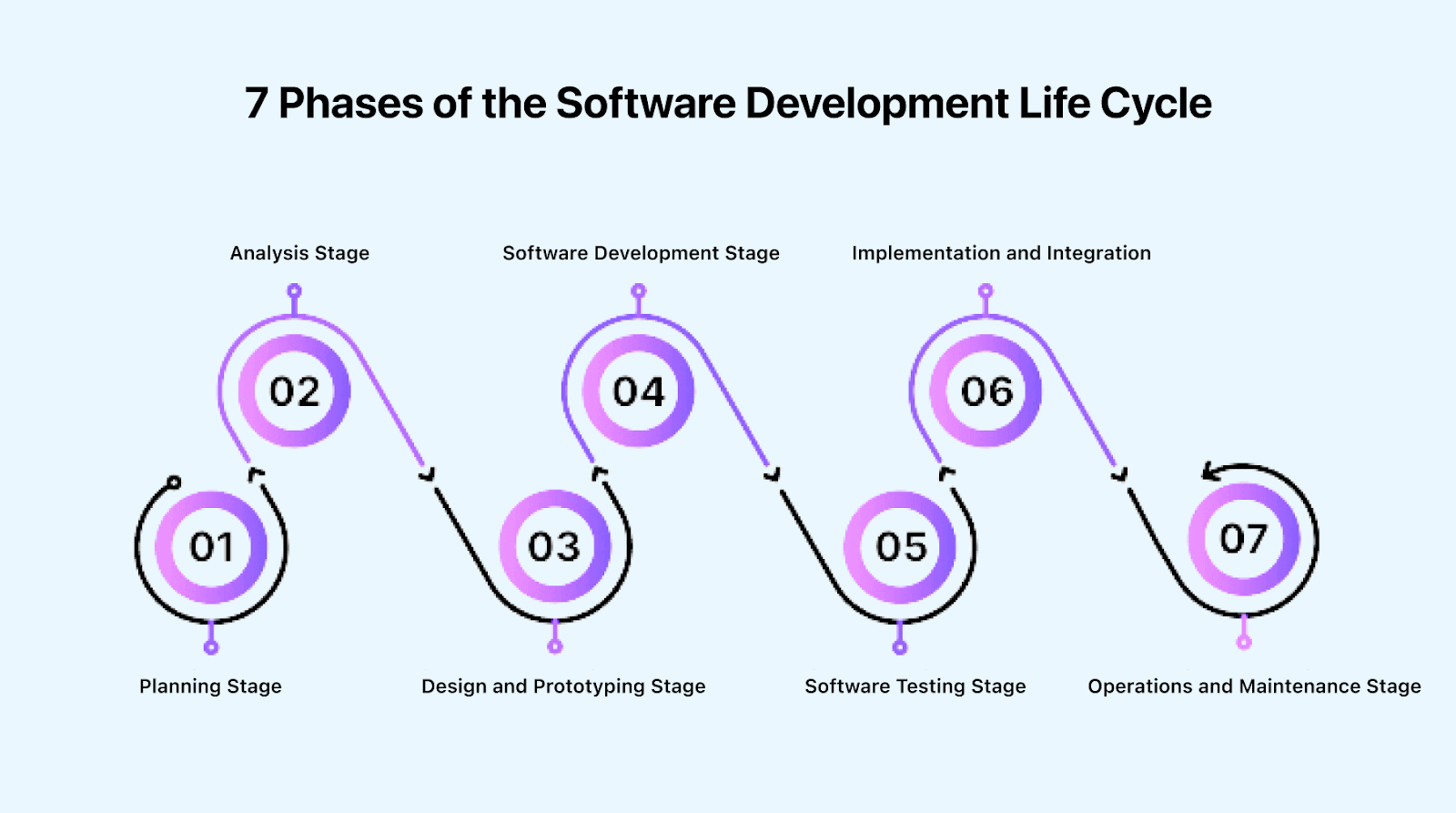
- Planning Stage - This stage, often called the feasibility stage, involves strategic planning for the upcoming project. Here, you carefully plan and define the problem, scope existing systems, and set objectives for new software applications.
- Feasibility or Requirements Analysis Stage - In this stage, you gather all the details needed for new software applications and develop initial ideas for prototypes. Define prototype system requirements, evaluate alternatives, and conduct research and analysis to understand end-users needs. Additionally, developers often create a Software Requirement Specification (SRS) document.
- Design and Prototyping Stage - In this stage, the details are outlined for the overall application, covering user interfaces, system interfaces, network requirements, and databases. The SRS document is then transformed into a more logical structure for implementation in a programming language.
- Software Development Stage - In this stage, the coding for the application commences, using the design documents and other highlighted specifications.
- Software Testing Stage - In this stage, the developed software undergoes thorough testing to ensure a bug-free experience for end-users. Here, you carefully verify the software application, noting any bugs or defects that need tracking, fixing, and retesting.
- On-premise testing - It means testing software on machines within the organization. It brings significant responsibility, requiring everyone to contribute to maintenance, monitoring, and upgrades for machines and software. Additionally, on-premise testing is known for being time-consuming and expensive.
- Cloud-based testing - It enables you to test your software over the cloud, offering added benefits such as scalability, reliability, flexibility, and enhanced security for the testing process.
- Implementation and Integration - In this stage, the complete design of the software application takes shape. The efforts involve integrating different modules or designs into the primary source code, typically using training environments to identify any remaining errors or defects.
- Operations and Maintenance Stage - In this stage, the SDLC doesn't conclude when your software application reaches the market. Instead, you transition into maintenance mode, addressing issues reported by end-users. The developer's and tester's responsibility extends to implementing any changes the software applications might need after deployment.
You have two paths for software testing: on-premise and cloud-based.
There are many cloud-based platforms available in the market that will help enhance the testing process efficiently. One such cloud-based platform is TestMu AI. TestMu AI is an AI-powered test orchestration and execution cloud-based platform where you can perform tests on over 3,000+ browser and OS combinations, browsers, and OS combinations.
This platform allows you to perform tests across various browsers, devices, and operating systems. Further, you can automate those test suites using popular frameworks like Selenium, Cypress, Playwright, Appium, and more. It also offers parallel test execution - that accelerates the test cycle needs.
To learn more about the TestMu AI platform and its functionality and features. Watch this detailed demo on how to use TestMu AI for your various testing needs.

In the mentioned SDLC phases, specific methodologies or approaches define their sequence. These methodologies, known as SDLC models, follow a distinct series of phases designed to their type. The aim is to ensure success at every step of the software development process.
The sections below cover the features, advantages, disadvantages, and more of various SDLC models.
Types of SDLC Models
The SDLC model is the framework guiding developers and testers throughout the software development process. These models act as roadmaps for software projects, helping in task management, resource allocation, and understanding development progress.
It defines the organizational structure of the process, determines the sequence for mitigating potential risks, and comes up with solutions to address challenges.
Many SDLC models are in the market, but choosing the suitable model is a significant challenge, depending on your software project's needs, nature, and the development team's preferences, organization, and requirements. Exploring this, we have compiled a list of the five main types of SDLC models to consider when deciding how to develop your software application.
Let's start uncovering the primary type of SDLC model!
This table compares the seven models covered below:
| Model | How work flows | When testing happens | Best for |
|---|---|---|---|
| Waterfall | Sequential phases, each finished before the next | After development is complete | Fixed, well-understood requirements |
| V-Shaped | Sequential, with a test phase paired to each development phase | Planned alongside each phase, executed after coding | Safety-critical and regulated systems |
| Iterative | Repeated cycles that refine a working version | In every iteration | Large systems whose requirements become clearer over time |
| Spiral | Risk-driven loops of planning, risk analysis, build, and review | In every loop, weighted by risk | High-risk, high-cost projects |
| Agile | Short sprints delivering working increments | Continuously, inside each sprint | Products with changing requirements |
| Incremental | The system is delivered in functional pieces, each fully built | For each increment and its integration | Products that can ship a core first and extend it |
| DevOps | Continuous integration and delivery with automated pipelines | Automated on every change, plus monitoring in production | Services released frequently |
1. Waterfall Model
The Waterfall model, also known as the linear-sequential life cycle model, is primarily a linear project management approach. It involves a step-by-step process for developing software applications, sequentially progressing through stages. The process begins with gathering stakeholder and user requirements at the project's outset. Subsequently, a sequential project plan is developed to meet those specific needs. The term "Waterfall" is quite descriptive, signifying the software development process unfolding in distinct phases, with each starting only after the completion of the previous phase.
Phases of the Waterfall SDLC Model:
When applying the Waterfall methodology to a software development process, we navigate through seven key stages or phases: requirements, analysis, design, code and implementation, testing, operation and deployment, and finally, the maintenance of the software. Now, let's examine a detailed understanding of each phase in the SDLC model.
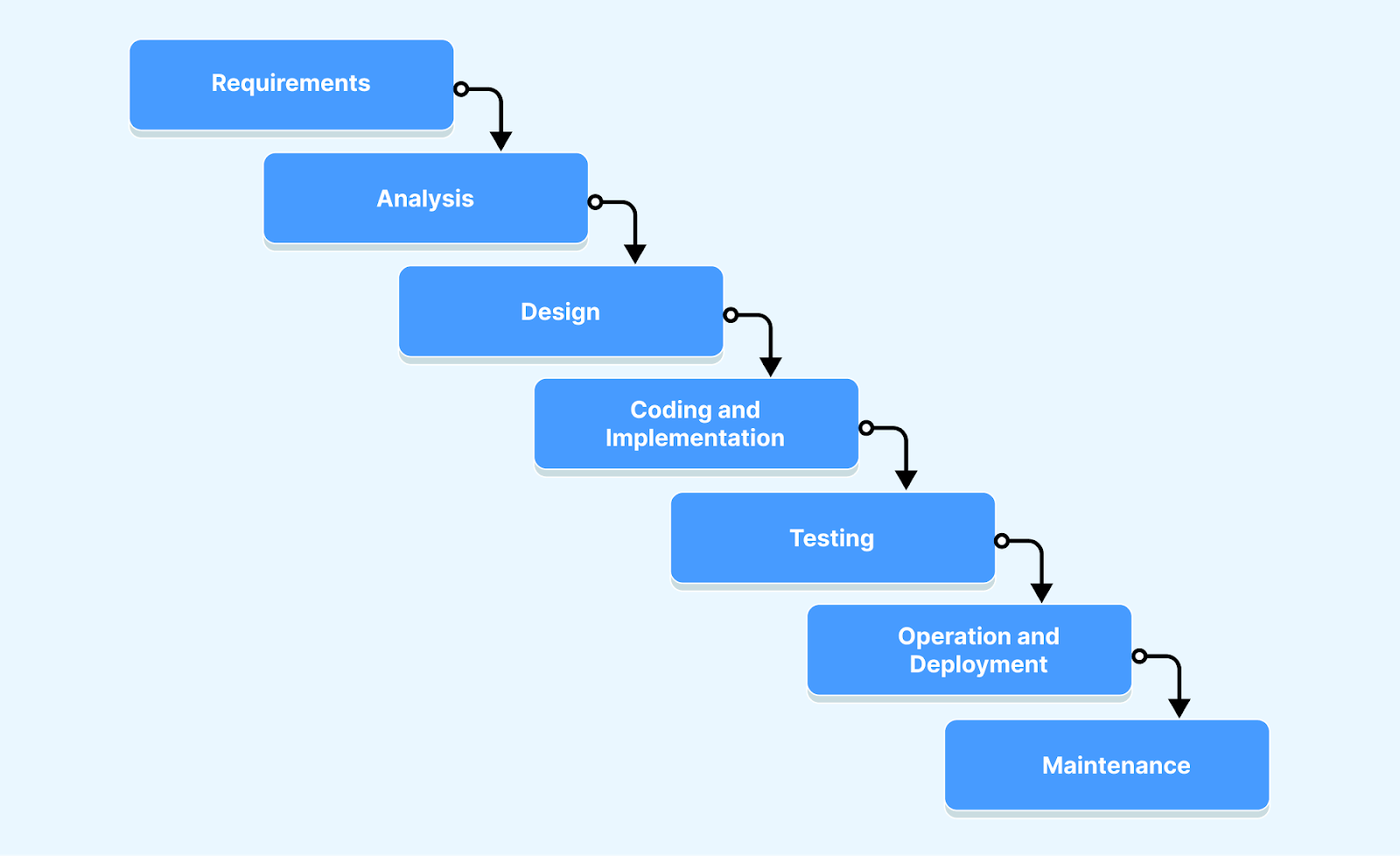
- Requirements - In this stage, you analyze potential requirements, project deadlines, and guidelines. These details are documented in a formal requirements document, a functional specification. This phase defines and plans the project without examining specific processes.
- Analysis - In this stage, you analyze software application specifications to create software application models and business logic that guide production. Additionally, you audit financial and technical resources for feasibility.
- Design - In this stage, the design specification document outlines technical requirements, encompassing programming language, hardware, data sources, architecture, and services.
- Coding and Implementation - In this stage, the source code is developed based on the models, logic, and requirement specifications outlined in earlier phases. The software application is typically coded into smaller components or units before integration.
- Testing - In this stage, the software application is tested, where the Quality Assurance (QA) team performs unit, system, and beta testing to identify and resolve issues. If needed, debugging may prompt a repeat of the coding stage. If the software application passes integration and testing, we move forward.
- Operation and Deployment - In this stage, the software application is marked as fully functional and ready for deployment in a live environment.
- Maintenance - In this stage, the maintenance of the deployed software is handled, involving ongoing corrective, adaptive, and perfective maintenance to continuously enhance the software application's functionality. It includes releasing patch updates and new versions.
Upon completion of the software application development, the testing phase takes center stage, marking the entry of testers into the process. Their primary responsibility is to carefully examine the codebase of the developed software application, aiming to uncover and address bugs and errors. A comprehensive test plan is created, encompassing various testing types such as integration, acceptance, unit, functional, and non-functional testing. It ensures a thorough evaluation of the software application's functionality, features, and adherence to the Software Requirements Specification (SRS).
During this testing phase, identified bugs are reported to the developers for resolution. Testers use manual and automation testing to validate the software application.
Manual testing involves a hands-on approach to examine the software application manually, detecting any potential bugs or issues. On the other hand, automated test execution entails the creation of automated test cases designed to evaluate the functionality of the software application. Automated testing aims to ensure that the software application aligns with the specifications outlined in the SRS.
Subscribe to the TestMu AI YouTube channel to catch up with the latest news on Selenium testing, `Playwright testing`, Cypress testing, and more.
Features of the Waterfall SDLC Model:
- Sequential Approach - It follows a systematic and sequential approach to software development. Each project phase is completed before progressing to the next, ensuring a structured progression.
- Document-Driven - Its reliance on extensive documentation ensures that the project is well-defined and the project team works towards achieving precise, documented goals.
- Quality Control - It emphasizes quality control and testing at every project phase. This meticulous testing ensures that the final product aligns with the requirements and expectations of stakeholders.
- Rigorous Planning - It involves a comprehensive planning process. Project scope, timelines, and deliverables are meticulously defined and monitored throughout the project lifecycle, contributing to effective project management.
Advantages of the Waterfall SDLC Model:
- It is easy to use and understand.
- It handles each process individually with no overlaps, ensuring clarity and organization.
- It is well-suited for smaller projects with clearly understood requirements.
- It is straightforward and helps identify critical points in the development cycle.
- It helps to classify and prioritize tasks easily.
Disadvantages of the Waterfall SDLC Model:
Despite several advantages, the Waterfall model has some shortcomings. Here are some of the limitations of the Waterfall SDLC model.
- The software is considered ready after completing the last stage.
- It involves high levels of risk and uncertainty.
- It is unsuitable for complex and object-oriented projects.
- This SDLC model is unsuitable for long-term projects.
Applications of the Waterfall SDLC Model:
- Large-scale Software Development Projects - It is frequently used in large-scale software development projects. Its structured and sequential approach is beneficial to ensure timely and budget-compliant project completion.
- Safety-Critical Systems - It is commonly applied in developing safety-critical systems like aerospace or medical systems. Its usage is essential in environments where errors or defects could have severe consequences.
- Government and Defense Projects - It often opts for government and defense projects due to its rigorous and structured nature. This approach ensures that the project meets all requirements and is delivered on time.
- Projects with Well-defined Requirements - It best suits projects with well-defined requirements. Its sequential nature demands a clear understanding of project objectives and scope.

Note: Run your tests across various browsers and operating system combinations. Try TestMu AI Today!
2. V-Shaped Model
The V-model, or Verification and Validation model, extends the traditional Waterfall model by aligning development (verification) and testing (validation) and stages. This implies that each phase is directly connected to the testing phase in the software development process, forming a comprehensive and rigorous approach shaped like a 'V.' The left half of the V represents Verification, the right half represents Validation, and both are connected by a coding phase, creating its distinctive V shape. For a detailed breakdown of its phases, benefits, and tools, see our guide to the V-Model in software development.
Phases of the V-Model (Verification):
The V-model comprises five stages or phases: business requirement analysis, system design, architecture design, module design, and coding. Let us get into more detail on understanding each phase below.
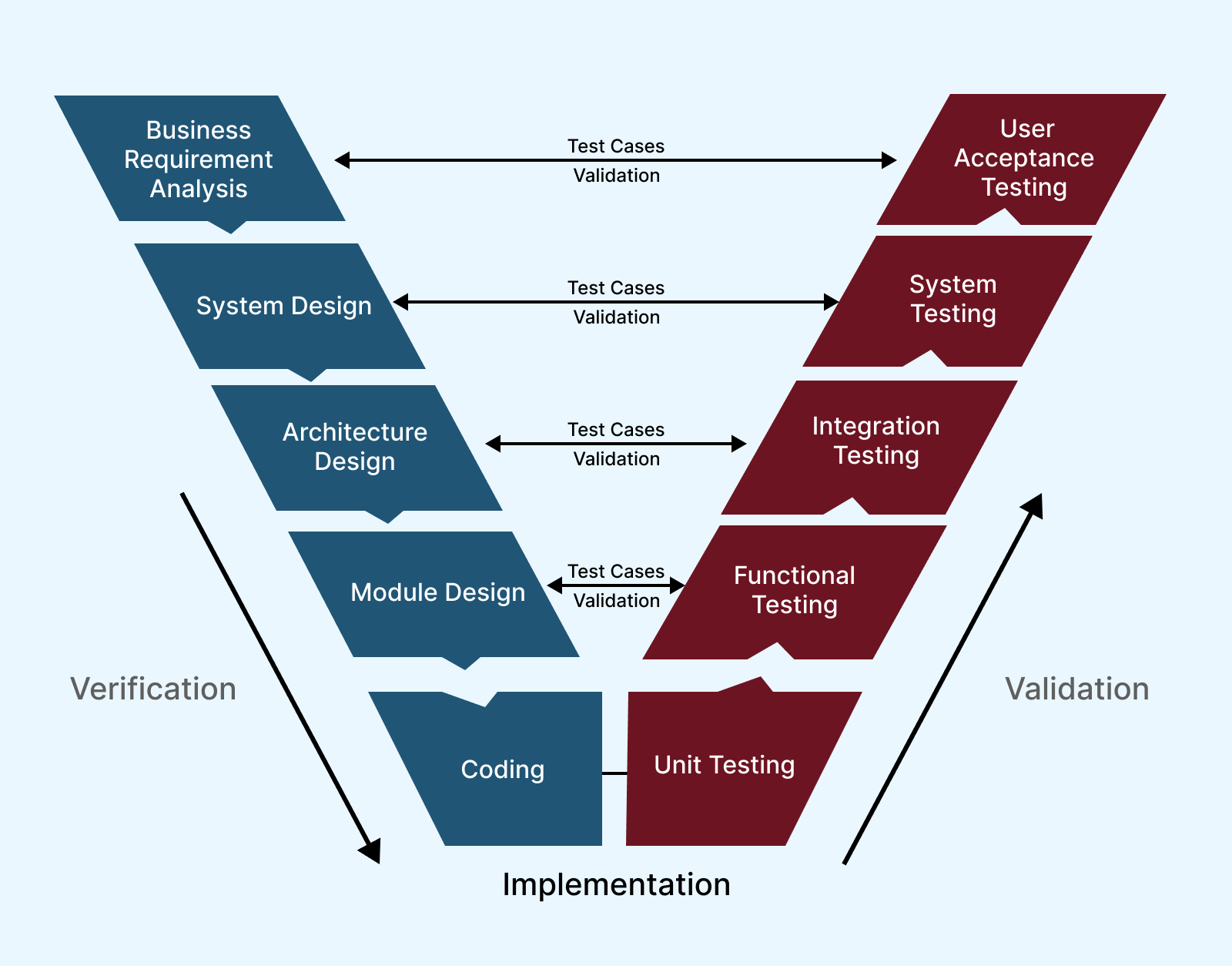
In the verification phase, static analysis examines whether the current phase meets its desired requirements without executing the code. Conversely, in the validation phase, dynamic analysis occurs, checking whether the current phase fulfills the desired requirements that users expect from the software application by executing the code.
- Business Requirement Analysis - In this stage of the development cycle, the focus is on understanding and addressing product requirements from the customer's perspective. Having effective communication with the customer is crucial to grasp their needs accurately.
- System Design - In this stage, the system design begins once we clearly understand the product requirements. It is crucial to design the system entirely, and this comprehension occurs at the initial stages of the entire product development process. This early understanding is valuable for the future execution of test cases.
- Architecture Design - In this stage, developers and testers understand and design architectural specifications. Typically, several technical approaches are considered, and the final decision is made by evaluating technical and financial feasibility. The system architecture is then divided into modules, each addressing a specific function called High-Level Design (HLD).
- Module Design - In this stage, the detailed internal design for each system module is specified. Ensuring compatibility between the design and other external systems and other modules within the system architecture is crucial. Unit tests are vital in any development process as they help identify and eliminate most mistakes and flaws early. These unit tests can now be developed with the internal module designs in place. This phase is also known as the Low-Level Design (LLD).
- Coding - In this stage, the actual writing of code for the system modules designed in the previous phase occurs. The system and architectural requirements guide the selection of the most suitable programming language.
Customers may only sometimes know their requirements precisely, so the acceptance test design planning becomes pivotal. This planning, conducted during the business requirement phase, serves as input for acceptance testing.
The data exchange and communication between internal modules and external systems are well understood and defined. This phase allows for creating and documenting integration tests based on the provided information.
The process of coding sticks to established coding standards and principles. Multiple code reviews and optimizations for optimal performance are conducted before the final build is checked into the repository.
Phases of the V-Model (Validation):
In the validation phase, dynamic analysis techniques are used, encompassing functional testing and non-functional testing, achieved through code execution. It is the evaluation process conducted after completing the development phase. It aims to assess whether the software aligns with customer expectations and requirements.
- Unit Testing - Unit test plans are formulated in this stage, specifically during the module design phase. The execution of these plans is carried out to identify and eliminate bugs at the code or unit level.
- Functional Testing - It involves testing various actions and functions of the system to ensure they meet the specified criteria. This is done by providing input to the system and comparing the actual output to the expected output. Test cases are designed based on the software requirements and customer expectations to ensure thorough testing of all functionalities.
- Integration Testing - After completing unit testing, the next step is integration testing. During this phase, the modules are combined, and the entire system undergoes testing. Integration testing is conducted based on the Architecture design phase, ensuring the verification of communication between modules.
- System Testing:
- User Acceptance Testing - This User Acceptance Testing (UAT) occurs in an environment mirroring the production setup. UAT aims to confirm that the delivered system aligns with user requirements and is prepared for real-world use.
System testing assesses the entire application, evaluating its functionality, interdependencies, and communication. This phase tests both the functional and non-functional requirements of the developed application.
To understand the different types of testing in the Software Testing Life Cycle (STLC), check out this guide on types of software testing. It explains each testing type, helping you grasp the details quickly. It's a simple and helpful resource to improve your understanding of testing in software development.

Features of the V-Model:
- Hierarchical Testing - It follows a hierarchical perspective. For instance, the project team identifies requirements and creates High-Level Design and Detailed Design phases. As each phase concludes, the defined requirements become progressively refined and detailed.
- Data/Process Integrity - Its principle emphasizes that a successful project design requires seamless integration of data and processes. Process elements must be identified at every requirement stage.
- Scalability - Its principle states that the V-Model concept can adapt to accommodate IT projects regardless of size, complexity, or duration.
- Cross-Referencing - It is the direct correlation between requirements and the corresponding testing activities, ensuring alignment and traceability.
Advantages of the V-Model:
- It provides guidelines focusing on one phase at a time.
- It makes use of a simple and easy-to-understand framework.
- It establishes specific deliverables, making task delegation and progress tracking easy.
- It includes a review process for each phase to ensure accuracy.
- It promotes high-quality design and development.
- It includes exhaustive documentation for each phase.
Disadvantages of the V-Model:
Despite many advantages, the V-model has several shortcomings that can impact its effectiveness:
- It is a structured approach that can be time-consuming for large projects.
- It is a rigid structure that can make alterations challenging.
- It delays implementation, reducing early prototype opportunities.
- It changes during software project execution and may require updates across all phases.
Applications of the V-Model:
- Structured Software Development - It provides a systematic and structured approach to software development, contributing to enhanced organization and overall efficiency.
- Alignment of Development and Testing - It emphasizes the alignment of development and testing activities; this SDLC model enables the early identification and resolution of defects.
- Thorough Verification and Validation - It ensures comprehensive verification and validation. This SDLC model rigorously tests the software throughout the entire development lifecycle.
- Documentation and Traceability - It strongly emphasizes documentation and traceability, promoting transparency and simplifying future enhancements.
- Adherence to Regulatory Requirements - It is commonly used in industries with strict regulatory requirements. This SDLC model helps in compliance and adherence to established guidelines.
- Collaboration and Communication - This SDLC model encourages collaboration between development and testing teams, enhancing communication and teamwork.
- Project Management and Control - It is a framework for project management and control; this SDLC model facilitates progress tracking and efficient resource management.
3. Iterative Model
In the Iterative model, you initiate the software development process by implementing a small requirements set. Over successive iterations, these versions are enhanced until the entire software application is ready for deployment. This approach enables continuous improvements and changes at each development stage, eliminating the need to wait until the project's completion.
The advantage lies in having a functional piece of software early in the lifecycle, as the iterative model starts with a basic execution of a limited set of requirements. This iterative refinement continues until the complete application is implemented and ready for distribution. Each release in the Iterative model adheres to a specific and predetermined time frame, known as an iteration.
The repetitive process facilitates the creation of new software versions in each cycle. Lasting from two to six weeks, each iteration involves the development of a distinct component of the system, which is then integrated with earlier features. Bugs and errors from previous iterations do not carry over, showcasing the model's flexibility to incorporate user feedback in every cycle.
Below, we will learn each phase in the Iterative model in detail.
Phases of the Iterative SDLC Model:
The Iterative model comprises seven stages or phases: requirement gathering, design, implementation, testing, deployment, review, and maintenance. Let us get into more detail on understanding each phase below.
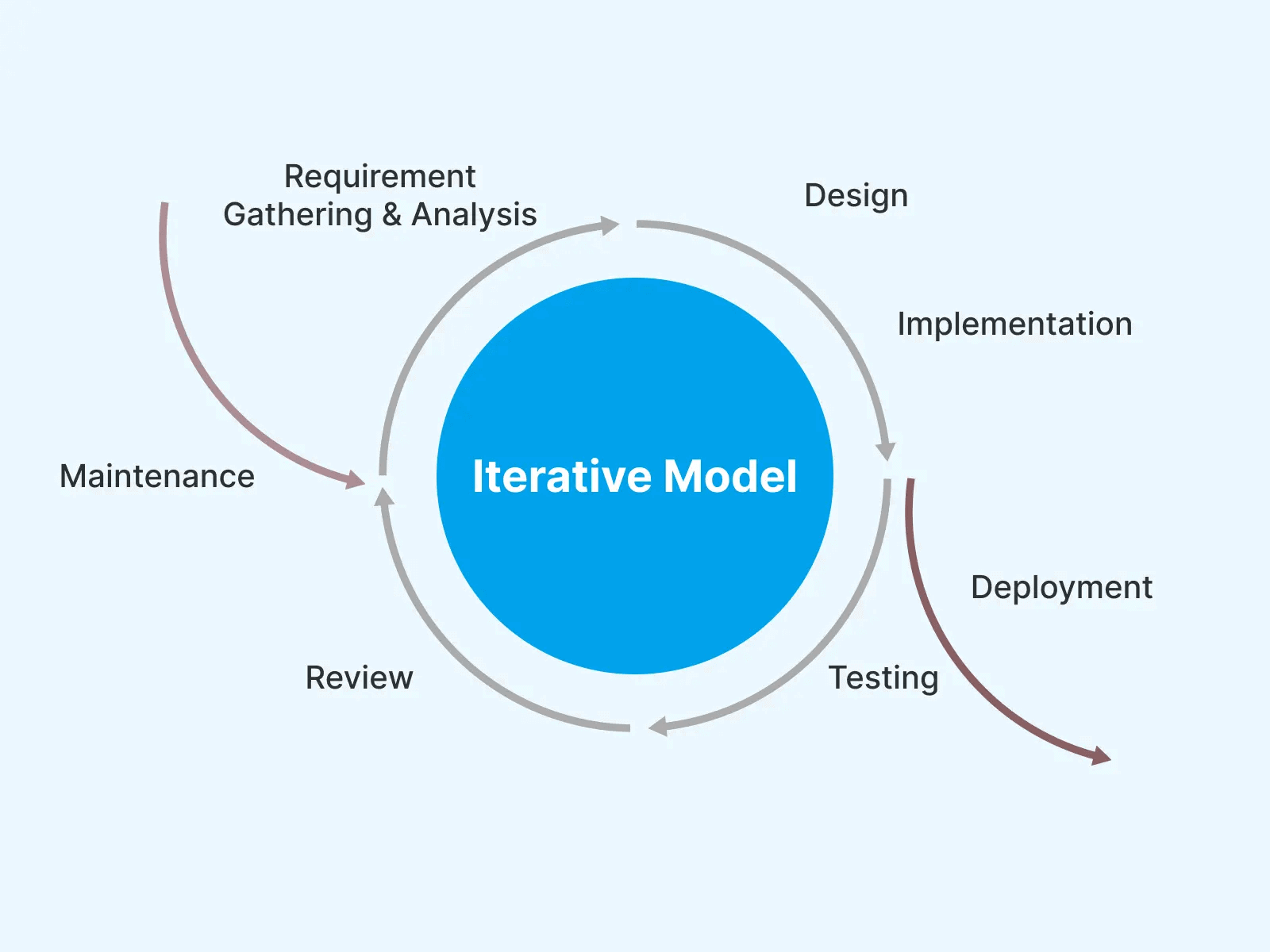
- Requirement Gathering - In the initial stage, business owners and developers collaborate to discuss the website's goals and requirements, laying the foundation for the project.
- Design - In this stage, the project team receives a comprehensive list of criteria. It uses various diagrams, such as data flow, class, activity, and state transition diagrams, to gain explicit knowledge of program design and guide development.
- Implementation - In this stage, the developers translate the design into a tangible website, adhering to predefined coding and metrics standards. Unit tests are implemented at each code development stage, aiming for a fully functional, testable system for that iteration.
- Testing - In this stage, the website undergoes rigorous testing to ensure it meets requirements and functions correctly. Various testing techniques, including performance, stress, security, requirements, usability, multi-site, and disaster recovery testing, are used to identify and rectify bugs or errors.
- Deployment - In this stage, the software application is deployed to its working environment.
- Review - In this stage, a thorough examination of the complete behavior and validity occurs after product deployment. Any identified errors prompt a return to the requirement-gathering phase.
- Maintenance - In this stage, the software that has been deployed and is now live undergoes maintenance. This may involve fixing bugs or implementing new updates to enhance the software's functionality.
Features of the Iterative SDLC Model:
- Iterative Development - Its project is divided into manageable iterations, each functioning as a mini-project. A subset of the software's features is designed, implemented, and tested within each iteration.
- Feedback Integration - It follows each iteration; stakeholders and team members review the progress, providing valuable feedback. This feedback is actively used to make necessary improvements and adjustments to enhance the project.
- Incremental Evolution - The software gradually evolves with each iteration, ensuring it is somewhat functional after each cycle. Subsequent iterations introduce new features, contributing to the progressive development of the software.
- Adaptability - Its iterative approach is inherently flexible and adaptive, particularly suitable for projects with evolving or uncertain requirements.
- Prototyping Integration - Its prototyping is frequently used within iterations to explore and clarify requirements, facilitating a better understanding of user needs and system functionality.
- Risk Identification and Mitigation - It enables early identification and mitigation of risks. Addressing issues and challenges in the initial stages significantly reduces the likelihood of encountering major problems later in development.
Advantages of the Iterative SDLC Model:
- It allows you to obtain working software early in the development lifecycle.
- It allows you to incorporate new functionalities at any point in development.
- It is cost-effective due to lower expenses for changing requirements than other models.
- It gives quick feedback from end-users and stakeholders and facilitates timely implementation into the software application.
- It helps identify errors and bugs in the software application early in the iterative process.
- It is suitable for smaller development teams to meet for this model compared to other process models.
Disadvantages of the Iterative SDLC Model:
Despite many advantages, the Iterative SDLC model has several limitations that can impact its effectiveness:
- It poses problems related to system architecture as all requirements are not gathered upfront.
- It may not be the best choice for smaller projects due to its inherent complexity.
- It can be more resource-intensive than the Waterfall model.
- It requires specialized skills for risk analysis to evaluate risks in the system.
- It manages the entire iterative process and can be challenging due to its dynamic nature.
Applications of the Iterative SDLC Model:
- Clearly Defined System Requirements - It facilitates a smooth development process when the requirements of the complete system are clearly defined and understood by the development expertise.
- Evolution of Functionalities - It allows major system requirements to be defined initially; however, some functionalities or requested enhancements may evolve.
- Flexibility in Resource Allocation - It allows flexibility in resource allocation if resources with the required skill set are unavailable and planned to be used on a contract basis for specific iterations.
- Opportunity for Skill Enhancement - It offers an opportunity for skill enhancement when the development team uses and learns a new technology while working on the project.
- Adaptation to High-Risk Features - It allows adaptation to evolving project requirements if some high-risk features and goals may change.
- Time-to-Market Constraint Advantage - It provides the advantage of delivering functional software in incremental releases when there is a time-to-market constraint.
4. Spiral Model
The Spiral model segments the software development life cycle into repetitive architecture and prototyping stages, merging iterative development with the structured aspects of the Waterfall model. It's a unique blend, emphasizing risk analysis and proving beneficial by allowing the incorporation of elements from multiple process models based on unique risk patterns, ensuring an efficient development process.
It is one of the most flexible methodologies, providing developers with significant freedom to develop highly personalized software applications. The transition to the next stage occurs even if the previous one is not fully completed, showcasing its adaptability and flexibility in handling diverse development scenarios.
Phases in the Spiral SDLC Model:
The Spiral model comprises four stages or phases: determining objectives, risk analysis and resolving, developing and testing, reviewing and planning for the next phase. A project cyclically traverses these stages, forming a spiral within the model.
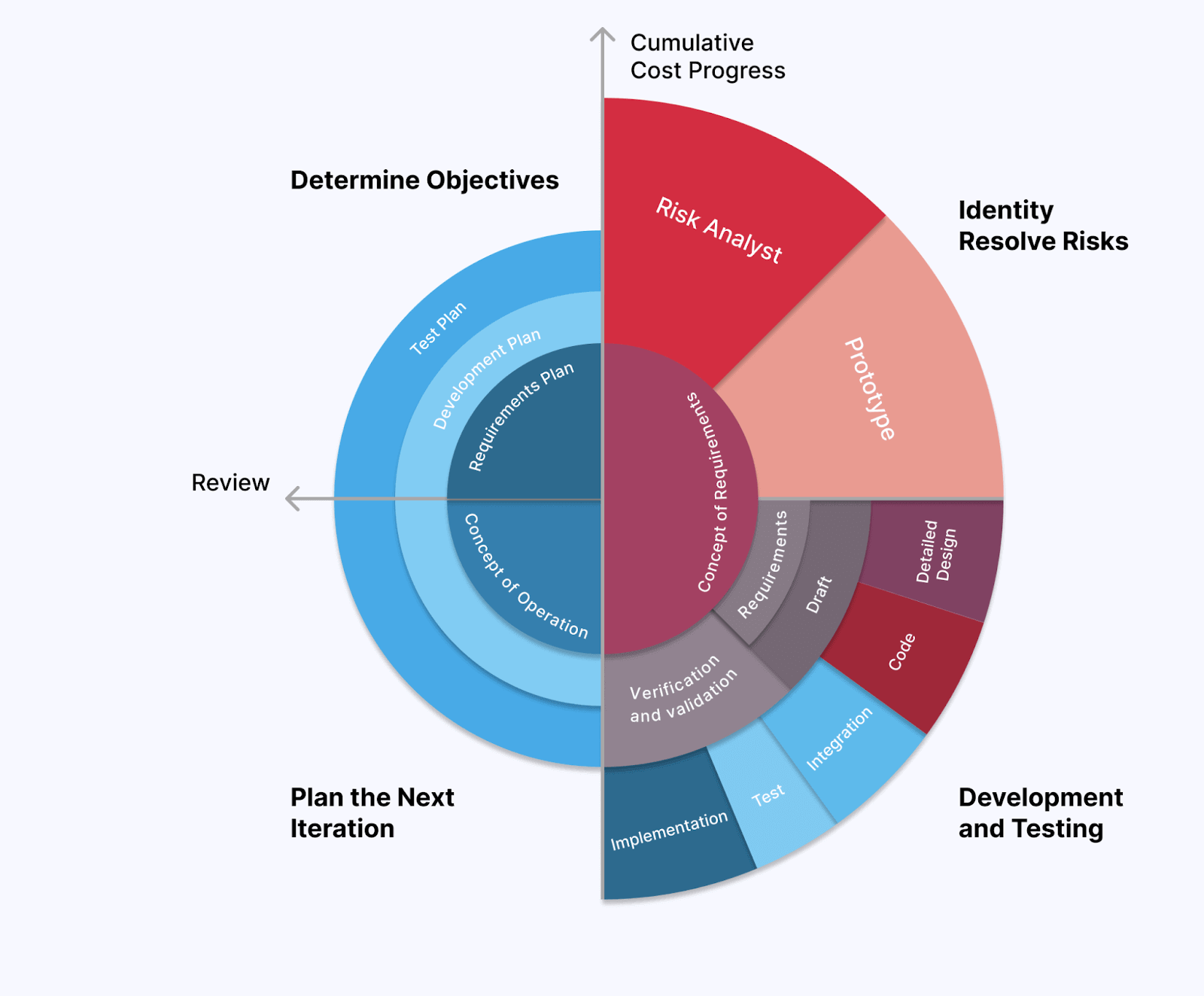
- Determine Objectives - In this stage, the requirements are gathered and analyzed, the objectives are defined based on the requirements, and various alternate solutions are proposed.
- Risk Analysis and Resolving - In this stage, all proposed solutions undergo analysis, and potential risks are identified and resolved.
- Development and Testing - In this stage, various features are implemented, and each implemented feature undergoes comprehensive testing.
- Reviewing and Planning of the Next Phase - In this stage, the software undergoes an evaluation to identify and monitor potential risks, such as cost overrun or schedule slippage. Following this assessment, the team begins planning for the next phase.
Features of the Spiral SDLC Model:
- Handling Unknown Risks through Prototypes - It is crucial to handle unknown risks after the project has started, which are effectively addressed through prototype development.
- Continuous Risk Mitigation with Prototypes - It provides the scope to build a prototype at every phase of software development, facilitating continuous risk mitigation.
- Flexibility for Adaptive Risk Management - It is more flexible than other SDLC models, allowing for adaptive risk management throughout development.
- Advantageous Handling of Post-Development Risks - It proves advantageous in real-life scenarios where project risks occur after the development work starts.
- Identifying and Resolving Risks through Prototyping - It uses a prototyping model to resolve risks identified for the analyzed product.
Advantages of the Spiral SDLC Model:
- It accommodates changing requirements, fostering flexibility throughout development.
- It allows for the extensive use of prototypes, facilitating a tangible representation of the system's evolving features.
- It enables more accurate requirement capture, enhancing the understanding of project needs.
- It provides early user visibility, promoting transparency and aligning development with user expectations.
- It supports effective risk management by segmenting development into smaller parts, enabling the prioritized development of riskier components. This helps in more effective risk management.
Disadvantages of the Spiral SDLC Model:
Despite many advantages, the Spiral SDLC model has several limitations that can impact its effectiveness:
- It becomes more complex due to its iterative and evolving nature.
- It may not be clear early in the process, introducing uncertainty.
- It may not be suitable for small or low-risk projects, potentially leading to increased expenses.
- It requires careful navigation and oversight throughout the development life cycle.
- Its spiral may continue indefinitely, raising concerns about project timelines and closure.
- Many intermediate stages necessitate extensive documentation, which can be a drawback due to the associated resource investment.
Applications of the Spiral SDLC Model:
- Modular Incremental Delivery - It divides software development into modules, allowing incremental delivery to the customer from project inception. This modular approach facilitates early customer engagement and adapts well to changing requirements.
- Adaptive and Flexible Development - It is a step-by-step process that supports an adaptive and flexible development process. It accommodates changes during development, making improvements at each stage. This iterative nature is advantageous for projects requiring responsiveness to evolving needs, making it particularly suitable for web-based applications and integrated into mobile application development for mobile apps.
5. Agile Model
The Agile model presents a highly practical and adaptive software testing and development approach. Designed to meet the specific requirements of each project, it integrates Iterative and Incremental process models. The primary objective is to achieve adaptability and user satisfaction by swiftly delivering functional software applications.
In Agile, projects are divided into cycles characterized by short time limits, ensuring the rapid delivery of software. These cycles, referred to as iterations, typically span one to three weeks within a Time Box timeframe.
Within each iteration in the Agile model, the development team concentrates on creating small, incremental software builds. The Time Box, a fixed end date, determines the maximum duration for delivering an iteration to clients. To meet deadlines, there are instances where the team might opt to limit the functionality within a Time Box. This iterative and time-bound approach ensures a focused and efficient development process.
Phases of the Agile SDLC Model:
The Agile model comprises six stages or phases: requirement gathering, design requirement, development, test, deployment, and review. Let us get into more detail on understanding each phase below.
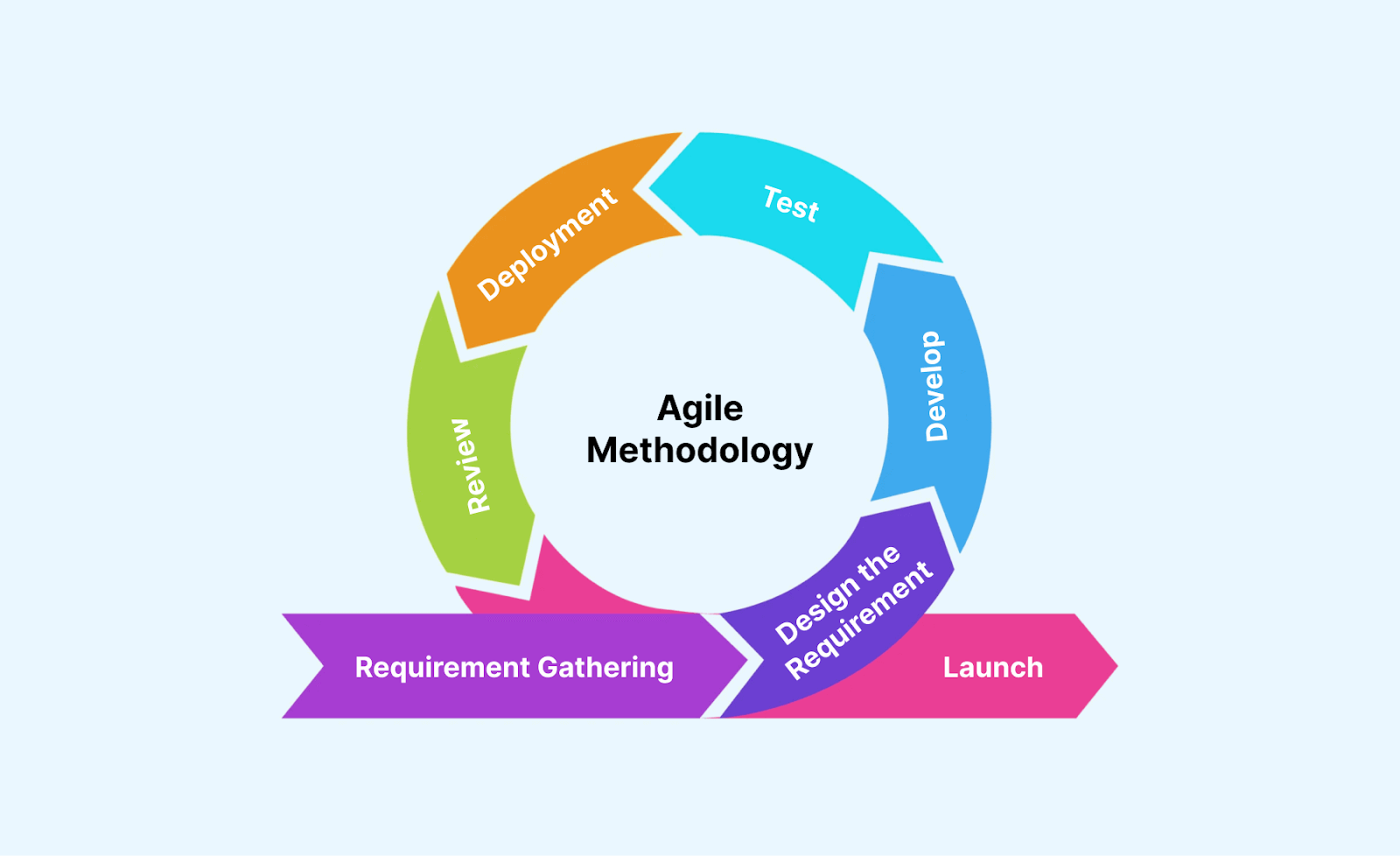
- Requirement Gathering - At this stage, you define the software project criteria, describe business opportunities, and estimate time and effort. Here, you evaluate the technical and economic feasibility based on this information.
- Design the Requirement - In this stage, the stakeholders collaborate to define project requirements. You can use user flow diagrams or high-level UML diagrams to illustrate how new features will function within the existing software application.
- Develop/Iteration - In this stage, once the requirements are defined, designers and developers begin working on the project to release functional software applications. The application undergoes multiple development stages before being deployed.
- Test - In this stage, the quality assurance team performs unit testing, integration testing, and system testing to ensure the software application's performance and identify bugs.
- Unit Testing - It performs testing on small components or units of code to ensure individual parts work properly.
- Integration Testing - It identifies and resolves issues that may arise when combining software units.
- System Testing - It performs testing on the complete system and is evaluated and verified to ensure that all the integrated components of the software application function accurately. If the system test is successfully passed, the testers allow the next deployment phase.
- Deployment - In this stage, the development team generates software applications tailored to the user's work environment.
- Review/Feedback - In this stage, following the release of the software application, the team gathers feedback and addresses it in this concluding phase.
Features of the Agile SDLC Model:
- Individuals and Interactions - In Agile development, self-organization and motivation are essential, as interactions like co-location and pair programming provide opportunities for effective collaboration.
- Working Software - Instead of relying solely on documentation, you can communicate effectively with users by presenting demo working software. This approach allows you to understand their requirements better.
- User Collaboration - Since project requirements may not be fully gathered at the project's onset, continuous interaction with users becomes crucial for obtaining accurate and evolving software requirements. Stay engaged with the users throughout the development process.
- Responding to Change - Agile development strongly emphasizes your ability to respond quickly and engage in continuous development. This means you can adapt swiftly to evolving circumstances, ensuring your project stays aligned with dynamic requirements.
Advantages of the Agile SDLC Model:
- It enhances the ability to swiftly revert to previous stages with minimal time and low costs in the Agile model.
- It boosts flexibility for development teams within the Agile model, allowing for adaptability and responsive adjustments.
- It ensures short and well-defined Agile iteration, simplifying the development process for better manageability.
- It embeds flexibility in the software project, effectively minimizing risks through the Agile approach.
- It facilitates the easy release of the initial version of your operational software application in Agile, showcasing progress sooner.
- It demands minimal resource requirements, enabling more efficient allocation of resources in Agile.
- It enhances teamwork and encourages cross-training among team members, fostering a collaborative environment within Agile.
Disadvantages of the Agile model:
Despite many advantages, the Agile SDLC model has several limitations that can impact its effectiveness:
- It measures the final software application cost might prove difficult in the Agile model, adding a layer of complexity to your project management.
- Its new changes may not always interact with the developed architecture, potentially causing complications.
- It is important that your development team is well-versed and user-oriented to navigate the Agile development methodologies.
- Its software application might not meet its scheduled market release deadline, which introduces uncertainty in your project timeline.
- It depends heavily on users, and their impact can steer the project in unexpected directions, sometimes leading to challenging situations.
Applications of the Agile SDLC Model:
- Customer Satisfaction is a Top Priority - Its foremost goal is to ensure customer satisfaction by delivering valuable software early and continuously.
- Embrace Changing Requirements - It welcomes changes in requirements, even in the later stages of development, to adapt and enhance the software.
- Frequent Delivery of Working Software - It delivers the software regularly, aiming for intervals ranging from a couple of weeks to a couple of months, with a preference for shorter timescales.
- Empower Motivated Individuals - it builds projects around motivated individuals. Provide them with the necessary environment, support, and trust to complete their tasks successfully.
- Working Software as the Measure of Progress - It gauges progress primarily by developing working software, emphasizing its functionality and tangible outcomes.
- Simplicity and Minimizing Unnecessary Work - It embraces simplicity - the art of maximizing the amount of work not done - as an essential principle in the development process.
- Effective Communication Through Face-to-Face Conversations - It acknowledges that face-to-face conversations are the most efficient and effective means of conveying information within a development team.
- Progress Gauged by Completed Work - It measures progress by the amount of work completed, emphasizing tangible outcomes over theoretical advancements.
- Commitment to Excellence - It upholds a commitment to excellence and consistently strives for the highest standards in software development.
- Leverage Change for Competitive Advantage - It embraces change as an opportunity to gain a competitive edge, recognizing its potential for innovation and improvement.
To better understand the Agile process and enhance your testing efficiency, explore how Agile testing practices can expedite your testing processes.
6. Incremental Model
The Incremental model splits the system into modules and delivers them one at a time. Each increment goes through requirements, design, coding, and testing, and is added to what was already delivered, so users get a working core early while later increments extend it.
- Pros - Early delivery of core functionality, lower risk per release, and easier testing of smaller pieces.
- Cons - Needs a sound overall architecture up front, and integration testing grows with every increment.
- When to use - When the core features are clear and can ship first, and the rest can follow in planned releases.
7. DevOps Model
The DevOps model joins development and operations into one continuous flow. Code is integrated, tested, and released through automated pipelines, and the running system is monitored so that production feedback shapes the next change. Releases become small and frequent rather than large and rare.
- Pros - Fast, frequent releases, quick feedback from production, and fewer large-release failures.
- Cons - Depends on mature test automation, pipelines, and monitoring, and requires cultural change between teams.
- When to use - For web services and applications that must ship changes often with high reliability.
A real release train - Mozilla publishes Firefox's release history as data. I pulled it from Mozilla's product-details service for the last eight major versions:
| Version | Release date | Days since previous release |
|---|---|---|
| Firefox 150.0 | 2026-04-21 | - |
| Firefox 151.0 | 2026-05-19 | 28 days |
| Firefox 152.0 | 2026-06-16 | 28 days |
| Firefox 153.0 | 2026-07-21 | 35 days |
| Firefox 154.0 | 2026-08-18 | 28 days |
| Firefox 155.0 | 2026-09-01 | 14 days |
| Firefox 156.0 | 2026-09-15 | 14 days |
| Firefox 157.0 | 2026-09-29 | 14 days |
Firefox shipped on a steady four-week cycle, with one five-week gap, and then moved to a two-week cycle from Firefox 155 in September 2026. At the same time, Mozilla's version data listed four builds in flight: Nightly 159, Developer Edition 158 beta, Release 157, and ESR 140 for enterprises. That combination of short fixed cycles and overlapping channels, visible on Mozilla's release calendar, is the DevOps model in practice: each change moves through automated testing on Nightly and Beta before it reaches the release channel.
Choose the Right SDLC Model
Choosing the appropriate SDLC model for your software project is complex, as there's no universal solution. Several factors, such as project size, complexity, stakeholder expectations, user requirements, and the capabilities of your development team, play a crucial role in the decision-making process. For larger and more complex projects, structured models like Waterfall or Spiral might be the optimal choice, while an agile model could be more suitable for smaller, live projects.
The selected SDLC model should align with stakeholder needs and team capabilities, promoting effective communication and feedback. Several criteria and arguments should be considered during the selection process:
- Does the chosen SDLC model align with our team's size and skill set?
- Is it suitable for the technology we've chosen for implementation?
- Does it address client and stakeholder concerns and priorities?
- Is it compatible with a distributed team scenario?
- Does it match the size and complexity of our software?
- Is it appropriate for the types of projects we typically undertake?
- Does it complement our software engineering capability?
- Does it effectively manage project risks and ensure quality assurance?
Defining these criteria requires thorough discussion with the team. Using a decision matrix, assigning defined weights, and scoring each criterion for every option help in a comprehensive analysis. Once the results are analyzed, documenting the decision in project artifacts and sharing it with relevant stakeholders ensures clarity and alignment across the board.
How Do AI Agents Change SDLC Models Today?
AI coding agents and AI test-generation tools now compress the coding and testing phases inside every SDLC model, from Waterfall's fixed sequence to Agile's short iterations.
- AI code generation - Tools such as GitHub Copilot and Claude Code, an agentic coding tool, generate boilerplate code and unit tests during the coding phase, cutting the time a team spends in that phase in any SDLC model.
- AI-generated test cases - An AI agent can read a requirements document and draft initial test cases before a developer writes code, which feeds the testing phase in the Waterfall and V-Shaped models earlier than before.
- Agentic CI/CD pipelines - An autonomous agent can run a test suite, flag a failing build, and open a fix pull request without a human trigger, which fits the short iterations of the Agile model and the repeated cycles of the Iterative model.
- Model Context Protocol - MCP lets an AI agent pull requirements, code, and test results from separate systems into one context window, which reduces the handoff friction between the phases every SDLC model defines separately.
Conclusion
In this blog, we provide a comprehensive overview of the primary SDLC models essential for developing high-quality software applications in line with evolving technology. We examine the Waterfall, V-shape, Iterative, Spiral, and Agile models, presenting the advantages and disadvantages of each software development phase in one consolidated resource. These models offer effectiveness and utility, ensuring a clear and structured development process for software applications to meet user requirements.
This blog will give you insights into each SDLC model's unique strengths and weaknesses. The significant challenge lies in selecting the right SDLC model for your software project. To guide you, choosing an SDLC model that aligns with your software projects, fulfills user expectations, and considers team dynamics and organizational goals is crucial.
Following the roadmap of SDLC models, whether Waterfall, V-shaped, Iterative, Spiral, and Agile is preferable. This approach aids in creating top-notch software, with a constant focus on prioritizing the end-user throughout the development process.
Author

Nazneen Ahmad
Blogs: 39


Nazneen Ahmad is a freelance Technical Content SEO Writer with over 6 years of experience in crafting high ranking content on software testing, web development, and medical case studies. She has written 60+ technical blogs, including 50+ top-ranking articles focused on software testing and web development. Certified in Automation Basic and Advanced Training - XO 10, she blends subject knowledge with SEO strategies to create user focused, authoritative content. Over time, she has shifted from quick, keyword-heavy drafts to producing content that prioritizes user intent, readability, and topical authority to deliver lasting value.
Reviewer

Mayank Bhola
Reviewer
Mayank Bhola is Co-Founder and Head of Products at TestMu AI (formerly LambdaTest), where he leads the entire product portfolio across KaneAI, Kane CLI, HyperExecute, SmartUI, the Real Device Cloud, Accessibility, and other software testing product lines. As an early Lead Architect he designed and built the company's flagship Tunnel technology from scratch, created the React-based automation platform, and architected the data-intensive pipelines and FAAS services that scale it. He brings more than 10 years of experience in software development and product engineering, with earlier roles as Head of Technology at Juggernaut Books and Senior Software Engineer at PressPlay TV and Zomato. Mayank holds a B.Tech in Computer Engineering from JIIT Noida.


SDLC Models FAQs
Did you find this page helpful?
More Related Blogs
TestMu AI forEnterprise
Get access to solutions built on Enterprise
grade security, privacy, & compliance
- Advanced access controls
- Advanced data retention rules
- Advanced Local Testing
- Premium Support options
- Early access to beta features
- Private Slack Channel
- Unlimited Manual Accessibility DevTools Tests