

Power Your Software Testing with AI Agents and Cloud
The Native AI-Agentic Cloud Platform to Supercharge Quality Engineering. Test Intelligently and Ship Faster.


- TestMu AI (Formerly LambdaTest)
- /
- Learning Hub
- /
- Agile Testing: A Complete Guide
Agile Testing: A Complete Guide
Agile testing explained: quadrants, principles, methods, and best practices for agile QA teams testing in agile sprints, plus how to plan and automate it.
Last Updated on:
Agile testing is a software testing methodology aligned with the principles of agile software development. Agile development emphasizes collaboration, flexibility, and continuous iteration, and it is designed to support these principles by providing a flexible and adaptable approach to testing.
It focuses on early and continuous testing throughout the development process, emphasizing automated testing and collaboration between testers and developers. For agile QA teams, testing in agile sprints means quality is everyone's job during the sprint, not a phase that starts after developers finish.
Overview
Agile testing is a continuous, collaborative testing practice built into every sprint of agile software development, rather than a separate phase that starts once coding is done. Testers and developers work side by side from day one, using the Agile Testing Quadrants to decide what needs automated coverage and what needs human judgment.
Core Concepts in This Guide
- Continuous testing: testing happens throughout the sprint alongside development, not as a gate at the end.
- Agile Testing Quadrants: a framework, from Brian Marick and popularized by Lisa Crispin and Janet Gregory, for deciding which tests need automation and which need human judgment.
- Agile vs. Waterfall testing: Agile testing runs in parallel with development in short iterations; Waterfall testing runs once, after implementation is complete.
- Shared testing responsibility: developers, testers, and business analysts all participate in agile QA, not just a dedicated testing team.
- Sprint-aligned test planning: test plans, cycles, and coverage tracking are organized around sprints and releases rather than a single end-of-project test phase.
History of Agile
The late 1970s saw a shift in technology with the introduction of personal computing. This meant that you had to meet customer requirements that were changing rapidly. You cannot rely on the traditional software development approach like Software Development Life Cycle (SDLC) for your software solutions and delivery.
By the early 1990s, a small group of software industry leaders had started developing and promoting new approaches that helped them to tackle changing requirements. In 2001, a small group of industry leaders met to introduce new and advanced methodologies. It was when the term Agile software development was first used. The set of values for using Agile, known as the Agile Manifesto, came into existence.
Agile Software Development
Agile Software Development is way beyond frameworks such as Scrum, Extreme Programming, or Feature Driven Development (FDD). It is an approach or mindset where you approach the software development process in a structured manner. It is driven by values and principles where you deliver iterative and high value to your customers.
One thing that separates Agile from other approaches we use in software development is the focus on individuals doing the work and how they work together to deliver significant value. The self-organizing cross-functional teams work in close collaboration, which is excellent from a customer delivery perspective.
Core values of Agile software development include:
- Focus on people rather than processes and tools. If the processes and tools drive development, then the team is less likely to be productive and less likely to respond to change. This means that you cannot meet key customer needs as well.
- A working piece of software is preferred over detailed documentation requirements. While Agile does not eliminate the use of documentation, it streamlines the way information is provided to the developers. This is where you have user stories that add significant value to the development teams.
- Ongoing collaboration with customers matters the most. Customers are involved throughout the development process through customer demos, user story mapping workshops, etc. They also interact with the teams daily to be well aware of the product progress.
- Be responsive to change rather than sticking to a fixed plan. It is all about working and delivering value in short iterations. The processes can be modified to best fit the software needs rather than relying on the traditional approach.

What is Agile Testing?
It is a testing practice that works on the rules and principles of Agile software development. Unlike the Waterfall method, Agile testing begins right at the beginning of the project, with development and testing happening simultaneously. It is a continuous approach where the development and testing teams collaborate closely to get things done. The objective of Agile development and testing is to achieve high product quality.
If you have been using the Waterfall model and planning to shift to Agile methodology, read through this tutorial on moving from Waterfall to Agile testing .
Key Agile Concepts
Agile Development is a set of principles and practices for delivering high-quality software in a rapid, incremental, flexible, and cost-effective manner. Agile values software development's "people" aspects, including individuals and interactions over processes and tools. It embraces change to meet customer needs with rapid adaptation to market conditions and technological advancements.
Here are some key concepts used in Agile and Agile testing:
- User Stories: It helps to divide the work into smaller increments known as user stories. Each user story adds value to the final product that is being developed.
- Daily Meeting: Each day, the entire team meets to discuss the daily progress on the assigned tasks.
- Team: A team in an Agile setup is a small group of people assigned to a module or feature.
- Incremental Development: Agile teams work on an incremental development approach where in each iteration, some predefined set of features or enhancements is added to improve customer value in the long run.
Agile Testing Vs Waterfall Testing
Below are the major differences between Agile and Waterfall testing:.
| Agile Testing | Waterfall Testing |
|---|---|
| It is an unstructured approach compared to waterfall testing, where you are not doing detailed planning. | The testing process is more structured, and a detailed analysis is done during the testing phase. |
| Since the testing begins at the start of the project, you can identify and fix issues when needed. This means you are well equipped to handle issues encountered during the project delivery. | The product is tested once the development is completed. For any issues, you need to go back and fix those issues. So, a lot of time is invested in performing testing and validation of those issues. |
| There is less documentation required. | The testing in the Waterfall approach requires detailed and elaborate documentation. |
| The features are shipped to the customer at the end of every iteration. | The features developed are delivered in one go once the implementation phase is completed. |
| Testers and Developers work in collaboration. | There is not much collaboration between developers and testers. |
| User acceptance is performed at the end of every sprint. | User acceptance can only be performed at the end of the project. |
| The testing team needs to be proactive and establish good communication with developers so that requirements can be analyzed and planned accordingly. The testing team needs to provide exact testing estimates in each sprint. | Testers can provide effort estimates once the development is over. |
Advantages of Agile Testing
Because Agile projects are often used with early release and often release methodologies, the need for an efficient testing process is crucial. In traditional projects, the testing process is often overlooked. Agile's focus on quality allows the team to identify defects early on while they are still easy to fix.
Early detection means that the developers can fix issues before they become costly and time-consuming issues. With a traditional approach, it might be too late when the customer discovers a defect because the defect might have been released to production.
Further advantages of Agile testing include:
- The tasks are divided into small iterations, so the project delivery is done within stipulated timelines.
- It is highly flexible and highly adaptable to changing project requirements
- You can identify blockers or issues through daily meetings and interactions
- The teams are well organized and self-motivated to get the required tasks done on time
- You can save a significant amount of time and effort with proper planning and execution
- It provides a great way for receiving regular feedback from the end user.
- The customers are involved during the entire course of the sprint, which means that they are well aware of the product requirements that are being developed.
Disadvantages of Agile Testing
Here are some of the shortcomings you must be aware of:
- Agile testing is all about being flexible and accommodating changes, but the changes are not always predicted. It becomes challenging for the users about what new features or enhancements will be introduced in the next iterations.
- Effort estimation can be difficult because there is a continuous change in requirements.
- Emphasis on documentation is lesser due to short sprints.
- Repetitive release of the software can result in higher expenses.
- Project delivery can be impacted if the resources are unavailable during each sprint or iteration.
Agile Test Plan
The kind of tests performed in each iteration is included in the Agile test plan. This consists of the test data needs, architecture, test environments, and different test results. The test plan is updated in every sprint. The Agile test plan contains the following aspects:
- Scope of testing
- New features and functionalities which are required to be tested
- Types of testing based on the complexity
- performance testing
- Risks and Mitigation Plan
- Resource Allocation
- Key Milestones
Agile Testing Life cycle
Agile testing life cycle contains five main phases:
- Phase 1 - Impact Assessment
- Phase 2 - Agile Test Planning
- Phase 3 - Release Readiness
- Phase 4 - Daily Scrums
- Phase 5 - Test Agility Review
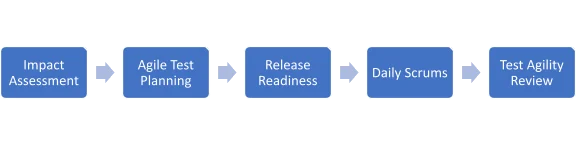
Let us discuss each of these phases in detail:
Phase 1: Impact Assessment
The first phase of the Agile testing life cycle is Impact Assessment. The required inputs and feedback are collected from users and required stakeholders to execute the impact assessment phase. This allows the testing team to decide on the expectations and needs for the next life cycle.
Phase 2: Agile Testing Plan
The second phase of Agile testing is Agile test planning. In this phase, all the required stakeholders such as developers, testers, business analysts, end-users, and even customers meet and finalize the testing process strategies, schedules, and deliverables.
Phase 3: Release Readiness
The third phase of Agile testing is Release Readiness, where the validation of features and enhancements are done by the testing team. The test engineers review and test the features to make sure that they are good enough to go live or not. Some of the features that are not built right need to be sent back to the development team.
Phase 4: Daily Scrums
The fourth phase of Agile testing is Daily Scrums. This is the daily status update meeting that helps to track the testing activities daily. It also allows an opportunity to discuss potential issues or blockers impacting product delivery. You can raise your problems or concerns repeatedly to provide a quick resolution.
Phase 5: Test Agility Review
The final phase of Agile testing is the Test Agility Review. It is about reviewing the key goals and milestones from a development perspective. It is all about reviewing some key aspects to ensure the project's progress is on the right track.
Agile Testing Principles
The Agile testing process is driven by some key principles:
- Continuous Testing: The testing is continuous and iterative. The Agile team performs continuous testing as it is the only way to ensure continuous progress and delivery of the product.
- Continuous Feedback Cycle: It is all about continuous and iterative feedback from relevant stakeholders so that the product meets the required quality and business needs.
- Testing is the Responsibility of the Entire Team: Gone are those days of the traditional software development life cycle where the testing team was involved in the end-to-end testing of the product or feature. In Agile testing, we have the developers as well as Business Analysts that are involved in testing the required product as well.
- Clean and Simplified Code: The code quality improves when all the defects raised by the Agile teams are fixed in the same iteration, which means that your code is clean and simplified.
- Test-Driven Approach: The testing is performed at the time of implementation, giving it equal importance along with development activities.

Methods of Agile Testing
The following methods are supported in Agile testing:
- Exploratory Testing In exploratory testing, test design and execution are done simultaneously. The tester is provided with the flexibility to break the system by using different user behaviors and patterns. No documentation is provided to the testing team, and the focus is on high-risk scenarios to be tested out.
- Risk-Based Testing: Under this method, the testing tasks are given priority based on the risks. This means that the areas that are critical and prone to greater risks are tested and verified first. Any issues or blockers in such areas can impact product delivery and quality. The less critical or smaller impact ones are validated at the last so that potential issues can be rectified easily.
- FIT Tests: FIT means Framework Integrated Test. As the name suggests, this method allows you to integrate tasks of developers, testers, and even customers. The result of testing in this method can be depicted in three different colors:
- Red
- Yellow
- Green
- Behavior-Driven Testing (BDD): In this method, testing is performed based on a system's behavior or functionality. The Business Analysts and testers understand each other's roles and responsibilities before the development starts and design requirements are finalized. Test scenarios are created, and the documentation of these scenarios can help to make informed testing decisions that help build the system's functionality.
- Acceptance Test-Driven Development (ATDD): These tests work based on customer feedback and inputs on how the software should perform. The acceptance tests showcase the behavior of the users so that the software meets their requirements in the long run.
Agile Testing Quadrants
Deciding what to test, and whether it needs to be manual or automated, gets harder as a backlog grows. The Agile Testing Quadrants solve exactly this. Brian Marick introduced the original matrix in 2003 to help teams categorize tests along two axes, and Lisa Crispin and Janet Gregory later refined and popularized it in their book Agile Testing: A Practical Guide for Testers and Agile Teams.
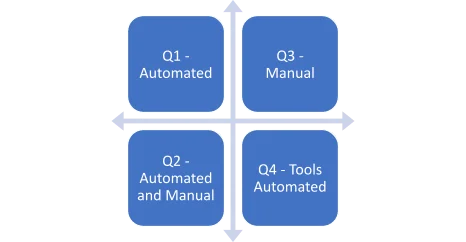
The two axes are: does the test support the team while they build (guiding development), or does it critique the finished product? And is the test business-facing (understandable to a product owner) or technology-facing (understandable to an engineer)? Crossing those two axes produces four quadrants:
Take a checkout flow as a running example across all four:
- Q1 - Technology-facing, supports the team: unit tests and component tests written as the code is built - a unit test confirming the discount calculation applies correctly to a cart total.
- Q2 - Business-facing, supports the team: functional and story tests that confirm the feature matches the requirement - a test verifying a customer can add an item, apply a coupon, and reach the confirmation page.
- Q3 - Business-facing, critiques the product: exploratory and user acceptance testing done by a human, evaluating whether the checkout flow actually feels right, not just whether it passes.
- Q4 - Technology-facing, critiques the product: performance, load, and security testing - confirming checkout holds up under a Black Friday traffic spike, not just that it works for one user.
Q1 and Q2 are typically automated since they run constantly as the code changes. Q3 stays manual by nature - it needs human judgment. Q4 uses specialized tools rather than hand-written test scripts. A sprint that only covers Q1 and Q2 will ship code that passes every test and still frustrates real users, because nothing evaluated Q3 or Q4.
Key Skills for Agile Tester
An Agile tester's day-to-day is different enough from a traditional QA role that it calls for a distinct skill set:
- Fast risk assessment: deciding which of a sprint's changes need deep coverage and which need a smoke check, since there usually isn't time to fully test everything before the sprint ends.
- Working test automation skills: not necessarily building frameworks from scratch, but reading and extending existing automated suites, since Q1/Q2 coverage depends on it.
- Comfort testing incomplete features: Agile testing starts alongside development, not after it, so testers work against a feature that's still changing rather than a finished build.
- Direct communication with developers: flagging a likely issue in a stand-up or a quick message, not writing a formal defect report and waiting for triage.
- Domain and business context: enough understanding of what the feature is actually for to do meaningful Q3 exploratory testing, not just verify acceptance criteria literally.
How to do Agile Testing?
It is important to understand how teams can perform Agile testing so that they can derive maximum business value. Some of the key aspects include:
- Creating and updating a test plan for each release or iteration.
- During the planning phase, testing resources are identified, testing tools are set up, and the entire testing strategy is finalized so that the entire team is well aware of the processes that are being followed.
- The Agile testing is done along with the development activities. The testing team can collaborate with developers to be well aware of the functionality changes and testing scope.
- The functionality is deployed in the production environment, users are trained, and acceptance testing is performed.
- The testing team makes sure that required features can be tested if there are improvements in the long run.
Having the right strategy in place for Agile testing within your teams is important. The testing team should be well aware of the testing scope and schedule so that they can plan their testing accordingly. When done right, Agile testing can greatly impact the overall end-user experience.
How TestMu AI Supports Agile Testing
The Quadrants model above only works if a team can actually see, in one place, which quadrant's tests ran this sprint and which are still red. TestMu AI's Test Management is built for exactly that: manual outcomes and automated pipeline results land in the same cycle view, so a QA lead can see Q1/Q4 automated coverage and Q2/Q3 manual coverage together instead of reconciling two separate systems every sprint.
Test cases group into plans and cycles aligned to a sprint or release, and a traceability matrix connects requirements to tests, runs, and defects - so "is this user story actually covered" is answerable from the tool instead of a stand-up guess. AI test case generation turns a user story or plain-English description into a structured case with steps and expected results, which matters most in Agile testing specifically: there is no time in a two-week sprint to hand-author test documentation from scratch.
The fifth phase of the Agile testing life cycle covered earlier, Test Agility Review, is where Test Insights fits in - it aggregates execution records across sprints into trend dashboards and flakiness signal, so a team reviewing "is our testing keeping pace with delivery" has data instead of impressions.

Note: Plan, execute, and trace Agile test coverage sprint over sprint in one workspace. Try TestMu AI Now!
Agile Testing Best Practices
Agile testing can be challenging if not performed considering some of the Agile testing best practices.
Agile development is not just about programming, it extends to all aspects of the software life cycle. As a result, Agile testing best practices vary from other testing methods in some fundamental ways.
Each phase has its purpose and time frame, and it is up to the organization to decide which activities fall within which phase. A new Agile tester needs to be aware of these phases and activities and knows how they impact the overall testing process.
Follow the following best practices to avoid Agile testing challenges:
- Maintaining code austerity
- Repetitive Tests
- Communication with Developers
- One Functionality at a Time
Agile software development relies on many principles and techniques to produce high-quality software. One of the most important is code austerity, which means keeping your code clean and simple by pruning away unnecessary elements.
As you create your test cases, you'll inevitably find that some tests must be repeated for each new feature or bug fix. The same test case might need to be run for every build type, branch, and environment. A test case with many variations is a sign of bad design.
Agile has made testing more critical than ever. With frequent deployments, ensuring that your software is always in a deployable state and working as expected is important. This requires well-tested and maintained code. To achieve this, Agile teams must make sure they have clear communication between their testers and developers.
Communication is essential in Agile because the team constantly adjusts its sprint priorities based on changing requirements. Both testers and developers must be able to adapt to these changes quickly, so they must always be in sync about what each team member is working on at any given time.
When you test one functionality at a time, it is easier to figure out what went wrong and why something did not go according to your expectations. If you have already tested a certain functionality, then you know that this particular feature works fine, and there is no need to spend time on it again.
Of those practices, communication with developers is the one teams most often get wrong, because every developer on a sprint team responds to a tester differently. In this TestMu Conf 2026 session, Working With Developers: A Tester's Survival Guide, Wessel Braakman walks through the range of developer working styles a tester runs into, from the ones who code at lightning speed to the ones who dive into every detail, and how to work with each.

Conclusion
Agile testing works when it stops being a separate phase and becomes part of every sprint: continuous, collaborative, and testing across all four Quadrants instead of just the ones that are easy to automate. Teams that get this right catch defects while they're still cheap to fix, not after a release.
If your team is still moving from Waterfall, the guide linked earlier covers that transition in detail. To put Test Management and Test Insights to work on your own sprint cycle, follow the getting-started documentation.
Author

Mythili Raju
Blogs: 58


Mythili is a Community Contributor at TestMu AI with 3+ years of experience in software testing and marketing. She holds certifications in Automation Testing, KaneAI, Selenium, Appium, Playwright, and Cypress. At TestMu AI, she leads go-to-market (GTM) strategies, collaborates on feature launches, and creates SEO optimized content that bridges technical depth with business relevance. A graduate of St. Joseph’s University, Bangalore, Mythili has authored 35+ blogs and learning hubs on AI-driven test automation and quality engineering. Her work focuses on making complex QA topics accessible while aligning content strategy with product and business goals.
Reviewer

Abhishek Mishra
Reviewer
Abhishek Mishra is a Technical Product Manager at TestMu AI, where he owns Test Manager, the test management product. He has over 8 years of experience in product management and market analysis. His expertise spans across AI-native software testing, product strategy, and analytics. Previously, Abhishek served as the Product Lead at IndiaClan and co-founded Gartley618 Technologies, where he led innovative projects in quantitative trading and blockchain. He holds a B.Tech degree.


Agile Testing FAQs
Did you find this page helpful?
More Related Learning Hubs
TestMu AI forEnterprise
Get access to solutions built on Enterprise
grade security, privacy, & compliance
- Advanced access controls
- Advanced data retention rules
- Advanced Local Testing
- Premium Support options
- Early access to beta features
- Private Slack Channel
- Unlimited Manual Accessibility DevTools Tests