

Power Your Software Testing with AI Agents and Cloud
The Native AI-Agentic Cloud Platform to Supercharge Quality Engineering. Test Intelligently and Ship Faster.


- TestMu AI (Formerly LambdaTest)
- /
- Learning Hub
- /
- What is Quality Assurance(QA)? Definition, Importance & More
What is Quality Assurance(QA)? Definition, Importance & More
Learn the basics of Quality Assurance(QA) to ensure your products & services meet standards & requirements through systematic & consistent practices. Master QA!
Last Updated on:
On This Page
- What is Quality Assurance?
- Importance of Quality Assurance
- How to Carry Out Quality Assurance?
- Quality Assurance Principles
- Quality Assurance Methods
- History of Quality Assurance
- QA Uses by Industry Assurance?
- Quality Assurance in Software
- Best Practices of Quality Assurance Testing
- Future of Quality Assurance
- Conclusion
QA, or Quality Assurance, is a process used across various industries to ensure that products and services meet specific standards and are free of defects before they reach the customer. This involves systematic monitoring and evaluation of the various aspects of a project, service, or facility to maximize the probability that minimum standards of quality are being attained by the production process.
QA can include any systematic process for checking to see whether a product or service being developed is meeting specified requirements. Many companies have a separate department devoted to quality assurance. A key component of quality assurance is the effective management of quality control, which is the operational techniques and activities used to fulfill requirements for quality.
In this tutorial, we will delve into the terms of quality, explore the concept of assurance, define quality assurance, and understand the necessity of implementing QA. We will also discuss relevant tools, challenges, and more.
So let's get started.
What is Quality Assurance?
Quality Assurance is critical for ensuring that end products align with both internal and external expectations and requirements. This discipline involves methodical procedures to evaluate and refine systems or outputs. Its strategic role includes defining standards, conducting audits, and facilitating continuous improvements, ultimately safeguarding customer satisfaction and organizational reputation.
Here are examples of what Quality Assurance might entail in different industries:
- Software Development: A QA team tests a new app for functionalities like user login and responsiveness, ensuring it meets user expectations before release.
- Pharmaceuticals: QA in pharmaceuticals involves testing drug compounds and checking production facilities to ensure safety and compliance with regulations.

To understand the concepts better, let us know the difference between quality control and assurance in the following section.
Difference between Quality Control and Quality Assurance
| Quality Control | Quality Assurance |
|---|---|
| Focuses on quality requirements, ensuring that a part meets specifications. | Focuses on all the activities and procedures that showcase the satisfaction of quality standards and requirements. |
| Specific and detailed, targeting individual components or processes. | It encompasses a broader scope, including all activities and departments, ensuring overall quality. |
| Often involves inspection and testing of products during or after production. | Involves comprehensive programs and departments, assuring various stakeholders that products meet quality and safety standards. |
| Reactive approach, identifying and rectifying defects in the finished product. | Proactive approach, implementing processes to prevent defects and ensure consistent quality throughout production. |
| Typically, part of the production phase is ensuring compliance with set standards. | Extends beyond production, covering the entire product development life cycle. |
| Emphasizes finding and fixing issues to meet specific criteria. | Emphasizes a holistic approach, demonstrating overall adherence to quality requirements. |
Difference between Quality Assurance V/S Testing
| Quality Assurance | Testing |
|---|---|
| A systematic process of ensuring that software meets specified standards and customer expectations. | The process of executing a system or application to identify bugs, defects, or errors. |
| Focuses on preventing defects. | Focuses on identifying defects. |
| Encompasses the entire software development process. | Typically limited to the testing phases post-development. |
| Establishing procedures and standards, adherence to standards, managing the test environment, and continuous improvement. | Designing test cases, executing tests, and identifying defects in the software. |
| To prevent defects through improved processes and system checks before testing begins. | To identify and solve defects in the software after it has been developed. |
| Proactive approach – aiming to improve the processes to eliminate errors before they occur. | Reactive approach – looking for errors after they have been introduced into the product. |
| Involves all team members across different roles in the project. | Primarily the responsibility of the testing team, although it may involve others for integration testing, etc. |
| A process that ensures the quality of the software product throughout its development. | A product that meets the quality standards as per the final tests conducted. |
| Process monitoring tools, audit management tools, and compliance management. | Test case management tools, automation tools, defect tracking tools, and performance testing tools. |
| Throughout the software development lifecycle, from requirements gathering to post-deployment. | Usually conducted after the completion of development, during the testing phase. |
Importance of Quality Assurance
QA is crucial for ensuring high product quality, meeting customer expectations, and complying with regulations. The main benefits include:
- Customer Satisfaction: QA ensures reliable and functional products, increasing customer trust and loyalty.
- Compliance and Safety: It guarantees products meet legal requirements and are safe, reducing legal risks.
- Market Reputation: QA builds a strong brand image and reputation, enhancing consumer confidence and competitive advantage.
- Operational Efficiency: By identifying inefficiencies, QA reduces waste and optimizes resource use.
- Cost Management: It cuts costs related to defects and reworks by addressing issues early in the development cycle.
- Product Development: QA enhances product design with effective feedback mechanisms and speeds up market readiness.
- Competitive Advantage: High-quality products can set a company apart in competitive markets.
QA drives business growth, reduces costs, and improves product reliability and customer loyalty.

Note: Improve your software quality by eliminating bugs and accurately managing QA metrics. Try TestMu AI Now!
How to Carry Out Quality Assurance?
QA steps involve various activities designed to prevent errors and effects. These steps verify whether a product or service meets customer expectations and needs. There is a detailed breakdown of how to carry out QA.
- Define Quality Standards: Begin by clearly defining the specific standards and criteria that the product or service must meet. These standards should align with customer expectations, regulatory requirements, and industry benchmarks.
- Plan the QA Process: Develop a comprehensive QA plan that outlines the methodologies, tools, and schedules to be used. This plan should include details on how quality will be monitored at each stage of the production or development process.
- Implement Quality Control Procedures: Quality control is a subset of QA and involves operational techniques and activities used to fulfill requirements for quality. This includes routine inspections, testing, and reviews to catch defects and ensure that the work aligns with the predefined standards.
- Document Everything: Keep detailed records of QA activities, including test results, inspection reports, and corrective actions taken. Documentation is crucial for tracking progress, identifying trends, and providing evidence of compliance with quality standards.
- Perform Audits: Regular audits help to ensure that the QA processes are being followed and are effective. Audits can also identify areas for improvement, helping to refine QA strategies continuously.
- Feedback and Continuous Improvement: Use feedback from QA activities to make informed decisions about how to improve products, services, and processes. Implement changes based on lessons learned, and continually strive to enhance quality.
- Training and Development: Ensure that all team members are trained in quality assurance practices relevant to their roles. Continuous training helps maintain high standards and adapt to new QA methodologies or technologies.
Quality Assurance Principles
QA in any organization is guided by fundamental principles, forming a roadmap to achieve customer-centric excellence and a continuous feedback-based improvement cycle. Here are some core principles.
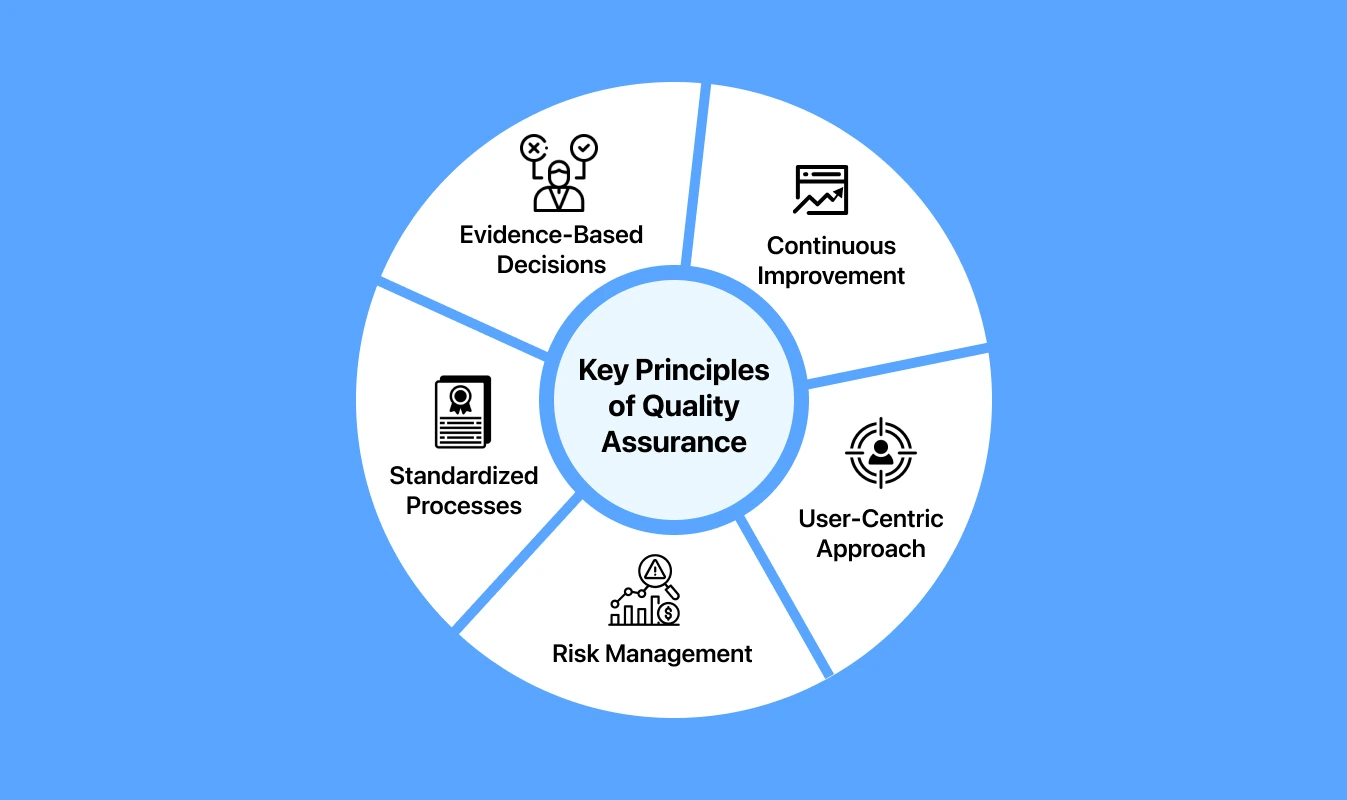
- Continuous Improvement: This principle is dedicated to the ongoing evaluation and refinement of processes to increase efficiency and effectiveness.
- User-Centric Approach: This strategy places the needs and expectations of the customer at the forefront, molding QA methods to yield superior user experiences and products.
- Risk Management: This involves identifying, assessing, and mitigating possible risks to avert quality deviations and guaranteeing a seamless operational flow.
- Standardized Processes: Highlights the necessity for procedure uniformity to minimize mistakes and uphold the delivery of high-quality outputs.
- Evidence-Based Decisions: Promotes making decisions grounded in verifiable data and information, enhancing the effectiveness and impact of quality improvements.
These principles lay the groundwork for a strong QA framework that strives for excellence and upholds customer satisfaction in any organizational setting.
Quality Assurance Methods
QA includes approaches applied and given to a product to ensure its conformity to standards of quality. These are just a few of the most common methods of QA, though.
- Testing: This encompasses both manual and automated testing to validate the functionality and performance of products.
- Statistical Process Control (SPC): This encompasses using statistical methods during the monitoring and controlling of the given processes to ascertain that they never compromise process capability.
- Total Quality Management (TQM): It is an approach toward the organization that consists of all members, including the workers and staff, with the sole perspective of continuous quality improvement.
- Six Sigma: Focused improvement process on reducing variability through the DMAIC (Define, Measure, Analyze, Improve, Control) framework.
- ISO 9001: These are requirements of a quality management system, and an organization needs to conform to the ability to consistently provide products that will meet the needs of customers and those of other stakeholders.
- Lean Manufacturing: Focuses on minimizing waste and boosting productivity by enhancing operational efficiencies.
- Quality Audits: This is a planned and systematic examination of a quality system that is being carried out, independently of whether it is done internally or by an external party, to verify adherence to standards.
- Failure Mode and Effects Analysis (FMEA): This procedure allows one to identify all the possible failure modes in a system together with their causes and the consequent effects so that they can be prevented from posing problems in the future.
- Root Cause Analysis: It is the process or technique implemented to find out the essential causes for drawing out more effective solutions for some defect or problem.
- Kaizen (Continuous Improvement): Organizational efforts that improve every aspect of an organization—the process, product, or service.
According to the Future of Quality Assurance Survey, 40% of large-scale companies allocate over 25% of their budget to testing, and nearly 10% spend more than half of their budget on testing. This highlights the significant investment organizations make in software quality testing.
Read the complete Future of Quality Assurance survey report for comprehensive insights into the current state and future prospects of quality assurance, based on input from 1615 respondents across 70 countries.
All these add up together, contributing considerably to defect reduction and process enhancements while bringing about improved customer satisfaction and enhanced market competitiveness simultaneously.
History of Quality Assurance
The history of QA is reflected in the developments that manufacturing and, later, software development methodologies have undergone to ensure product and service excellence. This presents a gist of important developments.
- Mid-18th Century: Mechanized manufacturing during the Industrial Revolution necessitated systematic quality controls.
- Early 20th Century: Statistical quality control methods were introduced by pioneers like Walter A. Shewhart.
- 1980s: TQM and the ISO 9000 series standards became global paradigms in quality management across various sectors.
- Late 20th Century: The advent of the digital revolution invited special strategies in QA regarding software development, ultimately resulting in Agile methodologies and DevOps getting integrated.
- 21st-century up-to-date QA: An integrative set of traditional tools, all enriched with the latest technologies, from automation to AI, all used for defect minimization and unbroken improvement.
- Emerging Technologies: AI and IoT are in the pipeline to revolutionize QA with real-time predictions and corrections of defects.
The scope of Quality Assurance has increased, and its present nature is of such a vast, very complex, and integral framework that looks after standards across industries. With the advent of technology, QA has been gearing up and refining its role in global business sustainability.
QA Uses by Industry Assurance?
QA is a must practice in many sections, ensuring the products and services are of the set quality norms to meet consumer expectations. Herein are a few industries that are depicting the use of QA in their operations:
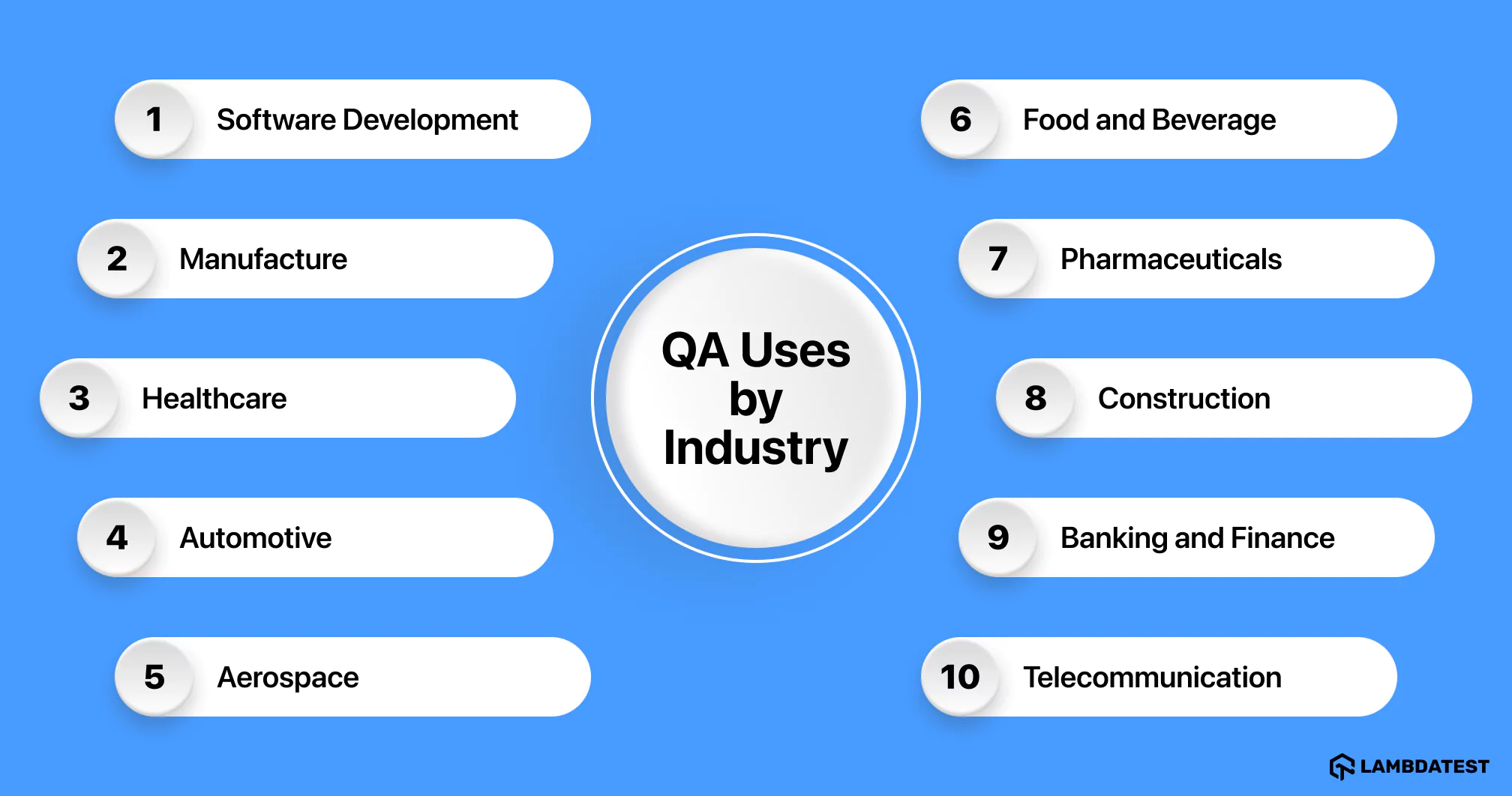
- Software Development: QA plays a crucial role in bug detection, ensuring software compliance with requirements, and enhancing quality and user experience.
- Manufacturing: QA is important in manufacturing to ensure products conform to quality requirements and standards, with testing carried out at various stages.
- Healthcare: QA is essential in healthcare to assure safety and reliability, with testing and quality controls throughout production.
- Automotive: QA is critical in the automotive industry for safety and reliability, with testing and quality controls throughout production.
- Aerospace: QA validates the safety and reliability of aircraft and spacecraft products through intensive testing and inspection.
- Food and Beverage: QA ensures products are safe for consumers, with tests for contaminants, procedure control monitoring, and food safety standards.
- Pharmaceuticals: QA ensures drug safety and efficacy, covering purity, potency, quality, and regulatory compliance tests.
- Construction: QA ensures construction components meet quality standards through material testing and inspection.
- Banking and Finance: QA in this industry ensures the accuracy and reliability of financial transactions and systems, including software testing and compliance audits.
- Telecommunication: QA maintains the reliability and quality of networks and services through equipment and system testing to meet performance criteria.
These examples show that QA could be applied in almost all areas to maintain quality, safety, and regulatory requirements.
Quality Assurance in Software
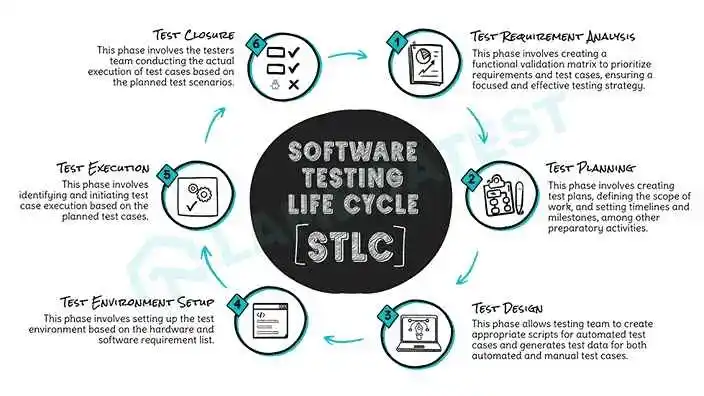
Software Quality Assurance (SQA) is a structured approach to enhance software development processes and ensure high-quality outcomes. It focuses on identifying trends and implementing preventative actions that improve development cycles, allowing for early detection and correction of errors—potentially before they manifest—thereby saving time and reducing costs. Despite rigorous execution, SQA can face challenges such as regressions, where resolving one issue may inadvertently introduce new ones.
Evolution of Development Methodologies:
SQA has significantly shaped various software development methodologies to enhance adaptability to changing project needs and boost efficiency:
- Waterfall: Suited for projects with fixed requirements, following a traditional, linear approach.
- Agile: A dynamic, iterative approach that quickly adapts to changing requirements and involves stakeholders in the project.
- Scrum: Based on Agile principles, breaking the project work into small sprints with cross-functional teams.
- Extreme Programming (XP): Allows software development to quickly adapt to changing customer needs, inspired by customer feedback.
- Lean Software Development: Centers on waste minimization and maximizing efficiency, mirroring lean manufacturing principles.
- DevOps: Integrates development and operations teams, allowing for quicker delivery through integration and deployment practices.
- Kanban: Uses visual boards to prioritize and schedule workflow, ensuring the team doesn't work on more than they can handle.
Implementing SQA:
Successful SQA deployment involves:
- Preventive Measures: Setting standards and conducting early testing to avert errors.
- Quality Metrics and Testing: Employing precise metrics and extensive testing techniques (unit, integration, system, acceptance) to verify all functionalities are correct.
- Iterative Improvement: Utilizing feedback and continuous testing (via Agile/Scrum methodologies) to progressively refine and improve the product across multiple iterations.
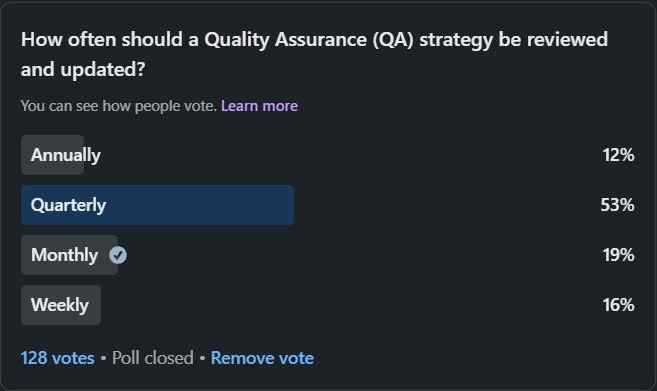
In line with these steps, a recent social media poll revealed that QA professionals and testers often update their quality assurance strategies quarterly. This frequent revision reflects an awareness of rapid technological advancements. By updating their strategies every three months, organizations ensure they remain adaptable and proactive, enabling their QA systems to effectively respond to new challenges and maintain high quality standards.
Explore this blog for tips on crafting a successful QA strategy and its essential components.
SQA is crucial for producing dependable, efficient, and user-endorsed software, integrating flawlessly with contemporary development practices to accommodate the evolving demands of projects.
Software QA Tool
Software development teams use QA testing tools to guarantee that their releases align with project requirements, provide an excellent user experience, and have minimal bugs and defects.
TestMu AI is an AI-Native testing platform that provides manual and automated testing on over 3000 real devices, browsers, and OS combinations. It automates repetitive tasks to streamline QA processes on various browsers and operating systems, saving time and resources. Here are some key features:
- Highest Coverage: Offers a wide selection of browsers and operating systems for comprehensive testing scenarios.
- Parallel Testing: Enables simultaneous execution of multiple tests to maximize productivity.
- Integration: Seamlessly integrates with major test automation frameworks, facilitating easy testing initiation.
- Advanced Debugging Tools: Includes tools like video recording and logs for efficient bug tracking and fixing.
- Mobile Device Lab: Features a scalable lab with numerous real Android and iOS devices to enhance mobile testing capabilities.
For more insights and tutorials on using TestMu AI for automation testing, visit and subscribe to the TestMu AI YouTube Channel.
Best Practices of Quality Assurance Testing
Best Practices of QA Testing To ensure top-tier product quality, consider these streamlined QA testing practices:
- Combine Manual and Automated Testing: Use manual testing for exploratory and unique scenarios and automation for repetitive tasks to increase efficiency.
- Use Crowd Testing: Engage a diverse pool of testers with various devices and backgrounds to achieve comprehensive compatibility checks across browsers and operating systems.
- Continuous Integration and Delivery (CI/CD): Implement continuous integration and delivery practices to automatically run tests from the code for quick problem detection and recovery.
- Risk Management in QA: Include risk-assessment strategies to identify and avert potential defects, contributing to the overall robustness of the product.
- Speed and Quality: Strike a balance between speed and quality by ensuring early integration, continuous QA reviews, and parallel testing.
- Effective Methodologies: Implement and improve QA methodologies in alignment with project and regulatory requirements to reduce costs and increase product quality.
- Continuous Monitoring: Monitor QA activities to ensure adherence to specified standards and procedures.
- Comprehensive Coverage: Develop test cases covering various situations and conditions to ensure compatibility with different devices, operating systems, and user environments.
- Test Under Various Loads: While QA provides a proactive framework for preventing defects, automation in load testing ensures that performance, scalability, and user experience remain intact during real-world conditions.
By combining automation with performance testing, teams can identify issues before they impact users, thus optimizing the software’s ability to handle high traffic. Dive deeper into how automated load testing can enhance QA efforts, ensuring consistent product quality while reducing the risk of defects.
For those looking to apply QA testing automation specifically in load testing, you can check this detailed article on ensuring software reliability under stress.
- Implement Regression Testing: Regularly perform regression testing to identify new errors in existing features and maintain system integrity during updates.
Future of Quality Assurance
The future of QA is increasingly intertwined with technological advancements, leveraging sophisticated technologies such as Artificial Intelligence (AI), Machine Learning (ML), cloud computing, and more.
- AI and ML in QA: AI and ML enhance QA by providing intelligent test creation, predictive analytics, and anomaly detection. This not only broadens test coverage but also refines test execution through early defect identification.
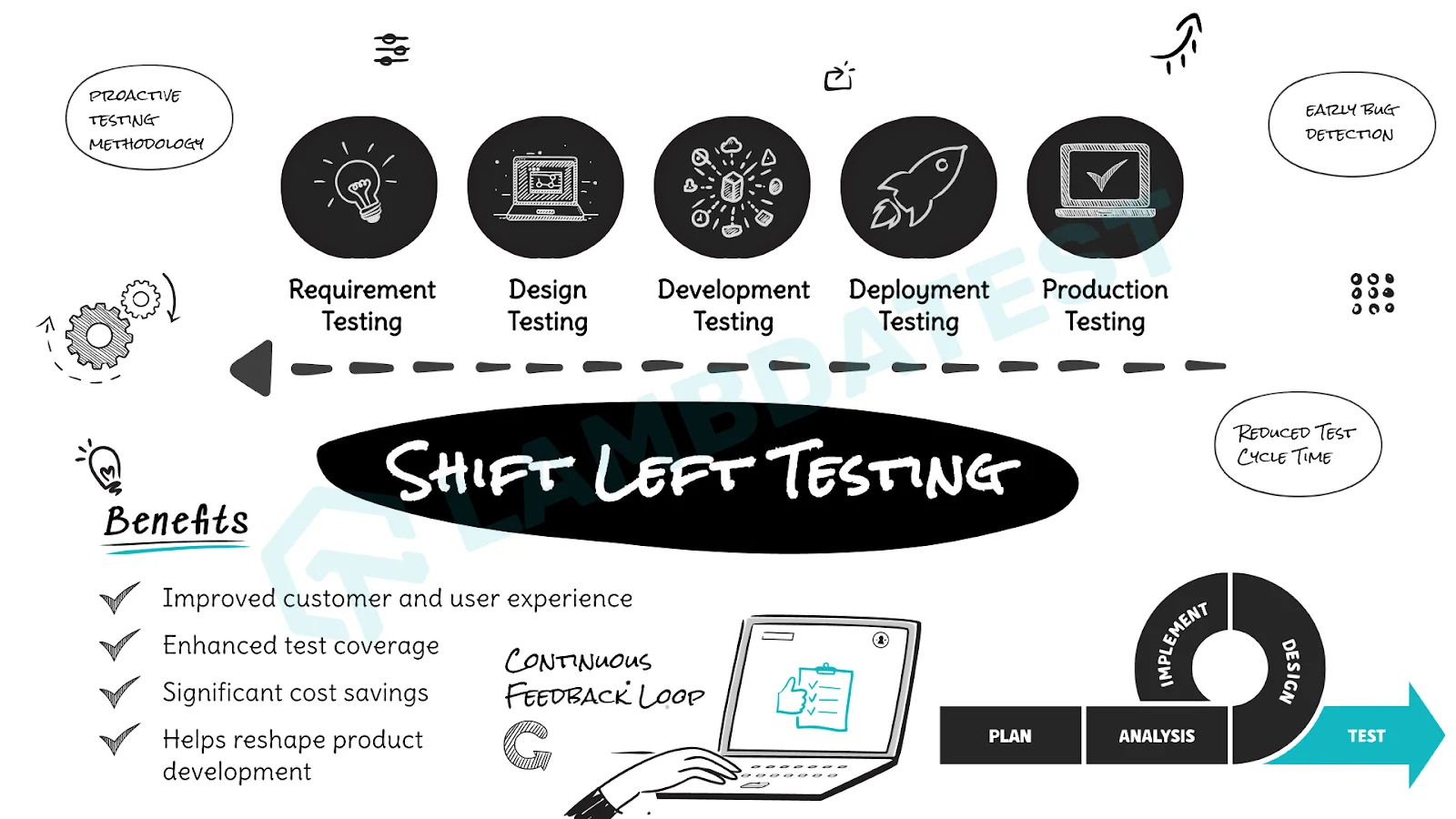
- Shift-Left Testing: This method emphasizes integrating QA as early as possible in the software development lifecycle, beginning from the requirements-gathering phase. Early testing reduces risks sooner, minimizes the need for rework, and enhances the integrity of the final product.
- QA in Cloud and Mobile Computing: As cloud and mobile technologies expand, QA must adapt to assess various products, screen sizes, and operational environments. A strong focus on scalability, security, performance, and compatibility is crucial.
- Security Testing and QA: Integrating security testing into QA processes is essential in response to escalating cybersecurity threats. Techniques like penetration testing and vulnerability scans are crucial to protect systems and secure sensitive data.
- VR and AR Testing: The rapid evolution of virtual (VR) and augmented reality (AR) technologies presents unique challenges for QA, requiring specialized testing strategies to ensure optimal user experiences and performance in these immersive environments.
Watch the video "Sneak Peek on Future of Quality Assurance Survey" to gain insights based on survey data. The video will provide a glimpse into the future of quality assurance and highlight key trends shaping the industry.

For more insights and tutorials on using TestMu AI for automation testing, visit and subscribe to the TestMu AI YouTube Channel .
Conclusion
Understandably, the above core principles—namely continuous improvement, user-centered design, effective risk management, standardized processes, and evidence-based decisions—are undoubtedly recognized as necessary for achieving excellence in quality assurance. QA covers essential components such as planning, control, documentation, training, audit, prevention measures, and continuous improvement and metrics.
Mastering these components and advanced QA tools and focusing on associated challenges are critical for consistently high standards. Furthermore, it is acknowledged that this approach will enable QA practices to evolve by integrating new innovative technologies alongside all emerging trends. Adopting such holistic strategies is generally seen as placing a business in a continual state of delivering success with quality, thereby ensuring long-term customer delight and success.
Author

Veethee Dixit
Blogs: 12


Veethee Dixit is a seasoned content strategist and freelance technical writer specializing in SaaS platforms and AI-driven testing technologies. She has over 8 years of hands-on experience writing SEO focused technical content, simplifying complex topics in software testing, and collaborating with product marketing teams to develop high converting blogs, documentation, whitepapers, and tutorials. She holds a Bachelor of Engineering in Computer Science and has authored 50+ learning hub articles in the software testing domain. Her work has been featured in leading software testing newsletters and cited by top technology publications. Veethee has played a key role in translating complex testing workflows into actionable guides, helping audiences implement automation strategies with clarity and confidence.


Frequently asked questions
Did you find this page helpful?
More Related Blogs
TestMu AI forEnterprise
Get access to solutions built on Enterprise
grade security, privacy, & compliance
- Advanced access controls
- Advanced data retention rules
- Advanced Local Testing
- Premium Support options
- Early access to beta features
- Private Slack Channel
- Unlimited Manual Accessibility DevTools Tests