

Power Your Software Testing with AI Agents and Cloud
The Native AI-Agentic Cloud Platform to Supercharge Quality Engineering. Test Intelligently and Ship Faster.


- TestMu AI (Formerly LambdaTest)
- /
- Learning Hub
- /
- The Software Development Process: A Complete Guide [2026]
The Software Development Process: A Complete Guide [2026]
Discover the software development process, methodologies, and tools. Learn to ensure code quality and security and measure effectiveness for successful projects.
Last Updated on:
On This Page
- What is the Software Development Process?
- Need for the Software Development Process
- Significance of the Software Development Process
- Types of Software Development Processes
- Software Development Process Methodologies
- Software Development Architecture Patterns
- Tools for Software Development Process
- Phases of the Software Development Process
- Project Management in the Software Development Process
- How to Measure Software Development Effectiveness?
- Best Practices of Software Development Process
- The Future of Software Development Process
Overview
To build reliable software efficiently, teams use the software development process to divide projects into manageable phases. Organizations should adopt the Agile methodology for iterative, feedback-driven updates or the Waterfall model for highly structured, sequential projects with fixed requirements.
What is the software development process?
- Software Development Life Cycle: This structured framework divides development into requirements, design, implementation, testing, deployment, and maintenance phases to build complex applications systematically.
Which methodologies are covered?
- Waterfall Model: This sequential approach requires completing each phase, from requirements to maintenance, before starting the next, making it ideal for projects with fixed requirements.
- Incremental Development: This approach breaks requirements into standalone modules and delivers the software in successive builds, adding features until the application is complete.
- Agile Methodology: This iterative approach uses short sprints to frequently update code, allowing teams to incorporate user feedback and adapt to changing requirements.
- DevOps: This methodology focuses on continuous delivery and integration to streamline the software creation process, ensuring reliable and rapid deployment.
What types of software development exist?
- Front-End Development: This type focuses on building the user interface and user experience using HTML, CSS, and JavaScript to manage visual layout and interactivity.
- Back-End Development: This type handles server-side logic, databases, and infrastructure, covering data modeling, authentication, and API communication.
- Web Development: This covers the full process of designing, building, and maintaining websites, including UI creation, database management, and performance optimization.
- Mobile Development: This involves building native or cross-platform applications for smartphones and tablets, requiring thorough testing on real devices to ensure consistent performance.
- Embedded Systems Development: This process creates low-level software for specialized hardware within larger systems like automobiles, appliances, or medical devices.
- API Development: This involves creating and documenting interfaces that enable distinct software applications to communicate and share data seamlessly.
What is the Software Development Process?
The software development process, also known as the Software Development Life Cycle (SDLC), is a structured method for developing and building software applications for a system or project. It includes applying various principles and techniques from computer science, engineering, and mathematical analysis.
It is better defined as the approach to enhance design and product management by dividing software development into smaller, manageable steps or sub-processes that can be performed in parallel or sequentially. These steps include research, designing data and process flows, creating technical documentation, comprehensive testing, debugging, and iterative deployment to a live environment. Software organizations implement this process to plan, develop, and test high-quality applications efficiently, contributing to the collaborative building of software products and designs.
Objectives:
- The software development process is an iterative and logical approach to developing programmed software applications that meet specific business or personal objectives, goals, or processes.
- This goal is achieved through software developers writing computer code.
- Another aim of the software development process is to produce exceptional software applications that exceed clients' expectations and fulfill their demands.
- Another objective is to streamline the software creation process, ensuring the completion of software development within the specified cost and timeline.
- The overall purpose of software development is to create efficient, reliable, and user-friendly software.
Need for the Software Development Process
The software development process is needed for several reasons: managing the complexity of software applications, lowering the error rate, and improving collaboration with the team. Let us understand this in more detail by illustrating examples.
Consider the development of a Software-as-a-Service (SaaS) application. Continuous updates and improvements necessitate a robust software development process. This ensures that user interfaces remain clear and consistent across updates, making it easier for users to navigate and understand the application. Additionally, it facilitates the prompt identification and resolution of potential security vulnerabilities.
In developing SaaS applications, the team mainly follows an iterative approach based on Agile development methodology. The developers and testers frequently sprint to update the software’s code and project management SaaS platform. The software development process ensures that these updates are seamlessly integrated, minimizing user disruptions and maintaining the overall reliability and security of the project management SaaS application.
With this iterative software development process, developers and testers can incorporate feedback from remote teams using software like Jira, ensuring that the application aligns closely with the evolving needs of its users. Thus, we can say that a well-established software development process is needed to facilitate communication, reduce misunderstandings, and contribute to the seamless integration of new features or improvements.
In this scenario, it is clear that the software development process is not just a technical necessity but a strategic imperative. It allows the SaaS development team to adapt easily to changing user demands and respond to emerging challenges. However, the challenges of delivering a secure, scalable, and user-friendly SaaS solution for remote project management would be significantly impacted without a structured development process.
Significance of the Software Development Process
The software development is significant for developing highly functional and bug-free software applications. Here are some reasons:
- Quality Assurance (QA): Placing quality at the forefront of every stage, a robust methodology prioritizes elements such as code reviews, testing protocols, and quality assurance techniques. These practices help detect and rectify errors, bugs, and security vulnerabilities during development.
- Consistency and Repeatability: A well-defined methodology provides a consistent framework for software development. It clearly outlines steps, roles, and tasks, ensuring project uniformity. This consistency enables teams to replicate successful practices, reuse components, and build upon previous work, enhancing productivity and minimizing risks.
- Collaboration and Coordination: A strong process enables seamless collaboration by providing clear instructions and established routines, streamlining communication across developers, designers, testers, and project managers, reducing misunderstandings and contributing to smoother development cycles.
- Risk Management: A predefined method assists in identifying and addressing risks throughout the software development process. It incorporates strategies for risk assessment, mitigation, and contingency planning. By addressing potential issues early in the process, the methodology diminishes the likelihood of delay in the project, unforeseen expenses, or major failures.
- Scalability and Efficiency: A robust software development process supports scalability, allowing teams to tackle more complex software projects. It helps in resource allocation, work distribution, and prioritizing tasks. With clearly defined processes, organizations can optimize their development efforts, shorten product time-to-market, and adapt swiftly to changing project requirements.
- Continuous Improvement: An integral aspect of a strong software development process involves a constant focus on improvement. This includes reviewing past projects, learning from experiences, and implementing feedback loops to identify areas for enhancement. Regularly reviewing and refining the process enables organizations to promote their software development capabilities, encourage new ideas, and stay competitive in a fast-changing field.

Note: Maintain the quality of the software by identifying and resolving issues in the development process. Try TestMu AI Now!
Now that we have learned about the software development process and its significance, we will proceed further to learn about different categories of software development. It will help you understand different types of developments in software, which will eventually clarify your concept of different types of processes.
Types of Software Development Processes
Each category of software development involves distinct technologies, skills, and testing requirements:
- Front-End Development: Focuses on building the UI/UX for websites and web apps using HTML, CSS, and JavaScript, covering visual layout, interactivity, and content presentation.
- Back-End Development: Handles server-side logic, databases, and infrastructure covering data modeling, server-side scripting, authentication, and API communication.
- Web Development: Covers the full process of designing, building, and maintaining websites, from UI creation and database management to performance optimization. Web application testing at each stage ensures the application meets requirements and maintains quality.
- Mobile Development: Builds apps for smartphones and tablets - native (iOS/Android) or cross-platform (React Native, Flutter). Consistent performance across diverse devices is the key challenge; thorough mobile app testing using a real-device cloud catches UI inconsistencies and performance bottlenecks across platforms, streamlining the test process end-to-end.

- Embedded Systems Development: Creates software for specialized hardware within larger systems - automobiles, appliances, or medical devices. The process involves understanding hardware constraints and designing low-level software that bridges frontend and backend requirements.
- API Development: Involves creating and maintaining APIs that enable communication between distinct software applications. The process covers defining specifications, implementing functionality, and ensuring thorough documentation for developers.
Software Development Process Methodologies
The software development process adopts different methodologies based on project requirements, team dynamics, technology stack, and the specific goals of the development project. The team uses different methodologies for designing, testing and managing software applications, which depend on the respective goal of software development. Based on this, here are popular software development models that highlight different methods of the software development process.
Waterfall Model
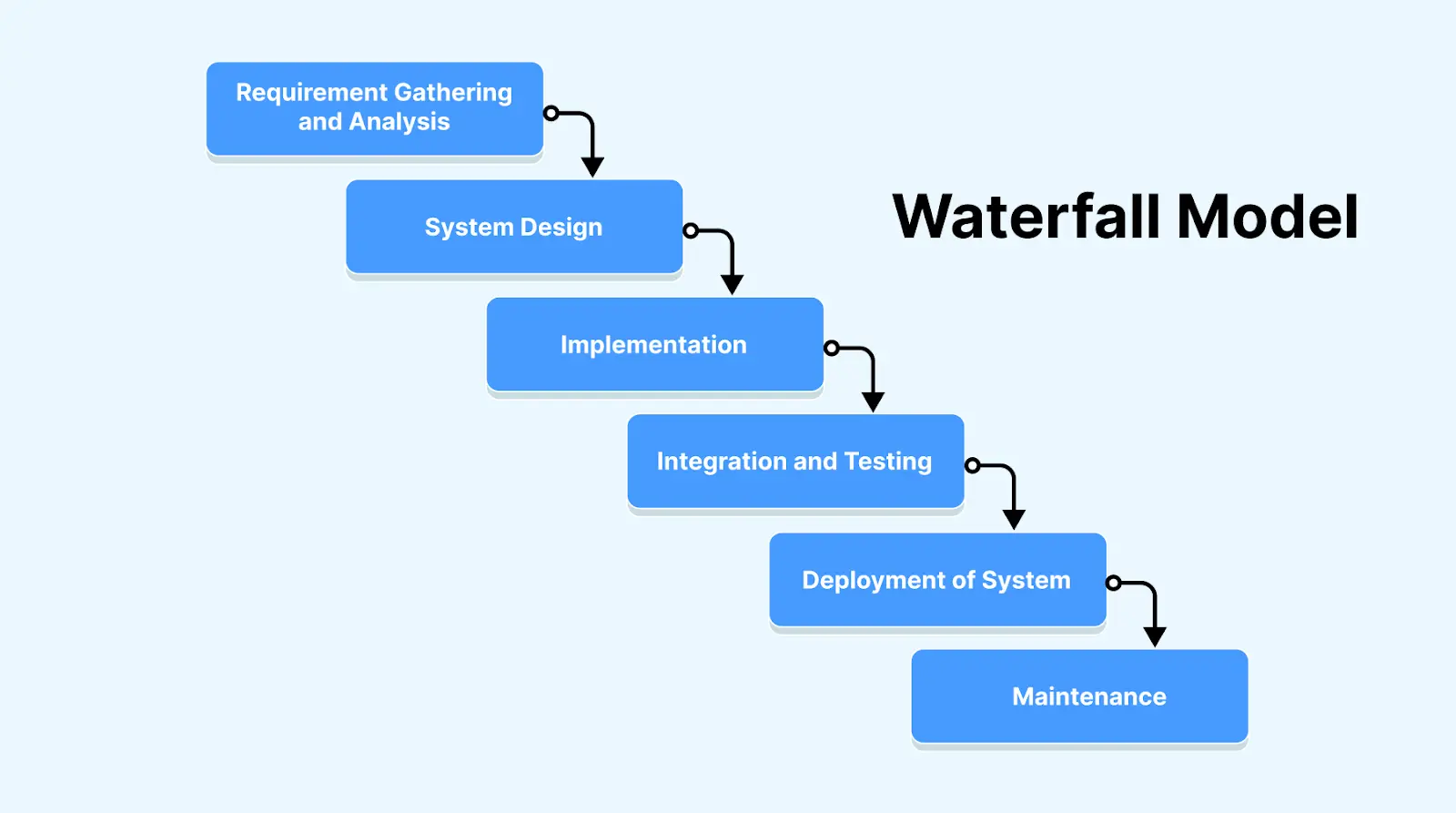
The waterfall model introduced process models known for their simplicity in comprehension and application. Operating sequentially, each phase in the waterfall model must be fully completed before the next phase, ensuring a clear, non-overlapping progression. The output of one phase serves as the input for the subsequent phase, enforcing a systematic development approach.
Phases in the Waterfall Model:
The waterfall model comprises six stages or phases: requirement gathering and analysis, system design, implementation, integration and testing, deployment of the system, and maintenance. Let us get into more detail on understanding each phase below.
- Requirement Gathering and Analysis: This phase captures all potential software application requirements, documented in a comprehensive requirement specification document.
- System Design: Building on the specifications from the initial phase, the system design is carefully prepared, outlining hardware, system requirements, and the overall system architecture.
- Implementation: Drawing from the system design, the system is developed in small units and individually tested in unit testing.
- Integration and Testing: After carefully testing each unit, they are seamlessly integrated into a system. The entire system undergoes testing for any faults and failures.
- Deployment of System: Following thorough functional and non-functional testing, the software application is deployed in the customer environment or released into the market.
- Maintenance: Addressing issues in the client environment involves releasing patches, and product enhancements are achieved by releasing improved versions.
Advantages of the Waterfall Model:
- Facilitates task division into distinct departments, enhancing management and control over diverse work aspects.
- Easy to follow, ideal for small projects with clear specifications and limited budgets.
- Clear milestones allow easy tracking and ensure the project stays on course.
- Permits the establishment of a schedule with deadlines for each developmental stage.
Disadvantages of the Waterfall Model:
- The waterfall model does not allow revisiting previous phases, posing challenges when software requirements change or new issues emerge.
- Sequential phase completion causes a prolonged duration between software development initiation and release.
- Testing at the end may result in unnoticed errors, complicating and escalating the cost of fixes.
- Difficulty in accurately predicting time and cost for each phase.
- Altering decisions made in earlier stages, especially during testing, can be problematic.
When to use the Waterfall Model?
The waterfall model is suitable for large organizations and government agencies requiring comprehensive documentation of requirements and scope before project initiation. The rigidity of the waterfall approach is emphasized, indicating that it is best suited when the minimal scope for substantial modifications is acceptable once the software development process is initiated.
Incremental Development Model
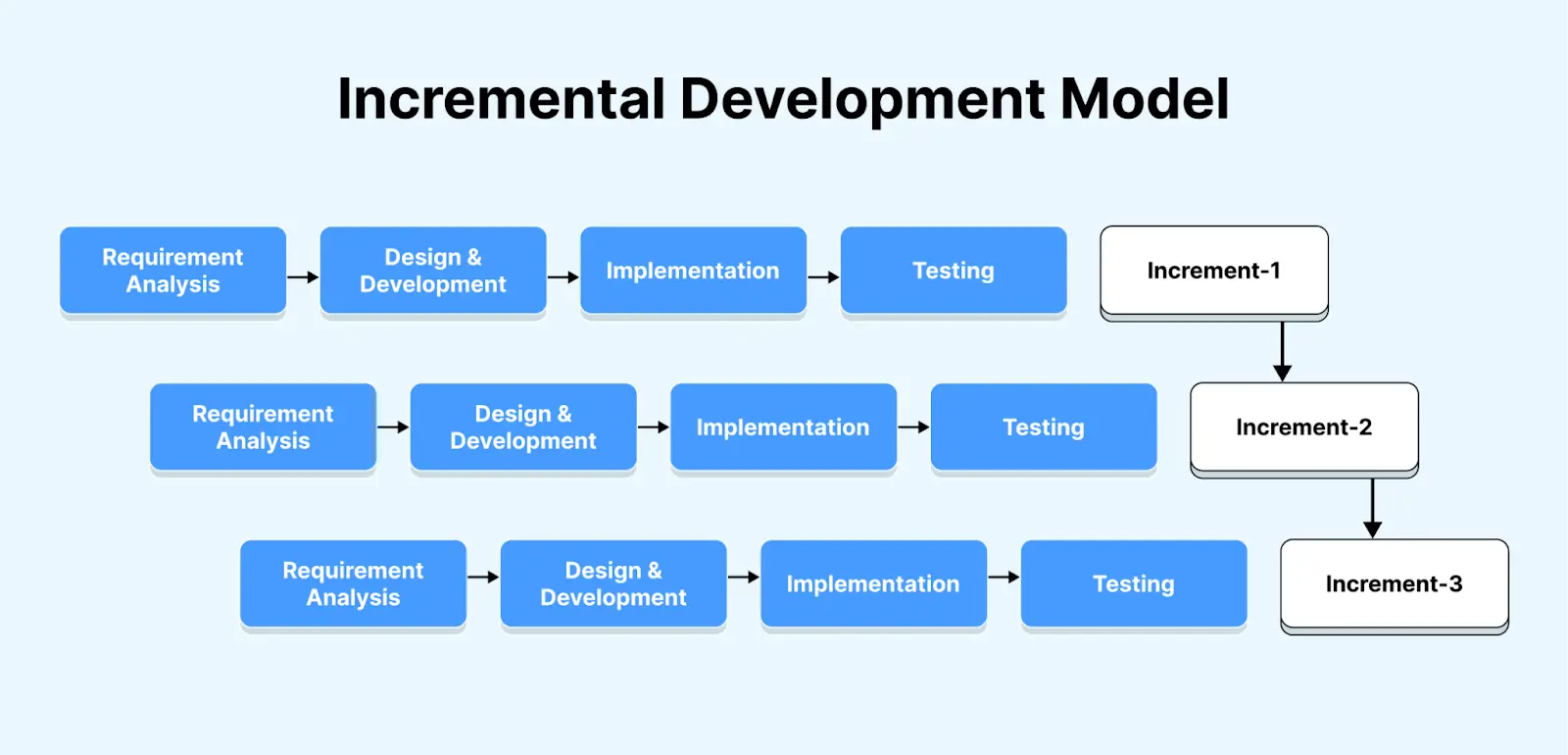
The incremental development model is a software development approach that breaks down project requirements into distinct standalone modules throughout the software development lifecycle. It involves determining user needs, defining the overall architecture, and delivering the software application in increments or software builds. Each build incorporates a portion of the planned capabilities, with subsequent builds adding more features until the entire software application is complete.
Phases in the Incremental Development Model:
The incremental model comprises four stages or phases: requirement analysis, design and development, implementation, and testing. Let us get into more detail on understanding each phase below.
- Requirement Analysis: In the initial phase of the incremental model, the product analysis team identifies requirements, and the requirement analysis team comprehends the software application's functional needs. This phase plays a crucial role in the software development process under the incremental model.
- Design & Development: During this phase of the software development process, the design of the software application's functionality and the development method are completed. The incremental model uses the design and development phase to introduce new functionality with each build.
- Implementation: The implementation phase is the stage where the project is implemented by writing the code based on the product requirements. Ensuring that the coding sticks to the established coding standards without unnecessary hard codes or defaults is crucial.
This adherence is essential for enhancing and updating software application quality. During this phase, the execution of designs is physically realized, bringing the project's conceptualization into tangible existence. After completing this phase, the working software application is enhanced and upgraded to the final system software application.
- Testing: In the testing phase, the entire software application, including any added functionality, undergoes thorough evaluation, integration, and testing as a cohesive whole. After each code implementation, testing the product to ensure seamless interaction with previously written code within the project is crucial. Upon completing the testing phase, the system is deployed to the production environment, becoming accessible for end-users.
Introducing new functionality or features during development presents a testing challenge in an incremental model. The integration of new code carries the risk of unintended impacts on existing components, potentially causing conflicts and issues.
To address this, testers repeatedly test the entire codebase alongside the new additions. Performing regression testing becomes crucial in this scenario. This ensures that existing code functions correctly when new code is added.
It involves retesting the entire application to detect unintended side effects and confirm that the recent changes haven't negatively impacted the previously established functionality. This proactive approach helps maintain the integrity of the software and provides confidence that the system remains stable and reliable after each incremental update.
Advantages of the Incremental Development Model:
- Errors are easily recognized during software development.
- It is very useful for testing and debugging software applications.
- This model offers more flexibility.
- It is simple to manage risks since they are handled during each iteration.
- Following this model, users receive important functionality early in development.
Disadvantages of the Incremental Development Model:
- It requires good planning.
- The total cost is high.
- Well-defined module interfaces are needed.
When to use the Incremental Development Model?
The incremental model is suitable when software application requirements are well-defined, allowing for gradual development and integration. An early product release is desired, making the Incremental Model beneficial for delivering functionalities in stages.
This approach is particularly helpful when the software engineering team lacks extensive training or expertise, enabling them to manage and test smaller, manageable components. The incremental model is also preferred when dealing with high-risk features and goals, allowing a step-by-step approach to mitigate potential challenges.
Moreover, this methodology frequently applies in web development and product-based companies, emphasizing its adaptability to these contexts.
Spiral Model
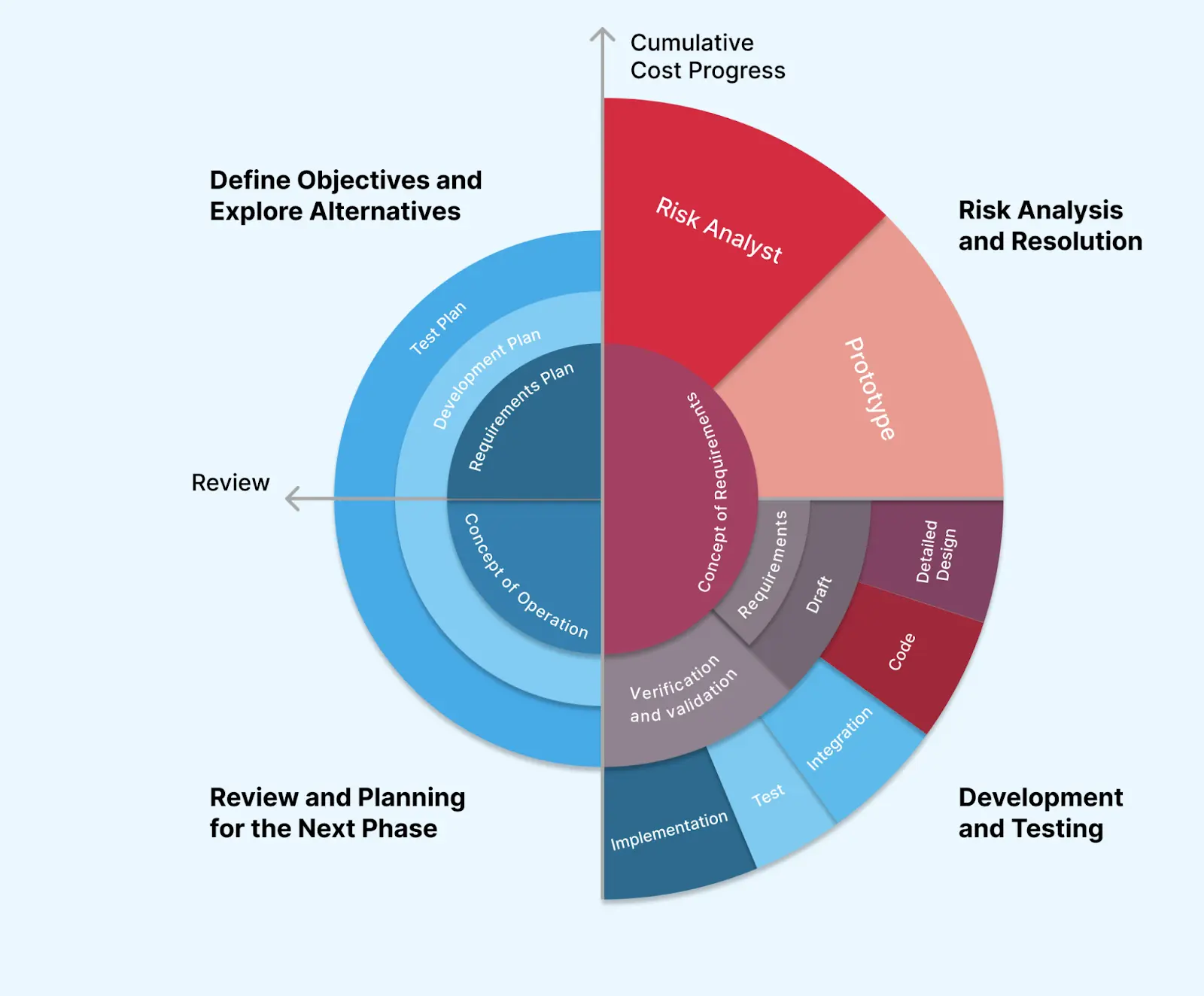
The spiral model seamlessly integrates the principles of iterative development with the structured, controlled elements of the waterfall model. It blends the iterative development process and sequential linear development models, significantly emphasizing rigorous risk analysis. This unique approach allows for incremental product releases or gradual refinement through each iteration around the spiral.
Phases of the Spiral Model:
The spiral model comprises four stages or phases: planning objectives, risk analysis, engineering or development, and review. A project cyclically traverses these stages, forming a spiral within the model.
- Define Objectives and Explore Alternatives: This phase includes the gathering and analysis of requirements. Objectives are formulated based on these requirements, and various alternative solutions are proposed.
- Risk Analysis and Resolution: In this quadrant, all proposed solutions undergo thorough analysis, and potential risks are identified, analyzed, and resolved.
- Development and Testing: This phase involves implementing different features. All implemented features undergo comprehensive testing to ensure their functionality.
- Review and Planning for the Next Phase: During this phase, the software application undergoes evaluation by the user. Risk identification and monitoring occur, such as cost overrun or schedule slippage. Following this, planning for the next phase starts.
Advantages of the Spiral Model:
- It is flexible to accommodate changing requirements.
- It allows extensive use of prototypes.
- It allows for a more accurate capture of requirements.
- This model gives early visibility of the system for users.
- Division of development into smaller parts facilitates better risk management by addressing the riskier components earlier.
Disadvantages of the Spiral Model:
- While developing software applications using a spiral model, the management complexity increases.
- Determining the project's end may not be evident early in the process.
- It is less suitable for small or low-risk projects and could be cost-prohibitive.
- The software development process is intricate.
When to use the Spiral Model?
This model is suitable for software projects requiring frequent releases or evolving requirements. It benefits long-term projects facing challenges due to shifting economic priorities, providing flexibility. It is well-suited for medium to high-risk projects, offering systematic, iterative cycles to address risks. The model is advantageous in software projects where thorough cost and risk analysis are crucial, enabling continuous evaluation and refinement throughout development.
V-Model
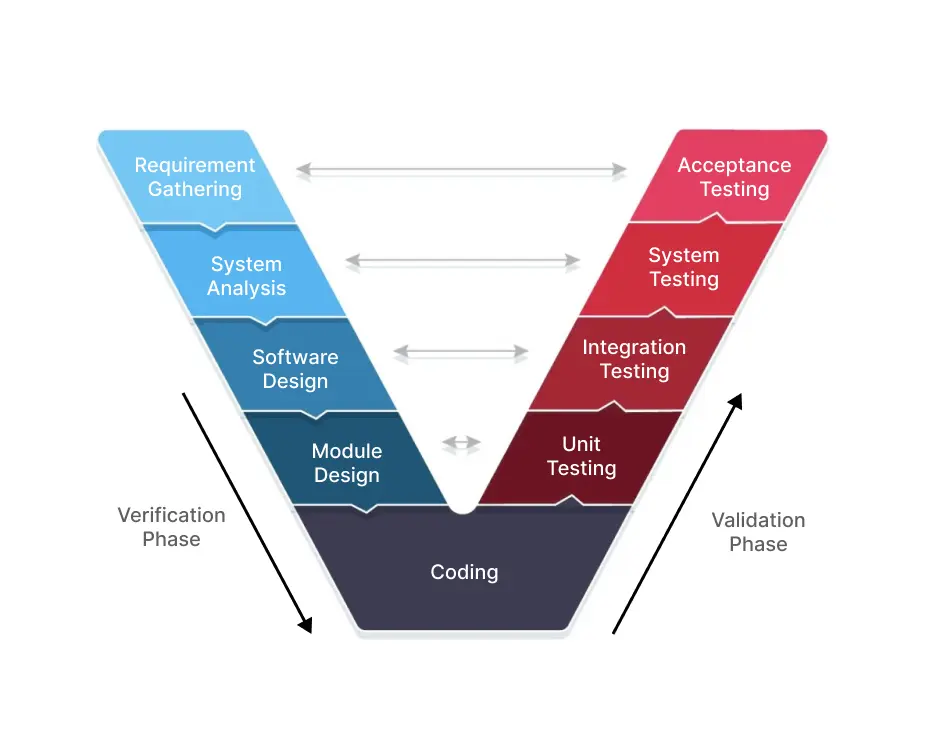
The V-model represents a software development process in a sequential V-shaped manner, extending from the waterfall model. It aligns with the testing phase corresponding to each development stage, reflecting a disciplined approach where the initiation of the subsequent phase occurs only after the completion of the preceding one. Here, the left side of the V-model shows the verification phase, while the right-hand side shows the validation phase.
Phases of the V-Model:
The six stages or phases include requirement gathering, design, build, test, deployment, and maintenance. Let us get into more detail on understanding each phase below.
- Requirement Gathering Stage: During the requirement gathering stage, comprehensive details and specifications of the desired software application are collected from the client.
- Design Stage: In the design stage, programming languages like Java, PHP, .net, and databases like Oracle and MySQL are planned based on project suitability, along with high-level functions and architecture.
- Build Stage: The build stage follows the design, involving the actual coding of the software application.
- Test Stage: Moving to the test stage, the software application undergoes testing to ensure adherence to the client's specifications.
- Deployment Stage: Deployment involves releasing the application into the respective environment.
- Maintenance Stage: In the maintenance stage, post-system readiness, code adjustments may be necessary for response to users' requests.
Advantages of the V-Model:
- This approach is highly disciplined, with one phase completed at a time.
- Effective for smaller projects with well-understood requirements.
- Simple, easy to comprehend, and implement.
- Manageable due to the model's rigidity, with specific deliverables and a review process for each phase.
Disadvantages of the V-Model:
- High risk and uncertainty are associated with this method.
- Not suitable for complex or object-oriented projects.
- Inappropriate for long and continuous projects.
- Unsuitable for projects with requirements at a moderate to high risk of changes.
- Once an application reaches the testing stage, altering functionality becomes challenging.
When to use the V-Model?
You can choose the V-model when requirements and understanding of software application functionality are well-defined from the project's inception. In scenarios where the project scope is clear and the development team possesses a solid grasp of the requirements, the V-model is an effective tool for delivering high-quality software applications.
Prototyping Model
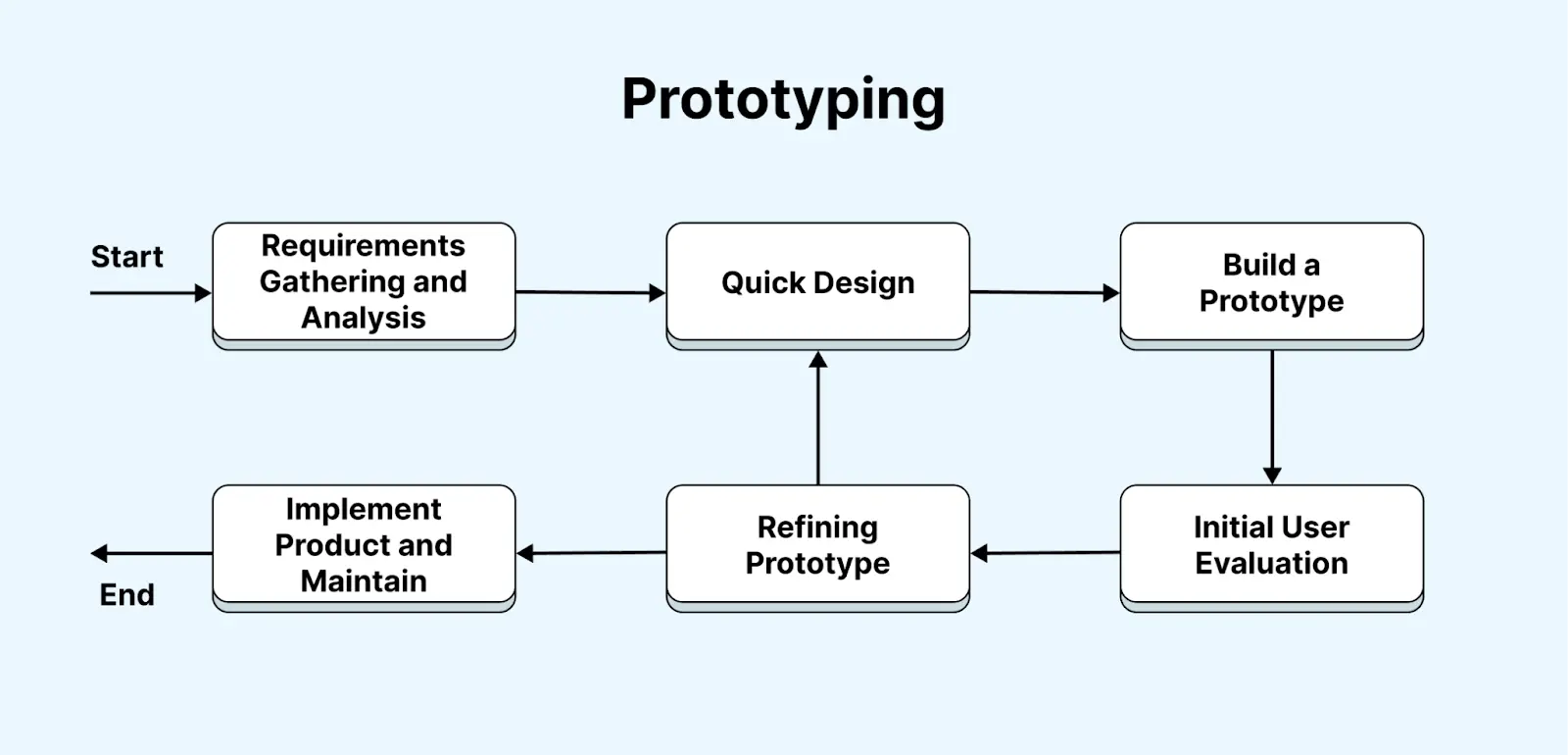
The prototyping model is a software development approach wherein a prototype is developed, tested, and refined until an acceptable version is attained, forming the foundation for the final software application. This model is particularly effective when project requirements lack detailed clarity, and it uses an iterative, trial-and-error methodology involving continuous collaboration between the developer and the users.
Phases in the Prototyping Model:
The prototyping model comprises six stages or phases: requirements gathering and analysis, quick design, prototype building, initial user evaluation, refining prototype, implementing the product, and maintenance. Let us understand each of these phases in detail below.
- Requirements Gathering and Analysis: Initiating with detailed analysis, this phase defines the system requirements comprehensively.
- Quick Design: The system's preliminary or quick design is formulated in this phase after requirement analysis.
- Build a Prototype: A prototype is developed based on the insights gleaned from the quick design, serving as a small working model of the desired system.
- Initial User Evaluation: The proposed system undergoes an initial evaluation by the client in this stage, unveiling the strengths and weaknesses of the working model.
- Refining Prototype: If the user expresses dissatisfaction with the current prototype, adjustments are made based on feedback and suggestions to enhance user satisfaction.
- Implement Product and Maintain: Following the development of the final system based on the refined prototype, rigorous testing and deployment to production occur.
Advantages of the Prototype Model:
- It allows mitigation of the risk of incorrect user requirements.
- It is ideal for scenarios with changing or uncommitted requirements.
- Following this model enables early software application marketing support.
- It lowers maintenance costs with early error detection during concurrent system development.
Disadvantages of the Prototype Model:
- An unstable or poorly implemented prototype may become the final product.
- It becomes difficult to estimate project duration.
- Prone to reverting to coding without complete requirement analysis, design, user evaluation, and feedback.
- Also, the costs associated with prototyping tools can be high.
When to use the Prototyping Model?
The prototyping model is used when software requirement specifications lack clarity or are subject to rapid changes, offering flexibility to adapt to evolving software project needs.
Iterative Model
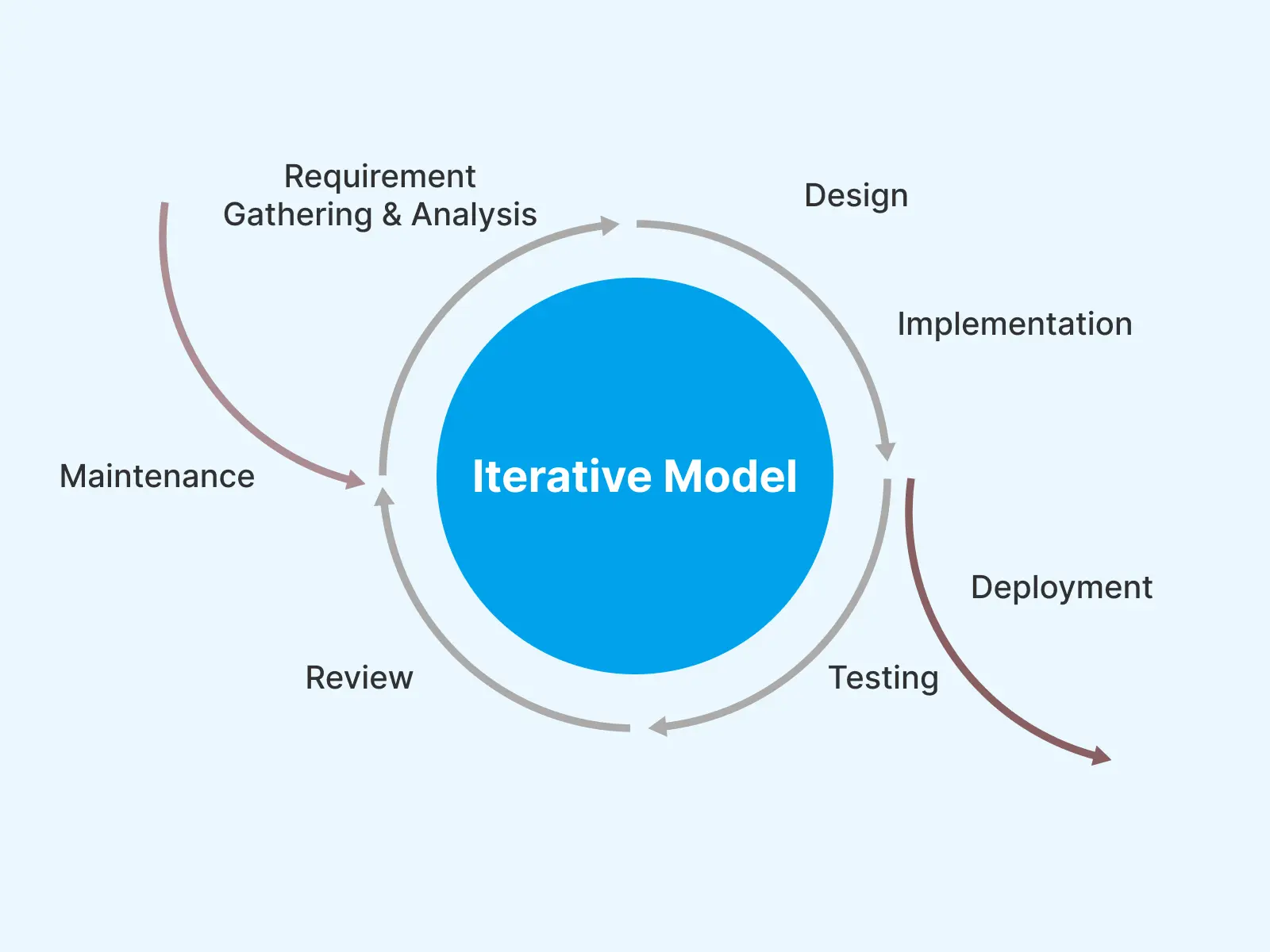
The iterative model is a software development process model that prioritizes an initial, basic implementation, progressively incorporating more complexity and features until the final software application reaches completion. In other words, you can simply understand iterative development as a strategy that involves breaking down the software development of a substantial program into smaller, manageable components.
Phases of the Iterative Model:
The iterative model comprises seven stages or phases: requirements gathering and analysis, design, implementation, deployment, testing, review, and maintenance. Let us understand each of these phases in detail below.
- Requirement Gathering & Analysis: In this initial phase, the user requirements are collected and checked by a quality analyst to ensure fulfillment. They evaluate whether the needs can be met within the allocated budget, and upon completion, the software team seamlessly transitions to the subsequent phase.
- Design: The design phase involves the creation of software designs using various diagrams such as Data Flow diagrams, activity diagrams, class diagrams, state transition diagrams, and more.
- Implementation: Transitioning from design, the implementation phase involves translating requirements into code, effectively transforming them into executable computer programs.
- Deployment: The software is deployed into its operational environment upon completing all preceding phases.
- Testing: Following the coding phase, software testing starts using diverse test methods, with white box, black box, and gray box test methods being among the most common.
- Review: Post-deployment, a review phase is undertaken to verify the behavior and validity of the developed software applications. If any errors are identified, the process restarts from the requirement-gathering phase.
- Maintenance: In the maintenance phase, post-software deployment, any bugs, errors, or the incorporation of new updates are addressed. Here, maintenance includes debugging and the addition of new features.
Advantages of the Iterative Model:
- Software applications are developed in iterations that help identify design or functionality issues rapidly and allow for corrective actions within budget constraints.
- A functional software application is generated early in the software development process.
- Early detection and prevention of errors and bugs.
Disadvantages of the Iterative Model:
- Structure or design issues in software applications may arise due to incomplete requirements collected at the outset of the entire life cycle.
- While the cost of change is lower, it may not be well-suited to frequently shifting requirements.
When to use the Iterative Model?
This model proves advantageous when project requirements are well-defined and easily understandable, allowing for iterative refinement. It is particularly suitable for managing large-scale software applications, enabling gradual development and enhancement.
Additionally, the iterative model is recommended when there is an anticipation of future changes in requirements, providing a flexible framework that accommodates evolving needs throughout development. Its iterative cycles allow continuous improvements, making it a valuable approach for projects with dynamic or changing requirements.
Rapid Application Development (RAD) Model
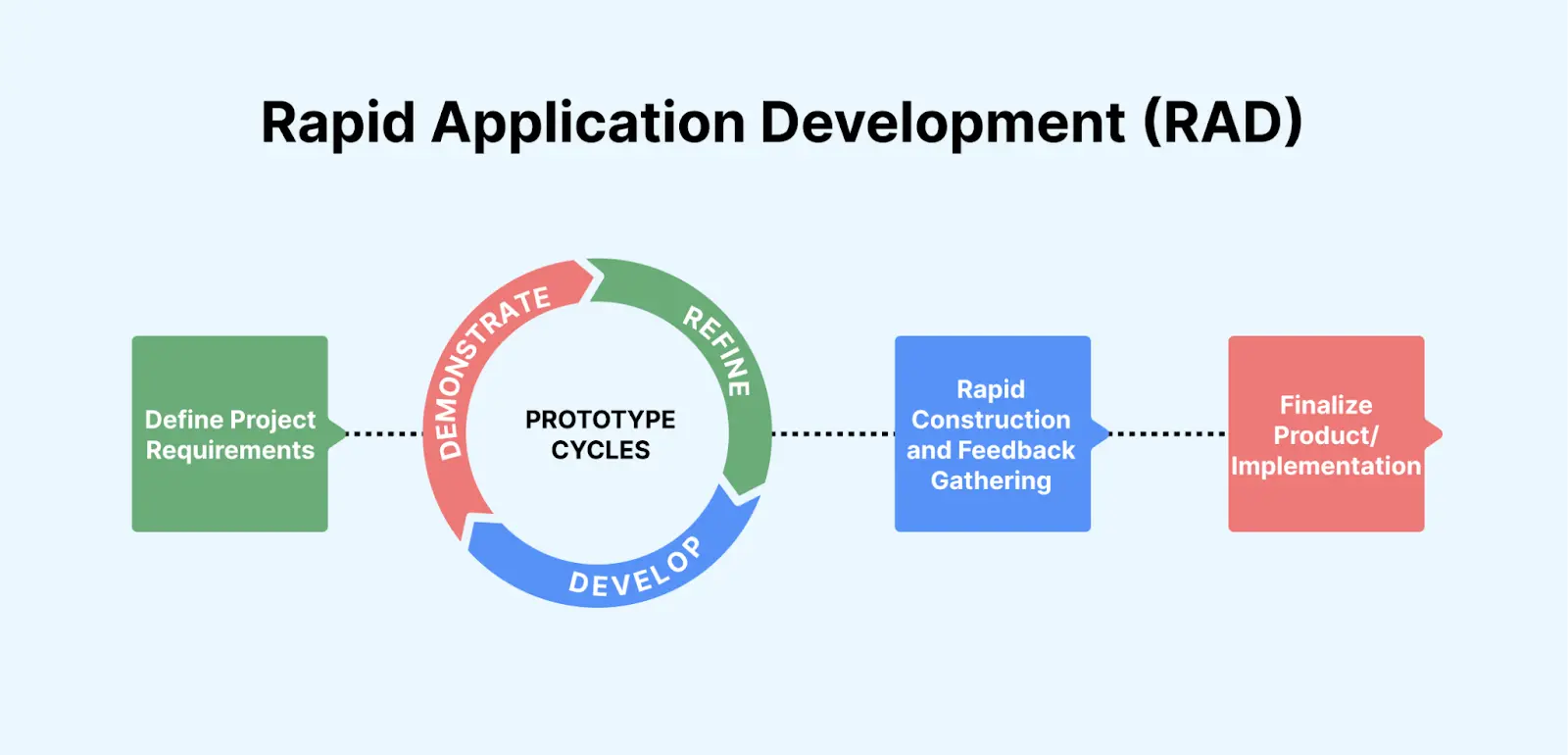
Rapid Application Development, commonly known as RAD, represents an adaptive software development model centered around prototyping and easy receiving of feedback, focusing less on careful planning. Essentially, the RAD approach prioritizes a prototype's rapid development and creation over extensive planning. This method allows developers to iterate and update the software applications without initiating the process. This ensures that the final developed software application is quality-focused and aligns with the end users' needs.
Phases in the RAD Model:
The cycle comprises four stages or phases: defining project requirements, prototyping, rapid construction and feedback gathering, and finalizing product/implementation. Let us understand each of these phases in detail below.
- Define Project Requirements: All project stakeholders, including developers, users, software users, and teams, collaborate to establish the software project's requirements and devise strategies for addressing potential challenges during development.
- Prototype: Once the software project has been scoped, teams develop initial models and prototypes. The objective is to generate a working design to present to the users. In this phase, developers and designers collaborate closely with users until the final software application is ready to ensure alignment with the user's needs.
- Rapid Construction and Feedback Gathering: Rapid construction involves application coding, system testing, and unit integration, transforming prototypes and beta systems into a functional model. This phase may be iterated as needed to accommodate new components and modifications.
- Finalize Product/Implementation: In the last phase of rapid application development, developers address technical debt accumulated during early prototyping. They optimize implementation to enhance stability and maintainability while finalizing the software application for launch.
Advantages of the RAD Model:
- It is flexible and adaptable to change.
- Each RAD phase introduces the highest priority functionality to the users.
Disadvantages of the RAD Model:
- Requires highly skilled designers.
- Not all applications are compatible with RAD.
- Unsuitable for smaller projects.
When to use the RAD Model?
This model is ideal for projects that deliver a system quickly, typically within 2-3 months. It is particularly effective when well-known project requirements facilitate accelerated development. User involvement is a key aspect of RAD, making it suitable for situations where continuous engagement is essential throughout the life cycle, ensuring the end product aligns closely with user expectations. Additionally, RAD is recommended when technical risks are minimal, allowing for a rapid and streamlined development process.
In this section, we have thoroughly discussed the different methodologies for the software development process that explain different procedures and approaches to build robust software applications based on different user requirements. Let us learn about different practices and actionable approaches the team adopts to improve the software development process.
Agile Model
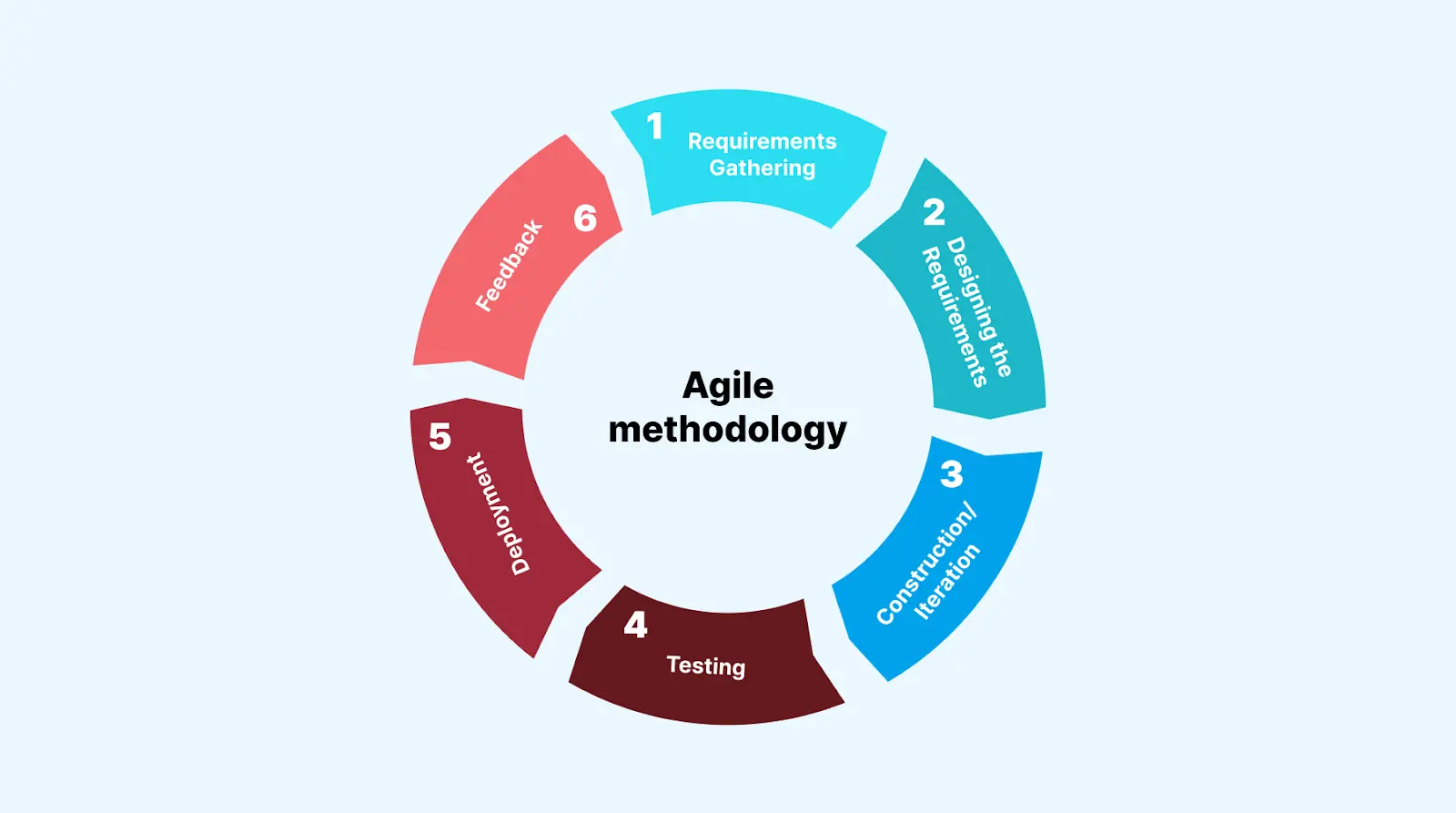
The Agile methodology is a project management framework that dissects projects into dynamic phases, commonly called sprints. This framework operates on an iterative methodology, with teams reflecting and evaluating after each sprint to identify areas for improvement and subsequently adjust their strategy for the upcoming sprint.
Phases of the Agile Model:
The agile development model comprises six stages or phases: requirement gathering, designing the requirements, iteration, testing, deployment, and feedback. Let us get into more detail on understanding each phase below.
- Requirements Gathering: During this initial phase, the focus is on defining project requirements, elucidating business opportunities, and planning the necessary time and effort for software project construction. Technical and economic feasibility is evaluated based on this information.
- Designing the Requirements: Stakeholder collaboration is initiated to define requirements once the software project is identified. User flow diagrams or high-level UML diagrams illustrate the workings of new features and their integration with the existing system.
- Construction/Iteration: With the requirements defined, the team begins the construction phase. Designers and developers commence work on the software project, aiming to deploy functional software applications. The applications undergo various stages of improvement, initially including simple, minimal functionality.
- Testing: The quality assurance team measures software application performance and identifies bugs in this phase.
- Deployment: During this phase, the team releases the software applications for use in the user's work environment.
- Feedback: Following the release of the software applications, the final step involves gathering feedback. The team receives input on the software applications and works through any feedback received.
Advantages of the Agile Model:
- It achieves user satisfaction by continuously delivering valuable software.
- This model mainly focuses on the people and interactions over processes and tools, giving constant collaboration between users, developers, and testers.
- Delivers working software frequently, with releases occurring in weeks rather than months.
Disadvantages of the Agile Model:
- It is difficult to analyze how much effort and time will be needed when the development of software applications starts.
- This process lacks focus on required designing and documentation.
When to use the Agile Model?
This model is well-suited for software projects anticipating frequent changes, providing a flexible and adaptive framework. It is particularly effective when a highly skilled and experienced team is available, allowing for efficient collaboration and quick adaptation to evolving requirements.
Agile is advantageous when users are willing to engage regularly with the software team throughout the development process, fostering collaboration and feedback. This model is recommended for relatively small-sized software projects, where its iterative and incremental nature can efficiently address evolving needs and deliver valuable increments on time.
Now that we have recognized the benefits of the Agile model for its adaptability and collaboration, let's delve into Agile testing, a crucial component that complements this dynamic approach. Agile testing aligns seamlessly with Agile development's iterative and incremental nature, ensuring testing activities are blended into the entire software development lifecycle.
Agile testing helps identify defects in the early stage of development, enabling quick feedback loops and rapid responses to changing requirements. This collaborative approach builds a close working relationship between development and testing teams, enhancing communication and contributing to the overall success of Agile projects.
Software Development Architecture Patterns
Software development architecture patterns are crucial in the overall software development process. They provide guidelines that directly impact how software applications are being developed. In simpler terms, architectural patterns act as the blueprint that guides the organization of code, design, and development of software applications.
When you have software development architecture patterns, you can make informed decisions on how to structure code, manage dependencies, and ensure the release of quality software applications.
Tools for Software Development Process
The software development process involves using several software tools, each with its specific purpose and function. Here are the different categories of software development tools that are needed in the development of software applications.
Software developer tools enhance the development process by improving efficiency, productivity, and code quality. They automate tasks, streamline workflows, facilitate collaboration, and ensure high-quality software products are delivered efficiently.

Integrated Development Environments (IDEs)
An IDE bundles code editing, debugging, and execution into a single application, cutting context-switching for developers. Common choices include:
- Visual Studio Code (VS Code): A lightweight, extensible editor from Microsoft with built-in debugging, Git integration, and a vast extension marketplace supporting most languages and frameworks.
- IntelliJ IDEA: A JetBrains IDE built for JVM languages (Java, Kotlin, Groovy) with deep code analysis, smart refactoring, and broad support for JavaScript, TypeScript, and Node.js.
- Eclipse: An open-source Java IDE that supports C/C++, PHP, and JavaScript through plugins, with a large marketplace for extending its capabilities to almost any language.
- PyCharm: A JetBrains IDE purpose-built for Python, offering intelligent code completion, on-the-fly error detection, and integrated testing and debugging tools.
Build Tools
They are specialized software tools designed to automate tasks such as compiling, linking, and packaging source code to create executable programs or libraries. These tools are important in managing dependencies, optimizing code, and ensuring a standardized build process across various development environments.
- Apache Maven: Apache Maven functions as a software project management and comprehension tool, operating on a page object model (POM) principle. With Maven, it becomes possible to centrally manage a project's build, reporting, and documentation using unified information.
- Gradle: Known for its adaptability in building software, Gradle is a build automation tool. This tool automates the software application development, including compiling, linking, and packaging code tasks. Utilizing build automation tools improves the consistency of the entire building process.
- Ant: Apache Ant, both a Java library and a command-line tool, focuses on driving processes outlined in build files, with targets and extension points interdependent. Although commonly associated with the Java application build, Ant offers a range of built-in tasks for compiling, assembling, testing, and running Java applications. It also proves effective in building non-Java applications like C or C++.
- Bazel: It is a tool for automating software builds and tests and supports various build tasks, including running compilers and linkers to generate executable programs and libraries. It is also well known for assembling deployable packages for Android, iOS, and other target environments.
CI/CD Tools
Here is a list of CI/CD tools that help track all your codebases and enable multiple developers to collaborate effectively on a single project.
- Jenkin: Jenkins is a Java-based cross-platform, open-source CI/CD tool that offers continuous integration and facilitates continuous delivery. It also supports real-time testing and reporting. To install Jenkins, one can download its executable in the .war format and initiate it from the terminal.
- Travis CI: Much like Jenkins, Travis CI is an early player in the CI/CD pipeline tools market. Initially designed for open-source projects, it later expanded to support closed-source projects. Written in the Ruby programming language, Travis CI is an excellent choice for open-source and enterprise-level projects, particularly if hosted on GitHub or Bitbucket.
- GitLab CI: GitLab CI, an integral part of GitLab, is one of the premier CI/CD tools, offering features like code reviews, CI/CD, and continuous deployment, all accessible within a single dashboard. To implement GitLab CI/CD, one needs to host the codebase in a Git repository and specify build, test, and deployment scripts in a YAML file named .gitlab-ci.yml, located in the root directory.
- CircleCI: Regarding CI/CD tools for open-source and large-scale projects, CircleCI is among the best. It offers CircleCI Cloud as a cloud-based solution and CircleCI Server for on-premise (or self-hosted) use. CircleCI supports languages buildable on Windows, Linux, and macOS platforms.
Integrate your development process with the best CI/CD tools, such as Jenkins, and learn how to perform CI/CD testing to streamline and enhance the development and testing processes. This integration aims to facilitate efficient collaboration, improve code quality, and ensure timely delivery of software products.
Learn more about one of the most widely used CI/CD tools, Jenkins, which is crucial in maintaining the testing process. Follow the video tutorial below to enhance your understanding and proficiency with this tool.

Source Control Tools
- Git: Git is a valuable DevOps tool for source code management. As a free and open-source version control system, Git efficiently handles small to large projects. Its primary function involves tracking changes in the source code and facilitating collaborative work among multiple developers on non-linear development.
- Subversion (SVN): Subversion software, commonly known as SVN, is an open-source version control system. SVN allows teams to review previous file versions and monitor changes over time. Initially released in 2000 by CollabNet, Subversion (SVN) is currently licensed under Apache.
- Mercurial: Mercurial, another free and distributed version control system, is often referred to as a revision control system or Mercurial source control. Software development teams utilize Mercurial to manage and track changes across various projects effectively.
Software Testing Tools
Below is the list of software testing tools that help enhance the development and testing process and help deliver quality software based on the user’s requirements.
- TestMu AI: TestMu AI is the popular platform in the software automation testing tool list, offering a cloud-based AI-native test orchestration and testing platform that allows access to 3000+ browsers, versions, and combinations to test web applications and mobile apps. This platform accelerates your release speed through high-end test automation on the cloud, supporting integration with a diverse range of frameworks and tools for web testing and app automation.
With compatibility for Selenium, Cypress, Playwright, Puppeteer, Taiko, Appium, Espresso, XCUITest, and more, TestMu AI provides versatility in your testing approach. Executing test scripts on this platform is seamless, contributing to a significant reduction in test execution time. Furthermore, it simplifies issue tracking and resolution, offering a streamlined process that can be achieved in three simple steps.
This platform allows you to test cross-browser compatibility with over 3000+ browsers and operating system environments. It eliminates the risk of flaky test results with improved hardware reliability. It offers HyperExecute, a powered test execution platform that allows 70% faster execution of the test.
It also monitors progress through a real-time dashboard and seamlessly integrates with project management tools, fostering collaborative efforts among teammates. This platform also supports integration with over 200 tools related to project management, providing a versatile testing solution.
Get started with the complete TestMu AI tutorial by following the video below and getting detailed insights on how this platform makes your development and testing process easy.

Subscribe to the TestMu AI YouTube channel when you want to catch up with the latest news on automated browser testing, Selenium testing, Playwright testing, Cypress testing, automated UI testing, and more.
- Selenium: Selenium is an open-source automated testing solution that allows users to generate and execute tests for web applications. Selenium's versatility spans various programming languages, enabling the testing of applications across multiple platforms. It proves to be particularly advantageous for teams seeking a quality assurance testing solution that offers adaptability and customization.
- Playwright: Playwright, on the other hand, is a Node.js library offering a unified API to automate Chromium, Firefox, and WebKit. Developers can harness these APIs using JavaScript code to establish new browser pages, navigate to URLs, and seamlessly interact with elements on a page.
- Cypress: Cypress is a web front-end testing tool developed using JavaScript Mocha. Unlike Selenium, it functions directly on browsers. Its distinctive DOM manipulation technique sets it apart, rendering it highly developer and QA-friendly.
- Appium: This tool is both open-source and widely acknowledged. It tests native, hybrid, and mobile web applications and can control Android, iOS, and Windows apps via the WebDriver protocol. Appium is built on the fundamental idea that testing a native app shouldn't require an SDK or app recompilation. Instead, the emphasis is on utilizing your chosen test frameworks, methodologies, and tools to perform efficient mobile app testing with Appium.
To gain proficiency in utilizing various automation testing tools with TestMu AI, refer to the TestMu AI support documentation. This comprehensive guide offers step-by-step instructions on integrating TestMu AI capabilities into your code and running your scripts over the cloud.
Project Management and Collaboration Tools
Here is a list of tools that enhance team efficiency and collaboration, enabling seamless communication and feedback exchange to address any issues. These tools contribute to building a robust team by facilitating effective communication and feedback mechanisms.
- Jira: Jira, introduced in 2002, was initially an issue-tracking and project management tool for teams. Since then, it has been used by over 65,000 companies globally, well known for its adaptability across various project types and its extensibility, seamlessly integrating with thousands of apps and integrations.
- Trello: Trello is a collaboration tool that arranges projects into boards. With a glance, Trello provides a clear overview of ongoing tasks, team assignments, and the current status of a process.
- Click Up: Click Up is an all-in-one productivity platform offering an ideal space for teams to collaborate on diverse tasks, from process documentation to product designs. Despite its versatile applications, ClickUp was purpose-built for this level of flexibility.
- Teamwork: Teamwork.com is an all-in-one platform to help manage, streamline, and optimize client work. While project management apps excel at handling projects, Teamwork.com goes further by addressing billable time, resource tracking, and profitability.
The 7 Core Phases of the Software Development Process
Planning
Planning defines what gets built, why, and at what cost, before any code is written. The project manager leads this phase alongside business analysts and stakeholders, assessing technical and financial feasibility and formally defining the project scope to prevent scope creep. Resources including team size, budget, and timeline are allocated based on project complexity. Risk identification also happens here: teams catalogue likely blockers and document mitigation strategies. Choosing the right development methodology, whether Waterfall for fixed-scope work or Agile for iterative delivery, is also a planning decision. Key outputs are a project plan, feasibility study, risk register, and resource allocation document.
Requirements Analysis
Requirements analysis captures exactly what the software must do before design or coding begins. Business analysts, developers, testers, and stakeholders collaborate through interviews, workshops, and user story mapping to translate business objectives into specific functional and non-functional requirements. Ambiguous items are clarified and everything is recorded in a Software Requirements Specification (SRS) document, which becomes the reference point for every subsequent phase. Acceptance criteria defined here are what testers will later use to validate the finished product. Key outputs are the SRS document, use case diagrams, and agreed acceptance criteria.
System Design
System Design translates requirements into a technical blueprint. Architects and senior developers make core decisions about the software architecture, technology stack, database structure, and integration points. Two levels of design are produced: High-Level Design (HLD), which covers overall system architecture and component interactions, and Low-Level Design (LLD), which specifies the logic for individual modules. UI/UX designers contribute interface mockups and user flows. Security, scalability, and performance requirements are addressed here. Getting these decisions right significantly reduces costly rework in later phases. Key outputs are the HLD and LLD documents, architecture diagrams, interface mockups, and the agreed technology stack.
Development (Coding)
Development is where the design becomes working software. Front-end developers build the user interface using HTML, CSS, and JavaScript frameworks, while back-end developers implement server logic, APIs, and database interactions. All team members follow agreed coding standards and use version control (typically Git) to manage changes and enable collaboration. Code reviews are conducted regularly to catch issues early and maintain quality. Larger projects are broken into sprints or modules so that working increments can be tested and reviewed before the full build is complete. Key outputs are reviewed and merged source code, unit tests, and technical documentation.
Testing and QA
Testing verifies that the software behaves as specified and is free from critical defects before release. QA engineers run a range of test types: unit testing (developers), integration testing (QA and developers), system testing (QA), and user acceptance testing (stakeholders). Entry criteria define what conditions must be met before testing begins; exit criteria specify the coverage and defect thresholds required before sign-off. Bug reports are filed, triaged, and resolved in collaboration with the development team. Automated regression testing on a real-device cloud accelerates this cycle. Key output is a signed-off test report confirming the product meets the agreed acceptance criteria.
Deployment
Deployment moves tested software from a staging environment into production, making it available to end users. DevOps engineers and release managers coordinate the rollout across environments: development, staging (pre-production), and production. Release strategies vary by risk tolerance. A rolling deployment updates servers gradually; a blue-green deployment switches traffic between two identical environments; a canary release exposes a small percentage of users to the new version before a full rollout. Rollback plans are prepared in advance so the team can revert to the previous stable version if critical issues appear post-release. Key outputs are the deployed application, release notes, and a tested rollback procedure.
Maintenance and Support
Maintenance begins once the software is live and continues for the product's lifetime. Development teams monitor production logs and dashboards for errors, performance degradation, and security vulnerabilities. Bug fixes are prioritized by severity and deployed through a structured patching process. Planned updates introduce new features or improvements based on the product roadmap. User feedback gathered through support tickets, in-app surveys, and analytics feeds directly into the next development cycle. Preventive maintenance, such as refactoring code, upgrading dependencies, and addressing technical debt, keeps the codebase healthy over time. Key outputs include patched releases, updated documentation, and a prioritized improvement backlog informed by real user data.
Project Management in the Software Development Process
The Software development process requires adequate project management to ensure that the intended software applications are delivered on time and within budget in expected quality. You can understand project management as the process involving applications and different methods to plan, execute, and control software projects. But do we need project management?
Software projects are becoming highly complex with the need for advanced features, necessitating project management in software development. In developing such projects, multiple team members work on different components of software applications; their collaboration and communication are highly critical.
Project management provides a roadmap guiding the team throughout the project, ensuring everyone is aligned with the project goals and objectives. It also helps identify and mitigate potential risks, manage uncertainties, and adapt to changes in requirements. Thus, project management gives a structured framework software developers use to ensure successful planning and completion of the software project.
In the software development process, project management is the most critical aspect that helps to establish clear and transparent communication among team members. It involves regular meetings, feedback loops, and progress reports through which teams can ensure that they are on the same page. Moreover, project management methodologies such as Agile or Scrum enhance flexibility, enabling teams to respond promptly to changing requirements and user feedback.
Here are the guiding steps for project management in the software development process:
- Get a clear scope and objective of the software project.
- Create a detailed plan for executing the software development process by defining the task, time, and resource allocation.
- Identify any underlying risks and develop strategies to eliminate those in the project.
- Ensure effective collaboration and communication in the team. You can also follow Agile methodologies (Scrum and Kanban) to adapt to the changing requirements of the project quickly.
- Monitor the progress of the projects by addressing crucial key performance indicators like defect density, test coverage, etc.
- Perform tests and quality assurance processes throughout the software development process.
- Implement code reviews and create comprehensive documentation for the software applications, including user manuals, technical specifications, and maintenance guides.
- Execute regular analysis to reflect on what went well, what could be improved, and how to implement positive changes in future projects.
Now that we better understand how the project management process enhances the software development process, the following section will delve into the methods employed to ensure quality while reviewing code.
How to Measure Software Development Effectiveness?
How would you know whether your software development process is heading in the right direction or what is the scope of improvement? To know this, it is essential to measure the effectiveness of the software development process. This will give quantitative insight into the efficiency and performance of the development team, which can be analyzed to evaluate the progress of the complete software development process. Here are some key QA metrics commonly used in software development:
- Code Churn: The code change rate over time.
- Code Coverage: The percentage of code covered by automated tests.
- Defect Density: The number of defects identified per unit of code.
- Lead Time: The time taken from the initiation of a task to its completion.
- Cycle Time: The time to complete a single development cycle, from coding to deployment.
- Velocity: The work a development team completes in a specific iteration or sprint.
- Bug Resolution Time: The time taken to resolve reported bugs.
- Code Review Effectiveness: The percentage of issues identified during code reviews that are successfully addressed.
Best Practices of Software Development Process
Building software is a complex task, and following the best practices for creating top-notch, efficient, and dependable solutions is important. These best practices include methods, principles, and strategies that guide developers in achieving optimal results at each stage of the software development process.
- Understanding your software application requirements is crucial in adhering to software development standards and best practices. You need to follow specific guidelines to implement software development processes consistently.
- Another recommended practice is keeping all software projects open for review to ensure the testing of the software applications before they enter the production cycle. For this, you should adopt Important techniques like code reviews, software testing, and creating troubleshooting documentation.
- Software developers must utilize software application frameworks instead of starting from scratch. Using frameworks provides reusable software components and tools, which help simplify the software development process.
- You should keep your code simple, which is considered good software development practice. This helps maintain coherence and makes it easy to modify and repurpose.
- Continuous testing throughout the software development process is necessary to identify errors and bugs in the code.
- Issue-tracking software is valuable for reporting software bugs or issues during development. By using issue-tracking software, developers can report and address issues early in the development process, preventing the need for costly fixes later on.
- Using a version control system is one of the best practices for software development projects, primarily when multiple developers work on the same project.
- Documenting your progress is among the most important software development best practices. It involves keeping track of your work, including code changes, issues, and resolutions. Documentation helps you keep track of your progress and provides a record of what you’ve done, which is helpful for future reference.
While best practices are essential, certain myths persist in software development. Adapting to new technologies isn't always necessary, especially since not all team members are quick learners. Using the latest technologies can be challenging and may lack community support, leading to delays. Therefore, many developers prefer sticking to established programming languages that offer reliable support.
To learn more about such best practices myths in software development, watch the below video and get valuable insights.

Ensuring Code Quality in Software Development Process
The quality assurance process and code review are the two most essential parts that ensure the quality of the software application. In this, the QA process refers to the methodology applied throughout the software development process to detect and fix bugs in the early stage. The QA process involves various activities, including requirement analysis, test planning, test case development, and test execution. This validates the overall quality of the software application, while code review mainly focuses on identifying code errors and evaluating code quality. Thus, when both practices are integrated into the software development process, development teams can address both functional and structural aspects of software quality.
Here are some best practices related to code review and quality assurance processes that you should follow to improve the software development process:
- Incorporate QA processes and code reviews early in the development lifecycle to detect issues at the beginning.
- Implement automated testing as part of the QA process to ensure thorough and consistent testing of software functionality.
- Perform regular and consistent code reviews to maintain code quality and facilitate knowledge sharing among team members.
The following section will guide us on how security matters in software development.
Ensuring Security in Software Development Process
In the software development process, considering the security of the software application is very important due to the increasing frequency of cyber threats. The most common security vulnerabilities could be injection attacks, Cross-Site Scripting (XSS), Cross-site request forgery, Insecure Direct Object References (IDOR), XML External Entity (XXE) Injection, and others. Implementing security measures in software development is significant to eliminate risks and protect sensitive data.
Here are some of the best practices you can apply to incorporate security in the software development process:
- Perform comprehensive threat modeling exercises during the initial stages of development.
- Follow secure coding practices to minimize vulnerabilities, which include validating inputs, avoiding hard-coded credentials, using parameterized queries to prevent SQL injection, etc.
- Execute regular security audits and code reviews to identify and address vulnerabilities in the codebase.
- Use secure protocols (such as HTTPS) to encrypt data during communication and employ encryption algorithms to safeguard stored data.
The Future of Software Development Process
As organizations focus on faster development lifecycles, they shift away from older software development models. The increasing need for speed and agility in software development has made automation important. The development and operations are merging, creating a DevOps capability where disparate teams seamlessly collaborate in a more streamlined and synchronized manner.
In the software development process, newer approaches have emerged in the form of DevOps, a combination of principles and practices to enhance an organization's ability to expedite software application release in the market. With the transition toward DevOps, it's crucial to address the role of security. Security is no longer an isolated step in the SDLC; it's integral to ensure secure software development at DevOps speed.
Conclusion
To develop high-quality and functional software applications, the software development process acts as the guiding roadway for developers. It helps properly research, plan, design, implement, and test the software application. However, it should be noted that the steps of the software application process are not constant for every type of software application. It can vary as the requirement and need of software applications.
In the future, it's clear that organizations will adopt a DevOps approach to their software development process and embrace a more refined DevOps methodology. This evolution will involve seamlessly integrating security into every phase of the software development process.
Author

Nazneen Ahmad
Blogs: 39


Nazneen Ahmad is a freelance Technical Content SEO Writer with over 6 years of experience in crafting high ranking content on software testing, web development, and medical case studies. She has written 60+ technical blogs, including 50+ top-ranking articles focused on software testing and web development. Certified in Automation Basic and Advanced Training - XO 10, she blends subject knowledge with SEO strategies to create user focused, authoritative content. Over time, she has shifted from quick, keyword-heavy drafts to producing content that prioritizes user intent, readability, and topical authority to deliver lasting value.
Reviewer

Saurabh Prakash
Reviewer
Saurabh Prakash is an Engineering Manager at TestMu AI (formerly LambdaTest), where he leads engineering on agentic AI development and scalable system architecture for the quality engineering platform. He has also contributed to Test at Scale, the company's open-source test intelligence platform. He brings over 9 years of experience across Node.js, Java, Spring, MVC, data structures, algorithms, and scalable system design, with earlier roles as SDE 2 at Zomato, Senior Software Engineer at LogicHub, and Software Development Engineer at Directi. Saurabh holds a B.Tech in Computer Science and Engineering from Delhi Technological University.


Software Development Process FAQs
Did you find this page helpful?
More Related Learning Hubs
TestMu AI forEnterprise
Get access to solutions built on Enterprise
grade security, privacy, & compliance
- Advanced access controls
- Advanced data retention rules
- Advanced Local Testing
- Premium Support options
- Early access to beta features
- Private Slack Channel
- Unlimited Manual Accessibility DevTools Tests