

Power Your Software Testing with AI Agents and Cloud
The Native AI-Agentic Cloud Platform to Supercharge Quality Engineering. Test Intelligently and Ship Faster.


- TestMu AI (Formerly LambdaTest)
- /
- Blog
- /
- Complete Guide To Software Testing Life Cycle (STLC)
What is the Software Testing Life Cycle (STLC)?
This article on the Software Testing Life Cycle (STLC) discusses the fundamentals of software testing, its phases, methodologies, and best practices.
Last Updated on:
The Software Testing Life Cycle, or STLC, is the sequence of activities a testing team works through to verify that software meets its requirements. It runs in phases, each with its own entry and exit criteria and its own deliverable, from analyzing requirements at the start to producing a test summary report at the end.
It is often confused with the Software Development Life Cycle (SDLC), which covers building the product rather than testing it. This guide covers the phases, how they change across waterfall, V-model, spiral, and agile, the entry and exit criteria for each, and where automation fits.
TL;DR
- The Software Testing Life Cycle runs through six phases, from requirements analysis and test planning to execution and test cycle closure.
- STLC covers testing while SDLC covers building, and STLC phases start at requirements analysis rather than after development completes.
- Each phase carries entry criteria, exit criteria, and deliverables, from the requirements traceability matrix to the signed off test closure report.
- Waterfall and V-Model suit smaller projects with clear requirements, spiral handles larger ones, and agile overlaps testing with development sprints.
- Testing does not always follow the standard sequence, since emergency patches skip planning and DevOps teams automate tests on every commit.
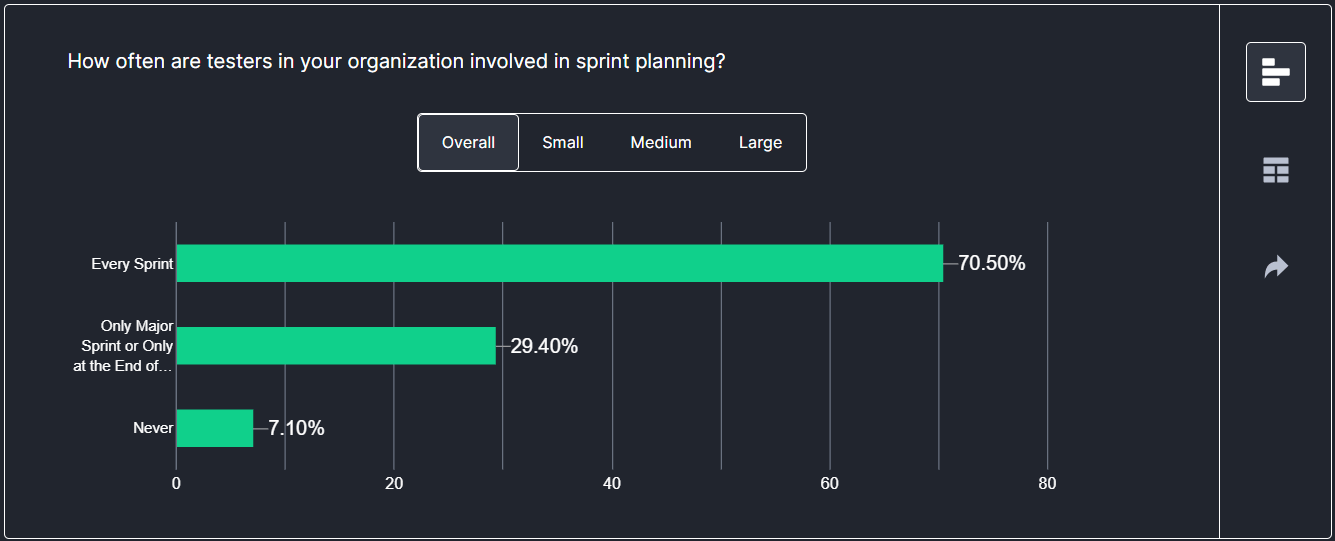
- TestMu AI's Future of Quality Assurance Survey found that 70.50% of organizations include testers in sprint planning meetings.
Why is Testing Software Important?
Software bugs can occur for various reasons, but not all are severe to the software application. Through software testing, we can make sure the software application is of high quality. For instance, a major bug could delay the release of a product, impacting the Return on Investment (ROI). So, testing is important because it reduces the overall costs of developing software.
If testing isn't done early in the software development process, it can become really expensive later on. Let's take an example. According to one of the reports by NP Group, over the December 2022 holiday period, there was a notable software failure that significantly halted operations of Southwest Airlines. The core issue was with their crew scheduling software, which proved inadequate in handling numerous complex scenarios simultaneously. The software inefficiency led to a major service breakdown, effectively stopping the airline's operations. This loss highlights how hard it is to track down and fix bugs later in the testing process. That's why software testing is crucial - it helps avoid such financial impacts.
According to the Future of Quality Assurance Survey by TestMu AI, 70.50% of organizations include testers in sprint planning meetings, indicating a significant trend towards prioritizing quality in software development.
Here are some of the benefits of testing software applications:
- Bug Detection - Thorough testing helps uncover bugs and errors within the code, preventing them from reaching production.
- Boost Quality - By identifying and resolving issues early, testing improves the overall quality of the software. It leads to a more polished and user-friendly experience.
- Build Trust - Full functional software application instills confidence in customers, knowing they're interacting with a reliable software product. Also, this contributes to increased brand loyalty and positive word-of-mouth.
- Save Cost - Addressing bugs early through testing is quite cheaper than fixing them after release. This approach prevents potential revenue loss and ensures efficient resource allocation.
- Accelerate Development - By uncovering roadblocks and pitfalls early on, testing helps developers adapt and refine their approach, ultimately accelerating the software development process.
Now that you know the benefits of software testing, let's dive deep into what is Software Testing Life Cycle.

What is the Software Testing Life Cycle (STLC)?
By Sathwik Prabhu
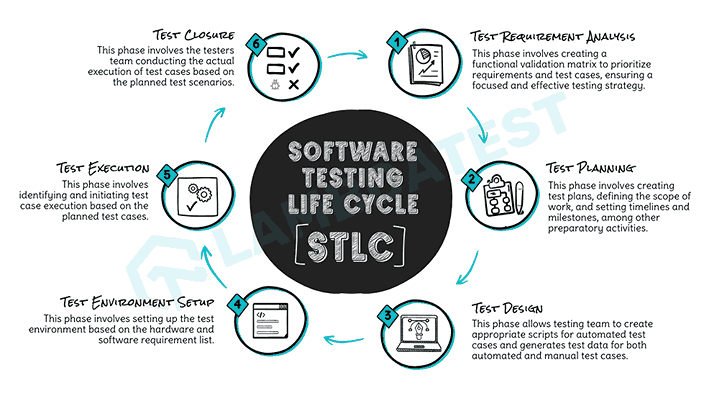
The Software Testing Life Cycle (STLC) is a structured process for testing software applications to ensure it meets quality standards. It involves several phases, each critical to the development of the software.
During the development of a software product, the STLC stages are repeated as necessary, refining the software application until it reaches a level of quality suitable for release. STLC follows a cyclical approach and ensures thorough testing and quality assurance before the software is made public.
Due to the complexity of software, it is impossible to ensure that a product will be free of errors if only one test is performed. Therefore, multiple tests are performed on every Software Testing Life Cycle (STLC) phase.
What is the Role of the Software Testing Life Cycle?
The Software Testing Life Cycle is essential for quickly identifying and documenting issues in the software application for developers to fix. In STLC, testers play a crucial role in:
- Streamlining the agile process for better communication across teams.
- Setting clear deadlines for testing in projects.
- Documenting project goals and ensuring consistent follow-through.
- Checking that all phase objectives are met accurately.
- Testing every software feature thoroughly before adding new ones.
- Identifying tasks that can be automated to enhance testing process.
STLC runs parallel to the Software Development Life Cycle (SDLC) for much of a software project. However, it aligns closely with SDLC during the development phase, especially in the SDLC testing phase - this pattern applies to various project types, from large-scale to smaller tasks within a project.
Benefits of Software Testing Life Cycle
The Software Testing Life Cycle (STLC) offers numerous benefits that enhance the overall quality and efficiency of software development:
- By shifting left in the development cycle, testing starts earlier, which improves test design and clarity in feature specs.
- Its structured approach ensures a thorough analysis of project requirements, leading to increased consistency and effectiveness in meeting project goals.
- It establishes clear, well-defined objectives for the product being tested. This clarity makes it easier to monitor and track the progress of the project.
- Each feature undergoes rigorous testing before the integration of additional features. This ensures a high level of confidence in the functionality and quality of each component.
- STLC provides clearer specifications, which benefits the entire development and testing team by enhancing understanding and communication.
- The process allows for the early and rapid identification of bugs or defects in the software product, offering timely resolutions and maintaining high standards of quality.
Difference between SDLC and STLC
What is SDLC in software testing and Software Testing Life Cycle (STLC)? They are both integral to software development, but they have distinct roles and functions. They often run in parallel, but each follows its own set of guidelines.
Both life cycles depend heavily on collaboration among stakeholders, the DevOps team, and testing teams. This teamwork is crucial to ensure that requirements are accurately defined, tests are relevant, and results are appropriately implemented.
| Aspects | Software Development Life Cycle (SDLC) | Software Testing Life Cycle (STLC) |
|---|---|---|
| Primary Focus | Focuses on developing a software application. | Focuses on testing the software application. |
| Quality Contribution | Helps in developing high-quality software. | Helps in making the software defects-free. |
| User and Product Understanding | Understands user needs and creates a product based on them. | Understands development requirements to ensure intended performance. |
| Requirements and Planning | Gathers requirements from business analysts and creates a development plan. | Analyzes requirements and QA team creates a test plan. |
| Design and Planning | Creates high and low-level design plans from the inputs given by the development team | Creates the integration test plan. Test analysts typically create the plan. |
| Responsibility in Development | Collects requirements and developing features. | Creates tests for these requirements and validating features. |
| Phase Sequencing | Phases run from requirements through to maintenance. | Phases run in parallel, starting at requirements analysis rather than after development completes. |
| End Goal | Delivers a high-quality, usable software application. | Uncovers and reports bugs for the development team to fix. |
Stages of Software Testing Life Cycle
It's important to understand the phases of the Software Testing Life Cycle (STLC) to make better decisions about how to test your software. One critical aspect of the testing lifecycle is determining which testing phase to perform on your software. The first step in this process is to determine whether you need to perform testing on your product or not.
If your product is an app that collects data, it will have less need for testing than if it were a banking website that processes financial transactions. Some products may undergo all testing phases, while others may be tested only partially. For example, a website that exists purely as a marketing tool might not need to go through tests other than usability.
Testing can happen anytime, and each phase should be performed at least once before moving on to the next. How much of each phase you run is a risk decision, but the phases feed each other - execution cannot start before cases, data, and an environment exist.
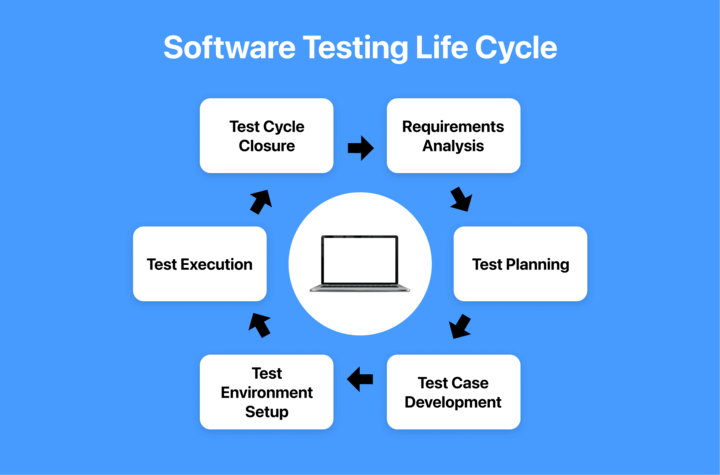
A typical Software Testing Life Cycle (STLC) consists of the following 6 phases, and let's have a detailed understanding of each stage.
Requirements Analysis
In the initial phase of the Software Testing Life Cycle (STLC), the QA and testing team determines the aspects of the project that need to be tested. This involves the QA team collaborating closely with business analysts, technical leads, system architects, customers, and other stakeholders to understand the testing needs of the software applications. The various software testing requirements that are examined include:
- Extracting the high-level business needs from the software application.
- Discussing and analyzing in detail the software architecture and design requirements to ensure they meet the business needs.
- Analyzing the comprehensive details of all components of the software application and any third-party integrations before the developers begin coding.
Test Planning
After requirements analysis, the test strategies are defined, along with cost and effort estimations. The testing manager plays an important role in determining different types of testing suitable for the software project, such as unit, API, integration, system, agile, and install/uninstall testing.
Once these testing types are selected, the test plan creation process begins, covering product analysis, test strategy designing, test objective defining, resources planning, test environment planning, scheduling, and others. This thorough and structured approach aims to bridge the gap between the expected and delivered results, ensuring the software development process meets its objectives and adheres to quality standards.
Test Case Development
After planning, testers start creating test cases that cover critical scenarios for the software's functionality. They decide which tests are more important based on their effectiveness. Then, they check if the software features work correctly and update the test cases as needed.
Mainly, they test different conditions using various inputs and expected results. Test case design mainly involves exploring actions the software can perform, developing test cases, deciding which ones to focus on, and preparing automated test scripts for these cases.
Test Environment Setup
Following the design and development of test cases, the software testing process requires a test environment for testing. The setup of the testing environment is a critical phase. It defines the conditions under which the software will be tested. As an independent activity, it can happen alongside the development of test cases. During this phase, the testing team conducts various types of testing to check the readiness and stability of the test environment, ensuring it's suitable for further testing activities.
Test Execution
In this phase of the Software Testing Life Cycle (STLC), the test execution begins, allowing testers to see the results of the test cases they created based on the test strategy. This stage is crucial for identifying, logging, and reporting bugs found in the software application, and a logged defect passes from here into the bug life cycle in software testing, which carries its own set of states and owners. It's also important to document any discrepancies between the expected and actual results, so the development team can address these differences.
Before executing tests, defining the scope and requirements for a test automation framework is essential. Consider your project's specific needs and challenges, the types of tests to be automated, integration with existing tools, scalability, maintainability, and your team's skill set. Assessing whether to adopt an existing framework or develop a custom one based on these criteria is crucial for ensuring the framework's success.
Watch the following video below to understand and define the scope and requirements for a test automation framework.

Once the software developers rectify the identified bugs, regression testing is performed. This step is essential to confirm that the changes implemented have fixed the issues without introducing new bugs, ensuring the software application performs as intended. To efficiently execute tests, especially repetitive ones, the use of automation testing tools is recommended, streamlining the test process and enhancing accuracy.
Test Cycle Closure
At this stage of the Software Testing Life Cycle (STLC), the QA team concludes the test execution phase. Here, the team collaborates to review the results, focusing on aspects that did not meet expectations. This discussion includes various aspects such as software quality, test coverage, and costs to understand the deviations from expected results.
This phase is critical in the software testing process and should not be overlooked. It unearths any issues that pop up during testing and identifies any shortcomings in the testing strategies and approaches.
Possible Variations in the Standard STLC Process
Sometimes, there are scenarios where you need to tweak the standard STLC process. Here are some instances where things don't quite follow the expected path.
- Agile Development - In the Agile world, testing doesn't always adhere to the typical STLC sequence, which is tailored for Waterfall development. Agile prioritizes flexibility, quick feedback, and constant iteration. Therefore, testing often occurs concurrently with development rather than in well-defined stages. Test planning, case development, and execution can all overlap with development sprints, creating a more dynamic and iterative cycle.
- Emergency Patches - There are times when a software application faces a critical issue that demands an immediate fix, like an emergency patch or hotfix. In such cases, the conventional STLC sequence may need to be expedited or even bypassed to quickly implement the fix. For instance, steps like test planning and case development may be skipped, and the focus shifts to executing pre-existing test cases to verify the patch's effectiveness.
- Legacy Systems - Within organizations using legacy systems, strict adherence to the STLC sequence may not be feasible due to technical constraints posed by outdated systems. Setting up the testing environment, in particular, can be exceptionally challenging or even impossible, as these legacy systems may not be compatible with modern testing tools and techniques. Consequently, testing teams may need to opt manual testing which requires a different approach to the testing process as a whole.
- Outsourced Testing - When an organization outsources its testing to a third-party vendor, the testing process may diverge from the standard STLC sequence. Vendors often bring their own testing methodologies and tools, which might differ from the organization's established practices.
Additionally, adapting the testing process to accommodate differences in infrastructure, culture, and communication between the vendor and the organization can be required. In such situations, clear expectations and guidelines may be needed to ensure that the vendor's approach aligns with the organization's quality standards.
- Continuous Testing - In a DevOps environment, testing becomes a part of the development process through continuous testing. This means running automated tests with every code change, commit, or build to detect defects and regressions as early as possible in the development cycle. Continuous testing narrows down the boundaries between different STLC phases and requires a unique approach to test planning, case development, and execution.
In these cases, the testing team must focus on creating reusable automated tests and ensuring that the testing process seamlessly integrates with the development pipeline.
Methodologies of Software Testing Life Cycle
In software testing, there are various methodologies to carry out the software testing processes. The following are:
- Waterfall Model
- V Model
- Spiral Model
- Agile Model
Waterfall Model
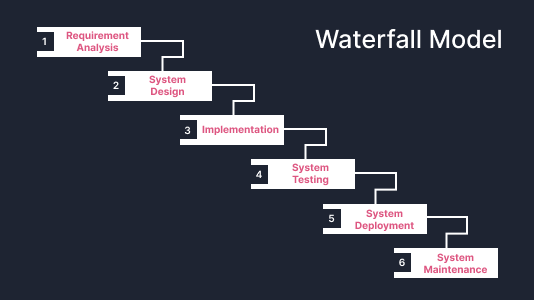
One of the earliest methodologies of the Software Testing Life Cycle (STLC) to be introduced was a Process Model called the Waterfall Model. It is quite basic and straightforward to use. It functions similarly to a downward-flowing waterfall. In this model, each phase is completed before the execution of the next phase, ensuring that no phases overlap.
There are 6 phases in the Waterfall Model, completed one after the other. They are:
- Requirement Analysis
- System Design
- Implementation
- System Testing
- System Deployment
- System Maintenance
V-Model
The Waterfall Model is an outdated model with numerous flaws and limitations. Later, a new Software Testing Life Cycle (STLC) methodology, called the V-Model, was developed to overcome those limits.
The Verification and Validation Model is another name for the V-Model. It is seen as a development of the Waterfall Model. The tasks in the V-Model are completed simultaneously. On the left-hand side, it shows software development activities, while on the right-hand side, it depicts the testing phases in progress.
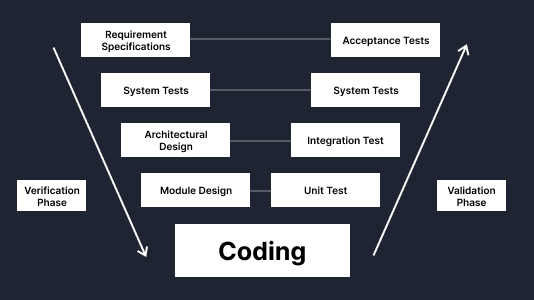
It means that each element of the software development cycle is inextricably linked to the phases of software testing. This model likewise follows the waterfall approach, as no stages overlap, and the next phase begins once the previous phase has been completed.
Spiral Model
The V-Model and the Waterfall Model are recommended only for smaller projects where the requirements are specified clearly. Spiral models are suitable for larger projects. The Sequential Linear Development Model and the Iterative Development Process Model are combined in this paradigm. This means it's similar to the waterfall approach but focuses on risk assessment. In the Spiral Model, a particular activity is done in one iteration. This is why it is called Spiral.
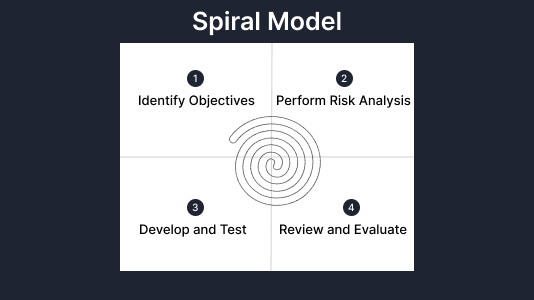
The same procedure is followed for every spiral created to build the entire software. There are four phases in the spiral model. They are:
- Identifying Objectives
- Risk Analysis
- Develop and Test
- Review and Evaluate
Agile Model
To overcome the challenges of longer iterations of testing and development, the agile paradigm is used throughout the Software Testing Life Cycle. It is currently the most popular model. If you are still working on the Waterfall Methodology, it is high time to move to the Agile methodology. You need to know some points while moving from Waterfall to Agile Testing.
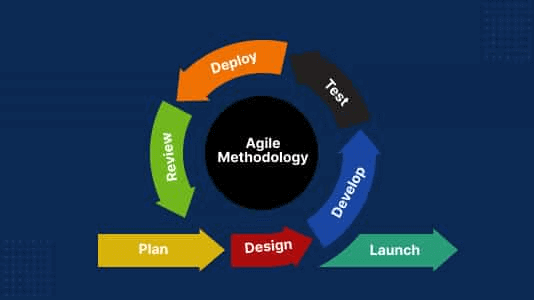
Agile Model enables developers and testers to adjust the software project to improve it and eliminate defects. In other words, any errors discovered during testing can be rectified on the spot without interrupting the testing process. There are 7 phases included in the agile methodology. They are:
- Plan
- Design
- Develop
- Test
- Deploy
- Review
- Launch

Note: Migrate from legacy test execution platform to cloud. Try TestMu AI Today!
What are the Entry and Exit Criteria in STLC?
In the Software Testing Life Cycle (STLC), fulfilling the entry criteria ensures that the testing environment is properly set up and that test cases and data are ready for execution. The exit criteria in the test execution phase ensure the completion of the testing activities, ensuring they align with the predetermined testing scope and objectives.
| STLC Phase | Entry Criteria | Exit Criteria | Deliverables |
|---|---|---|---|
| Requirement Analysis | Requirements specification document, acceptance criteria document, application architectural document. | Signed off requirements traceability matrix, signed off automation feasibility report. | List of all testable requirements, automation feasibility report. |
| Test Planning | Requirements documents, automation feasibility report. | Approved test plan document, approved test strategy document, signed off effort estimation document. | Test strategy, test plan, test effort estimation document. |
| Test Design | Requirements documents (updated version of unclear or missing requirement). RTM, test plan, test estimation document, automation analysis report. | Reviewed and approved test cases, test scripts, test data. | Test cases, test scripts (if automation), test data. |
| Test Environment Setup | Test plan, test environment setup plan, smoke test cases, test data. | Working test environment setup, valid test data setup, successful smoke test. | Test environment, smoke test results. |
| Test Execution | Test plan document, test cases, test scripts, test data, test environment. | Execute all planned test cases, log all defects found. | Test case execution report, defect reports, RTM. |
| Test Closure | Testing has been completed, test case execution report (make sure there are no high severity defects opened). | Signed off test closure report. | Test closure report, test metrics. |
When it comes to ways of performing testing, both manual and automated testing are an integral part of the Software Testing Life Cycle. Manual testing involves executing test cases manually, while automated testing relies on automation tools to automate repetitive scenarios.
Manual and automation testing each have their benefits and shortcomings. However, incorporating test automation into your STLC will make your software release cycles much faster by reducing manual efforts and repetitive test cycles. Building on this, let's look at how test automation fits into your STLC process.
How Test Automation Fits in the STLC?
Test automation plays a critical role in making software testing more efficient and effective. It involves using test automation frameworks that can perform predefined actions and compare the results with expected results. These automated tests help identify issues and report the results to a tester.
Once set up, these tests can be easily repeated and expanded to handle tasks that are too time-consuming or complex for manual testing. This makes automated testing a crucial part of the Software Testing Life Cycle.
Automation can be performed both locally and remotely. However, since organizations are embracing digital transformation, cloud-based testing is often recommended. There are numerous benefits of cloud testing, and it is considered a valuable option for scalable and a reliable approach to testing. It helps testers move their testing to a cloud grid and avoid the hassle of maintaining an in-house grid, thereby reducing operational overheads.
AI-powered test orchestration and execution platforms like TestMu AI offer a cloud grid that helps developers and testers perform manual and automated testing on an online browser farm of 3000+ real desktop and mobile environments. They can execute automated tests using frameworks like Selenium, Cypress, Playwright, Appium, and more. You can also accelerate your software release cycles by running tests in parallel using the online Selenium Grid that TestMu AI provides.
Check the guide on how to perform automation testing on TestMu AI.
In addition, you can go through the video tutorial to learn how to run automated tests on TestMu AI.

You can also Subscribe to the TestMu AI YouTube Channel for tutorials around Selenium testing, mobile app testing, and more.
Best Practices for Successful STLC
To ensure that the Software Testing Life Cycle process runs smoothly and effectively, software development teams should adopt certain best practices for software testing . These include:
- Clear and Testable Requirements - Before starting testing, it's crucial to establish clear and testable requirements. This ensures that you can easily determine whether your testing efforts have been successful or not.
- Comprehensive Test Planning - Your test plan should be comprehensive, leaving no critical components untested. A well-thought-out plan helps avoid overlooking essential areas that require testing.
- Concise Test Cases - Test cases should be easy to understand and cover all necessary scenarios.
- Diverse Testing Techniques - Don't limit yourself to just one type of testing. It's essential to diversify your testing techniques to cover a wide range of scenarios and issues.
- Thorough Regression Testing - Regression testing is vital for checking whether changes made as a result of testing have impacted other aspects of the software application.
- Cloud testing - It's recommended to use cloud testing over on-premise testing. Cloud testing enables organizations to adopt digital transformation and stay ahead of the competition. Its ability to offer flexibility, scalability, and cost-effectiveness makes it a strategic choice for businesses of all sizes.
Conclusion
Identifying bugs in the last stage of an SDLC is no longer an effective approach. An organization must also concentrate on a variety of other aspects. Spending too much of your valuable time testing and fixing bugs can hamper productivity.
After all, it will take longer to produce less output. It's critical to make efficient use of time and resources to make the testing process go more smoothly. Following a systematic STLC allows you to fix bugs quickly and improves the quality of your software applications.
Author

Salman Khan
Blogs: 138


Salman is a Test Automation Evangelist and Community Contributor at TestMu AI, with over 6 years of hands-on experience in software testing and automation. He has completed his Master of Technology in Computer Science and Engineering, demonstrating strong technical expertise in software development, testing, AI agents and LLMs. He is certified in KaneAI, Automation Testing, Selenium, Cypress, Playwright, and Appium, with deep experience in CI/CD pipelines, cross-browser testing, AI in testing, and mobile automation. Salman works closely with engineering teams to convert complex testing concepts into actionable, developer-first content. Salman has authored 120+ technical tutorials, guides, and documentation on test automation, web development, and related domains, making him a strong voice in the QA and testing community.
Reviewer

Harish Rajora
Reviewer
Harish Rajora is a software developer at TestMu AI with over 6 years of hands-on experience in Python and cross-platform application development across Windows, macOS, and Linux. He has authored 800+ technical articles and worked on large-scale projects, including GenAI applications and core engineering features used by millions. Harish has led DevOps initiatives building CI/CD pipelines with Jenkins, AWS, GitLab, and GitHub, and holds an M.Tech in Software Engineering from IIIT Allahabad.


STLC FAQs
Did you find this page helpful?
More Related Blogs
TestMu AI forEnterprise
Get access to solutions built on Enterprise
grade security, privacy, & compliance
- Advanced access controls
- Advanced data retention rules
- Advanced Local Testing
- Premium Support options
- Early access to beta features
- Private Slack Channel
- Unlimited Manual Accessibility DevTools Tests