

Power Your Software Testing with AI Agents and Cloud
The Native AI-Agentic Cloud Platform to Supercharge Quality Engineering. Test Intelligently and Ship Faster.


- TestMu AI (Formerly LambdaTest)
- /
- Learning Hub
- /
- What Is Agentic AI? How It Works, Examples, and Testing
Software has always needed humans to tell it exactly what to do. You write the instructions, the machine follows them, unless the code breaks. That arrangement worked for decades. Then something shifted.
Today, a growing class of AI systems doesn't wait to be told every step. They read a goal, figure out a plan, use tools, check their own work, and keep going until the task is done. These are called agentic AI systems, and they are changing how software gets built, tested, and shipped.
By the end of this tutorial, you will understand what agentic AI actually is at a technical level, why it is changing software testing, what types of agents exist and how they map to real testing tasks, how to get your first hands-on experience with a tool called KaneAI, and what the current limitations of the technology are.
Overview
To deploy autonomous systems, use agentic AI to execute multi-step goals via a continuous perceive, plan, act, and reflect loop, and leverage TestMu AI to automate QA with self-healing natural language tests and evaluate non-deterministic agents across thousands of scenarios.
- Agentic AI: Agentic AI autonomously pursues complex, multi-step objectives by perceiving its environment, planning sequential actions, utilizing tools or APIs, and adjusting its behavior based on feedback.
- Generative AI: Generative AI reacts to individual prompts by producing static text, code, or images, and serves as the core reasoning engine within broader agentic systems.
- TestMu AI agentic testing: The TestMu AI agentic testing platform applies agentic AI to quality assurance via KaneAI, which plans coverage, writes natural language tests, runs them on real browsers, and self-heals.
- Four-stage loop: Agentic AI operates through a continuous cycle of perceiving the environment, planning the next steps, acting with tools, and reflecting on results to replan.
- Non-deterministic evaluation: Testing non-deterministic agents requires evaluating behavior across thousands of scenarios, mocking APIs, and red-teaming adversarially rather than asserting single static outputs.
What Is Agentic AI?
You must have interacted with generative AI; you type a prompt, and it generates an output. ChatGPT answers your question, Midjourney draws your image, and the interaction stops there until you prompt again. Agentic AI works differently: it is a class of AI systems built to pursue a goal on its own, rather than just respond to a single instruction.
Agentic AI is a class of autonomous artificial intelligence systems that can plan, decide, and perform goal-directed actions with minimal human supervision. The word "agentic" comes from "agent", any entity capable of independent action and decision-making. Given a goal, the system breaks it into sub-tasks, uses tools and memory to execute them, and adjusts its actions based on the results, looping until the goal is reached.
What Are the Core Components of an Agentic AI System?
Any agentic AI system can be identified by its core components. These are not optional features; they are structural requirements:
The Brain: LLM as the Reasoning Engine
At the core of every AI agent is a large language model (LLM). The LLM is not just for generating text; it is the reasoning engine that drives every decision the agent makes.
The architecture of agentic AI typically includes core components like planning modules, vector or semantic memory for persistence, natural language processing, tool-use interfaces for API interaction, and reinforcement or self-reflective learning engines that adapt over time.
When you give an agent a goal, say, "test the checkout flow on this e-commerce site and flag any failures", the LLM is the component that interprets that goal, decides what sequence of steps makes sense, evaluates the outcome of each step, and recalibrates its approach if something goes wrong. It is the part of the system that understands context, handles ambiguity, and makes judgment calls that a traditional rule-based script simply cannot.
This is why the quality of the underlying model matters so much. A weak LLM will misinterpret goals, get stuck in loops, or take wrong actions. A powerful one with proper access to tools and memory can complete complex, multi-step workflows that previously required human expertise to orchestrate.
The Memory: Short-Term vs Long-Term
One of the things that separates a capable AI agent from a simple chatbot is memory. Without memory, every interaction starts from scratch. With memory, an agent can reason across sessions, learn from past results, and build institutional knowledge over time.
AI agents typically have two kinds of memory working together:
- Short-term memory (also called working memory or context) refers to everything the agent is actively holding in its attention during a single session. This is the full conversation history, the current task state, recent tool outputs, and the agent's internal chain-of-thought reasoning. It is fast and immediately accessible, but it is temporary. When the session ends, it is gone.
- Long-term memory is persistent storage that survives between sessions. Retrieval-Augmented Generation (RAG) enables agents to retrieve relevant past test artefacts, such as previous test results, failure patterns, or test case metadata, from vector databases that serve as AI agents' memory, thereby informing analysis and planning. This is what allows an agent to remember that a particular UI element always causes flakiness, or that a specific API endpoint has been unreliable in the past.
For software testing, long-term memory is transformative. A testing agent that remembers failure patterns from six months of test runs can intelligently prioritise which tests to run first, focus energy on historically unstable areas of the codebase, and avoid re-testing parts of the application that rarely fail.
The Tools: What the Agent Can Actually Do
An LLM by itself can only produce text. What turns that text-generating capability into real-world action is a set of tools and external functions the agent can invoke to interact with systems, retrieve data, and take actions in the environment.
Common tools available to AI agents include web browsers and UI interaction frameworks, API callers, file system readers and writers, database query interfaces, code executors, search engines, and calendar or task management integrations. AI testing agents' capabilities go beyond traditional scripted automation.
As self-governing software systems, AI agents make decisions intelligently based on historical data and adapt to changing environments, generate new test cases dynamically based on risk assessment, detect changes in user interfaces or APIs and automatically update test scripts through self-healing test automation, and analyse patterns in historical test data to predict potential defects.
The more tools an agent has access to, the more autonomously it can operate. A well-equipped testing agent might open a browser, navigate to a URL, interact with UI elements, call APIs, log the results, compare them against expected behaviour, and write a failure report without a human touching the keyboard at any point.
The Perception, Reasoning, and Action Loop
The architecture that ties all of this together is called the Perception, Reasoning, Action loop, sometimes abbreviated as PRA. It's the core operating cycle of any agentic system, and it repeats continuously until the goal is met or the agent decides it can't proceed.
- Perception is how the agent takes in information about its current state. This might mean reading test output logs, inspecting a web page's DOM, receiving the result of an API call, or processing a screenshot. The agent normalises this raw input into a form it can reason about.
- Reasoning is where the LLM earns its place. Given what the agent has perceived, it interprets what's happening, forms a hypothesis about what to do next, and selects an action from its available tools. This may involve evaluating multiple possible next steps, simulating likely outcomes, and choosing the path most likely to advance the goal.
- Action is the execution, the agent calls a tool, modifies state, sends a request, clicks a button, or does whatever the reasoning step determined was appropriate. The result of that action then feeds back into the next perception cycle.
This loop can run hundreds of times during a single agent task. A testing agent working through a complex user journey might perceive the current page state, reason that it needs to click the "Add to Cart" button, take that action, then perceive the new page state, reason that the cart total isn't updating correctly, and flag that as a potential bug, all without human instruction at any of those steps.
This loop is what separates agents from traditional scripts.
How Is Agentic AI Different From Generative AI and Traditional Automation?
Here is how they differ:
| Dimension | Traditional Automation | Generative AI | Agentic AI |
|---|---|---|---|
| Trigger | Rule or schedule | User Prompt | Goal Objective |
| Memory | None | Session only | Short and long-term |
| Decision-making | Pre-programmed | None | Autonomous, in-loop |
| Handles ambiguity | No | Partially (generates a plausible response) | Yes |
| Adapts to change | No | No | Yes |
| Best for | Stable, repetitive processes | Content, drafting, Q&A | Multi-step workflows requiring judgment |
How Does Agentic AI Work?
Every agentic system, regardless of what it is built on or what it is built for, executes these core operating cycles:
- Receive a goal: The agent is given an objective, not a script. "Find all failing tests in the last deployment and generate a fix proposal for each one". This is a goal. "Click the login button" is a script. The distinction matters because goal-oriented instructions leave the agent room to reason about the approach.
- Decompose the goal into sub-tasks: The reasoning layer, which is always an LLM, breaks the goal into a sequence of steps. This decomposition is not fixed in advance; it depends on what the agent knows about the environment and what it discovers as it works.
- Select and execute a tool: Each step, the agent identifies the right tool from its available set and calls it. In testing, that might mean calling the browser tool to open a page, the DOM parser to read element state, or the API client to send a request. The tool returns a result.
- Observe and reason: The agent reads the tool's output and decides what to do next. Did the page load correctly? Did the API return the expected schema? Does the result change the plan? If a step fails, the agent does not simply stop; it assesses whether to retry, adjust, or escalate.
- Loop until the goal is achieved or a stopping condition is met. The agent keeps cycling through steps until the goal is complete, it runs out of allowed attempts, or it determines the goal cannot be achieved and surfaces that finding to the human.
Understanding Failure Mode in Agentic AI: What Happens When the Loop Breaks
Understanding failure modes is as important as understanding the happy path.
- The most common failure is the agent getting stuck in a reasoning loop, generating a plan, executing it, finding it did not work, generating a slightly different plan, executing that, and repeating indefinitely. This is why production agentic systems always require explicit maximum-iteration limits and graceful exit conditions. Without them, an agent that cannot complete a goal will keep burning API tokens until something external stops it.
- A second common failure is the agent acting on stale information. Agentic systems work from the context window, the information they have been given or have gathered during the session. If the environment changes mid-session (a deployment happens, a feature flag flips, a database is updated), the agent may continue making decisions based on an outdated view of the world.
- A third failure is incorrect tool selection: the agent calls the right kind of tool but with wrong parameters, or calls the wrong tool entirely for a step. LLMs can confidently call tools with incorrect parameters, which is why every production tool integration needs explicit input validation and structured error messages that the agent can reason about. Silent failures, where a tool returns null and the agent does not notice, are a particularly common trap.

Note: See agentic AI in action for QA: KaneAI plans, writes, and runs tests in plain English across 3,000+ browsers and 10,000+ real devices on TestMu AI. Try TestMu AI free.
Common Agentic AI Architecture Patterns
Different tasks require different agent architectures, and choosing the wrong one is a common source of production failures. Common Agentic AI architecture patterns include:
- ReAct (Reasoning + Acting): ReAct is the foundational pattern and the right default for general-purpose agents. The agent alternates between a reasoning step (thinking about what to do next, given what it observed) and an acting step (actually doing it). Each observation from the action step feeds into the next reasoning step, creating a tight feedback loop. ReAct is the most battle-tested of all agent patterns in production, and it maps naturally to how humans approach unfamiliar tasks: think, try, observe, think again. For testing agents, the ReAct loop handles the core execution cycle; the agent reasons about what to test, executes a step, observes the result, reasons about whether it passed or failed, and proceeds accordingly.
- Reflection: Reflection adds a self-critique step after the agent generates an output. Instead of accepting its first result, the agent enters critic mode, evaluates its own work against explicit criteria, identifies problems, and produces a revised version. This cycle repeats until quality thresholds are met.
- Plan-and-Execute: Plan-and-Execute separates the planning phase from the execution phase. A planning agent produces a complete, structured plan before any execution begins. A separate execution agent then works through the plan step by step. If a step fails, the planner is re-engaged to revise the remaining plan based on the new information.
- Multi-Agent Orchestration: Multi-Agent architectures assign specialised agents to specific roles and coordinate them through either a supervisor (hierarchical) or a peer network (decentralised). The architecture pattern at the orchestration level is the Orchestrator-Worker: a coordinator agent manages sub-tasks and delegates to specialist workers, collecting and synthesising their outputs.
- Human-in-the-Loop (HITL): Certain decisions should always route to a human before the agent can proceed. It is the right design choice for any action that is irreversible, high-stakes, or outside the agent's demonstrated reliability envelope. In testing, HITL means that agent-generated tests are reviewed before they are merged, that agent-proposed changes to existing tests are flagged for approval, and that agent-identified bugs go through human triage before becoming tickets. Any production agentic system touching real customers or real money that does not implement HITL is taking on a big risk.

Agentic AI in Software Testing
Software testing has always been one of the most difficult parts of software development. Writing test scripts, maintaining them as the codebase changes, analysing failures, and reporting results consume enormous amounts of engineering time.
Agentic AI is changing that completely. Software testing is undergoing its biggest transformation since the shift from manual to automated testing. The driver this time is not just automation, it is Agentic AI: systems that can reason, plan, and act autonomously across complex testing workflows. In 2026, agentic testing is no longer experimental. It is the new standard.
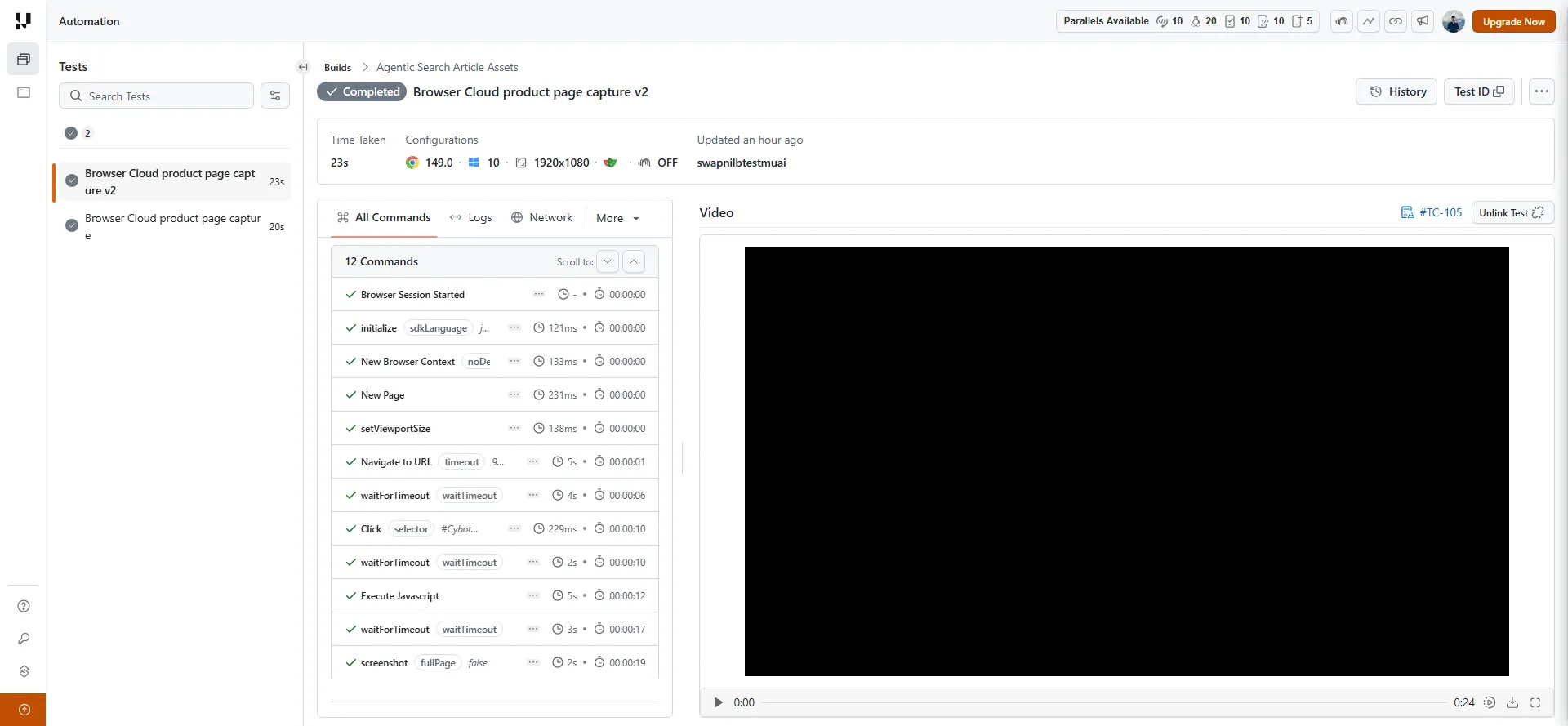
From Script-Based to Goal-Based Testing
Traditional automated testing is script-based at its foundation. A QA engineer writes a Selenium or Playwright script that says: open this URL, find this element by this selector, click it, and assert that this text appears. The script is brittle. If the selector changes because a developer renamed a CSS class, the test breaks. If the page layout shifts during an A/B test, the test breaks. If a new modal appears during checkout, the test breaks.
Engineers spend enormous amounts of time maintaining these brittle scripts. According to CloudQA Industry Research 2026, traditional test automation maintenance consumes up to 50% of the QA team's effort.
Agentic testing or Goal-Based Testing changes this at the foundational level. Rather than telling the system every step, you tell it the goal: "Verify that a new user can register, add a product to their cart, and complete a purchase." The agent figures out the steps. Agentic QA uses autonomous AI agents to plan, execute, and maintain software tests based on goals rather than scripts.
The Five Things Agents Change for Your QA Team
Here are the five things agentic AI changes for QA teams:
- Test Generation: Instead of manually writing test cases, agents generate them automatically from requirements, user stories, or even by simply observing the application, and this dramatically speeds up the test creation process.
- Self-Healing Tests: One of the biggest costs in test automation is maintenance. Agentic systems can dynamically re-identify elements and update test logic in response to application changes, drastically reducing the time you spend fixing broken tests.
- Intelligent Bug Detection: An agent doesn't just report that a test failed; it can analyse logs, trace execution paths, perform root cause analysis and even suggest a fix.
- Exploratory Testing: Agents can act as explorers, constantly probing the application to uncover edge cases, vulnerabilities, and unexpected behaviours that scripted tests would miss.
- Shift in Human Role: Agentic AI doesn't eliminate the need for QA engineers. Instead, it frees them from the difficult tasks of writing and maintaining scripts. The QA role evolves into an AI supervisor, someone who sets the goals, reviews the agent's work, and uses their domain expertise to guide the agent's strategy.
Real-World Use Cases For Agentic AI
Commonly used cases include:
- Software Testing and QA: This is the most popular use case, and one of the most mature deployments of agentic AI in production. Testing is exactly the kind of multi-step, context-dependent workflow where agents excel at understanding requirements, generating test cases, executing them, analysing failures, and updating the suite as the application changes.
- Healthcare, Clinical and Administrative Workflows: On the administrative side, agents update electronic health records from lab systems, wearables, and telehealth visits. They optimise scheduling, predict bed occupancy, and manage staffing based on dynamic demand. On the clinical side, agents analyse data from monitoring tools and scans, flag early signs of deterioration, and surface diagnostic suggestions to clinicians. The agent never makes the clinical call, the physician does, but it sharply cuts the time needed to gather and synthesise information.
- Finance, Fraud Detection and Reconciliation: Agents monitor transactions continuously, cross-referencing known fraud indicators and flagging anomalies in real time. Unlike rules-based detection, which misses novel patterns, agentic systems reason about context, whether a transaction is unusual for this account's history. They weigh amount, location, and timing together to judge whether the combination matches a specific known attack pattern, rather than checking each signal in isolation.
- E-commerce, Customer Operations at Scale: Resolving support queries, handling returns, and managing escalations is among the highest-volume, most repetitive work in e-commerce and also highly variable, since every customer situation differs slightly. Agentic systems handle full resolution for straightforward cases: reading the issue, checking order status, verifying eligibility, processing the return, and confirming it. Complex cases escalate to humans, who receive a case already investigated and summarised rather than one to start from scratch.
- Cybersecurity, Threat Detection and Response: Security operations centres deal with enormous alert volumes, most of which are false positives. Analysts spend most of their time triaging rather than investigating genuine threats. Agentic systems handle initial triage, reading alert data, cross-referencing threat intelligence, and correlating network activity to judge severity. Low-confidence alerts are dismissed with reasoning logged; high-confidence threats trigger automated containment while the analyst is notified with a full summary.
For a wider catalogue across industries, see our roundup of agentic AI examples.
How Do You Test and Evaluate Agentic AI Systems?
Agentic pipelines are non-deterministic. Two identical prompts can lead to different reasoning paths, tool choices, or retrieval strategies. Success is not only about the final answer, but it is also about how the agent actually got there.
Key Metrics to Track
- Task Completion Rate: Did the agent complete the assigned task? For a testing agent, did it produce a runnable test? For a support agent, did it resolve the ticket without escalating? Completion rate is necessary but not sufficient; an agent can complete a task badly.
- Trajectory Accuracy: For a given goal, what is the optimal path through the available tools and reasoning steps? Trajectory accuracy measures how closely the agent's actual execution matches that of the optimal path. An agent with a high completion rate but low trajectory accuracy is getting to the right answer the long way, burning more tokens and time than necessary.
- Tool Call Accuracy: Measures whether the agent calls the right tools with the correct parameters. A customer service agent can achieve high task completion while still calling the wrong API endpoint on a subset of cases, and those cases surface as customer complaints rather than test failures.
- Goal Fulfilment: It measures whether the agent actually achieved what the human needed, as defined by a human reviewer rather than an automated metric. A research agent can call every required API and still deliver a summary that a domain expert would reject. Goal fulfilment captures that gap.
- Cost Per Run: Tracks token consumption and execution time per agent run. For agents running at scale, cost per run is a direct line item. Teams that optimise for goal fulfilment without tracking costs often discover that their agents are effective but economically unsustainable at the scale required to run.
The TestMu AI Agent Testing platform automates this discipline, scoring agent behaviour across scenarios instead of asserting a single output, and the wider practice is covered in our guide to AI agent evaluation.
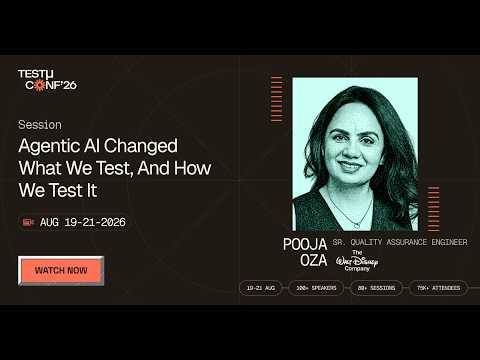
In the TestMu Conference 2026 session Agentic AI Changed What We Test, And How We Test It, Pooja Oza works through what breaks when the same prompt returns a different, and not necessarily wrong, output on every run, and an agent picks a different path to the same goal.
Your First Hands-On: Agentic AI Testing with KaneAI
Understanding the theory is one thing. Getting your hands on a working agentic testing system is another. For beginners, the right starting point matters. You want something that abstracts away the complexity while still showing you what agentic testing actually feels like.
KaneAI, built by TestMu AI, is the right starting point for almost every beginner. Here is why.
KaneAI as a Beginner's Starting Point
KaneAI is the world's first GenAI-native QA agent for software testing, designed to help you plan and evolve AI tests in plain English, no code required, with agentic and autonomous testing capabilities.
What makes KaneAI stand out for beginners is its design philosophy: it meets you where you are. You do not need to know Playwright, Selenium, or any testing framework. You do not need to write a single line of code. You describe what you want to test in natural language the same way you would explain it to a colleague, and KaneAI handles the rest.
KaneAI sits on top of TestMu AI's broader Agentic Test Cloud Platform, which gives it access to real browsers across hundreds of configurations, a full CI/CD integration layer, and the HyperExecute parallel execution infrastructure. This means that what you build with KaneAI can scale from a single test run on your laptop to thousands of parallel test executions in production without any architectural changes.
From Natural Language to Running Test, Step by Step
Here is the step-by-step guide from natural language to a running test that works with KaneAI.
Before You Start
To follow this walkthrough, you need a TestMu AI account. Go to testmuai.com and sign up for a free trial, no credit card required. Once you are in on your profile, go to the left side of your browser, click KaneAI.
You will also need a real account on the test site. Go to ecommerce-playground.lambdatest.io, click My Account, and register with any email and password you choose. Write those credentials down; you will use them in Step 1. For this walkthrough, the examples use testuser@example.com and Test1234! as placeholders; replace them with the credentials you just created.
Step 1: Describe your test goal. Type this: "Go to the eCommerce Playground login page at ecommerce-playground.lambdatest.io. Use the email address testuser@example.com and the password Test1234!. Verify that the user lands on the account dashboard after successful login and that the welcome message displays the correct name."
Note: Use the email and password you use to access the e-commerce playground site, as the email and password provided are only placeholders.

That is it. No selectors. No assertions written in code. Just the goal, described the way a human would describe it.
Step 2: KaneAI generates the test plan. KaneAI's Planner Agent interprets your description and breaks it down into discrete test steps: navigate to the login URL, locate the email field, enter the email, locate the password field, enter the password, click the login button, verify the URL has changed to the dashboard, and verify the welcome message text contains the expected name.
You see this plan laid out transparently, and you can adjust it before execution.

Step 3: When successful, the Generator produces executable code. KaneAI helps automate test creation, improving coverage and saving time, letting teams focus on delivering high-quality software faster. Behind the scenes, the Generator Agent translates the test plan into executable Playwright code that you can download. You can inspect the code, modify it, and commit it to version control.
Note: The code is generated only when it passes, i.e., shows Ready.
Step 4: The test runs on the cloud. KaneAI connects to the TestMu AI cloud and executes the test on a real browser. You see a live feed of the execution: the browser opening, the fields being filled, the button being clicked, the assertions being checked.
Step 5: Results and artefacts. After execution, KaneAI provides a full report: pass or fail, screenshots at every step, video recording of the full session, network logs, and console output. If the test fails, the report tells you exactly where and why, and if it passes, it shows you Ready as seen in the image below.

Step 6: Iterate with natural language. If you need to adjust the test, add more steps, change the expected outcome, or cover an edge case, you simply tell KaneAI in plain English. KaneAI updates the test and re-runs it.
This natural language iteration is what makes KaneAI genuinely beginner-friendly. The getting started with KaneAI documentation covers the setup in more detail.
Scaling What You Built with HyperExecute
Once you have built tests with KaneAI, the natural next question is: how do I run hundreds of these at once without waiting for them to run sequentially?
The answer is HyperExecute, TestMu AI's parallel execution engine. HyperExecute is designed specifically for agentic test workloads, providing fast execution across multiple browsers, operating systems, and device configurations simultaneously.
The practical impact for your team is significant. A test suite that takes 45 minutes to run sequentially can be completed in a fraction of that time with HyperExecute's parallel execution. This matters enormously for CI/CD pipelines, where long test times create bottlenecks that slow down the entire deployment process.
HyperExecute also integrates natively with KaneAI, meaning the tests you build through natural language can be immediately routed to parallel execution without any additional configuration. You build with KaneAI, you scale with HyperExecute, and the whole system works together without friction.


For teams moving from traditional test automation to agentic testing, this combination represents a complete stack: natural language test authoring, agentic self-healing, and hyperfast parallel execution, all from a single platform: TestMu AI.
Note: HyperExecute execution requires the test case to be in a Ready (passing) state; a Faulty test case blocks access to the Execute button.
Risks and Limitations of Agentic AI
There are some risks and limitations you need to understand before building your QA strategy around it.
Hallucination in Testing Means False Passes
LLMs can hallucinate, generating output that sounds confident but is factually wrong. In testing, this produces false passes, a test reporting success when the application is actually broken. A false pass is worse than a broken script, since a broken script at least signals red.
Mitigate this by capturing screenshots, logs, and evidence for every assertion, and treating agent results as inputs to human review, not final verdicts.
Cost Per Agent Run Adds Up at Scale
Every agent invocation consumes LLM tokens, browser cloud resources, and compute time. Negligible for small suites, but at enterprise scale, thousands of tests on every commit, the costs become significant.
Reserve agentic execution for tests where it adds real value: complex journeys, frequently changing UI, and new feature coverage. Let traditional scripts handle the stable, low-complexity core.
Agents Need Human Review, Always
The phrase "autonomous testing" can create a dangerous expectation: that you can set agents running and walk away. AI agents should operate with well-defined boundaries, escalation paths, and review checkpoints, not full autonomy over critical decisions.
The right mental model is "agents amplify QA engineers," not replace them. Agents handle volume work; humans handle strategy, triage, and judgment calls.
Compounding Errors in Multi-Step Workflows
Every step in an agent's execution carries a small error probability, and these compound. An agent that's 95% reliable per step is only about 60% reliable across ten sequential steps.
Mitigate with checkpointing: verify state at defined milestones (cart, payment, confirmation) rather than only checking the final output.
Skill Gap and Organisational Readiness
Agentic AI systems require a different kind of operational discipline than traditional software. Teams need to understand how to write effective goal specifications, how to review agent outputs, how to interpret failure analysis, and how to gradually expand agent autonomy as trust is established. Our agentic AI interview questions pressure-test that understanding, and TestMu AI certifications validate it.

Conclusion
Agentic AI is not a distant future. It is the operational reality for leading software teams right now, in 2026. The shift from script-based to goal-based testing, from reactive automation to autonomous agents that perceive, reason, and act, represents the most significant change in software quality engineering.
For beginners, the path forward is clearer than it has ever been. You do not need to understand transformer architectures or write your own LLM integration. You can start today with tools like KaneAI, describe a test in plain English, and see a working agentic test running in minutes. You can scale what you build with HyperExecute, integrate it into your CI/CD pipeline, and begin experiencing the compounding benefits of a test suite that learns and adapts alongside your application. The testing your first AI agent guide covers evaluating the agents you build, and our agentic AI frameworks comparison covers choosing a stack.
The key principles to carry forward are these: start small, stay curious, and always keep a human in the loop. Agentic AI is powerful, but it is a tool, and like all tools, it performs best in the hands of someone who understands both its capabilities and its limitations. See it running when you meet TestMu AI at Microsoft Build'26, or read about scaling browser infrastructure for AI agents.
Testμ 2026 had a session on exactly this, Will the Real Autonomous Agent Please Stand Up.
Citations
- CloudQA, Why Your Automation Suite Is Slowing You Down, linked in the goal-based testing section above.
- Agentic AI in Software Testing, a guide with practical examples and documentation on GitHub.
- Towards Effective GenAI Multi-Agent Collaboration: Design and Evaluation for Enterprise Applications, Shu et al., arXiv:2412.05449.
- KaneAI: World’s First End-to-End Software Testing Agent, TestMu AI on YouTube.
- TestMu AI documentation, Getting Started With KaneAI, linked in the walkthrough above.
Author

Onwuemene Joshua
Blogs: 1


Onwuemene Joshua is a Documentation Writer with expertise in API and product documentation. He holds a Bachelor's degree in Engineering (BEng) and actively contributes as a freelancer and open-source documentation writer. He has 3+ years of hands-on experience using tools such as Docusaurus, Markdown, Swagger, and Git. His work includes leading and authoring end-to-end developer documentation for APIs, onboarding guides, and open-source projects. Joshua led a three member team during phase one of the Technical Writing Mentorship Program (TWMP) documentation migration from Hugo to Docusaurus. In this role, he reviewed pull requests and provided constructive feedback to contributors.
Reviewer

Himanshu Sheth
Reviewer
Himanshu Sheth is the Director of Marketing (Technical Content) at TestMu AI, with over 8 years of hands-on experience in Selenium, Cypress, and other test automation frameworks. He has authored more than 130 technical blogs for TestMu AI, covering software testing, automation strategy, and CI/CD. At TestMu AI, he leads the technical content efforts across blogs, YouTube, and social media, while closely collaborating with contributors to enhance content quality and product feedback loops. He has done his graduation with a B.E. in Computer Engineering from Mumbai University. Before TestMu AI, Himanshu led engineering teams in embedded software domains at companies like Samsung Research, Motorola, and NXP Semiconductors. He is a core member of DZone and has been a speaker at several unconferences focused on technical writing and software quality.


Agentic AI FAQs
Did you find this page helpful?
More Related Blogs
TestMu AI forEnterprise
Get access to solutions built on Enterprise
grade security, privacy, & compliance
- Advanced access controls
- Advanced data retention rules
- Advanced Local Testing
- Premium Support options
- Early access to beta features
- Private Slack Channel
- Unlimited Manual Accessibility DevTools Tests