

Power Your Software Testing with AI Agents and Cloud
The Native AI-Agentic Cloud Platform to Supercharge Quality Engineering. Test Intelligently and Ship Faster.


- TestMu AI (Formerly LambdaTest)
- /
- Learning Hub
- /
- What Is a Test Script? Types, Examples, and How to Write One
What Is a Test Script? Types, Examples, and How to Write One
A test script lists every action, input, and expected result for a test. See manual, Selenium, and Playwright examples, plus a template and how to write one.
Last Updated on:
On This Page
- What are Test Scripts?
- Why Use Test Script?
- How to Write a Test Script
- Type of Test Scripts
- Script vs Case vs Scenario
- Understanding Test Script Template
- Information in Test Script
- When to Use the Test Script Approach?
- Test Scripting Tools
- Test Scripting Frameworks
- Test Script Development Process
- Test Script Examples
- Identification of Test Script Failures
- Debugging Techniques for Test Scripts
- Best Practices for Writing a Test Script
- Future Advancements in Test Scripting
- Conclusion
A test script that only its author can run is not really a script, it is a memory. Written properly, it gives anyone on the team, or a machine, the same result on every environment and at every stage of the software development life cycle.
TL;DR
To validate software functionality, write a test script as a detailed, step-by-step set of instructions using manual test scripts for exploratory testing or automated test scripts to run repeatable regression tests. You can create them using record and playback tools or by writing code directly in programming languages like Python or Java.
- Test Scripts: These standardized instructions reduce manual errors, improve consistency, and provide measurable evidence of testing completeness across complex workflows to ensure software quality.
- Manual Test Scripts: Human testers execute these step-by-step instructions to find unique usability and exploratory issues that automated tools might miss.
- Automated Test Scripts: Programs written in languages like Python or Java automatically verify software functionality under diverse conditions, making them ideal for repetitive and regression testing.
- Record/Playback Method: This approach records user actions to generate a code base, allowing testers to refine the script later without writing the initial code from scratch.
- Keyword/Data-Driven Scripting: This method separates tester and developer responsibilities by allowing testers to define tests using keywords while developers handle the underlying code maintenance.
- Direct Coding: Testers write scripts directly in accessible programming languages like JavaScript, Ruby, or Python to handle complex test scenarios and gain flexible automation control.
- Test Script Templates: These standardized documents outline objectives, steps, and expected results to ensure consistency, save time, and reduce errors across testing teams.
- AI-Powered Automation: This emerging approach relies on intelligent, self-healing, and codeless automation tools to enable faster, smarter, and more scalable shift-left testing.
What are Test Scripts?
A test script is a line-by-line description of what to do, what to enter, and what should happen as a result. It is the level below a test case: the case says which behavior is being checked, and the script says exactly which steps prove it. That precision is what makes the same check repeatable by a different person next quarter, or by a machine every night.
Testing scripts are detailed, step-by-step instructions used to test a test case, encompassing individual steps to check and verify each functionality. These scripts are programs that execute tests on software products or applications. Testers must write and run these scripts to confirm if the application meets the business requirements.
We all know that test cases are the foundation for creating test scripts. There can be multiple scripts and different testing environments in a single test case. While most scripts are associated with automation testing, they can also be part of manual testing. However, testers write automated scripts to generate data for testing various functionalities.
Typically, these scripts run automatically, checking each test case with different input data. Python, Ruby, Perl, Java, VB Script, etc., are some scripting languages used for writing test scripts. Once written, a test script can execute multiple test instances to assess a single application function. Due to their detailed and extensive nature, writing scripts in a reusable format is an excellent practice that simplifies the tester's work.
Why Use Test Script?
Using test scripts in the software testing process offers several advantages, which is why they are commonly employed in testing activities. They contain information regarding the function of the software applications, which needs to be performed to validate and verify the working of the software application. Here are some of the key reasons why to use test scripts.
- Comprehensive Testing: Provides a dependable means of ensuring that no steps are overlooked during testing, leading to accurate and desired testing outcomes.
- Specific User Requirements: Scripts are particularly valuable when user requirements are clear, helping to meet precise criteria.
- Controlled User Performance: It allows for controlled and structured user interactions, ensuring consistent and reliable testing.
- Unambiguous Execution: When testers navigate software freely and assume expected outcomes, test scripts prevent ambiguities and provide clear directions for each test scenario.
- Reduced Errors: A well-prepared test script minimizes the likelihood of errors during the testing process, enhancing overall testing efficiency and effectiveness.
How to Write a Test Script
Creating a test script can be approached in several ways, each with its unique methodology and requirements.
Record/Playback Method:
- In this approach, instead of writing code from scratch, testers record the user's actions. This method doesn't require initial coding but may need coding later to rectify errors or refine the automation process.
- It's simpler than crafting an entire test script manually, as it provides a complete code base to start with. This method is often utilized with user-friendly programming languages like VBScript.
Keyword/Data-Driven Scripting:
- This technique establishes a distinct division between testers and developers. In data-driven scripting, testers define tests using keywords, without needing to understand the underlying code.
- The responsibility of developers is to create and maintain the test script code corresponding to these keywords. Testers, therefore, do not have to be concerned with the system's intricacies but are dependent on development resources for testing any new features automatically.
Writing Code Using a Programming Language:
- For those preferring to script tests using programming languages, there's usually the option to record/playback and generate a basic script.
- As a tester, you'll eventually need to move beyond simple record/playback and learn to code straightforward scripts. It's crucial to recognize that the choice of programming language for test scripting is independent of the language used in the application's development. For instance, even if the application is developed in Java, it doesn't necessitate writing test scripts in Java, which might be challenging to learn. Instead, you can opt for simpler languages like JavaScript or Ruby, or any other language you're comfortable with.
Type of Test Scripts
Typically, scripts are divided into two types aligned with manual and automated testing approaches. Here are some of those:
Manual Test Scripts
Manual test scripts are mainly written and executed by human testers without assistance from automation tools. They only adhere to a predetermined set of steps and instructions to manually assess the software applications. This approach proves valuable for exploratory testing, usability testing, ad-hoc testing, and scenarios that evade automation. Despite its resource-intensive nature, manual testing offers a unique advantage in detecting specific issues that may bypass the automated testing approach.
Automated Test Scripts
On the other hand, automated scripts are particularly written in a programming language and run with the help of automation testing tools. These scripts use automation testing frameworks to mimic user interactions, interact with the application, and automatically verify expected outcomes. Within the category of automated scripts, there are further subtypes contingent on the level of testing and the extent of automation.

- Unit Testing Scripts: These concentrate on assessing individual units or components of the software applications, typically composed by developers during the development phase.
- Integration Testing Scripts: These verify the interaction between multiple components, ensuring maintained operations.
- Functional Testing Scripts: These validate that the software application functions impeccably per the specified requirements.
- Regression Testing Scripts: These affirm that existing functionalities remain unaffected following new changes or updates done in the software applications.
- Performance Testing Scripts: These help the application performance under diverse load conditions.
- End-to-End (E2E) Testing Scripts These simulate real-world scenarios to comprehensively evaluate the entire application flow from inception to completion.
- Smoke Testing Scripts: These are swift assessments aimed at verifying the basic functionality of the software application after significant updates.
- Security Testing Scripts: These assess the software application's resilience against security threats.
The choice between manual and automated testing depends on the specific software project requirements, complexity, and the available resources. Manual and automation testing is often deployed to ensure exhaustive test coverage and detect any vulnerabilities or discrepancies within the application.
Revamp testing and ensure software quality with TestMu AI. Try it now and experience a new level of testing excellence! Try TestMu AI Now!
Test Script vs Test Case vs Test Scenario
These three terms describe the same testing work at three levels of detail. A test scenario names what to verify. A test case defines the conditions and the expected outcome. A test script spells out every action and every piece of data needed to get there. Detail increases from scenario to script, and the tester experience required decreases in the same direction.
One distinction is worth correcting up front, because it is repeated often and it is wrong: a test script is not automatically an automated test. A manual test script is a line-by-line procedure a human follows, and it is the most detailed manual artifact a QA team produces. What makes a script a script is the level of instruction, not whether a machine runs it.
| Aspect | Test Scenario | Test Case | Test Script |
|---|---|---|---|
| What it captures | A user objective worth verifying. | A specific condition and the outcome it should produce. | Every action and every input needed to execute the check. |
| Level of detail | Lowest. One line is often enough. | Moderate. Preconditions, inputs, expected result. | Highest. Step-by-step, with expected results per step. |
| Example | Verify that a customer can pay with a saved card. | With a valid saved card selected, placing the order shows the confirmation page and an order number. | 1. Open /cart. 2. Click Checkout. 3. Select the saved card ending 4242. 4. Click Place Order. 5. Assert the page contains Order Confirmed. |
| Tester experience needed | High. The tester decides how to approach it. | Moderate. The tester supplies the steps. | Low. The steps are already written down. |
| Manual or automated | Usually manual and exploratory. | Either. | Either. A manual script is followed by a person; an automated script is code. |
| Time to author | Minutes. | Longer, because the expected result has to be pinned down. | Longest, and the cost repeats every time the interface changes. |
| Maintenance cost | Near zero. It rarely goes stale. | Low. It only changes when behavior changes. | Highest. Renamed elements and layout changes break steps and selectors. |
| Best used when | Coverage planning and exploratory work. | The team knows the product and needs a repeatable check. | The check is repetitive, regulated, or handed to someone new to the product. |
The maintenance row is the one that decides most team debates. Scripts pay off when the same check runs many times without change, and they cost the most when the interface underneath them is still moving. Scripting a screen that is redesigned every sprint means rewriting the script every sprint.
Understanding Test Script Template
Writing test scripts involves a template, which eases this process in software testing. It is a standardized document with pre-selected and essential information for creating good-quality scripts. Such documents can be reused whenever there is a need to develop scripts for any test. These scripts serve as testers' guidelines, ensuring consistency and uniformity in structure and content.
The test script template outlines the required format and specifies what information should be incorporated into each test case. Generally, a test script template has sections on the test case name, test objective, test environment, expected result, and others. Its detailed information is as follows.
- The test case name: It is a unique identifier or name of the test cases to differentiate it from others.
- Test objective: It highlights the objective of the test cases.
- Test steps: It gives detailed steps to run during the test.
- Expected result: It includes information on the specific outcomes expected when test steps are run accurately.
- Test data: It has specific data or inputs needed for test cases. It includes values, parameters, or variables that the test case needs to process during its execution.
- Test environment: It has information on hardware, software, operation systems, and configurations.
- Test preconditions: These are the starting points or prerequisites necessary for the test to be valid and accurate.
- Test execution steps: It has the instruction to run a test case with particular information on setup and configuration.
- Actual result: The real outcomes observed when the test is executed.
- Pass and fail criteria: These criteria show test cases that have passed or failed based on expected and actual results.
- Notes and comments: Any additional notes, comments, or observations related to the test case or its execution.
Utilizing a standardized template within the team helps save time and reduce errors in software testing. It also promotes consistent script creation and fosters effective communication among team members.
Information in Test Script
What makes test scripts beneficial? A well-written test script always includes valuable information. This information serves the purpose or aim of the script, outlining the actions to be performed during software testing.
The key components of potential information are as follows.
- Inputs and Expected Results: The test script contains the raw content, including inputs and sometimes the expected results.
- User Information: This section outlines the user-related details, such as the data to be provided to the script, the required software state during script execution, and the software's condition after the test.
- Usage Information: Testers may include additional useful information, such as explanations of specific usage scenarios or references to related tests that might require modifications.
- Annotation: Comments embedded within the script explain the logical steps and actions performed with the software being tested.
Including this essential information ensures the test script is clear, comprehensive, and effective in validating the software's functionality.
When to Use the Test Script Approach?
There are various scenarios where the test script approach is employed. While the approaches mentioned earlier are prevalent in software testing, there are instances in the testing process where they are essential.
- Testing scripts come in handy for automating repetitive or manual tests, saving time and effort.
- In regression testing, they enable the execution of multiple test cases to check for changes in new code.
- For large and complex software applications, scripts simplify the management of numerous test cases.
- In data-driven testing, they execute multiple test data sets efficiently.
- They are also valuable in load and performance testing, simulating multiple users, and test scenarios.
Hence, using the test script approach in these scenarios enhances the testing process's efficiency, accuracy, and reliability, leading to better software quality.
Now, let us understand in detail test scripts with examples in the next section.
Test Scripting Tools
The software applications, which possess user-friendly interfaces, are designed to support creating, editing, and running scripts. These tools empower testers and developers alike to write scripts without requiring extensive programming knowledge. Some test scripting tools include the following:
- Selenium: It is one of the most used automation testing tools, which is open source. A fantastic feature of Selenium is that it supports multiple programming languages like Java, Python, and C#. It helps testers to interact with web elements that mimic user actions and verify the expected outcome.
- Appium: Appium is an open-source testing tool compatible with iOS and Android platforms, enabling testers to create scripts for native, hybrid, and mobile web applications.
- Cypress: Cypress is a modern JavaScript-based test automation tool focusing on front-end testing. Cypress offers a developer-friendly environment replete with real-time reloading and advanced debugging capabilities.
You can leverage the above automation testing tools for writing scripts using a cloud-based platform like TestMu AI. TestMu AI is an AI-Native test orchestration and execution platform based on its cloud infrastructure for manual and automation testing. You can test your website or web application across 3,000+ browser and OS combinations and 10,000+ real devices on a cloud grid that scales with the suite. Here are some critical offerings of TestMu AI.

- Users can perform real-time testing on various devices, including smartphones and tablets, running operating systems like Android and iOS.
- It supports automation testing frameworks like Selenium, Cypress, Playwright, Appium, etc. This, in turn, allows you to write automated scripts based on different programming languages.
- It gives API documentation and sample code examples for various programming languages. It helps developers to integrate their scripts with the platform.
- Users can upload their existing scripts and execute them on the TestMu AI platform, allowing them to leverage their test codebase.
Subscribe to our TestMu AI YouTube Channel for the latest updates on tutorials around Selenium testing, Playwright testing, and more.
Test Scripting Frameworks
Test automation frameworks provide a structured approach to effectively organize and manage test automation scripts, ensuring their reusability and scalability and simplifying the long-term maintenance of test automation projects. Various test automation scripting frameworks encompass these aspects. To better understand how scripting works across different styles, explore the different types of scripting techniques for automation testing.
Mentioned below are some of the major categorizations of the frameworks.
Data-driven Framework: This framework divides test data from test scripts and helps the software testers set up and execute the tests with diverse datasets. It will, in turn, enrich test coverage and mitigate redundancy.
Keyword-driven Framework: It is the framework where the test cases adopt a tabular format, and the inclusion of keywords represents various test actions. With the help of the framework, testers can quickly write scripts without going deep into programming and using predefined keywords.
Behavior-driven Development (BDDFramework: BDD frameworks, like the Cucumber framework, develop collaboration between technical and non-technical team members. These scripts are written in a human-readable format using the Gherkin language. It eventually leads to creating better communication and understanding.
Hybrid Framework: Hybrid frameworks combine the strengths of multiple frameworks used to write scripts. It gives the testers the flexibility to leverage the advantages of each approach. It provides adaptability to meet diverse testing needs.
Page Object Model (POM): POM, a design pattern, creates a logical representation of web pages, effectively separating page elements from test logic, thus enhancing test script maintainability and reusability.
Selecting the appropriate test scripting tools and frameworks mainly depends on various factors, including requirement analysis, application type, team expertise, and the scalability of the automation effort. The right tools and frameworks cut the setup work, expand test coverage, and ultimately contribute to the overall success of software testing endeavors.
Simplify test automation with TestMu AI! Elevate your projects effortlessly. Try TestMu AI Now!
Now, let us understand how to write a test script.
Test Script Development Process
Writing test scripts follow a set of processes to address all the required testing needs. Some primary phases of test script development allow for writing quality scripts.

- Requirement Gathering and Analysis
- Test Design and Planning
- Test Script Implementation
- Test Data Preparation
- Test Script Execution
- Test Script Closure
Before indulging in writing testing scripts, the testing team collaborates with stakeholders like product owners, developers, and business analysts to have information on the software requirements for the tested application. The main aim of this phase is to understand the function, performance, and behavior of the software applications so that the script includes all the related test cases that require testing.
Here, the software testers carefully evaluate the requirement so that they can identify the testable scenarios, any underlying risks, or specific conditions that need to be covered by the test scripts.
In this phase, the software testers develop a comprehensive testing strategy based on the requirements and evaluation performed in the first phase. Here, they outline the test objective, testing scope, different testing approaches, and related factors. Based on this, the test case includes diverse types of functionality, edge cases, and test scenarios.
When software testers develop test cases, they proceed with the implementation phase, which includes composing scripts using scripting languages and software testing tools. These scripts contain various commands that simulate interactions with the software application, such as clicking buttons, inputting data, and validating test outcomes.
There is a requirement to have essential data that includes various test scenarios and conditions like boundary values, valid and invalid inputs, and diverse user roles to execute the test scripts. These are important for the successful execution of tests.
In the test script execution phase, the scripts are run against the software application being tested. On the different test environments and configurations, the scripts are executed so that it is easy to assess the behavior and functionality of the software application. Here, the application's responses and checks are carefully made for discrepancies between expected and actual outcomes.
A test closure report is a summary paper describing all the tests done while making software. It includes what tests were finished, the results, and a chart showing which tests are complete.
Throughout the Test Script Development Process, documentation is crucial to maintain traceability, track progress, and facilitate collaboration among team members.
Test Script Examples
All three examples below verify the same behavior on the same page, so you can compare the formats directly. The application under test is the Simple Form Demo on the TestMu AI Selenium Playground: it takes a message, and on clicking the button it displays that message back on the page.
The element IDs used below (user-message for the input, showInput for the button, and message for the output) are the ones live on that page, so each script runs against it directly. Two details in the automated versions are there because the page was actually run against, not read: the id user-message is reused by wrapper elements, so the locator qualifies it by tag, and the form is React-rendered, so the script waits for hydration before typing.
1. Manual test script
A manual test script is a numbered procedure with an expected result on every step. The per-step expected result is what separates a script from a test case: a tester who has never seen the product can execute this and know at exactly which step it failed.
| Step | Action | Test data | Expected result |
|---|---|---|---|
| 1 | Open the Simple Form Demo page. | URL of the page under test | The page loads and the Enter Message field is visible and empty. |
| 2 | Click the Enter Message field and type the message. | Welcome to TestMu AI | The typed text appears in the field exactly as entered. |
| 3 | Click the Get Checked Value button. | None | The button responds to the click and the page does not navigate away. |
| 4 | Read the text below Your Message. | None | It reads Welcome to TestMu AI, matching step 2 character for character. |
| 5 | Reload the page. | None | The message area is empty again and the field is cleared. |
Note what step 5 does. It verifies that the result was not persisted, which is a check most people leave out because it confirms an absence rather than a presence. Scripts that only assert on things appearing miss defects where state is retained when it should not be.
2. Automated test script in Selenium with Java
The same four steps as code. The structure maps one to one onto the manual script: navigate, enter data, act, assert. The explicit wait before the assertion is the part that most first attempts omit, and it is the most common source of a script that passes locally and fails in CI.
import org.openqa.selenium.By;
import org.openqa.selenium.WebDriver;
import org.openqa.selenium.chrome.ChromeDriver;
import org.openqa.selenium.support.ui.ExpectedConditions;
import org.openqa.selenium.support.ui.WebDriverWait;
import org.testng.Assert;
import org.testng.annotations.AfterClass;
import org.testng.annotations.BeforeClass;
import org.testng.annotations.Test;

import java.time.Duration;

public class SimpleFormDemoTest {

    private WebDriver driver;
    private WebDriverWait wait;

    @BeforeClass
    public void setUp() {
        driver = new ChromeDriver();
        wait = new WebDriverWait(driver, Duration.ofSeconds(10));
        driver.manage().window().maximize();
    }

    @Test
    public void shouldDisplayTheSubmittedMessage() {
        // Step 1: navigate to the application under test
        driver.get("https://www.testmuai.com/selenium-playground/simple-form-demo/");

        // Step 2: enter the test data. Wait for the field to be clickable
        // first: the form is React-rendered, and typing before the handler
        // is attached leaves the component state empty.
        String expected = "Welcome to TestMu AI";
        wait.until(ExpectedConditions.elementToBeClickable(
                By.cssSelector("input#user-message"))).sendKeys(expected);

        // Step 3: perform the action under test
        driver.findElement(By.id("showInput")).click();

        // Step 4: wait for the expected state, then assert on it
        wait.until(ExpectedConditions.textToBePresentInElementLocated(
                By.id("message"), expected));
        String actual = driver.findElement(By.id("message")).getText();

        Assert.assertEquals(actual, expected,
                "The displayed message did not match the submitted message.");
    }

    @AfterClass
    public void tearDown() {
        if (driver != null) {
            driver.quit();
        }
    }
}
The assertion carries a failure message. When this script fails at 2am in a pipeline, the message is the only context the person triaging it gets, so writing it is not optional detail.
3. Automated test script in Playwright with TypeScript
The same test again, in a framework with built-in auto-waiting. The explicit wait disappears because expect retries the assertion until it passes or the timeout expires, which removes the single largest source of flakiness in the Selenium version.
import { test, expect } from '@playwright/test';

test('displays the message that was submitted', async ({ page }) => {
  const expected = 'Welcome to TestMu AI';

  // Step 1: navigate to the application under test, then let the page
  // finish hydrating. Filling before the handler is attached writes to
  // the DOM but not to the component state, and the click reads nothing.
  await page.goto('https://www.testmuai.com/selenium-playground/simple-form-demo/');
  await page.waitForLoadState('networkidle');

  // Step 2: enter the test data. The tag qualifier matters: this page also
  // carries wrapper divs with the same id, and a bare #user-message would
  // match three elements and fail Playwright's strict mode.
  await page.locator('input#user-message').fill(expected);

  // Step 3: perform the action under test
  await page.locator('#showInput').click();

  // Step 4: assert. Playwright retries this until it passes or times out,
  // so no explicit wait is needed.
  await expect(page.locator('#message')).toHaveText(expected);
});
Comparing the two, the Playwright script is shorter because the framework absorbs the waiting, not because it does less. Both assert the same condition. When choosing between them, the deciding factor is usually the language your team already maintains, not line count. Running either across 3,000+ browser and OS combinations requires changing only the driver or project configuration, and none of the four steps.
Identification of Test Script Failures
In automation testing, failure of test scripts is a common occurrence that may create hurdles in completing the test process. Knowing about those failures and their reasons will help you overcome such issues while performing software testing. Here are some of the reasons for test script failure.
- Element not found: This test script fails when it cannot locate the elements on the user interface it needs to interact with.
- Synchronization issues: When a software application's response time is slower than expected, there can be timing issues. For example, some scripts involve navigating from one page to another. If the application takes longer to load the new page, the test script might fail as it cannot find the expected elements on the new page.
- Incorrect data: Test data is crucial for the execution of a test script, which may include inputs and datasets to simulate real-world scenarios. However, when test data is incorrect, it may cause unexpected results or errors during the execution of the test. It may eventually lead to failure.
- Environment-related issues: Lead to failures in software testing when tests are executed in different environments due to varying configurations and dependencies.
- Flaky tests: This may happen in the test process where the test fails without any known or actual reasons. This makes it challenging to find any root cause of the failure. The occurrence of flaky tests in software testing also leads to the failure of the test scripts.
- Code defects: Errors in the test script's implementation can lead to incorrect interactions with the application.
Now, let’s learn some debugging methods that the testers can use to address the above test script failure.
Debugging Techniques for Test Scripts
Debugging techniques in case of test case failures is one of the most crucial skills for testers. Some methods that can be used to identify and fix issues may include the following:
- You may implement an approach of logging and reporting in the test scripts that allows easy tracking of the test execution flow and errors. When you analyze the logs, you can pinpoint the location of the failure.
- You may comment or remove parts of the scripts to find any specific features or code snippets leading to failure. With this, you can narrow down the issue and identify the root cause more effectively.
- You may leverage browser developers' tools and testing frameworks to learn more about specific elements of the software applications during the execution of the test to validate their correct identification.
- Debugging features of the integrated development environments can also help the software testers step through the code and evaluate the test execution flow.
Best Practices for Writing a Test Script
To improve the writing of test scripts, here are some of the standard best practices:
- The test script should be clear and requires communication with the project in charge to provide details on the software applications. However, to avoid this, consistently verify that each step in the test script is clear, concise, and coherent, facilitating a smooth testing process.
- To create a test script, you should contain one specific action for testers. It helps ensure that each function is tested accurately and does not lead to skipping any software testing steps.
- You should always define a clear objective for the test script to know what you want to achieve from the test and the functionality that requires testing.
- To the test cases, give descriptive names, as it will help you identify the main aim of the test without going through the entire script.
- Clearly define each test case's test data, input values, and expected results.
- You should ensure that each test case is independent and does not rely on the results of previous tests. It allows for easier debugging and isolation of issues.
- An excellent practice is to create reusable code that can be applied across multiple testing scenarios.
Future Advancements in Test Scripting
The future of test scripting holds tremendous excitement and dynamism as AI and ML get integrated into test script generation and Shift-Left Testing practices gain traction. These trends change how scripts get written, moving authoring closer to the development process itself. The sections below cover what that looks like in practice.
AI and ML in Test Script Generation
The clearest shift underway in test scripting is the use of Artificial Intelligence (AI) and Machine Learning (ML) to generate scripts. The practical effect lands on all three stages of the work: how scripts are created, how they are maintained as the interface moves, and how they are executed.
Traditional test script creation heavily relies on manual efforts, where testers invest in particular design and writing to cover diverse test scenarios. This process can be time-consuming and resource-intensive, particularly for large-scale applications with intricate functionalities. However, with the infusion of AI and ML, test script generation can transcend into a more automated and intelligent domain.
AI-native testing tools can analyze the application under test, adeptly learn from its behavior, and automatically generate scripts based on observed patterns and usage. Such tools can discern crucial test scenarios, prioritize test cases, and even identify potential edge cases that might escape human testers' attention. Consequently, test script generation attains swiftness, enhanced efficiency, and reduced error propensity.
Moreover, AI and ML are indispensable allies in test script maintenance. When the application undergoes changes or updates, AI-based tools demonstrate their intelligence by updating the testing procedures to accommodate the modifications, thereby minimizing the effort required for regression testing. This adaptive prowess ensures that the testing procedures remain relevant and practical throughout the software development lifecycle.
Shift-Left Testing and its Impact on Test Scripts
Another critical future trend with a significant impact on test scripting and the entire testing process is Shift-Left Testing. Traditionally, software testing was a phase that transpired toward the culmination of the development cycle. However, with the emergence of Agile and DevOps methodologies, testing has been integrated earlier in the development process.
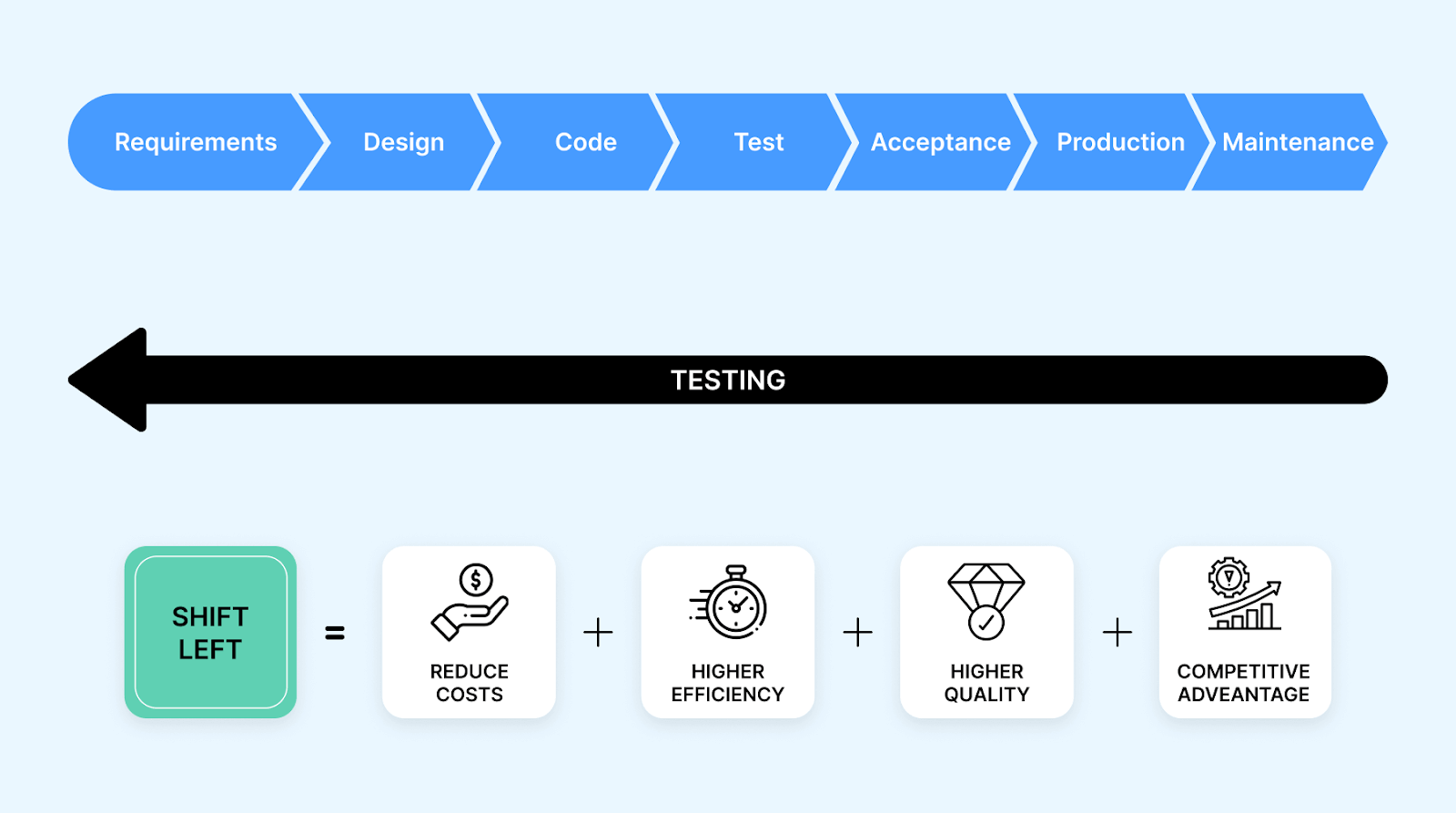
Shift-Left Testing advocates for the active involvement of testers right from the project's inception, enabling a close alignment with developers and other stakeholders. This paradigm shift emphasizes the early detection of defects and issues, ultimately reducing the cost and time involved in rectifying them later in the development cycle.
In software testing, Shift-Left Testing promotes the early creation of testing procedures right at the beginning of the development process, even before the actual coding begins. This proactive approach aids in defining precise testing requirements, identifying potential risks, and establishing a solid testing strategy from the outset.
By engaging testers in the early phases, Shift-Left Testing brings developers and testers into the same feedback loop, leading to swift feedback loops and improved software quality. Test scripts created with the Shift-Left approach serve as guiding beacons throughout the development journey, ensuring that the application adheres to the desired functionality and performance requirements from the outset.
Furthermore, testing scripts evolve into dynamic and adaptive assets as testers and developers embrace close collaboration. Feedback from the early testing phases continually improves the test scripts, rendering them more potent in detecting defects and preempting issues before propagating to later stages of development.
Now that you have learned about testing scripts, you must have analyzed how they differ from the test case. Let us get brief on this in the below section.
Conclusion
Test Scripts refer to detailed descriptions that outline the system transactions necessary for validating the application or system under test, guiding testers through the testing process. On the other hand, a Test Case is a step-by-step procedure used to test an application, while a Test Script provides instructions for automated application testing. There are three methods to create test scripts: record/playback, keyword/data-driven scripting, and writing code using a programming language.
Ensure your test script is clear and focuses on a specific action for testers to execute. Using a test script is the most reliable approach to ensure comprehensive testing, leaving no space for omissions and guaranteeing accurate results per the desired testing plan. A Test Script Template is a reusable, formatted document containing essential information for creating a practical test script.
Write one script by hand before automating the writing. The exercise of choosing preconditions, naming test data, and deciding what the assertion should be is the part that carries the value, and it is also what you need in order to judge whether a generated script is any good.
After that, the authoring step is increasingly worth handing over. Kane CLI takes a plain-English objective, drives real Chrome to complete it, and exports the finished run as native Playwright code. The objective syntax maps directly onto the anatomy above: imperative verbs are the steps, "assert" and "verify" phrases become the expected result, and a "store X as name" clause captures a value for later use.
It also migrates in both directions, importing existing Playwright or Selenium scripts and converting them into intent-driven flows, which matters when a suite already exists and rewriting it is not on the table.

Note: Write the objective the way you would write the test step, run it against real Chrome, and export the passing run as native Playwright code. Read the Kane CLI docs
Author

Nazneen Ahmad
Blogs: 44


Nazneen Ahmad is a freelance Technical Content SEO Writer with over 6 years of experience in crafting high ranking content on software testing, web development, and medical case studies. She has written 60+ technical blogs, including 50+ top-ranking articles focused on software testing and web development. Certified in Automation Basic and Advanced Training - XO 10, she blends subject knowledge with SEO strategies to create user focused, authoritative content. Over time, she has shifted from quick, keyword-heavy drafts to producing content that prioritizes user intent, readability, and topical authority to deliver lasting value.
Reviewer

Harish Rajora
Reviewer
Harish Rajora is a Software Developer 2 at Oracle India with over 6 years of hands-on experience in Python and cross-platform application development across Windows, macOS, and Linux. He has authored 800 + technical articles published across reputed platforms. He has also worked on several large-scale projects, including GenAI applications, and contributed to core engineering teams responsible for designing and implementing features used by millions. Harish has worked extensively with Django, shell scripting, and has led DevOps initiatives, building CI/CD pipelines using Jenkins, AWS, GitLab, and GitHub. He has completed his post-graduation with an M.Tech in Software Engineering from the Indian Institute of Information Technology (IIIT) Allahabad. Over the years, he has emphasized the importance of planning, documentation, ER diagrams, and system design to write clean, scalable, and maintainable code beyond just implementation.


Test Script FAQs
Did you find this page helpful?
More Related Blogs
TestMu AI forEnterprise
Get access to solutions built on Enterprise
grade security, privacy, & compliance
- Advanced access controls
- Advanced data retention rules
- Advanced Local Testing
- Premium Support options
- Early access to beta features
- Private Slack Channel
- Unlimited Manual Accessibility DevTools Tests