

Power Your Software Testing with AI Agents and Cloud
The Native AI-Agentic Cloud Platform to Supercharge Quality Engineering. Test Intelligently and Ship Faster.


- TestMu AI (Formerly LambdaTest)
- /
- Learning Hub
- /
- What Is Browser Automation: A Complete Tutorial
What Is Browser Automation: A Complete Tutorial
Learn what browser automation is, how QA teams and AI agents drive real browsers, and how MCP connects LLMs to the web. Tools, code, and cloud setup included.
Last Updated on:
On This Page
Browser automation is the practice of driving a real web browser with code instead of a human, so that navigation, clicks, form fills, and data extraction happen programmatically. The TestMu AI cloud alone runs 1.5 billion tests a year for more than 18,000 enterprises, and browser automation is the machinery underneath nearly all of it.
What changed recently is who does the driving. For two decades the driver was a test script written by a QA engineer. Today it is increasingly an AI agent that decides its own next step, which is why browser automation now sits underneath both software testing and the agent browser tooling built on top of large language models.
This tutorial covers both halves: the established QA practice (frameworks, cross-browser coverage, cloud execution) and the agent-era additions (perceive-act-verify loops, Model Context Protocol, and structured data extraction from JavaScript-rendered pages).
Overview
What Is Browser Automation?
Browser automation is the practice of driving a real browser with code or an AI agent rather than a person. The browser renders pages and runs JavaScript exactly as it would for a human, but the instructions arrive programmatically.
Who Drives Browser Automation Today?
- QA engineers, through deterministic test scripts written in Selenium, Playwright, Cypress, or Puppeteer.
- AI agents, through perceive-act-verify loops and Model Context Protocol tool calls, deciding each step at runtime.
What Do You Need to Run It at Scale?
Real browsers, in parallel, that you do not have to maintain. For framework-based QA suites, TestMu AI's test automation cloud provides 3,000+ browser and OS combinations. For AI agents that need real Chrome with session persistence and access to private environments, TestMu AI's Browser Cloud is the agent-facing equivalent.
What is Browser Automation?
Browser automation is the process of controlling a web browser programmatically to replicate the actions a person would perform on a website. A tool or agent issues the instructions, and a real browser carries them out: loading a URL, waiting for elements to render, clicking, typing, submitting, and reading values back off the page.
The distinction that matters is between a browser and an HTTP client. A plain request fetches raw markup. A browser executes JavaScript, hydrates the page, and produces the DOM a user actually sees. On a modern single-page application, those two results are not remotely the same, which is why browser automation remains necessary rather than a heavyweight alternative to fetching a URL.
It supports web testing, data extraction, form filling, website monitoring, and, increasingly, autonomous agent tasks. Each of these needs the same thing: a browser that renders like a real one, driven by something that is not a human.
Why use Browser Automation?
Cross browser testing is crucial to ensure a seamless user experience. However, there are different cross browser testing challenges, especially if you wish to set up a local infrastructure to run the tests.
The blocker is usually economic. Covering meaningful permutations of browsers, devices, and operating systems means buying and maintaining every one of them. A local grid is feasible at small scale and stops being feasible the moment coverage grows, because each new combination is another machine to patch, upgrade, and keep online.
Browser automation addresses this by making test execution a function of software rather than hardware. Scripts are reusable, run unattended, and execute in parallel, so coverage scales with the suite instead of with the size of your device lab. It reaches past testing, too: the same techniques drive day-to-day business workflows in regulated industries, including browser automation for insurance claims portals.
Here are some key benefits of web browser automation:
- It can be used to test across different browsers, devices, and platforms. This ensures that the web application will function correctly across different combinations.
- It helps execute repetitive tests quickly and efficiently. This can save time and money, especially for large web projects.
- Support parallel testing, which means that multiple tests can be run at the same time, speeding up the test process.
- Browser automation can be scaled to adapt to changing test requirements. For example, if new test cases need to be added, the automated testing framework can be easily modified to accommodate them.
- It provides better test coverage than manual testing. This is because automated tests can be run repeatedly and can be designed to test specific areas of the website or a web app.
- Browser automation can help to achieve faster-to-market. This is because automated tests can be used to verify the quality of the software before it is released to the public.
- It is easy to implement as there are multiple automated testing frameworks available, and most of them are relatively easy to use.

Different Approaches to Browser Automation
Four approaches dominate, and they differ mainly in how much control you trade for how much setup:
- Scripting languages give the most control. Java, JavaScript, and Python all have mature libraries for driving browsers, and Selenium WebDriver exposes that control across languages for form submission, content extraction, and navigation.
- Purpose-built frameworks such as Selenium, Puppeteer, and Playwright wrap the browser protocols in an API, which is the standard choice for a test suite that has to be maintained by a team, though teams often weigh browser harness alternatives before settling on one.
- Record and playback tools capture your actions in the browser and replay them. They lower the barrier to a first test and tend to produce suites that are brittle under refactoring, so they suit smoke checks better than a core regression suite.
- Agent-driven automation hands an objective to an AI agent that decides the steps itself, perceiving the page and verifying each action as it goes rather than replaying fixed instructions. It handles UI change far better than a hardcoded script and gives up the exact repeatability a deterministic test needs. The section on browser automation for AI agents covers how that loop works.
Steps to Perform Browser Automation
The sequence below applies whether you are writing a first Selenium test or wiring a browser into an agent:
- Choose a framework based on the languages your team already writes, the browsers you must support, and whether a human or an agent will drive it. For the two closest rivals, see this Puppeteer vs Playwright comparison. Selenium, Puppeteer, and Playwright are the common starting points, weighed against cross browser compatibility needs.
- Set up the test environment with the framework, the language runtime, and any driver binaries. Running against a cloud grid removes most of this step, since the browsers and drivers are already provisioned.
- Configure the driver for the browser you intend to automate. Modern Selenium manages driver binaries automatically, so this is mostly a matter of pointing at a local browser or a remote hub URL.
- Identify the pages you want to automate and the specific elements you need to interact with. Prefer stable hooks such as test ids or accessibility roles over positional selectors that break on the next redesign.
- Write the scripts that navigate, fill, click, extract, and assert. Keep waits explicit and condition-based rather than fixed sleeps, which is the single biggest source of flakiness.
- Execute and observe. Run against the target browsers and watch what the automation actually does rather than trusting a green result on first run.
- Handle exceptions so a run recovers or fails loudly with enough context to diagnose, instead of dying on the first unexpected modal.
- Iterate against edge cases and refine. A suite that is never revisited decays into a set of tests everyone ignores because they fail for unrelated reasons.
Implementation details vary by framework and language. For a comparison of the leading frameworks and platforms, see our guide to web automation tools.
Browser Automation Tools
Tools now split into two families that are often compared as if they were interchangeable. They are not: one automates a browser deterministically for testing, the other gives an AI agent a browser to act in. Choosing well starts with knowing which family you need.
| Factor | Traditional QA frameworks | AI-agent and no-code tools |
|---|---|---|
| Examples | Selenium, Playwright, Cypress, Puppeteer, WebdriverIO, TestCafe. | Browser Use, Firecrawl, Axiom.ai, Bardeen, Browserflow, and MCP-based browser servers. |
| How steps are decided | Written in advance by an engineer and replayed identically on every run. | Decided at runtime from an objective, or configured visually with no code. |
| Response to UI change | A changed selector breaks the test until someone updates it. | Often adapts, because the agent re-reads the page rather than trusting a stored selector. |
| Repeatability | Deterministic, which is what makes a result trustworthy as a release gate. | Non-deterministic, so the same objective can be met by different paths on different runs. |
| Best suited to | Regression suites, cross-browser coverage, CI gates. | Open-ended tasks, LLM-ready data extraction, workflows where the steps are not known upfront. |
The established frameworks remain the right default for testing:
- Selenium drives the widest range of browsers (Chrome, Firefox, Safari, Edge) from the widest range of languages (Java, Python, C#, JavaScript), which is why it stays the default for large, polyglot suites.
- Playwright, from Microsoft, offers one API across Chromium, Firefox, and WebKit plus network interception and mobile emulation. It also ships an MCP server, which makes it one of the few frameworks that spans both families in this table.
- Cypress runs inside the browser and optimizes for developer experience and debuggability, which suits front-end teams doing end-to-end testing on their own application.
- Puppeteer, from Google, gives a high-level API over Chrome and Chromium and is a common choice for screenshots, PDF generation, and handling web elements in Selenium Python in Node.js.
- WebdriverIO compared with Selenium: both drive browsers over the W3C WebDriver standard, and WebdriverIO wraps it in a Node.js API with its own test runner.
- TestCafe runs tests on real browsers in JavaScript or TypeScript without WebDriver setup or browser plugins.
The agent-oriented tools are worth knowing by category rather than by brand, because the category is moving quickly. Some make websites navigable by AI agents, some turn pages into LLM-ready structured output, and some expose browser control to a model through MCP. What they share is that a model, not a script, decides what happens next. Verify any specific capability on the vendor's own documentation before committing, since these products change faster than any article can track.
Local vs. Cloud-Based Browser Automation
Both run the same scripts. They differ in who owns the machines, and that ownership question is what decides how far the suite can scale.
| Local-Based Browser Automation | Cloud-Based Browser Automation | |
|---|---|---|
| Overview | Set up and configure the automation environment on the local machine. | Utilize remote infrastructure provided by cloud service providers. |
| Scaling | Challenging to scale, especially with a large number of browser instances or parallel execution. | Offers scalability with the ability to scale resources up or down based on demand. |
| Maintenance | Responsible for maintaining and updating the test automation environment. | Test automation providers handle maintenance and updates of automation infrastructure. |
| Resource Management | Consumes local machine's system resources (CPU, memory, disk space.) | Offload resource-intensive tasks to remote servers, allowing efficient resource utilization. |
| Accessibility | Accessible only from the machine where the automation environment is set up. | Accessible from anywhere with an internet connection, enabling collaboration among team members. |
| Debugging a failure | You wire up your own logging, screenshots, and recording before you can see what went wrong. | Session artifacts such as video, console logs, and network logs are captured automatically for every run. |
How to Perform Browser Automation on Cloud?
Running on a cloud grid removes the part of the job that is pure overhead: provisioning browsers, matching driver versions, and keeping test infrastructure online. TestMu AI runs Selenium, Cypress, Playwright, and Puppeteer suites across 3,000+ browser and OS combinations, and pairs them with 10,000+ real devices when a test needs actual hardware rather than an emulator.
Subscribe to the TestMu AI YouTube Channel and stay updated with the latest tutorials around Selenium automation, Cypress testing, and more.
To run web automation on the TestMu AI cloud:
- Register for free and log in to your TestMu AI account.
- From the modal box, choose the Automation Testing card.
- Go to the Automation tab in the left menu, where you will find options for Demo Project or Configure Test Suite.
- Choose Configure Test Suite and pick your automation framework.
- Configure your tests and start the run.
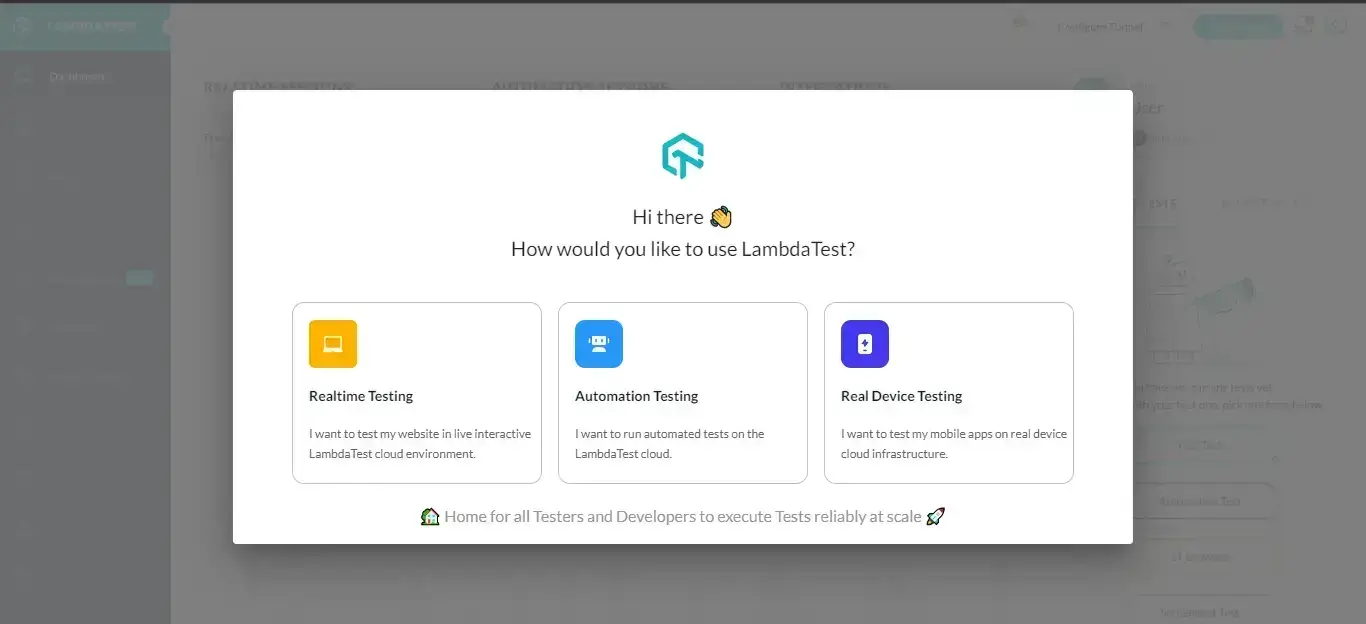
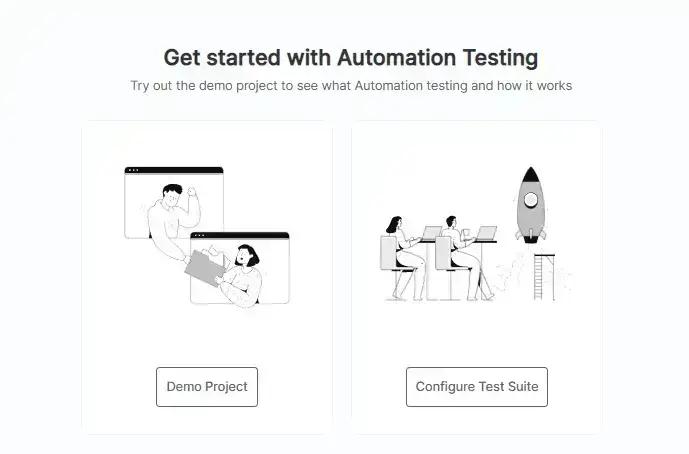
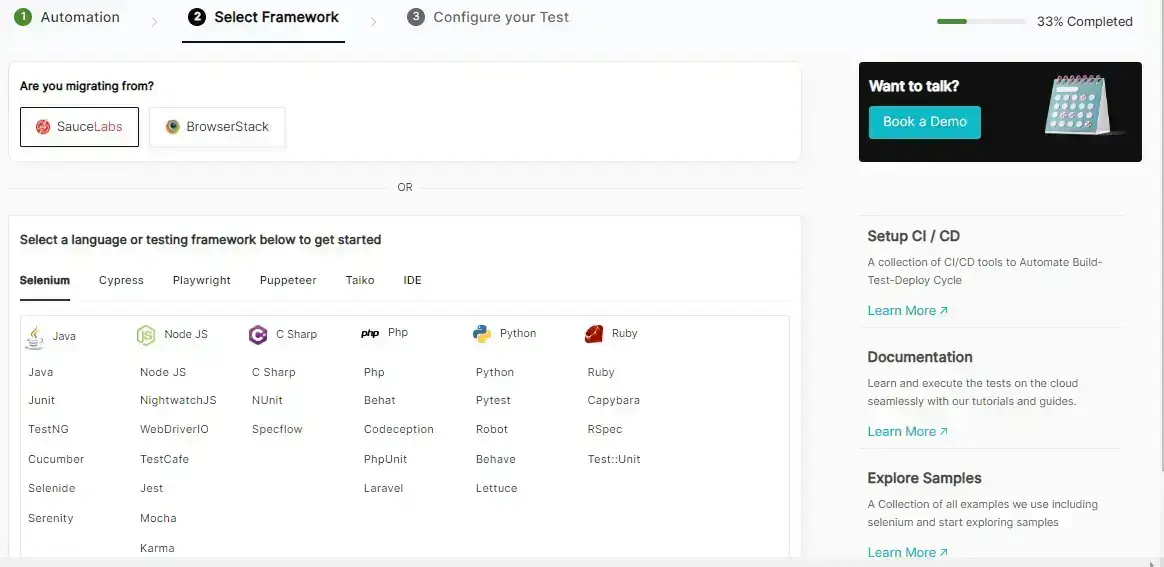
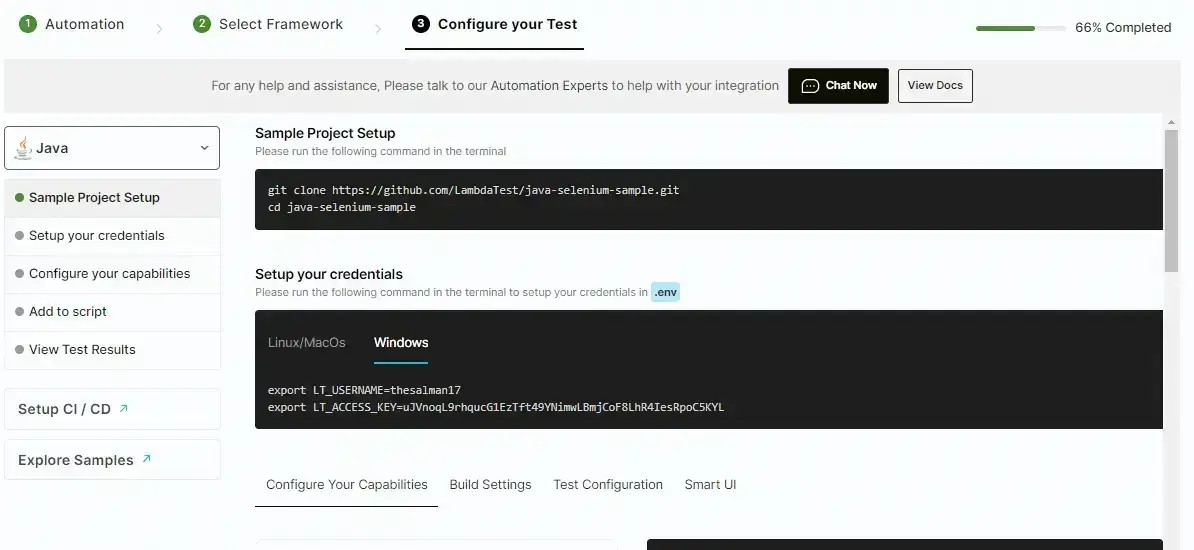
The documentation walks through the full setup to getting started with TestMu AI automation on TestMu AI.

Code-Based Examples of Browser Automation
Both examples use Selenium WebDriver with Python and run against the Selenium Playground, so you can execute them as written rather than substituting your own URLs. They use the Selenium 4 element finder syntax (driver.find_element(By.ID, ...)).
Example 1: Opening a Web Page and Performing Actions
from selenium import webdriver
from selenium.webdriver.common.by import By
from selenium.webdriver.support.ui import WebDriverWait
from selenium.webdriver.support import expected_conditions as EC

driver = webdriver.Chrome()

# Open the Simple Form Demo page on the Selenium Playground
driver.get("https://www.testmuai.com/selenium-playground/simple-form-demo")

# Wait for the message input to render, then type into it
message_box = WebDriverWait(driver, 10).until(
    EC.presence_of_element_located((By.ID, "user-message"))
)
message_box.send_keys("Hello from browser automation")

# Submit and read the value back off the page
driver.find_element(By.ID, "showInput").click()
result = driver.find_element(By.ID, "message").text
print("Displayed message:", result)

driver.quit()
Example 2: Running the Same Script on the TestMu AI Cloud
The only change needed to move a local script to the cloud is the driver construction. The rest of the script is untouched, which is the practical reason cloud execution is a low-risk migration.
Selenium 4 passes cloud capabilities through an options object, since the older desired_capabilities argument has been removed.
from selenium import webdriver
from selenium.webdriver.common.by import By
from selenium.webdriver.support.ui import WebDriverWait
from selenium.webdriver.support import expected_conditions as EC

options = webdriver.ChromeOptions()
options.set_capability("browserVersion", "latest")
options.set_capability("LT:Options", {
    "platformName": "Windows 11",
    "build": "Browser Automation Tutorial",
    "name": "Simple Form Demo on cloud",
    "username": "YOUR_USERNAME",
    "accessKey": "YOUR_ACCESS_KEY",
})

driver = webdriver.Remote(
    command_executor="https://hub.lambdatest.com/wd/hub",
    options=options,
)

driver.get("https://www.testmuai.com/selenium-playground/simple-form-demo")
WebDriverWait(driver, 10).until(
    EC.presence_of_element_located((By.ID, "user-message"))
).send_keys("Running on the cloud grid")
driver.find_element(By.ID, "showInput").click()
print("Displayed message:", driver.find_element(By.ID, "message").text)

driver.quit()
Replace the username and access key with the credentials from your TestMu AI dashboard. Every run then produces a build in the dashboard with video, console output, and network logs attached, which is what turns a failed assertion into something you can actually diagnose.
How AI Agents Use Browser Automation
Tell a Selenium script to buy a pair of headphones and it does nothing until someone writes out every click. Tell an AI agent to buy a pair of headphones and it goes and works the steps out. A script follows instructions. An agent makes decisions, and that changes what the browser underneath it has to do.
How an Agent Reads and Acts on a Page
A test script is handed the exact address of what it should click, usually something like id=checkout-btn. An agent gets no such hint. It has to look at the page, work out which control means "checkout", click it, and then check whether anything actually happened.
So it runs the same four steps, over and over, until the job is done:
- Open the page and let it finish rendering.
- Snapshot it, so the model can read what a person would see on screen.
- Act on one element, such as filling a field or clicking a button.
- Snapshot again to see what changed, then choose the next move.
The snapshot is the clever bit. Agents read the accessibility tree, the same structure a screen reader uses, instead of CSS selectors. It labels the page by meaning ("Search button") rather than by position in the markup, so it keeps working after a developer renames a class and breaks every selector in your suite.
The catch is that a snapshot only describes the page as it looks right now. Navigate somewhere new and every reference from the last one is stale, which is why step four is not optional.
Why Agent Workloads Break QA Grids
Test grids were built around a human rhythm. Someone starts a session, watches it, shuts it down. Agents do not work like that. They open and close sessions on their own schedule, run hundreds side by side, and nobody is watching any of them.
Failures get stranger too. A script fails on a line number you can go and read. An agent fails because it looked at the page and made the wrong call, and no stack trace will tell you what it thought it saw. To debug that, you need a recording, not a log.
Browser Infrastructure Built for Agents
TestMu AI built Browser Cloud for exactly that job. Four things matter most to an agent:
- Real Chrome, started on demand, so pages render the way they do for a person.
- A built-in tunnel, so an agent can reach localhost and staging, not just the public web.
- Saved cookies and login state, so it signs in once instead of on every single run.
- A recording of every session (video, console, network, and each command in order), so you can watch what the agent saw at the moment it went wrong.
It works with Claude, Cursor, Gemini, OpenAI Computer Use, and anything you build yourself, through the SDK, an installable agent skill, or the MCP server covered next. One distinction is worth keeping straight: the test automation cloud runs framework suites, Browser Cloud runs agents. The Browser Cloud documentation covers setup.

Note: Give your AI agents real Chrome sessions with a built-in tunnel, persistent login state, and full session replay. Try TestMu AI for free!
The Role of Model Context Protocol (MCP) in Browser Automation
Model Context Protocol (MCP) is, in the words of its official documentation, "an open-source standard for connecting AI applications to external systems" such as data sources, tools, and workflows. The documentation compares it to a USB-C port for AI applications: one standardized connector instead of a bespoke integration per pairing.
Applied to browsers, MCP changes who writes the automation. Without it, an agent that needs to visit a page has to generate automation code, run it, and interpret the output. With an MCP server in front of a browser, navigation, interaction, and extraction are exposed as structured tools the agent calls directly at runtime. The browser becomes one more tool in the agent's list, alongside everything else it can call.
The protocol is supported across a broad ecosystem rather than one vendor. Its documentation names AI assistants including Claude and ChatGPT and development tools including Visual Studio Code and Cursor among the clients that speak it, which is what makes "build once, integrate everywhere" a realistic claim rather than marketing.
Browser-side MCP servers are now common. Playwright ships one, and TestMu AI's Browser Cloud agent skills pair with an MCP server that exposes browser automation as grouped tools such as browser_navigate, browser_interact, browser_query, browser_state, and browser_devtools. Which integration path to pick comes down to when the code runs:
| Integration path | What it does | When it fits |
|---|---|---|
| Agent skill | Teaches a coding assistant the SDK so the assistant writes the browser integration into your project itself. | You are building an application or pipeline and want durable, reviewable code committed to your repository. |
| MCP server | Exposes browser actions as live tools that an MCP-compatible agent calls directly, with no code generation step. | You want the agent to act on the web right now, as part of its own task loop. |
A useful rule of thumb: reach for the skill when you are writing code that will run later, and reach for MCP when the agent needs to act on the web as it works. The two compose, so a team can scaffold an integration with the skill and still give live agents on-demand browser access through MCP.
Challenges involved in Browser Automation
These are the problems that consume real maintenance time, in rough order of how often they bite:
- Dynamic web elements change attributes, position, or visibility in response to interaction or data updates, so a selector that worked yesterday resolves to nothing today. Explicit waits, stable identifiers, and well-scoped XPath or CSS Selectors are the standard defenses.
- Cross-browser inconsistency comes from each browser having its own rendering engine and JavaScript behavior, so a script that passes in Chrome can fail in Safari on element visibility or layout alone. Running the suite across browsers is the only reliable way to find these.
- Asynchronous operations such as AJAX calls and timeouts mean the page is not ready when the script thinks it is. Condition-based waits fix this; fixed sleeps hide it until the day CI is slow.
- Captchas and bot defenses exist specifically to block automated access. Some are handled with Captcha handling techniques, but treat any evasion capability as best-effort rather than guaranteed, and confirm you are permitted to automate the target.
- File uploads are restricted by browsers for security reasons, so automating file upload needs the framework's dedicated input handling rather than simulated clicks on the OS dialog.
- Performance and stability degrade over long runs through memory leaks and resource consumption, which is why suites that pass individually fail when run end to end.
Most of these reward the same discipline: explicit waits, stable selectors, honest error handling, and enough run artifacts to diagnose a failure without reproducing it. Our guide to test automation best practices covers the wider set.
Best Practices Followed for Browser Automation
Five practices separate a suite the team trusts from one it ignores:
- Run across multiple browsers and versions, because a suite that only ever runs in one browser is a suite that has never actually tested compatibility.
- Wait for element readiness with explicit wait strategies rather than fixed sleeps. This is the highest-leverage change available for flaky suites, and it makes runs faster as a side effect.
- Handle errors deliberately by capturing and logging each failure with enough context that the next engineer can act on it without re-running the suite locally.
- Drive tests from external data so one script covers many input combinations, which keeps the suite small while data-driven testing grows the coverage.
- Keep the test environment close to production in browser versions, OS, and network conditions, since a mismatch turns every real bug into an argument about the environment.
Conclusion
Where you start depends on who is driving the browser.
If it is a test script, take the Selenium 4 example from the code section and get it green locally against the Selenium Playground. Then swap the driver construction for the remote capabilities block. That one change moves the same suite onto TestMu AI's automated browser testing cloud and its 3,000+ browser and OS combinations, and it is the cheapest way to find out whether cloud execution suits your suite before you commit to it.
If it is an AI agent, the QA grid is the wrong tool for the job, and the checklist from earlier is what to shop for: real Chrome that renders the way a person's does, a tunnel into localhost and staging, login state that survives between runs, and a recording you can watch when the agent makes the wrong call. Browser Cloud covers all four. It works with Claude, Cursor, Gemini, and OpenAI Computer Use, through the SDK, an agent skill, or MCP. Our write-up on browser infrastructure for AI agents goes deeper.
The quickest way in is to install the Browser Cloud agent skill and let your coding assistant write the integration for you, instead of reading an SDK reference yourself. If you would rather drive a local browser from plain English before picking a framework at all, compare the Kane CLI browser automation tool first.
Author

Irshad Ahamed
Blogs: 11


Irshad Ahamed is a Technical Writer and Information Architect with over 4 years of experience working across notable companies like Amazon, IBM, and Symantec. He specializes in crafting high-quality documentation, technical writing, and content strategies for software development, APIs, and process documentation. Irshad’s expertise spans across product documentation, creating instructional content, and collaborating with cross-functional teams to ensure clear, concise, and easily understandable outputs. His certifications include PMI-ACP and Camtasia 2019 Essentials.
Reviewer

Harish Rajora
Reviewer
Harish Rajora is a Software Developer 2 at Oracle India with over 6 years of hands-on experience in Python and cross-platform application development across Windows, macOS, and Linux. He has authored 800 + technical articles published across reputed platforms. He has also worked on several large-scale projects, including GenAI applications, and contributed to core engineering teams responsible for designing and implementing features used by millions. Harish has worked extensively with Django, shell scripting, and has led DevOps initiatives, building CI/CD pipelines using Jenkins, AWS, GitLab, and GitHub. He has completed his post-graduation with an M.Tech in Software Engineering from the Indian Institute of Information Technology (IIIT) Allahabad. Over the years, he has emphasized the importance of planning, documentation, ER diagrams, and system design to write clean, scalable, and maintainable code beyond just implementation.


Browser Automation FAQs
Did you find this page helpful?
More Related Blogs
TestMu AI forEnterprise
Get access to solutions built on Enterprise
grade security, privacy, & compliance
- Advanced access controls
- Advanced data retention rules
- Advanced Local Testing
- Premium Support options
- Early access to beta features
- Private Slack Channel
- Unlimited Manual Accessibility DevTools Tests