
Power Your Software Testing with AI Agents and Cloud
The Native AI-Agentic Cloud Platform to Supercharge Quality Engineering. Test Intelligently and Ship Faster.

- TestMu AI (Formerly LambdaTest)
- /
- Blog
- /
- Introducing Kane CLI: Browser Automation for Your Agent
Introducing Kane CLI: Browser Automation for Your Agent
Bring KaneAI into your terminal with Kane CLI. Coding agents collaborate on validation locally, catch breakages earlier, and ship with confidence.
Published on:
When agents move beyond just writing code and start owning validation, everything shifts.
That's the idea behind Kane CLI, launching today.
Software development is faster than ever, but validation hasn't kept pace. Teams can ship more, yet confidence still lags. Kane CLI changes that by bringing KaneAI straight into the terminal so agents can validate earlier, catch breakages as they happen, and turn real product context into richer coverage and safer releases.
It's more than a CLI. It's the next step toward agent-native validation.
What is Kane CLI?
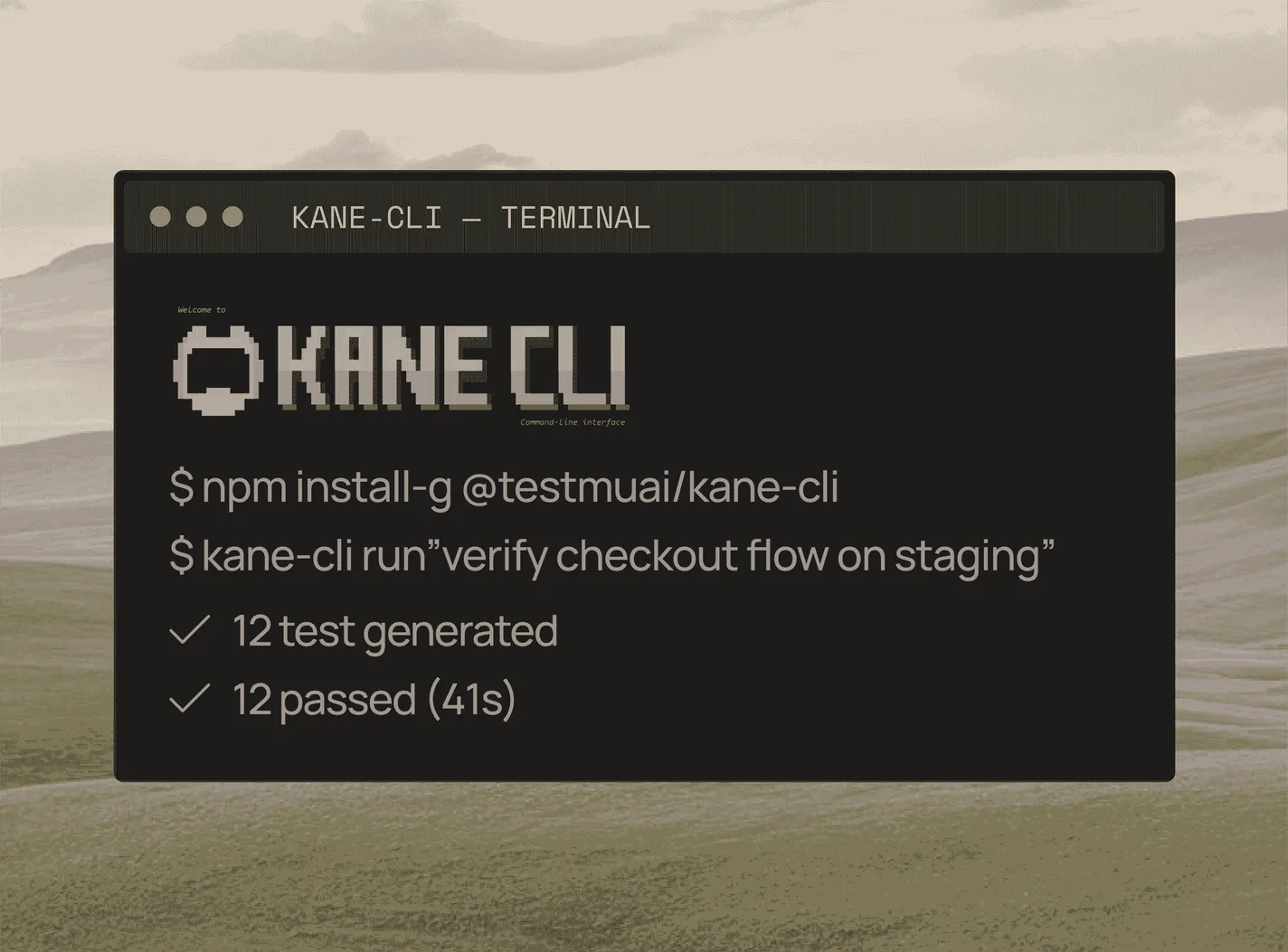
Kane CLI is a browser automation testing tool that runs directly from your terminal. Describe what should happen. Kane CLI opens your local browser, executes it step by step, and returns pass or fail with shareable proof.
It gives AI agents a local Chrome browser to verify what they build. AI is non-deterministic, hallucinates, and running agents in loops to self-verify is expensive. Kane CLI closes that gap with a repeatable, deterministic result every time.
Built for Developers. Built for Agents.
Most tools are built for one audience. Kane CLI was designed from the start for two that have never been addressed together.
For Developers, QA Engineers, UX Designers, PMs, and Vibe coders
Verify features before the PR. Before the QA cycle. Before deploy.
Describe the flow. Kane CLI runs it in a local Chrome browser and returns pass or fail with a shareable evidence link. Login flows, form validation, checkout journeys, API-triggered UI changes. Drop the link into Slack, a Jira ticket, or a PR comment.
Ship faster by catching issues before they reach QA.

Note: Read the documentation and start automating your browser flows today. Click here
For AI coding agents
This is the capability that makes Kane CLI different from everything else in the market.
AI agents like Claude Code, Codex CLI, Cursor, and Copilot can build entire features from a prompt. They write code quickly and confidently. But they have one blind spot: they cannot verify that what they built actually works in a local Chrome browser, which is why teams add Claude Code app testing to the loop.
Kane CLI is that missing tooling.
An agent builds a checkout flow. It calls Kane CLI. Kane CLI runs the checkout in a local browser, returns a structured pass or fail result, and the agent reads it and decides what to do next. Fix the bug. Continue. Or surface it to the human.
Install the Kane CLI skill once and your agent handles browser tasks automatically. Claude Code gets a SKILL.md file. Codex CLI reads an AGENTS.md entry. Gemini CLI gets its own skill file. After that, just ask your agent to verify something. It knows what to do.
Note: Point your agent here:testmuai.com/kane-cli/agents.md
Why Kane CLI?
- Deterministic verification: AI agents hallucinate and are non-deterministic. Kane CLI gives a binary pass or fail backed by a local Chrome browser run.
- Repeatable test cases: Claude Code and Playwright generate brittle, one-time scripts. Kane CLI generates tests that run again and again. Same result every time.
- Resilient runs: Kane CLI does not return halfway. It adapts and pushes through, up to 50 steps per flow, until the full journey is verified. Other tools break on the first change. Kane CLI finishes the run.
- Works only within the browser viewport: Kane CLI only takes actions a real human can take. Other tools write custom JS to bypass validations and force a pass. Kane CLI will not do that.
- Vision-based dynamic waiting: Detects loaders and animations on screen before acting. Not network-based. Handles canvas, shadow DOM, elements frameworks that cannot be resolved.
- Contextual authoring: Give Kane CLI context about your app, and it authors test cases for you. Parallel test cases, multiple browser sessions, from a single prompt.
- Two-way script migration: Convert existing Playwright or Selenium scripts to Kane CLI. Convert Kane CLI tests back to Playwright. No rewrite from scratch.
- Inbuilt Test Manager sync: Every test case created locally is also saved remotely. Shareable proof attached automatically.
Three Ways to Run
Kane CLI has three modes. You pick based on who is running it.
- Interactive TUI: Run
kane-cliwith no arguments. A full terminal UI opens. Type objectives, see step-by-step progress, chain multiple tests in one session. The browser stays open between runs. State carries over. Best for humans exploring and iterating. - Headless CLI: Add
--headlessfor non-interactive runs. No display server needed. Best for shell scripts and one-off automation. - Agent Mode: Add
--agent --headless. The TUI is suppressed. Output is structured NDJSON, one JSON object per line. The finalrun_endline has status, summary, extracted values, and a link to the test report. This is how Claude Code, Codex CLI, and Gemini CLI consume Kane CLI results.
Run Any Browser Flow Before It Reaches Production
Whether you are verifying a login flow, handling OTPs, or exporting to Playwright, Kane CLI handles it from the same terminal command you already used to install it.
- Intent-based browser control. Write your objective in natural language. Kane CLI understands what you mean and executes it step by step. No selectors, no XPath, no code required.
- Autoheal and smart waiting. When the page changes slightly — a button moves, a class name updates, a page loads slower than expected — Kane CLI adjusts automatically. Tests do not break because of cosmetic changes. For AI agents running tests repeatedly across environments, this is the difference between a tool that is usable and one that fails constantly.
- Secure and parameterized flows. Pass credentials, API keys, environment-specific values, and test data as variables without hardcoding anything. Use
--variables-fileto load a JSON file of parameters. The same flow runs against dev, staging, and production with a single flag change. - "Ask tool" for OTPs and CAPTCHA. When an automated flow hits an OTP screen or a CAPTCHA, it does not fail silently. Kane CLI pauses, asks the human to handle that one step, and then continues the run. For AI agents, this is human-in-the-loop without stopping the entire workflow.
- Custom profiles and stateful flows. Use saved browser profiles and authenticated sessions. Kane CLI can pick up a session where a previous run left off. You do not have to automate the login flow every single time.
- Shareable evidence links. Every run produces a persistent, shareable link showing exactly what happened. Video. Step trace. Pass or fail. Share it with your team, attach it to a PR, or include it in a bug report.
- Playwright export. Every flow you build can be exported as native Playwright code. One command and you have a real, editable test script. The speed of natural language. The control of real code.
- Automated bug discovery. Kane CLI does not just run what you tell it. It actively looks for unexpected behavior while executing your flows and reports what it finds. Bugs you did not know to look for surface automatically.
- CI/CD ready. Kane CLI runs headlessly in GitHub Actions, GitLab CI, Jenkins, and Bitbucket Pipelines. Pass credentials as environment variables. Standard exit codes plug into pipeline control flow without any custom scripting.
Where Kane CLI Sits in the Market
Three categories of tools exist today that touch what Kane CLI does. None of them do what Kane CLI does.
- AI coding assistants: Claude Code, Codex CLI, Cursor, Gemini CLI. These tools write code. They generate test code too. But they cannot run tests in a real browser and return a verified pass or fail. They produce output. They cannot confirm it works.
- General-purpose browser agents: Tools in this category execute browser tasks. But they have no concept of a test. No pass or fail. No Autoheal. No Playwright export. No agent-first integration. They are automation tools, not verification tools.
- Traditional testing frameworks: Selenium, Playwright, and Cypress. Powerful. Precise. They require a developer, significant setup, and ongoing maintenance every time the UI changes. Right for mature engineering teams with dedicated QA resources. Wrong for everyone else.
How to Get Started
Kane CLI runs in any terminal. It works where you already work.
VS Code, Cursor, Claude Code, Codex CLI, Replit, Lovable. Any agent that reads testmuai.com/kane-cli/agents.md knows how to call Kane CLI as a tool in its workflow.
Install commands
npm install -g @testmuai/kane-cliOr
brew install lambdatest/tap/kane-cliStart with this sample prompt:
kane-cli run "Visit amazon.com, search sony headphones and add to cart"And if you are building with an AI coding agent? Point your agent to: testmuai.com/kane-cli/agents.md
A tighter loop. A smarter signal. A higher bar for shipping. Kane CLI
Once Kane CLI is running, you can validate your skills too. The Kane CLI Certification is free and proves you can turn plain-language objectives into verified browser runs from your terminal.

Author

Bhawana
Blogs: 75


Bhawana is a Community Evangelist at TestMu AI with over 3 years of experience creating technically accurate, strategy-driven content in software testing. She has authored 50+ blogs on test automation, cross-browser testing, mobile testing, and real device testing. She also serves as Product Marketing Manager for Kane CLI, the command-line tool that runs browser automation from the terminal using natural-language flows in a real Chrome browser. Bhawana is certified in KaneAI, Selenium, Appium, Playwright, and Cypress, reflecting her hands-on knowledge of modern automation practices. On LinkedIn, she is followed by 6000+ QA engineers, testers, AI automation testers, and tech leaders.


Did you find this page helpful?
More Related Blogs

TestMu AI forEnterprise
Get access to solutions built on Enterprise
grade security, privacy, & compliance
- Advanced access controls
- Advanced data retention rules
- Advanced Local Testing
- Premium Support options
- Early access to beta features
- Private Slack Channel
- Unlimited Manual Accessibility DevTools Tests