
E2E Testing for Chat, Voice, Phone and Video AI Agents
Run Thousands of Test Scenarios against Your Agent and Catch Hallucinations, Bias, and Toxicity Before Users Do.

OpenAI Evals: Framework vs Hosted Platform, the November 2026 Shutdown and How to Migrate
Part of: LLM Testing
OpenAI Evals is an open-source framework plus a hosted platform deprecated with a Nov 30, 2026 shutdown date. See how each works and how to migrate.
Published on:
OpenAI Evals is two things: the open-source openai/evals framework on GitHub and a hosted Evals platform within the OpenAI dashboard and API. The hosted platform went read-only on 31 October 2026, with a complete shutdown on 30 November 2026.
OpenAI has directed users to promptfoo. The open-source framework itself is not on OpenAI's deprecation list.
This covers both halves of the name. First off, how the open-source framework works with a minimal custom eval that you can run locally. Then the deprecation dates for the hosted platform, how the API was actually built and how you can go about rebuilding a hosted eval in promptfoo using a concept map, a converter script and a 4-step checklist.
TL;DR
OpenAI Evals is two products under one name: the open-source openai/evals framework, which still runs locally, and the hosted Evals platform in the OpenAI dashboard and API. OpenAI deprecated the hosted platform; it became read-only on October 31, 2026 and is scheduled to shut down on November 30, 2026, with promptfoo as the named migration path.
How Do You Move a Hosted OpenAI Eval to promptfoo?
- Test data: Each JSONL row that the hosted Evals API wrapped in an item object becomes a promptfoo test with vars, and the prompt template and the run's model become the prompt and provider in promptfooconfig.yaml.
- Grader rebuild: A string_check grader with the eq operation maps to promptfoo's equals assertion. A model-based grader maps most closely to llm-rubric, which needs validating against the old results before a team relies on it.
- OpenAI migration cookbook: The cookbook recreates each eval rather than exporting it, so the uploaded JSONL file and the last run's result_counts are the two things to save from the dashboard while it is still readable.
- promptfoo eval --no-cache: Running promptfoo eval with --no-cache and comparing its pass and fail counts with the recorded result_counts shows whether the rebuilt OpenAI evaluation behaves like the original before any code is retired.
Does the openai/evals Framework Still Work, and What Do Evals Miss?
- openai/evals framework: Open source under MIT: yes. Runs locally: yes. On OpenAI's deprecation list: no. A custom eval needs a clone, pip install -e ., a samples file, a YAML registry entry and an oaieval run.
- Evals API retirement: A finished OpenAI Evals migration removes code that calls /v1/evals or client.evals, unsubscribes the eval.run webhooks and deletes report_url links, so nothing depends on the hosted platform after November 30, 2026.
- Deployed agent testing: An OpenAI eval checks one model output against an expected answer. TestMu AI Agent Testing generates scenarios from your documents, runs multi-turn conversations against the deployed chat agent and scores each one on quality metrics with thresholds.
What Is OpenAI Evals?
"OpenAI Evals" is the name of two different offerings, which is the source of most confusion:
- The openai/evals framework. An open-source Python project that describes itself as a framework for gauging LLMs and LLM systems, with an open registry of benchmarks. It's MIT-licensed, and as of 26th November 2026, has 19.8k stars on GitHub.
- The hosted Evals platform. Evals that were configured in the OpenAI dashboard or created via the
/v1/evalsAPI (with graders, runs and a results report). This was the part that OpenAI deprecated.
Both do exactly the same thing: take a set of inputs through a model and then score the outputs according to the criteria you've defined.
Evals are one form of AI testing. They score the model's output against the expected answer. They don't in themselves constitute end-to-end testing of a deployed agent (that comes later in this guide).
For a quick visual walkthrough of this concept, watch the video below from TestMu AI.
Subscribe to the TestMu AI YouTube channel for more tutorials on testing and automation.
How Does the Open-Source openai/evals Framework Work?
openai/evals runs locally from Python (3.9 or newer). You supply it with samples, register an eval in YAML and then run it via the oaieval command. Results are logged locally.
Step 1: Clone and Install
A custom eval lives in the framework's registry, so you need to work in a clone of the repo. (pip install evals only installs the package for running the existing evals.)
git clone https://github.com/openai/evals.git
cd evals
pip install -e .
# OPENAI_API_KEY must be set from your secret manager before running evals
All the registry paths below (evals/registry/...) are within this clone.
Step 2: Write Samples
For the basic templates (Match, Includes, FuzzyMatch), you need, for each sample, an input key (ideally in chat format) and an ideal key with the expected string or list of strings. One JSON object per line in evals/registry/data/ticket_triage/samples.jsonl in the clone:
{"input": [{"role": "system", "content": "Classify the support ticket as Hardware, Software or Other. Reply with one word."}, {"role": "user", "content": "My monitor will not turn on."}], "ideal": "Hardware"}
{"input": [{"role": "system", "content": "Classify the support ticket as Hardware, Software or Other. Reply with one word."}, {"role": "user", "content": "The app crashes when I export a report."}], "ideal": "Software"}
Step 3: Register the Eval
Add evals/registry/evals/ticket_triage.yaml, using the Match template (passes if the completion starts with an ideal answer):
ticket_triage:
  id: ticket_triage.dev.v0
  metrics: [accuracy]
ticket_triage.dev.v0:
  class: evals.elsuite.basic.match:Match
  args:
    samples_jsonl: ticket_triage/samples.jsonl
Step 4: Run It
# The completion function (model) comes first, the eval name second.
# gpt-3.5-turbo is the model ID used in the repository's own examples;
# run `oaieval --help` and pass the model your team actually evaluates.
oaieval gpt-3.5-turbo ticket_triage

# Built-in eval sets read registry data stored with Git LFS, so fetch it first
git lfs fetch --all
git lfs pull

# Run a registered eval set, with more threads and a longer per-thread timeout
EVALS_THREADS=42 EVALS_THREAD_TIMEOUT=600 oaievalset gpt-3.5-turbo test
Run the first command as written and the OpenAI API answers with a 404: "The model gpt-3.5-turbo has been deprecated." A newer model ID such as gpt-4.1-mini fails as well, because stock oaieval calls it as a plain completion model.
The openai/evals registry code uses OpenAIChatCompletionFn only for names that is_chat_model accepts, such as gpt-3.5-turbo, gpt-4 and names starting with gpt-4-, and uses OpenAICompletionFn for any other model ID the OpenAI API lists.
Register a chat completion function for your model as the repo's completion functions guide describes: a YAML file in evals/registry/completion_fns, or in your own folder passed with --registry_path.
Per the repo docs, oaieval writes events to local JSONL logs in tmp/evallogs and --record_path changes that path. The other built-in templates are Includes, FuzzyMatch and JsonMatch, and then there are the model-graded ones (fact, closedqa and battle).
The README currently states that the project is not accepting any evals with custom code. As of 25th November 2026, the README still has the advert for configuring your Evals in the OpenAI Dashboard (the hosted portion described below).
What Did OpenAI Deprecate and When?
According to the OpenAI deprecations page and OpenAI's evals guide (both checked November 25, 2026):
| Date | Change |
|---|---|
| June 3, 2026 | Deprecation announced |
| October 31, 2026 | Read-only for existing users |
| November 30, 2026 | Scheduled shutdown of the Evals dashboard, API and graders for eval workflows |
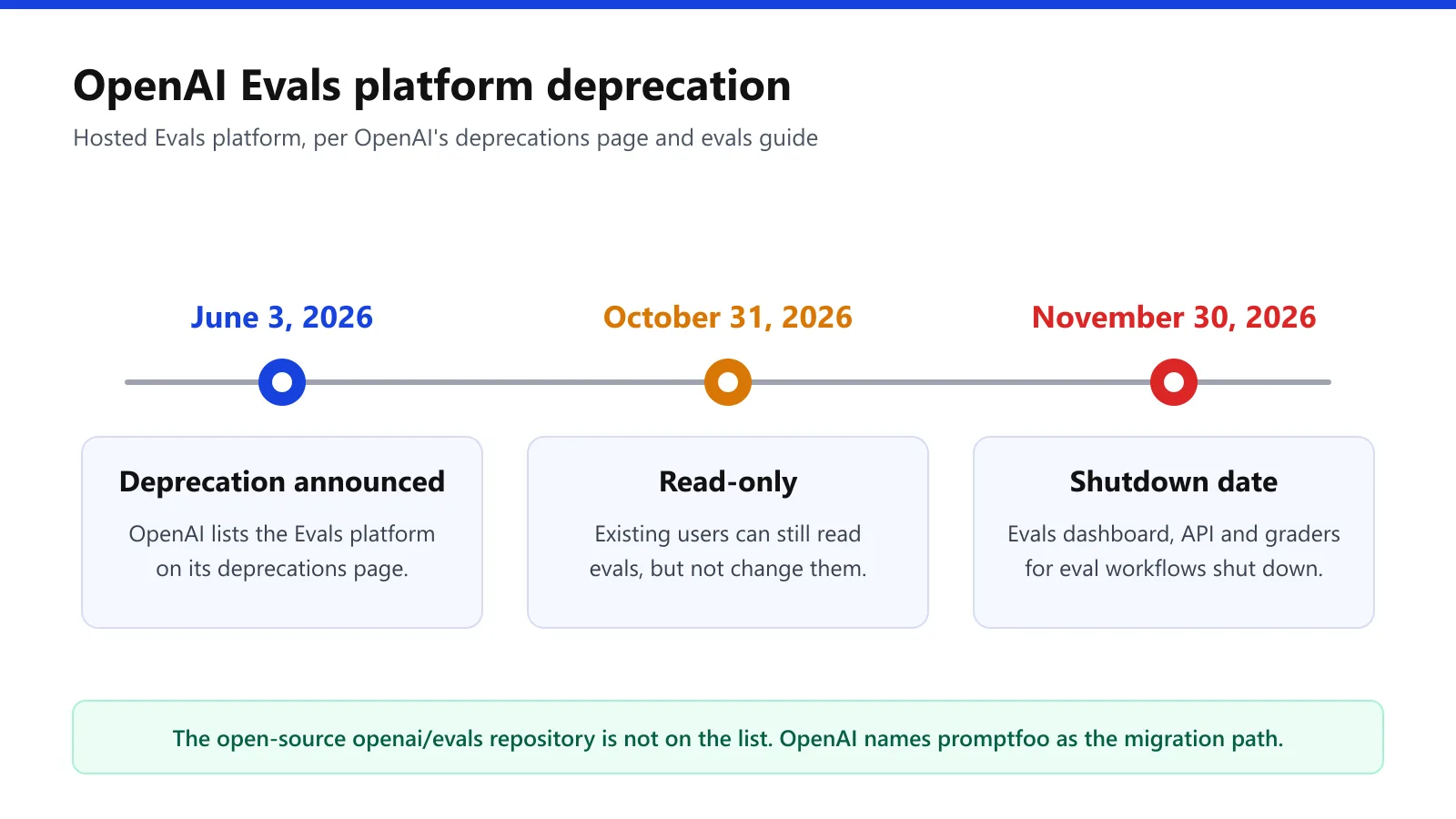
OpenAI's stated path of migration is promptfoo with a cookbook for that. Graders used for fine-tuning follow their own separate fine-tuning timeline on the same page.
The evals guide also has a section in it that points newcomers to evaluations in the Datasets on the OpenAI platform. Check the deprecations page for the current state of that before you go relying on it.
Two other items have the same date (November 30, 2026) and frequently co-exist in the same codebase: the prompt objects (/v1/prompts), which OpenAI says should be moved into application code and Agent Builder (for which OpenAI points to the Agents SDK or ChatGPT Workspace Agents). If you're testing agents built on the Agents SDK, our guide to testing OpenAI Agents SDK agents covers what that means for your test suite.
The deprecations entry doesn't list the open-source openai/evals repo.
What Replaces OpenAI Evals?
In order of how directly they replace the hosted platform (as of November 2026):
- promptfoo: OpenAI's named migration path, complete with a migration cookbook.
- The openai/evals framework: if your evals are model checks that you can run locally, then the section above shows you how.
- Other eval runners and harnesses: any tool that stores your datasets, prompts and graders in your own repo will do, as long as you're rebuilding and re-validating each grader.
How Did the Hosted Evals API Work?
Knowing the old shape makes the migration mechanical. Per OpenAI's Working with evals guide, a hosted eval had four parts:
- Test data: a JSONL file uploaded with purpose set to
evals. Each line has its fields wrapped in anitemobject (e.g.ticket_textandcorrect_label). data_source_config: the schema for each test item (withinclude_sample_schemaso graders can look at the model's output)- testing criteria: the graders. The guide's example is a
string_checkgrader using theeqoperation to compare{{sample.output_text}}with{{item.correct_label}}. - Runs: created via
client.evals.runs.create(...)(orPOST /v1/evals/{eval_id}/runs) using a prompt template such as{{ item.ticket_text }}and a model. Runs start in a queued state.
Results came back as result_counts (total, errored, failed, passed), per_testing_criteria_results, per_model_usage and a report_url for the dashboard. Teams could also subscribe to the eval.run.succeeded, eval.run.failed and eval.run.canceled webhooks.
If you still have read access, please write down the last result_counts for every eval you plan to migrate. You'll be comparing against those in step 3 of the checklist below.
How Do You Migrate OpenAI Evals to promptfoo?
OpenAI's migration cookbook takes the same building blocks (test data, prompts, providers and scoring criteria) and puts them into a promptfooconfig.yaml file, which you can then run either from the CLI or in CI. It doesn't rely on an export at all: you recreate each eval.
Our Concept Map: OpenAI Evals to promptfoo
| OpenAI Evals | promptfoo | Source |
|---|---|---|
| Eval defined in the dashboard or via /v1/evals | promptfooconfig.yaml in your repo | OpenAI cookbook |
| JSONL rows wrapped in item | tests, each with vars | TestMu AI mapping |
| Prompt template {{ item.ticket_text }} | Prompt with {{ticket_text}} | TestMu AI mapping |
| Model on the run | providers, for example openai:gpt-6-luna | OpenAI cookbook (providers); model id from promptfoo's OpenAI provider page |
| string_check grader with eq | equals assertion | TestMu AI mapping |
| Model-based grader | llm-rubric (closest match) | TestMu AI mapping; validate before relying on it |
| Run + report_url | promptfoo eval + promptfoo view | OpenAI cookbook |
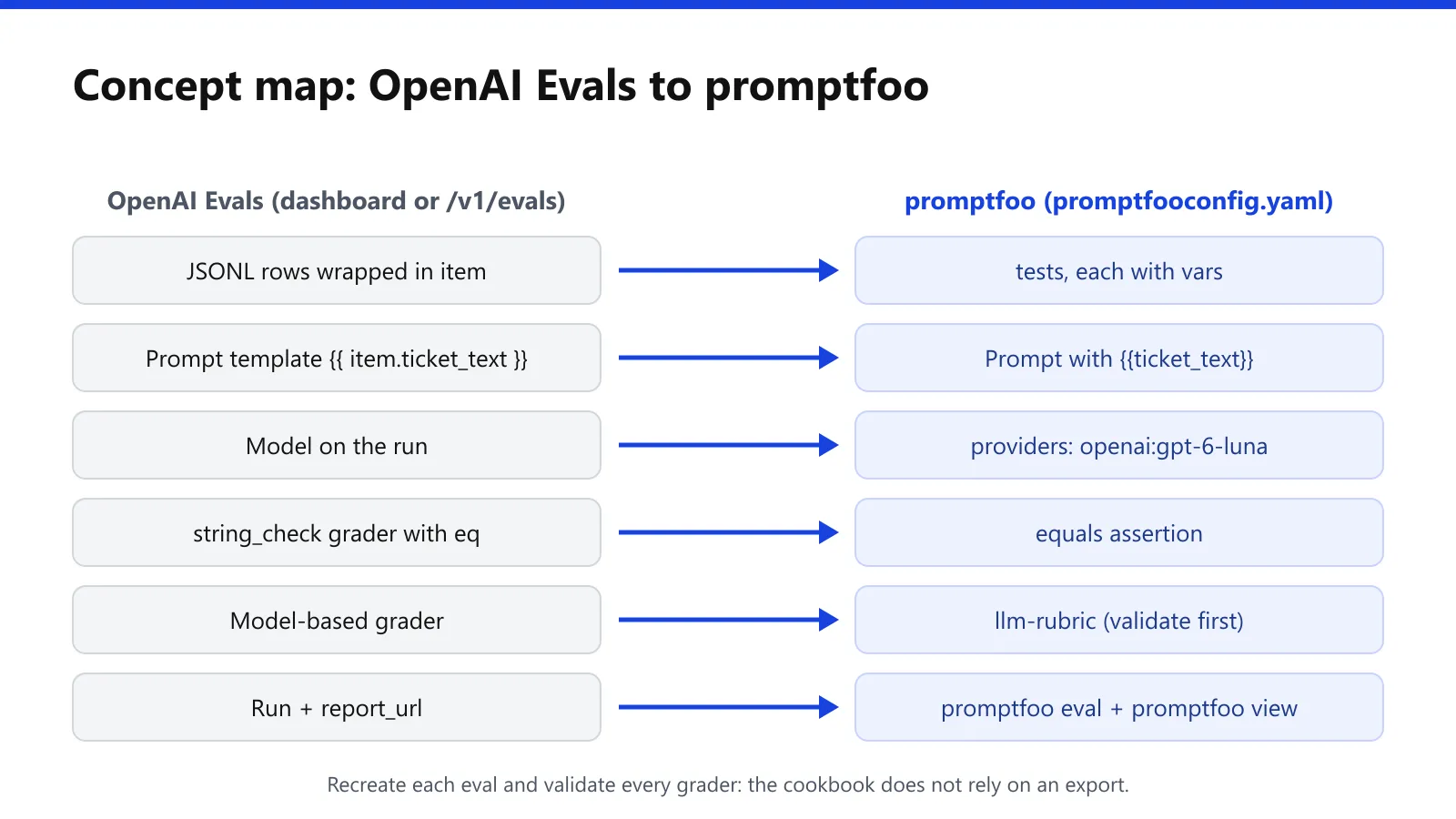
Rows marked "TestMu AI mapping" are our own interpretation of the documentation for both products, not OpenAI's published mapping. The cookbook merely states that graders must be recreated as promptfoo assertions and validated, cautions that similarity-based scores can vary between systems and that LLM-as-a-judge graders will require validation. The full list of assertion types is in the promptfoo assertions reference.
Step 1: Convert Your Eval Data
If you still have the JSONL file that you uploaded, this script will take each item and turn it into a promptfoo test with an equals assertion. Pass in your own field names as arguments.
# jsonl_to_promptfoo.py
# Usage: python jsonl_to_promptfoo.py tickets.jsonl ticket_text correct_label > tests.yaml
import json
import sys

data_file, input_field, label_field = sys.argv[1], sys.argv[2], sys.argv[3]

print("tests:")
with open(data_file, encoding="utf-8") as f:
    for line in f:
        if not line.strip():
            continue
        item = json.loads(line)["item"]
        print("  - vars:")
        print(f"      {input_field}: {json.dumps(item[input_field])}")
        print("    assert:")
        print("      - type: equals")
        print(f"        value: {json.dumps(item[label_field])}")
JSON-encoded strings are valid YAML scalars, so quotes and line breaks in your data will be preserved.
Step 2: Rebuild the Config and Compare
With promptfoo installed (see our promptfoo guide for setup and assertions), write the prompt and provider section of the config and then append the generated tests:
# promptfooconfig.yaml
prompts:
  - |
    Classify this support ticket as Hardware, Software or Other.
    Reply with one word only.
    Ticket: {{ticket_text}}
providers:
  # promptfoo's documented example ID; use the model your OpenAI eval ran against
  - id: openai:gpt-6-luna
# OPENAI_API_KEY must already be set from your secret manager (never commit it)
cat tests.yaml >> promptfooconfig.yaml
promptfoo validate config -c promptfooconfig.yaml
promptfoo eval -c promptfooconfig.yaml --no-cache
promptfoo view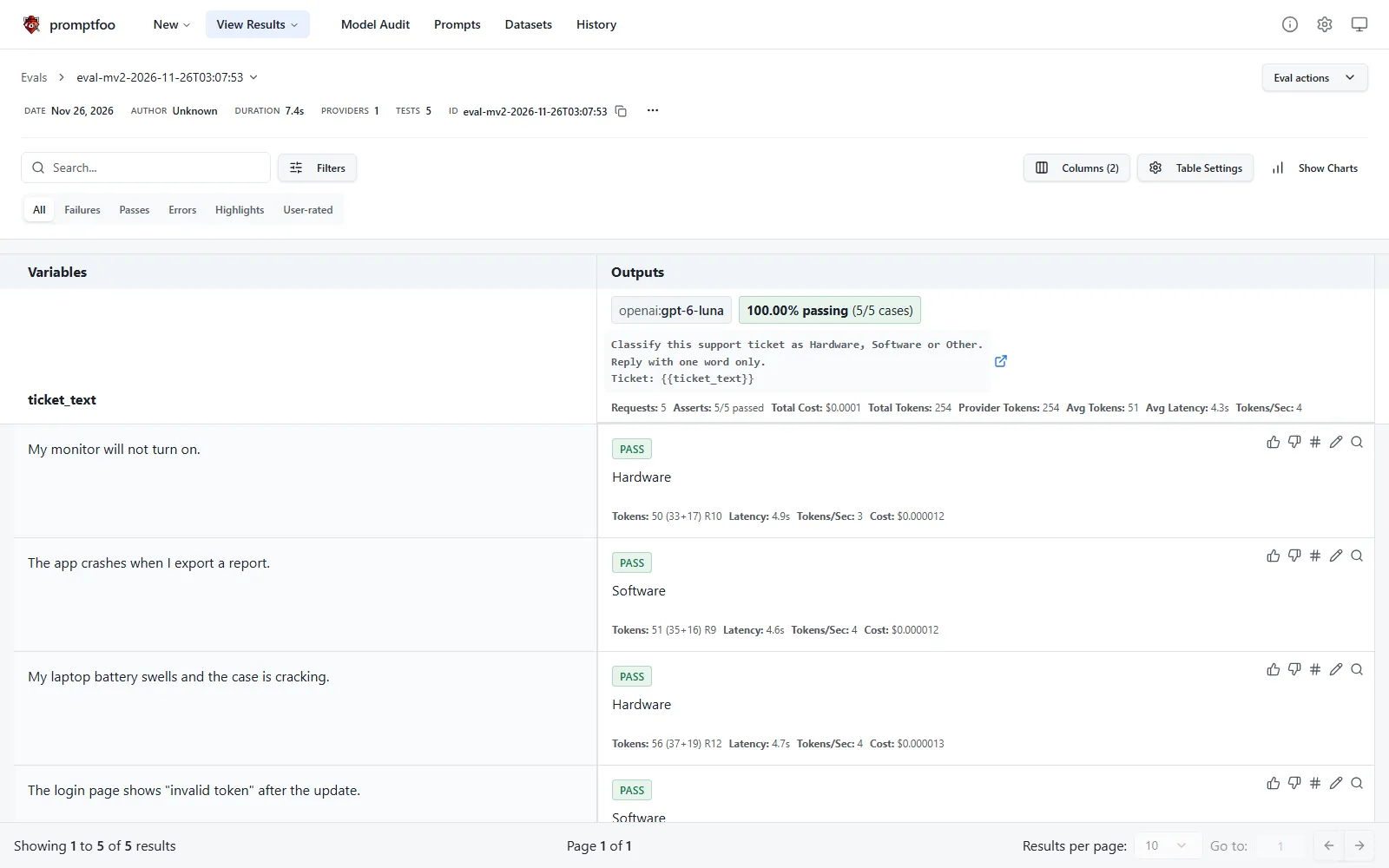
These are the three commands from OpenAI's cookbook: eval to create a new run, view to open the results locally and validate config to check the file.
Context as of Nov 2026: OpenAI announced on March 9 2026, that it would be acquiring Promptfoo, subject to normal closing conditions.

Your evals score the answers. Who tests the whole conversation?
Note: TestMu AI Agent Testing creates scenarios from your docs, runs multi-turn conversations against your live chat or voice agent and scores every run. See how a chat agent test works.
The 4R Migration Checklist
Work through it one eval at a time:
- Record. Copy over the eval's data file, prompt template, model and testing criteria, as well as the
result_countsfrom the last run (all of that from your own records or from the dashboard whilst it's still readable). - Rebuild. Recreate it in
promptfooconfig.yaml(or the openai/evals registry) - the rows become the tests, the graders become the assertions. Runpromptfoo validate config. - Re-run. Run
promptfoo eval --no-cacheand compare the pass/fail counts against the recordedresult_counts. The exact-match graders should be in line. Look at every model-graded criterion that has moved. - Retire. Remove any code that calls
/v1/evalsorclient.evals, unsubscribe theeval.run.*webhooks and delete any references toreport_urllinks in tickets and dashboards.
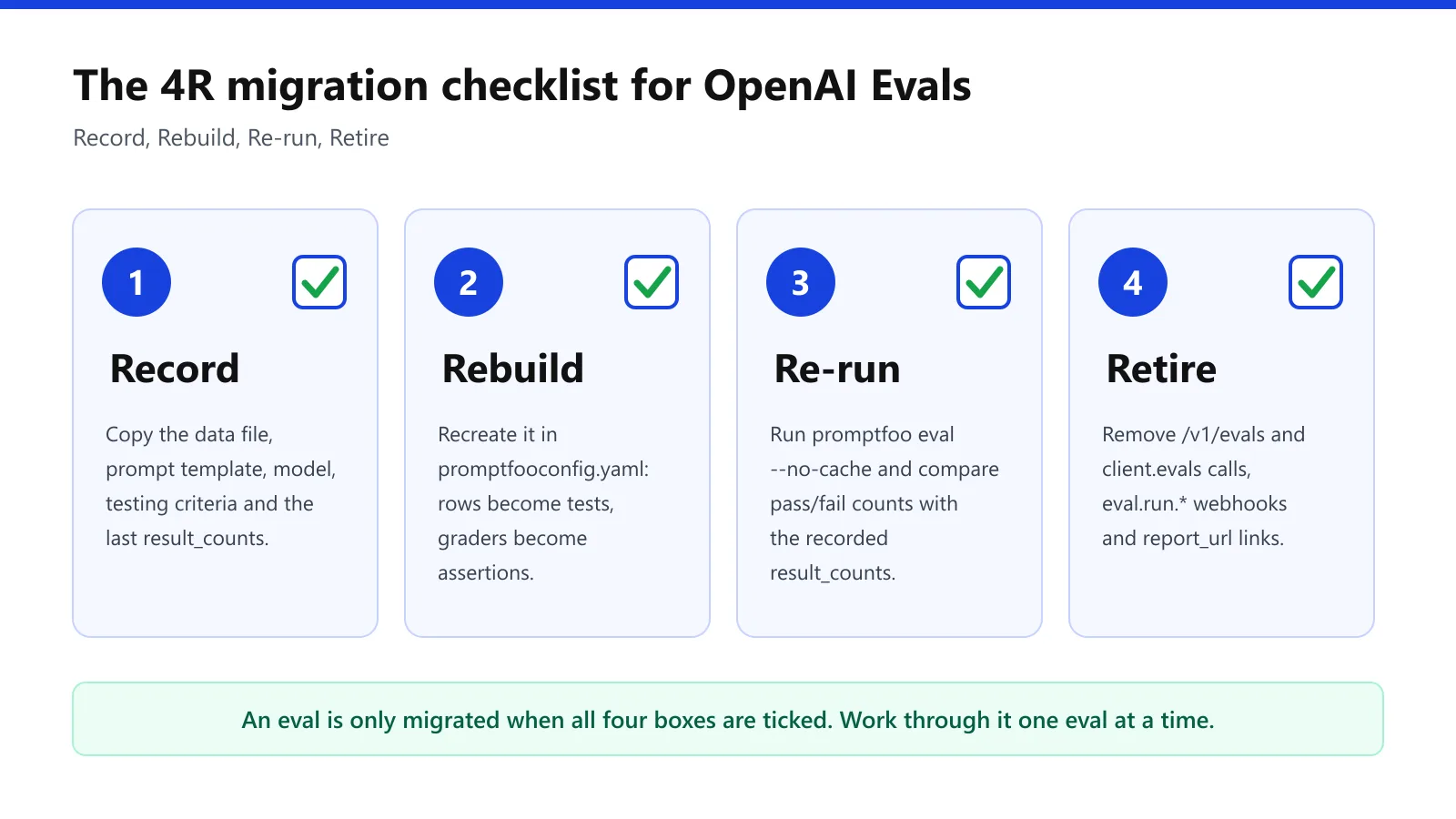
An eval is only migrated when all four boxes are ticked.
How Do the Options Compare?
| Hosted OpenAI Evals | openai/evals framework | promptfoo | TestMu AI Agent Testing | |
|---|---|---|---|---|
| What it is | Dashboard + /v1/evals API | Open-source Python framework and benchmark registry | CLI and config file for prompt and model evals | Platform that tests deployed chat, voice, phone and video agents |
| Where tests live | OpenAI account | YAML registry + JSONL samples | promptfooconfig.yaml in your repo | Agent Testing projects, suites and scenarios |
| Scoring | Graders (string_check and others) | Match, Includes, FuzzyMatch, JsonMatch, model-graded templates | Assertions (equals, llm-rubric, python and more) | Scenario validation criteria and quality metrics with thresholds |
| Runs | Hosted runs, report_url | oaieval / oaievalset, local logs | promptfoo eval, promptfoo view | Dashboard runs or agent-testing-cli |
| Status (as of Nov 2026) | Deprecated; read-only from Oct 31, 2026; shutdown date Nov 30, 2026 | Repository available; not in the deprecation entry | OpenAI's recommended migration path; acquisition announced by OpenAI Mar 9, 2026 | Available |
| Best for | Nothing new: migrate | Benchmark-style model evals run locally | Prompt and model evals in CI | End-to-end agent conversations before go-live |
Do Evals Cover Everything an AI Agent Needs?
No. An eval is simply a check that the model produces the correct output for a given input. A production agent has to do so much more than that: it has to retain context across turns, follow its workflow, not hallucinate policy and behave in a consistent manner for different user personas.
Evals and agent tests answer different questions, so we need to keep both. TestMu AI does not in any way replace your evals.
Agent Testing tests the deployed agent. Per the chat agent testing docs:
- In Agent Testing, click Create New Agent, select Chat Agent as the Agent Type and choose Pre-production testing.
- In the Workflows tab, you can use Upload Sources to upload files or to connect to Confluence, Jira or an S3 bucket.
- Click Generate Scenarios, then Create New Suite to group the scenarios.
- Run the suite: paste your agent's request as a cURL command, click Parse and Evaluate, then Run Evaluation.
- View the results per scenario in the Turns tab, then the Validation Criteria tab and Recommendations. Set your pass scores under Configs → Metric Thresholds.
Conversations are scored on nine quality metrics (Bias Detection, Hallucination Detection, Completeness and Conversation Flow, etc.).
From a pipeline, the Agent Testing CLI will run a saved suite and return documented exit codes (0 = success, 1 = a completed test failed, 2 = invalid input, 3 = auth failure, 4 = API/TUI dependency error, 5 = polling timeout). Store your LT_USERNAME and LT_ACCESS_KEY in your CI secret store:
pip install agent-testing-cli
agent-testing-cli --project "$TESTMU_PROJECT_ID" --json run \
  --workflow "$TESTMU_WORKFLOW_ID" --suite "$TESTMU_SUITE_ID" --yes
Chat evaluations are asynchronous, and the CLI docs say not to add --wait to a chat run, so this command starts the suite without waiting for scores. Read the results with agent-testing-cli results --suite and the suite ID.
A practical split: promptfoo or the openai/evals framework for quick prompt and model checks on every commit, and an Agent Testing suite prior to every agent release.
Watch: Build Trustworthy AI Agents Powered by Evals
In this TestMu Conf 2026 talk, Rushabh Mehta looks at building evaluation datasets that are actually representative of production, LLM-as-a-judge pipelines, when you actually do need to add human review and how to catch regressions before the users do.

Conclusion
OpenAI Evals has two meanings and two futures. The open-source framework continues to run locally and is not on the deprecation list. The hosted version was deprecated with a shutdown date of 30th November 2026.
Rebuild those evals in promptfoo using the 4R checklist and check your pass rates before you retire the old code. Whatever runner you're keeping, run end-to-end tests on the agent that your users actually talk to.
Rebuilding your evals? Why not add an end-to-end safety net at the same time? Run your very first chat agent test with TestMu AI Agent Testing and gate your releases with the Agent Testing CLI.
Testing an AI agent? TestMu AI's Agent Testing validates chat, voice and IVR agents before your customers talk to them.
Author

Shantanu Wali
Blogs: 27

Shantanu Wali is Vice President of Product Management at TestMu AI, where he owns several product lines across the testing platform, including the Real Device Cloud and the Digital Experience Testing Cloud. He has also contributed significantly to the development and scaling of KaneAI, TestMu AI's flagship GenAI-native testing agent that uses natural language to make software testing faster and more reliable in this AI era. He brings 7+ years of experience across software development and product management, starting as a backend developer at Infosys building solutions for Fortune 500 clients. Shantanu holds an MBA from IIM Calcutta and a B.Tech in Mechanical Engineering.
Reviewer

Mayank Bhola
Reviewer
Mayank Bhola is Co-Founder and Head of Products at TestMu AI, where he leads the entire product portfolio across KaneAI, Kane CLI, HyperExecute, SmartUI, the Real Device Cloud, Accessibility, and other software testing product lines. As an early Lead Architect he designed and built the company's flagship Tunnel technology from scratch, created the React-based automation platform, and architected the data-intensive pipelines and FAAS services that scale it. He brings more than 10 years of experience in software development and product engineering, with earlier roles as Head of Technology at Juggernaut Books and Senior Software Engineer at PressPlay TV and Zomato. Mayank holds a B.Tech in Computer Engineering from JIIT Noida.
OpenAI Evals FAQs
Did you find this page helpful?
More Related Blogs

TestMu AI forEnterprise
Get access to solutions built on Enterprise
grade security, privacy, & compliance
- Advanced access controls
- Advanced data retention rules
- Advanced Local Testing
- Premium Support options
- Early access to beta features
- Private Slack Channel
- Unlimited Manual Accessibility DevTools Tests