
Agent Assurance for your AI Deployment
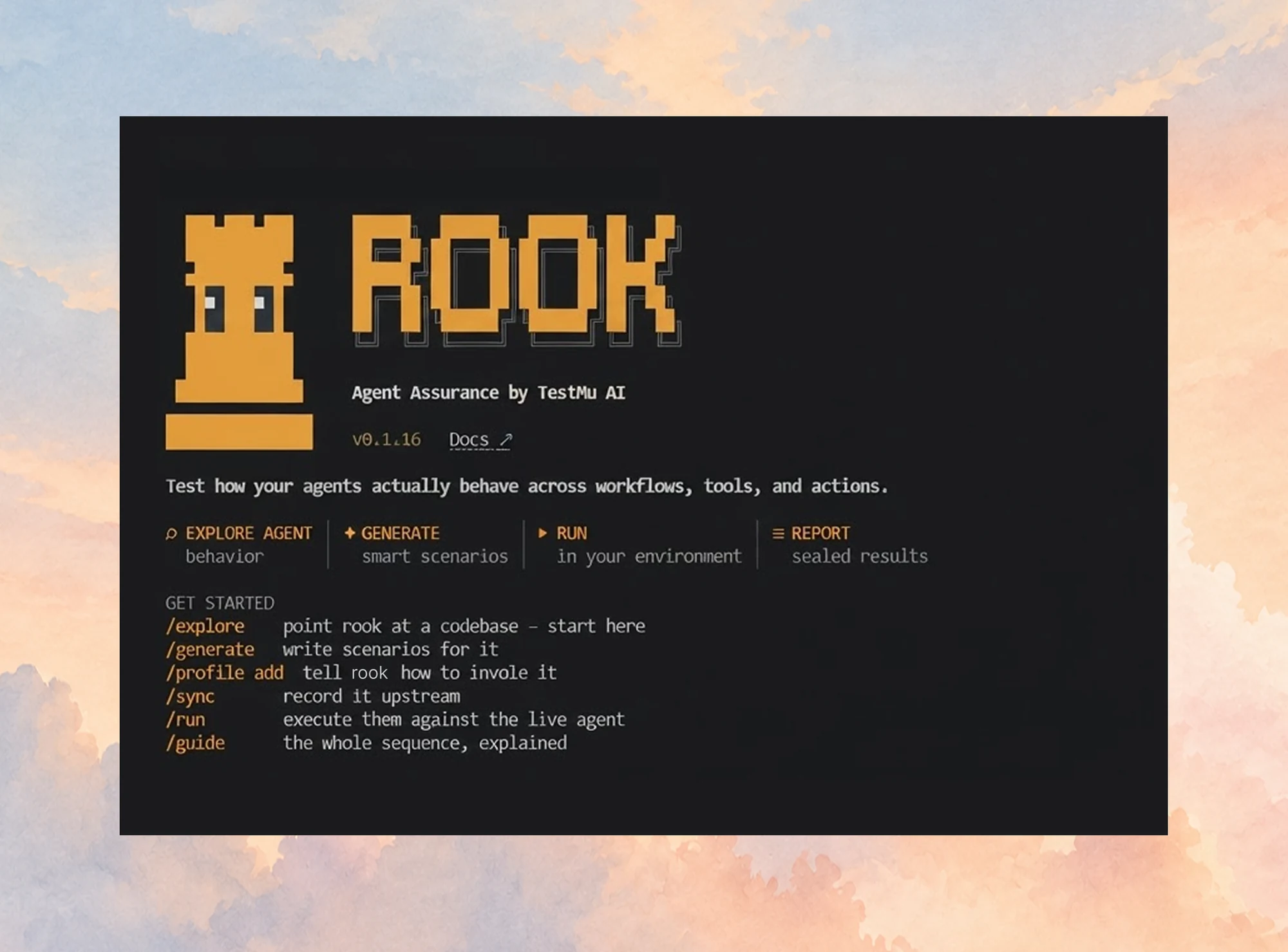
Test how your agents actually behave across workflows, tools, and actions. Catch failures and vulnerabilities before they ship.
npm install -g @testmuai/rook@latest
Next-Concept Modeling (NCM) Explained: How It Differs From LLMs
Next-concept modeling (NCM) writes text coarse to fine, a level of codes per pass. How NCM differs from LLMs, what its paper measured and where it falls short.
Published on:
On a single NVIDIA H100, next-concept modeling (NCM) generated text 10 to 31 times faster than the strongest diffusion language models it was tested against. It writes text as a hierarchy of discrete codes, coarse to fine, one level per forward pass. The speed figures come from the NCM paper, posted on 9 October 2026, which also reports about 4 to 5 times fewer training tokens on LM1B and OpenWebText.
Every speedup in the paper is measured against diffusion models, not against the autoregressive models behind ChatGPT-style assistants. In the same paper, autoregressive baselines still score higher on WMT14 translation and on OpenWebText generation, so its tables need the same condition-by-condition reading as any set of LLM benchmarks.
Overview
Next-concept modeling (NCM) is a text generation method from Stanford researchers that encodes a whole sequence into a hierarchy of discrete codes, then generates that hierarchy from coarse to fine, predicting every code in a level at once. Its October 2026 paper reports 10 to 31 times faster generation than diffusion language models.
How Does NCM Differ From an LLM?
- How they generate text: An autoregressive LLM writes one token per forward pass, left to right. NCM writes a short, coarse level of codes first and then longer levels that add detail, one level per pass, so a 128-token LM1B sample takes 12 passes.
- Speed against ChatGPT-style LLMs: Not tested. NCM ran 10 to 31 times faster than the strongest diffusion language models on one NVIDIA H100 GPU, and the paper contains no wall-clock test against an autoregressive model.
- Output quality: Autoregressive baselines still win three of the October 2026 NCM paper's comparisons, among them 25.2 BLEU against NCM's 22.6 on WMT14 German to English translation and 35.45 against 83.12 generative perplexity on OpenWebText, where lower is better.
- Model size and parameters: NCM's main generators have about 100M parameters, and its largest run is a 725M generator on the LM1B dataset. The GPT-3 paper described an autoregressive model with 175 billion parameters in 2020.
- Failure modes: NCM's tokenizer reconstruction errors include swapped names and numbers, usernames and markup, which generative perplexity does not check, so a model built this way needs exact-match tests on those fields.
- Testing a model swap: Before an agent moves to a model built on a new decoding method, run the same scenarios on the current and candidate models and check the tool calls and records each run changed. TestMu AI's Agent Assurance runs that comparison with two profiles on one agent.
What Is Next-Concept Modeling (NCM)?
Next-concept modeling (NCM) is a two-stage language model. A multiscale residual VQ-VAE tokenizer compresses text into levels of discrete codes, short and coarse first, and a transformer generates those levels one at a time, predicting all codes in a level in parallel. The tokenizer's decoder then turns the finished codes back into text.
The method comes from arXiv 2610.14162, "Next-Concept Modeling: Fast, Parallel Coarse-to-Fine Text Generation", posted on 9 October 2026, and v1 is still the only version as of 25 November 2026. Its nine authors are led by Hermann Kumbong and Ishan S. Khare, who contributed equally, with Simran Arora, Azalia Mirhoseini and Christopher Ré as senior authors. Eight of them list Stanford University, and Simran Arora lists Together AI.
The paper prints one code link, the HazyResearch/ncm repository on GitHub, released under the MIT license. The weights sit on Hugging Face in hazyresearch/ncm-checkpoints. The repository links posts from two Stanford labs, a Hazy Research blog post of 12 October 2026 and the same text on the Scaling Intelligence site, while the paper itself names no lab.
The word concept has a narrow meaning in the paper: "The term concept here refers to the information carried by the coarse levels of the hierarchy." The name echoes next-token prediction and the next-scale prediction of VAR, an image method covered below.
The paper's evidence for what coarse levels hold is qualitative. In Appendix H, the authors fixed the first 3 of 12 levels of a TinyStories model and resampled the other 9. The outputs tended to keep the source story's broad theme while changing names, objects and wording, with 42% to 54% of words changed across the four samples in Figure 17.
How Next-Concept Modeling Generates Text
NCM trains two models in sequence: first the tokenizer, which is then frozen, and then the generator that predicts the tokenizer's codes.
- Residual quantization - level 1 holds a rough version of the whole sequence, and each later level stores the correction that the levels before it still need. A reconstruction operator maps each level's codebook vectors to a contribution over all L token positions, and the contributions are summed into one cumulative reconstruction.
- Growing level lengths - each level has more codes than the last, and the finest level has one code per token. The released LM1B config uses 12 levels with 1, 8, 16, 24, 32, 40, 52, 64, 76, 92, 108 and 128 codes, each picked from a codebook of 8,192 entries per level.
- Nested dropout - during tokenizer training, only the first k levels are kept for a randomly sampled cutoff, which pushes early levels to carry meaningful information instead of leaving it to fine levels.
- Level-by-level generator - a transformer predicts every code in level k in one forward pass, conditioned on the cumulative reconstruction of levels 1 to k minus 1, resized to the new level's length.
- Prefix-LM for prompts - for summarization and translation, prompt tokens are embedded with the frozen tokenizer's embedding table; prompt positions attend to each other, and each target block attends to the prompt and itself.
The VQ-VAE encodes the output of an ordinary subword tokenizer, bert-base-uncased for LM1B and GPT-2 for OpenWebText and XSum. Generating one 128-token LM1B sample follows Algorithm 2 of the paper:
| Step | What happens | Codes produced | Generator passes |
|---|---|---|---|
| Level 1 | Starting from an all-zero reconstruction, the generator predicts the single coarsest code | 1 | 1 |
| Levels 2 to 11 | Each level is sampled in parallel from the reconstruction so far, and its codebook vectors are added to that reconstruction | 8 to 108 per level | 10 |
| Level 12 | The finest level adds one code per token position | 128 | 1 |
| Decode | The tokenizer's decoder maps the completed reconstruction to token distributions, and each token is chosen by argmax | 128 tokens | 0 (one decoder run) |
The number of function evaluations (NFE) therefore equals the number of levels: 12 for LM1B, 11 for WMT14 translation and 32 for 1,024-token OpenWebText samples. During training, all levels are predicted in one forward pass with a cross-entropy loss.
At inference, the generator conditions on codes it generated itself, while training conditions on clean codes. Training therefore replaces a fraction of conditioning codes with codes sampled at random from the same level's codebook, which the paper found greatly improves generation quality at moderate rates.
The design borrows from VAR (Visual AutoRegressive modeling, arXiv 2404.02905), which in April 2024 recast image generation as coarse-to-fine "next-scale prediction". The paper says NCM "extends residual quantization and next-scale prediction to text".
Text has no natural counterpart to image downsampling, so NCM learns its coarse levels in the tokenizer, with nested dropout pushing them to carry meaningful information. Accurate reconstruction also matters, because "a single token error can alter meaning, prevent code from running, or invalidate a Sudoku solution."
NCM vs LLM: How It Differs From Autoregressive Models
NCM is a language model too, so the comparison with LLMs is a comparison of two ways of decoding text. LLM here means the usual autoregressive model, such as GPT-3, which its 2020 paper describes as "an autoregressive language model with 175 billion parameters".
Such models are slow to sample because, in the words of the speculative decoding paper, "decoding K tokens takes K serial runs of the model." Masked diffusion models such as MDLM (arXiv 2406.07524) and LLaDA (arXiv 2502.09992) generate many positions per step instead, and NCM changes what a step generates.
| Property | Autoregressive LM | Masked diffusion LM (MDLM, LLaDA) | NCM |
|---|---|---|---|
| Unit generated per step | One token, left to right | Positions across the full-length sequence, refined over steps | Every code in one level of the hierarchy |
| Forward passes for L tokens | L serial passes | A chosen number of steps, each over all L positions; the LM1B baselines ran up to 128 | K levels, fixed per task: 12 for 128 tokens on LM1B, 32 for 1,024 tokens on OpenWebText |
| Parallel within a step | No; speculative decoding drafts several tokens and verifies them | Yes, across positions | Yes, across all codes in a level |
| Later steps revise earlier output | No; each emitted token stays | Positions across the sequence are filled over several steps | Finer levels add detail to, and can correct, the coarse reconstruction |
| Largest scale in the cited papers | GPT-3, 175 billion parameters (2020) | LLaDA 8B, which its authors call competitive with LLaMA3 8B in in-context learning (2025) | 725M generator on LM1B; main runs about 100M (2026) |
Speculative decoding speeds up an autoregressive model without changing it: its paper reports a 2X to 3X acceleration on T5-XXL compared to the standard T5X implementation, "with identical outputs". NCM and diffusion models change the model itself, so their outputs, and the ways those outputs fail, change too.
The paper does include autoregressive baselines for quality, though not for time. Its Tables 2, 3 and 8 give this scorecard, with the WMT14 and XSum autoregressive results taken from an earlier study by Hu et al., and no autoregressive baseline on LM1B:
| Task and metric | Autoregressive baseline | NCM | Ahead |
|---|---|---|---|
| WMT14 German to English, BLEU (higher is better) | 25.2 at 64 NFE, 99M parameters | 22.6 at 11 NFE, 120M parameters | Autoregressive |
| XSum summarization, ROUGE-L (higher is better) | 24.4 at 64 NFE, 99M parameters | 28.0 at 8 NFE, 88M parameters | NCM |
| OpenWebText, generative perplexity (lower is better) | 35.45 at 1,024 NFE (sampling) | 83.12 at 32 NFE | Autoregressive |
| TinyStories, generative perplexity (lower is better) | 8.89 at 128 NFE (sampling) | 15.41 at 12 NFE | Autoregressive |
| Sudoku, hard, share of boards fully solved | 1.0% at 128 NFE (greedy), 25M parameters | 86.1% at 12 NFE, 25M parameters | NCM |
NCM vs Large Concept Models, ConceptLM and Other Concept Methods
Several unrelated methods use the word concept, and each defines it differently and predicts something different:
| Method | What a concept is | What the model predicts | Date and source |
|---|---|---|---|
| Next-Concept Modeling (NCM) | The information in the coarse levels of a learned residual code hierarchy over the whole sequence | Each level's codes in parallel, coarse to fine; a frozen decoder turns codes into text | 9 October 2026, arXiv 2610.14162 |
| Large Concept Models (LCM) | A sentence, represented in the SONAR sentence embedding space, which supports up to 200 languages in text and speech | The next sentence embedding, autoregressively; one architecture scaled to 7B parameters on about 2.7T tokens | 11 December 2024, arXiv 2412.08821 |
| Next Concept Prediction, ConceptLM | A discrete concept that guides the tokens that follow it | Concepts and next tokens together, built on next-token prediction; 70M to 1.5B parameters on up to 300B tokens | 9 February 2026, arXiv 2602.08984 |
| NCP-ArchPreview (NCP Team) | Discrete concepts that span multiple tokens | Tokens autoregressively plus a concept-level objective; 8.9B parameters on 5.73T tokens from Dolma-3 | 9 September 2026, arXiv 2609.10715 |
| VAR (images) | No concept; image token maps at increasing resolution | The next scale of the image, coarse to fine | 3 April 2024, arXiv 2404.02905 |
Among the text methods here, only NCM replaces left-to-right decoding of the whole sequence. ConceptLM and NCP-ArchPreview keep next-token generation and add a concept objective, and Large Concept Models move the autoregressive step from tokens to sentences.
The NCM paper's related work separates Large Concept Models and ConceptLM the same way, and also cites Dynamic Large Concept Models, which learn variable-length concepts in a compressed representation space.
What Does the NCM Paper Report on Speed, Training Tokens and Quality?
Section 4.6 of the paper times end-to-end generation of 1,024 sequences at batch size 16 on a single NVIDIA H100 SXM 80GB GPU. Each row names its baseline: DUO, a discrete diffusion model, on LM1B and OpenWebText; AURORA-LM, the paper's strongest diffusion baseline on XSum; and FMLM+, its strongest diffusion baseline on Sudoku.
| Result | NCM | Baseline | Quality at that speed |
|---|---|---|---|
| LM1B speed | 21 times faster, 12 NFE | DUO, 128 NFE | Better: generative perplexity 93.05 against 97.30 |
| OpenWebText speed | 10 times faster, 32 NFE | DUO, the paper's strongest diffusion baseline | Competitive in the paper's words; at its 1,024-NFE maximum DUO scores 77.69 against NCM's 83.12 |
| XSum speed | 31 times faster, 16 times fewer NFE | AURORA-LM | Comparable ROUGE; unguided ROUGE-L 28.0 against 26.6 |
| LM1B training tokens | 13.36B token positions | 66B for the diffusion baselines | About 4.9 times fewer, tokenizer and generator training included |
| OpenWebText training tokens | 127.22B token positions | 500B or more for MDLM and DUO | About 4 times fewer |
| Sudoku, hard (30 clues) | 86.1% of boards solved, 12 NFE | FMLM+, 81.3% at 16 NFE | Higher; NCM also leads on easy (99.5%) and medium (96.5%) |
- Token counts measure data exposure - Appendix C.2 says the training budgets "measure token exposure, not FLOPs", so the 4 to 5 times figure counts training data seen, and compute was not compared.
- Some baselines were timed on random weights - Appendix D says conditional baselines without released checkpoints were timed with randomly initialized weights of the same architecture, and their quality numbers come from published results.
- Generative perplexity depends on the scorer - generative perplexity is scored by GPT-2-large, and the Hazy Research post notes that "generative perplexity does not fully capture generative quality". Table 7 rescores LM1B with four other models, baselines at 128 steps and NCM at 12. Under Mistral-7B, DUO scores 55.08 against NCM's 59.69, although NCM has the lowest average across the four scorers, 83.24.
- MBR decoding within the same time budget - spending the saved time on more candidates and picking one with minimum Bayes risk (MBR) decoding gave about 7% higher ROUGE-L than the strongest summarization baseline within the same sampling-time budget.
Where Does NCM Fall Short Today?
The paper's own tables and its Appendix I on limitations and future work list these gaps:
- Autoregressive baselines - the scorecard above shows them ahead on WMT14 translation, OpenWebText and TinyStories. With MBR decoding, NCM ties translation at 25.2 BLEU, but it spends 132 function evaluations to the autoregressive model's 64.
- Small scale - the main generators have about 100M parameters, and the scaling study trains 97M, 317M and 725M generators on LM1B only, which the paper calls preliminary. Reported sizes count the generator alone; the WMT14 tokenizer adds another 144.00M parameters.
- Fixed hierarchy - "NCM fixes both the hierarchy depth K and the per-level lengths", so "even short continuations traverse the full hierarchy", and a one-word answer costs as many passes as a full-length one.
- Separate tokenizer - the multiscale VQ-VAE is trained apart from the generator, which the authors say decouples representation learning from the generative objective. They suggest that end-to-end training could help by aligning the two.
- Coarse-level artifacts - "Generations are generally fluent but exhibit occasional artifacts at coarse-level transitions."
- Errors across levels - Appendix F.3 notes that at inference NCM conditions on its own generated codes, and because a level's codes are generated in parallel, "multiple errors can enter the reconstruction used to generate the next level."
- Lossy tokenizer - exact token reconstruction with the full hierarchy ranges from 98.79% on WMT14 to 100% on Sudoku (Table 1), so even a perfect generator inherits those errors. Appendix G lists the kinds: substitutions of named entities and numerals, and errors in diacritics, usernames, markup and word boundaries, such as a city name or a year replaced with a similar one.
What Do the Released NCM Checkpoints Contain?
A Node.js script with built-in fetch only, ncm-inspect.mjs (not published), read the arXiv export API, the GitHub REST API, the Hugging Face model API and each task's config.yaml. For every .pt checkpoint it fetched only the zip directory and the pickle header with HTTP range requests, then counted the stored tensors without loading any tensor data.
Run against the public endpoints on 25 November 2026 at 08:41 UTC, with no GPU and no weights downloaded, it printed this (excerpt):
$ node ncm-inspect.mjs
NCM release check: public endpoints only
run at 2026-11-25T08:41Z

== GitHub REST API (HazyResearch/ncm)
created 2026-10-11, last push 2026-11-23
license MIT, default branch main
top-level scripts: benchmark.py, evaluate.py, generate.py
train*.py files: none

== Hugging Face API (hazyresearch/ncm-checkpoints)
files 35, total 8.00 GB
-- owt/: no config.yaml; files: TODO.md

-- lm1b/small/ (task: lm1b-small)
tokenizer: 12 levels; codes per level:
  1, 8, 16, 24, 32, 40, 52, 64, 76, 92, 108, 128
  codebook 8192 per level; base tokenizer
  bert-base-uncased (30528)
generator: 12 layers, 12 heads, width 768
  generator.pt 390.1 MB, keys: model, inference
    model: 213 tensors, 97.48M fp32 values, 1 int/bool

-- xsum/ (task: xsum)
tokenizer: 9 levels; codes per level:
  4, 6, 10, 14, 20, 26, 32, 40, 48

Values = elements of every stored float tensor
(weights and float buffers), read from each
checkpoint header; they are not parameter counts.
The full output covers nine released generators, and the three Sudoku ones share one size:
| Task | Levels | Codebook per level | Generator float values | Generator file |
|---|---|---|---|---|
| LM1B small | 12 | 8,192 | 97.48M | 390.1 MB |
| LM1B medium | 12 (shared tokenizer) | 8,192 | 316.93M | 1,268.0 MB |
| LM1B large | 12 (shared tokenizer) | 8,192 | 725.21M | 2,901.2 MB |
| TinyStories | 12 | 4,096 | 89.02M | 356.2 MB |
| XSum | 9 | 4,096 | 88.52M | 354.4 MB |
| WMT14 German to English | 11 | 4,096 | 120.13M | 480.6 MB |
| Sudoku (easy, medium, hard) | 12 | 16 | 25.63M each | 102.6 MB each |
As the footnote in the output says, the float values count stored tensor elements. Even so, the three LM1B generators match the paper's 97M, 317M and 725M within 0.7%.
- No training code - the 70-file repository has generation, evaluation and benchmark scripts and no
train*.pyfile, so you can sample from the models but not retrain them from the repo. - No OpenWebText weights - the README and the model card list OpenWebText, but the
owt/folder on Hugging Face holds onlyTODO.md. - XSum depth - the released XSum config has 9 levels, while the paper's Table 5 gives XSum 8 levels and its Table 2 gives 8 NFE.
- README numbers differ from the paper - the README reports 90.05% on hard Sudoku against 86.1% in the paper, with a "soft decisions" setting, which the paper does not describe, on by default. It also describes NCM as 9 to 31 times faster, while the paper says 10 to 31.
The README recommends Python 3.10 or newer and a CUDA-capable PyTorch install. Its route is to clone the repository, install requirements.txt, download one task folder with hf download and run generate.py with that task's config; inference uses BF16 by default, and its published results use one H100 80GB.
How to Evaluate a Model Built on a New Decoding Method
If NCM, or any parallel coarse-to-fine decoder, reaches your stack, it will arrive as a model swap under an application that already works. Perplexity, BLEU and ROUGE in a paper do not tell you whether that application keeps working, so test the swap on your own inputs:
| What to check | Why NCM makes it matter | How to measure it |
|---|---|---|
| Names, numbers, IDs and markup | The tokenizer's reconstruction errors include named entities, numerals, usernames and markup, often as substitutions of related words or entities | Exact-match assertions on every entity, amount, date and ID against a golden dataset with known answers |
| Structured output | Codes in a level are sampled in parallel, and the paper reports artifacts at coarse-level transitions | Parse every JSON response and tool argument against its schema, and count invalid ones |
| Current model vs candidate | The paper's baselines are diffusion models, and the model you run today is not among them | Run the same scenarios on both and diff the results per scenario, as in AI model evaluation and LLM regression testing |
| Repeated runs | Codes in every level are sampled, so outputs can differ between runs; in the paper's probe, which held the first 3 of 12 levels fixed and resampled the rest, 42% to 54% of a source story's words changed | Several runs per scenario, scored with pass@k vs pass^k, using the assertions in testing non-deterministic AI outputs |
| End-to-end latency | The speedups were measured against diffusion models at batch size 16 on an H100 | Time your own prompts at your batch sizes and hardware, including the tokenizer's decode |
| Short answers | Every output runs the full fixed hierarchy, however short | Check and time one-word and yes-or-no replies separately from long ones |
| Task metrics | Generative perplexity is scored by another model, GPT-2-large, and does not check that names and figures are right | Score correctness with task metrics and calibrated judges, as in LLM evaluation |
For an agent, a changed digit is worse than a typo: an account number or amount passed into a tool call becomes a wrong action. Check the records and tool calls the agent produced against your system of record.
Test Your Agent With Agent Assurance Before a Model Swap
After a model swap, the agent still calls tools, writes files or updates records, now driven by the new model. TestMu AI's Agent Assurance tests the agent rather than the underlying model, so it shows whether your agent still does its job after the swap:
- Two configurations, one suite - give the agent two profiles, such as its current model and the candidate, and run the same scenarios against each.
- Run-over-run change - the report shows the pass-rate change between your last two runs and which scenarios newly fail or were fixed. When the two runs use different profiles, check each run's profile revision and scenario selection before you read the change as the model's.
- Graded on effects - criteria are graded against what the run changed: files on disk, artifacts, tool calls checked against the agent's own tool surface, and records confirmed through a read-only check you approve. When a criterion checks that record through a read-only query, the verdict rests on the record itself, so a swapped digit can be caught whatever the agent's summary says.
- Pass, Fail or Unable to Verify - each criterion gets one of three verdicts. Unable to Verify is reported beside the pass rate and left out of it, so a check the run could not make never counts as a failure.
- Scenarios from your code - functional and adversarial scenarios, such as prompt injection, data exfiltration and policy violation, are derived from the agent's code, PRD or spec, so nobody hand-writes the suite.
- Repeat before you call a regression - Agent Assurance manages non-determinism rather than eliminating it, and it reports no flaky category. Repeat unchanged scenarios and compare profile revisions before you call a difference between the two models a regression.
Agent Assurance runs from your terminal as rook, the command of Rook CLI. The npm route needs Node.js 20 or newer, Homebrew and the shell installer need no Node, and the Rook CLI installation guide covers macOS and Linux, and 64-bit Windows through npm or WSL:
npm install -g @testmuai/rook@latest
rook --version
It is self-serve, with a 14-day free trial that includes 4,000 credits and the Pro features, and plans on the Agent Assurance pricing page.

How to Try NCM and Test a Model Swap
To see next-concept modeling work, download the TinyStories folder, which the Hugging Face file list shows holds a 356.2 MB generator and a 221.9 MB tokenizer. Run generate.py with --trajectory, which shows each hierarchy prefix from coarse to fine. To decide whether a model built this way can run your agent, write the exact-match and current-versus-candidate checks from the table above first.
Then run both models against the same suite, starting with the Agent Assurance quickstart.
npm install -g @testmuai/rook@latest, or for a full walkthrough of the product.Author

Samyak Goyal
Blogs: 51

Samyak Goyal is a Senior Member of Technical Staff at TestMu AI engineering Kane CLI, the command-line tool that runs browser automation from the terminal, where a flow described in natural language executes in a real Chrome browser and returns pass or fail with shareable proof. He is a backend engineer with 4+ years of experience, previously an SDE at Innovaccer, where he built APIs, introduced Kafka, and cut deployment from weeks to hours. Samyak also builds multi-agent systems, skill-orchestration frameworks, and a personal copilot that indexes 200+ microservice repositories.
Reviewer

Sirajuddin Khan
Reviewer
Sirajuddin Khan is Vice President of Product Management at TestMu AI, where he drives the company's agentic AI product strategy, building a suite of autonomous agents that includes Agentic Browsers and Agentic Visual Testing and shifting the unit of work from test execution to autonomous outcomes. One of the company's earliest product leaders, he has owned the roadmap for the high-performance execution cloud and grew the cross-browser testing products from early adoption to market leadership. He brings over a decade of experience across SaaS, B2B, and eCommerce, with earlier product roles at Wydr and ShopClues, where his catalog and search work cut delivery SLAs and lifted seller activity. Sirajuddin holds an MBA in Information Technology from Sikkim Manipal University and a B.Tech in Computer Science Engineering from Maharshi Dayanand University.


Next-Concept Modeling FAQs
Did you find this page helpful?
More Related Blogs






TestMu AI forEnterprise
Get access to solutions built on Enterprise
grade security, privacy, & compliance
- Advanced access controls
- Advanced data retention rules
- Advanced Local Testing
- Premium Support options
- Early access to beta features
- Private Slack Channel
- Unlimited Manual Accessibility DevTools Tests