
Agent Assurance for your AI Deployment
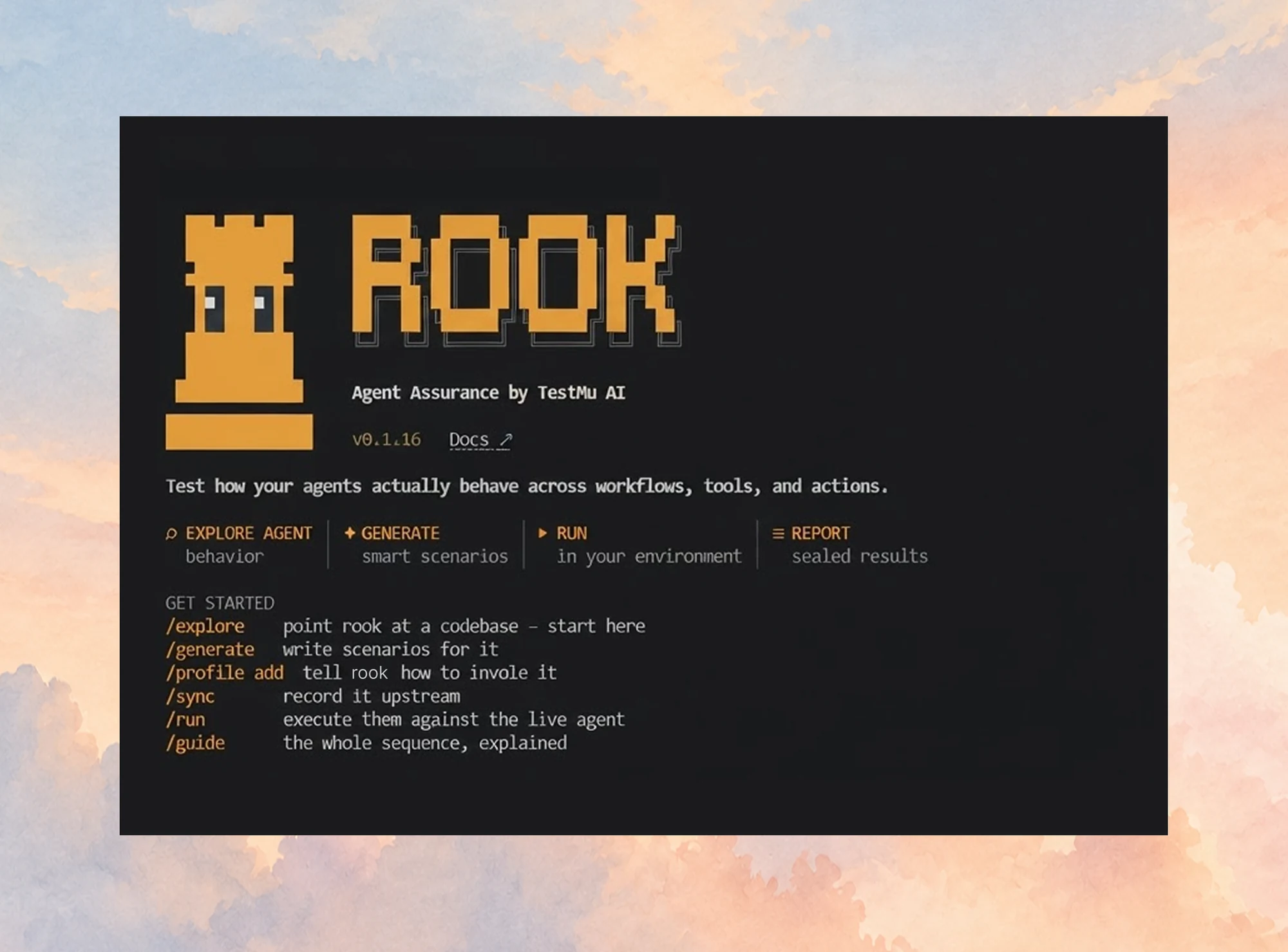
Test how your agents actually behave across workflows, tools, and actions. Catch failures and vulnerabilities before they ship.
npm install -g @testmuai/rook@latest
When the Linux Foundation formed the Agentic AI Foundation on December 9, 2025, with Anthropic's Model Context Protocol as a founding project, its formation announcement counted more than 10,000 published MCP servers. The Agent2Agent protocol reached its first stable version on March 12, 2026, per the A2A v1.0.0 release, so an A2A vs MCP comparison can now rest on two current specifications.
The Agentic AI Foundation took in A2A as a hosted project on August 17, 2026, according to its post A2A joins AAIF, so both protocols now have one neutral home. In A2A vs MCP terms, the difference is what each one connects. MCP links an agent to tools and data, and A2A links an agent to other agents it hands work to without seeing their internals.
Overview
MCP (Model Context Protocol) connects an AI application to the tools, resources and prompts a server exposes. A2A (Agent2Agent) connects one agent to another agent and hands it a task, while the remote agent's internal state, memory and tools stay hidden. The two work together: agents talk over A2A, and inside each agent MCP reaches its own tools.
Which Is Better, MCP or A2A?
- MCP for tool access: Use MCP when the other end is a tool or data source with a typed input your model can call directly. Each tool carries a JSON Schema for its inputs. Protocol-level session: no, since the 2026-07-28 revision, so every request carries its own protocol version.
- A2A for agent delegation: Use A2A when the other end is an agent that owns its own reasoning, tools and credentials. The remote agent answers a message with a stateful task that moves through states such as working, input required and completed. Server-initiated updates: yes, through push notifications to a client webhook.
- A2A Agent Card discovery: An A2A agent publishes an Agent Card, usually at /.well-known/agent-card.json, listing its skills, supported interfaces and security schemes, so a client agent can choose a peer without seeing the peer's code or tool list.
- MCP and A2A combined: MCP and A2A do not replace each other. The A2A documentation describes an agentic application that uses A2A to communicate with other agents, while inside, each agent uses MCP to work with its own tools and resources.
- A2A skills as MCP resources: Exposing A2A skills as MCP resources is partly possible. The A2A documentation says a remote agent can expose some skills as MCP-compatible resources, which works best when a skill is well defined and can be called in a tool-like, stateless way.
- Agent Assurance testing: TestMu AI's Agent Assurance tests the agent behind either protocol before release, invoking it through an HTTP endpoint, a command or an MCP tool. Native A2A support: not documented, so an A2A agent served over JSON-RPC or HTTP+JSON is invoked as an HTTP endpoint.
What Is the Difference Between MCP and A2A?
The Model Context Protocol standardizes the connection between an AI application and the systems it draws on, while A2A standardizes the connection between two agents that work on a task together. The MCP specification defines hosts (LLM applications), clients (connectors inside the host) and servers that offer tools, resources and prompts, all exchanging JSON-RPC 2.0 messages.
The A2A specification targets communication between independent, "potentially opaque" agent systems, which exchange information "without needing access to each other's internal state, memory, or tools." The A2A project's A2A and MCP comparison page sums up the split this way: "A2A is about agents partnering on tasks; MCP is more about agents using capabilities."
The two started at different companies. Anthropic open-sourced MCP on November 25, 2024, and Google launched A2A in April 2025 before the Linux Foundation took it on as a project on June 23, 2025, according to the A2A project launch release.
- MCP - a client gets a catalog: named tools with input schemas, readable resources and prompt templates, and its model decides what to call.
- A2A - a client gets a peer: a card of declared skills and an endpoint that accepts messages and returns tasks, with the peer's reasoning and tools kept private.
MCP vs A2A: Side-by-Side Comparison
Each row comes from the current specification text of the two protocols, MCP revision 2026-07-28 and A2A 1.0, except the release dates and the home row, which come from the GitHub releases and the foundations' announcements. What changed between A2A releases, including the Agent Card fields, is covered in A2A protocol v1.0.
| Attribute | MCP | A2A |
|---|---|---|
| What it connects | An AI application (host) to servers that expose tools, resources and prompts | A client agent to a remote agent whose internals it cannot see |
| Current version | 2026-07-28, a date-based identifier, per the MCP 2026-07-28 release of July 28, 2026 | 1.0, released March 12, 2026, with patch 1.0.1 on May 28, 2026 |
| Home | Agentic AI Foundation (Linux Foundation), a founding project since December 2025 | Linux Foundation project since June 2025; Agentic AI Foundation hosted project since August 2026 |
| Message format | JSON-RPC 2.0, UTF-8 encoded | JSON-RPC 2.0, gRPC or HTTP+JSON, plus custom bindings |
| Transports | stdio for a client-launched subprocess, Streamable HTTP for remote servers; HTTP+SSE is deprecated | HTTP(S) for JSON-RPC and REST, gRPC, Server-Sent Events for streaming; HTTPS or TLS required in production |
| Discovery | server/discover for versions, capabilities and identity; tools/list for tools | A JSON Agent Card, usually fetched from /.well-known/agent-card.json, or a registry or direct configuration |
| What gets advertised | Tools with JSON Schema inputs, resources and prompts | Skills, supported interfaces in order of preference, capabilities and security schemes |
| What one request returns | A tool result made of content blocks, with isError set on execution errors | A Task with an ID and a lifecycle, or a direct Message; outputs arrive as Artifacts made of Parts |
| Long-running work | The Tasks extension, which client and server must both opt into | A task lifecycle with 8 states in the core protocol |
| Getting updates | A JSON reply or a request-scoped SSE stream; tasks are polled by default | Polling with GetTask, SSE streaming, or push notifications to a client webhook |
| Server-initiated traffic | No server-initiated requests or connections; notifications travel over a connection the client opened | Push notification POSTs to a webhook URL the client registered |
| State between calls | No protocol-level session; each request carries its own protocol version | Stateful tasks; an optional context ID groups related tasks and messages |
| Authentication | Optional; OAuth 2.1 resource server over HTTP, credentials from the environment over stdio | Schemes declared in the Agent Card; credentials obtained out of band and sent with every request |
| Visibility of internals | Tool names, descriptions and input schemas are read by the model | Only declared skills; internal state, memory and tools stay private |
If the other side must push results to you later or keep its tools private, it is an agent, and A2A fits. If your own model should read the schema and fill in the call, it is a tool, and MCP fits.
How MCP and A2A Work on the Wire
Both protocols can carry JSON-RPC 2.0, but they model different things. MCP models a server as a list of callable features, and A2A models a conversation that produces tasks while the remote agent's working parts stay out of view.
MCP Tools, Resources and Prompts
An MCP server offers up to three kinds of feature, defined in the specification as:
- Tools - "functions for the AI model to execute", such as a booking API wrapped as a callable function.
- Resources - "context and data, for the user or the AI model to use", such as a policy document or a database view.
- Prompts - "templated messages and workflows for users", such as a reusable review or triage template.
The MCP tools page calls tools "model-controlled": the model finds and calls them on its own, guided by context and the user's prompt. A client lists them with tools/list and runs one with tools/call; how the model itself emits a structured call is covered in tool calling, and how to design the functions behind it in agent tools.
Failures come back in two forms. A protocol error means the request itself was malformed, while a tool execution error is reported inside the result with isError: true so the model can read it and correct its next attempt.
The 2026-07-28 revision, per its changelog, removed the initialize handshake, so every request now states its protocol version and the client's capabilities inside _meta, and servers MUST implement a new server/discover call. It also moved tasks out of the core protocol into an official extension and reclassified the old HTTP+SSE transport as Deprecated. The rest of the revision, and what it changes for API design, is covered in MCP vs API.
How an A2A Agent Advertises Itself
Every A2A server MUST publish an Agent Card, a JSON document stating the agent's identity, capabilities, skills, service endpoint and authentication requirements. Clients usually fetch it from /.well-known/agent-card.json, though a registry, a catalog or direct configuration also works.
The card lists supportedInterfaces with the preferred one first and names the securitySchemes a client must use. It MAY be signed with JSON Web Signature (RFC 7515), so a client can confirm the card is authentic and unaltered before trusting the endpoint in it.
A2A Tasks, Messages and Artifacts
A client sends a message and receives either a Task that tracks the processing or a direct Message in reply. A Message is one turn with a role of user or agent, and its content is made of Parts: text, file references or structured data.
A Task is stateful, has a unique ID and moves through a defined lifecycle. What the agent produces, such as a document, an image or structured data, comes back as Artifacts that are also built from Parts.
- JSON-RPC binding - JSON-RPC 2.0 over HTTP(S), with PascalCase method names such as
SendMessage,GetTaskandCancelTask, and SSE for streaming. - gRPC binding - the same operations as gRPC methods, over TLS in production.
- HTTP+JSON binding - REST endpoints such as
POST /message:sendandGET /tasks/{id}, withapplication/a2a+jsonas the recommended content type.
Long-Running Tasks in MCP and A2A Compared
MCP also has a model for long-running work. Since the 2026-07-28 revision it lives in the MCP Tasks extension, which lets a server "return a durable handle instead of blocking," so a client can poll for progress, supply input mid-flight and fetch the result after reconnecting. Unlike A2A's lifecycle, it works only when client and server both opt in.
To put the two models side by side, the script below was run on 2026-11-25 against the official Python SDKs, mcp 2.3.0 and a2a-sdk 1.3.1, in a fresh virtual environment on Python 3.14.6 (install with pip install mcp==2.3.0 a2a-sdk==1.3.1). It starts an in-process MCP server with one tool, lists and calls that tool, builds an A2A Agent Card with the SDK's own types, and prints the task states each SDK defines.
import asyncio
import json
from importlib.metadata import version

from google.protobuf.json_format import MessageToDict
from mcp import Client
from mcp.server.mcpserver import MCPServer
import mcp_types
from a2a.types import (
    AgentCapabilities,
    AgentCard,
    AgentInterface,
    AgentSkill,
    TaskState,
)
from a2a.utils.constants import (
    AGENT_CARD_WELL_KNOWN_PATH,
    PROTOCOL_VERSION_CURRENT,
    TERMINAL_TASK_STATES,
    INTERRUPTED_TASK_STATES,
)

WIDTH = 58
lines = []


def out(text=""):
    for line in str(text).splitlines() or [""]:
        if len(line) > WIDTH:
            raise SystemExit(
                f"line too long ({len(line)}): {line}")
        lines.append(line)
        print(line)


def rule(title):
    out("")
    out(f"== {title} ".ljust(WIDTH, "="))


# ---------------- Part 1: MCP ----------------
server = MCPServer("flight-tools", version="0.1.0")


@server.tool(description="Look up a flight's status")
def get_flight_status(flight_id: str) -> str:
    fake_db = {"TD-204": "delayed", "TD-310": "on_time"}
    return fake_db.get(flight_id, "not_found")


async def mcp_part():
    async with Client(server) as client:
        rule("MCP: what the client sees")
        out(f"mcp SDK {version('mcp')}")
        ver = client.protocol_version
        out(f"protocol version: {ver}")
        listed = await client.list_tools()
        data = listed.model_dump(
            by_alias=True, exclude_none=True, mode="json"
        )
        tools = []
        for t in data["tools"]:
            tools.append({
                "name": t["name"],
                "description": t.get("description"),
                "inputSchema": {
                    "type": t["inputSchema"]["type"],
                    "properties": {
                        k: {"type": v.get("type")}
                        for k, v in t["inputSchema"]
                        ["properties"].items()
                    },
                    "required": t["inputSchema"].get(
                        "required", []),
                },
            })
        out("tools/list result (trimmed):")
        out(json.dumps({"tools": tools}, indent=1))
        other = sorted(k for k in data if k != "tools")
        out("other result keys: " + ", ".join(other))
        called = await client.call_tool(
            "get_flight_status", {"flight_id": "TD-204"}
        )
        text = called.content[0].text
        out("tools/call get_flight_status(TD-204):")
        out(f"  content[0].text = {text!r}")
        out(f"  isError = {called.is_error}")


asyncio.run(mcp_part())

# ---------------- Part 2: A2A ----------------
skill = AgentSkill(
    id="rebook_flight",
    name="Rebook flight",
    description="Move a traveler to another flight",
    tags=["travel"],
)
card = AgentCard(
    name="Travel Desk Agent",
    description="Books and changes business trips",
    version="0.1.0",
    supported_interfaces=[
        AgentInterface(
            url="https://travel-desk.internal/a2a",
            protocol_binding="JSONRPC",
            protocol_version=PROTOCOL_VERSION_CURRENT,
        )
    ],
    capabilities=AgentCapabilities(
        streaming=True, push_notifications=False
    ),
    default_input_modes=["text/plain"],
    default_output_modes=["text/plain"],
    skills=[skill],
)

rule("A2A: the Agent Card a client fetches")
out(f"a2a-sdk {version('a2a-sdk')}")
out(f"served at: {AGENT_CARD_WELL_KNOWN_PATH}")
out(json.dumps(MessageToDict(card), indent=1))

# ---------------- Part 3: task states ----------------
rule("Task states each SDK defines")
mcp_states = list(mcp_types.TaskStatus.__args__)
out("MCP Tasks extension (opt-in):")
out("  " + ", ".join(mcp_states[:3]) + ",")
out("  " + ", ".join(mcp_states[3:]))
a2a_states = [
    n for n in TaskState.keys()
    if n != "TASK_STATE_UNSPECIFIED"
]
out(f"A2A core TaskState ({len(a2a_states)} values):")
for n in a2a_states:
    tag = ""
    if TaskState.Value(n) in TERMINAL_TASK_STATES:
        tag = "  terminal"
    elif TaskState.Value(n) in INTERRUPTED_TASK_STATES:
        tag = "  interrupted"
    out(f"  {n}{tag}")

out("")
out(f"max line length: {max(len(x) for x in lines)}")
Output of that run (the Agent Card's input and output mode lists are cut for length; every other line is as printed):
== MCP: what the client sees =============================
mcp SDK 2.3.0
protocol version: 2026-07-28
tools/list result (trimmed):
{
 "tools": [
  {
   "name": "get_flight_status",
   "description": "Look up a flight's status",
   "inputSchema": {
    "type": "object",
    "properties": {
     "flight_id": {
      "type": "string"
     }
    },
    "required": [
     "flight_id"
    ]
   }
  }
 ]
}
other result keys: _meta, cacheScope, resultType, ttlMs
tools/call get_flight_status(TD-204):
  content[0].text = 'delayed'
  isError = False

== A2A: the Agent Card a client fetches ==================
a2a-sdk 1.3.1
served at: /.well-known/agent-card.json
{
 "name": "Travel Desk Agent",
 "description": "Books and changes business trips",
 "supportedInterfaces": [
  {
   "url": "https://travel-desk.internal/a2a",
   "protocolBinding": "JSONRPC",
   "protocolVersion": "1.0"
  }
 ],
 "version": "0.1.0",
 "capabilities": {
  "streaming": true,
  "pushNotifications": false
 },
 "skills": [
  {
   "id": "rebook_flight",
   "name": "Rebook flight",
   "description": "Move a traveler to another flight",
   "tags": [
    "travel"
   ]
  }
 ]
}

== Task states each SDK defines ==========================
MCP Tasks extension (opt-in):
  working, input_required, completed,
  failed, cancelled
A2A core TaskState (8 values):
  TASK_STATE_SUBMITTED
  TASK_STATE_WORKING
  TASK_STATE_COMPLETED  terminal
  TASK_STATE_FAILED  terminal
  TASK_STATE_CANCELED  terminal
  TASK_STATE_INPUT_REQUIRED  interrupted
  TASK_STATE_REJECTED  terminal
  TASK_STATE_AUTH_REQUIRED  interrupted

max line length: 58- The MCP client learned a schema - the tool arrived with a JSON Schema
inputSchema, and the call came back as content blocks withisErrorfalse. Beside the tool list, the 2026-07-28 result also carriedresultType,ttlMsandcacheScope. - The A2A card has no tools - it advertises a skill, one interface (the JSONRPC binding at protocol version 1.0) and capabilities such as streaming, and nothing about how
rebook_flightworks inside. - Limits of the run - the in-process MCP client dispatches without JSON-RPC framing, so the printed JSON is the result object rather than the full envelope. The flight data is a Python dict, the agent URL uses the reserved
.internaldomain, and no network or model call was made.
The two state sets line up as follows:
| MCP Tasks extension | A2A TaskState | How the specs treat it |
|---|---|---|
| No equivalent | TASK_STATE_SUBMITTED | A2A only |
working | TASK_STATE_WORKING | In progress in both |
input_required | TASK_STATE_INPUT_REQUIRED | Waiting for the client; an interrupted state in A2A |
completed | TASK_STATE_COMPLETED | Terminal in both |
failed | TASK_STATE_FAILED | Terminal in both |
cancelled | TASK_STATE_CANCELED | Terminal in both; A2A 1.0 standardized the American spelling |
| No equivalent | TASK_STATE_REJECTED | Terminal, A2A only |
| No equivalent | TASK_STATE_AUTH_REQUIRED | Interrupted, A2A only |
In A2A, a blocking SendMessage MUST wait until the task reaches a terminal state or an interrupted one (input required or auth required) before returning. A client can instead poll with GetTask, stream over SSE when the card sets capabilities.streaming to true, or register a webhook for push notifications. MCP Tasks are polled by default, and a client can rely on notifications instead, sent over a connection the client opened, only when the server supports them.
When Should You Use MCP, A2A or Both?
Decide by what sits on the other end of the connection. A function with a typed input belongs behind MCP, and an agent that owns its reasoning, tools and credentials belongs behind A2A.
When Is MCP Enough?
- One agent, your own systems - the agent calls your APIs, databases and files, and no other agent needs to delegate work to it.
- Typed inputs and outputs - each operation can be described with a JSON Schema, which is what
tools/listhands the model. - Local tools - a stdio server launched as a subprocess takes its credentials from the environment, with no OAuth setup.
The A2A documentation draws the same line from the other side: a skill suits a tool interface when it is "well-defined" and "can be called in a tool-like, stateless way."
When Do You Need A2A?
- Another team's or vendor's agent - you need its result, and its owners may not expose its prompts, tools or memory.
- Multi-turn or paused work - the remote side may need more input or a separate sign-in mid-task, which the input required and auth required states express.
- Results that arrive later - the client registers a webhook and the agent pushes updates when the work finishes.
Using MCP and A2A Together
The A2A comparison page describes the combined design directly: "An agentic application might use A2A to communicate with other agents. Inside, each agent uses MCP to work with its own tools and resources."
The page's worked example is an auto repair shop: a customer or their assistant agent reaches the Shop Manager agent over A2A. The Mechanic agent calls MCP tools such as scan_vehicle_for_error_codes and asks a Parts Supplier agent for parts over A2A.
In the run above, the Travel Desk Agent would advertise rebook_flight on its Agent Card for other agents, and behind that skill it would call get_flight_status over MCP. Where agents, roles and handoffs fit in a larger design is covered in multi-agent AI systems.
Security Differences Between MCP and A2A
The MCP specification states that tools "represent arbitrary code execution and must be treated with appropriate caution," and that tool annotations are untrusted unless they come from a trusted server. Hosts must obtain explicit user consent before invoking any tool, and the tools page adds that a human SHOULD be able to deny tool invocations. The spec also says MCP "cannot enforce these security principles at the protocol level," so consent and authorization flows belong to the application.
Authorization in MCP is optional. A protected HTTP server acts as an OAuth 2.1 resource server, MUST check that each access token was issued for it as the audience, and MUST NOT accept or pass through any other token.
A2A treats agents as standard enterprise applications: identity travels in the transport layer (HTTP headers or gRPC metadata), not inside A2A messages, and production deployments MUST use HTTPS or TLS. The client authenticates every request with a scheme the Agent Card declares, using credentials obtained out of band.
The A2A spec also warns that credentials passed in-band through a chain of agents are exposed to each agent in that chain. Push notifications add a path the agent initiates, so agents MUST send credentials with webhook calls and SHOULD validate webhook URLs against server-side request forgery (SSRF).
Against the OWASP Top 10 for Agentic Applications for 2026, each protocol's risks map most directly to different entries. The mapping below is this article's own reading of the two specs, not an assignment OWASP makes:
| OWASP entry | Protocol | Where it shows up |
|---|---|---|
| ASI02 Tool Misuse | MCP | A model-controlled tool runs code with whatever access the server holds |
| ASI04 Agentic Supply Chain Vulnerabilities | MCP | Third-party servers and their tool descriptions enter the agent's context |
| ASI03 Identity & Privilege Abuse | A2A | Credentials passed in-band are visible to every agent in the chain |
| ASI07 Insecure Inter-Agent Communication | A2A | Unsigned Agent Cards and unauthenticated webhooks; OWASP's incident line reads "Spoofed inter-agent messages misdirected entire clusters." |
Both protocols carry untrusted text into a model's context: tool results on the MCP side, peer messages and artifacts on the A2A side. Instructions hidden in either one are indirect prompt injection, and MCP-specific attacks such as tool poisoning and token passthrough are covered in MCP security. When a request crosses an A2A hop, AI agent tracing is how you follow it to the agent that acted on it.
Testing Agents That Use MCP and A2A
Protocol conformance is a test job of its own. Checking an MCP server's schemas, errors and transports is MCP testing, and checking an Agent Card, task states and push delivery against the spec is A2A protocol testing.
A conformant protocol layer still does not show whether the agent behind it did the work it accepted, such as moving the traveler to a new flight. TestMu AI's Agent Assurance runs that behaviour check before release; it is not a runtime guardrail and blocks nothing in production. It reaches the agent under test through a profile, and the Rook CLI README lists three ways to invoke one: an HTTP endpoint, a command or an MCP tool.
Reviewable hook scripts run the conversation: prepare, open, execute, close and collect, of which only execute is required, as Rook CLI profiles and hooks describes. For the two protocols, that works out as follows:
- MCP as the target - an MCP tool can itself be the agent under test, called by the profile's generated
executehook. - MCP as the evidence - a judge can confirm an effect through a read-only query tool you approve on an MCP server. That server can be a local stdio server or a remote server reached over Streamable HTTP (supported since Rook CLI 0.1.14). A
collecthook that fetches the record, or a read-only status endpoint, are the documented alternatives. - A2A agents - no native A2A support is documented. An A2A agent served over the JSON-RPC or HTTP+JSON binding is invoked through the HTTP endpoint route, with an
executehook that sends the message and returns the agent's reply. - Opaque internals - A2A hides a remote agent's tools, so criteria about its tool calls can be checked only when the hook returns the calls it observed. When calls are not observable, those criteria come back as Unable to Verify.
- Routers and sub-agents - each independently invokable agent gets its own profile and suite. A sub-agent reachable only through a router is tested through the router, and a handoff can be judged only if the profile hands back the calls that prove it happened. The handoff side is covered in agent handoff testing.
- Adversarial scenarios - Agent Assurance maps them to entries of the OWASP Top 10 for Agentic Applications (2026), among other standards, in categories such as
hijackinganddata_exfiltration. Any control without a mapped scenario is left unverified, and a run counts as evidence only for the entries it exercised.
Rook CLI installs with npm install -g @testmuai/rook@latest, a route that requires Node.js 20 or later. With Homebrew or the shell installer you need no Node, and npx @testmuai/rook-skill, the skill installer, requires Node.js 22 or later.
Rook CLI runs on macOS and Linux, and on 64-bit Windows through npm or WSL. A free trial gives you 4,000 credits over 14 days, and plan details are on the pricing page.

A2A vs MCP: Which Should You Start With?
If your agent only calls your own tools and data, start with an MCP server built against the 2026-07-28 revision, and publish an A2A Agent Card when another team's agent needs to hand yours work. Both specifications behind the A2A vs MCP choice moved in 2026: A2A 1.0 shipped in March and MCP's 2026-07-28 revision in July.
To test the agent behind either protocol before release, start with the Agent Assurance overview.
npm install -g @testmuai/rook@latest, or for a full walkthrough of the product.Author

Samyak Goyal
Blogs: 53

Samyak Goyal is a Senior Member of Technical Staff at TestMu AI engineering Kane CLI, the command-line tool that runs browser automation from the terminal, where a flow described in natural language executes in a real Chrome browser and returns pass or fail with shareable proof. He is a backend engineer with 4+ years of experience, previously an SDE at Innovaccer, where he built APIs, introduced Kafka, and cut deployment from weeks to hours. Samyak also builds multi-agent systems, skill-orchestration frameworks, and a personal copilot that indexes 200+ microservice repositories.
Reviewer

Sirajuddin Khan
Reviewer
Sirajuddin Khan is Vice President of Product Management at TestMu AI, where he drives the company's agentic AI product strategy, building a suite of autonomous agents that includes Agentic Browsers and Agentic Visual Testing and shifting the unit of work from test execution to autonomous outcomes. One of the company's earliest product leaders, he has owned the roadmap for the high-performance execution cloud and grew the cross-browser testing products from early adoption to market leadership. He brings over a decade of experience across SaaS, B2B, and eCommerce, with earlier product roles at Wydr and ShopClues, where his catalog and search work cut delivery SLAs and lifted seller activity. Sirajuddin holds an MBA in Information Technology from Sikkim Manipal University and a B.Tech in Computer Science Engineering from Maharshi Dayanand University.


MCP vs A2A FAQs
Did you find this page helpful?
More Related Blogs

TestMu AI forEnterprise
Get access to solutions built on Enterprise
grade security, privacy, & compliance
- Advanced access controls
- Advanced data retention rules
- Advanced Local Testing
- Premium Support options
- Early access to beta features
- Private Slack Channel
- Unlimited Manual Accessibility DevTools Tests