

Power Your Software Testing with AI Agents and Cloud
The Native AI-Agentic Cloud Platform to Supercharge Quality Engineering. Test Intelligently and Ship Faster.


- TestMu AI (Formerly LambdaTest)
- /
- Learning Hub
- /
- What Is a Manual QA Tester: Roles, Skills, and Career Path
What Is a Manual QA Tester: Roles, Skills, and Career Path
Explore the role of a manual QA tester, essential skills, top testing tools, career path, and steps to become a successful QA professional.
Last Updated on:
Quality assurance is an important step in software development, and a manual QA tester plays a crucial role in this process. A QA manual tester is a professional responsible for testing software applications manually.
Unlike automated testing, which involves writing test scripts, manual testing involves human observation and intervention to identify issues in the software. The primary goal is to ensure the product meets quality standards before it reaches users.
TL;DR
A manual QA tester is a professional who validates software quality by executing test cases without automation tools. To become one, you must master software development concepts, learn manual testing fundamentals, build basic technical skills, and gain hands-on experience using tools like TestMu AI for live testing and Jira for defect tracking.
What Is a QA Manual Tester?
- Role definition: A manual QA tester is a professional who validates software quality by executing test cases without automation tools to ensure applications meet functional, usability, and performance requirements.
How to Become a QA Manual Tester
- Software development concepts: Aspiring testers must study the Software Development Life Cycle, focusing on Agile and Waterfall models, to understand how applications move from requirements to release.
- Manual testing fundamentals: Testers need a strong foundation in functional, regression, integration, and usability testing, alongside practice in designing test cases and logging defects.
- Basic technical skills: Gaining working knowledge of HTML, CSS, HTTP protocols, and SQL helps testers validate user interface behavior, inspect network calls, and confirm database accuracy.
- Practical experience: Applying skills through internships, sample projects, or testing demo applications helps build hands-on experience in test documentation, bug tracking, and developer collaboration.
- Professional certifications: Earning credentials like ISTQB Foundation Level, CAST, CSTE, or the TestMu AI Manual Testing Certification validates theoretical knowledge and improves visibility to employers.
- QA communities: Participating in forums, LinkedIn groups, Reddit, or the TestMu AI Community allows testers to exchange practical knowledge and stay updated on industry trends.
- Entry-level roles: Starting in positions like Junior QA Tester, QA Intern, or QA Trainee provides real-world experience on live projects to continue developing testing skills.
Essential Manual Testing Tools
- Cloud-based live testing: TestMu AI allows teams to perform manual testing of websites and mobile applications on real browsers, operating systems, and devices hosted on the cloud.
- Defect tracking: Jira is a widely used issue and defect tracking system that helps log bugs, manage workflows, monitor status, and link defects to requirements.
- Team communication: Slack enables real-time communication of test updates, defects, and issues among quality assurance, development, and project teams.
- API testing: Postman supports manual API testing by enabling request construction, response validation, and environment configurations while documenting test interactions.
- Security testing: OWASP ZAP aids in manual web testing by capturing and inspecting HTTP traffic to identify common vulnerabilities during exploratory QA sessions.
What Is a Manual QA Tester?
A manual QA tester is a professional who performs manual testing, which means executing test cases without automation to ensure software meets functional, usability, and performance requirements.
They design test scenarios, verify acceptance criteria, and maintain test artifacts like test cases, bug reports, and traceability matrices. Manual testers collaborate with developers and stakeholders to clarify requirements, perform regression testing and exploratory testing, and ensure software quality before release.
What Does a QA Manual Tester Do?
A QA manual tester creates and runs test cases, identifies and tracks defects. They verify fixes and document results to ensure software meets requirements and works as expected.
Here are the responsibilities of a manual QA tester:
- Test Planning and Analysis: The tester reviews functional and non-functional requirements to identify testable components. A test strategy is created, defining the scope, priorities, types of software testing, entry and exit criteria, resources, and timelines to ensure effective testing.
- Writing Test Scenarios and Test Cases: Requirements are translated into structured test scenarios and test cases with preconditions, execution steps, expected results, and postconditions. Best practices include maintaining traceability, grouping tests by module, and using templates to ensure consistency and coverage.
- Test Execution: Test cases are executed for functional, system, integration, and regression testing. Exploratory testing is used to uncover defects beyond predefined scenarios. Actual results are compared against expected results, and deviations are noted for analysis.
- Defect Management: Defects are logged with reproduction steps, severity, and expected versus actual behavior. They are classified, tracked, and monitored using tools like Jira until resolution. Collaboration with development teams ensures accurate defect verification.
- Reporting and Documentation: Test execution is documented, and regular status updates are provided. Daily logs include executed tests, defects identified, and any blocked scenarios. Test reports consolidate coverage, defect trends, risk areas, and release readiness recommendations.

Note: Run manual tests across 3000+ real desktop & mobile environments. Try TestMu AI Now!
What Are the Skills of a Manual Tester?
A manual software tester needs SDLC knowledge, manual testing, SQL, and defect tools. They also need analytical thinking, attention to detail, communication, problem-solving, teamwork, and adaptability.
Here are the essential skills every QA manual tester should have:
Key Technical Skills:
- SDLC and Testing Methodologies: Understanding software development and testing life cycles, including functional, regression, integration, and performance testing, ensures structured, consistent, and aligned testing.
- Manual Testing Principles: Knowledge of test case design, planning, exploratory testing, and structured execution forms the foundation of effective QA work.
- Test and Defect Management Tools: Proficiency in bug tracking tools like Jira or Bugzilla enables efficient test planning, bug logging, tracking, and collaboration with development teams.
- SQL and Database Testing: Basic SQL knowledge allows verification of backend data integrity and accurate application-database interactions during functional testing.
- Test Documentation: Ability to create clear, detailed test cases, bug reports, and summary reports ensures traceability, consistency, and effective communication of test results.
- Agile and Waterfall Models: Familiarity with SDLC models allows integration of testing within iterative and linear workflows, supporting continuous collaboration and quality assurance.
- User-Focused Testing: Evaluating software from an end-user perspective helps identify usability issues alongside functional correctness.
Key Soft Skills:
- Analytical Thinking: Ability to analyze complex software, interpret test results logically, and identify defects efficiently.
- Attention to Detail: Detecting subtle defects, inconsistencies, and UI bugs requires methodical observation and precision.
- Communication: Clear reporting of defects, test progress, and risks to developers, QA leads, and stakeholders facilitates prompt resolution.
- Problem-Solving: Identifying failures and root causes, and recommending solutions ensures defects are effectively addressed.
- Team Collaboration: Working with cross-functional teams, providing constructive feedback, and aligning with project goals supports quality delivery.
- Documentation Discipline: Maintaining detailed records of tests, defects, and test data ensures traceability and supports knowledge sharing.
- Time Management: Prioritizing tasks, managing coverage, and meeting deadlines ensures timely test execution within project schedules.
- Adaptability and Continuous Learning: Staying updated with new manual testing tools, techniques, and workflows supports evolving QA requirements and professional growth.
What Are the Best Manual Testing Tools for QA?
Top manual testing tools for QA are TestMu AI for cross-browser and real device testing, Jira for bug tracking, Slack for communication, Postman for API testing, and OWASP ZAP for security testing.
Here are some of the best manual testing tools every manual QA tester can use:
- TestMu AI: It is a cloud-based testing platform that allows teams to perform live testing (manual testing) of websites or mobile applications on real browsers, operating systems, and devices hosted on the cloud.
- Browser and OS Combinations: Run tests on multiple browsers and operating systems to ensure cross-platform compatibility.
- Real Device Cloud: Test websites and mobile applications on a real device cloud of Android and iOS devices to check functionality, compatibility and performance.
- Real-Time Debugging: Use built-in developer tools to inspect and troubleshoot issues during live test sessions.
- Project Management: Organize test sessions, switch between project versions, and save progress within the testing environment.

Features:
To get started, head over to this real-time web browser testing guide.
- Jira: Widely used issue and defect tracking system for logging bugs, managing workflows, monitoring status, and linking defects to requirements or test cases.
- Slack: Enables real-time communication of test updates, defects, and issues among QA, development, and project teams.
- Postman: Interface for manual API testing, enabling request construction, response validation, and environment configurations while documenting test interactions.
- ZAP (OWASP ZAP): A security-focused tool aiding in manual web testing by capturing and inspecting HTTP traffic, identifying common vulnerabilities during exploratory QA sessions.
How to Become a Manual QA Tester?
To become a manual tester, learn SDLC, manual testing, and basic HTML/CSS/SQL. Use manual testing tools, earn certifications, join communities and apply for entry-level tester roles.
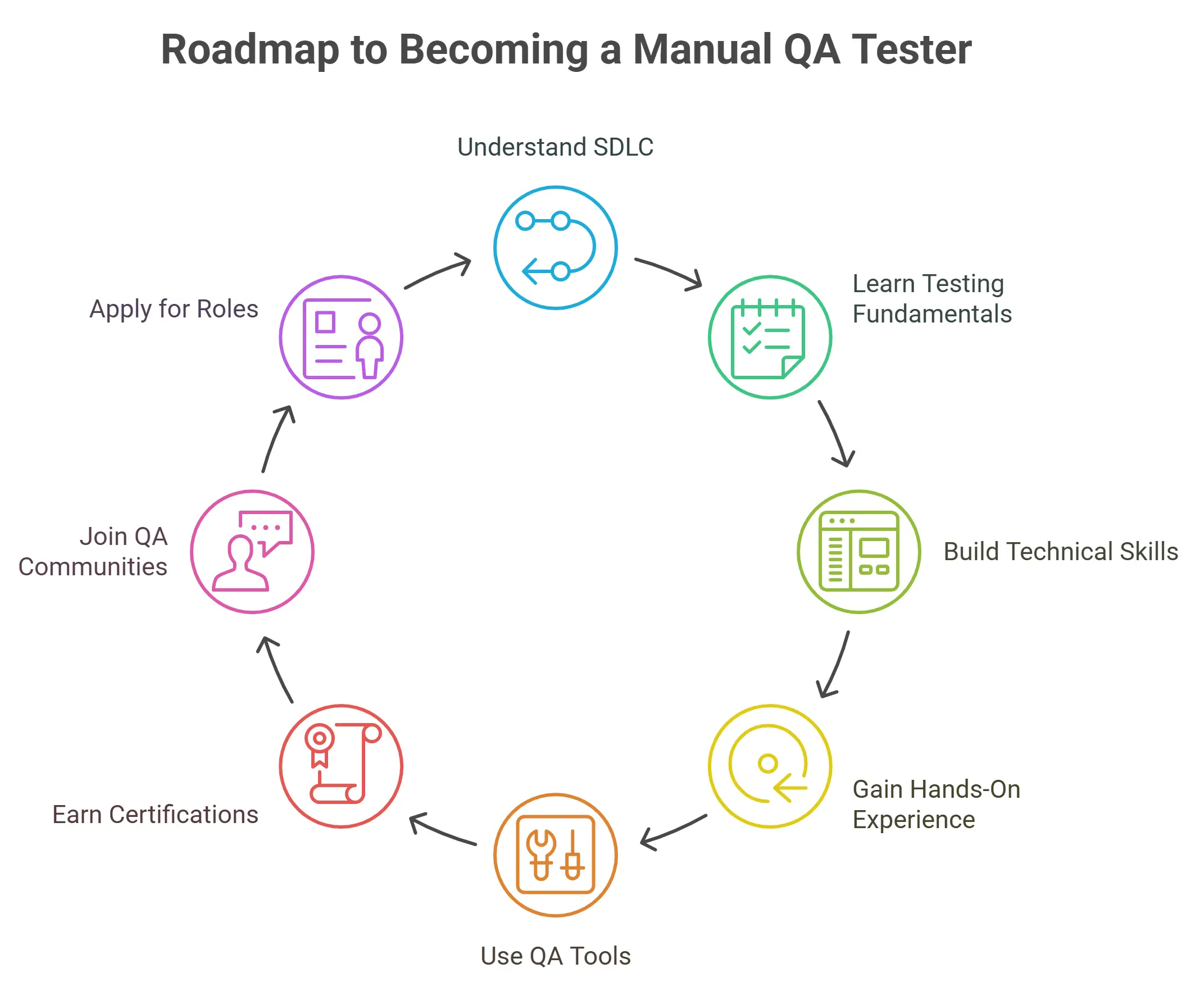
Here’s a roadmap to begin a career as a manual QA tester:
- Understand Software Development Concepts: Learn how software is built and delivered, including the Software Development Life Cycle (SDLC) with a focus on Agile and Waterfall models. Understanding these frameworks helps coordinate testing with development tasks and timelines.
- Learn Manual Testing Fundamentals: Study testing types such as functional, regression, integration, and usability testing. Practice writing clear test cases, executing them accurately, and reporting defects in an organized manner.
- Build Basic Technical Skills: Gain foundational knowledge of HTML, CSS, HTTP protocols, and SQL. This understanding helps in verifying front-end functionality and validating backend data during testing.
- Gain Hands-On Experience: Apply knowledge gained through internships, open-source projects, or sample test cases for dummy applications. Focus on documenting tests, tracking bugs, and collaborating with developers.
- Get Proficient with QA Tools: Familiarize yourself with tools for test management, defect tracking, and cloud testing platforms such as TestMu AI for scalable testing.
- Earn Certifications: QA certifications like ISTQB Foundation Level, CAST, and CSTE demonstrate theoretical knowledge and practical skills, improving visibility to employers.
- Join QA Communities: Participate in forums, LinkedIn groups, or Reddit QA communities to stay updated on tools, practices, and job opportunities, and to expand professional networks.
- Apply for Entry-Level Roles: Start with positions like QA Intern, Junior QA Tester, or QA Trainee. These roles provide real-world experience and allow continued skill development on live projects.
For example, TestMu AI's test management platform helps teams handle growing test coverage by centralizing test cases and running them across multiple environments without maintaining local infrastructure.
Some platforms, including TestMu AI, also offer Manual Testing Certification that combines fundamentals with hands-on practice in real testing environments.
The TestMu AI Community, for example, allows testers to exchange practical knowledge, ask questions, and learn from discussions around real testing scenarios.

What Is the Career Path of a Manual QA Tester?
For manual QA testers, a career path depends on skill development, experience, and exposure to diverse projects. Advancement is less about tools and more about expertise, process knowledge, and leadership capability.
Here’s an overview of the typical career path for a manual QA tester:
- Growing into Senior Manual QA: With consistent performance and a deeper understanding of test design, defect management, and complex software, testers can progress to senior roles.
Responsibilities expand to mentoring juniors, reviewing test strategies, and ensuring quality across multiple modules or projects.
- Transitioning into Test Automation: Manual testers can leverage their testing experience to learn automation testing, testing frameworks, and CI/CD integration. This allows them to design automated test cases, maintain test suites, and improve test coverage efficiency.
You can also refer to this guide on how to move from manual testing to automation as part of your career progression.
- Moving into QA Leadership or Product Quality Roles: Experienced QA professionals can transition into leadership positions, such as QA Lead, Test Manager, or Product Quality Analyst.
These roles focus on strategic planning, process improvement, cross-team coordination, and ensuring product quality at an organizational level.
Each of those steps now has to be planned against a market that has already changed. In this TestMu Conf 2026 session, Rahul Parwal argues in Productize Yourself - AI Proof Yourself that AI is competing with you, layoffs are normal, junior hiring is slowing down, and resumes are dead as a signal.

Conclusion
The role of a manual QA tester remains relevant in modern software development. While automation is widely used, manual testing is still essential for areas that require human judgment, exploratory testing, and direct validation of user experience.
Manual QA testing can offer a stable and long-term career for professionals with strong attention to detail, analytical thinking, and communication skills. When combined with sound technical knowledge, these skills help testers contribute to the quality, reliability, and usability of software across industries.
Citations
- Quality Assurance and Testing Strategies of Quality Engineers in Software Product Development: https://www.researchgate.net/publication/396573375
Author

Salman Khan
Blogs: 138


Salman is a Test Automation Evangelist and Community Contributor at TestMu AI, with over 6 years of hands-on experience in software testing and automation. He has completed his Master of Technology in Computer Science and Engineering, demonstrating strong technical expertise in software development, testing, AI agents and LLMs. He is certified in KaneAI, Automation Testing, Selenium, Cypress, Playwright, and Appium, with deep experience in CI/CD pipelines, cross-browser testing, AI in testing, and mobile automation. Salman works closely with engineering teams to convert complex testing concepts into actionable, developer-first content. Salman has authored 120+ technical tutorials, guides, and documentation on test automation, web development, and related domains, making him a strong voice in the QA and testing community.
Reviewer

Rajas Nawar
Reviewer
Rajas Nawar is a Community Contributor at TestMu AI (formerly LambdaTest), where he authors software-testing content for QA engineers and testers. His articles cover black box testing, state transition testing, CI/CD test case templates, and software-testing interview questions, giving testing teams practical guides and ready-to-use templates for their quality assurance work.


Manual QA Tester FAQs
Did you find this page helpful?
More Related Learning Hubs
TestMu AI forEnterprise
Get access to solutions built on Enterprise
grade security, privacy, & compliance
- Advanced access controls
- Advanced data retention rules
- Advanced Local Testing
- Premium Support options
- Early access to beta features
- Private Slack Channel
- Unlimited Manual Accessibility DevTools Tests