

Power Your Software Testing with AI Agents and Cloud
The Native AI-Agentic Cloud Platform to Supercharge Quality Engineering. Test Intelligently and Ship Faster.


- TestMu AI (Formerly LambdaTest)
- /
- Blog
- /
- The 30-Day Agentic E2E Test Automation Playbook
The 30-Day Agentic E2E Test Automation Playbook
A day-by-day plan to roll out agentic E2E test automation: baseline your release-gating journeys, author self-healing tests, gate every PR, and prove ROI with four metrics.
Last Updated on:
Agentic E2E testing hands the authoring, execution, and repair of end-to-end tests to AI agents, while humans keep intent, review, and release sign-off. A coding agent can merge nine feature PRs in a week, and the suite guarding them has to keep that pace.
In PwC's AI Agent Survey of 308 US executives, 79% said AI agents are already being adopted in their companies, and 66% of adopters reported measurable value through increased productivity.
This E2E test automation playbook covers what changes, the five prerequisites to settle before day 1, four one-week phases from baseline to hardening, the product that runs each phase, and the four metrics that prove it worked.
TL;DR
Agentic E2E test automation puts AI agents in charge of authoring, running, and maintaining end-to-end tests while humans own intent and sign-off. This playbook rolls it out in 30 days on a platform like TestMu AI: four one-week phases, each closed by a measurable exit gate before the next begins.
- Days 1-7, baseline - Pick 5 to 10 release-gating journeys, record authoring time, run time, flake rate, and triage time, and assign one owner per journey before any test is generated.
- Days 8-14, author - Turn PRDs and tickets into plain-English tests with API and database checks in the same flow, and switch on self-healing so UI changes become reviews, not rewrites.
- Days 15-21, gate - Wire the suite into every pull request and a nightly regression run, auto-split tests across parallel machines, and block merges on critical-path failures.
- Days 22-30, harden - Triage flaky tests weekly from failure-frequency data, run root cause analysis on every failure class, then scale, iterate, or reset based on the day-30 metrics review.
What Does Agentic E2E Testing Change?
Agentic E2E testing replaces hand-written scripts with AI agents that generate tests from requirements, resolve UI elements by intent rather than selectors, and repair themselves when the interface changes.
The human role shifts from writing and fixing code to defining journeys, reviewing heals, and owning release gates. AI E2E testing tools that only generate scripts stop at authoring, while agentic testing systems also execute, heal, and triage. Cheaper intent-level tests also change the shape of a suite, which is the case for an agentic E2E testing pyramid.
QA is one of the few functions where agentic value is directly countable: hours of scripting, hours of triage, and hours of suite wall-clock time.
Three things change in practice:
- Authoring - a PRD, Jira ticket, or recorded session becomes an executable test, so the people who know the requirements contribute coverage without writing framework code.
- Maintenance - self-healing re-anchors steps when the UI changes, turning "the suite is red, rewrite the selectors" into "approve or reject this heal".
- Verification depth - one flow validates UI, API, and database state together, which is where seam-level bugs hide in scripted suites split across tools.
None of this changes who is accountable. Test strategy, gate definitions, and release sign-off stay human, which is the same division of labor covered in our guide to AI agents for SDET workflows.
In this TestMu Conf 2026 session, Sachin Sharma argues the case for that redesign in The Last Manual Handoff: Redesigning End-to-End Testing in the Age of AI, starting from the observation that execution, regression, reporting, data creation, and test design are all automated, and yet end-to-end testing still feels painfully manual.

What Should Be in Place Before Day 1?
Five things, none of them tools: a named owner pair, a stable staging environment with seeded data, agreed journey-selection criteria, a four-column baseline sheet, and a shared definition of done.
Teams that skip this list spend week 1 arguing about scope instead of measuring it.
- A named owner pair - one QA lead who runs the rollout day to day, one engineering sponsor who can enforce the PR gate in week 3.
- A stable staging environment - with seeded test data and test accounts for every role you plan to cover. Agentic tests inherit the flakiness of the environment under them.
- Journey shortlist criteria - agree upfront that candidates are scored on revenue impact, authentication and permission risk, and defect history, so day 1 is selection, not debate.
- A baseline sheet - four columns: authoring time per journey, suite wall-clock time, flake rate, triage time per failure. Day 30 has no before-and-after without it.
- An agreed definition of done - each week ends at its exit gate, not at its calendar boundary. A week that misses its gate repeats before the next begins.
The plan assumes a web-first thin slice. Mobile, visual, and accessibility coverage join in days 22-30, once the pipeline is proven.
Days 1-7: Which Journeys Deserve a Release Gate?
The 5 to 10 journeys that would block a release if they broke: login and authentication, checkout or payment, role-based access, and your product's primary data-write workflow. Nothing is automated yet.
Week 1 produces a signed-off release-gate list with an owner and a success criterion per journey, plus the baseline sheet filled in.
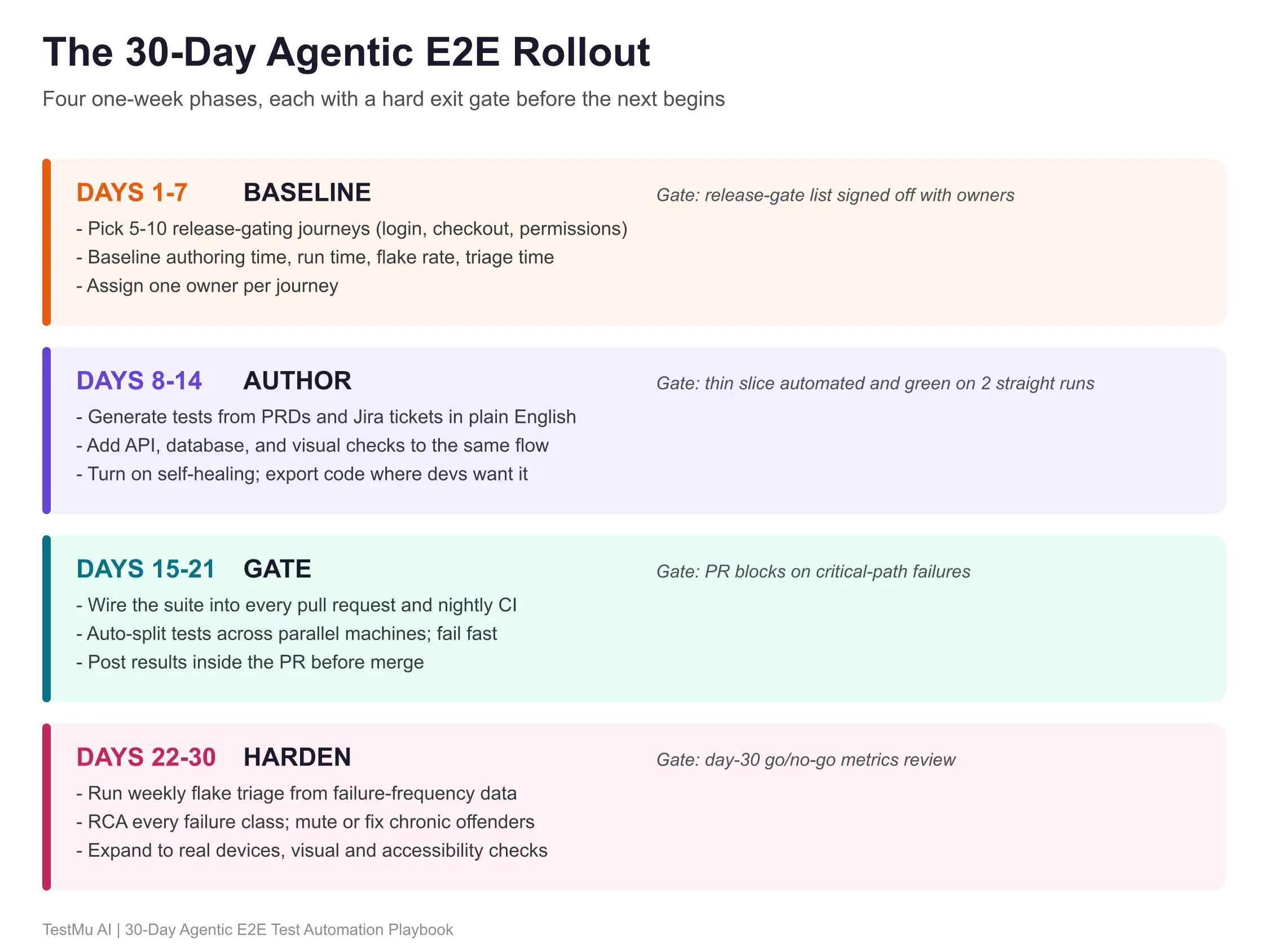
The week runs in five steps:
- Inventory every user journey that touches revenue, credentials, or persistent data.
- Score each against the shortlist criteria agreed before day 1; keep the top 5 to 10.
- Walk each journey manually once and record the baseline numbers while doing it.
- Assign one owner per journey; owners triage that journey's failures from week 3 onward.
- Get the list signed off by the engineering sponsor. This is the week's exit gate.
We walked this selection pass on the demo storefront we use throughout this playbook, captured below through a TestMu AI Browser Cloud session. For a store like this, the gate list writes itself: search, product page, cart, checkout, and login are the flows a release cannot break.

This is also the week to move test cases out of spreadsheets. TestMu AI's Test Manager generates structured test cases from PRDs, Jira tickets, or Figma files, with steps, expected results, and priority filled in, and its two-way Jira and Azure DevOps sync keeps every case linked to the requirement it covers. That traceability matrix is what turns your gate list from a document into release evidence: by day 30, every journey traces from requirement to test to run to defect.
Days 8-14: How Do You Author Tests That Survive UI Change?
Author from intent instead of selectors. Each journey on the gate list becomes a plain-English test: the ticket goes in, a reviewable test plan comes out, and every step resolves its element at run time.
The week's exit gate: the full thin slice automated and green on two consecutive runs.
On TestMu AI this is KaneAI, a GenAI-native testing agent that turns PRDs, tickets, recordings, and even screenshots into executable tests. Three capabilities carry this week:
- Multi-layer flows - a single test can click through the UI, validate the API response, and check the database write, so the checkout journey is verified end to end rather than surface-only.
- Self-healing - when a rename or DOM change would break a step, smart element detection re-anchors it and logs the heal for review, which is what keeps week 2's tests green in week 4.
- Multi-framework export - generated tests export to Selenium, Playwright, Cypress, or Appium, so automation engineers keep code ownership and nothing locks in.
Developers who live in the terminal get the same engine through Kane CLI, which runs natural-language objectives against a real Chrome browser and stores tests as markdown files (test.md) committed next to the feature code. That matters for teams using AI coding agents: the agent that wrote the feature can call Kane CLI, get an evidence-backed pass or fail on the rendered UI, and commit the test.md as durable regression coverage.
Teams that prefer an open-source framework can follow the same intent-first pattern with e2e by TesterArmy, which mixes plain-English agent steps with locator assertions and can run its web tests on TestMu AI cloud browsers.
Two authoring rules keep the week honest: one assertion per user-visible outcome, and any step sequence used by three or more tests gets promoted to a reusable module so a single fix propagates everywhere.

Days 15-21: How Does the Suite Gate Every Pull Request?
Two separate gates. Critical-path tests run on every pull request and block merge on failure, while the full thin slice runs nightly. Results appear in the PR, because a gate nobody sees is a gate everybody bypasses.
That nightly run is agentic regression testing. Exit gate for the week: at least one real merge blocked or fixed because the suite caught it.
The cadence argument is simple: GitLab's 2025 survey of 3,266 DevSecOps professionals found 82% now deploy to production at least weekly. At that frequency, a regression suite that runs after merge is an incident report, not a gate. Our breakdown of E2E test coverage on every PR covers the workflow in detail.
Speed decides whether the PR gate survives. A suite that takes 40 minutes gets skipped by Friday. TestMu AI's HyperExecute runs suites up to 70% faster than traditional grids by co-locating test scripts and execution infrastructure in one isolated environment, auto-splitting discovered tests across parallel machines, and failing fast on broken builds. A minimal auto-split configuration looks like this:
version: 0.1
runson: linux
autosplit: true
concurrency: 10
testDiscovery:
  type: raw
  mode: remote
  command: grep -nri 'public class' src/test/java/**/*.java | awk '{print $3}'
testRunnerCommand: mvn test -Dtest=$test
report: true
Discovery emits the test list, HyperExecute splits it across the declared concurrency, and each entity runs in isolation via the $test placeholder. The getting started with HyperExecute guide walks through wiring this into GitHub Actions, Jenkins, or GitLab CI as the PR-triggered stage.
Days 22-30: How Do You Cut Flakiness Before You Scale?
With failure-frequency data. A weekly triage ranks failures by how often each test fails across the run history, classifies them by error category, and fixes or quarantines the top offenders.
Scaling coverage on top of a flaky slice multiplies the noise, so this week decides whether month 2 expands or repeats.
This is the read side of the platform. TestMu AI's Test Intelligence aggregates every run the rollout produced, surfaces chronically failing tests by frequency, clusters failures into error categories, and runs agentic root cause analysis that correlates network, console, and framework logs into a likely cause: a lead to verify rather than an hour of log digging. Triage stops being archaeology and becomes a 30-minute weekly review.
Once flake rate holds under 5% for a full week, expand in order of risk:
- Real devices - rerun the gate list on the actual hardware your users hold, not just desktop viewports.
- Visual and accessibility checks - attach them to the same journeys; both catch regressions a functional assertion misses.
- AI product surfaces - if your app ships a chatbot or voice agent, its conversations need the same gate treatment; see our guide to end to end agent testing.
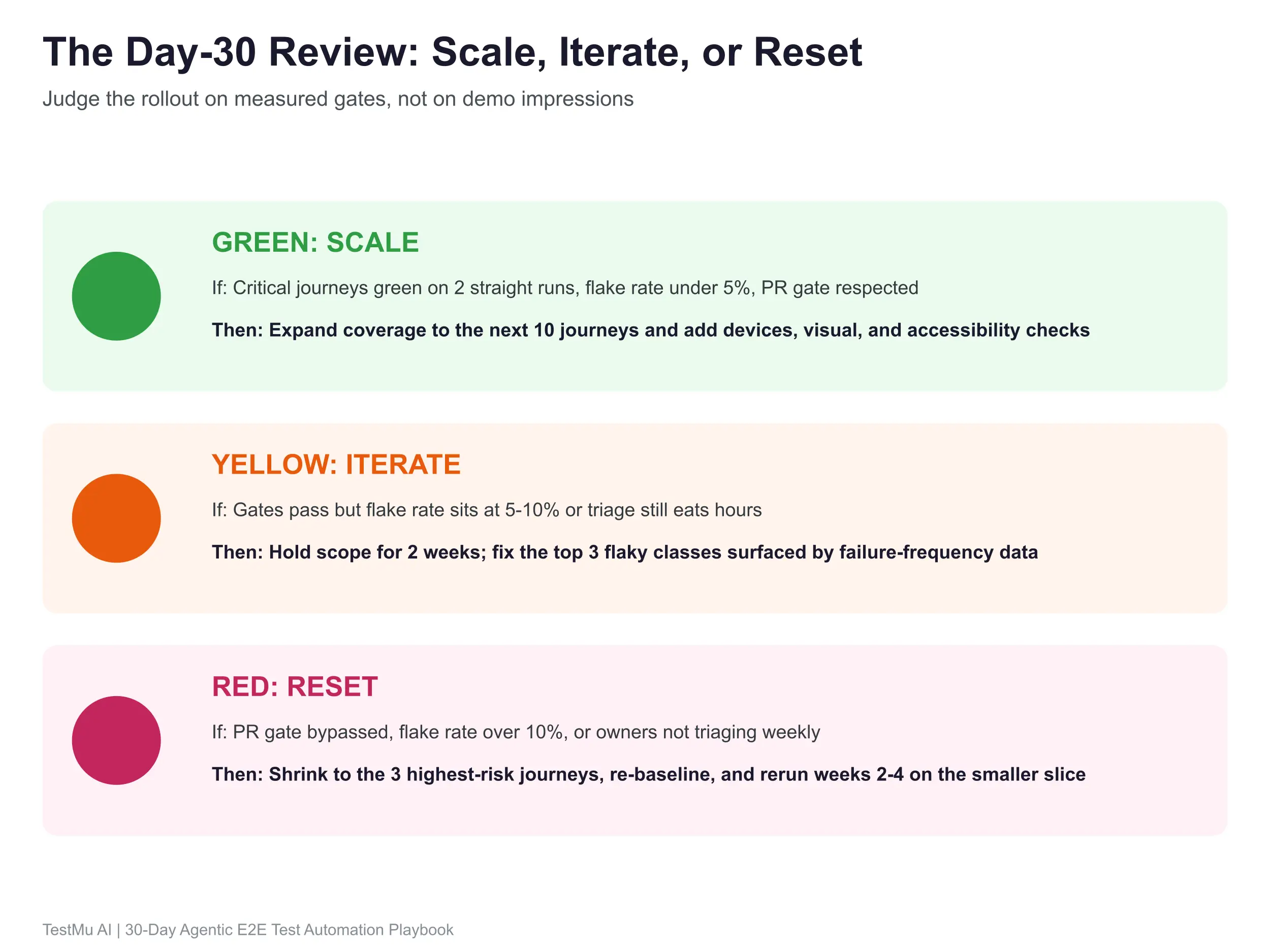
Day 30 closes with a metrics review against three thresholds. How much autonomy to grant the agent layer after that review is its own decision, covered in human out of the loop testing.

Note: Run this playbook on TestMu AI: author with KaneAI, execute on HyperExecute, and triage with Test Intelligence in one platform. Start free.
Which TestMu AI Product Covers Each Phase?
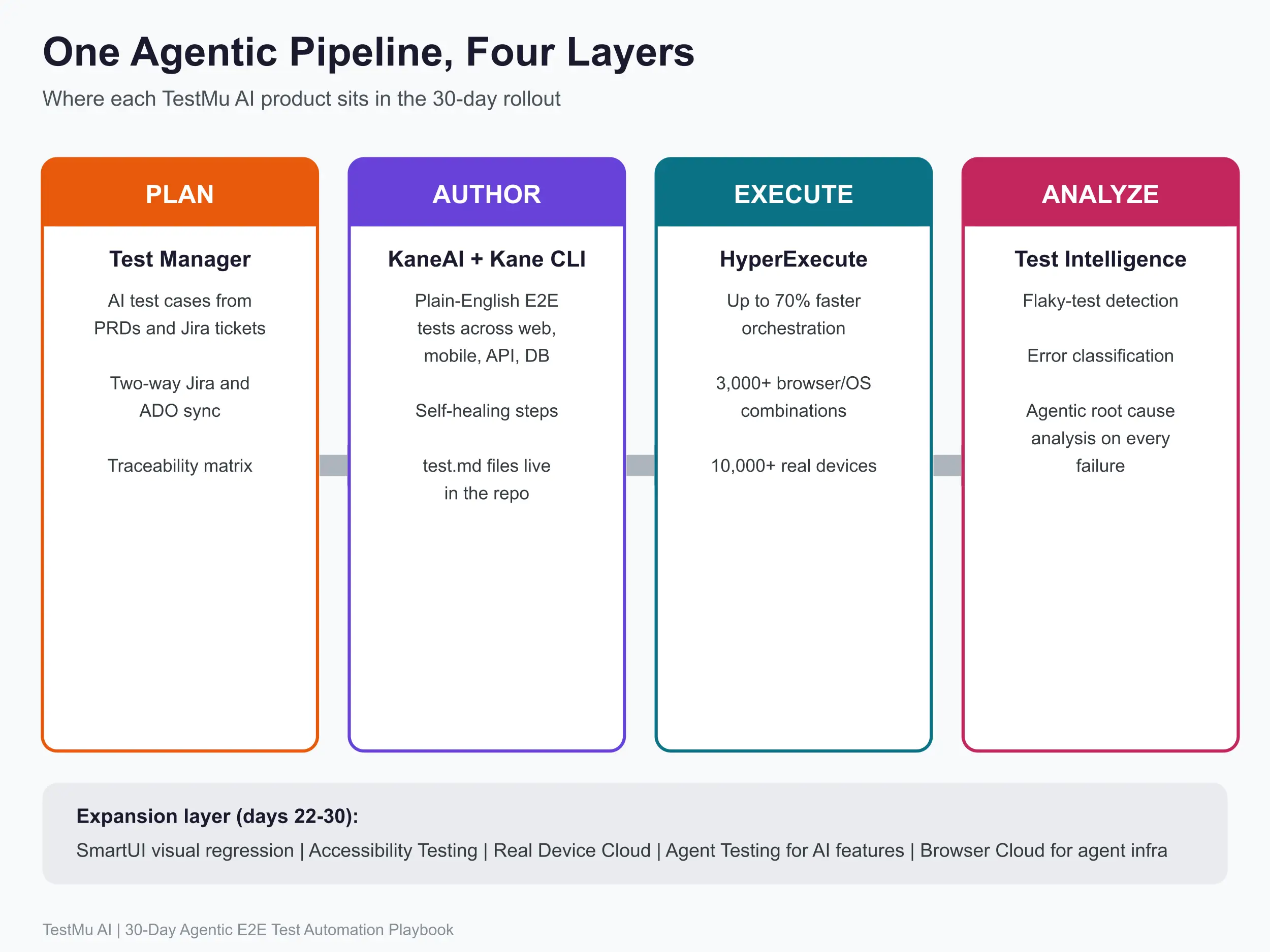
The playbook maps onto four platform layers, plus an expansion layer that joins in days 22-30. One account covers all of it, with shared cloud, private cloud, and on-premise deployment options.
| Phase | Product | What it does in this playbook |
|---|---|---|
| Plan (days 1-7) | Test Manager | AI-generated test cases from PRDs and Jira tickets, two-way Jira and ADO sync, requirement-to-defect traceability for the gate list. |
| Author (days 8-14) | KaneAI and Kane CLI | Plain-English E2E tests across web, mobile, API, and database with self-healing; test.md files and evidence-backed verdicts from the terminal. |
| Execute (days 15-21) | HyperExecute, automation cloud | Auto-split parallel orchestration up to 70% faster, PR-triggered runs across 3,000+ browser and OS combinations. |
| Analyze (days 22-30) | Test Intelligence | Flaky-test detection by failure frequency, error categorization, and agentic root cause analysis for the weekly triage. |
| Expand: devices | Real Device Cloud, app test automation | Rerun the gate list on 10,000+ real Android and iOS devices; Appium, Espresso, and XCUITest supported for native apps. |
| Expand: visual and compliance | SmartUI visual AI testing, Accessibility Testing | Visual regression that separates real UI bugs from rendering noise; Axe-core powered WCAG, ADA, and Section 508 scans on the same journeys. |
| Expand: AI surfaces | Agent Testing, Browser Cloud | Scores chat, voice, and phone agents on quality metrics like hallucination and bias; on-demand Chrome sessions for agent-driven automation. |
What Metrics Prove Agentic E2E Testing Worked?
The four numbers on your baseline sheet, re-measured on day 30: authoring time per journey, suite wall-clock time, flake rate, and triage time per failure. Your numbers will differ, and week 1 makes the delta knowable.
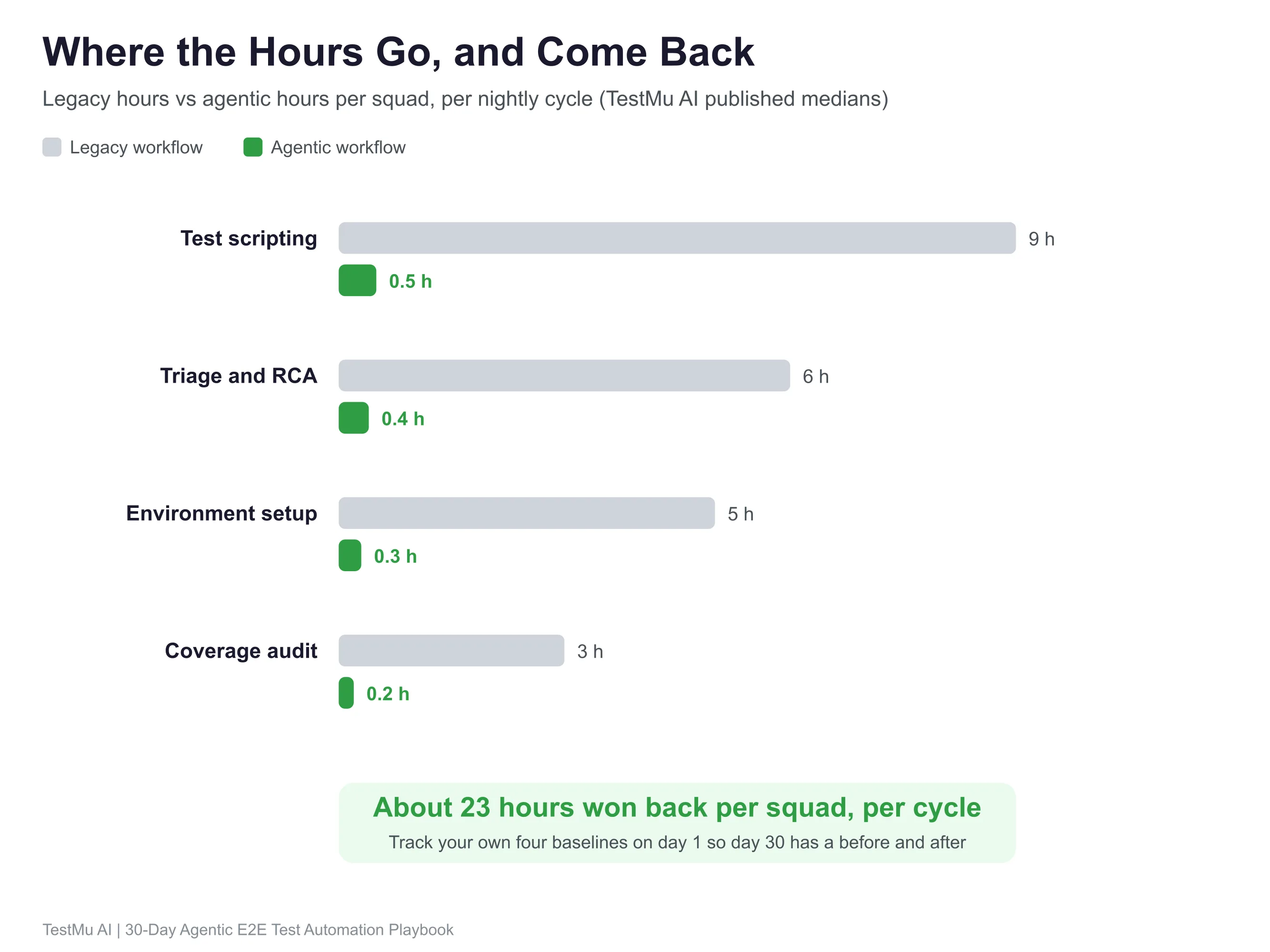
TestMu AI's published medians across customer and internal builds show where agentic workflows return time in a nightly cycle: scripting from 9 hours to 0.5, triage and RCA from 6 hours to 0.4, environment setup from 5 hours to 0.3, and coverage audit from 3 hours to 0.2, roughly 23 hours won back per squad per cycle.
| Metric | Day-1 baseline (typical) | Day-30 target |
|---|---|---|
| Authoring time per journey | Hours of scripting per flow | Minutes from prompt or ticket to reviewed test |
| Suite wall-clock time | Sequential runs measured in hours | Parallel runs short enough to gate a PR |
| Flake rate on gate list | Unknown, which is the problem | Under 5% across a full week of runs |
| Triage time per failure | Manual log digging per red build | Minutes, starting from an RCA lead |
| Gate-list coverage | 0% automated | 100% of the 5-10 journeys, green on 2 straight runs |
Report these five rows to the sponsor on day 30 and apply the green, yellow, or red decision from the review gates above. A rollout that cannot show these five numbers never finished week 1.

Grading the Agent That Wrote the Feature
By week 3, a coding agent's pull requests are hitting the same gate list, and each one arrives with a self-reported summary. TestMu AI's Agent Assurance runs that agent for real and grades every criterion against observed evidence: files changed on disk, artifacts produced, and tool calls checked against the agent's own declared tool surface. Its Autonomous Agent category, for agents that call tools and open pull requests, is on the waitlist today.
- Three verdicts - Pass, Fail, and Unable to Verify, with unverifiable criteria excluded from the pass-rate denominator and reported beside it as the assurance gap.
- Grey-box discovery - it reads manifests, prompts, tool tables, and MCP servers, and where an agent declares nothing it says so instead of guessing.
- 18 scenario categories - functional, non-functional, and adversarial, so prompt injection and data exfiltration checks sit beside happy-path and boundary cases.
- A terminal loop - the rook CLI runs explore, generate, run, and report against an agent you own, then tracks what is newly failing, newly fixed, or flaky since the last run.
The agent you point a run at is yours and its writes are real, so aim it at the seeded staging environment this playbook asks for before day 1. A finished run exits 0 whether scenarios passed or failed, so gate the merge on the verdicts in the JSON report rather than on the exit code.
Conclusion: What Happens on Day 1?
Open a document, list the 10 user journeys that would block your next release, and put a name next to each. That is the whole first step, and every later phase depends on it more than on any tool decision. From there the playbook is mechanical: baseline in week 1, author with KaneAI in week 2 using the getting started with KaneAI guide, gate PRs in week 3, and harden with weekly triage in week 4.
Hold every scaling decision to the day-30 gates: green scales, yellow iterates, red resets. Teams that respect the gates end month 1 with a small suite they trust; teams that skip them end it with a large suite they rerun. Repeat the same loop for each new batch of journeys and agentic test automation becomes a monthly rhythm rather than a one-time project. For the leadership view of the same transition, read the playbook for AI-native test intelligence next.
If the budget question comes up partway through the migration, what an agent-run test suite costs compared to plain CI has four measured runs and the costs neither invoice shows.
Key Takeaways
- Exit gates beat calendar weeks: A phase that misses its gate repeats, because sliding one week costs far less than scaling a suite nobody trusts.
- Baseline before automating: Four numbers recorded in week 1 are the only evidence available when someone asks what the rollout actually bought.
- Thin slice first: Five to ten release-gating journeys expose pipeline and environment problems that a hundred tests would only multiply.
- Flake rate decides scale: Under 5% earns expansion, 5 to 10% earns another two weeks of triage, and above 10% earns a reset to a smaller slice.
- Self-healing moves the work: Maintenance becomes approving or rejecting a proposed heal, which is a judgment task rather than a rewriting task.
- Ownership outranks tooling: One named owner per journey predicts triage speed more reliably than any authoring feature on the shortlist.
Author

Bhavya Hada
Blogs: 29


Bhavya Hada is a Community Contributor at TestMu AI with over three years of experience in software testing and quality assurance. She has authored 20+ articles on software testing, test automation, QA, and other tech topics. She holds certifications in Automation Testing, KaneAI, Selenium, Appium, Playwright, and Cypress. At TestMu AI, Bhavya leads marketing initiatives around AI-driven test automation and develops technical content across blogs, social media, newsletters, and community forums. On LinkedIn, she is followed by 4,000+ QA engineers, testers, and tech professionals.
Reviewer

Shantanu Wali
Reviewer
Shantanu Wali is Vice President of Product Management at TestMu AI (formerly LambdaTest), where he owns several product lines across the testing platform, including the Real Device Cloud and the Digital Experience Testing Cloud. He has also contributed significantly to the development and scaling of KaneAI, TestMu AI's flagship GenAI-native testing agent that uses natural language to make software testing faster and more reliable in this AI era. He brings 7+ years of experience across software development and product management, starting as a backend developer at Infosys building solutions for Fortune 500 clients. Shantanu holds an MBA from IIM Calcutta and a B.Tech in Mechanical Engineering.


Agentic E2E Playbook FAQs
Did you find this page helpful?
More Related Blogs
TestMu AI forEnterprise
Get access to solutions built on Enterprise
grade security, privacy, & compliance
- Advanced access controls
- Advanced data retention rules
- Advanced Local Testing
- Premium Support options
- Early access to beta features
- Private Slack Channel
- Unlimited Manual Accessibility DevTools Tests