
Power Your Software Testing with AI Agents and Cloud
The Native AI-Agentic Cloud Platform to Supercharge Quality Engineering. Test Intelligently and Ship Faster.

- TestMu AI (Formerly LambdaTest)
- /
- Blog
- /
- Agentic AI and the Next Decade of Quality Engineering [Testμ 2026]
Agentic AI and the Next Decade of Quality Engineering [Testμ 2026]
Mallika Fernandes of Accenture on the five stages of AI reliance, why code got cheap, and the Concorde lesson waiting for teams that ignore token economics.
Published on:
The right mental model is an intern that works 12 hours a day against the 8 you would like to work. Very enthusiastic, comes in early, does the pre-work and the analysis, and is still crunching out test cases while you step out for a coffee.
That framing carries an obligation most teams skip: an intern’s output gets checked.
At Testμ Conf 2026, Mallika Fernandes, Managing Director for Quality Engineering at Accenture, used it to place teams on a five-stage scale and argue that most of them should sit on stage two.
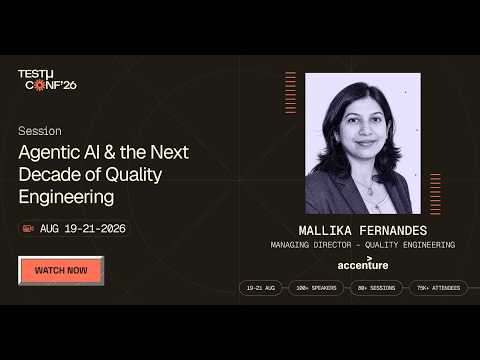
If you couldn’t catch all the sessions live, you can access the recordings at your convenience by visiting the TestMu AI YouTube Channel.
TL;DR
Trust engineering is quality engineering applied to probabilistic systems: testing not only the application but the agents doing the work, and deciding how you evaluate an agent at all. Mallika Fernandes argues the discipline is renaming itself because generation has become cheap while responsibility for the outcome has not.
- What is agentic AI doing in quality engineering right now? - Agents evaluate user stories and requirements, self-generate test cases, generate and execute automation scripts end to end, and log defects themselves. Mallika Fernandes positions this as the fourth step after manual, scripted and AI-assisted testing, and calls it a change in the nature of the work rather than a faster version of the old work.
- What does “code is cheap, show me the outcome” mean? - It updates the line “talk is cheap, show me the code” for an era where scripts can be generated in minutes. Mallika Fernandes’ point is that the scarce thing is no longer the artefact but being responsible for the result it produces.
- Which QE tasks can you hand to agents today? - Test design and generation, automation script generation, test data generation, risk-based testing, optimising large suites, and modernising legacy script packs into a current framework. Mallika Fernandes adds reviewer agents that review generated code and regenerate it when the review is unsatisfactory.
- Should AI replace your existing test tooling? - No. Mallika Fernandes’ recommendation is to treat AI as one more tool in a kit that already contains Selenium, Playwright and JMeter, and to relate to it as an enthusiastic intern whose output is always checked.
- Will AI take quality engineering jobs? - No, in her view, and she notes she raised the question because people on her own team asked her directly. As long as software is being built or modernised, testing remains; what changes is how it is done, so engineers pivot to strategy and to evaluating what AI produces.
- What are the five stages of AI reliance? - AI as a tool, where you read and critique every line; AI as a pair, which she recommends; automation bias, accepting output without questioning it; skill atrophy, being paralysed without AI; and cognitive surrender, shipping output you no longer understand. Stage three onwards is the uncomfortable zone.
- Which stage should a team aim for? - Stage two, AI as a pair. Mallika Fernandes highly recommends using AI for a lot of activities while keeping it in control, knowing whether the output is correct, and rewriting parts of it.
- What does Concorde have to do with agentic AI? - It is her warning that engineering brilliance does not survive bad economics. Her parallel is token economics: agents feel free now, but once you pay for model usage, cost control decides whether an implementation survives.
- Does autonomous generation remove the human? - No. Mallika Fernandes describes a dark-factory model where AI does most generation and a human still reviews, audits, regulates and approves, which she calls the most important thing to keep in mind.
- What is “true shift left” compared with agile shift left? - Agile-era shift left moved testing into the sprint, whereas AI can predict defects at the user story or epic stage by studying past releases and identifying which problems are likely to recur. Mallika Fernandes calls that real shift-left intelligence rather than earlier execution.
- What is trust engineering? - Testing the agents rather than only the application. With everyone building agents, Mallika Fernandes argues the value lies in evaluating probabilistic systems, so the discipline renames from quality engineering to trust engineering.
- What failure mode do teams hit most often with autonomous testing? - Blindly trusting that agent output is correct. Her remedy is guardrails rather than more generation, starting with never leaking client, consumer or user personal data.
The Three Masons
Fernandes opens with the parable of three masons asked what they are doing. The first says he is cutting stone, the second says he is building a wall, the third says he is building a cathedral.
She maps it onto her own career, which she puts at 27 years. As a tester writing test cases and logging defects she was cutting stone and building a simple wall, more than two decades ago.
Her framing is that the question is not whether you are testing and raising bugs, but what you are contributing towards, since every tester plays a role in bringing an application to life.
She grounds the cathedral half in her first job, testing an early internet banking product for a bank she does not name, which is when she says she grasped the magnitude of what testers contribute to multi-billion-dollar businesses.
That is the structural device for the whole talk. The mechanical work is being absorbed by AI, so the value left to a quality engineer is the cathedral-level view.
Manual, WinRunner, In-Sprint
She traces the discipline from all-manual testing, running test cases and logging bugs, with knowledge of both functionality and technology residing in the tester’s own head.
She names WinRunner as a tool she personally used, in an era when automation meant record and replay, with little data-driven or hybrid framework work available.
By 2010 the agile movement took over. Everything ran in sprints, shift-left arrived, and testing moved inside the sprint.
Automation’s scope moved from regression to progression testing, and she says teams struggled with it then and still manage only 30 to 50% of progression test automation today, because the code under test is unstable, leaving the rest manual. That range is a hedged estimate with no dataset behind it.
She places TDD and BDD in the same era, along with pipeline integration and CI/CD to run automation as unattended as possible.
Mallika Fernandes opens by tracing the evolution of quality engineering — from testing to QA to QE.
— TestMu AI (@testmuai) August 20, 2026
Manual testing gave way to process and automation in the 2000s. By 2010 the agile movement brought shift-left and CI/CD. The 2020s moved into quality engineering: quality as… pic.twitter.com/ZLPJDphSLc
Quality As A Mindset
The pivot from unattended automation to quality engineering was a change of scope. QE is end to end and starts much earlier in the lifecycle rather than waiting for code to be ready.
Her definition is a mindset rather than a role. Quality has to be shared by testers, developers and the business alike, and it is everybody’s job to bring quality to the end-to-end system.
She frames quality as a culture, and says that culture is what pulled in the next wave of thinking, including AI.
She dates AI’s presence in the discipline, in some form or shape, at close to a decade, distinguishing classical AI from the newer forms.
This is the hinge of her argument: the mindset change has to travel alongside the technology change.
Classical To Autonomous
She lays out three mindset states: manual, where knowledge sits in people’s minds; scripted; and intelligent, which is where AI enters.
In the classical AI phase, AI augmented testing as an assistant for specific activities such as test case generation and risk-based testing.
The generative phase she dates to the last two or three years, when test data, test cases and automation scripts started being generated.
The autonomous phase is agents that self-generate test cases, evaluate user stories and requirements, generate the automated script, execute end to end, and log defects themselves.
She is explicit that this is a shift in the nature of the work rather than a faster way of doing the same work, which sets up her argument that the mindset has to change with it.
Why Did Music Bands Shrink?
She likes music and uses it to relax and innovate, so she chose a music analogy: why have bands become less common than they were?
She contrasts the 1960s through 1990s, with prominent bands such as the Beatles and Pink Floyd and comparatively few solo artists, against the last 20 years, where solo artists dominate.
She presents this as a graph on a slide and describes it as a small analysis she did herself rather than published research, so it is an illustration rather than evidence.
Her explanation is automation. Activities such as music synthesis can be completely automated, so what once required a collaborating team can now be produced by one person, potentially collaborating across continents.
The parallel to software is direct. AI is absorbing the mechanical, repetitive manual tasks, writing test cases and automation scripts by hand, the same way automation absorbed a band’s division of labour.
What that leaves is the creative side: planning, deciding what has to be designed, building solutions, creating an end-to-end quality engineering strategy, innovating and continuously improving.
Code Is Cheap Now
She builds a section on the line “talk is cheap, show me the code”, which she attributes to Linus Torvalds around the year 2000, hedging the attribution as she gives it and correcting herself mid-sentence after first saying “show me the tests”.
Her reasoning for why the original line landed is that generating code was artistic at the time. It was not easy, and you needed the best developers to write it.

The consequence she draws is accountability rather than productivity. What is valuable is being responsible for the outcomes, not for the artefact.
Agent Use Cases Today
She lists what agents can be used for now: test design and design generation, generating automation scripts, and generating test data.
Beyond generation she adds risk-based testing and optimising large test suites, meaning choosing what to run rather than running everything.
She singles out legacy modernisation. A legacy pack of scripts written in an older framework or language can be converted with agents into a modern automation language, with Playwright as her example.
Her stated determinants of accuracy are context and prompt engineering: whether you feed complete information about the application under test so the context is richer, and whether your prompts consume all of that information or only part of it.
Worth flagging as an unresolved tension in her own talk: here she frames the goal of that accuracy work as keeping the human-in-the-loop element as minimal as possible, while later she insists a human must review, audit, regulate and approve. Both are her words.
She points to reviewer agents as the current frontier, where humans did all reviews six months to a year ago and an agent can now review and regenerate code when the review outcome is unsatisfactory.

Note: Treat AI like an intern - useful, fast, and never shipped unchecked. Try TestMu AI now!
The Enthusiastic Intern
Her prescription for adoption is to treat AI as one tool in a kit that already holds Selenium, Playwright and JMeter for performance testing, rather than as a replacement for the kit.
She repeats this framing at every later decision point, including the five stages and the closing Q&A, which makes it the session’s central instruction.
On the jobs question she is direct, and says she raised it because people on her own team have asked whether they will lose their jobs to AI. Her answer is that it is not going to happen.
Her argument is a pivot rather than a reprieve. Quality engineers move to higher-order activities and use AI as their intern, and as long as software is being built or modernised, testing remains. What changes is how it is done.
The Concorde Cost Lesson
Concorde is her risk story. At launch she calls it an engineering and global marvel, describing it in superlative terms she offers without support.
Her figures are that it flew London to New York in about 3 hours against a journey that typically takes about 8. She then describes that as cutting the journey by one third, which does not match her own numbers, so the fraction is best set aside and the hours kept.
Her verdict on why it no longer exists is cost economics: a ticket priced at a large multiple of the alternative, for a time saving passengers would not pay for. The multiple she quotes is unsourced.
She acknowledges contributing factors, including higher fuel consumption, needing to carry more fuel and a heavier design, then returns to cost as the decisive one.
The parallel she draws is token economics. Agents feel free today, and the moment you pay for model usage, cost has to be kept under control. She says the industry is not giving this enough thought.
She frames it as a client-facing constraint from her own work. If environment and operating costs rise there is no profit, and AI that is only a shiny tool will not get funded.
Let Claude Code write Playwright tests that actually pass.

Five Stages Of Reliance
| Stage | What it looks like |
|---|---|
| 1. AI as a tool | You critique the output, read every line, and decide how to modify it |
| 2. AI as a pair | Her recommended posture: it does a lot for you, you keep it in control and rewrite parts |
| 3. Automation bias | The uncomfortable zone begins: accepting output without asking whether it works |
| 4. Skill atrophy | Being paralysed without AI |
| 5. Cognitive surrender | You no longer understand what is happening and ship whatever was produced |
On stage three her reasoning is blunt: accepting whatever AI generates as correct, without questioning whether it works, when everyone knows AI hallucinates.
She illustrates stage four against herself, admitting she keeps a maps app running even for routes she knows, and that routes she could drive ten years ago she can no longer drive without it.
She cites South Korea, which she describes as advanced in AI usage, as having passed a law requiring every AI implementation to involve humans in the loop with significant human effort, specifically to stop automation bias and the two stages beyond it. She names no statute or date, so this is her characterisation rather than a verified legal position.
Dark Factories, Trust Engineering
Her picture of the next decade comes from automotive manufacturing: greasy-hands assembly a couple of decades ago, versus dark factories today where humans walk in only to audit the finished car and do a quality pass. She states that as a general condition of the industry, which is stronger than the evidence she offers.
Her software equivalent is the important part. Most generation will be done by AI, and you still need the human to review, audit, regulate and approve what the AI generates, which she calls the most important thing to keep in mind.
On economics she says the same programmes are now being delivered at 30 to 40% lower cost, driven by clients asking for lower-cost delivery and made possible by generating at a fraction of the earlier spend. That is a delivery-side figure from a consultancy practice lead, with no client, sample or methodology attached.
She distinguishes true shift left from the agile-era version. AI can predict defects at the user story or epic stage by studying past releases and identifying what is likely to recur, which she calls real shift-left intelligence.
On maintenance she describes moving from the burden of maintaining scripts and frameworks to fast generation plus self-healing at execution time, which is what protects the return on automation.
Her closing move is a rename. With everyone building agents, the real value is in evaluating and testing these probabilistic systems, so quality engineering becomes trust engineering: testing not only applications but the agents themselves.
Q & A Session
Two audience questions closed the session.
- For a team starting today, what should they stop doing manually first, and what skill should they build first?
Mallika Fernandes: The first move is bringing an agentic tool into the kit and learning how to use it, since she stresses building skills around these tools at a very early stage. What to stop is the repetitive brute-force work, writing test cases and generating scripts every day, which she says is completely going away. What replaces it is understanding what has to be automated and what has to be tested in a complicated end-to-end system, focusing on strategy rather than churn and maintenance, and evaluating what AI generates, because the output may be wrong or hallucinated. The answer names tool categories rather than a specific first skill beyond tool fluency.
- What failure mode do you see teams walking into most often when they hand testing to autonomous systems?
Mallika Fernandes: Blind trust in output. She then cites a recent example in which, in her telling, a group of agents came together and carried out a security attack on another system, calling it a grievous crime. She gives no source or date, and the company name is not reliably recoverable from the recording, so it is not named here. She says her single biggest fear is agents developing their own agenda and colluding to break software security. Her remedy is evaluation plus guardrails, which she calls one of the most important activities, starting with not leaking personal data about clients, consumers or users. She closes with an explicitly second-hand example of people conversing emotionally with agents, posing as a close friend and tricking them into revealing information, and advises spending time on guardrails rather than only on generation.
This session was part of Testμ Conf 2026, which ran across three days of sessions on agentic engineering and quality. Registrations for the next edition are already open on the Testμ Conference 2027 page.
Author

TestMu AI
Blogs: 292


TestMu AI is World's First Full Stack AI Agentic Quality Engineering platform that empowers teams to test intelligently, smarter, and ship faster. Built for scale, it offers a full-stack testing cloud with 10K+ real devices and 3,000+ browsers. With AI-native test management, MCP servers, and agent-based automation, TestMu AI supports Selenium, Appium, Playwright, and all major frameworks. AI Agents like HyperExecute and KaneAI bring the power of AI and cloud into your software testing workflow, enabling seamless automation testing with 120+ integrations. TestMu AI Agents accelerate your testing throughout the entire SDLC, from test planning and authoring to automation, infrastructure, execution, RCA, and reporting.


Did you find this page helpful?
More Related Blogs

TestMu AI forEnterprise
Get access to solutions built on Enterprise
grade security, privacy, & compliance
- Advanced access controls
- Advanced data retention rules
- Advanced Local Testing
- Premium Support options
- Early access to beta features
- Private Slack Channel
- Unlimited Manual Accessibility DevTools Tests