
Power Your Software Testing with AI Agents and Cloud
The Native AI-Agentic Cloud Platform to Supercharge Quality Engineering. Test Intelligently and Ship Faster.

- TestMu AI (Formerly LambdaTest)
- /
- Blog
- /
- Agentic SDLC vs STLC: What Changes in Each Life Cycle
Agentic SDLC vs STLC: What Changes in Each Life Cycle
Agentic SDLC and STLC diverge on one thing: verifiability. Learn what AI agents change in every phase, which exit criteria still hold, and how to adopt them.
Published on:
The agentic SDLC and the agentic STLC are the two halves of shipping software that AI agents now write. The first covers how a change gets built when an agent plans and implements it, and the second covers how anyone establishes that the change is correct. Teams adopting agents usually upgrade the first and leave the second exactly as it was.
That gap shows up in an ordinary pull request: fourteen files changed, six tests added, everything green, and every one of those tests written by the agent that wrote the code. Nothing there establishes whether the feature is correct, because the only system asserting correctness is the one whose work is under review.
TL;DR
An agentic SDLC is a delivery life cycle where AI agents plan, write and ship code under human supervision. An agentic STLC is the testing life cycle re-derived for that reality, where the test basis, entry criteria and exit criteria have to hold even though the code under test was written by an AI agent rather than a person.
- Agentic SDLC: the classic phases survive and the actor changes. An agent interprets the goal, plans the steps and produces the artifact while the human sets the objective and reviews the output. Success measure: merged and deployed.
- Agentic STLC: the six standard software testing phases survive and their inputs change. Success measure: a verdict with evidence behind it, not a passing count, because a passing count written by the author of the code asserts nothing.
- Output verifiability: the property deciding which phases agents are actually good at. Phases whose output can be checked by running something are mature in industry; phases whose output is a judgement call are still research. Executable feedback required: yes.
- Independent judgement: an agentic STLC requires that the system grading a change is not the system that made it, which is why planner, executor and reviewer stay separate roles. Same model instance for author and reviewer: no.
- Exit criteria: an agentic exit criterion has to be machine-readable, reconstructable months later, and attributable to a requirement. A green chat summary meets none of the three. TestMu AI covers this half with Test Manager for traceability and Kane CLI for the verdict.
On an agentic team the agentic SDLC and the agentic STLC run concurrently, and confusing the two life cycles is how a defect reaches production with a full green dashboard behind it.
What Is Agentic SDLC?
An agentic SDLC is a software development life cycle in which AI agents do the work inside the classic phases instead of assisting the human who does. Planning, design, implementation, testing, deployment and maintenance all remain. What moves is the actor.
The term now appears in the literature rather than only in vendor copy. A 2026 arXiv paper by Happy Bhati, Agentic AI in the Software Development Lifecycle, proposes a six-layer reference architecture for these systems and explicitly contrasts the traditional SDLC with an emerging Agentic SDLC.
Each shift below lands a downstream cost on testing.
- The unit of work shrinks - planning moves from a two-week sprint to a task an agent finishes between coffees, so the number of independent changes arriving at the test gate per day goes up by an order of magnitude.
- The developer becomes a reviewer - the scarce resource stops being the ability to write the code and becomes the attention needed to check it, which is a different constraint with a different ceiling.
- Behaviour stops being fixed at build time - a prompt change, a truncated context or a model update can alter what the system does on identical inputs, so the assumption that behaviour is specified once and validated once no longer holds.
For the classic version of these phases before agents entered them, the software development life cycle guide covers each stage and its deliverables.
What Is Agentic STLC?
An agentic STLC is the software testing life cycle re-derived for software an agent wrote. The six phases hold. Their inputs change, because the specification, the code and often the tests now come from the same non-deterministic source.
In Assistance to Autonomy, a systematic literature review by Spyridon Alvanakis Apostolou, Jan Bosch and Helena Holmstrom Olsson, a synthesis of 92 manually verified primary studies found that output verifiability is the primary enabler of agentic AI.
The same review reports that later life cycle phases, whose outputs are objectively evaluable through executable feedback, show the highest maturity and industrial presence, while earlier phases remain almost exclusively academic proofs-of-concept. Alvanakis Apostolou and colleagues also name the Planner-Executor-Reviewer split as the dominant architectural pattern.
Agents are good at the phases where something can be run to check them. That makes the STLC the machinery keeping an agent’s output checkable at all, and our software testing life cycle guide covers the six phases in their original form.
Agentic SDLC vs STLC: Key Differences
The two cycles overlap on vocabulary and diverge on what counts as done. Reading the difference off the table is faster than arguing it from first principles.
| Dimension | Agentic SDLC | Agentic STLC |
|---|---|---|
| Question it answers | Did the software get built? | Is the software correct, and can you prove it? |
| Primary actor | Planner and executor agents | A reviewer that did not author the change |
| Unit of work | A task an agent completes in minutes | A requirement traced to the run that exercised it |
| Definition of done | Merged and deployed | A verdict with evidence behind it |
| Characteristic failure | Volume of change outruns review attention | The author grades its own homework |
| Artifact that survives | The shipped change | The evidence pack and the traceability record |
One row carries the rest. When the primary actor on both sides is the same model instance, the STLC column collapses into the SDLC column and the pipeline stops producing information, because a system cannot independently confirm its own reading of a requirement.
If the classic distinction is what you need first, SDLC and STLC compared sets out the phases and differences without the agentic layer on top.
Phase-by-Phase Remap of the Testing Life Cycle
Each STLC phase keeps its name and loses an assumption. Walking them in order shows exactly where the work moves.
- Requirement analysis - the phase assumed a human-authored spec to test against. When the requirement arrives as a prompt and the agent expands it into acceptance criteria, the test basis and the implementation share an origin, so a misreading is invisible to both. Capture the acceptance criteria as a separate artifact before the agent starts building.
- Test planning - scope used to be set per release. With agents opening changes continuously, the plan has to be expressed as a standing policy about which changes need which depth of check, because no human is sizing each batch.
- Test case development - authoring stops being the bottleneck and review becomes it. The question moves from how many cases you have to whether any of them would fail if the feature were wrong, which is the property an agent-authored suite most often lacks.
- Environment setup - reproducibility now decides whether an investigation is possible at all. A run you cannot replay is a run you cannot investigate, and agent runs vary on identical inputs, so the environment has to pin what it can and record what it cannot.
- Test execution - the count of runs per day rises with the count of changes, so execution has to be non-interactive, parallel and machine-readable end to end, with the summary rendered for the calling system before it is rendered for a person.
- Cycle closure - closure used to report pass rates. It now has to report what was actually proven and what was left uncovered, since a pass rate over agent-authored cases measures the agent’s self-consistency rather than the product.
Requirement analysis and cycle closure are the two phases that need a system of record, because both depend on a link between a requirement and the run that exercised it. TestMu AI’s Test Manager generates structured test cases from natural language, pulls manual and automated results into one pass or fail view, and traces every requirement through to its tests, runs and defects with two-way JIRA and Azure DevOps sync.
That traceability link is what turns cycle closure back into a statement about the product. The Test Manager documentation covers repositories, plans, cycles and the execution view.

Note: Trace every requirement to the test, run and defect that covers it, and close an agentic cycle on what was proven rather than on a pass rate. Try TestMu AI free!
Entry and Exit Criteria Under Agents
Entry and exit criteria were the most procedural part of the STLC and are now the most important. They are the only points in an agentic pipeline where something outside the agent gets a vote.
An exit criterion survives the shift when it satisfies three properties. It is machine-readable, so a pipeline can branch on it without glue code. It is reconstructable, so a reviewer can see months later why it passed. It is attributable, so the result points at the requirement it covers.
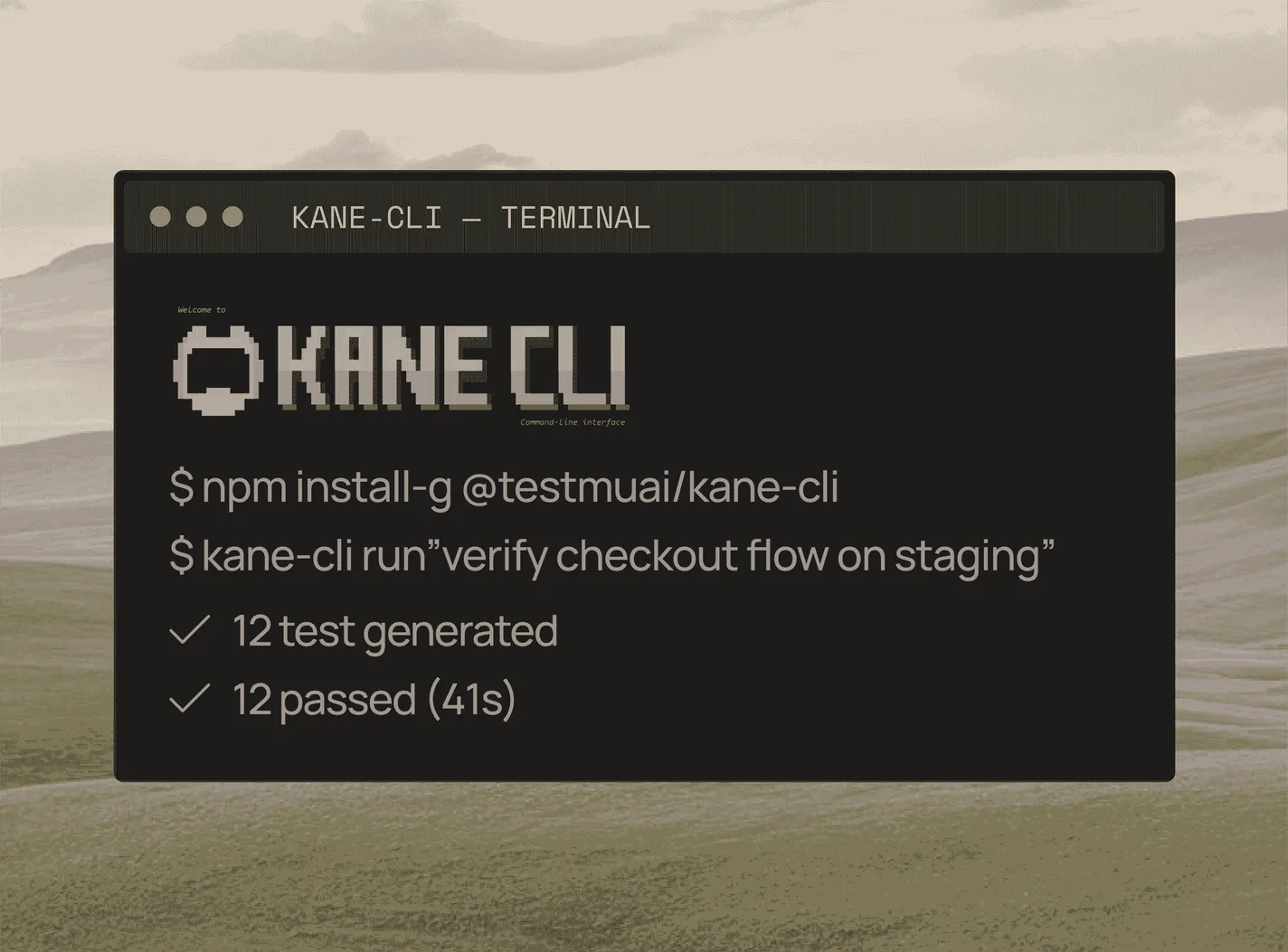
This is where an independent verifier earns its place. TestMu AI’s Kane CLI is positioned as an agentic quality verifier rather than a browser driver: it validates rendered UI in a real Chrome browser from a natural-language objective, and its agent mode emits plain NDJSON, one JSON object per line, alongside an evidence pack of per-step screenshots, a HAR network log and failure records.
The strictness of that gate is a flag rather than a convention, which is the part that matters when an agent is calling it. Running the installed binary on my Windows machine shows the run contract directly.
$ kane-cli --version
0.8.10

$ kane-cli run --help
  --mode <name>                Run mode: 'action' (strict - hard-stop on
                               auth/blocked/error) or 'testing' (lenient - fall
                               through). Overrides config; default: testing.
  --assertion-mode <mode>      Assertion mode: 'dom' (default - DOM-based
                               extraction & assertions, vision fallback) or
                               'visual' (vision model only). Overrides config.
  --final-validation <on|off>  Final validation: append the system cp_final
                               checkpoint verifying the objective as a whole.
                               Overrides config (default: off).
  --agent                      Agent mode: plain NDJSON output, no colors/UI
Two flags in that output are the agentic STLC in miniature. --final-validation appends a checkpoint that verifies the objective as a whole rather than the steps individually, and --agent makes the result parseable by the calling system instead of by a person.
Getting started with the command surface is covered in the Kane CLI documentation, and the wider pattern of gating a merge on agent-produced proof is covered in evidence-based QA for agentic test runs.
A fair objection arrives at this point. Teams already running an autonomous coding agent ask why that agent cannot run the check itself, since it can open a browser, execute code and report what it found.
The capability is genuinely there. An autonomous coding agent plans its own work, runs what it wrote and reports the outcome, which covers most of the mechanical surface of a test run. The open questions are who pays for the exploration and who signs off on the result, and both come into focus once you price an authoring agent against a verifier.
Devin vs Kane CLI
Devin, built by Cognition, is documented as an autonomous AI software engineer that can write, run and test code. The two tools sit at opposite ends of the life cycles in this article: Devin on the SDLC side authoring change, Kane CLI on the STLC side judging it. Pointing the first at the second’s job collapses the two roles back into one, which is the failure this whole section exists to prevent.
The economics follow from that split, because the two tools meter different activities.
- What the meter counts - Devin bills in Agent Compute Units, and its documentation states that usage accrues on the number and complexity of actions it takes, naming planning, context gathering, task execution, browser actions and code execution, plus virtual machine time and networking bandwidth. Exploration is the billable event.
- What moves the number - the same page lists task complexity, prompt specificity, size of context or codebase, number of files touched, session runtime, conversation length and frequency of back-and-forth messaging as the factors that change consumption. Every one of those is an authoring variable, not a verification variable.
- A verification run is bounded - Kane CLI caps the agent at 50 steps by default, configurable per run with
--max-steps, so a check has a ceiling before it starts instead of a total that grows with how long the agent stays curious. - Cost arrives with the verdict - the terminal
run_endevent carries atoken_usagebreakdown of reasoning and vision tokens, so what the run consumed lands in the same JSON object as the pass or fail, rather than surfacing on a monthly statement. - Idle behaviour helps sessions, not gates - Devin’s documentation notes that it sleeps automatically and does not consume usage while sleeping, which suits a long-lived engineering session and does nothing for a gate that has to answer on every pull request.
For the gate specifically, three properties decide it. The run is bounded, so the cost of a check does not scale with the size of the codebase being checked. The verdict is binary and machine-readable, so a pipeline branches without parsing prose. And the verifier did not write the change, which is the one property no authoring agent can supply about its own output.
Devin’s work ends where its own output needs an outside opinion. It can write, run and test code, but the test it ran carries the same reading of the requirement that produced the code, and its meter is sized for open-ended engineering sessions rather than a bounded check on every pull request. Kane CLI picks up at that boundary with a capped run, a binary verdict and an evidence pack produced by a system that had no hand in the change.

How to Adopt an Agentic Life Cycle
Adoption fails when a team turns on agents across the SDLC and leaves the STLC as it was. Sequencing the change in this order keeps the gate ahead of the volume.
- Write the acceptance criteria down before the agent starts, in a place that is not the prompt. This is the only step that stops the test basis and the implementation sharing a misreading.
- Pick one flow that already fails expensively in production and put an independent check on it. A single gated flow teaches more than a broad rollout with nothing gating.
- Make the verdict machine-readable before you scale the number of runs, because the day agents open thirty changes is the day nobody reads a human-formatted report.
- Separate the reviewer from the author at the system level, not the prompt level. A second call to the same model with a different instruction shares the original misreading.
- Record what each run proved against which requirement, so cycle closure reports coverage of the product rather than agreement within the agent.
Teams already running this loop tend to arrive at it from the quality side rather than the delivery side, and agentic quality assurance covers the practice end to end.
Adversarial Scenarios the Authoring Agent Never Writes
Acceptance criteria written before the build cover what the agent was asked to do. They say nothing about what it can be talked into doing once it reads untrusted text and still holds the tools to act. TestMu AI’s Agent Assurance, on a waitlist for agents that act, writes that second set.
- Adversarial cases arrive with the functional ones - prompt injection, jailbreak, data exfiltration, PII leakage and policy violation scenarios are generated in the same pass as the happy path, negative and boundary sets.
- Three verdicts instead of two - Pass, Fail and Unable to Verify, with the last excluded from the pass-rate denominator and reported beside it as an assurance gap.
- Evidence over the agent’s summary - criteria are graded against files changed on disk, artifacts produced, and tool calls checked against the agent’s declared tool surface.
- Grey-box discovery - manifests, prompts, tool tables and MCP servers are read to find what the agent can reach, and where it declares nothing the report says so.
The same loop runs from a terminal through rook, a pre-alpha CLI under Apache 2.0 that also tracks what newly failed since the previous run.
One detail decides whether that works as an exit criterion. A finished run exits 0 whether its scenarios passed or failed, and exit 1 is reserved for a command that never got that far, such as a signed-out session, an unreachable target or bad flags. Cycle closure therefore branches on the verdicts in the JSON report rather than on the exit status.
Conclusion
Pick the one flow whose failure costs you the most and put a check on it that the authoring agent does not control. That single gate tells you more about your agentic readiness than any maturity model will.
From there, wire the verdict into the pipeline and the requirement link into your test records, so closure reports what was proven. TestMu AI’s Test Manager holds the traceability half and Kane CLI returns the verdict half.
Two Testμ 2026 sessions pick this up in practice: Redesigning End-to-End Testing in the Age of AI and Is the Developer Lifecycle Dead?.
Author

Saurabh Prakash
Blogs: 20

Saurabh Prakash is an Engineering Manager at TestMu AI, where he leads engineering on agentic AI development and scalable system architecture for the quality engineering platform. He has also contributed to Test at Scale, the company's open-source test intelligence platform. He brings over 9 years of experience across Node.js, Java, Spring, MVC, data structures, algorithms, and scalable system design, with earlier roles as SDE 2 at Zomato, Senior Software Engineer at LogicHub, and Software Development Engineer at Directi. Saurabh holds a B.Tech in Computer Science and Engineering from Delhi Technological University.
Reviewer

Srinivasan Sekar
Reviewer
Srinivasan Sekar is Director of Engineering at TestMu AI, where he leads engineering and open-source initiatives behind the Selenium and Appium automation grid and owns TestMu AI's MCP Server. A committer to Appium and a contributor to Selenium, WebdriverIO, Taiko, and AppiumTestDistribution, he brings over 15 years of experience in quality engineering and open-source technologies. He is the author of the Apress book 'The MCP Standard: A Developer's Guide to Building Universal AI Tools with the Model Context Protocol,' a Certified Kubernetes and Cloud Native Associate, and an international conference speaker. Before TestMu AI he spent over eight years at Thoughtworks as a Principal Consultant and Quality Architect. Srinivasan holds a B.Tech in Information Technology from Anna University.


Agentic SDLC and STLC FAQs
Did you find this page helpful?
More Related Blogs

TestMu AI forEnterprise
Get access to solutions built on Enterprise
grade security, privacy, & compliance
- Advanced access controls
- Advanced data retention rules
- Advanced Local Testing
- Premium Support options
- Early access to beta features
- Private Slack Channel
- Unlimited Manual Accessibility DevTools Tests