

Power Your Software Testing with AI Agents and Cloud
The Native AI-Agentic Cloud Platform to Supercharge Quality Engineering. Test Intelligently and Ship Faster.


- TestMu AI (Formerly LambdaTest)
- /
- Blog
- /
- Human Out of the Loop Testing: Autonomy Levels and Exit Criteria
Human Out of the Loop Testing: Autonomy Levels and Exit Criteria
Human out of the loop testing explained: the five autonomy levels, the exit criteria that qualify a gate for unattended runs, and the evidence a run must emit.
Last Updated on:
Most teams debate human out of the loop testing as a yes or no question about their whole QA function, and that framing is why the debate never resolves. You grant it one gate at a time. A smoke check on a preview branch is a fair candidate; a payment flow is not.
The pressure to decide is real. Google's DORA research found that 90% of technology professionals now use AI at work, while 30% of developers report little to no trust in the code it generates. This guide shows which gates qualify, how to measure that, and what an unattended run must record.
TL;DR
Human out of the loop testing lets an automated system run a test and decide the verdict with nobody approving it. You write the pass conditions up front and audit the evidence after. Grant it one gate at a time, scored on flake rate, verdict agreement, and how fast a bad pass can be reversed.
How Do You Measure Whether a Test Gate Is Ready for Autonomy?
- Human in the loop: A person approves each action mid-run. Runs unattended: no.
- Human out of the loop: The run finishes and reports alone. Runs unattended: yes.
- Five autonomy levels: L0 scripted through L4 self-directed. Unattended runs start at L3.
- Task length: METR measured 50% success at roughly 320-minute tasks. Short objectives survive unattended; long ones do not.
- Four exit criteria: Flake rate, verdict agreement, blast radius, rollback time. Record all four before promoting a gate.
- Evidence contract: Objective, step outcomes, the assertion that granted the pass, screenshots, logs. TestMu AI Kane CLI streams it as newline-delimited JSON.
Is Human Out of the Loop Testing Safe for Production Releases?
Only where a wrong verdict is cheap and reversible, such as preview-environment smoke checks. Payment flows, personal data paths, compliance sign-off, and vague objectives stay supervised.
What Human Out of the Loop Testing Means
Human out of the loop testing is a mode in which an automated system authors, executes, and adjudicates a test without a person approving any step of that specific run. The human contribution moves to two places: defining the objective and pass conditions before the run, and auditing the evidence after it.
The term is borrowed from control theory, where it describes an automated controller acting without operator confirmation. Applied to QA, it is the third position on a spectrum rather than the opposite of supervision.
| Mode | Who decides mid-run | What the run blocks on | Fits |
|---|---|---|---|
| Human in the loop | A person approves or corrects each significant action before execution continues | Human availability, so the run cannot complete unattended | New flows, exploratory work, anything where the expected result is still being discovered |
| Human on the loop | The system decides; a person watches live and retains an interrupt | Nothing, but someone is expected to be present | The trial period while a gate builds the track record it needs to go unattended |
| Human out of the loop | The system decides alone against pass conditions written in advance | Nothing, and no one is expected to be watching | Stable, well-specified gates where a wrong verdict is cheap to detect and reverse |
The distinction that matters operationally is the third column. A gate is only genuinely unattended when nobody is expected to be watching, which means the run has to be trustworthy at 3am on a weekend, not just during a demo. Everything else in this article follows from that constraint.
This is narrower than autonomous testing as a capability category. Autonomy describes what the tooling can do; human out of the loop describes what authority you have granted it on a particular gate.
The Five Autonomy Levels in Testing
Treating autonomy as binary hides the only useful question: which specific decision has the human given up? The five-level ladder below is this article's own framing, and grading against it makes that explicit, and it makes the next promotion a concrete piece of work rather than a leap of faith.
| Level | The system does | The human still owns | Typical gate |
|---|---|---|---|
| L0 Scripted | Replays hand-written steps and selectors exactly as authored | Authoring, every selector, every assertion, all maintenance | A classic Selenium or Playwright regression suite |
| L1 Assisted | Drafts test cases and repairs broken locators when the UI shifts | Reviewing every generated test and every repair before merge | Suites using self-healing test automation |
| L2 Supervised | Plans and executes a stated objective end to end in one run | Watching the run and approving the verdict before it gates anything | A new agentic flow during its trial period |
| L3 Unattended | Runs, adjudicates, and reports with nobody watching | Writing the pass conditions and auditing evidence after the fact | Nightly regression sweeps, pull-request smoke checks |
| L4 Self-directed | Chooses what to test next from product changes, without a stated objective | Setting the risk budget and reviewing coverage direction periodically | Exploratory sweeps against a preview environment |
Human out of the loop begins at L3. The jump from L2 to L3 is the expensive one, because it is where the verdict stops being reviewed before it takes effect. L4 is a different jump again: the system now selects the target, so a coverage gap becomes invisible rather than merely unfixed.
Most teams run several levels at once, and that is the correct end state. A mature setup might sit at L3 for smoke checks, L2 for a newly built checkout flow, and L0 for the compliance suite that an auditor reads. Grading each gate separately is what agentic QA looks like in practice.
How Task Length Affects AI Agent Reliability
Vendor comparisons frame reliability as a property of the tool. The measured evidence says it is mostly a property of how long the task is, which is a variable you control directly.
METR measures this as a model's time horizon, the length of human task that a model completes with a given success probability. Under its Time Horizon 1.1 methodology published in January 2026, the highest estimate belonged to Claude Opus 4.5 at 320 minutes for a 50 percent success rate, with a confidence interval of 170 to 729 minutes. METR also revised the post-2023 doubling time to 131 days.
Read the 50 percent carefully. That figure is a coin flip on a task that takes a human more than five hours, from the highest-scoring model in the measurement. The shape of the curve is the operational lesson: in METR's earlier time-horizon study, models hit almost 100% success on tasks taking humans under four minutes and under 10% on tasks over roughly four hours.
- Scope down before you trust up - a gate that fails unattended at 40 steps often succeeds reliably at 12, so splitting the objective buys more reliability than switching vendors.
- Cap the step count explicitly - reasoning drift grows with step count, and TestMu AI Kane CLI guidance puts the noticeable drop past roughly 15 steps in a single objective.
- Measure length in human minutes - wall-clock runtime tells you about infrastructure, while the human-equivalent length of the task is what predicts the failure rate.
- The doubling trend cuts both ways. A gate that fails autonomy review this quarter may qualify next quarter without any change on your side, which is an argument for re-running the review on a schedule rather than deciding once.

Note: Long agentic objectives drift. TestMu AI Kane CLI caps a run with an explicit step budget and streams every step outcome so you can see exactly where a long objective started to wander. Try it free
Exit Criteria for Removing the Human From a Gate
Autonomy should be earned against measurements, not granted because a tool advertises it. These four criteria are the ones that make a promotion from L2 to L3 defensible in a post-incident review, and the first of them depends on having a real handle on flaky tests already.
| Criterion | What to measure | Why it gates autonomy |
|---|---|---|
| Flake stability | Flake rate on this specific suite over a rolling window, plus whether it is trending down | An unattended gate cannot tell a flaky failure from a real one, so it either blocks releases wrongly or gets muted into uselessness |
| Verdict agreement | How often the unattended verdict matched the human verdict during the L2 trial period | This is the only direct evidence that the pass conditions mean what you think they mean |
| Blast radius | What actually reaches a customer if this gate returns a false pass | A false pass on a preview branch costs a rerun; a false pass on a release gate can cost a rollback and an incident |
| Rollback time | Elapsed time from detecting a bad change to it being fully reverted | Fast, rehearsed rollback is what makes an occasional wrong verdict survivable rather than an outage |
Blast radius and rollback time are the pair teams skip, and they are the two that decide whether autonomy is reckless. A gate with an unimpressive verdict-agreement record is still a reasonable candidate if a wrong pass is caught in minutes and reverted in one command.
The DORA research supports treating rollback as a first-class criterion here: higher AI adoption is associated with an increase in both software delivery throughput and software delivery instability. More changes reaching production faster raises the value of being able to reverse one quickly.
Write the four numbers down per gate before you promote it, and re-check them monthly. A gate that silently drifts back above its flake threshold has effectively demoted itself, whether or not anyone noticed.
The Evidence Contract an Unattended Run Must Emit
When nobody watched the run, the artifact is the only thing anyone can audit. A green tick with no trail behind it is not a passing test; it is an unverified claim.
A useful contract holds one thing fixed even when the model's internal path varies. TestMu AI's Kane CLI takes this position explicitly: the language model is not deterministic, but the validation contract is. A pass is granted only when the expected state is verified through explicit evidence, including DOM state, stable selectors, accessibility labels, URL changes, network and API responses, screenshots, console logs, database state, or assertions the team defines. The model decides how to reach an element; it does not get to decide that the test passed.
In agent mode, invoked with --agent --headless, every lifecycle event becomes a typed JSON object on stdout, one per line. That is what makes an unattended run parseable by a pipeline rather than by a person reading logs. Below is that event shape from a real unattended run we executed on TestMu AI Browser Cloud against the Selenium Playground while writing this article:
{"type":"run_start","objective":"Submit Simple Form Demo and assert the message renders","session":"session_1787251228841_sda5sx"}
{"type":"step_end","index":0,"status":"passed","detail":"navigated to simple-form-demo"}
{"type":"step_end","index":1,"status":"passed","assertion":"#message === \"human out of the loop\"","actual":"human out of the loop"}
{"type":"run_end","status":"passed","duration_s":15.8,"evidence":["dom_text","screenshot"]}

# Build report: automation.lambdatest.com/test?build=101775489
The line that earns the pass is the second step_end. It names the assertion and records the observed value, so a reviewer three weeks later can confirm the verdict without rerunning anything. The screenshot below is the browser state that run captured at the moment of the assertion.
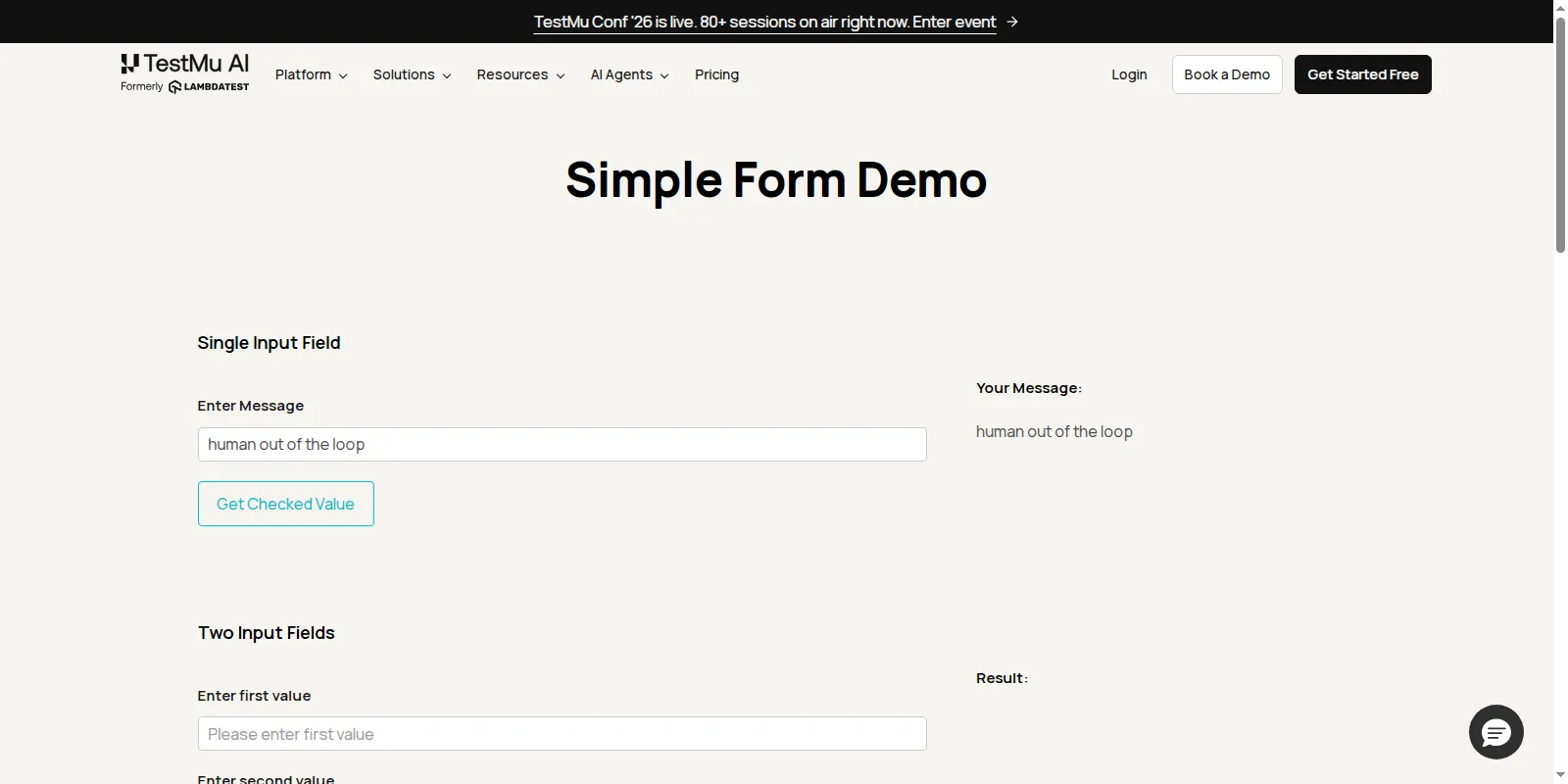
Use that pairing as your minimum bar. Every unattended gate should emit a machine-readable verdict naming its assertion, plus a visual artifact showing the state that satisfied it. The Kane CLI agent mode documentation covers the full event schema, including token usage and run directories.

Where Human Out of the Loop Testing Is Unsafe
Some gates should stay supervised regardless of how good the measurements look, because the cost of a wrong verdict is not paid in reruns.
- First runs of a new flow - there is no verdict-agreement history yet, so the exit criteria cannot be evaluated. Run the flow at L2 until a record exists.
- Payment and personal data paths - a false pass here can move money or expose records, and neither is reversible by redeploying. Keep the release gate human-approved even when the regression sweep around it is not.
- Compliance and accessibility sign-off - conformance attestations need a named human accountable for the claim. An unattended verdict can inform that decision but cannot be it.
- Objectives with vague pass conditions - an objective like "check that the page works" has no defined pass condition, so the run produces a passed verdict that means nothing. Ambiguity is the failure, not the autonomy.
- Anything holding secrets in the objective text - credentials written into an objective end up in screenshots, logs, and shared reports. Pass them as flagged secret variables instead.
- Very long multi-stage journeys - the time-horizon data makes these the least reliable candidates. Split them into shorter gates that each qualify on their own.
Note what is not on this list: complexity by itself. A long checkout journey split into four narrow gates with explicit assertions is a better autonomy candidate than a single short objective phrased vaguely. Specificity matters more than simplicity.
Testing an AI system is a separate discipline from letting AI run your tests, and the two get conflated often. If your product itself contains agents, the evaluation methods in AI agent testing apply on top of everything here.
How Humans Re-Enter the Loop When Something Breaks
Removing the human from the run does not remove the human from the system. It changes when they arrive and what they are handed, which has to be designed rather than assumed.
The most important re-entry trigger is disagreement between runs. When two runs of the same objective produce different outcomes, that usually points to application flakiness, an ambiguous objective, unstable selectors, or environment drift. A retry hides it. A trend surfaces it.
That is the job TestMu AI Test Insights does across an unattended fleet. It ingests the execution records the platform already holds, then uses failure-frequency analysis to surface consistently failing tests, clusters similar failures by error message, and reports a stability score per suite. Its agentic Root Cause Analysis correlates network, console, and framework logs to localize a likely cause, which the product is careful to describe as a lead to verify rather than a verdict.
The division of responsibility is worth stating plainly, because it is the shape of the QA role at L3. The execution products run the test and capture the record. The test's own assertions decide pass or fail. Test Insights aggregates, correlates, and surfaces the signal. A human fixes the chronically failing test, fixes the bug the analysis pointed at, or makes the release decision the trend supports.
- Set a flake threshold per gate and alert when the rolling rate crosses it, rather than reviewing dashboards on a schedule nobody keeps.
- Route a first-time failure differently from a repeat failure. The first needs investigation; the repeat needs a fix at the source.
- Sample passing runs, not only failing ones. False passes are invisible in a failure-driven workflow, and they are the specific risk autonomy introduces.
- Re-run the exit criteria monthly and demote any gate that no longer clears them. Autonomy granted once and never reviewed is how a quiet regression ships.
Note: Unattended runs only pay off when the failures they surface are readable. TestMu AI Test Insights turns per-run results into flakiness trends, error clusters, and AI root cause analysis you can act on. See the AI Root Cause Analysis documentation
Conclusion
Start with one gate this week. A pull-request smoke check on a preview branch is the easiest first pick: the objective is short, little breaks if the verdict is wrong, and you can undo it fast.
Run it at L2 for two weeks and write down four numbers: flake rate, verdict agreement, blast radius, and rollback time. Move it to L3 only if those numbers hold up, then re-check them every month.
For the authoring side, TestMu AI's KaneAI writes the tests from plain-English intent, and Kane CLI runs them unattended in CI with the evidence stream shown above. Grant autonomy one gate at a time, and only where the numbers back it.
For practitioner accounts, see The Full Agentic QA Loop for Web Applications and Legacy vs Autonomous QA Arena from Testμ 2026.
Author

Saurabh Prakash
Blogs: 19

Saurabh Prakash is an Engineering Manager at TestMu AI (formerly LambdaTest), where he leads engineering on agentic AI development and scalable system architecture for the quality engineering platform. He has also contributed to Test at Scale, the company's open-source test intelligence platform. He brings over 9 years of experience across Node.js, Java, Spring, MVC, data structures, algorithms, and scalable system design, with earlier roles as SDE 2 at Zomato, Senior Software Engineer at LogicHub, and Software Development Engineer at Directi. Saurabh holds a B.Tech in Computer Science and Engineering from Delhi Technological University.
Reviewer

Samyak Goyal
Reviewer
Samyak Goyal is a Senior Member of Technical Staff at TestMu AI engineering Kane CLI, the command-line tool that runs browser automation from the terminal, where a flow described in natural language executes in a real Chrome browser and returns pass or fail with shareable proof. He is a backend engineer with 4+ years of experience, previously an SDE at Innovaccer, where he built APIs, introduced Kafka, and cut deployment from weeks to hours. Samyak also builds multi-agent systems, skill-orchestration frameworks, and a personal copilot that indexes 200+ microservice repositories.


Human Out of the Loop Testing FAQs
Did you find this page helpful?
More Related Blogs
TestMu AI forEnterprise
Get access to solutions built on Enterprise
grade security, privacy, & compliance
- Advanced access controls
- Advanced data retention rules
- Advanced Local Testing
- Premium Support options
- Early access to beta features
- Private Slack Channel
- Unlimited Manual Accessibility DevTools Tests