

Power Your Software Testing with AI Agents and Cloud
The Native AI-Agentic Cloud Platform to Supercharge Quality Engineering. Test Intelligently and Ship Faster.


- TestMu AI (Formerly LambdaTest)
- /
- Learning Hub
- /
- What Is Quality Engineering? Role of a Quality Engineer
What Is Quality Engineering? Role of a Quality Engineer
Learn what quality engineering is, what a quality engineer does, digital QE, QE vs test engineer vs SDET, tools, metrics, and how AI shifts quality left.
Last Updated on:
On This Page
- What Is Quality Engineering?
- Digital Quality Engineering (DQE)
- Why Is Quality Engineering Important?
- Role of a Quality Engineer
- QE vs Test Engineer vs SDET
- Quality Engineering Goals
- Components of Quality Engineering
- Quality Engineering Tools
- Quality Engineering Life Cycle
- Quality Engineering Metrics
- How AI Enhances Quality Assurance and Engineering?
- Quality Engineering vs. Quality Assurance
Quality engineering, or QE, is the discipline that focuses on ensuring quality throughout the Software Development Life Cycle. It involves not only testing but also designing, developing and maintaining processes to ensure high-quality software products.
It includes various practices such as test automation, CI/CD, and others, which help simplify the development and testing process. When organizations adopt quality engineering principles, they can deliver software that meets customer expectations while fostering continuous improvement.
TL;DR
- Quality engineering builds quality into every phase of the software lifecycle instead of checking it only at the end.
- Quality engineering prevents defects in design and coding, where they are cheapest to fix, rather than finding them after the build.
- Requirements, design, implementation, testing and maintenance each carry their own quality gate in the quality engineering lifecycle.
- A quality engineer owns strategy, metrics and prevention, while an SDET builds the automation frameworks and CI tooling tests run on.
- Quality metrics such as defect density, escaped-defect rate and mean time to resolve are read as trends, not used to judge individuals.
- Quality assurance verifies a finished build against requirements, while quality engineering works proactively across design, development and deployment.
What Is Quality Engineering?
Quality engineering ensures quality is built into the Software Development Life Cycle right from the start. Instead of only looking for issues at the end, it focuses on embedding quality throughout the entire development process.
QA practices have evolved over time to be more proactive, but quality engineering takes this a step further by embedding quality throughout every phase. It incorporates quality measures as a key part of every phase, from design and planning to development, deployment, and maintenance. QE combines test automation, DevOps, CI/CD and continuous improvement to make quality a core part of the development lifecycle.
Quality engineering integrates with modern methodologies like DevOps and Agile, ensuring consistent quality in development and testing even as processes become faster and more adaptable. It also emphasizes collaboration between developers, testers and the operations team to identify areas for improvement and enhance processes.
The term "quality engineering" also has roots in manufacturing, where it covers industrial methods such as Six Sigma, Statistical Process Control (SPC), and Design of Experiments (DOE), governed by bodies like the American Society for Quality (ASQ). This guide focuses on quality engineering in software, where that same prevention-first mindset is applied across the SDLC.
What Is Digital Quality Engineering (DQE)?
Digital Quality Engineering (DQE) is the modern evolution of quality engineering for digital-first, cloud-native products.
It widens the goal from "does the software work" to business assurance: making sure every digital touchpoint, web, mobile, API, and connected device, delivers the outcomes the business depends on.
In practice, DQE shifts a team from reactive bug-hunting to proactive, data-driven system engineering. Its pillars are:
- Continuous testing - quality checks run on every commit in the CI/CD pipeline, not in a single phase at the end.
- Omnichannel coverage - the same journey is validated across browsers, real devices, and APIs so the customer experience holds everywhere.
- Business assurance - quality is measured against business outcomes like conversion, uptime, and accessibility, not just pass and fail counts.
- AI-driven engineering - AI generates tests, triages failures, and predicts risk, so effort goes where defects are most likely.
This is where an AI-native platform earns its place. TestMu AI pairs a cloud grid of 3,000+ browser and OS combinations and 10,000+ real devices with KaneAI for natural-language test authoring, so continuous, omnichannel quality engineering runs without a local device lab.
Why Is Quality Engineering Important?
Quality engineering is crucial as it ensures that your software is reliable, effective, and centered on users from the beginning. Here's why QE is crucial for delivering high-quality software products:
- Quality engineering focuses on implementing practices like testing, code reviews, and continuous integration, which help catch and fix bugs early. It makes your software more reliable, reducing the risk of crashes or unexpected issues. As a result, you build user trust and satisfaction.
- QE makes sure that a significant portion of your code is tested automatically. High code coverage means fewer runtime errors in production, which makes your software more stable and dependable.
- Automated regression tests are a key part of QE. They ensure that new changes don't affect existing functionality, which is especially important when your codebase is growing or when you frequently update your software.
- With QE, performance testing, such as load testing, stress testing, and profiling, helps you find issues in your code. It also ensures that your software works well even under heavy loads, can scale and stays responsive.
- Testing for security is an essential component of quality engineering. Methods like penetration testing, static code review, and dynamic analysis help detect security vulnerabilities like SQL injection or cross-site scripting.
- Quality engineering ensures that software is designed for scalability and maintainability. This involves creating modular, clear code structures that can adapt to increasing user demands, data growth, or feature expansions.
To implement QE practices effectively, it's essential to recognize the responsibilities of a quality engineer.

Note: Enhance your QE and QA with AI and the cloud. Run tests across 3,000+ browser and OS combinations on the TestMu AI cloud grid. Try TestMu AI Now!
Role of a Quality Engineer
Quality engineers often have a software engineering background, as their role involves writing automated tests. Their tasks vary based on company practices, tools, and whether the pipeline is cloud-based or on-premises.
In cloud environments, they adapt testing for scalability, while on-premises, they focus on infrastructure and compatibility. In addition to testing, they may also manage dependencies and governance policies. Further responsibilities will be discussed later.
Here is an overview of the main responsibilities of a quality engineer:
- Define and document quality standards, metrics, and KPIs with teams to ensure consistency and align with goals.
- Develop test plans, procedures, and quality assurance documentation to simplify software testing and improve team collaboration.
- Use automated testing tools to identify bugs early, maintain CI/CD pipelines, and simplify releases.
- Gather and report quality metrics to stakeholders, providing insights into trends, progress, and areas for improvement.
- Document errors and work with engineers to implement effective solutions.
- Perform regular testing to detect potential issues early in the development cycle.
- Write detailed reports on technical issues, offering solutions to fix bugs and improve software quality.
- Review consumer complaints and feedback to address quality issues.
- Monitor software performance in real-time, identify issues, and optimize the software to reduce operational costs and improve efficiency.
With this understanding in place, the primary goals below guide QE practices.
Quality Engineer vs Test Engineer vs SDET
These three roles overlap but sit at different points on the quality spectrum. Understanding the difference helps teams hire and structure QA correctly.
| Aspect | Test Engineer | SDET | Quality Engineer |
|---|---|---|---|
| Primary focus | Executing and maintaining tests | Building test frameworks and tooling | Designing quality processes across the SDLC |
| Core skill | Test case design, manual and automated execution | Coding, framework and CI integration | Strategy, metrics, pipelines, and prevention |
| Scope | A feature or product area | The automation infrastructure | The whole delivery lifecycle |
| Typical output | Test runs and defect reports | Reusable frameworks and harnesses | Quality gates, KPIs, and shift-left practices |
A Test Engineer verifies the product, an SDET builds what tests it, and a Quality Engineer owns how quality is engineered end to end.
Quality Engineering Goals
When implemented in software development, quality engineering has clear and specific goals that aim to ensure the quality of software products. These goals address the unique challenges and needs of the software development process:
- Detecting issues early - by performing thorough testing and validation early on, you can detect issues before they become major problems, helping prevent costly fixes later in the process.
- Ensuring quality - quality measures must be implemented throughout every stage of development, from collecting requirements to deployment.
- Enhancing the ongoing process - quality engineering is not just about achieving accuracy once. It involves consistently refining processes, tools, and practices to enhance software quality over time.
- Meeting customer expectations - your software should meet or exceed customer expectations. Quality engineering ensures that the final product delivers high value and user satisfaction.
Achieving these goals depends on the components that make up the QE framework.
Components of Quality Engineering
Quality engineering is about embedding quality into every step of software development. Here are its core components:
- Lifecycle integration - quality is incorporated at every stage, from design through to deployment. This method ensures that each decision and procedure aids in providing a reliable, high-quality product.
- Test automation - automated testing tools help speed up repetitive tasks like regression testing. They ensure consistent results and identify issues early, keeping the software stable and reliable.
- Continuous Integration and Delivery (CI/CD) - QE integrates into CI/CD pipelines. Every code change is automatically tested before deployment, reducing risks and supporting faster, smoother releases.
To put quality engineering into practice, teams use the following methodologies:
- Shift-left testing - this approach prioritizes testing early in development. Catching issues during the design or coding stages reduces the cost and effort of fixing them later.
- Test-driven development (TDD) - tests are written before the code, so it is built to pass specific tests, improving functionality and reliability.
- DevOps - DevOps brings developers and operations teams together. This collaboration ensures that quality checks are properly integrated throughout development.
These components are implemented effectively through the structured quality engineering life cycle.
Quality Engineering Tools and Technologies
No single tool covers quality engineering end to end. A working QE stack blends categories, and the goal is the fewest tools that still cover automation, pipelines, code quality, performance, and management with a shared evidence trail:
- Test automation - frameworks like Selenium and Playwright drive browser and end-to-end tests, ideally run at scale on a cloud grid rather than a handful of local machines.
- CI/CD - pipelines built with Jenkins, GitLab, or GitHub Actions run quality gates on every change so defects are caught at commit time.
- Code quality - static analysis tools such as SonarQube flag bugs, code smells, and security issues before code ships.
- Performance testing - load tools like JMeter verify the system holds up under realistic traffic.
- Test management - a management layer links requirements to tests, runs, and defects, keeping traceability and evidence in one place.
TestMu AI ties several layers together: a cloud grid for Selenium, Playwright, and Cypress across 3,000+ browser and OS combinations and 10,000+ real devices, plus KaneAI for test authoring.
A test management layer adds traceability and reporting, so the QE stack stays connected instead of siloed. The Test Manager documentation walks through cases, cycles, and traceability.
Quality Engineering Life Cycle
The quality engineering lifecycle consists of five phases: requirements, design, implementation, testing, and maintenance. Each stage is important for maintaining quality throughout development.
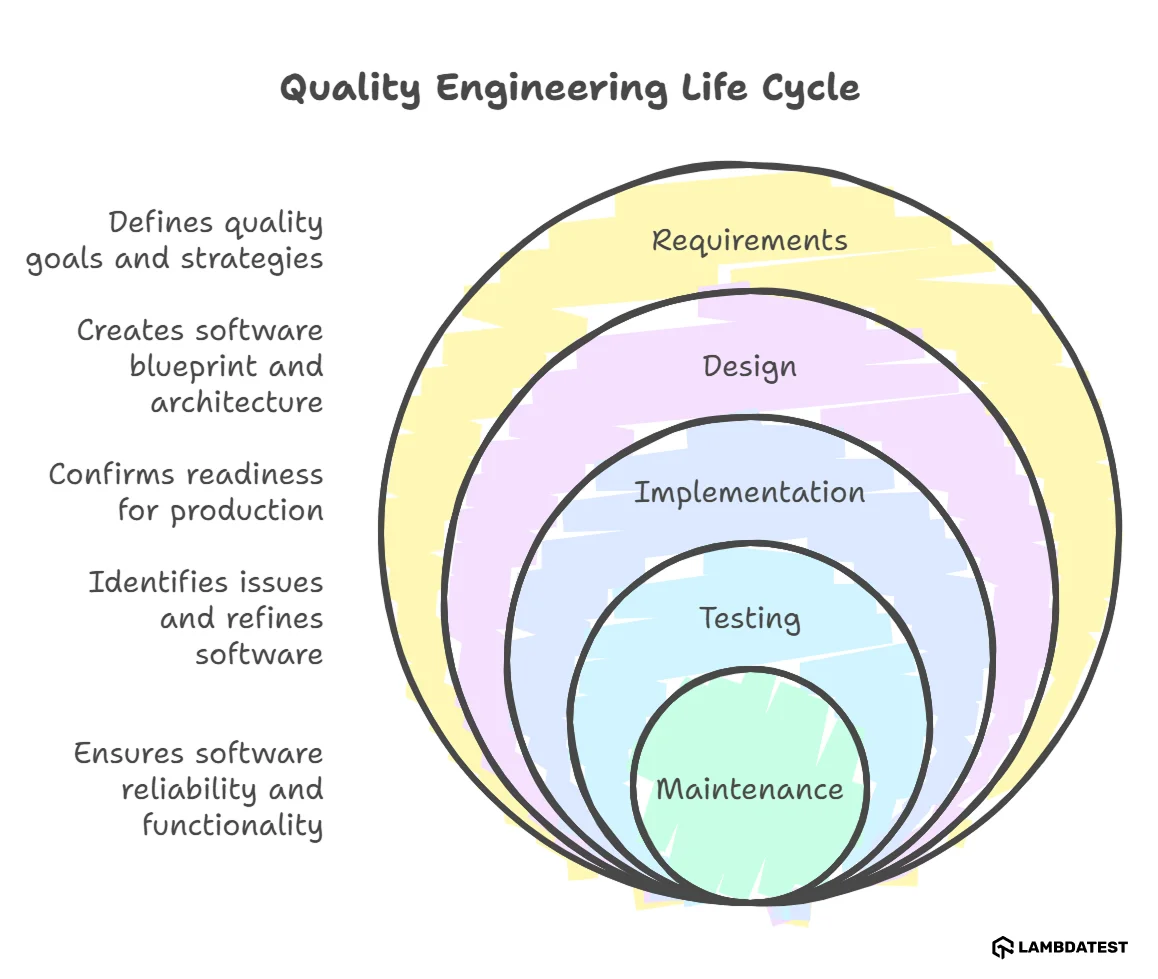
- Requirements - defines the project's quality goals and strategies. Quality engineers work with stakeholders to identify performance specs like reliability, scalability, and security.
- Design - the focus here is on creating a detailed software blueprint. Quality engineers work together to design the architecture and workflows required to meet the quality goals established during planning.
- Implementation - in this phase, the focus is on building the software product according to the design specifications. Developers write and integrate code, following the quality standards and best practices defined earlier.
- Testing - during this phase, the software is thoroughly tested to identify any issues. Quality engineers evaluate prototypes or early builds using both manual and automated testing methods.
- Maintenance - the lifecycle continues after deployment, focusing on monitoring and updating the software to keep it reliable and functional.
They also list down production requirements, tools, resources, timelines, and potential risks. Developers, testers, and product managers work together to align expectations and create a clear roadmap that focuses on quality at every stage.
Every design element, from user interfaces to backend functions, is carefully reviewed to ensure it aligns with these standards. Best practices in coding and predefined quality checkpoints are incorporated into the development process to minimize errors and improve overall results.
Quality engineers collaborate closely with the development team to ensure adherence to coding standards and conduct early-stage testing.
Automated testing handles repetitive tasks, while manual testing focuses on more complex scenarios that need human judgment. Teams that want that automated layer to keep pace with every build often bring in an AI QA agent that turns a natural language description of a flow into runnable steps, executes them across browsers and real devices, and self-heals those steps when the UI shifts, with quality engineers reviewing each plan and heal before it lands. The feedback from these tests helps developers refine the software and resolve issues.
Regular testing helps identify new issues or areas for improvement, while performance monitoring tools track real-world functionality to ensure the software meets user expectations.
Quality Engineering Metrics
Quality engineering relies on specific metrics to gauge performance and identify areas that may require improvement.
Below are key indicators used to measure QE success:
- Defect density - evaluates codebase quality by determining the number of defects for each code unit, like defects per thousand lines of code. A reduced defect density signifies fewer errors.
- Test coverage - measures the amount of code that has been tested. Higher test coverage reduces the chances of missed defects and ensures greater reliability.
- Mean time to detect and resolve issues - reflects how quickly your team can find and fix defects. Faster detection and resolution lead to smoother development cycles and help avoid production delays.
- Customer satisfaction - measures how well the software meets user expectations. Positive feedback indicates that the software works as intended in real-world scenarios.
- Cost of quality - checks for the expense of maintaining quality during development. It includes testing costs, fixing defects, and addressing any business impact from issues.
- Release stability - monitors the number of major issues or defects that appear after a product release. Fewer defects indicate a successful QE process.
- Regression test pass rate - tracks the number of regression tests that passed after software updates or changes. A high pass rate shows that new changes have not impacted existing functionality.
These metrics describe the system, not the individual. Counts attached to a person, such as bugs logged or test cases executed, are easy to game and push engineers toward volume instead of risk coverage, so quality engineers read the indicators above as trends across runs rather than as scorecards.
Reading them that way needs data from every run in one place. TestMu AI's Test Intelligence aggregates execution records across builds, browsers, devices, and teams, ranks flaky tests by severity, clusters failures that share an error signature so one fix closes many tickets, and generates root cause analysis that correlates network, console, and framework logs into a likely cause for an engineer to confirm. One caveat matters: these trends only reflect reality when the assertions and logs behind them are sound, so instrumentation quality sets the ceiling on every metric here.
How AI Enhances Quality Assurance and Engineering?
Quality engineers use QA testing tools to ensure that their releases meet project requirements. This helps provide a great user experience and minimize bugs or defects. However, with the rise of AI today, AI native agents, such as KaneAI, boost the efforts of QE teams and make testing more efficient.
KaneAI by TestMu AI is a GenAI native QA Agent-as-a-Service platform for high-speed quality engineering teams. With KaneAI, you can quickly create and refine complex test cases using natural language, removing the learning curve associated with test automation.
Key Features:
- Smart test generation - create tests easily using natural language commands.
- Intelligent test planner - creates and automates test steps using high-level objectives.
- Multi-language code export - convert your automated tests into different programming languages and frameworks.
- Easy integration - use KaneAI in Slack, Jira, or GitHub issues to trigger test automation directly from these platforms.

Now, let's look at how quality engineering is different from traditional quality assurance in embedding quality throughout the development process rather than focusing on final-stage testing.
Quality Engineering vs. Quality Assurance
Here's how quality engineering differs from quality assurance:
| Aspect | Quality Engineering | Quality Assurance |
|---|---|---|
| Focus | Focuses on integrating quality into the entire development lifecycle. | Ensures product meets quality standards through defined processes. |
| Scope | Covers the entire Software Development Life Cycle. | Mostly centered on the testing phase. |
| Approach | Proactive and prevents defects by improving processes and practices. | Reactive and detects and fixes defects after they occur. |
| Techniques | Uses automation testing, DevOps, and CI/CD pipelines for testing and deployment. | Uses manual and automation testing and also includes usability, performance, regression testing, and more. |
| Feedback Loop | Provides continuous feedback to developers to fix the issues. | Feedback is primarily retrospective and used for process improvement. |
Conclusion
Start by mapping your current QE stack against the five lifecycle phases above and flagging where quality checks are still a final-phase gate instead of a continuous one. That gap, usually between design and implementation, is where most escaped defects originate.
Unlike traditional quality assurance, which focuses on finding defects, QE emphasizes preventing them. It also promotes collaboration and continuous improvement. QE uses data-driven insights and advanced tools to improve processes, helping reduce defects and enhance the product's overall performance.
To put this into practice, run your first suite on the TestMu AI automation cloud and follow the Test Manager documentation linked above to connect requirements, runs, and defects in one traceability view.
Author

Nazneen Ahmad
Blogs: 39


Nazneen Ahmad is a freelance Technical Content SEO Writer with over 6 years of experience in crafting high ranking content on software testing, web development, and medical case studies. She has written 60+ technical blogs, including 50+ top-ranking articles focused on software testing and web development. Certified in Automation Basic and Advanced Training - XO 10, she blends subject knowledge with SEO strategies to create user focused, authoritative content. Over time, she has shifted from quick, keyword-heavy drafts to producing content that prioritizes user intent, readability, and topical authority to deliver lasting value.
Reviewer

Srinivasan Sekar
Reviewer
Srinivasan Sekar is Director of Engineering at TestMu AI (formerly LambdaTest), where he leads engineering and open-source initiatives behind the Selenium and Appium automation grid and owns TestMu AI's MCP Server. A committer to Appium and a contributor to Selenium, WebdriverIO, Taiko, and AppiumTestDistribution, he brings over 15 years of experience in quality engineering and open-source technologies. He is the author of the Apress book 'The MCP Standard: A Developer's Guide to Building Universal AI Tools with the Model Context Protocol,' a Certified Kubernetes and Cloud Native Associate, and an international conference speaker. Before TestMu AI he spent over eight years at Thoughtworks as a Principal Consultant and Quality Architect. Srinivasan holds a B.Tech in Information Technology from Anna University.


Quality Engineering FAQs
Did you find this page helpful?
More Related Learning Hubs
TestMu AI forEnterprise
Get access to solutions built on Enterprise
grade security, privacy, & compliance
- Advanced access controls
- Advanced data retention rules
- Advanced Local Testing
- Premium Support options
- Early access to beta features
- Private Slack Channel
- Unlimited Manual Accessibility DevTools Tests