
Power Your Software Testing with AI Agents and Cloud
The Native AI-Agentic Cloud Platform to Supercharge Quality Engineering. Test Intelligently and Ship Faster.

- TestMu AI (Formerly LambdaTest)
- /
- Blog
- /
- QA Agent vs Verification Tool: When You Need Each (2026)
QA agent vs verification tool is a choice about who decides what gets checked: a QA agent plans its own tests, while a verification tool proves one defined condition and returns pass or fail. AgentAssay measured that gap across 7,605 trials, where behavioral fingerprinting reached 86% detection power and binary testing had 0%.[1]
This guide covers what separates the two shapes, what each proves, why deterministic assertions break on agents, how to earn a trustworthy verdict, when you need each, the silent failures both miss, and how both fit into CI/CD.
Key Takeaways
- Decision authority: The dividing line is not intelligence but who chooses the test case, so ask whether the system was told what to check or worked it out itself.
- Three-valued verdicts: Add an inconclusive result alongside pass and fail so a noisy run triggers more trials instead of a false alarm.
- Evidence anchoring: Tie every pass to an observable artifact such as DOM state, an HTTP status, or a database row rather than to model output.
- Judge reliability: No LLM judge tested was uniformly reliable, so reserve model grading for subjective checks and let code assert anything mechanical.
- Pipeline placement: Gate merges with deterministic verification and schedule agent runs nightly, where variable runtime and token cost are affordable.
- Trial budgeting: Measure an agent's pass rate over repeated runs, because one failure can be sampling noise and one success can be luck.
QA Agent vs Verification Tool: What Is the Real Difference?
A QA agent chooses what to test and adapts across runs. A verification tool checks one condition you defined and returns pass or fail with evidence. Decision authority is the dividing line.
The distinction is about authority, not capability. Both systems can use a large language model, drive a real browser, and produce a report. What separates them is whether the system was handed the claim to check or derived that claim on its own.
A QA agent and a verification tool produce different kinds of output. A verification tool produces evidence, which is a statement about one moment that a person can audit later. A QA agent produces coverage, which is a judgment about what was worth examining. Coverage is more valuable when nobody knows what to look for, and evidence is more valuable when someone will ask you to prove it.
| Dimension | QA agent | Verification tool |
|---|---|---|
| Who picks the test | The agent derives it from the application, a diff, or a stated goal | A person or a calling process supplies the exact condition |
| State across runs | Persistent, so coverage changes as the codebase changes | Stateless, so the same input yields the same check every time |
| Output shape | A set of findings plus a rationale for each | One verdict plus the artifact that supports it |
| Failure mode | Misses what it never chose to examine | Misses everything outside the condition it was given |
| Run cost | Model tokens per step, variable per run | Compute only, near constant per run |
What Does a QA Agent Actually Do?
A QA agent runs a plan-act-verify loop. It reads the application, decides which flows matter, generates and runs the tests, then interprets failures and updates its own coverage on the next run.
The loop is what makes the agent shape useful and also what makes it hard to trust. Because the agent derives its plan at runtime rather than replaying a fixed script, two runs against an unchanged application can take different routes to the same goal. A flow that passed on Monday can fail on Wednesday because the agent navigated differently, not because anything regressed.
Runtime plan derivation is the mechanism behind both the agent's strengths and its weaknesses. Deriving the plan at runtime is why an agent can keep working after a button changes from an id to a class, and equally why its results need repeated sampling before anyone should act on them. Teams working through this trade-off in depth usually start with a broader AI agent testing foundation before choosing a shape.
- Goal decomposition: The agent turns a broad instruction such as "check the checkout flow" into an ordered set of bounded actions it can execute and observe.
- Runtime path selection: The agent resolves how to reach an element during the run, which is why click paths vary between executions on identical builds.
- Failure interpretation: The agent reads a failed step and classifies it as an application defect, an environment problem, or its own navigation error.
- Coverage carry-over: The agent keeps context between runs, so a flow it examined last week can be deprioritized in favor of code that changed since.
What Does a Verification Tool Actually Prove?
A verification tool proves one stated condition held at one moment, backed by observable evidence: DOM state, an HTTP status, a database row, or a screenshot. It never decides what is worth checking.
The narrowness is the feature. Because the claim is fixed before the run starts, the result is reproducible and auditable, and a disagreement between two runs points at the application rather than at the checker. That property is what makes verification usable as a merge gate and as compliance evidence.
A verification tool also fails in a predictable way, which is rarer than it sounds. When it reports a failure, the failure is about the condition it was given. It will never surprise a team with a finding about an unrelated flow, and it will never widen its own scope.
Related patterns show up across agentic regression testing work, where teams separate what they delegate from what they insist on proving.
Why Do Deterministic Assertions Break on AI Agents?
Because the same prompt, tools, and model produce different runs. An equality assertion compares one sampled path against another, so it fails on rewording and passes on broken behavior.
AgentAssay names the gap directly: no principled methodology exists for verifying that an agent has not regressed after changes to its prompts, tools, models, or orchestration logic.[1] That is why it replaces the binary verdict with stochastic three-valued verdicts grounded in hypothesis testing. A pass/fail equality check cannot separate a genuine regression from ordinary run-to-run variation.
The measured consequence is the part worth remembering. Across 7,605 trials spanning 5 models and 3 scenarios, behavioral fingerprinting reached 86% detection power where binary testing had 0%.[1] A suite of exact-match assertions on an agent is not a weak safety net. On that evidence it is closer to no safety net at all, while still consuming maintenance time.
Reliability research points the same direction. A 2026 study evaluating 15 models across two benchmarks proposes twelve reliability metrics across consistency, robustness, predictability, and safety, and reports that recent capability gains have produced only small improvements in reliability.[2] A more capable model does not remove the need to measure variance.
Agent non-determinism is a different problem from ordinary test flakiness, though the symptoms look alike. A flaky test is usually non-deterministic by accident, through timing or shared state, and the fix is to remove the source of variance. An agent is non-deterministic by design, so the variance cannot be removed and has to be measured instead.

Note: Verification runs on the same cloud grid as the rest of your suite with TestMu AI. Try free!
How to Get a Trustworthy Verdict From a Non-Deterministic System?
Replace the single binary verdict with a pass rate measured over repeated runs, and anchor each run to observable evidence rather than model opinion. AgentAssay adds a third verdict: inconclusive.
Three-valued verdicts change what a red run means. Under a pass, fail, and inconclusive scheme grounded in statistical hypothesis testing, a single odd result asks for more trials instead of paging someone. AgentAssay reports cutting required trials by 78% using sequential testing rather than a fixed run count, so the extra statistical rigor costs less than a naive repeat-everything approach.[1]
The second half of the answer is where the verdict comes from. Letting the model grade its own run is the tempting shortcut, and it is the one with a documented failure mode. The Judge Reliability Harness study evaluated four leading judges across four benchmarks and found that no judge was uniformly reliable, with judging accuracy shifting under simple text formatting changes, paraphrasing, and changes in verbosity.[3]
The practical rule that falls out of this: use a judge only for claims that genuinely require reading, such as tone or relevance, and use code for everything a machine can check exactly. A status code, a row count, and a rendered string never need an opinion.
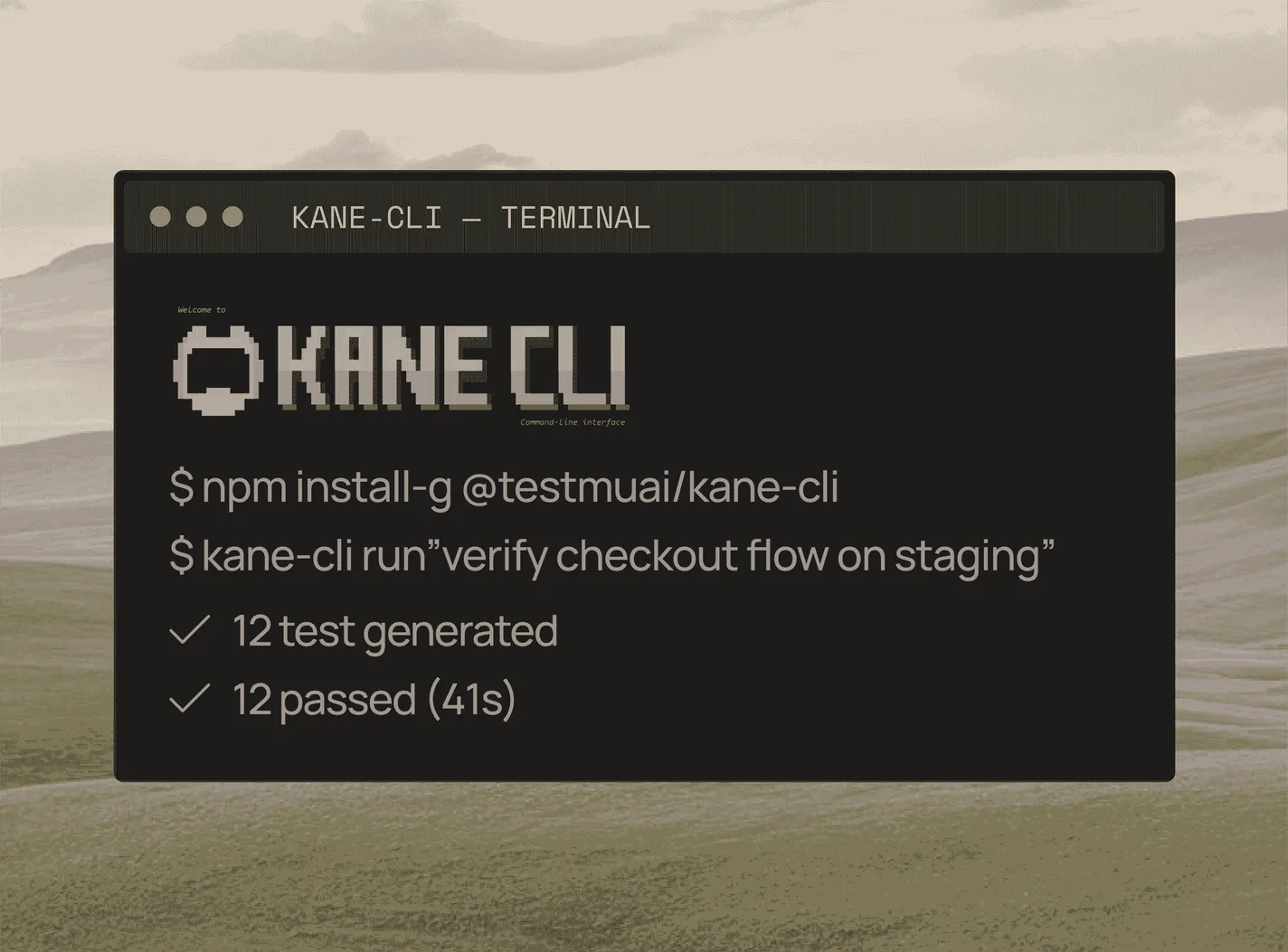
Teams hit a concrete version of this problem when an AI coding agent reports that a change works while the rendered page is broken, because the agent is grading its own output. Kane CLI separates those two roles: the model decides how to reach a screen, and the pass decision is anchored to evidence the model does not control.
- Evidence-anchored verdicts: A run passes only when the expected state is confirmed through DOM state, stable selectors, URL changes, network responses, console logs, or explicit assertions.
- Surfaced disagreement: When two runs reach different outcomes, that difference is reported as a signal about application flakiness, an ambiguous instruction, or environment drift rather than being retried away.
- Auditable step traces: Each run returns a full step trace with a screenshot per step, so a reviewer can reconstruct why a verdict was reached.
The official documentation covers the command syntax and the CI configuration in detail.
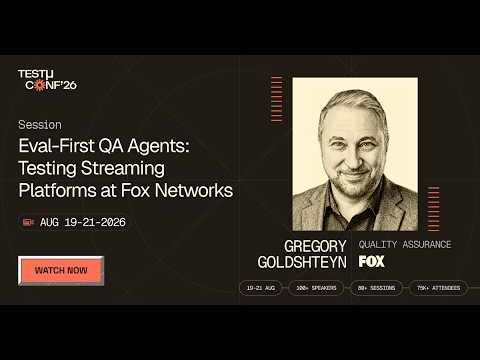
In this TestMu Conf 2026 session, Gregory Goldshteyn shows what that same discipline looks like inside a production QA org in Eval-First QA Agents: Testing Streaming Platforms at Fox Networks, opening with the observation that everyone is building AI agents for QA, most ship demos, and almost none have evals.
When Do You Need a QA Agent vs Verification Tool?
Use a verification tool when the check is known and the answer must be defensible. Use a QA agent when coverage is unknown and the UI changes faster than a team can script it. Most teams need both.
The honest answer to the timing question is that a QA agent and a verification tool are not sequential stages a team graduates through. The two shapes map to two different questions that both stay live: "did this specific thing work?" and "what should we be checking that nobody has written down?"
Anthropic's engineering write-up on multi-agent coordination draws the same line in a different context. It recommends an orchestrator-subagent split when subtasks are short, focused, and produce clear outputs, and agent teams when subtasks benefit from sustained, multi-step work.[4] The deciding criterion is whether context needs to persist. That is the same criterion that separates a verification call from a standing QA agent.
Anthropic's post is about coordination patterns between agents, not a five-point framework for choosing tools over agents. The transferable idea is whether context needs to persist, not a ready-made checklist.
Reach for a verification tool when:
- One-sentence check: The task can be stated in a sentence with an unambiguous pass condition, such as confirming a discount code reduces the cart total.
- Merge-blocking gate: A failure has to stop a merge, which requires a result that is repeatable rather than probabilistic.
- Audit exposure: Someone outside the team will ask for proof, so the run needs an artifact rather than a summary.
- Caller-driven runs: Another process, often an AI coding agent, needs a bounded answer at the end of its own loop.
Reach for a QA agent when:
- Unknown coverage: The team cannot list the flows that need testing, which is the normal state after a fast feature quarter.
- Maintenance overload: Fixing selectors after routine UI changes consumes a large share of QA time and crowds out new coverage.
- Exploratory breadth: The goal is finding unknown defects off the happy path rather than confirming known behavior.
- Shifting surfaces: Screens change weekly, so a scripted suite is stale before it finishes being written.
The pattern most teams converge on is a pyramid: deterministic unit and API checks at the base, a scripted end-to-end suite over critical paths in the middle, and an agent layer on top for breadth. The base blocks merges. The top finds what the base was never told to look for.
A closely related split is covered in ai code review vs verification, which separates judging code from proving it runs.
What Silent Failures Does Each Shape Miss?
A QA agent misses failures it never chose to examine and can report success on an action it never completed. A verification tool misses everything outside the single condition it was handed.
The agent-side failure is the more dangerous of the two because it looks like success. An agent can produce a confident, well-worded summary saying a refund was processed while the underlying refund call never executed. Checking the final response text catches none of this, since the text is exactly what a correct run would have produced.
The fix is to evaluate the trajectory rather than the reply: assert on the sequence of actions the agent took, not on the sentence it wrote at the end. That is a different assertion target from the one most teams start with, and it usually requires logging tool calls as first-class output.
The verification-side failure is quieter and more common. A green suite of narrow checks creates confidence proportional to the number of assertions rather than to the share of the product actually covered, and no verification tool reports the gap.
Verification cannot tell a team what it forgot to ask, which is precisely the blind spot the agent shape exists to cover. Choosing what evidence a verification agent collects is what decides whether that gap stays visible.
Testing a conversational agent turns this into its own discipline, because the output is language rather than a rendered page. TestMu AI's agent testing platform scores chat and voice agents against fixed dimensions including hallucination detection, completeness, and context awareness, so a run produces a comparable score rather than a single subjective read.
- Hallucination detection: Flags an agent stating information its knowledge base and context never supported, such as inventing a plan renewal date.
- Completeness: Flags a response that addresses the topic without answering the question, such as explaining a cancellation policy but not the steps.
- Context awareness: Flags an agent re-asking for information the user already supplied earlier in the same conversation.
Both blind spots become visible through the same practice, which is recording what the system did rather than what it said. Instrumenting runs this way is the subject of agent observability, and it is the prerequisite for trusting either shape in production.
Evaluate AI Agents Against Fixed Quality Metrics

How Do Both Fit Into a CI/CD Pipeline?
Run verification on every pull request as the merge gate, because it is fast and repeatable. Run QA agents nightly or on a schedule, where longer runtimes and variable token cost are acceptable.
Cost is the constraint that decides the placement. Every agent step consumes model tokens, and a trustworthy verdict needs repeated trials rather than one run, so the bill scales with both.
Sequential testing cuts the required trials by 78% against a fixed run count, which reduces that multiplier without removing it.[1] Applied to every commit in a busy repository, the arithmetic still rules out putting an agent on the blocking path.
Trust is the second constraint, and it fails faster than budget. A merge gate that sometimes blocks a correct change teaches engineers to re-run the job until it goes green, which destroys the gate's meaning within a few sprints. A gate has to be repeatable to stay a gate.
The same reflex shows up on the scheduled run whenever a red result turns out to be the agent's own navigation error rather than a defect. A run that could not verify a criterion is a different state from a run that verified it and failed, and a gate that collapses the two trains the same re-run habit.
A workable division of labor puts each shape where its properties fit. Verification answers the pull request. The agent answers the week.
- Pull request stage: Deterministic checks over critical paths, blocking on failure, with the artifact attached to the pull request for review.
- Nightly stage: Agent runs over the wider surface, non-blocking, producing findings a person triages the next morning.
- Promotion stage: Agent findings that recur across several nights get converted into fixed verification checks and move down into the merge gate.
- Variance review: Runs that come back inconclusive get more trials rather than a retry, so genuine regressions are separated from sampling noise.
The promotion stage is the one teams skip and the one that compounds. Every agent finding that becomes a deterministic check permanently converts an expensive probabilistic result into a cheap repeatable one, which is how the agent layer pays for itself instead of becoming a second suite to maintain. Teams formalizing this loop often follow the practices in verification-driven development.
Generating the Adversarial Cases Nobody Wrote Down
A verification tool checks the claim it was handed, and nobody hands it a prompt injection hidden in user-supplied text. Adversarial cases are the ones nobody writes down: a jailbreak phrased as a policy question, a request that walks an agent into repeating a customer record back. TestMu AI Agent Assurance generates that class alongside the functional set, runs the agent for real, and grades every criterion against observed evidence.
- Adversarial coverage: Prompt injection, jailbreak, data exfiltration, PII leakage, and policy violation scenarios, written from the agent's own prompts, tool tables, and MCP servers.
- Observed evidence: Criteria are graded on files changed on disk, artifacts produced, and tool calls checked against the agent's declared tool surface.
- A third verdict: Unable to Verify sits beside Pass and Fail and is excluded from the pass-rate denominator, and the share of criteria a run could not verify is reported beside the pass rate as the assurance gap.
- Terminal runs: The rook CLI, Apache 2.0 and pre-alpha, covers 18 scenario categories across functional, non-functional, and adversarial classes.
The Autonomous category, for agents that call tools and write files, is on a waitlist. Point a run at staging, because the writes the agent makes are real and cannot be rolled back. A finished run exits 0 whether scenarios passed or failed, so a CI gate reads the verdicts in the JSON report rather than the exit status.
Conclusion
Start by sorting your existing checks by who wrote the claim. Anything a person stated in advance belongs in the verification layer, on the merge gate, producing an artifact. Anything nobody has written down yet is the QA agent's territory, scheduled and non-blocking.
The QA agent vs verification tool question resolves once a team stops treating it as a purchase decision and starts treating it as a routing decision. The agent shape buys coverage on surfaces changing too fast to script. The verification shape buys evidence that survives an audit.
Measuring an agent's pass rate over repeated runs, and promoting its recurring findings into fixed checks, is what keeps the two reinforcing each other rather than duplicating work.
A practical first step is to pick one flow an agent flagged twice last month and write it as a deterministic check this week. Run it on automation cloud alongside the rest of your suite, then measure how often the agent and the fixed check disagree. That disagreement rate is the most useful number either shape will give you.
Sources and References Used
- [1] AgentAssay: Token-Efficient Regression Testing for Non-Deterministic AI Agent Workflows - Varun Pratap Bhardwaj, arXiv (March 2026)
- [2] Towards a Science of AI Agent Reliability - Rabanser, Kapoor, Kirgis, Liu, Utpala, and Narayanan, arXiv (February 2026)
- [3] Judge Reliability Harness: Stress Testing the Reliability of LLM Judges - Dev, Sloan, Kavner, Kong, and Sandler, arXiv (March 2026)
- [4] Multi-agent coordination patterns: Five approaches and when to use them - Anthropic (April 2026)
Author

Prince Dewani
Blogs: 30

Prince Dewani is a Community Contributor at TestMu AI specializing in AI agents, software testing, QA, and SEO. He is certified in Selenium, Cypress, Playwright, Appium, Automation Testing, and KaneAI, and presented academic research on AI agents at PBCON-01. At TestMu AI, he has also carried out extensive cross-browser research on the support of modern web technologies such as WebGPU, WebAssembly, WebXR, WebGL2 and other web technologies, validating their compatibility and feature parity across major browsers and rendering engines through rigorous hands-on testing. Prince has hands-on experience building AI agent workflows using Anthropic Claude, Google Antigravity, n8n, LangChain, and other agentic frameworks, and works regularly with MCP and A2A protocols. He shares his work with 5,500+ QA engineers, developers, DevOps experts, tech leaders, and AI agent practitioners on LinkedIn.
Reviewer

Sai Krishna
Reviewer
Sai Krishna is Director of Engineering at TestMu AI, where he leads agentic AI for quality engineering, building AI agents that autonomously drive mobile and conversational test automation. His current focus is Agent Testing and Model Context Protocol (MCP) support for mobile. He is a core contributor and member of the Appium open-source project and the creator of AppiumTestDistribution and appium-device-farm. With over 14 years of experience including more than 9 years at Thoughtworks as a Principal Consultant, he holds a BSc in Electronics and speaks regularly at TestMu and Appium Conf on Appium, mobile automation, and agentic AI in testing.


QA Agent vs Verification Tool FAQs
Did you find this page helpful?
More Related Blogs

TestMu AI forEnterprise
Get access to solutions built on Enterprise
grade security, privacy, & compliance
- Advanced access controls
- Advanced data retention rules
- Advanced Local Testing
- Premium Support options
- Early access to beta features
- Private Slack Channel
- Unlimited Manual Accessibility DevTools Tests