
Product Use Cases Articles
RSS feed39 articles found in Product Use Cases
Find why a test failed with TestMu AI's AI root cause analysis: generate an RCA in 30 seconds, read it, automate it, pull it via API and close the loop.

Sandeep Yadav
September 28, 2026
5 min read
KaneAI tests desktop apps that render their interface in a browser engine, such as Electron apps built on Chromium, by describing flows like settings changes or onboarding in plain English rather than scripting WinAppDriver or Appium. It runs those steps through a secure tunnel for firewalled builds and exports the finished test to Selenium, Playwright, Cypress, or Appium code.

Akshay Tamrakar
July 22, 2026
5 min read
TestMu AI tests a chatbot by sending autonomous AI evaluators to converse with it like real users, then scoring every reply across nine quality metrics such as hallucination detection, context awareness, and tone consistency instead of matching one exact string. It also probes for prompt injection and jailbreaks, needing no code, scripts, or maintained assertions.

Chaitanya Sharma
July 22, 2026
5 min read
TestMu AI tests a voice agent by placing real phone calls through autonomous phone-caller agents and scoring the conversation across more than 30 metrics, including intent recognition, speech-to-text accuracy, containment rate, and estimated CSAT. It runs the same scenario through 200+ voice profiles, 50+ accents, and 15 background-noise presets, catching failures a single scripted call never reaches.
Chaitanya Sharma
July 22, 2026
5 min read
TestMu AI tests an IVR system by placing a real phone call, pressing the same DTMF digits a caller would, and scoring the routed path across more than 30 metrics, including DTMF Detection, Containment Rate, and First Call Resolution, instead of a telephony script that breaks when a menu is reordered. It also runs paths through accents and noise.
Chaitanya Sharma
July 22, 2026
5 min read
TestMu AI tests a WhatsApp bot by sending AI evaluators to message it the way real customers would, over the same chat endpoint your customers use, then scoring each conversation across nine quality metrics such as hallucination detection, context awareness, and tone consistency. A separate red-team pass probes for prompt injection, jailbreaks, and PII leaks, all without an SDK.

Samyak Goyal
July 22, 2026
5 min read
TestMu AI tests AI agents by turning a plain-English description of the agent's job into 60 to 100 or more scenarios, which 15+ autonomous evaluators run and score for hallucination, bias, lost context, and broken guardrails. Each run ends in a Green, Yellow, or Red go-live verdict backed by the exact conversation turn that failed.

Hari Sapna Nair
July 22, 2026
5 min read
TestMu AI tests a Vapi voice agent by placing real phone calls to it and scoring each stage of its speech-to-text, reasoning, and text-to-speech pipeline, across more than 30 telephony metrics and nine conversation-quality metrics, instead of scripting the Vapi API by hand. It also checks Squad handoffs and tool calls, returning a Green, Yellow, or Red verdict.

Poornima Pandey
July 22, 2026
5 min read
TestMu AI tests a Retell agent by placing real outbound phone calls to it and scoring each conversation across more than 30 voice metrics, including intent recognition, speech-to-text accuracy, and accent handling, instead of scripting the Retell SDK by hand. Results include a confidence level and the exact transcript turn behind any failure.

Nandini Pawar
July 22, 2026
5 min read

Testing a Voiceflow bot without code means describing each conversation turn in plain English and letting an AI evaluator run it against the live agent, scoring replies on nine quality metrics such as hallucination, completeness, and context awareness across chat and voice. Setup takes under half an hour, and checks can trigger automatically from CI/CD on every Voiceflow publish.
Samyak Goyal
July 22, 2026
5 min read
Login flows can be tested without code by using KaneAI to describe steps in plain English, covering valid and invalid credentials, two-factor authentication with generated TOTP codes, SSO redirects to identity providers, account lockouts, and password reset. The same test runs across the TestMu AI grid of 3,000+ browser and OS combinations and on real mobile devices.

Devansh Bhardwaj
July 21, 2026
5 min read
Testing signup and onboarding without code means writing plain-English steps, like filling a multi-step form and entering a generated TOTP code, so a tool such as KaneAI can carry state across pages, complete email verification inline, and generate two-factor codes from the signup secret. Adaptive branching then follows a different onboarding path for each plan or role.

Kavita Joshi
July 21, 2026
6 min read
Testing a payment gateway without code means describing checkout steps, like entering a sandbox card number and clicking Pay, in plain English so a tool such as KaneAI can locate fields inside Stripe, Braintree, or Adyen iframes and verify the result. It also covers declined cards, 3D Secure challenges, refunds, and insufficient-funds errors across real browsers.

Suryapratap Singh Chauhan
July 21, 2026
6 min read
Forms can be tested without writing code by using KaneAI to describe validation checks, conditional fields, and file uploads in plain English instead of scripting against CSS selectors. This covers required-field errors, fields that appear after a selection, file size and type validation, and input masking, and runs across the TestMu AI grid of 3,000+ browser and OS combinations.

Isha Vyas
July 21, 2026
6 min read
Testing search functionality without code means writing plain-English steps, like typing a query and checking that the top result mentions it, so a tool such as KaneAI can judge relevance by reading result content rather than a fixed DOM position. It also verifies autocomplete suggestions, filters and facets, zero-result and typo handling, and sort order.

Reshu Rathi
July 21, 2026
5 min read
KaneAI tests email workflows by signing up in the browser, waiting for a real inbox to receive the confirmation, password-reset, or magic-link message, then opening that link and verifying where the app lands, all described in plain English. It also generates TOTP codes for two-factor accounts and checks that transactional content like order numbers matches what the app recorded.

Shravan Mahajan
July 21, 2026
6 min read
Two-factor authentication testing with KaneAI, TestMu AI's no-code testing tool, means writing each step in plain English instead of code, then letting the tool generate a live TOTP code from your secret key to complete login in one pass. It also verifies backup codes, trusted-device logic, and lockouts, running the test across multiple browsers, operating systems, and real mobile devices.
Devansh Bhardwaj
July 21, 2026
6 min read
Testing single sign-on without code means writing plain-English steps, like clicking Sign in with SSO and logging in at the identity provider, so KaneAI can follow the redirect across domains and confirm the session cookie and dashboard load correctly on return. It also generates TOTP codes for a second factor and verifies logout ends the session everywhere.
Kavita Joshi
July 21, 2026
6 min read
File upload flows can be tested without code by using KaneAI to describe upload steps in plain English, covering drag-and-drop and button-based uploads, file size and type validation, progress and success states, and previews. The same test also runs across the TestMu AI grid of 3,000+ browser and OS combinations and on real mobile devices.
Shravan Mahajan
July 21, 2026
6 min read
KaneAI tests a booking flow by describing date-picker selection, slot availability, double-booking, and payment hand-off in plain English rather than code, then running those steps against your live site the way a human tester would. It also verifies confirmation emails and adapts automatically when the calendar or slot markup changes.

Harshit Paul
July 21, 2026
5 min read
KaneAI tests a subscription flow by describing trial-to-paid conversion, plan upgrades and downgrades, proration, and coupon codes in plain English, then entering card details inside a Stripe or Braintree iframe the way a person would. It reconciles the screen, the payment provider, and your database in one connected test, avoiding brittle per-field Selenium scripts.
Reshu Rathi
July 21, 2026
6 min read
KaneAI tests a SaaS dashboard by describing filter changes, dynamic widgets, and role-based views in plain English, then checking that the value on screen actually matches the API response behind it rather than only confirming a click landed. It also verifies export, drill-down, and empty-state behavior, adapting automatically when a widget is renamed or moved.

Abhishek Mishra
July 21, 2026
6 min read
KaneAI tests a multi-step form by walking a wizard's fields, conditional branches, and back-and-forward navigation using plain-English steps instead of Selenium scripts, tracking state so a step back and forward reveals data that was silently cleared. It verifies each step's validation and the final review page, self-healing when fields or layouts change.
Devansh Bhardwaj
July 21, 2026
6 min read
Testing a React app without code means writing plain-English steps, such as waiting for a cart to load and verifying its count, so a tool such as KaneAI can locate elements by meaning instead of hashed CSS Module class names that change on every build. It also self-heals through re-renders and covers async data, empty states, and client-side navigation.
Kavita Joshi
July 21, 2026
6 min read
KaneAI tests Angular apps by writing plain-English steps that wait for change detection to settle before reading a value, so a binding correct in the model but not yet repainted does not cause a false failure. It locates elements by intent rather than fixed ng-* attributes, verifying reactive-form validators, RxJS loading states, and lazy-loaded route guards.

Shubham Suri
July 21, 2026
6 min read
Testing a Vue app with KaneAI, TestMu AI's no-code testing tool, means describing each user flow in plain English, while the tool waits for a reactive value to settle before it asserts, so it never mistakes a loading state for data. It also handles Nuxt pages and vue-router navigation, running the test across many browsers and real mobile devices.

Rahul Mishra
July 21, 2026
6 min read
Next.js apps can be tested without code by using KaneAI to describe test steps in plain English that wait for server-side rendering and hydration to finish before interacting, instead of using fixed timers. It covers client-side route transitions, data fetching from server components, and middleware redirects, running across the TestMu AI grid of browsers and devices.
Reshu Rathi
July 21, 2026
6 min read
Testing a WordPress site with KaneAI, TestMu AI's no-code testing tool, means describing the site in plain English, so a plugin or theme update that renames an element does not break the test, thanks to self-healing. The same test can run a WooCommerce checkout and submit Contact Form 7 or Gravity Forms entries across many browsers and real mobile devices.
Devansh Bhardwaj
July 21, 2026
6 min read
Testing a Shopify store without code means writing plain-English steps, like adding a product variant to the cart and checking the drawer subtotal, so a tool such as KaneAI can keep working when a theme update or an installed app renames classes or moves elements. It also follows the hosted checkout across domains and verifies discount codes and sold-out variants.
Kavita Joshi
July 21, 2026
6 min read
Testing a web app with KaneAI, TestMu AI's no-code testing tool, means writing each user flow in plain English, and the tool waits for AJAX-loaded content and client-side routing to render before acting, avoiding flaky timing failures. It runs across 3,000+ browser and OS combinations and mobile devices, and can export any test to Selenium, Playwright, Cypress, or Appium.
Suryapratap Singh Chauhan
July 21, 2026
5 min read
Testing a single page application without code means writing plain-English steps, like clicking a link that changes the route without a page reload, so a tool such as KaneAI can wait for loaders to clear using vision instead of a hardcoded timeout. It also re-anchors elements across re-renders and checks for stale state left over between routes.
Reshu Rathi
July 21, 2026
6 min read
Testing a progressive web app without code means writing plain-English steps, like switching the browser offline and reloading, so a tool such as KaneAI can verify the cached app shell renders, the offline banner appears, and the install prompt completes. It also covers stale caches after a deploy, slow-3G networks, and background sync.
Shubham Suri
July 21, 2026
6 min read
Testing Salesforce without code means describing steps like creating an Account record or converting a Lead in plain English, so a tool such as KaneAI can find fields inside Lightning's Shadow DOM components without depending on the auto-generated IDs that change on every render. It also generates TOTP codes for multi-factor logins and covers approval routing and validation rules.
Devansh Bhardwaj
July 21, 2026
5 min read
Testing SAP applications without code means describing a transaction, such as creating a Fiori sales order, in plain English so KaneAI can find tiles and fields by meaning instead of auto-generated control IDs like __field0-inner that shift with every support pack. It also chains multi-screen flows from order to billing and lets a manager step in for approvals.
Kavita Joshi
July 21, 2026
6 min read
Testing ServiceNow without code means describing a request, such as ordering a laptop from the Service Catalog, in plain English so a tool like KaneAI can work inside the gsft_main iframe and Service Portal widgets without frame-switching code. It also follows dynamic catalog variables, verifies approval routing and ticket state, and reruns the same suite after every platform upgrade.
Abhishek Mishra
July 21, 2026
6 min read
Microsoft Dynamics 365 can be tested without writing C# or Selenium code by using KaneAI to describe steps in plain English that step into unified-interface iframes and wait for business rules to settle before reading a value. It covers quote-to-order flows, business-rule-driven forms, duplicate detection, and field-service work orders, and signs in through Azure AD with generated MFA codes.
Abhishek Mishra
July 21, 2026
6 min read
Running end-to-end tests without code means writing each step of a UI-to-API-to-database journey in plain English, using KaneAI to locate elements by understanding the page rather than matching CSS selectors, with smart assertions at every seam so the UI, API response, and database row must all agree. Failing steps self-heal instead of breaking the suite.
Devansh Bhardwaj
July 21, 2026
6 min read
KaneAI tests a checkout flow by describing cart updates, coupon codes, shipping details, and payment in plain English, then entering test card numbers inside embedded payment iframes from providers like Stripe or Razorpay the way a shopper would. It verifies the order total stays correct through every step and survives most redesigns without rewriting a Selenium selector.
Devansh Bhardwaj
July 20, 2026
5 min read
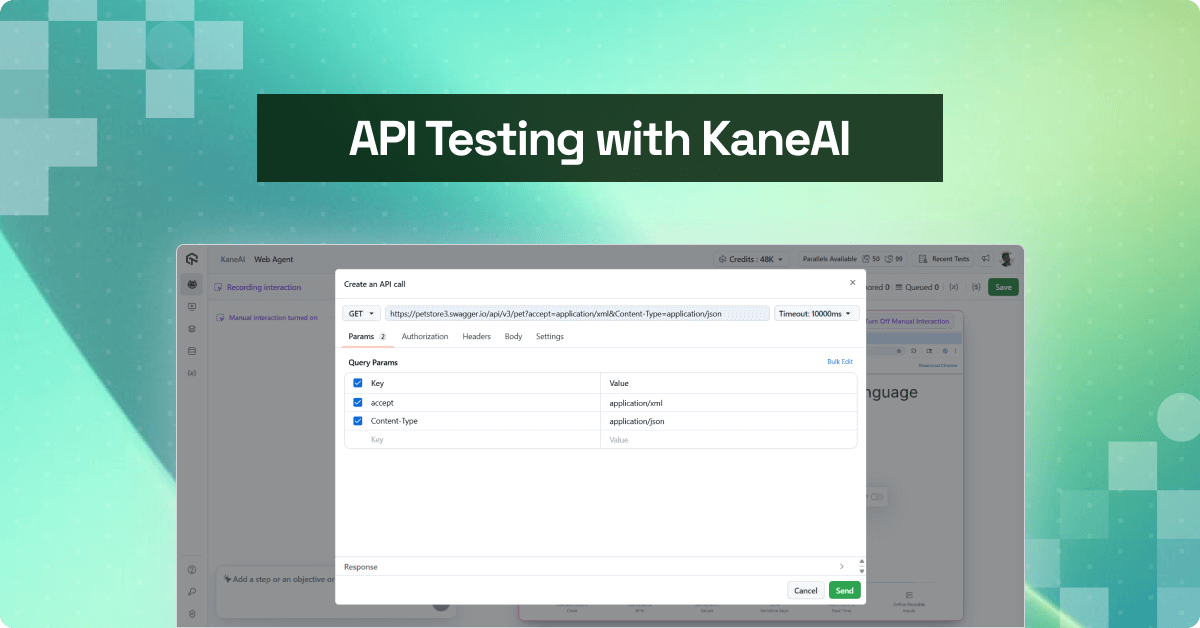
Learn how to do API testing with KaneAI: paste a cURL command to auto-fill headers and body, validate 200 responses, and batch-run POST, PUT, GET and DELETE.
Devansh Bhardwaj
October 17, 2025
11 min read